Buy a Lighthouse

[Image: Photo courtesy General Services Administration].

A remote, 76-foot lighthouse is for sale in Maine, and it could be yours for only $30,000.

[Image: Photo courtesy General Services Administration].

It’s located far to the south of the coast of Bailey Island, on a place called Halfway Rock, due east from Portland in the cold ocean waters of Casco Bay. Indeed, it’s so far out in the waves that Google Maps doesn’t even show detail for the seas around it.

[Image: Halfway Rock seen on Google Maps].

The photos seen here were taken by Kraig Anderson and Jeremy D’Entremont, and were made available to the bidding public courtesy of the U.S. General Services Administration—who strongly advise that you physically travel to and inspect the lighthouse to make sure you know what you’re getting into.

The structure is listed on the National Register of Historic Places, and it “will continue to serve as an active aid to navigation, maintained by the United States Coast Guard,” the GSA explains. “Maintained” is a subjective concept, on the other hand.

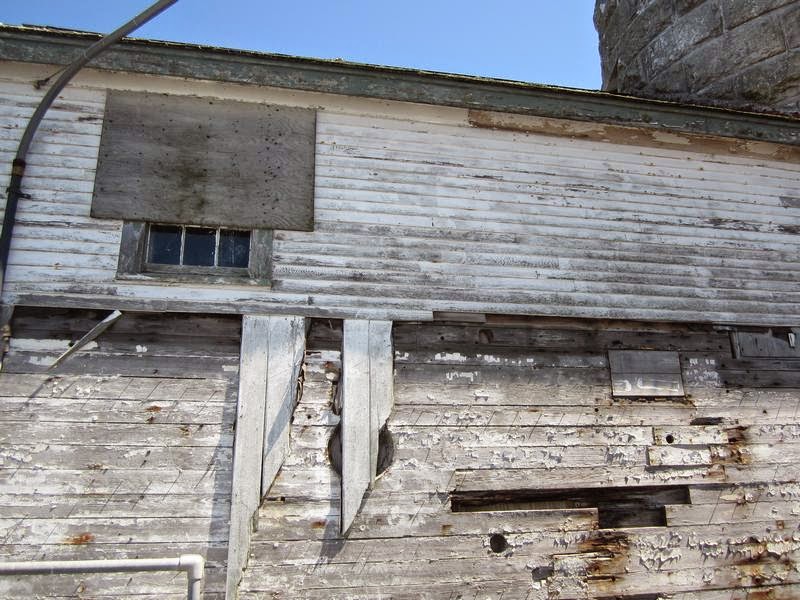
[Images: Photos courtesy General Services Administration].

After all, it clearly needs fixing up—to the extent that that’s possible, given the structure’s status on the National Register—so tread carefully if you are not in the market for a strenuous project.

Waterproofing Nationally Registered wood panels and repainting iron doors as minor storms of sea spray crash on the rocks nearby might not be your idea of a perfect Sunday.

[Images: Photos courtesy General Services Administration].

But I say buy it, visit it now and again when you’re bored, and then invite a changing parade of architecture bloggers to come out for one week at a time in the summer, writing spatial fictions as the fog rolls in. It will be our generation’s Villa Diodati.

Don’t like the looks of this? Consider bidding on the singular, island-less Minots Ledge Light for only ten grand

[Image: Photo courtesy General Services Administration].

—which, at the time of its (second) construction (because the first Minots Ledge Light was washed away in a violent storm), was actually “the most expensive light house that was ever constructed in the United States,” according to Wikipedia.

Here’s a photograph of it taken from a passing tour boat.

[Image: Minots Light, courtesy of Wikipedia].

Or put in a bid on the Boon Island lighthouse for $12,000, instead.

[Images: Photos courtesy General Services Administration].

Then invite me around for a candlelit tour.

(Thanks to Chelsea H. B. DeLorme for the tip! Post updated after a note from Daniel H. Cantwell. Earlier real estate listings on BLDGBLOG: Buy an Underground Kingdom, Buy a Prison, Buy a Tube Station, Buy an Archipelago, Buy a Map, Buy a Torpedo-Testing Facility, Buy a Silk Mill, Buy a Fort, Buy a Church).

Road Trips, Routes, and Landscape Instrumentation

[Image: Venue at the Center for Art + Environment, Nevada Museum of Art; courtesy Nevada Museum of Art].

I’m extremely pleased to say that a small exhibition based on Nicola Twilley’s and my project Venue has opened at the Center for Art + Environment, part of the Nevada Museum of Art in Reno.

[Image: Venue at the Center for Art + Environment, Nevada Museum of Art; courtesy Nevada Museum of Art].

Venue, in effect, was a 16-month discontinuous road trip around the continental United States, with a deliberate emphasis on the west and southwest states, during which we toured sites and interviewed people whose work foregrounded the intersection of human activity and the landscape—whether those landscapes were real, virtual, simulated, augmented, or “natural,” in the broadest terms.

They ranged from mines to landfills, from a simulated lunar landscape in Arizona to the remains of a Hollow Earth cult in southern Florida, from a novelist to an historian of American river fish, from a speleo-biologist to an architecture critic, from neutrino detectors to the Astroturf factory in Dalton, Georgia, to name barely a few.

[Image: Venue at the Center for Art + Environment, Nevada Museum of Art; courtesy Nevada Museum of Art].

For example, we made a lengthy pilgrimage into the mountains of eastern Oregon to visit the world’s largest organism; we learned how National Parks are curated, preserved, mapped, and remembered in our backstage visit to the archives of Arches National Park in Moab; we tagged along for a simulated military raid on a replicant Middle Eastern city made of shipping containers in the California desert; we went in search of darkness with author Paul Bogard, discussing the impact of light pollution on human history; we flew with aerial photographer Michael Light over the incredible shores of Mono Lake; we sat down with Edward Burtysnky to discuss the concept of primary and secondary landscapes of industrial production; and we learned about the strange paintings used as backdrops in prison photography with artist Alyse Emdur, among many, many other site visits and interviews, many of which have yet to be written up.

In fact, some of my favorite experiences of the entire project have yet to be written up, including our first-hand private tour of the nuclear waste repository at WIPP, the Waste Isolation Pilot Plant in Carlsbad, New Mexico; our no-photos-allowed visit to the GPS control room at Schriever Air Force Base in Colorado; and the aforementioned tour of a factory in Georgia where Astroturf is woven on huge looms; but the opening of the exhibition is a good spur to get those online.

[Image: Venue at the Center for Art + Environment, Nevada Museum of Art; courtesy Nevada Museum of Art].

Of course, while we were traveling we also deployed our own landscape instruments—designed by the multi-talented Chris Woebken—allowing us to take our own readings of the U.S. landscape.

The huge sets of information produced by all this—what we called our “site readings” ran from details as simple as time of day, elevation, and ambient air temperature to more complicated parameters, like phases of the moon, number of sunspots, and local seismic activity—were then turned into some fabulous examples of data visualization for us by Everything-Type-Company; you can see those surrounding the giant map that adorns the back wall of the exhibition space.

[Image: Venue at the Center for Art + Environment, Nevada Museum of Art; courtesy Nevada Museum of Art].

The exhibition itself will remain open for most of 2014, closing on November 30, 2014, and the Venue website will continue to be updated as we comb through the intimidatingly deep backlog of material we accumulated during our travels. Nicola and I will also be presenting our travels at the Center for Art + Environment conference this October, specifically on Friday, October 10th; check out the conference website if you are interested in attending.

Go Fish

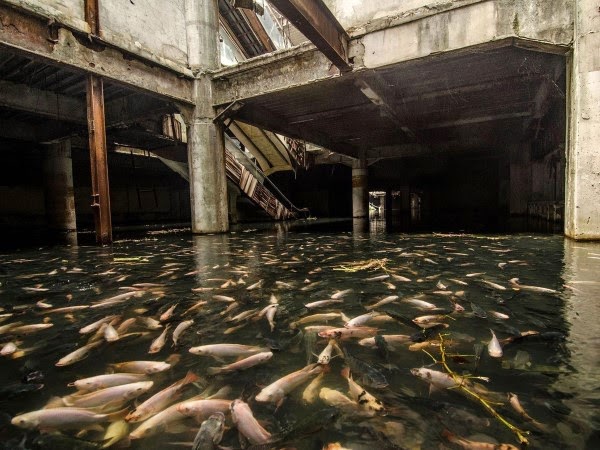
[Image: Photo by Jesse Rockwell/Rex Features, via The Verge].

You might already have seen this small gallery of images showing an abandoned shopping mall in Bangkok, now partially flooded and “infested with koi carp and catfish.” The images—taken by Jesse Rockwell—were originally published on the photographer’s own blog back in October.

“At some point in the early 2000s,” Rockwell explains there, “an unknown person began introducing a small population of exotic Koi and Catfish species. The small population of fish began to thrive and the result is now a self-sustained, and amazingly populated urban aquarium. I will not tell exactly where it is, as locals somewhat discourage people visiting it. In fact we had to wait for a policeman who was parked on his motorcycle in front of the gate to leave before we timidly entered.”

The sight of an eviscerated old escalator dissolving with rust, its internal cables now exposed to the air like the roots of some future tree, surrounded by the white blurs of fish, is particularly evocative.

[Image: Photo by Jesse Rockwell/Rex Features, via The Verge].

Perhaps offering us a glimpse of things to come, this Bangkok mall inadvertently reveals what the outer coastal suburbs of the U.S. east coast might look like in the century to come, as the waterlogged edgelands of cities will be slowly but totally reclaimed by rising waters. Escalators, subway stations, and basements all turned into polluted fish farms for the deeply impoverished, families and entrepreneurs harvesting their protein in what used to be lobbies and parking lots. From malls to salt marshes.

Put another way, perhaps the real future of urban agriculture is actually urban aquaculture: slithering pens of marine life bred amongst the ruins of lost megastructures.

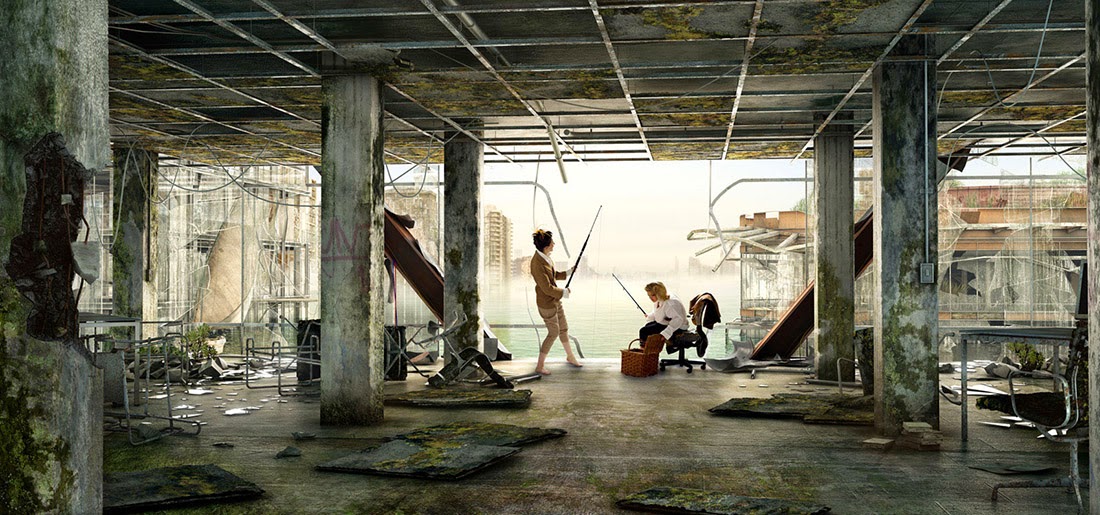
[Image: From Flooded London by Squint Opera].

If you recall Squint Opera’s 2008 project, Flooded London, with its images of people fishing in the streets of a semi-submerged metropolis, then you’ve probably got a good sense of what things might eventually come to look like, as scenes like these—appearing poetic and even whimsical to us today—will be nothing more than the sad, everyday conditions of a coastal disaster to which our descendants will somehow have to learn to adapt.

Catching eyeless fish in abandoned shopping malls and living in networked tents attached precariously to the dark ceilings high above, our distant and greatest grandchildren will see images like these and wonder how we ever found them extraordinary.

(Link to sea level rise after 2100 via Rob Holmes).

X

It’s hard to believe, but BLDGBLOG began exactly ten years ago today. It’s been a life-changing and incredibly unexpected decade for me, and, although 10-year birthdays justifiably mean little in the world of online publishing, I nonetheless wanted to mark the date with a quick post and a thanks: thanks for reading, commenting, critiquing, and following along, whoever and wherever you are.

The magic of a more or less anonymous audience is such that you never really know who you are writing to—after all, every post is also like a letter, an open postcard, a note directed outward at some unidentified reader or future friend—but that also means that the energy and support I have found over these last 10 years have both been all the more surreal and exciting.

For now, I just wanted to say thanks both to linkers and to haters alike—and a quick happy birthday to this strange digital thing I never thought would be anything more than a textual sketchbook. Here’s to ten more, be they weeks, years, posts, or decades.

Buffer Space

[Image: Photo taken by Your Captain Aerial Photography, via Wired].

Here are two short, conceptually related pieces to read, both of which revolve around the notion of a buffer landscape: a marginal, otherwise unused land that is nonetheless deliberately maintained as a spatial intermediary between two very different zones.

1) The first of these pieces describes an acoustic buffer grooved into the landscape around Amsterdam’s Schiphol Airport. Wired writes that “these mysterious-looking formations”—a crystallographic ridged pattern of lines and diamonds designed by artist Paul de Kort and visible in the above photo taken by Your Captain Aerial Photography—is actually a series of “noise-deflecting ridges.” It is a garden of aeronautical silence, designed to nullify noises from the sky.

People identified only in the abstract as “researchers” apparently noticed that recently plowed agricultural fields near Amsterdam’s airport had an unintended side-effect: they dampened the constant, very aggressive sounds of airplane engines that had been coming out of Schiphol. Taking these “grooved landscapes” to their logical conclusion, Paul de Kort simply exaggerated that topography using what Wired describes as “GPS-guided robot excavators” to produce an abstract terrain that would precisely cancel-out the sounds of airplanes.

Their height and location thus corresponds not to some overlooked aesthetic tradition of Dutch landscape architecture, but to wavelengths of airplane noise.

Acting as the spatial equivalent of a giant mute button, these ridges and furrows thus help to silence local aircraft, erasing their otherwise deafening and thunderous engine noise for the sake of nearby suburban homes. Those same planes would normally drone and roar over the vast flatlands around the runways, where, as Wired writes, “noise can travel unobstructed for miles.”

As it happens, I’ve written before about one of my favorite landscapes in England, a small forest planted entirely for acoustic reasons outside of Heathrow Airport, southeast of London. This grove—a visually nondescript bank of trees that I’ve passed at least half a dozen times on my way to the airport—exists not for visual or aesthetic reasons but for its sonic effect on the space around it. The trees absorb echoes and reverb, roars and booms, and would never have been planted in the first place were it not for their function as an acoustic intermediary between domestic suburbia and international air travel.

In fact, these same acoustic buffer zones and sound forests have also been documented by photographer Bas Princen in his excellent book, Artificial Arcadia.

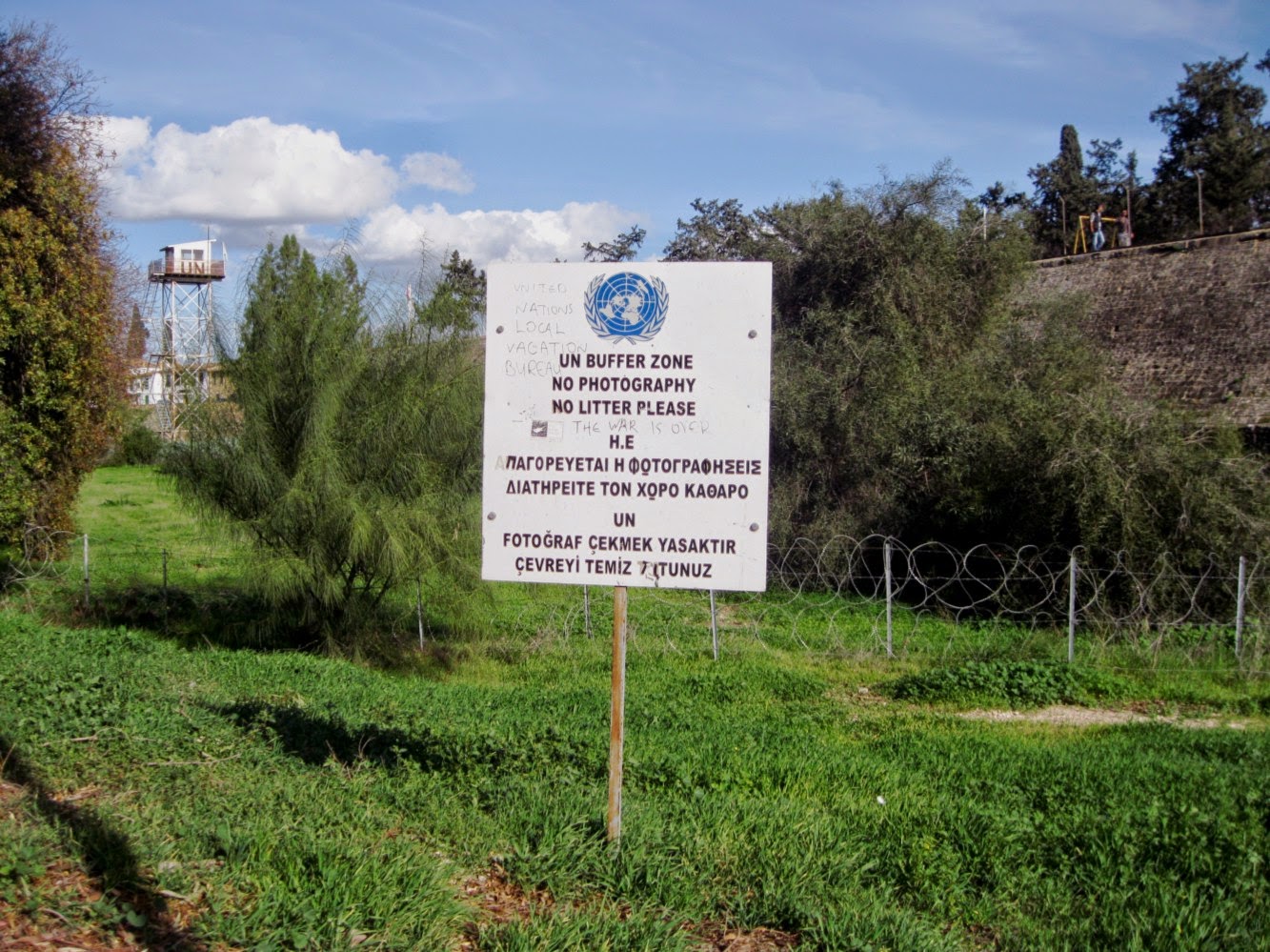
[Image: UN Border zone in Cyprus, photographed by Athena Lao, via War is Boring].

2) The other is a short but interesting interview over at War is Boring about the often literally changing nature of those spaces known as “no-man’s-lands,” or militarized dead zones.

These are landscapes, described in this Q&A with geographer Noam Leshem, that function as “a very significant space economically,” yet are also “a space that is constantly inhabited, governed, monitored and practiced.” As Leshem explains, however, the notion of no man’s land is actually “much older than 1915, i.e. the Battle of the Somme. It dates back to the 14th century and to London during the months preceding the plague, when the bishop of London buys a lot of land outside the city to prepare a mass grave ahead of the bubonic plague.”

Leshem’s current project is an attempt to learn “what do no-man’s-lands in the 21st century mean?” Check out the full interview for more.

(Thanks to Andrew Elvin for the Wired link).

The Snow Mine

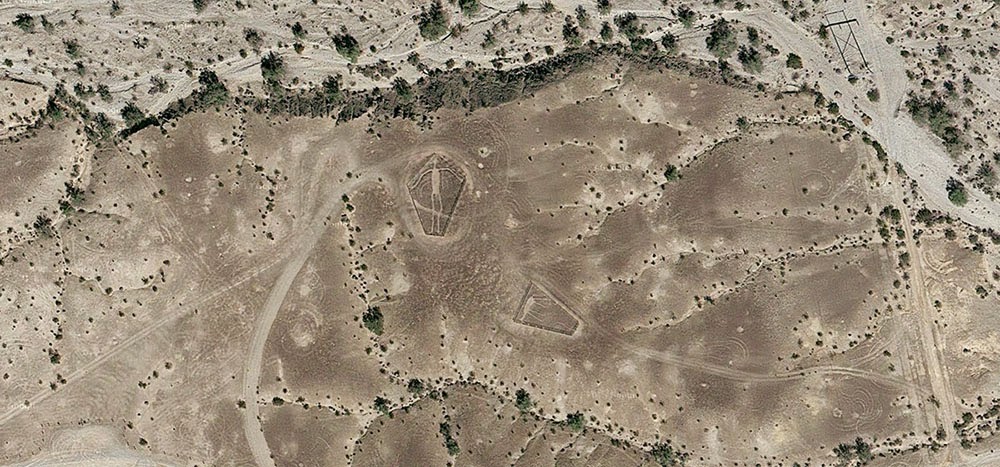
[Image: The “Blythe Intaglios,” via Google Maps].

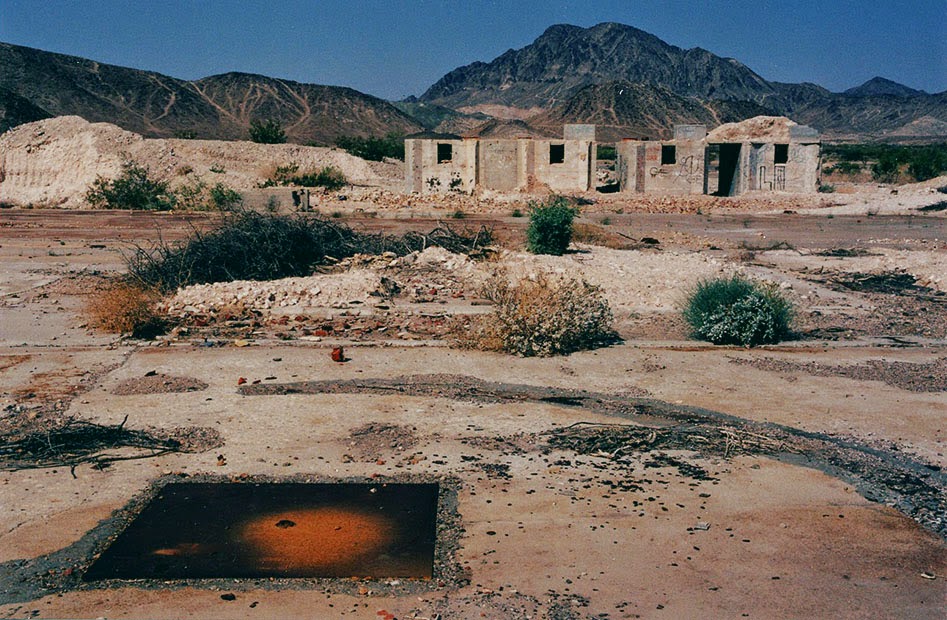
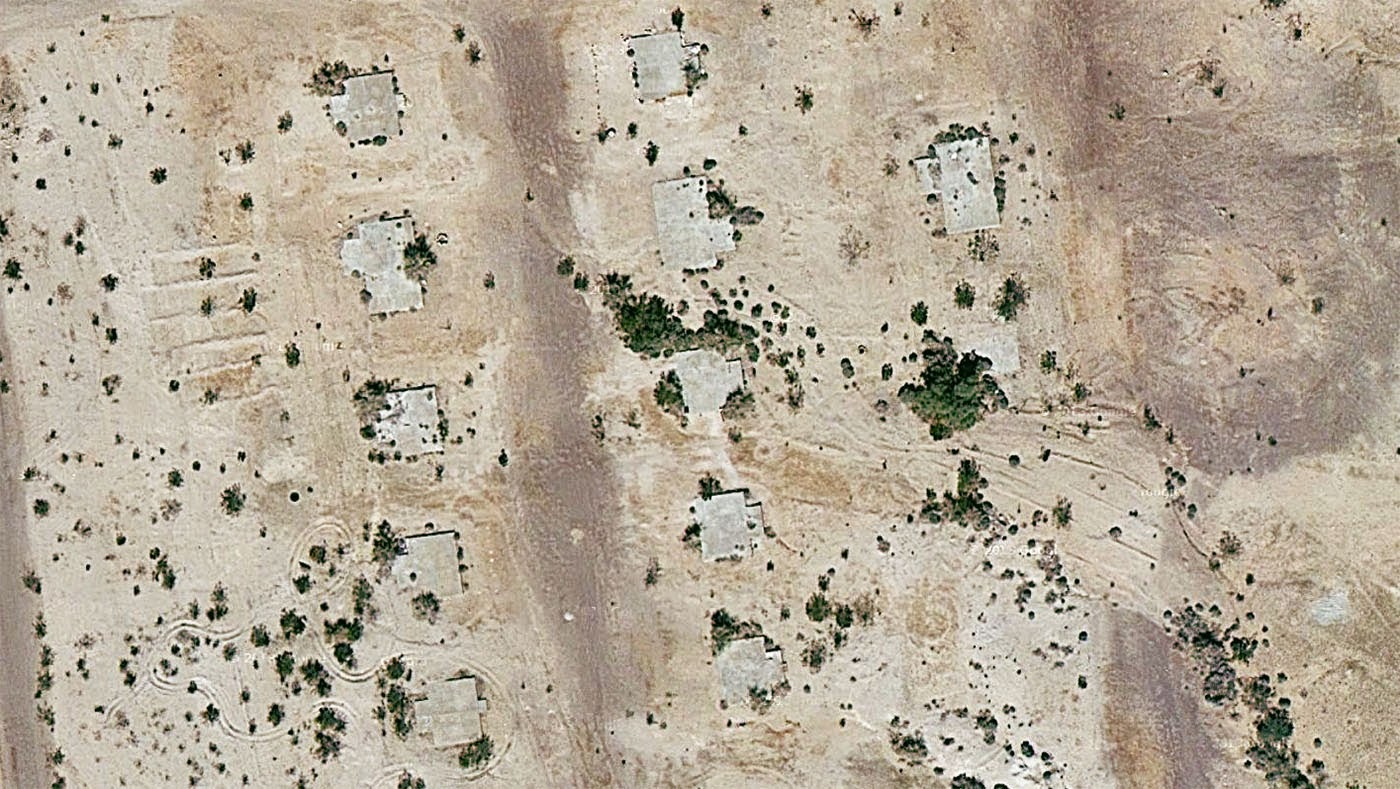
After reading an article about the “Blythe geoglyphs”—huge, 1,000-year old images carved into the California desert north of Blythe, near the border with Arizona—I got to looking around on Google Maps more or less at random and found what looked like a ghost town in the middle of nowhere, close to an old mine.

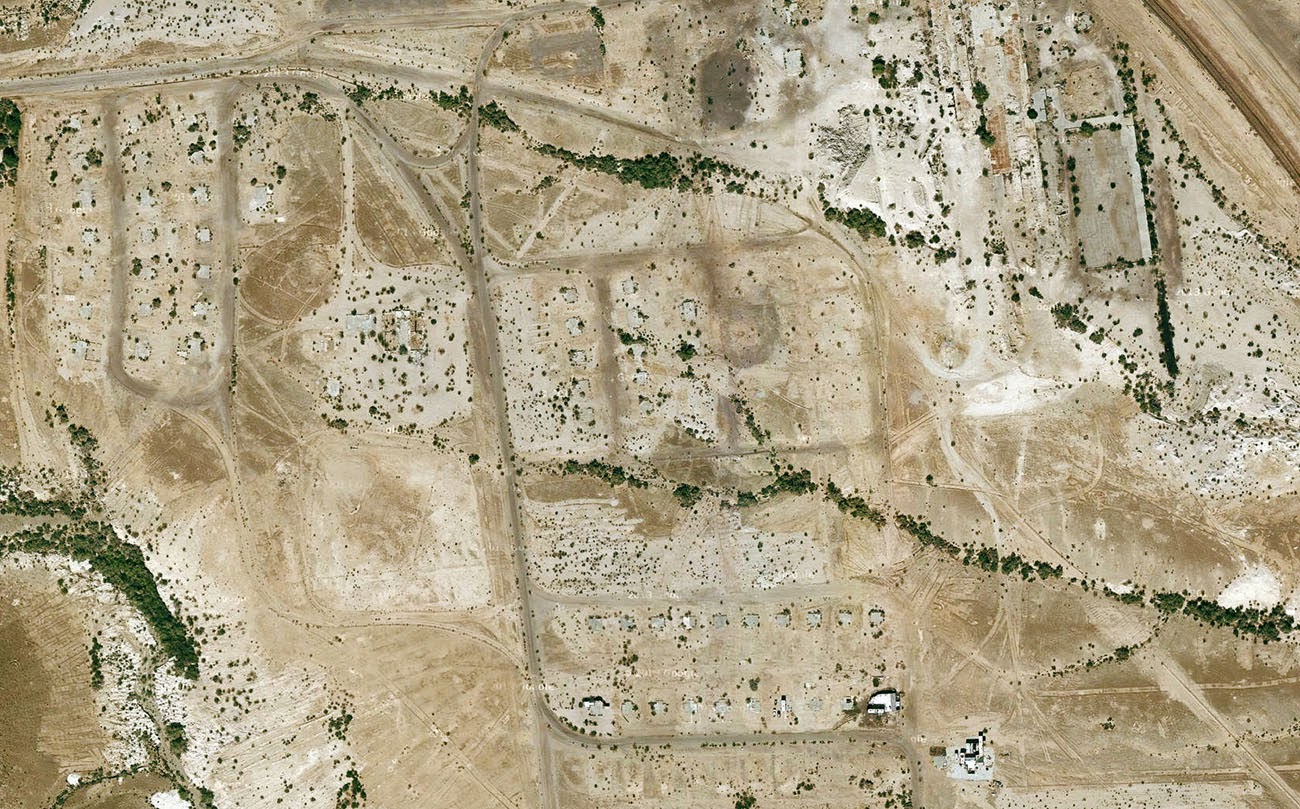
Turns out, it was the abandoned industrial settlement of Midland, California—and it’s been empty for nearly half a century, deliberately burned to the ground in 1966 when the nearby mine was closed.

[Image: Midland, California, via Google Maps].

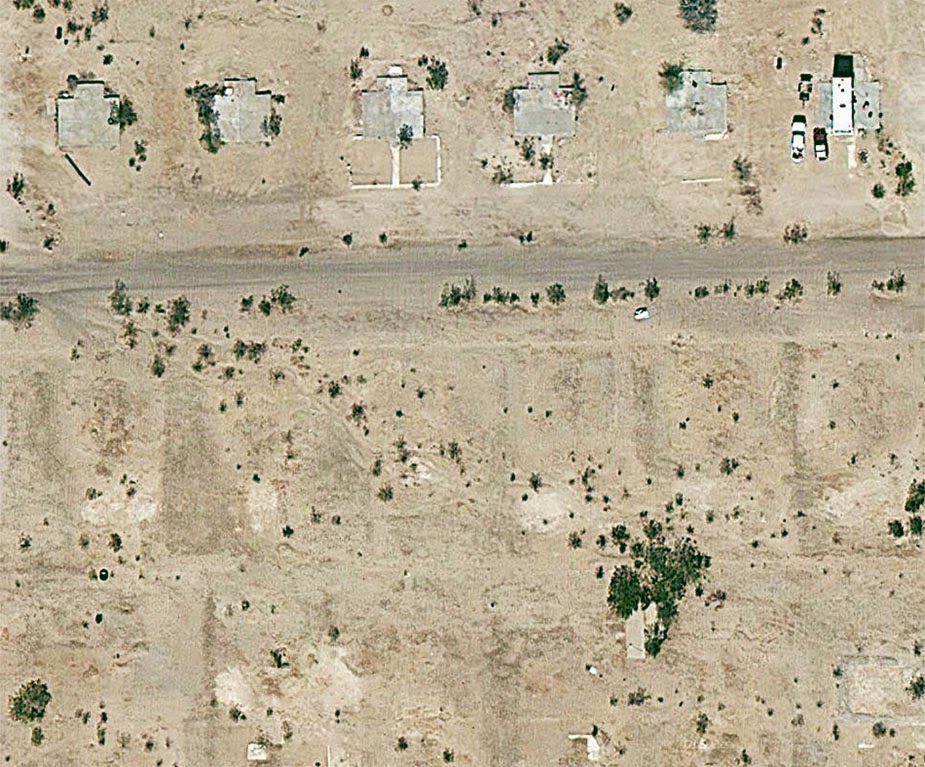
What’s so interesting about this place—aside from the exposed concrete foundation pads now reused as platforms for RVs, or the empty streets forming an altogether different kind of geoglyph, or even the obvious ease with which one can get there, simply following the aptly named Midland Road northeast from Blythe—is the fact that the town was built for workers at the gypsum mine, and that the gypsum extracted from the ground in Midland was then used as artificial snow in many Hollywood productions.

[Image: Midland, California, via Google Maps].

As the L.A. Times reported back in 1970—warning its readers, “Don’t Go To Midland—It’s Gone”—the town served as the mineral origin for Hollywood’s simulated weather effects.

“Midland was started in 1925 as a tent city,” the paper explained, “with miners in the middle of the Mojave Desert digging gypsum out of the Little Marias to meet the demands of movie studios. All the winter scenes during the golden age of Hollywood were filmed with ‘snowflakes’ from Midland.”

[Image: The abandoned streets of Midland, former origin of Hollywood’s artificial snow; photo via CLUI].

Like some strange, artificial winter being mined from the earth and scattered all over the dreams of cinemagoers around the world, Midland’s mineral snow had all the right qualities without any of the perishability or cold.

See, for example, this patent for artificial snow, filed in 1927 and approved in 1930, in which it is explained how gypsum can be dissolved by a specific acid mix to produce light, fluffy flakes perfect for the purposes of winter simulation. Easy to produce, with no risk of melting.

[Image: Midland, California, via Google Maps].

I’ve long been fascinated by the artificial snow industry—the notion of an industrially controlled climate-on-demand, spraying out snowflakes as if from a 3D printer, is just amazing to me—as well as with the unearthly world of mines, caves, and all things underground, but I had not really ever imagined that these interests might somehow come together someday, wherein fake glaciers and peaceful drifts of pure white snow were actually something scraped out of the planet by the extraction industry.

As if suggesting the plot of a deranged, Dr. Seussian children’s book, the idea that winter is something we pull from a mine in the middle of the California desert and then scatter over the warm Mediterranean cities of the coast is perhaps all the evidence you need that life is always already more dreamlike than you had previously believed possible.

(Very vaguely related: See also BLDGBLOG’s earlier coverage of California City).

Urban Giants

The wife & husband team of director Davina Pardo and journalist Andrew Blum—the latter of whom you might also know as the author of Tubes and a prolific writer on architecture and design—have released a short documentary about the literal architecture of the internet: the huge buildings looming amongst us here in New York City, inside of which sit much of the telecommunications equipment that switches, routes, and relays global internet traffic.

These “urban giants,” in the filmmakers’ words, are over-built monsters, their titanic foundations, floor plates, and empty rooms reinforced to hold early telegraph machines. Yet they are also surprisingly delicate and beautifully detailed Art Deco structures. The internet is a kind of chandelier of controlled light, beaming information through fiber optic lines all over the world, relying on anchorage points and cables strung deep inside buildings like these.

“Between 1928 and 1932,” the film explains, “Western Union and AT&T Long Lines built two of the most advanced telecommunications buildings in the world, at 60 Hudson Street and 32 Avenue of the Americas in Lower Manhattan. Nearly a century later, they remain among the world’s finest Art Deco towers—and cornerstones of global communication. Urban Giants is a 9-minute filmic portrait of their birth and ongoing life, combining never-before-seen-construction footage, archival photographs and films, interviews with architectural and technology historians, and stunning contemporary cinematography.” That cinematography is by David Sundberg from Esto.

The film is embedded above or you can watch it over on Vimeo—and Blum’s descriptions of these buildings and their inner machinery in Tubes are not to be missed.

Mathematical Equations as Architectonic Forms

[Image: From the Altgeld Math Models Collection at UIUC].

Architects—or really anyone captivated by complex geometric forms—should find something of interest in a small set of images posted over at Wired. From the Altgeld Math Models Collection at UIUC, the photos show complex mathematical equations modeled as architectonic forms, and many of them are stunning.

Here are a few of my favorites, taken not from Wired but from the Altgeld Collection itself. This first model totally blows me away, for example. Imagine this thing blown up to the scale of urban infrastructure and built as a woven coil of multiple suspension bridges intersecting over a river, like some hyper-dimensional Brooklyn Bridge strung between cities.

[Images: From the Altgeld Math Models Collection at UIUC].

The models, of course, are not intended as architectural suggestions. So what were they, really?

“In 1893,” Wired explains, “a prominent mathematician named Felix Klein brought a boatload of models from his laboratory in Göttingen to the World’s Fair in Chicago. These perfect plasters stood out in the pavilion showcasing Germany’s technical achievements. The scientists who walked by took note. Soon major American universities had ordered hundreds of surface models from thick catalogs, and had them shipped thousands of miles over the Atlantic. Large collections remain at MIT, the University of Arizona, Harvard, and the University of Illinois at Urbana-Champaign, whose models feature prominently in this gallery.”

[Image: Bridge proposal by Penda for the Salford Meadows design competition].

But, like one of my favorite speculative bridge projects of the last year or two—a proposal designed by Penda for the Salford Meadows competition—I just can’t stop imagining how these could be translated almost exactly into suspension bridges, public plazas, or other works of urban infrastructure.

A city peppered with large, harped megastructures like these would be extraordinary, a kind of inhabitable catalog of topology. Or huge sewers like this, torquing and curling through pretzels of self-intersection beneath our feet. Barbara Hepworth as civil engineer.

Even the relatively simple-looking Math Model 8 would make a delirious pedestrian overpass or skybridge.

[Images: From the Altgeld Math Models Collection at UIUC].

You can read more about the collection over at Wired, but you can also see a lot more images at the Altgeld Math Models Collection itself—like the incredible Math Model 3 (imagine it extruded vertically into a cathedral or power station), the weird floating quasi-object of Math Model 81 (imagine that central vertex as a kind of urban overlook or observation deck), the looming innards of Math Model 44, or the slightly bonkers Math Model 39, seen below.

[Images: From the Altgeld Math Models Collection at UIUC].

You can also help support the collection’s efforts to preserve the models; here is more info.

Drive-By Archaeology

[Image: From a patent filed by MIT, courtesy U.S. Patent and Trademark Office].

The technical systems by which autonomous, self-driving vehicles will safely navigate city streets are usually presented as some combination of real-time scanning and detailed mnemonic map or virtual reference model created for that vehicle.

As Alexis Madrigal has written for The Atlantic, autonomous vehicles are, in essence, always driving within a virtual world—like Freudian machines, they are forever unable to venture outside a sphere of their own projections:

The key to Google’s success has been that these cars aren’t forced to process an entire scene from scratch. Instead, their teams travel and map each road that the car will travel. And these are not any old maps. They are not even the rich, road-logic-filled maps of consumer-grade Google Maps.
They’re probably best thought of as ultra-precise digitizations of the physical world, all the way down to tiny details like the position and height of every single curb. A normal digital map would show a road intersection; these maps would have a precision measured in inches.

The vehicle can thus respond to the city insofar as its own spatial expectations are never sufficiently contradicted by the evidence at hand: if the city, as scanned by the vehicle’s array of sensors and instruments, corresponds to the vehicle’s own internal expectations, then it can make the next rational decision (to turn a corner, stop at an intersection, wait for a passing train, etc.).

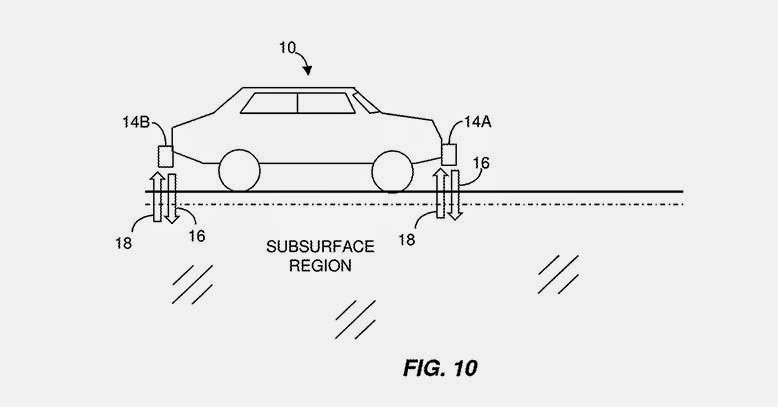
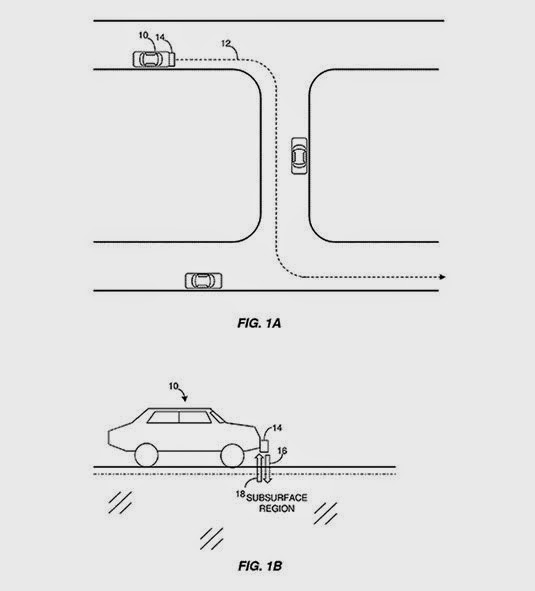
However, I was very interested to see that an MIT research team led by Byron Stanley had applied for a patent last autumn that would allow autonomous vehicles to guide themselves using ground-penetrating radar. It is the subterranean realm that they would thus be peering into, in addition to the plein air universe of curb heights and Yield signs, reading the underworld for its own peculiar landmarks.

[Image: From a patent filed by MIT, courtesy U.S. Patent and Trademark Office].

How would it work? Imagine, the MIT team suggests, that your autonomous vehicle is either in a landscape blanketed in snow. It is volumetrically deformed by all that extra mass and thus robbed not only of accurate points of measurement but also of any, if not all, computer-recognizable landmarks. Or, he adds, imagine that you have passed into a “GPS-denied area.”

In either case, you and your self-driving vehicle run the very real risk of falling off the map altogether, stuck in a machine that cannot find its way forward and, for all intents and purposes, can no longer even tell road from landscape.

[Image: From a patent filed by MIT, courtesy U.S. Patent and Trademark Office].

Stanley’s group has thus come up with the interesting suggestion that you could simply give autonomous vehicles the ability to see through the earth’s surface and scan for recognizable systems of pipework or other urban infrastructure down below. Your vehicle could then just follow those systems through the obscuring layers of rain, snow, or even tumbleweed to its eventual destination.

These would be cars attuned to the “subsurface region,” as the patent describes it, falling somewhere between urban archaeology and speleo-cartography.

In fact, with only the slightest tweaking of this technology and you could easily imagine a scenario in which your vehicle would more or less seek out and follow archaeological features in the ground. Picture something like an enormous basement in Rome or central London—or perhaps a strange variation on the city built entirely for autonomous vehicles at the University of Michigan. It is a vast expanse of concrete built—with great controversy—over an ancient site of incredible archaeological richness.

Climbing into a small autonomous vehicle, however, and avidly referring to the interactive menu presented on a touchscreen dashboard, you feel the vehicle begin to move, inching forward into the empty room. The trick is that it is navigating according to the remnant outlines of lost foundations and buried structures hidden in the ground around you, like a boat passing over shipwrecks hidden in the still but murky water.

The vehicle shifts and turns, hovers and circles back again, outlining where buildings once stood. It is acting out a kind of invisible architecture of the city, where its routes are not roads at all but the floor plans of old buildings and, rather than streets or parking lots, you circulate through and pause within forgotten rooms buried in the ground somewhere below.

In this “subsurface region” that only your vehicle’s radar eyes can see, your car finds navigational clarity, calmly poking along the secret forms of the city.

In any case, for more on the MIT patent, check out the U.S. Patent and Trademark Office.

(Via New Scientist).

London And Its Dead

[Image: By Andrew Winning, courtesy of Reuters, via National Geographic].

In her excellent and morbidly fascinating book Necropolis: London and Its Dead, Catharine Arnold describes in detail how parts of the London Underground were tunneled, blasted, picked, and drilled through a labyrinth of plague pits and cemeteries.

To no small extent, she makes clear, the subterranean presence of corpses can be found throughout the British capital. Dead bodies were basically buried everywhere, to the point that, as Arnold pithily states, “London is one giant grave.” The city is saturated from below with the dead.

In one of my favorite examples of this from the book, Arnold explains how the London Hospital maintained its own burial ground from 1849 to 1854. Somewhat astonishingly, however, we learn that housing projects for the medical staff were then built over these old graveyards—and the coffins were not very far below the surface.

As Arnold describes it, this led to some rather unsafe ground conditions: 

The remaining part of the burial ground became a garden for nurses and medical students, complete with tennis court, “where they are in the habit of capering about in their short times off-duty, and where it sometimes happens that the grass gives way beneath them—an ordinary occurrence when the subsoil is inhabited by coffins!”

In other words, these tennis-playing nurses “capering about” on their grass tennis courts would occasionally and literally fall through the surface of the earth only to find themselves standing in a maze of rotting coffins hidden just beneath the soil, an infernal honeycomb of badly tended graves like something out of Dante. 

This image—of young women frolicking in their 19th-century sports gear suddenly falling through the earth into coffins—is absolutely astonishing and surely belongs in a movie coming soon to a cinema near you, a London-based, hospital-themed remake of Poltergeist.

[Image: An otherwise unrelated London cemetery, photographed by Louise McLaren/Creative Commons].

Of course, as London’s population exploded, so too did the number of its dead; and, thus, some local churches got in on the financial action of corpse disposal by accepting dead bodies (and the high fees associated with their interment) only to do nothing at all with the corpses but toss them down into the cellar.

One church was so bad, Arnold explains, that its parishioners would often become light-headed and even pass out from the horrible smell of rotting and partially liquified bodies wafting up from beneath the floorboards.

A particularly nightmarish location described by Arnold is Enon Chapel, a Baptist church founded “as a speculative venture.” That is, the minister—Mr. W. Howse—was in it purely for the money. 

Arnold’s own description of what happened next says it best: 

Worship there was a dangerous business; for members of the congregation frequently passed out—yet, because nobody guessed at the minister’s appalling secret, it never occurred to them that the cause of their sickness lay beneath a flimsy layer of floorboards, in the vault of the chapel.

In warm, damp weather, local residents were assaulted by a peculiarly disgusting smell. Occasionally, when a fire was lit in a nearby building, an intolerable stench arose, which did not originate from the drains. Vast numbers of rats infested the houses; and meat exposed to the atmosphere turned putrid after an hour or two.

The parishioners could even taste it, apparently: an acrid, oily slick on their tongues, resulting from the humid corpse-fog that filled the church, a kind of artificial weather system created by the dissolving bodies of the dead jumbled up in the darkness below them.

Mind-bogglingly, when all of this was finally discovered, how many corpses do you think London city authorities found down there? Several dozen? A few hundred, perhaps? They found twelve thousand corpses. 12,000 corpses all turning into jello and contaminating the local water supply. 

[Image: London’s Abney Park Cemetery, photo by BLDGBLOG].

Yet those churchgoers were lucky to escape with their own lives, we read. At times, London’s urban burial grounds simply exploded, their cheap coffins dangerously over-pressurized from within with corpse gas. 

The resulting blasts and long-burning subterranean infernos, for the most part limited to the crypts and basements of churches, were physically repellent and not at all easy to extinguish. “In the 1800s,” Arnold writes, “fires beneath St. Clement Dane’s and [architect Christopher] Wren’s Church of St. James’s in Jermyn Street destroyed many bodies and burned for days.”

To help prevent these corpulent bombs from bursting, sextons of the churches were required to “tap” the coffins now and again; this tapping would jostle the bodies within and thus “facilitate the escape of gases which would otherwise detonate from their confinement.”

Entrepreneurial architects were not going to stand idly by, however, as a new market for spatial ideas took shape. Designers of speculative necropolises were beginning to ask: why bury when you can build? 

Specifically, Arnold explains, an architecturally inclined businessman named Thomas Willson “proposed a huge pyramid for Primrose Hill. At an estimated cost of £2,500, this massive mausoleum, higher than St. Paul’s, would contain five million Londoners.” 

[Image: The great London pyramid of the Pyramid General Cemetery Company, via Wonders & Marvels].

Intended to invoke solemnity, inspire awe, and earn lots of money, Willson’s colossal geometric structure was to be funded through subscription and run by a new corporation called the Pyramid General Cemetery Company: 

Constructed from brick, with granite facing, the plans comprised a chapel, office, quarters for the Keeper, Clerk, Sexton and Superintendent, four entrances and a central ventilation shaft. A series of sloping paths would allow bodies to be moved. Each catacomb took up to twenty-four coffins and could be sealed up after all interments had been completed. Resembling a beehive, it would be a thing of awe and wonder to all who saw it.

The pyramid was never constructed, of course, but perhaps in our own era of London megaprojects, some brick and granite Giza might yet emerge on the marshy edges of town to support and protect the dead of southeast England.

All of which finally brings us back to the real reason I started writing this post, which was to tell the story of how these corpses—the city absolutely littered with burial grounds and plague pits—came to influence the construction of London’s Underground train system. It’s a brief anecdote, but it’s both ghoulish and interesting.

As Arnold points out, there is an otherwise inexplicable shift in direction in the Piccadilly line passing east out of South Kensington. “In fact,” she writes, “the tunnel curves between Knightsbridge and South Kensington stations because it was impossible to drill through the mass of skeletal remains buried in Hyde Park.” I will admit that I think she means “between Knightsbridge and Hyde Park Corner“—although there is apparently a “small plague pit dating from around 1664″ beneath Knightsbridge Green—but I will defer to Arnold’s research.

But to put that another way, the ground was so solidly packed with the interlocked skeletons of 17th-century victims of the Great Plague that the Tube’s 19th-century excavation teams couldn’t even hack their way through them all. The Tube thus had to swerve to the side along a subterranean detour in order to avoid this huge congested knot of skulls, ribs, legs, and arms tangled in the soil—an artificial geology made of people, caught in the throat of greater London.

London’s Tube thus sits atop, cuts around, and tunnels through a citywide charnel ground of corpses, its very routes and station locations haunted by this earlier presence in the ground below.

For much more info on the geography of London’s dead, check out a copy of Necropolis.

(An earlier version of this post was previously published on Gizmodo).

A Pyramid in the Middle of Nowhere Built to Track the End of the World

[Image: Photo by Benjamin Halpern, courtesy of the U.S. Library of Congress].

The Stanley R. Mickelsen Safeguard Complex in Cavalier County, North Dakota, is the focus of an amazing set of images hosted by the U.S. Library of Congress, showing this squat and evocative megastructure in various states of construction and completion.

It’s a huge pyramid in the middle of nowhere tracking the end of the world on radar, an abstract geometric shape beneath the sky without a human being in sight, or it could even be the opening scene of an apocalyptic science fiction film—but it’s just the U.S. military going about its business, building vast and other-worldly architectural structures that the civilian world only rarely sees.

[Images: Photos by Benjamin Halpern, courtesy of the U.S. Library of Congress].

As Pruned described these structures back in 2008, it was a “mastaba-shaped radar facility reminiscent of the work of architect Étienne-Louis Boullée.”

As such, Pruned suggests, it offers convincing architectural evidence that we should consider “the “U.S. anti-ballistic landscape as a subset of Land Art”—as lonely pieces of abandoned infrastructure isolated amidst sublime and almost unreachably remote locations.

[Images: Photos by Benjamin Halpern, courtesy of the U.S. Library of Congress].

The photos seen here, taken for the U.S. government by photographer Benjamin Halpern, show the central pyramid—pyramid, monument, modular obelisk: whatever you want to call it—that served as the site’s missile-tracking station. Its omnidirectional all-seeing white circles stared endlessly at invisible airborne objects moving beyond the horizon.

The Library of Congress gives the pyramid’s location somewhat absurdly as “Northeast of Tactical Road; southeast of Tactical Road South.” In other words, it’s ensconced somewhere in a maze of self-reference and tautology, perhaps deliberately obscuring exactly how you’re meant to arrive at this place.

[Image: Photo by Benjamin Halpern, courtesy of the U.S. Library of Congress].

Yet the pyramid has become something of a roadtripper’s delight in the last decade or two. When I initially published a slightly different version of this post on Gizmodo, commenters from around the world jumped in with their own photos and memories of driving hours out of their way to find these military ruins looming spookily on the horizon.

Most if not all of them then discovered that it was as easy as simply saying hello to the guard, walking unencumbered through the front gate, and then hanging out for hours, running up the side of the pyramid, taking pictures against the North Dakota sky, and enjoying this American Giza as a peculiarly avant-garde site for an afternoon picnic.

You can even see the structures, arranged like some ritual sequence of spatial objects—a chapel of radar aligned with war—on Google Street View.

[Image: The pyramid, seen somewhat jarringly in full color, via Google Street View].

One thing I like so much about these shots is how they resemble early expeditionary photos of the hulking Mayan ruins found at Chichén Itzá.

Check out these comparative shots, for example, where the latter image was taken by photographer Henry Sweet during a 19th-century archaeological journey led by Alfred P. Maudslay. The photo was featured as part of an exhibition at the University of North Carolina back in 2007.

[Images: (top) Photo by Benjamin Halpern, courtesy of the U.S. Library of Congress; (bottom) photo by Henry Sweet, courtesy of the UNC-Chapel Hill].

Of course, there is nothing really to compare outside of their same overall geometry—yet it’s striking to consider the functional, if obviously metaphoric, similarities here as well. 

One structure was built as part of a kind of analogue system for tracking divine events and celestial calendars, as dark constellations of gods spun across the sky; the other was a temple to mathematics built for guiding and pinging missiles as they streaked horizon to horizon, a site of early warning against the apocalypse, as a new zodiac of nuclear warheads would burst open to shine their world-blinding light on the obliterated landscapes below. 

Trajectories, paths, horizons: both pyramids, in a sense, were architectural monuments for navigation of different kinds. Both timeless, strange, and seemingly inhuman: spatial artifacts of lost civilizations.

[Image: Photo by Benjamin Halpern, courtesy of the U.S. Library of Congress].

In any case, the original photos on the Library of Congress website are heavily specked with dust and some lens artifacts, but I’ve cleaned up my favorites and posted some of them here. 

[Images: Photos by Benjamin Halpern, courtesy of the U.S. Library of Congress].

This is how modern-day pyramids are made: huge budgets and ziggurats of rebar, as tiny figures wearing hardhats scramble around amidst gargantuan geometric forms, checking diagrams against reality and trying not to think of the nuclear war this structure was being built to track.

[Images: Photos by Benjamin Halpern, courtesy of the U.S. Library of Congress].

(An earlier version of this post previously appeared on Gizmodo).