Homefront Dissolve

Keiichi Matsuda, a student at the Bartlett School of Architecture, produced this short video in the final year of his M.Arch. It was, he writes, “part of a larger project about the social and architectural consequences of new media and augmented reality.”

The latter half of the 20th century saw the built environment merged with media space, and architecture taking on new roles related to branding, image and consumerism. Augmented reality may recontextualise the functions of consumerism and architecture, and change in the way in which we operate within it.

The bewildering groundlessness of surfaces within surfaces is beautifully captured by this video, and its portrayal of drop-down menus and the future hand gestures needed to access them is also pretty great. Augmented-reality drop-down menus are the Gothic ornamentation of tomorrow.

Now how do we use all that home-jamming ad space for something other than Coke and Tesco? What other subscription-content feeds can be plugged into this vertiginous interface?

Take a look—and you can find more thoughts, and another video, on Matsuda’s own blog.

(Thanks to Nic Clear for the tip!)

The Right Printhead

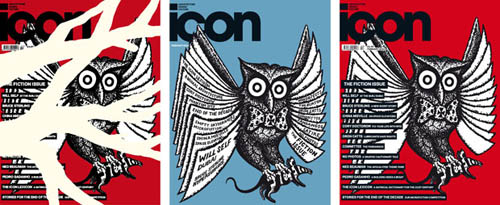
I was excited finally to pick up a copy of Icon’s February issue today; it is, in its entirety, an exploration of how fiction can be used to explore architectural ideas and the future of the built environment.

Contributors range from China Miéville, Bruce Sterling, and Cory Doctorow to Ned Beauman, Alexandra Daisy Ginsberg & Oron Catts, and Will Self, with microfiction contributions from Tim Maly of Quiet Babylon fame and Simon Sellars of Ballardian. I was also very happy to see that “Landscapes of Quarantine” participant Scott Geiger appears with a short review, and there is much else besides.

China Miéville’s story, “The Rope is the World,” takes place amidst “the space elevators, the skyhooks, the geostationary tethered-dock haulage columns” of a planet bound to its lower atmosphere by giant pieces of astral infrastructure. However, these elevators, in Miéville’s telling, are doomed to become fantastic aerial ruins, turning the Earth into “an irregularly spoked wheel” studded with abandoned elevator shafts, each “longer than Russia.” Derelict chain-cities hang flaccid in the skies. What might Caspar David Friedrich have painted in such a world?

Bruce Sterling, meanwhile, presents us with a world in which nothing seems to exist but broadband access—and that world is far from exhilarating. The story’s accompanying photograph shows us a Windows-powered laptop sitting alone on a plaster-flecked apartment floor, plugged into the wall of a room that otherwise has nothing in it; this solipsistic interior, void of anything like human presence or culture, reminded me of an old Peter Lamborn Wilson interview in which Wilson launches into an amazing rant against the rise of home internet use (even if I don’t agree with his conclusions):

Yes. You’re slumped in front of a screen, in the same physical situation as a TV watcher, you’ve just added a typewriter. And you’re “interactive.” What does that mean? It does not mean community. It’s catatonic schizophrenia. So blah blah blah; communicate communicate; data data data. It doesn’t mean anything more than catatonics babbling and drooling in a mental institution. Why can’t we stop?

In Sterling’s fictional world, these empty interiors freed of all personal possessions, with not even a place to sit, pulsate with instant access to Gmail; you can check your Twitter feed even if you can’t cook a decent meal.

But when the story’s protagonist obtains a mail-order 3D printer (“This sleek and sturdy overnight parcel contains everything one might need for do-it-yourself, open-source digital home fabrication,” Sterling writes), he or she gains an ability to produce objects—which then seems to be greeted with hipster disillusionment, rather than with ecstasy.

Indeed, the story ends on a low note; its final line: “I have to print my bed, so that I can lie in it.”

I have to admit to having already read that final sentence courtesy of Matt Jones’s Twitter feed a few weeks ago, and I had imagined, between then and now, a totally different story. I had pictured Sterling’s story, called “The Hypersurface of the Decade,” set in a world where personalized 3D printers create everything from our furniture to our food; today we might print our boarding passes at home before getting on an airplane, but tomorrow we will print our hamburgers, TVs, and even bedspreads.

Maybe we’ll print dogs and subway passes and prescription medications. Maybe we will even print our children.


[Image: MIT’s Fluid Interfaces Group’s Cornucopia 3D food-printer].

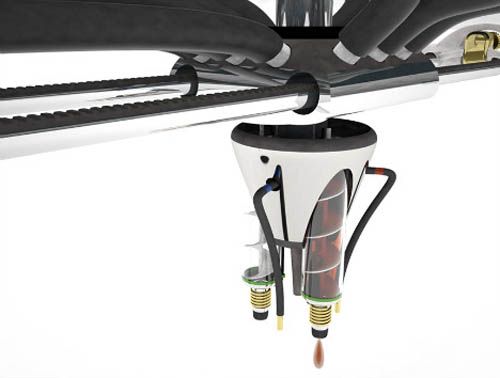
Maybe it’s just a question of having the right new infrastructure of pipes—no, not those pipes. Maybe we need to forget ink cartridges; we’ll just subscribe to personal flows of speciality ingredients, chemical mixtures that come to us through a radically retooled infrastructure of pipes embedded in the walls of our cities. As unsurprising to someone in 50 years as piped water is to residents of New York today, anyone will simply print a pill of Prozac when they really need it or even print themselves a birthday cake.

Forget killer apps; all you need is the right printhead. Plug it into a nozzle on the wall and voilà.

In any case, I had pictured a story set in some strange Dr. Seuss world of instantly-printed objects. Forget furniture and clothing and utensils. Forget the Apple Tablet; instead you’d carry portable printheads, emitting on-demand, dissolvable realities of the present moment. Trapped in a room, you’d simply print a hammer and attack the wall. Of course, in many ways that is exactly what Sterling has described in his story, but it takes till the last three or four paragraphs to get a glimpse of this malleable world.

But, speaking only for myself, I’d love to spend more time inside this strange fever-dream in which instantly realizable objects appear left and right. I would hold something not unlike a gateway in my hand—some fabulous new printhead—spraying forms into the world of human beings.

Pick up a copy of Icon’s Fiction Issue before it disappears.

Quick Links 3


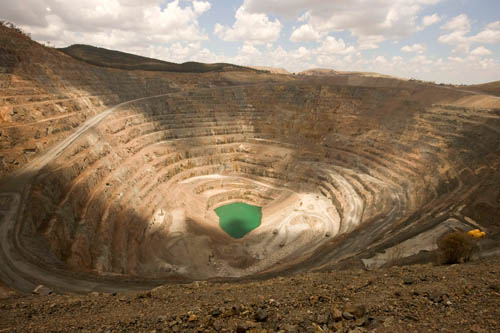
[Image: Australia’s Cadia gold mine, photographed by Jacky Ghossein for Getty Images, spotted at the Big Picture].

L.A. Times | “Ozone from Asia is wafting across the Pacific on springtime winds and boosting the amount of the smog-producing gas found in the skies above the Western United States,” the L.A. Times reports.

Economist | “Much of [California’s central valley] was an inland sea in its geological past,” we read in the Economist, “and its alluvial soils and Mediterranean climate make parts of it, particularly the San Joaquin valley in the south, about the most fertile agricultural region in the world. But this status is at risk because water, the vital ingredient to make the soil productive, is increasingly scarce.”

Popular Science | Undersea Cables Could Be Used as an Early Tsunami Detection System: “Monstrous tsunami waves, like the one that killed over 200,000 people in the Indian Ocean in 2004, create an electric field as they form. This field could possibly be sensed by a network of underwater sensors.”

ABC | “U.S. military veterans are sorting through a massive government archaeological collection that has been neglected for decades, with the hope of archiving the stone tools, arrows and American Indian beads that were found beneath major public works projects.”

Scientific American | Simulating the growth of the Tokyo subway system using slime mold: “A Japan-based research team found that if they placed bits of food (oat flakes) around a central Physarum polycephalum [slime mold] in the same location as 36 outlying cities around Tokyo, the mold created a network connecting the food sources that looked rather like the existing rail system.”


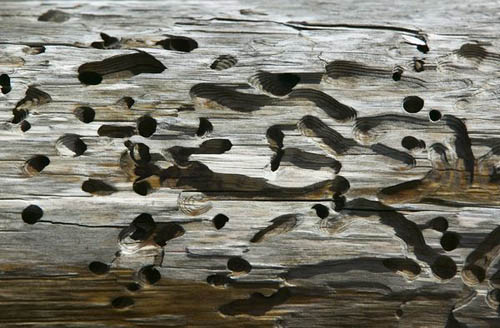
[Image: A “shipworm invasion” is threatening “thousands of Viking vessels and other historic shipwrecks” in the Baltic Sea, National Geographic reports; photo by Paul Kay, Oxford Scientific Photolibrary].

Scientific American | “Wind energy could generate 20 percent of the electricity needed by households and businesses in the eastern half of the United States by 2024, but it would require up to $90 billion in investment,” according to Scientific American.

BBC | “A new US assessment of Venezuela’s oil reserves could give the country double the supplies of Saudi Arabia,” we read at the BBC.

Brookings Institution | The Suburbanization of Poverty: “Suburbs saw by far the greatest growth in their poor population and by 2008 had become home to the largest share of the nation’s poor.”

Washington Post | “The gravelly beaches of Prince William Sound are trapping the oil [from the Exxon Valdez] between two layers of rock, with larger rocks on top and finer gravel underneath… creating a nearly oxygen-free environment with low nutrient levels that slowed the ability of the oil to biodegrade.”

Financial Times | Stray dogs in Moscow are “evolving greater intelligence and wolf-like characteristics”—as well as an ability to use the subway.

(Some links via Archinect, Futurismic, Reid Kotlas, and @stevesilberman. Quick Links 1 and 2).

States of Metamorphosis

Photographer David Maisel will be celebrating the opening of his show “Library of Dust” tonight, Thursday, January 21, at New York’s Von Lintel Gallery.

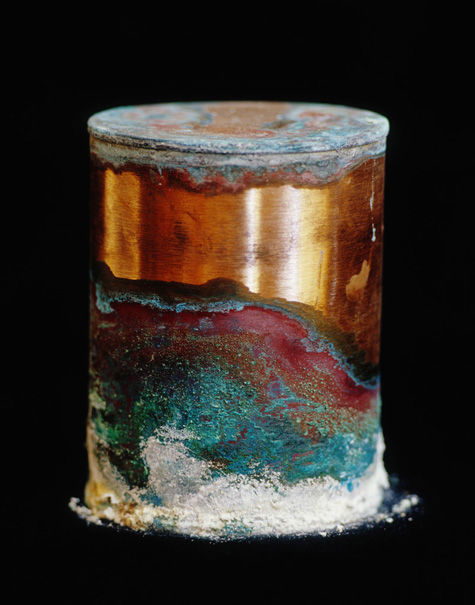
[Image: From Library of Dust by David Maisel].

Chronicle Books put out an absolutely gorgeous book documenting Maisel’s work last year. From the project’s own description:

David Maisel’s Library of Dust features copper canisters in varying states of metamorphosis. The containers are photographed individually, black backdrop in place, each posed like a subject sitting for a portrait. Maisel’s treatment of these objects is apropos. The canisters, once stored in a dilapidated outbuilding of a state-run psychiatric hospital, hold the cremated remains of people—more specifically, the unclaimed ashes of the asylum’s patients. The Oregon State Hospital, inaugurated as the Oregon State Insane Asylum in 1883, interred the canisters in an underground vault in the mid-1970s. As the vault flooded repeatedly, the canisters—some containing remains more than a century old—underwent potent transformations. The chemical composition of each cremated body’s ashes has caused unique and colorful mineralogical blooms to form on its individual copper surface.

The gallery opens at 6pm—roughly one hour from now—and the show will stay up until February 27, 2010. Be sure to stop by if you are near; here is a map.

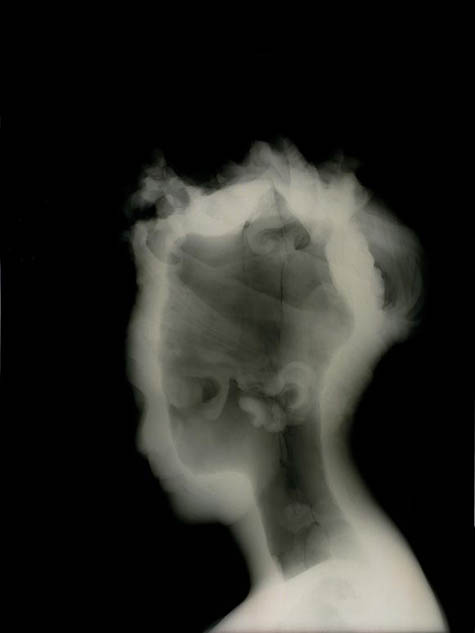
For those of you already familiar with this project, meanwhile, Maisel has been working on a new, long-term series called “History’s Shadow.” This consists entirely of “re-photographed x-rays of art objects from antiquity,” and the results offer eerily delicate views inside objects thousands of years old. An example appears below, but the whole series is well-worth checking out in full.

[Image: “GM12,” from History’s Shadow by David Maisel].

I would love to see an architectural version of this project, with Maisel somehow re-photographing large-scale x-rays of cathedrals and temple walls, peering inside columns, arches, and ruins, with buttresses doubled and tripled with the grain of their rock revealed, stuttering into the silent core of an object not ever meant to be seen this way.

(I was fortunate enough to have an essay included in Maisel’s Library of Dust; you can read that essay in its entirety on BLDGBLOG).

Glacier / Island / Storm

I thought it might be fun to post the course description and design brief for a course I’ll be teaching this semester at Columbia.
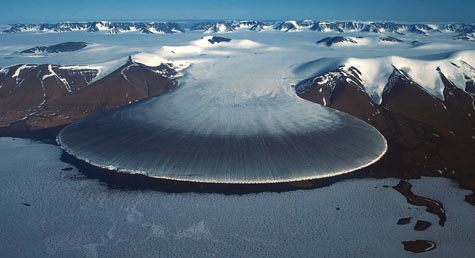
[Image: Photo via the Alfred Wegener Institute].

The idea behind the studio is to look at naturally occurring processes and forms—specifically, glaciers, islands, and storms—and to ask how these might be subject to architectural re-design.

We will begin our investigations by looking at three specific case-studies, including the practical techniques and concerns behind each. This research will then serve as the basis from which studio participants will create original glacier/island/storm design proposals.

GLACIER: For centuries, a vernacular tradition of constructing artificial glaciers in the Himalayas has been used to create reserves of ice from which freshwater can be reliably obtained during dry years. This is the glacier as non-electrical ice reserve, in other words; some of these structures have even received funding as international relief projects—for instance, by the Aga Khan Rural Support Program in Pakistan. Interestingly, the artificial glacier here becomes a philanthropic pursuit, falling somewhere between Architecture For Humanity and a sustainable water-bank.

Through an examination of glacier-building techniques, water requirements, and the thermal behavior of ice, we will both refine and re-imagine designs for self-sustaining artificial glaciers, for the ultimate purpose of storing fresh water.

But what specific tools and spatial techniques might this require? Further, what purposes beyond drought relief might an artificial glacier serve? There are myths, for instance, of Himalayan villagers building artificial glaciers to protect themselves against invasion, and perhaps we might even speculate that water shortages in Los Angeles could be relieved with a series of artificial glaciers maintained by the city’s Department of Water and Power at the headwaters of the Colorado River…

ISLAND: Building artificial islands using only sand and fill is relatively simple, but how might such structures be organically grown?

In the ocean south of Japan is a complex of reefs just slightly below the surface of the water; Japan claims that these reefs are, in fact, islands. This is no minor distinction: if the international community supports this claim, Japan would not only massively extend its Exclusive Economic Zone (EEZ), complete with seabed-mining and fishing rights, but it would also block China from accessing those same resources. This would, however, also limit the ability of Chinese warships to patrol the region—and so the U.S. has publicly backed Japan’s territorial claim (China does not).

Okinawan scientists have thus been developing genetically-modified species of coral with the express idea of using these species to “grow” the reefs into a small but internationally recognized archipelago: the Okinotori Islands. Think of it as bio-technology put to use in the context of international sovereignty and the U.N. Law of the Sea.

The stakes are high—but, our studio will ask, by way of studying multiple forms of reef-building as well as materials such as Biorock, where might other such island-growing operations be politically and environmentally useful? Further, how might the resulting landforms be most interestingly designed? Assisted by a class visit from marine biologist Thomas Goreau, one-time collaborator of architect Wolf Hilbertz, we will look at the construction techniques and materials necessary for building wholly new artificial landforms.

STORM: For hundreds of years, a lightning storm called the Relampago del Catatumbo has flashed in the sky above Venezuela’s coastal Lake Maracaibo. The perfect mix of riverine topography, lake-borne humidity, and rain forest air currents has produced what can be described, with only slight exaggeration, as a permanent storm.

This already fascinating anecdote takes on interesting spatial design implications when we read, for instance, that Shanghai city officials have expressed alarm at the inadvertent amplification of wind speeds through their city as more and more skyscrapers are erected there—demonstrating that architecture sometimes has violent climatological effects. Further, Beijing and Moscow both have recently declared urban weather control an explicit aim of their respective municipal governments—but who will be in charge of designing this new weather, and what role might architects and landscape architects play in its creation?

We will be putting these—and many other—examples of weather control together with urban, architectural, and landscape design studies in an attempt to produce atmospheric events. For instance, could we redesign Manhattan’s skyline to create a permanent storm over the city—or could we rid the five boroughs of storms altogether? And under what circumstances—drought-relief in the American southwest or Gulf Coast hurricane-deflection—might our efforts be most practically useful?

• • •

The studio will be divided into three groups—one designing “glaciers,” one designing “islands,” one designing “storms.” Each group will mix vernacular building technologies with what sounds like science fiction to explore the fine line between architectural design and the amplified cultivation of natural processes. Importantly, this will be done not simply for the sake of doing so (although there will be a bit of that…), but to address much larger questions of international sovereignty, regional drought, global climate change, and more.
They Will Build Clouds For Us

[Image: A C-141 Starlifter flying toward sunset; via Wikimedia].

A cloud of metal dust released by U.S. military airplanes in the skies 100 miles west of Los Angeles caused a temporary blackout in the city and “interfer[ed] with radar at airports in southern California” when the cloud began blowing back toward land.

What exactly was the purpose of this inadvertently weaponized offshore atmospheric event? “The Navy says it spread several thousand pounds of the particles of chaff in an operation 100 to 300 miles offshore designed to test its ability to jam radar,” the New York Times reported.

However, all of this actually occurred 25 years ago, in January 1985; I simply stumbled upon it while researching blackouts.

The idea, though, that there are airplanes flying somewhere out there west of Los Angeles creating strange weather for those of us on shore—clouds sculpted on the rising winds of the Southland, drifting unpredictably toward Santa Monica—seems both extraordinary and all too ready for capitalization. Sunsets on demand! Your least favorite celebrity gets married on a Malibu terrace and repurposed military aircraft paint the distant skies red, weaving fantastic ribbons of color in front of the falling sun.

It’s like something out of J.G. Ballard’s old short story “The Cloud Sculptors of Coral D,” in which famous portraits are carved into passing cloud forms by trained kite operators standing below on the shores of a tropical island. They have invented a stunning, lo-fi, vernacular 3D printing that can only be applied to the earth’s atmosphere.

“Lifted on the shoulders of the air above the crown of Coral D, we would carve seahorses and unicorns, the portraits of presidents and film stars, lizards and exotic birds,” Ballard wrote, describing this new mythology of atmospheric design and the “manicurists of the air” who so beautifully practiced it.

Or, for that matter, perhaps this strange meteorological event—the metal chaff of a new weather emperor, self-installed atop his flying throne, deploying cloud-weapons across the horizon—was an electromagnetically active twist on the anti-hero from Roberto Bolaño’s novel Distant Star. There, we meet a skywriting poet-pilot with a penchant for fascism who sells his political soul to the Nazis in order to write his Romantic words in huge drifting scripts above the mountains of South America.

He becomes “a Michelangelo of the sky,” as Ballard might have it.

Meanwhile, radar-jamming clouds of nanoparticles settle onto the plates of outdoor diners in Venice Beach, salting take-out pizzas and dusting the bodies of sunbathers, as screens inside the LAX control tower madly ping with invisible aircraft.

Super Powers Cultivate

Mitchell Joachim and Maria Aiolova of Terreform 1 have launched the From Mowing to Growing competition, aka the One Prize.

The competition hopes to inspire design research into “larger issues concerning the environment, global food production and the imperative to generate a sense of community in our urban and suburban neighborhoods.”

From Mowing to Growing is not meant to transform each lawn into a garden, but to open us up to the possibilities of self-sustenance, organic growth, and perpetual change. In particular, we seek specific technical, urbanistic, and architectural strategies not simply for the food production required to feed the cities and suburbs, but the possibilities of diet, agriculture, and retrofitted facilities that could achieve that level within the constraints of the local climate.

Citing the work of Fritz Haeg, the competition brief points out that “North Americans devote 40,000 square miles to lawns,” more than is used “for wheat, corn, or tobacco.” Further, U.S. residents “spend $750 million dollars a year on grass seed alone while only 2% of America’s food is locally grown.” So, the competition asks:

How can we break the American love affair with the suburban lawn?
Can green houses be incorporated in skyscrapers?
What are the urban design strategies for food production in cities?
Can food grow on rooftops, parking lots, building facades?
What is required to remove foreclosure signs on lawns and convert them to gardens?

Prizes go as high as $10,000, and judges include Cameron Sinclair and Kate Stohr of Architecture For Humanity, vertical agriculturalist (agriverticality?) Dickson Despommier, and many more. Register by March 31, with submissions due before April 30.

Quick Links 2

[Image: Proposal for a Museum of Polish History, Warsaw, by Paisajes Emergentes].

Nick Sowers | The End of the Grand Tour (see also)
Washington Post | Work begins on first planned Palestinian city
The New Republic | The Case Against Blowing Up Mountains
San Francisco Chronicle | Design Fantasies for Obsolete Bay Bridge Span (also earlier)
Treehugger | 3D Food Printer from Lab at MIT
Urban Omnibus | Clip-on Architecture: Reforesting Cities
InfraNet Lab | Islands of Waste pt. 1
Discovery News | “Oceans of liquid diamond, filled with solid diamond icebergs, could be floating on Neptune and Uranus”
The Journal of Tunnelling and Underground Space Technology

(Some links via @alexismadrigal, @leebillings, @lloydalter, and @eatingbark; don’t miss Quick Links 1).

River City

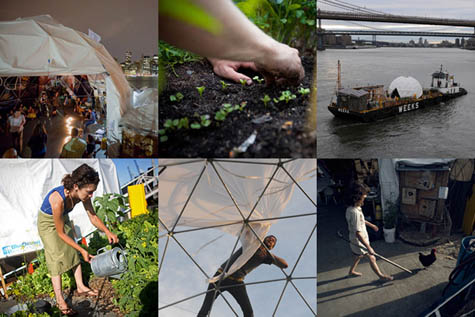
If you’re near New York City tomorrow night, Friday, January 15th, Exit Art is hosting an event in honor of the Waterpod project, exploring the twin ideas of interactive architecture and “reinventing social spaces.”

[Image: Glimpses of the Waterpod].

The Waterpod, if you are not familiar with it already, “was a floating, sculptural structure designed as a futuristic habitat and an experimental platform for assessing the design and efficacy of living systems fashioned to create an autonomous, fully functional marine shelter.” It traveled around the waterways of New York, bringing equal parts aquatic farm, mobile bio-utopia, and urban sci-fi to the hydroscape of the city.

As a self-sufficient, navigable living space, the Waterpod showcased the critical importance of water within the natural world. Collectively embracing the richly-patterned folkways of the five boroughs of metropolitan New York, the Waterpod reified positive interactions between communities: private and public; artistic and societal; scientific and agricultural; aquatic and terrestrial.

The New York Times described it as “an independent project [artist Mary] Mattingly dreamed up three years ago to explore the possibility of creating a self-sufficient community on the water—a kind of aquatic version of the Biosphere 2 complex built in the Arizona desert in the 1980s—that might offer an alternative to living on land in the future, if ‘our resources on land grow scarcer and sea levels rise,’ she said.”

Tomorrow night will feature three short presentations by Natalie Jeremijenko, “an artist whose background includes studies in biochemistry, physics, neuroscience and precision engineering”; architect Maria Aiolova, cofounder with Mitchell Joachim of Terreform 1; and myself, followed by a panel discussion and public Q&A. For my own part, I plan on discussing a number of hydrological topics, including the vernacular design of artificial glaciers and other kinds of “ice reserves” as a response to global water shortages, and, given time, to present a brief look at the history of weather control and urban storm cultivation.

Entrance is free, although there is a suggested donation of $5, and there is a cash bar to ease the mood of a Friday evening; things kick off at 7pm, and you will find us all gathered at 475 10th Avenue, near 37th Street. Here is a map and more info about the night in general.

Hope to see you there!

Flexible Filmography

I’m in the strange (and semi-sleepless) situation of having our apartment rented out for the day while a Ewan McGregor film is produced in our building. The industry of urban film location scouts seems particularly fascinating to me, I have to say; you put out some flyers in a certain neighborhood, say, asking for something really quite specific (in our case, south-facing windows on the fourth floor or higher) and I suppose you then just hope that someone in a specific building will respond or perhaps you just deal with what you get (and I wonder if there are films out there whose screenplays, or whole characters, were actually adapted based on location availability). But the idea that, out there somewhere, there is a little black book, or a huge three-ring binder, a whole mythic cabinet, full of hand-me-down insights about buildings and rooms and rooftops and halls and stairwells scattered throughout the city is amazing to me, a collection of first-hand urban research that architects would do very well to access and study. Advanced film location as an esoteric science of the city. Architects could rent these binders by the hour, interviewing film set installation professionals about the lived reality and emotional impact, the narrative demands and implications, of increasingly precise spatial parameters. Rooms with wall-to-wall carpet on the Upper West Side, with east-facing windows, are apparently perfect for divorcee clients… Meanwhile, location scouts drive lonely around the city, maps in hand, looking up through odd-angled windows at barely glimpsable pieces of punched tin ceilings, imagining the internal lives of yet-to-be-acted future characters. Taking notes. Filing photographs. Assembling a dossier on this unpredictable constellation of rooms, charting the human impact of the city to a degree that no other industry can ever quite have.

(Note: This is actually the first blog post I’ve written entirely on an iPhone, out for breakfast, typing very slowly with one finger… a method that seems to require more practice!)

Exploring the Megastructure: Smugglers’ Caves and Shipwrecks

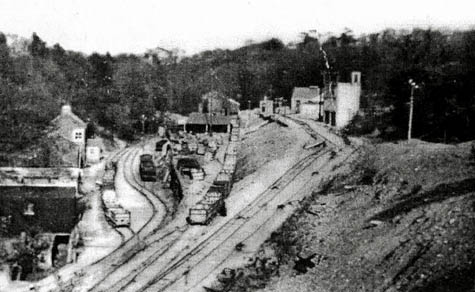
[Image: Archival view of the old mines at Grinkle, Yorkshire, UK].
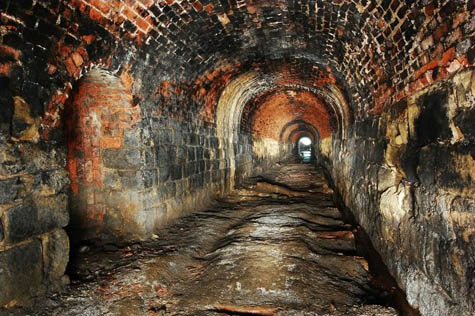
Worth checking out is a massive post detailing photographer Phill Davison‘s recent exploration of the half-collapsing tunnels and overgrown hillside entrances of an old Yorkshire iron mine.

Right when you think it’s over, they hike out through snow drifts and cross into another walled-up creek entrance—and the post just keeps on going.

[Images: Planetary vaultwork; photos by Phill Davison, from his monumental post exploring the Grinkle Ironstone Mine].
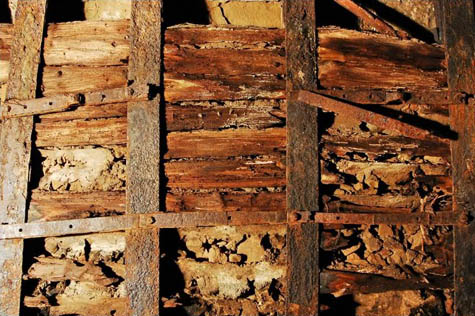
Davison remarks at one point that the structures he finds himself surrounded by down there remind him of smugglers’ caves and shipwrecks—and pictures like this one, below, detailing the awesomely compressed strata of wood boards and rock, and the rusting ironwork that holds it all back from collapse, make that comparison viscerally obvious.

[Image: The earth is like a sandwich; photo by Phill Davison, from his monumental post exploring Yorkshire’s Grinkle mine].

How amazing, though, to descend into the earth only to find it kitted-out like the hull of an oceangoing ship. Where the hills you’re walking on are actually engineered archways of an earlier civilization, with the occasional entryway peeking out from beneath the weeds. And so you descend into the vaults and debris-support cages of an artificial interior, hidden behind fences and beneath the winter snow.

Check out Davison’s post in its entirety—and then stop by the Flickr pool “Exploring the Megastructure,” where I originally saw these photos.