El Resplandor

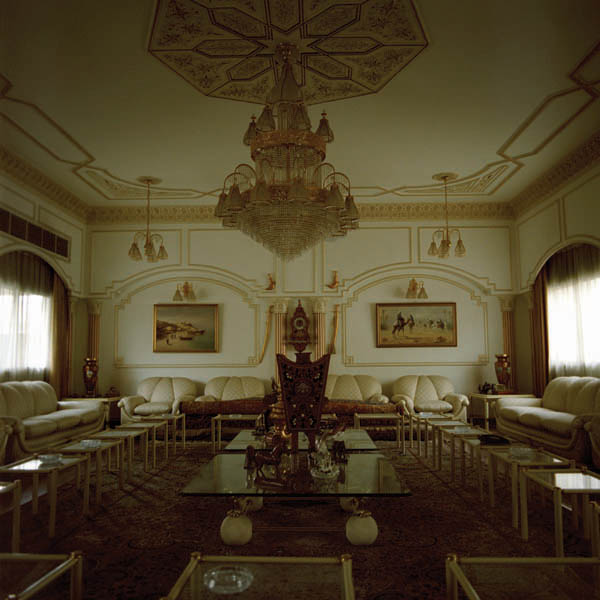
[Image: “Meelas Yadee” (2005-2006) by Lamya Gargash].

Nettle’s newest album, El Resplandor: The Shining in Dubai, released last month by Sub Rosa, comes with an awesome premise: it is a speculative soundtrack for an unmade remake of Stanley Kubrick’s film, The Shining, set in a mothballed luxury hotel in Dubai. It is sonic architecture fiction.

Less a horror film, however, than its predecessor, Nettle’s version seems instead to offer a melancholy audio glimpse of a world in decline: the album’s family lost in circumstances far too large—and too alienating, too foreign—to comprehend fully, unraveling alone in the hotel’s empty rooms and hallways.

[Image: “Fatima’s Kitchen Cupboard” (2005-2006) by Lamya Gargash].

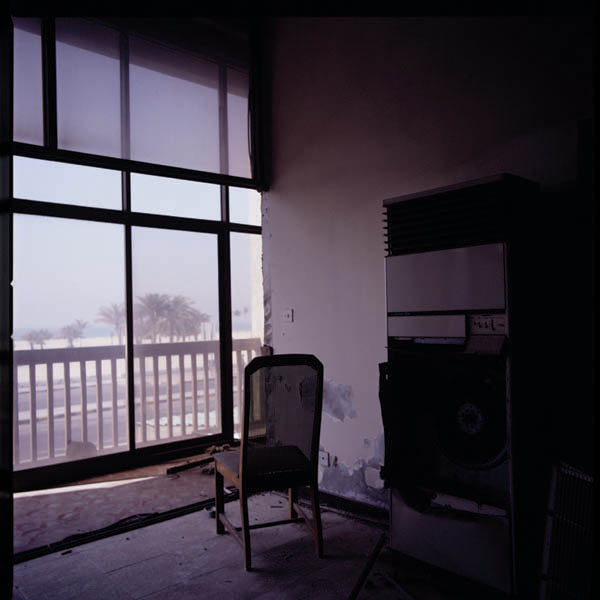
El Resplandor‘s liner notes feature these photographs by Lamya Gargash, depicting extravagantly furnished rooms in afternoon darkness, empty kitchens, halls, and ruined stairways in the UAE.

As the artist herself explains, many of the houses seen here “are recently vacant, whereas others have been deserted for a long time. There were some houses that still had people living in them when I started my project; the families residing there were preparing to move to newer homes.” Many more images from the series can be found here.

[Images: (top) “Blue Purple Chair” (2005-2006) and (bottom) “The Staircase” (2005-2006) by Lamya Gargash].

Jace Clayton and Lindsay Cuff of Nettle will be at Thrilling Wonder Stories 3 on Friday afternoon, October 28th, to talk about the album, the entirety of which will be streamed throughout the day.

[Image: “Mona Lisa” (2005-2006) by Lamya Gargash].

Stop by if you’re in the area, not only to learn more about the concept behind the album—after all, there’s something highly compelling about the idea of a speculative soundtrack for an unmade remake (perhaps this could be the first soundtrack optioned by Hollywood for a film it later serves to score)—but also about the technical set-up used by the band during studio production and live sets. Nettle’s more sonically aggressive earlier work, Build a Fort, Set that On Fire, is also worth a listen in the meantime.

Thrilling Wonder Stories 3

Since 2009, an annual Thrilling Wonder Stories event has taken place at the Architectural Association in London, bringing people together from multiple disciplines to explore the spaces between fiction, science, and design.

On one hand, these events take the form of an extended look into the role of architectural spaces—including real buildings, but also film sets, computer game environments, and spatial simulations—in propelling, staging, catalyzing, or otherwise framing narrative storylines. This requires speaking not only to architects, but to novelists, game developers, screenwriters, film set designers, and even Hollywood directors to discuss their own particular requirements for, and relationships to, the built environment—but also to ask, more specifically, how the spaces they design, describe, feature, or build affect the development of narrative.

This is the cultural dimension of the event—the “wonder stories.”

On the other hand, Thrilling Wonder Stories has also looked both to science and science fiction as resources of ideas that might play spatial roles in future design projects—where I use the word spatial, not architectural, very deliberately, so as not to limit this to a discussion of buildings. This means bringing in robot makers and biologists, geologists and geneticists, not to ask them about architecture but simply to learn about their work. The point, in other words, is not to extract architectural ideas from their research—as if fully formed building programs could somehow be pulled from a presentation about synthetic organisms—but simply to add to the overall mix of scientific (and science fictional) ideas available for reference in future design conversations.

This is the “thrilling wonder” side of the series.

[Images: Photos from Thrilling Wonder Stories 2 at the Architectural Association].

To date, Liam Young, the event’s co-organizer, and I have hosted comics author Warren Ellis, architect Sir Peter Cook of Archigram, game critic Jim Rossignol, TED Fellow and architectural biologist Rachel Armstrong, novelists Will Self and Jeff VanderMeer, spatial provocateurs Ant Farm, designer Matt Webb of BERG, and more than a dozen other figures from the worlds of film, gaming, architecture, literature, engineering, science, interaction design, and more.

[Image: From “Animal Superpowers” by Chris Woebken and Kenichi Okada; Woebken will be speaking at Thrilling Wonder Stories 3 at Studio-X NYC].

This year, we’re trying out an ambitious new format. Not only are we teaming up with Popular Science magazine as our media partner and co-organizer—so watch for content on popsci.com in the lead up to and during the event—but we are leading two simultaneous events: one at the Architectural Association in London, the other across the pond at Studio-X NYC.

So, on Friday, October 28th, Thrilling Wonder Stories 3—sponsored by the Architectural Association, Studio-X NYC, and Popular Science—kicks off in London with a truly phenomenal line-up. It’s an all day blow-out, lasting from noon to 10pm, featuring:

VINCENZO NATALI*
Director of Cube, Splice, and forthcoming feature films based on J.G. Ballard’s High-Rise and Neuromancer by William Gibson

BRUCE STERLING
Scifi author, commentator, and futurist

KEVIN SLAVIN
Game designer and theorist of “how algorithms shape our world

ANDREW LOCKLEY
Academy Award-winning visual effects supervisor for Inception, compositing/2D supervisor for Batman Begins and Children of Men

PHILIP BEESLEY
Digital media artist and experimental architect

CHRISTIAN LORENZ SCHEURER
Concept artist and illustrator for computer games and films such as The Matrix, Dark City, The Fifth Element, and Superman Returns

CHARLIE TUESDAY GATES
Taxidermy artist and sculptor—to lead a live taxidermy workshop

DR. RODERICH GROSS AND THE NATURAL ROBOTICS LAB
Head of the Natural Robotics Lab at the University of Sheffield—to lead a live Swarm Robotics demonstration

GAVIN ROTHERY
Concept artist for Duncan Jones’s film Moon

GUSTAV HOEGEN
Animatronics engineer for Hellboy, Clash of the Titans, and Ridley Scott’s forthcoming film Prometheus

JULIAN BLEECKER
Designer, technologist, and researcher at the Los Angeles-based Near Future Laboratory

RADIO SCIENCE ORCHESTRA
Theremin-led electro-acoustic ensemble

SPOV
Motion graphics artists for Discovery Channel’s Future Weapons and Project Earth

ZELIG SOUND
Music, composition, and sound design for film and television

Better yet, Matt Jones of the ultra-talented design studio BERG will join Liam Young to serve as co-host for the day. Here’s a map for how to get there; the event is free but space is limited.

[Image: “Glass Weed” from Super-Natural Garden by Simone Ferracina; Ferracina will be speaking at Thrilling Wonder Stories 3 at Studio-X NYC].

That same day—Friday, October 28th—over at Studio-X NYC, Thrilling Wonder Stories 3 will kick off at 1pm local time, lasting till 4 or 4:30pm. Speaking that day are:

NICHOLAS DE MONCHAUX
Architect and author of Spacesuit: Fashioning Apollo

HARI KUNZRU
Novelist and author of Gods Without Men, Transmission, and The Impressionist

BJARKE INGELS
Architect, WSJ Magazine 2011 architectural innovator of the year, and author of Yes Is More: An Archicomic on Architectural Evolution

SETH FLETCHER
Science writer, senior editor of Popular Science, and author of Bottled Lightning: Superbatteries, Electric Cars, and the New Lithium Economy

JACE CLAYTON AND LINDSAY CUFF OF NETTLE
Nettle’s new album, El Resplandor, is a speculative soundtrack for an unmade remake of The Shining, set in a luxury hotel in Dubai

[Image: One of many evolutionary robotic research projects by Hod Lipson, featured in this PDF; Lipson will be speaking at Thrilling Wonder Stories 3 at Studio-X NYC].

Then, Saturday, October 29th, everything comes to a close with an epic second day—from 2-7pm—at Studio-X NYC, featuring:

JAMES FLEMING
Historian and author of Fixing The Sky: The Checkered History of Weather and Climate Control

MARC KAUFMAN
Science writer for the Washington Post and author of First Contact: Scientific Breakthroughs in the Hunt for Life Beyond Earth

ANDREW BLUM
Journalist and author of Tubes: A Journey to the Center of the Internet

DAVID BENJAMIN
Architect and co-director of The Living

DEBBIE CHACHRA
Researcher and educator in biological materials and engineering design, featured in Wired UK‘s 2010 “Year In Ideas”

HOD LIPSON
Researcher in evolutionary robotics and the future of 3D printing at Cornell University

CARLOS OLGUIN
Designer at Autodesk Research working on the intersection of bio-nanotechnology and 3D visualization

CHRIS WOEBKEN
Interaction designer

SIMONE FERRACINA
Architect, winner of the 2011 Animal Architecture Awards, and author of Organs Everywhere

DAVE GRACER
Insect agriculturalist at Small Stock Foods

MORRIS BENJAMINSON
Bioengineer of in-vitro edible muscle protein and CEO of Zymotech Enterprises

ANDREW HESSEL
Science writer and open-source biologist, focusing on bacterial genomics

The events in New York will be moderated by myself, Studio-X NYC co-director Nicola Twilley, and PopSci senior associate editor Ryan Bradley. In both locations, events are free and open to the public; however, if you plan on attending the Studio-X NYC event, please register as limited space will be available. Here’s a map.

[Image: The “plastic” extruded by New England’s Colletes inaequalis bees; photo by Debbie Chachra].

Finally, if you can’t make it in person, consider following Thrilling Wonder Stories on Twitter—and keep your eye out at the end of summer 2012, for the Thrilling Wonder Stories book, published by the Architectural Association.

But I hope to see some of you there!

*Vincenzo Natali will be speaking via Skype.

Eye Roller

[Image: The GroundBot system by Rotundus].

The GroundBot system by Swedish firm Rotundus is a remote-controlled, all-weather polycarbonate sphere that “can trundle through snow, mud and sand as it supplies a live feed via a pair of cameras,” Wired UK explains. “Its operator sees the image in 3D on a screen.”

It apparently comes with knobby treads or without.

[Image: The GroundBot system by Rotundus].

The sphere is currently “undergoing trials” with the Swedish Defense Forces for use “in airports and other locations in need of surveillance,” but the system also has potential applications in urban mapping, remote terrain exploration, and even post-disaster search and rescue. While the GroundBot can only reach speeds a bit more than 6mph—which means it won’t be breaking any speed records, and it certainly won’t be hard to outrun—the idea that failed criminals of the future might be seen sprinting away from swarms of autonomous black spheres the size of car tires is quite extraordinary.

[Images: The GroundBot system by Rotundus on patrol].

See the Rotundus site for more info.

Film Grenade

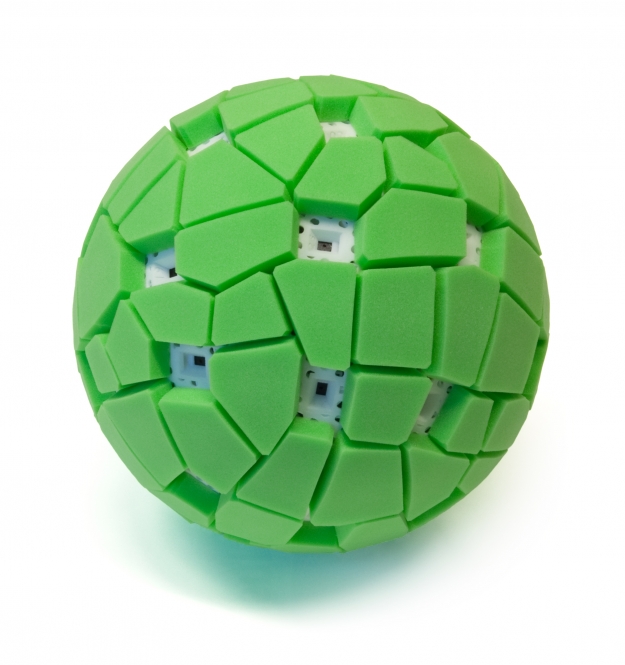
[Image: The “Throwable Panoramic Ball Camera” by Jonas Pfeil].

The “Throwable Panoramic Ball Camera,” designed by Jonas Pfeil as part of his thesis project at the Technical University of Berlin, creates spherical panoramas after being thrown into the air.

The camera “captures an image at the highest point of flight—when it is hardly moving.” It “takes full spherical panoramas, requires no preparation and images are taken instantaneously. It can capture scenes with many moving objects without producing ghosting artifacts and creates unique images.” You can see it at work in this video:

Pfeil explains in detail:

Our camera uses 36 fixed-focus 2 megapixel mobile phone camera modules. The camera modules are mounted in a robust, 3D-printed, ball-shaped enclosure that is padded with foam and handles just like a ball. Our camera contains an accelerometer which we use to measure launch acceleration. Integration lets us predict rise time to the highest point, where we trigger the exposure. After catching the ball camera, pictures are downloaded in seconds using USB and automatically shown in our spherical panoramic viewer. This lets users interactively explore a full representation of the captured environment.

It’s easy enough to imagine such a thing being mass-produced and taken up by the Lomo crowd; but it seems equally likely that such a technology could be put to use aiding military operations in urbanized terrain, with otherwise disoriented squad leaders tossing “robust” optical grenades up above dividing walls and blocked streets to see what lies beyond.

Either way, a throwable camera strong enough to withstand bad weather and strong bounces—and able to store hundreds of images—sounds like an amazing way to start documenting the urban landscape. In fact, the very idea that a “photograph” would thus correspond to a spherical sampling of all the objects and events in a given area adds an intriguing spatial dimension to the act of creating images. It’s a kind of reverse-firework: rather than release light into the sky, it steals traces of the light it finds there.

(Spotted via Popular Photography).

Do Black Swans Dream of Electric Sheep?

In just a few hours here at Studio-X NYC—an off-campus event space and urban futures think tank run by Columbia’s GSAPP—we’ll be hosting a live interview with Ilona Gaynor. Gaynor is a London-based concept artist, filmmaker, and multimedia designer.

As Gaynor explains it, her work “largely consists of artificially constructed spaces, systems and atmospheres navigated through fictional scenarios,” her intention being “to intensify, fantasize and aestheticize the darker, invisible reaches of political, economical and technological progress. Grounded in rigorous research, consultation and collaboration,” she continues, “my aim is to reveal these worlds by exploring the imaginary limits within them both as critique and speculative pleasure.”

Most of Gaynor’s work has a strong financial bent, as you’ll notice from her portfolio, whether it’s the photographic series “Corporate Heaven,” a research project on insurance and risk, the short film Suspicion Builds Confidence, or even a “fictional artifact designed for the corporate world of tomorrow.”

Her most recent short film, Everything Ends In Chaos, embedded at the start of this post, presents “a mixed-media collection of objects, narrative texts and films that reveal the intricate trajectories of an artificially designed and reverse engineered Black Swan event.” A Black Swan, in Gaynor’s telling of it, based on the economic work of Nassim Nicholas Taleb, is the idea that humans “are collectively and individually blind to uncertainty, and therefore often unaware of the impact that singular events can have on [their] lives: economically, historically and scientifically, until after their occurrence.” Her film is thus an attempt to “reverse-engineer” such an event, piecing together chaos from order; the film’s backstory, which is unfortunately quite hard to detect from the imagery alone, involves an elaborate kidnapping plot, stolen jewels force-fed to doves (which then escape from their cage and fly away), and an actuarial committee in charge of insuring against this event.

In another work, nature—that is, non-human lifeforms, especially plants—has become so expensive and, thus, so out of reach for everyday workers—in Gaynor’s future, for example, a single Ficus tree costs £450,000—that indulging in any interaction with the natural world becomes an experience of “unapologetic decadence.” That film, 120 Seconds of Future, is embedded below:

Gaynor kicks things off at 7pm tonight—Wednesday, 12 October—to be followed by an open Q&A. We’ll be at Studio-X NYC, 180 Varick Street, Suite 1610. Here’s a map.

(More on Studio-X NYC, earlier on BLDGBLOG).

Literary Climatology

[Image: The Blue Angels create their own cloud systems over the San Francisco Bay; view larger].

My week in San Francisco, now at an end, coincided with Fleet Week—and, thus, the arrival of the Blue Angels, the U.S. Navy’s “Flight Demonstration Squad.” While the often overwhelming noise of the Blue Angels—rattling whole buildings at a time and setting off car alarms—is extremely polarizing, both acoustically and politically, I continued to have incredibly interesting, albeit very brief, conversations about them, extending beyond mere love or hate.

1) Performance Physics
After a friend of mine drove into town for a meeting, he described to me how the individual planes—high-speed military jets flying often disconcertingly low over the city in geometrically complex configurations—would disappear behind one of San Francisco’s many hills… only to pop out behind a different hill altogether, visibly out of synch with the Doppler’d roar of its passage (which seemed to echo hilltop to hilltop across the Bay).

But then another identical jet—or was it the same?—would appear behind a different hill, or it would come circling up from another direction entirely, and it began to feel, my friend explained, as if he had inadvertently driven into the middle of a kind of quantum event, with the same—or was it?—airplane appearing and disappearing, over and over again, reappearing and swooping back from different angles, all the while mis-timed with its own acoustic side-effects.

It was, we might say, not performance art but performance physics: an immersive, urban-scale demonstration of quantum dislocation, one object—or multiple?—and multiple objects—or just one?—constantly out of self-synch in a single setting. It was not the military-industry complex but airborne physics: the skies of San Francisco temporarily modeling an inter-dimensional event.

2) Sky Forensics
During the two-day “blogging workshop” that I led this past weekend at the San Francisco Art Institute, one of the participants—artist Alex Shepard—noted that the passage of the Blue Angels had been setting off car alarms all over the city. But, he added, the locations of the car alarms always—of course—coincided with the physical passage of the airplanes, following around right behind them; so, he suggested, you could actually reconstruct the aerial trajectories of the planes through entirely indirect means, using nothing but AAA data and SFPD noise complaints.

These street-level data, collated with enough ambition and accuracy, could thus be seen as a kind of fossil record for the Blue Angels’ weekend performance: a distributed motion-capture device parked throughout the peninsular city. The planes, in other words, left more traces than just artificial clouds: they mapped their own passage through car alarms.

In twenty years’ time, then, forensic historians could reconstruct the skies of Fleet Week 2011 using nothing but data from parked cars.

[Image: The literary medium of clouds: J.G. Ballard’s “The Cloud Sculptors of Coral D” and Distant Star by Roberto Bolaño].

3) Literary Climatology
Because we met up for a blogging workshop, the students at the SFAI and I began to talk about other media for literary self-expression—beyond paper and digital screens—and we briefly got onto the subject of skywriting. A Geico ad had been spotted earlier in the day, one of them pointed out, drifting from the back of a skywriting plane, as if in competition with the more abstract cloud shapes produced by the Blue Angels (who, seemingly seduced by San Francisco, took to drawing hearts in the sky).

That led us to the subject of J.G. Ballard’s short story, “The Cloud Sculptors of Coral D,” in which a small Pacific island—if I remember the story correctly—serves as the setting of a peculiar cultural contest: the advanced cultivation of artificial clouds, using kites and small by-planes.

From there, we got onto the premise of Roberto Bolaño’s novella Distant Star. There, Bolaño tells the story of Carlos Wieder, a poet who—to quote the Daily Telegraph, as I am ironically on board an airplane right now, flying over central Wyoming, and thus do not have access to my copy of the book—”wears the uniform of the Chilean air force and pilots an old Messerschmitt—with which he writes stirring poetic phrases in the sky. The generals and their wives think these aerial stunts are wonderfully entertaining, but Wieder’s professed ambition is to inaugurate a new, populist poetry of “barbarism”, which abandons old literatures and flies into the glorious future.”

The idea of blogging in the sky through the medium of artificial weather—chemically produced, aerodynamic clouds draping the city in a haze of literary climatology—thus presented at least one more alternative way of looking at the highly polarizing urban presence of the Blue Angels.

Foamed Infrastructure

[Image: The weird artificial geology of “soil equivalent” landfill foam; image courtesy of the Environmental Protection Agency].

On the way over to the west coast last week, I read Universal Foam: Exploring the Science of Nature’s Most Mysterious Substance by Sidney Perkowitz. Amongst references to “applied foam science,” “computational foam” studies, and even a “power-producing sonoluminescent foam” that might someday be used to generate electricity for the national grid, there were two ideas for future infrastructure that seem worth repeating here.

1) Foam Roads
While discussing the buffering quality foam can offer as protection against explosions, Perkowitz points out the logical next step in the neutralization of land mines: he writes, roughly 11 years ago, that “a quick-hardening rigid polyurethane foam is being tested at Sandia”—already manufacturers of a successful “decontamination foam“—”for use in nullifying mines on land or in water by buffering soldiers and equipment against their explosive force, or to lay down a safe ribbon for vehicles to travel.”

This “safe ribbon” is, of course, a road—a road made entirely of foam, laid down over active land mines so as to protect vehicles against detonation from below. A whole new class of transportation infrastructure arises: unexplodable foam roads fanning out across military landscapes; instant roads-in-a-can, like shaving cream, that you spray over dangerous terrain; even foam bridges spanning rivers and caves.

Whether or not we’ll see roads-in-a-can coming soon to a Home Depot or city works department near you, however, I’d be shocked not to see foam-road weapons in a computer game shortly—foamed infrastructure brought to you in a flash as new roads and bridges bubble out and harden over otherwise inaccessible terrain. Post-geologic weaponized foam activities.

[Image: Applying “soil equivalent” landfill foam; image courtesy of the Environmental Protection Agency].

2) Foam Geotechnics
Later in the book, Perkowitz refers to “the possibility that foam could extinguish the twenty-year old Percy Coal Mine fire in Pennsylvania,” as well as to “the use of an acidic foam to destroy asbestos installed in buildings by simply spraying it on.” In both cases, you would fill a closed space with foam, which would thus go to work extinguishing underground fires or chemically dissolving asbestos.

However, this segues directly into a brief exploration of the geotechnical implications of quick-hardening foam. Chemist Paul Kittle, Perkowitz explains, “worked out a way to cover garbage landfills with foam” back in the 1980s. Quoting at length:

A significant portion of a landfill is occupied by plain dirt, which according to EPA guidelines must be piled six inches deep every night to cover that day’s trash. Kittle came up with an environmentally benign shaving cream-like foam that would adhere even to steep slopes and would not blow away. The foam stopped rats and bugs, and prevented odors from rising. But unlike dirt, it dissipated after thirty-six hours, no longer taking up room when it was no longer needed under newer trash. For this reason, says Kittle, using his foam could save up to 15 percent of landfill space.

Geotechnical foams are now used in places like the Puente Hills landfill in Los Angeles, using equipment manufactured by Rusmar Foam; Rusmar offers foams of various durations, from 12 hours to 180 days, and with scents such as Vanilla and Wintergreen. Best of all, their product is called “Soil Equivalent Foam”—it is an earth-surrogate, a replicant geology.

But this leaves Perkowitz with what he calls “an image to relish”: Perkowitz closes that section of his book imagining “the huge track vehicle Kittle designed, patiently spreading liquid foam to cover acres of garbage made partly of indestructible foamed plastic peanuts, coffee cups, and McDonald’s clamshells.” Inside a plastic earth, in other words, we simply find more plastics, in an artificial geology sealed with geotechnical foam. Literally what on earth might future geologists think?

Carry That Weight

From the annals of moving large objects come two stories, one of a rock, the other a bridge.

[Image: Photo by Monica Almeida, courtesy of the The New York Times].
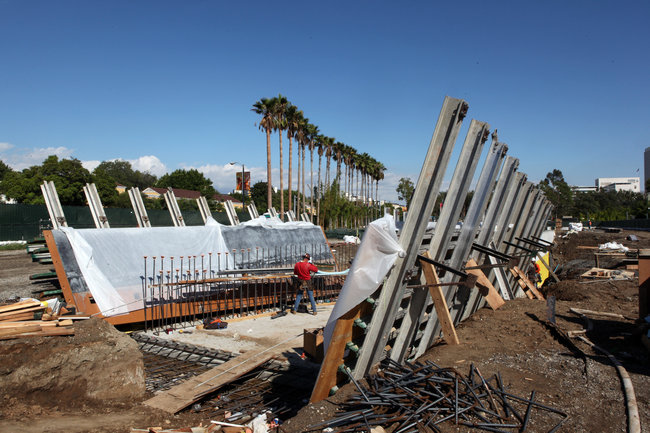
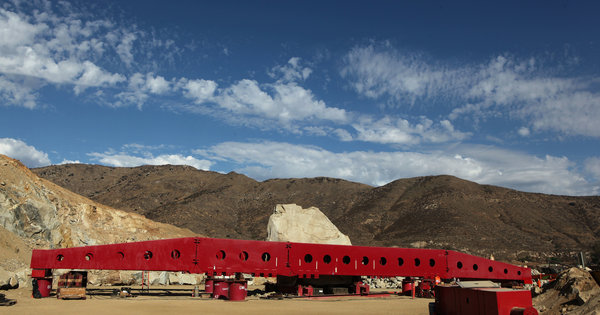
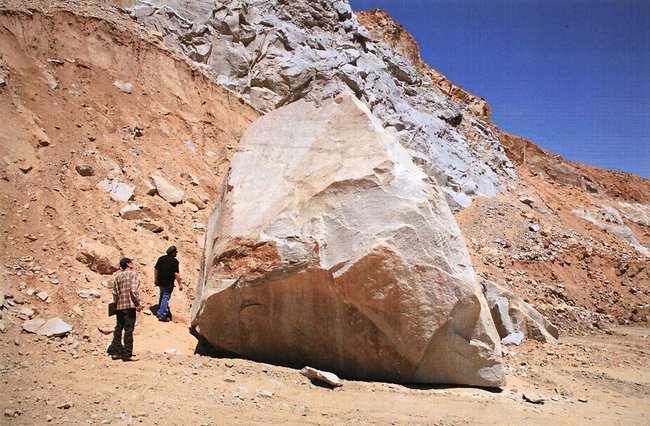
A very large boulder is on its way to Los Angeles, we read in the New York Times this morning: a 340-ton rock on a journey moving “through the heart of one of the most congested urban centers in the country: nine nights at six miles an hour, through 120 miles of roads, highways, bridges, overpasses, overhead wires, alarmingly low-hanging traffic lights and sharp turns.”

The rock is going there for an installation by artist Michael Heizer, called “Levitated Mass,” and it was “dynamited out of a hillside” 60 miles from Los Angeles.

[Image: The rock in question; photo by Monica Almeida, courtesy of the The New York Times].

“The effort, nearly five years in the planning (though Mr. Heizer has been making sketches of it as far back as the late 1960s), feels nothing short of a military movement: an incursion through a bewildering thicket of state, city and county regulations and a region with a notoriously difficult street grid,” Adam Nagourney writes in the New York Times.

In fact, the rock’s specific route never relied on one path through that “bewildering thicket,” but has been constantly updated and changed; as Michael Govan, director of the Los Angeles County Museum of Art, where Heizer’s rock will be displayed, points out, “the State of California is always reviewing the state of its bridges and roads. So a route plan that would have worked a couple of days ago doesn’t work today.”

This has the effect of doubling the distance covered: “Door to door,” Nagourney writes, “the distance is 60 miles, though the actual drive is going to be closer to 120 miles, as engineers plot a route that can accommodate the huge size of what is known as the Prime Mover, and one that steers clear of low bridges and wires. Any route must have stopover spots to park the rock as it waits for night.”

[Image: Photo by Monica Almeida, courtesy of the The New York Times].

The museum’s $10 million boulder-displacement project has, of course, faced some public criticism—but Govan has a response for that: “we are putting more people to work here in L.A. than Obama,” he quips. This includes “teams of workers… deployed to lift telephone and power lines, swing traffic lights to the side and lay down steel plates on suspect patches of roads or bridges.”

Read more at the New York Times.

Elsewhere, meanwhile, thieves have dismantled and stolen an entire steel bridge near Pittsburgh. “Pennsylvania State Police are looking for a steel bridge worth an estimated $100,000 that was dismantled and taken from a rural area in Lawrence County,” we read. “Police said they believe a torch was used to cut apart the bridge, which measured 50 feet by 20 feet, near Covert’s Crossing in North Beaver Township.”

If you see the bridge—or its parts—moving slowly down a remote Appalachian road somewhere, I’m sure the police would appreciate a heads up.

(Bridge story via @wired).

Tar Creek Supergrid

For his thesis project at the University of Toronto, Clint Langevin, in collaboration with Amy Norris, proposed “repurposing abandoned mines as renewable energy infrastructure in the U.S.”

[Image: Inside the Picher, Oklahoma, supergrid, by Clint Langevin and Amy Norris].

The specific site for their project is the Tar Creek Lead and Zinc Mine in Picher, Oklahoma, which long-term BLDGBLOG readers might remember as the town at risk from cave-ins. As the Washington Post reported in 2007, “Trucks traveling along the highway are diverted around Picher for fear that the hollowed-out mines under the town would cause the streets to collapse under the weight of big rigs.” The unlucky town was then gutted by a tornado in 2008.

Langevin’s and Norris’s work highlights the area’s surreal, almost Cappadocian landscape: “Dozens of waste rock piles, some up to 13-storeys high,” they write, “and contaminated ground and surface water are the legacy of mining operations in the area, which produced a significant portion of the lead used in the World Wars.”

[Images: Photos of waste rock piles in Picher; (top) Jason Stair, (bottom) Moonlight Cocktail Photography. Photos via the architects].

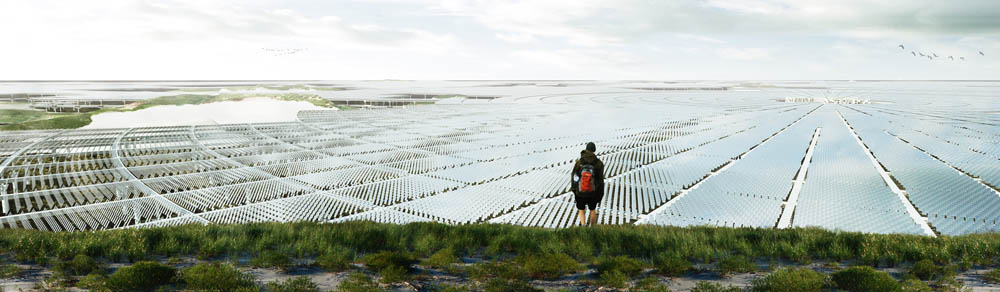
The architects specifically propose “a structure that raises the solar energy infrastructure off the ground [and] creates the opportunity to host other activities on the site, as well as to remediate the polluted ground and waterways. The concrete structure, pre-fabricated using waste rock material from the site, is assembled in a modular fashion from a kit of parts that accommodates a variety of programs.”

[Image: The “kit of parts”].

“Importantly,” the architects add, “the hollow structure also acts as a conduit to carry water, energy, waste—all the infrastructure for human habitation—to all inhabited areas of the site.”

The result is a three-tiered plan: the topmost layer is devoted to solar energy development and production: testing the latest solar technology and producing a surplus of energy for the site and its surroundings. This layer is also the starting point for water management on the site. Rainwater is collected as needed and transported through the structure to one of several treatment plants around the radial plan. The middle layer is the place of dwelling and exploration of the site. As the need for space grows, beams are added to create this inhabited layer: the beams act as a pedestrian and cycling circulation system, but also the infrastructure for dwelling and automated transit. Finally, the ground layer becomes a laboratory for bioremediation of the ground and water systems. Passive treatment of both the waste water from the site and of the acid mine drainage is coupled with a connected system of boardwalks to allow inhabitants and visitors to experience both the industrial inheritance of the site and the renewed hope for its future.

It’s a bit of a Swiss Army knife—in the sense that it tries to solve everything and have a solution for every possible challenge—with the effect that the architects seem to under-emphasize the titanic supergrid that clearly defines the overall proposal. It’s as if the proposal is so large—more landform building than architectural undertaking—that even the architects lose sight of it, focusing instead on individual systems in their description.

[Images: A wanderer above the sea of white cubes gazes at the Picher supergrid].
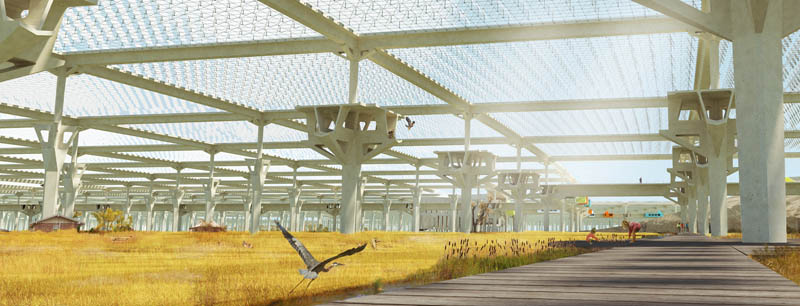
But inside this continuous and monumental space frame, whole communities could live—the “infrastructure for dwelling” and “pedestrian and cycling circulation system”—surrounded by a toxic geography for which the grid itself serves as both sublime filter and possible remedy.

[Images: More views inside the supergrid; second image is simply a detail from the first (view larger)].

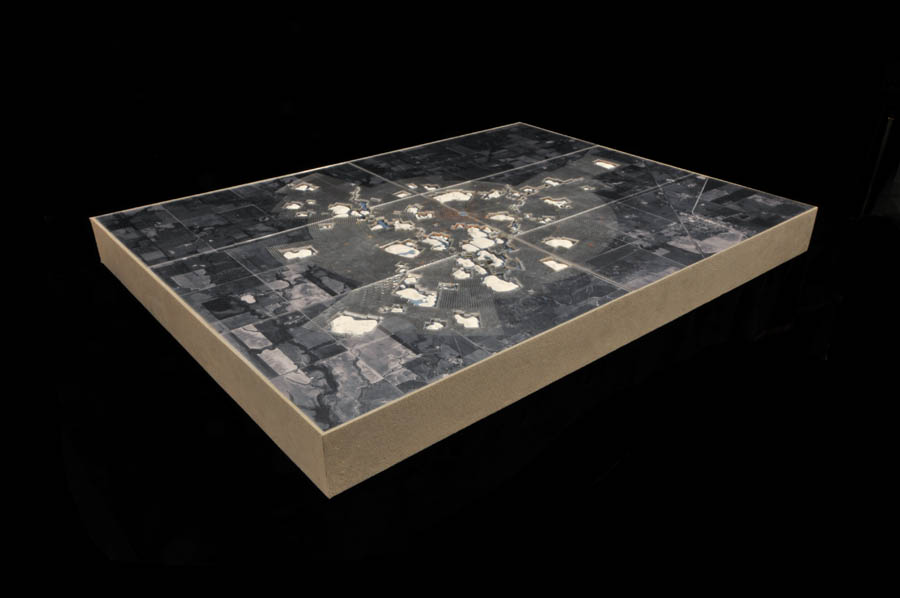
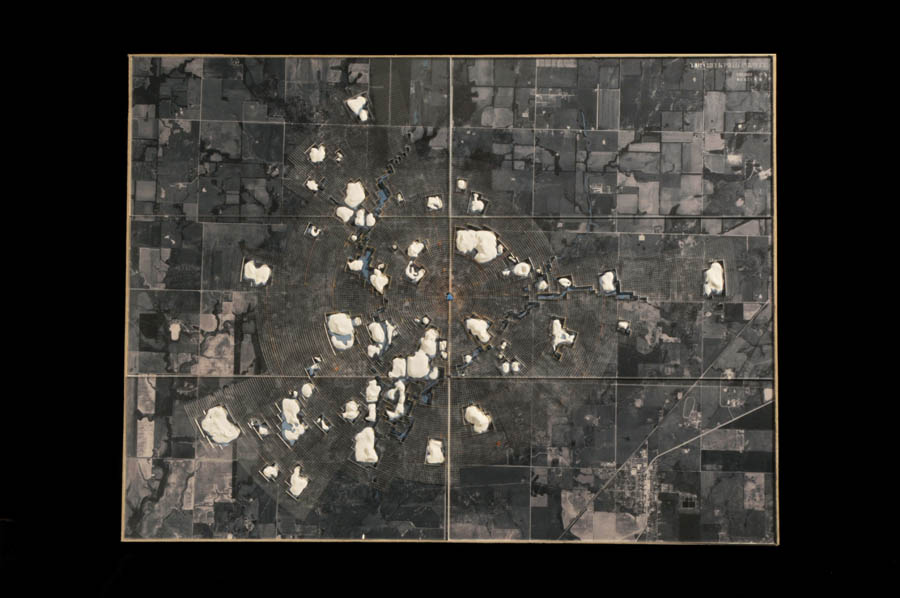
The model for the project is pretty great, and I would love to see it in person: a cavernous grid envelopes the site’s artificial topography, wrapping tailings piles and hills of waste rock, whilst treading lightly on ground too thin to hold the weight of architecture.

[Images: The model, by Clint Langevin and Amy Norris].

You can see more—including aerial maps and structural details, such as the placement of solar panels—at Langevin’s and Norris’s site.

Sea Caverns of Singapore

[Image: Singapore expands beneath the Pacific Ocean; via the BBC].
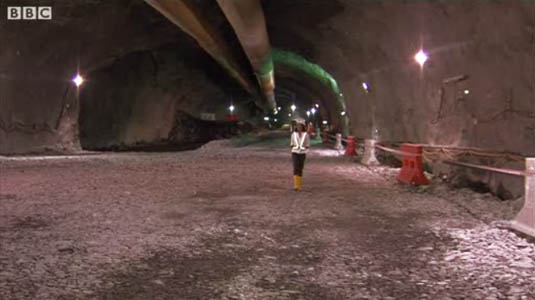
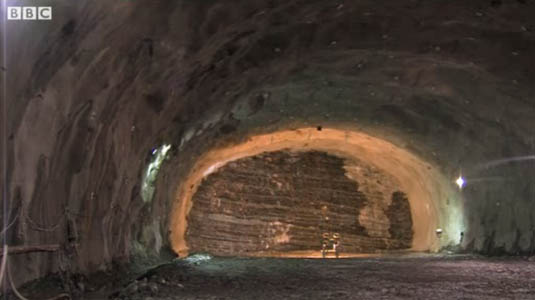
Singapore has embarked upon the excavation of an underground oil reserve, expanding the city’s industrial port beneath the floor of the Pacific Ocean. It is “no ordinary construction site,” the BBC tells us, but an elaborate project of engineering and infrastructure currently underway “several hundred feet underground, below the seabed in Singapore.”

There, workers are “laboring around the clock to carve out an enormous network of caverns that will eventually store vast amounts of oil.”

[Images: Singapore expands beneath the Pacific Ocean; via the BBC].
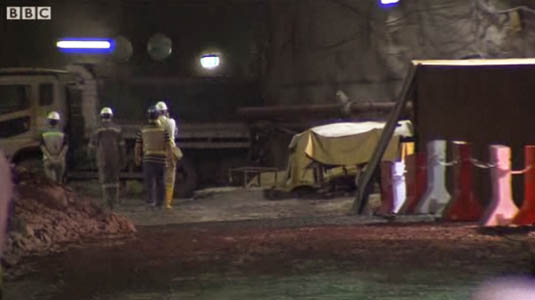
More specifically, “Five oil storage caverns are being dug out under the seabed of Banyan Basin, off Jurong island, a series of mostly-reclaimed islands that house most of Singapore’s petrochemical industry.”

Artificial caverns built offshore from manmade islands?

The terrestrial mechanics of Singapore’s existence are increasingly interesting, if ecologically problematic. As Pruned‘s recent look at the city’s sand-importation economy shows, the island-nation exists through a near-ceaseless act of geological accumulation, piecing itself together and expanding from the inside out using deposits of earth taken from neighboring countries.

Singapore, Pruned writes, “has been reclaiming land from the sea since the mid-1960s, expanding its total land area by nearly 25% as a result. And it’s still growing. With no hinterlands to supply it with natural resources, however, it has to import sand, the primary landfill material. But exactly where, the Singaporean government does not disclose. Its supply lines are not public information.”

Earlier this year, we looked at the idea of forensic geology, whereby even a single piece of sand can be tracked back to its terrestrial origins. As that link explains, the source of electronics-grade silicon is often deliberately occluded from public documents, treated as an industrial trade secret. Here, though, it is not microchips but internationally recognized political territory that is being mined, traded, and assembled—a black economy without audit or receipts.

Singapore’s off-the-books experiment in sovereign expansion—not through military conquest but through intelligent geotextiles, Herculean dredging projects, and, of course, new undersea caverns—is perhaps a kind of limit-case in how nation-states not only utilize natural resources but literally build themselves from the ground up (and down) as political acts of landscape architecture.

(Earlier on BLDGBLOG: Artificial Caverns Expanding Beneath Chicago).

A Spatial History of Trapdoors

[Image: Poster for “The Queen of Chinatown” by Joseph Jarrow, courtesy of the Library of Congress].
Someone should write a short history of the trapdoor as a spatial plot device in Broadway plays, literary fiction, Hollywood thrillers, dreams, CIA plots, and more. How does the trapdoor—as an unexpected space of strategic perforation and architectural connection—serve to move a plot forward and to give spatial form to characterization?

The “Queen of Chinatown” poster seen above, for instance, with its sprung floor collapsing beneath the weight of a hapless sailor, seems to promise an entire urban district—“Chinatown” as an Orientalist fantasy of inscrutable passageways and other devious spatial practices—illicitly Swiss-cheesed with unexpected wormholes. Chutes, pits, wells, and shafts are perhaps distributed throughout the neighborhood, we’re led to imagine, giving the erstwhile “Queen” her strategic mastery of the area. Chinatown becomes a hive of “mysterious Chinese tunnels,” a porous space guarded not through high fortress walls or even by watchmen or CCTV, but through a camouflaged network of surprise openings, like architectural sinkholes, that no one can predict and of which only one person knows the true extent.

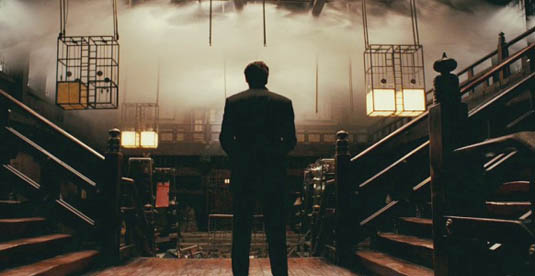
That poster suggests an alternative version of Christopher Nolan’s recent heist film, Inception: there are opium addicts slumbering in a warren of stacked bunkbeds in an off-the-books Chinatown dream academy, and there is a man—an anonymous investigative agent of the state—crashing through the floor into this world of broadly Asiatic decor. A multi-layered hive of architectural space seen sliced through in section, where trapdoors lead to further trapdoors. Inception as an 1890s heist caper, serialized on the popular stage.

[Image: A still from Inception, courtesy of Warner Brothers].

In any case, a spatial history of trapdoors—in film, literature, myth, dreams, and theater—would make an amazing pamphlet or book, perhaps part of a larger series of pamphlets looking at other minor architectural typologies—like log flumes and National Park trail structures and hay mazes.

[Image: “Then let it be the kiss of death!” Courtesy of the Library of Congress].

The two posters reproduced here, both available through the Library of Congress, are at least one place to start.