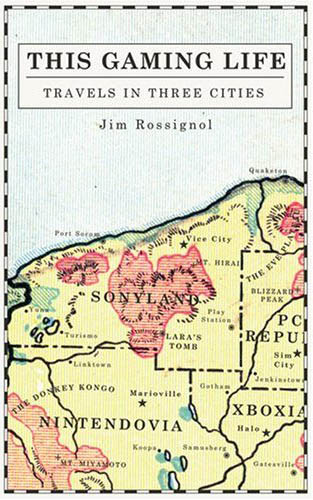
 [Image: Jim Rossignol’s This Gaming Life: Travels in Three Cities].
Jim Rossignol is a games critic, blogger, and the author of This Gaming Life: Travels in Three Cities, published by the University of Michigan Press. Rossignol’s book is “a wonderfully literate look at gaming cultures,” according to The New Yorker‘s John Seabrook; Chris Baker of Wired magazine says that “we need more writers like Jim Rossignol,” writers who can intelligently explore “the deeper significance of games.”
My own familiarity with Rossignol’s work came through blogging: we first crossed paths online a few years ago; I read his book; we managed to meet up at the Barbican last winter; and we soon decided to have a much longer conversation about our mutual interests and books.
The following interview is an edited transcript of that discussion, focusing on Rossignol’s book, but also covering my own interests in gaming and architecture, Rossignol’s travels to Seoul and Reykjavik for games research, the plug-in avant-gardism of Archigram and others, the psychological effect of historic preservation in the UK, and the rewards of speculative thinking in the design of both physical and virtual worlds.
I’ve often wondered, for instance, how the process of playing a game might compare to the experience of using a building, and if these must necessarily be different ways of engaging with another person’s created space. Further, if the same software packages and other digital effects can be used to design a building and a new videogame, might this imply that there are deeper structural similarities between games and architecture—or is this merely a sharing of aesthetics and tools?
Such a conversation could go in any number of directions, of course; this interview merely helps kick things off.
Rossignol and I spoke by phone.
BLDGBLOG: First, what was the origin of your book?
Jim Rossignol: This Gaming Life came out of an essay I wrote about the Korean gaming scene, which is fairly unusual for gaming cultures around the world. There was a series of circumstances in Korea that led to something quite strange in the way Koreans approach gaming—via massive social gaming through internet cafes, but particularly their E-Sports, which focus on professional players playing games like Starcraft. I went out and looked at that for PC GAMER magazine—which, at the time, was doing very progressive games journalism. So I wrote a piece on that and it was very popular, and people became interested in the cultural angle of gaming. The University of Michigan, which does a collection of technology writing each year, put that into their 2007 anthology. Afterwards, UMICH came back to me and asked if there was any similar material that I had written, and we eventually decided it would be a good idea to sit down and put together a longer work—and that’s what became This Gaming Life.
I actually found it very difficult initially to come up with a cogent theme for the book! It developed quite a lot along the way, particularly in its focus on three cities. The structure of the book is broken up between London, Seoul, and Reykjavik, the London part being the most autobiographical. It’s me explaining my particular angle on gaming; moving into Seoul to talk about gaming cultures worldwide, particularly the differences between the west and Korea. Then the third section is Reykjavik, which I suppose is more personal once again, because it’s expressing some ideas and angles on a particular game—EVE Online, which was developed in Reykjavik by a company called CCP. I think there are some very interesting lessons and ideas in that game model. EVE, being a massively multi-player game, is never a static, fixed thing, as games have been in the past, and I think it points to the way games are going to work more as social systems, involving both the gamers and the developers. It creates a sort of symbiotic process where the developers are developing for and reacting to the way that gamers are using and doing the game. That stuff fascinates me.
 [Image: A scene from EVE Online, taken from Robin Burkinshaw‘s massive EVE Online Flickr set].
BLDGBLOG: Your section about Seoul almost seems to imply that there’s less of a cultural difference between the gaming cultures of London and Seoul, and more of a recreational drug difference. What I mean is that everybody goes out drinking in London—it’s a social culture built very much around alcohol—but, when you go out in Korea, it sounds more like an all-night caffeine binge. That creates a very different urban and social reality.
Rossignol: I may be wrong in my impression of Seoul, of course! But wandering round the city myself, I didn’t tend to stumble across many bars—whereas it’s impossible not to stumble across a bar in any British town. There’s a lot of social eating, as well, in Seoul. It’s hard to really gauge how dominant gaming is there, and how much this is a factor of caffeine consumption; but, on the surface, the gaming is very obvious. It’s well-promoted and it takes place in public.
I was thinking the other night, though, about what prohibition would do to England. The disabling aspect of alcohol certainly changes motor tasks—but gaming does appear in bar culture here. There’s darts and pool, and so on. And there are slot machines, which are sort of prototypical video games. Gaming itself is so ubiquitous in British culture that you perhaps don’t even notice all the aspects of it and where they appear.
BLDGBLOG: In that sense, you suggest, gaming pops up everywhere. There’s a lot of stigmatism around the idea that you might sit at home alone playing a computer game—or blogging—or that you might go out to an internet café and play a game with your friends, as if there’s something socially wrong with you; but if you go down to the pub for a game of pool, that’s the height of sociability. That’s the right kind of gaming. So only specific types of games are stigmatized, and only specific types of play have been rewarded.
Rossignol: I wonder whether there will be a massive generational shift over the next 40 years, so that electronic gaming will just be everywhere. People will be so familiar with it. Kids who are growing up now are so used to the idea of a digital interface that they will expect to find one everywhere. When I was in Vegas a few years ago, I sat at a bar and there was a little betting machine panel in the bar top—a touch-screen betting system. But I was thinking: I would have happily sat at that bar longer if it had been a touch-screen Tetris.
BLDGBLOG: I can easily see games being embedded in different social environments—even instead of hold music, when you call the bank, you get a short text game.
Rossignol: Or a sound-based game. There are apparently a number of games which are based just on sound response, for blind people—sound-structure games. There’s no reason you couldn’t play a pure audio game while you’re just holding on the phone, by responding to sound cues.
BLDGBLOG: Something else you mention in the book, and that has been getting more and more attention in popular media, is the idea that games aren’t just a frivolous way to waste time; they’re almost a form of job training. You can learn to be a better brain surgeon and so on. Do you think games are a kind of pedagogical device like that, or even an emerging neurological frontier?
Rossignol: The U.S. military did, I think, say gamers were ideal helicopter pilots, due to the spatial awareness and coordination required. But games have other roles: like that Tactical Iraqi thing—that was actually a role-playing game: you go into a village, and you have a bunch of text trees, and you explore how you should approach the situation, and how you should talk to the locals. I thought that was interesting because the immediate thought is always the helicopter fighter-pilot angle—the classic “games make you have better reactions” angle—but games as social teaching devices I think is quite interesting. Perhaps crucial, from a military angle.
One of the things about games journalism, though, is that it’s dominated by business, and by products and product marketing, so a lot of the writing is preview/review cycle stuff. The other end of the scale is very academic material that tends to be theory-based. But there’s not a lot of practical study of the fundamentals of gaming, which I find very interesting.
It’s also one of those areas where I almost don’t want to make too much comment, because I feel like all I really want to say is, “For God’s sake, scientists! Spend some time with the subject and really use your methodology to see how people react to games. Do that kind of deep research that’s been done on so many other subjects.” It increasingly comes up. Just the other week there was an article called “Your Brain on Games,” where researchers had used an MRI scanner to look at someone’s brain while they were gaming, and talked about the effects and so on—but that still seems like a trivial treatment of the subject.
I think the University of Rochester in NY is doing some research on this, and I hope they continue to. One of the things they’re looking at is, as you were saying, the effect on the brain long-term. Which is a completely new frontier for neuroscience research. What they have shown is that visual processing is increased—so that gamers are much better at figuring out what’s happening in a particularly busy visual field—and it’s a very quick change, as well. People only have to play games for a few hours to see a distinct difference. What I think is interesting about that is that we don’t yet have any real handle on what’s going to happen to an entire generation of people who have spent years and years increasing their visual processing. Will we have this sort of super-visual human whose abilities to pick things out and understand things on a visual basis are going to be massively accelerated beyond what we’ve had in the past? I can’t even really see what sort of ramifications that would have—other than that we might be short-sighted as well, from being sat looking at the screen for so long. [laughs]
I read in a recent story about texting—I think it was in New Scientist—that texting actually improves your general literacy. That was the headline. I think the actual content of the article was that people who were more literate were better at texting, and better at reducing words down to a shorter form. There are graphical forms finding their way into text—obviously, the smileys and emoticons—and people have started doing other ones, like an o with a slash—a little man waving hello—and stuff like that. That kind of pictorial thing—this truncation that you’re getting from text-speak—is rapid visual processing.
BLDGBLOG: That reminds me of something else about your book—it has no images. However, I think that actually helps to demonstrate what your book is talking about—which is that you can have a literate, intelligent, and articulate approach to gaming, and it doesn’t require pyrotechnic visuals for people to be interested.
Rossignol: Yeah, we quickly dismissed the idea of using pictures at all. I wanted to make it pure text, which I’m quite pleased with. Even if we’d had color plates, I think that would have distracted from the themes I was talking about. I think a lot of the material isn’t easily illustratable—you can’t really illustrate interactions or game development, or indeed a lot of the cultural or theoretical stuff I was going to talk about. Having a picture of Mario would have been redundant.
Something I wanted to ask you about was how being speculative seems to be rewarded in architecture writing—which is almost the opposite condition that we have with games. Critics and writers are heavily dissuaded from being speculative when talking about games, and I think this is because there’s a tendency for gamers to be backseat designers. There’s a strong tendency for people to dismiss journalists who write speculatively about games or who talk about games’ futures or the possibilities of game design the way that you do with architecture. I wonder if that’s different with architecture because there are so few backseat architects, so to speak.
 [Image: From Pixel City by Shamus Young].
BLDGBLOG: That’s interesting. I’d say that one of the ways that blogging is doing this—leading to more speculation in today’s architecture writing—is that blogging has tapped into a massive class of unprofessional writers who, nonetheless, have strong opinions about the built environment. After all, they’re surrounded by it at all times. It’s not just Harvard graduates now who have the microphone, so to speak; even some kid in the suburbs—playing videogames—can offer an opinion about architecture, and it almost definitely will not involve references to Mies van der Rohe. It will be about shopping malls, or the suburbs themselves, or the ruined cities you see in movies like Terminator Salvation. It will be about the architecture of videogame worlds.
In any case, I think as people start to realize that they can have an opinion about architecture, in the same way that they can have an opinion about the food they order in a restaurant, or an opinion about a book they’ve just read, then they will also realize that they can ask questions about the buildings they see all around them. You know: why am I surrounded by buildings that look like this? Or: why on earth is there a road in the middle of that children’s park downtown? Or why can’t the world look like this—or this, or this? Very soon, you start speculating about how the world could really be.
But I’d also say that one of the reasons this is the case—why I can speculate freely about a Rem Koolhaas building, or about the future of London in an era of rising sea levels—is that there’s almost no risk that someone is going to take my ideas and realize them in built form. No one’s going to build an alternative version of London, with 80-foot seawalls, because they read about it on BLDGBLOG! But if I outline an amazing idea for a new videogame, then there’s every chance in the world that someone might take that idea and run with it.
I think I even saw something like this on Warren Ellis’s blog, where he says that, if you email him, don’t mention any new ideas for future stories or comics—because, at least in my interpretation of that, if he then puts that idea into a comic strip five years later, he’s probably going to be sued. It’s unlikely, on the other hand, that Zaha Hadid will read on my blog about some great new room she should design someday—and then actually go and add that exact thing to a new museum of hers in Potsdam.
In other words, there’s quite a large barrier to entry to becoming an architect. The idea that I would actually build the next Olympic Stadium is absurd, whereas—and I don’t mean to make it sound easier than it is—I think I could presumably become a games designer much faster than I could design the next Los Angeles airport. You’re less of a competitor as an architecture critic than you would be as a video game critic.
Rossignol: At the last game developers conference in San Francisco, one of my colleagues said to me that perhaps what was most interesting were all the ideas that were walking around inside the heads of the developers—the ideas that they wouldn’t talk about, or stuff they kept secret because it was too good and too commercially important for their companies. It did make me wonder whether the fact that games are so commercial stunts their futurology—after all, if game developers were given free rein to be pure creatives, I think there would be a massive exchange of ideas. This kind of accelerated avalanche of development could come out of there being no limits on sharing ideas. It makes it very difficult for game designers to get the ideas they need to make games better—because they’re going to be protected, or hidden, or otherwise held back by commercial concern.
BLDGBLOG: In a way, though, this brings us back to EVE Online—to the idea that there is a feedback loop between the players and developers. You do seem to be able to influence the future structure of a game, and it’s precisely through playing it in a certain way or demonstrating a certain behavior. That sort of thing doesn’t happen very often in architecture—it’s way too expensive to redesign buildings every two years based on how people have actually been using the space.
Or—actually, here’s a random example. When I lived in London seven or eight years ago, I worked at Norman Foster’s office in Battersea. I’m not an architect; I was just an admin person. One day, though, my task was to go through this huge cupboard full of old VHS tapes, many of which were unlabeled. I actually had to put them into the VCR, watch them for a few minutes, take notes, and figure out what they were—then label them and stick them back in the cupboard, in an organized way, based on chronology.
At one point, I found a bunch of tapes that were nothing but surveillance footage taken inside Wembley Stadium. It was unlabeled, black and white footage of people milling about outside the bathrooms, near the ticket gate, and so on—and my initial thought was actually that some sort of crime must have taken place. There had been a stabbing, or a riot—and, I thought, maybe even someone here at Foster & Partners had been involved. That’s why we had the tapes. Then again, that’s how it always is with surveillance tapes: you’re always waiting for something to happen on them. All CCTV footage of road traffic, for instance, looks like CCTV footage taken right before an accident.
In any case, nothing happened: there was no crime. What those tapes were actually used for was a kind of spatial research project: the office had pulled a bunch of surveillance tapes from the stadium so that they could watch how people actually used the space: where they congregated, what needed to be better designed, how things really, on a social level, worked. They could then figure out how to design the next Wembley Stadium.
My point is that that was an example of user-research coming to influence the spatial future of a building project—but it’s very rare, I think. Most people just design buildings based on whether or not it fits into their own stylistic development, regardless of whether anyone else will like what results. They just put up a new building—and you have to adapt to it, not the other way around.
Having said all that, I’m wondering if you could talk about how, in the specific case of EVE Online, the players’ interaction with the game affects how that game might be developed in the future.
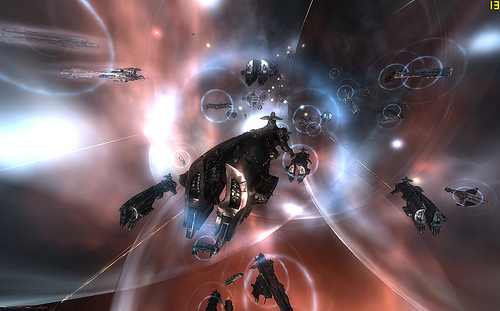

 [Images: Scenes from EVE Online, taken from Robin Burkinshaw‘s EVE Online Flickr set].
Rossignol: The thing about EVE, which is distinct from other online games, is that it’s a single galaxy—a single space. Most games aren’t like that. Even massively multiplayer games, like World of Warcraft, are broken up into “shards”—so that, if you’re playing Warcraft, you’ll be on a shard with maybe two or three thousand other people. In EVE, everyone is in the same galaxy together. It’s never been switched off or restarted, although there’s a brief downtime everyday, so there’s been this continuous etching-in of detail since the game was first launched.
To create the actual structure of the galaxy, they used some crystal-forming algorithms—the maths that explain how crystals grow—and then a bunch of random generation to architect the solar systems (which creates some weird anomalies in places). It’s the system that they’ve laid down on top of that, and the detail that’s gone in subsequently, that often reflects how the players started using the world itself.
The two best examples of this occurred quite early on. One was this phenomenon called “can mining.” It may even have been in the beta version, but certainly in the early weeks of the game, when players realized that the asteroid belts could be mined for resources, and that that was the best way of making money. That’s no longer true, but it was true when it started. The logistical problem of getting minerals back to the space station hadn’t really been considered. There was no model for it, although there were these industrial hauler ships that could take large amounts.
What players realized early on is that they could eject a cargo container from their ship, a container which had vastly more cargo space than a mining ship, and they developed this process where they would mine into their own cargo hold and then move the minerals over to a canister; the industrial ships would hurry back and forth over to the can to take minerals back to the space station, where they could then be used to build stuff. I don’t think that CCP initially thought that their economic system would definitely work from the ground up like that, or that they would have people wanting to put together the most basic resources in the game; but once players discovered this cargo canister loophole, mining became very important to them. Subsequently there’s a huge section of the game, and the updates that followed, just based around mining. That perhaps goes counter to the designers’ expectations, because designers come in looking at gamers wanting to shoot things, wanting to blow things up, wanting to do combat and exciting stuff like that.
Another, bigger, example is the alliance system. Quite early on in the game, CCP introduced the alliance management systems. They expected players to band together in alliances to fight each other, but they didn’t quite know how it was going to work. They wanted players to be able to capture space, and very early on, pretty much from day one, players banded together in these sort of feudal tribes to do that. Initially it was done purely by the players saying, “Right, anyone in this corporation or in this small group of corporations which are all friendly with each other can use this space. Anyone else that comes in, we’ll just blow them up.” CCP waited to see what tools players would need to make this work before they implemented them.
But this created a kind of “piled up” evolution of game structures. The Something Awful GoonSwarm war against Band of Brothers—those are the two main alliances within the game as it is now—demonstrated how CCP had laid down layer after layer of game functionality in a sort of house of cards manner. They pulled down one part of that and the system collapsed drastically. Vital defensive systems were based on the alliance tools—not in any logical way, just in a kind of design legacy way—so when a Goon Swarm defector shut down the Band Of Brothers alliance, many of their entrenched defensive systems shut down, too. It handed the keys to the fortress over to the enemy—and it was a loophole created by the evolving design of this single galaxy.
That kind of ongoing development is pretty much unique to EVE. It’s come about because CCP’s philosophy is essentially that the game needs to be purely about human interaction. There is non-player interaction in the game, and there are non-player ships that populate various areas—and you can go blow them up, and you can do missions against them and so on. But the crucial step for CCP has been the idea that what fuels the game is interactions by players with each other, and that interaction is either through combat or through trade.
The economics of it are really interesting. I’ve had people say, “I can just stay in my space station and trade, or just play on the stock market, and not really interact with any other players”—but, of course, when it’s a purely player-based in economy, when players are mining to get the minerals that produce the materials that are sold in the market, any economic interaction is still interaction with other people. That in itself is unique within EVE. There are elements of it within lots of other games—Second Life, for example—but I think EVE’s game-like structure is what makes it so interesting.
Although it might not always be to its advantage: I’ve recently written an article about whether this dependence on interaction could actually be the downfall of EVE, because there is always the danger that the game will run into an evolutionary dead end—that the way the players behave within the systems that these people have created simply won’t continue functioning. A lot of people are speculating now, after this recent Band of Brothers/GoonSwarm conflict, that the big game—the alliance game—will be over, because everyone will be essentially allied with each other, and there won’t be enough war to make it worth playing. This would bring the whole game grinding to a halt, because once there isn’t any war and there aren’t any losses, then there’s no reason for a massive economy to turn out spaceships to get destroyed.
BLDGBLOG: It’s funny, though: listening to that as an outsider, or as a non-player, it sounds a lot like the end of the Cold War, when people like Francis Fukuyama were predicting that we were now at the “end of history.” If there was no more USSR vs. the USA—if there was no more good vs. evil—then everything would come to a halt and we could all go shopping. That would be the end of history. But, as we’ve seen, all it takes is these much smaller minor conflicts, and maybe one or two ambitious groups, like an Al-Qaeda—or, for that matter, an internal economic collapse—to step on stage and kick-start the engines of history again. If part of EVE is watching for these emergent, unexpected, angular behaviors, then there’s no telling what might happen next.
Rossignol: Absolutely.
BLDGBLOG: To go back to can mining briefly: your description made me wonder whether you might ever be playing a game that requires a certain behavior to win, but that behavior has absolutely no interest for you. It’s boring. But what if that game is Chinese, say, and the winning behavior for that game is something highly valued in Chinese culture—even though it leaves you basically wondering when the shooting begins. It’s incomprehensible that someone would actually want to do this. So it’s a kind of anthropological exchange through the embedded goals of gaming.
Rossignol: There is an element of that. Korean MMOs are seen as what’s called “grind-heavy,” in that they tend just to be about killing 50 floating eyeballs—and then you go off and kill 200 more, and then you move on to bats, or evil horses or something. It’s deeply repetitious, and there’s very little story. Some Korean MMOs—I think RF Online and ArchLord are probably the best examples—have stumped Western audiences, who have said, “Why are they so grind-heavy? Why are they so repetitious?”
I think there’s just a different philosophy for Korean developers. They want to create those games because they know that the players will spend time doing that. The high-end castle sieges and stuff have been invested in very heavily, long-term, by Korean players—it comes out of what Lineage did: huge castle sieges where you’d get hundreds of people, all fighting. I wonder whether that’s born out of their different gaming culture, where all 40 people who were fighting online in the castle siege would probably have been together in the same internet café. Whereas, in the West, it’s a much more solitary, single-player experience—like what you find in World of Warcraft, where it’s much more about the solo player’s experience.
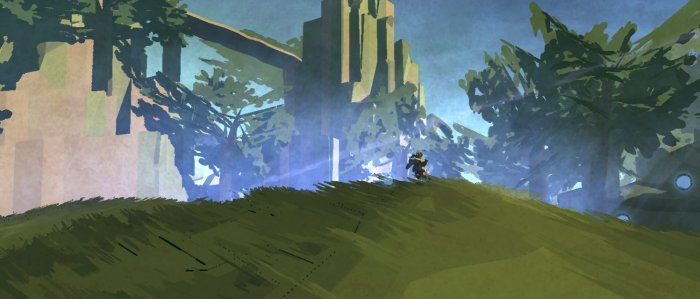 [Image: A scene from Love by Eskil Steenberg].
BLDGBLOG: So if the sorts of user-generated structures you were describing are unique, at least for now, to EVE Online, do you think it’s something other people might start incorporating into their own games?
Rossignol: It’s a tough one. I think one of the main problems—and one of the reasons I’ve written so much about EVE—is that a lot of game designers who are making these games haven’t played EVE and they don’t understand the systems. It’s that traffic of ideas thing again: I think most people just don’t get it. They don’t understand why it works. It’s much easier to copy, say, World of Warcraft, which has quite a prescribed level structure—sort of “go and kill X number of monsters for X reward in money or experience points to continue to the next level up.” Game designers understand that a lot better.
EVE has been such an esoteric project anyway. The EVE computer cluster is one of the world’s supercomputers, and they’ve had to build this up over time to cope with the sheer number of people who are logging into a single world. The single galaxy model is such a big deal for them. I don’t think anything other than Second Life does the same thing. Any big commercial launch that tried to do the same thing would need to aim higher for more people to try to make more money, and, right now, that’s just not happening. I think where it’s most likely to come from is, in fact, going to be someone independent, starting very small like CCP did, and then slowly building it up over time.
There’s one developer operating at the moment who just programs things on his own—this guy called Eskil Steenberg. He’s sort of a graphical programming savant who used to be a tools programmer, and he’s now building his own tools to make his own world. He takes some similar ideas from EVE—it’s not quite the same, but his concept is basically city-building. It has a similar ethos, in that he wants players to build a lot of the content. They’ll be creating the architecture, creating the game world by being able to interact physically with the terrain. So he’s going to procedurally generate the landscapes, and then the players will have to build cities into them and then go out on quests to find stuff in the world, and bring that back to furnish the cities that they’ve built. It has a similar reliance on player productivity to make the game function.
I think that realizing that players want to work and want to invest in these things, and that they will put a lot of effort in over time, is probably the lesson that EVE has given to other game designers.
Have you seen LittleBigPlanet on the Playstation 3? The idea behind that is essentially that players can build their own levels. There are very simple tools—it allows you to cut-and-paste a world, and to import assets such as photos and so on. They’re relying on player creativity there to create game content.
 [Image: Plug-In City by Archigram; meanwhile, check out The BLDGBLOG Book for an interesting, and previously unpublished, interview with Archigram’s Sir Peter Cook].
BLDGBLOG: One of the things I was doing while reading your book was trying to read the word “building” wherever you wrote “game.” In other words, every time you referred to user-generated content for a game, I was trying to imagine: could you do the same thing for a building? Could a building also have a built-in quest or goal? Could you have player-generated rooms and levels?
What’s interesting, though, is that once you start asking those questions you’ve basically just rediscovered the avant-gardes of the 1960s and 70s—where you had people like Archigram proposing plug-in architecture. You know, you’d show up in London with your own room and you would just plug it into an existing anchorage point on a building core near the Thames—it’d be a kind of user-generated utopia of temporary levels and rooms. That was the Archigramian vision of the city: I could bring my building, level, or room anywhere in the world and just plug it in to everyone else’s before eventually moving on. But what if I wanted to add a floor to the Empire State Building?
Anyway, what would user-generated content be in architecture? The most immediate thing that comes to mind is when you do things like geo-tagging, or immersive gaming, like cellphone gaming, where you chase someone through the Louvre based on cellphone signals—things like that. It seems, though, that user-generated content for architecture only exists through the digital world: you can have a temporary Google Maps mash-up that allows you to see who else is in Trafalgar Square with you—but that’s about as deep as it gets. Compare that, for instance, to showing up in London with your own Trafalgar Square. What might be called a gamer’s approach to architecture still has unrealized structural possibilities that might even allow that sort of thing to happen.
Rossignol: I think that’s born of the extent that architecture is often about preservation in urban environments. Isn’t that sort of the great frustration of architecture—that you can only ever put down small layers and make small changes? There can’t be a blank canvas—unless you’re building in the middle of the desert, on billions of dollars of oil money.
BLDGBLOG: That’s definitely part of the imaginative allure of cities like Dubai, Shanghai, and Beijing, even after the bust. There was, and perhaps still is, a real jealousy amongst architects, in the sense that China gets to do this but “we” don’t. You know, why is all this happening in Dubai and not Berlin?
Rossignol: That’s always been an interesting aspect to living in the UK, particularly where I live—Bath—which has an incredibly strict architectural theme. It’s all sandstone. Even modern buildings—they’re building a huge new shopping complex in the center of town—are built with sandstone in the Georgian style. Preservation lends a weird sort of museum air to a lot of the UK. Even where I live, outside of Bath, there are no new buildings—it’s all stone cottages and so on. But it can be quite complex: I love the fact that Bath is like that, and it’s very beautiful—but I’m also such a neophile. I like to see new buildings. I find the obsession towards heritage, and sustaining this mummified England, quite terrifying.
I can’t think whether it was an essay or a short story by the writer Will Self, but Self wrote about England as controlled by the National Trust. The National Trust is our core heritage organization that looks after stately homes and parks and so on. Self reimagines the UK as this fascist state where brown-shirted Heritage Police—the National Trust uniform is a brown shirt—are controlling the UK and not allowing any kind of change. I think that’s a splendid satirical image, and very telling about what it’s like to live here.
It’s also one reason why I love modern videogames: they are really heavy on architectural fantasies. They’re probably the best place to feel out a lot of that stuff. Sim City is obviously an amazing example of that.
BLDGBLOG: Yeah—there’s a funny gap between what people actually enjoy and what they feel is theoretically appropriate for their output as a designer. I’m referring to architects when I say that. I think that many students today, in order to be rigorous to the legacy of Le Corbusier, or to be rigorous to algorithmic design philosophies as laid down through a rereading of Gilles Deleuze in the mid-1990s, feel like they have to produce a certain kind of design—but then they go home and play a videogame, or watch a movie, or even read a fantasy novel or whatever, and they see these vast tree-cities, or old castles on cliffs, or Japanese pagodas the size of whole planets, or derelict mining spaceships, and they actually like that kind of architecture. But it’s exactly what they do not design in the studio. Of course, part of that is the fact that the physical realization of those sorts of ideas very quickly crosses over into kitsch, into the realm of the theme park: that’s Euro Disney or Busch Gardens. Or, for that matter, it’s Dubai.
But I do wonder about this. At the same time that it’d be ridiculous if San Francisco was rebuilt as a mock European village, I also wonder why I think that. Is there not a way to adapt fantasy architectures to the real-world without taking on the air of a kind of Walt Disney postmodernism?
There seems to be a very real sense that you have to design certain things, in a certain style, in order to demonstrate your seriousness as an architect—to the point that it might actually be that you’re out of touch with what you, yourself, desire and what you would actually want to build. I often wonder: do architects really enjoy these sprawling, biomorphic, 21st-century algorithmic buildings that look like huge webs of kudzu—or would they rather, just for kicks, design Dracula’s castle? It’s a question that doesn’t seem to be asked very often in architecture school.
 [Image: A geological rethinking of Dracula’s castle, by a designer named Audit; from a recent Environment of the Week thread on ConceptArt.org].
Rossignol: I’d love to see figures for trained architects going into the videogame industry. I wonder how many of them actually are building castles and cities and so on.
BLDGBLOG: I’d love to see that number, too.
However, I’d like to reverse what I just said. Instead of asking: “Why aren’t architecture students designing the real world to look like a videogame?” It might be interesting if videogames started to use what are precisely not fantasy environments. For instance, at what point might architects stop putting out $100 coffee-table books that are only bought by libraries, and instead commission someone to design a game environment that features all of their buildings? It’d be a new kind of monograph. You buy the new Grand Theft Auto—but all the buildings are designed by Richard Rogers. It seems like you’ve got incredibly imaginative and very passionate people playing those games, so why not present your buildings to that audience? It seems like a missed opportunity.
Rossignol: I don’t know if you’ve seen Mirror’s Edge? That’s the one game recently that really made me think: wow, that’s a studio that’s paying attention and trying to use a specific architectural theme. The game is this perfect, controlled utopia, with whole cities full of pure white concrete skyscrapers. You also have these beautiful monochrome interiors, where everything is green or everything is orange. It’s a unique visual theme.
I’m hoping that kind of experimentation might push designers to create something that is more wholesale environment design, rather than lifting stuff either from the real world—or just trying to do Aliens again.
 [Image: The architecture of Mirror’s Edge by Digital Illusions Creative Entertainment (DICE), from an article by Charlotte West published last month in Varoom. “What distances Mirror’s Edge from the murky visuals often associated with gaming is its sharper, more intricate imagery,” West suggests].
Thanks again to Jim Rossignol for taking part in the conversation!
For more, check out Rossignol’s This Gaming Life: Travels in Three Cities; his ongoing reviews at Rock, Paper, Shotgun are also always worth a look.
Thanks, as well, to Nicola Twilley for transcribing this interview.
 [Image: The epicenter: 3300 W. 112th Street].
 [Image: The
 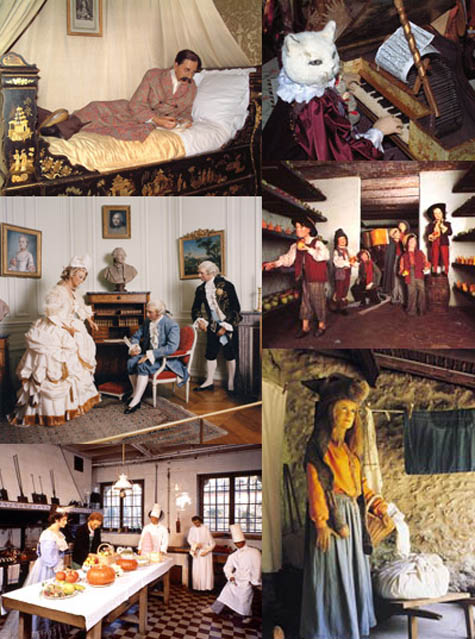 [Image: The wax stand-ins of
 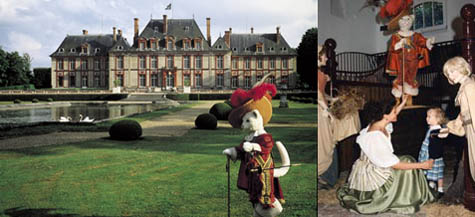 [Image: Puss in Boots stands before the
  [Image: A
  [Image: The semi-suburban origins of a seismic event].
 [Image: The Berlin
  [Image: Hitler’s office in the
  [Image: From
 [Images: (top)
  [Image: From
  [Image: From
  [Image: Channeling Ayn Rand, Andrew Ryan’s city banner announces “No Gods or Kings. Only Man.” From
  [Image: From
  [Image:
  [Image: The “
 1)
1)  2)
2)  6)
6)  9)
9)  12)
12)  [Image: A stunning and very nearly unbelievable glimpse of
  [Image: Youth storm a building; photo by