Bride of Climate Change

[Image: The earth is coming to get you… A dust storm in Iraq, via Pruned].

“Someday the U.S. military could drive a trailer to a spot just beyond insurgent fighting and, within minutes,” we read, “reconfigure part of the atmosphere, blocking an enemy’s ability to receive satellite signals, even as U.S. troops are able to see into the area with radar.”

They’ll roll up, in other words – and throw storms at you.

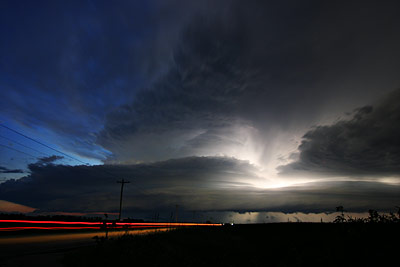
[Images: The Grand Island Supercell, photographed by Mike Hollingshead].

But imagine what an architect, or landscape architect, might do with such a thing: some atmosphere-reconfiguration technology disguised inside pillars, towers and arcades. An 18th c. English garden maze, lined with lichen-covered statuary, and each standing figure is an atmosphere-machine, generating clouds or clearing them. A cure for British weather.

You can turn them all on, in the right order, fast enough, and form tornadoes. The murderer of birds, whirled to their doom. And if it’s too close to Heathrow, your garden becomes a national security threat.

Harry Potter and the Garden of Storms.

[Images: An almost theologically intense supercell, photographed by Mike Hollingshead].

A new tower is built in midtown Manhattan, attracting storms, its upper floors constantly awash in sleeves of cloud cover. Ghostbusters III. Transmitters hidden inside marshland graveyards far east of London: Dracula Returns.

Or none of the above, just a military unit on a border somewhere, staring through binoculars, preparing to hurl hurricanes, the grand wizardy of war: Bride of Climate Change. A weaponized earth.

Unrecognized for what they are

A few months ago, BLDGBLOG explored suggestions by physicist Paul Davies that alien life may exist on Earth – though it would be unrecognizable to microbiologists, and thus ignored or wrongly identified.


Paul Davies now reviews a book by Peter Ward in New Scientist – and Davies writes some extraordinary things.
The planets in our solar system, for instance, “are not completely quarantined from each other. Debris splattered into space by comet and asteroid impacts gets distributed around the solar system. Mars and Earth in particular have been trading rocks throughout their history, and it is clear that microbes could hitch a ride and be transported in relative safety from one planet to the other.” Which could make for an award-winning Pixar film… Finding E. Coli.
“Martian organisms might not be alien at all,” Davies concludes, “but merely members of another branch on the terrestrial tree of life.”


Even better is “the intriguing idea” – mentioned above – “that alien organisms may lurk all around us, unrecognised for what they are because they fail to respond to standard biochemical analysis” – or they’re very bad at conversation. “For example, there could be microbes that use RNA instead of DNA, or employ a different genetic code.”
There is even a chance “that some viruses could be relics of ancient alternative forms of life.” Which blows me away! In other words, an infection is really an encounter with ancient life.
Living fossils inside injuries.
But my enthusiasm here is ultimately more inspired by the possibilities for landscape design, say, using gardens as a form of astrobiological research. It’s not a garden, it’s a laboratory; it’s not your backyard, it’s a kind of skin graft from an alien planet, a celestial infection of the earth. Patches from elsewhere. J.G. Ballard’s “nightmare world of competing organic forms” – an “insane Eden,” indeed.
One could even imagine a series of classified landscapes, grown by infrared in a cave beneath Los Alamos National Laboratory, incomprehensible genetic lines cultivated into a kind of aterrestrial Versailles. Fountains of amino acids washing slowly over alien flowers.
Weird topiary mazes made of symmetrical creeper vines from space.


(For more of this, see BLDGBLOG’s Alien Rain on India).

Borderville


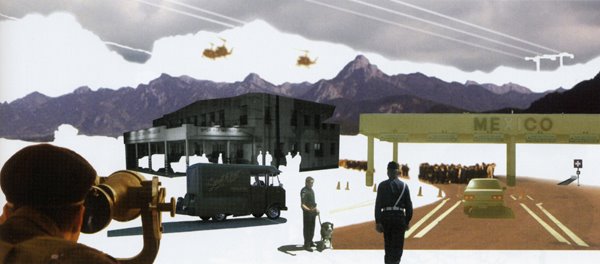
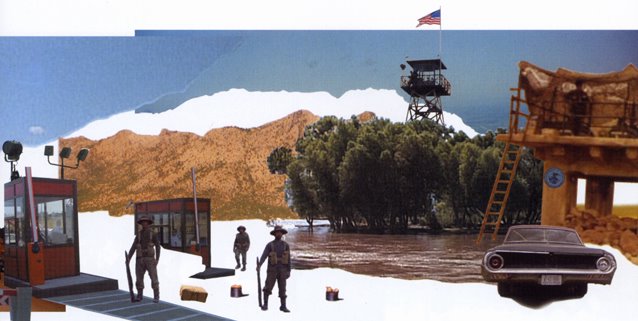
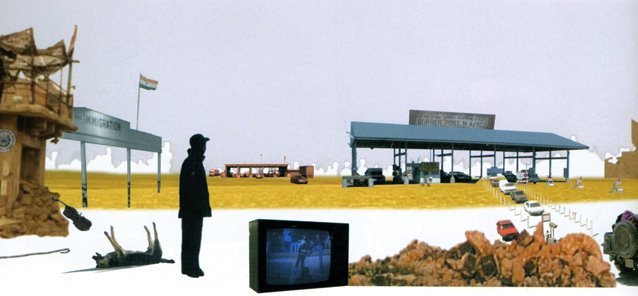
[Images: Borderville by Invertebrate; scanned from Issue #18 of Cabinet Magazine. These were “assembled out of objects ripped from (…) movies featuring border crossings,” including Salvador, The Great Escape, Three Kings, Traffic, The Day of the Jackal, Not Without My Daughter, Bad Boys II, The Wild Bunch, From Dusk Till Dawn – etc. In other words, these are absolute borderlands, in-between spaces, a “backlash landscape” of political division. (Invertebrate: be in touch!)].

(Simultaneously posted on subtopia).

Gondolas of New York

New York City’s Mayor Michael Bloomberg recently announced an interest in building a network of gondolas across New York City.

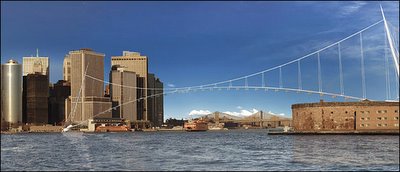
[Image: Santiago Calatrava].

Well… not quite a “network” – “across New York City” – but one route, “linking Brooklyn to Manhattan by way of Governors Island on a tramway.”
Governors Island, incidentally, is a small island in the New York harbor: “The city and state of New York bought the island in 2002 from the U.S. government for $1. Until 2000, it had been the longest continuously used U.S. military facility, dating back more than 200 years.” $1!

[Image: Governors Island, upper left; Manhattan, upper right. The rest is Brooklyn. The gondola would go zipping back and forth].

In any case, the gondola, “estimated to cost $125 million, would be designed by the architect Santiago Calatrava, and would greatly change the face of Upper New York Bay. But there is a catch,” we read: Bloomberg “acknowledged that the system was still only an idea. He said, however, that he hoped it would eventually become reality and in the meantime inspire others to come up with big ideas for the development of Governors Island.”
Like a Shakespearean theatre?
Well, here’s an idea:
More routes. More gondolas. Gondolas you can rent as a live/work space. Private gondola routes, from high-rise to high-rise, with windows of bulletproof glass. Night-club gondolas. Church confessional gondolas. Flying prison cells, an Alcatraz of the sky, reforming criminals through scenic views.

Different architects and engineering firms should design the gondolas – Foster and Partners, Zaha Hadid, Michael Sorkin, Halcrow, even BLDGBLOG – and they shouldn’t stop there: gondolas linking to gondolas, which in turn link to more gondolas. Gondolas switching through Ferris wheels. Gondolas connecting to the space elevator – which leads upward to gondolas in space… then back to Greenwich Village. Return trip: two hours.
The city could recoup its investment by selling film permits to Hollywood. Die Hard 4.
Gondola greenhouses that follow the sun in a heliocentric circuit round Manhattan, growing mutant flowers.
An airborne hospital for the depressed.
Rumors break out that there is a hidden gondola somewhere, itself unreachable by gondola – Kabbalists and Aristotelians argue that, in fact, this is impossible, citing Maimonides. Entire websites go up, dedicated to finding it.
Folk maps are produced, printed in the back of Time Out, charting the fastest route, the most interesting route, the longest route, the scenic route. A listserv begins, describing gondola hacks: how to make your gondola do a 360º.
You can win the Olympics with it.

[Image: Santiago Calatrava].

Alternatively, forget the gondolas: Governors Island, in its 172-acre entirety, should be uprooted, dismantled, geologically ground-down to soil and dust – then hung from a series of sacks and hammocks off the side of the Empire State Building. Hanging gardens, indeed.

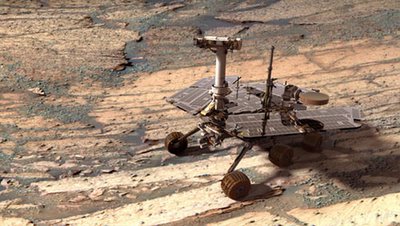
Mars Rover: A New Film by BLDGBLOG


While editing a recent post about the Mars rover, I got to thinking – as you would – about how to make an animated, feature-length children’s film, starring another such rover, set in the immediate future…


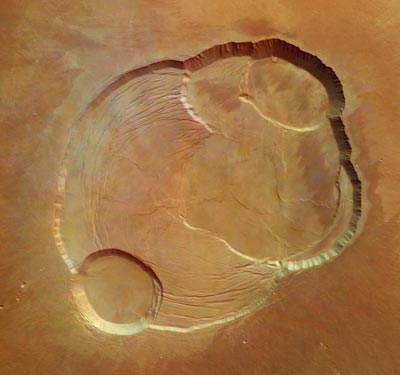
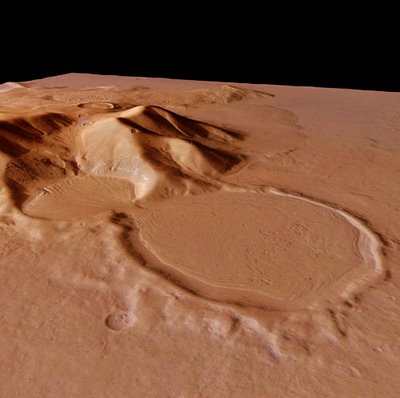
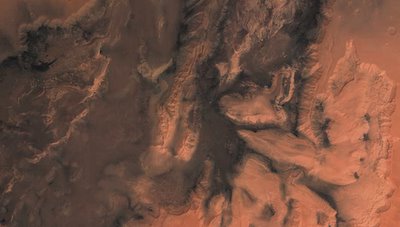
In the film, the rover would go tootling around in its cute little animated way, wheeling across unbelievable landscapes, snapping Ansel Adams-like photographs of alien tectonics, volcanoes and basins, systems of canyons that redefine the sublime.


Hills, arches, gorges; mountains surrounded by clouds of methane. Erosion; windstorms; evidence of ancient floods.
Plus, it’s a cute little rover. Kids love the thing. They pressure their parents to name family pets after it. Burger King sells a small plastic version of it with their happy meals, or whatever they make there. T-shirts. Pajamas.


In any case, our erstwhile hero, the little rover, is Artificially Intelligent – and he’s funny. Maybe his voice is by Paul Giamatti. And he gradually sort of wakes up, comes to consciousness, and falls head over heels – monitor over wheels – in love with the world, in love with landscapes, with everything – with emotion and memory – with hope and fear – and he starts to wax poetic over a radio-link back to mission control, his friends and creators, they’re cheering, to television viewers sitting on sofas at home, going on about how wonderful everything is.
How beautiful that world, in which he travels alone, can really be. It’s not lonely, see. He’s on fire inside. His own little robot mind is as deep as the canyons he explores.


Kids in the cinema aren’t blinking at this point; it’s too amazing. Everyone’s in love with this little rover. Everyone’s alive. Cynics are vomiting into popcorn boxes.
But then the Martian seasons change, and the rover has to shut down – to be shut down, by mission control. The kids in the cinema start to worry. Frowns appear. Dads grow nervous, re-crossing their legs, only vaguely reassured that the film is rated PG.
You see people on-screen, back at mission control, wringing their hands, preparing to remotely shut off the rover – but the rover loves life, damn it, he loves what he’s seeing, he wants to see more! He wants to live – and he’s funny – and he’s got a friend back at mission control who has to push the button, but she can’t because she loves him – what do you mean shut him down?! – she loves his silly robot eyes, and his enthusiasm, and his stupid voice, and these amazing things he’s been showing to everyone back on earth, and she can’t do it.
She can’t kill the little guy.


Some kids are crying now; she’s crying. Not the little guy! With his tiny wheels pushing further into life and alien landscapes.
Not him!
Enter some sinister, technocratic boss figure – with a voice by Robert Duvall – and he forces her: the button is pushed, mission control sends the command, and our friendly, naive robot hero of off-planet landscape exploration, in the midst of a sad why are you doing this to me? weepy monologue, his AI-eyes wide and worried and scared of that darkness into which his circuits will go – overlooking the most beautiful canyon he’s discovered so far – suddenly he is no more.


The rover’s eye-lights fade. Martian winds erase his tracks. Grown men wipe away tears before their wives can see them.
The credits roll.
Kids leave the cinema howling. Moms give out hugs left and right. Oscar nominations roll in. I retire to Arizona on the proceeds and begin carving strange topological forms into the desert floor.
Movie producers: you know where to find me.

Planetarium Among the Dunes


[Image: The Milky Way reflected in the dish of a derelict telescope, left unused and eroding in Chile’s high Atacama Desert. Perhaps this is what night will look like in 10,000 years, after bird flu and nuclear terrorism, war and water shortages, have reduced humans to a few breeding pairs in the Arctic: a landscape of ruined pavilions once dedicated to space – Ballard’s “deserted planetarium among the dunes” – beautifully lit by nothing but stars].

Mars and its stunt double


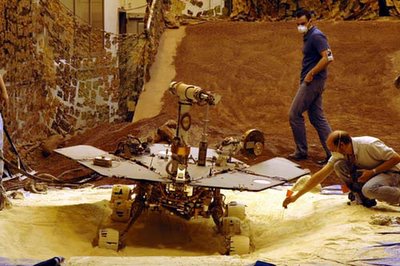
[Images: A “faux Mars” being air-brushed and constructed in a lab in southern California “to simulate the environment” on the red planet. Contrast that with a photo taken by Spirit, the robotic Ansel Adams of Mars, showing “Larry’s Lookout, a pit stop along the robot’s uphill trail as it explores the red planet.”

Dessert Landscapes


A friend of mine emailed, reminding me of an earlier post – then someone left a comment comparing BLDGBLOG to creme brulée. (I hope that’s a good thing).


So I decided to revisit the world of dessert landscapes.


Yes, dessert landscapes.


These are all culinary creations by Akiko Ida and Pierre Javelle, whose own website is both handicapped by excess Flash and chock full o’ chocolate goodness.


The pair have used kiwis, pastries, mushrooms, watermelons – and, of course, more desserts. But to sidestep the Flash agony, check out this blog for more images – or just look through BLDGBLOG’s own earlier review.


(Thanks, Megg! Foodscapes originally spotted back in October through things magazine).

Terrain vague


Brooklyn-based painter Angelina Gualdoni was in the midst of some photographic studies of what she calls “‘terrain vague’ areas around Chicagoland,” when she became interested in “a mall that had been abandoned for the better part of twenty years.” She started to produce a few paintings of it. Each painting required “several days of pouring and staining,” after which she “employed taping to establish crisp architectural lines,” using “thicker, more viscous oil paint to build up figures, whether it’s weeds, dirt, or trash.”


Of course, it turns out this is the infamous Dixie Square Mall of Blues Brothers fame, “in which police cars were driven through the stores and walkways.” Now, after two decades of slow structural collapse, “multiple rapes and at least one murder have occurred there.”
“The place itself is strange, scary, sad, and amazing all at once,” Gualdoni writes. “Inside the mall there’s moss growing over much of the cement and laminate ground, trees (sometimes) growing inside the atrium, gangs that claim it with tags (though I’ve never encountered anyone else in there) and some wild dogs who call it home (I have been chased out by them). The place is entirely water-logged and creaky, damp and fetid. And used as a dumping ground, as well, for trash and toys, from both individuals and institutions.”
As Gualdoni is careful to point out: “it is illegal to enter, and is trespassing. Aside from the police, the dogs, and possible vagrants, there are also just genuinely concerned people at the day care center nearby who will drive through looking for you, if they see you enter the mall, concerned that you may be suicidal or crazy.” Or perhaps undead.
Of course, Gualdoni has other, equally eye-catching architectural work –


– on view at Chicago’s Kavi Gupta Gallery, and it’s certainly worth taking a look. And if Urban Exploration is your thing, don’t miss BLDGBLOG’s own tour through the self-intersecting topological knotwork of tunnels and abandoned bunkers coiling underneath Greater London.

(Thanks to the DC madman, Lonnie Bruner, for putting Angelina and I in touch).