Tatlin’s Tower

In 1919, Russian artist Vladimir Tatlin proposed a 400m-high Monument to the 3rd International.


Once constructed, it would have stood nearly 100m taller than the Eiffel Tower, giving physical expression to the social and artistic dynamism of the Russian Revolution. Intended as a kind of archi-sculptural testament to the strength of the world’s workers, the Tower was ultimately never built.
Or was it?
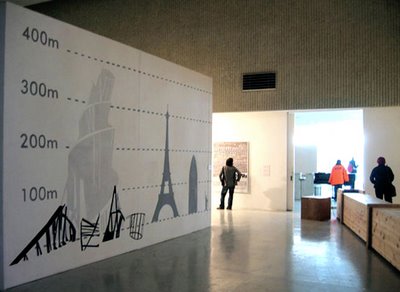

[Image: Sara De Bondt].

Recently, a British group called Henry VIII’s Wives has made artistic waves with their proposal to build the Tower in its entirety – although in pieces, distributed throughout the world. Thus the Tower will exist, albeit in an unassembled, ironically incomplete form. An art gallery in Sydney, a wine cellar in Rome, a cupboard in outer Rajasthan – there you will find small, unique and official pieces of Tatlin’s Tower.
Advertisements for this future “unrealized Tower” even began appearing on the walls of the London Underground.
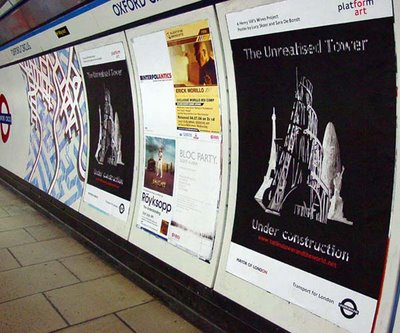

[Image: Sara De Bondt/Lucy Skaer].

Then, tonight, 19 March 2006, at an event in the Bern Kunsthalle, Switzerland, the group formally presented their plan – alongside Tatlin-inspired presentations by unbuilt-monument specialist Takehiko Nagakura, novelist Zoë Strachan and others. BLDGBLOG was also invited to submit a short text, which I’ve reproduced below. (Thanks to Bob Grieve for commissioning it!)
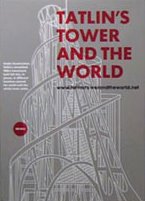

The unbuilt status of Vladimir Tatlin’s Monument to the 3rd International – or Tatlin’s Tower – is both befuddling and possibly contentious. In other words, are we sure that Tatlin’s Tower has not actually been built? Can this state of unconstruction be proven?
Perhaps Tatlin’s Tower exists after all – but we’ve been looking in all the wrong places.
There is, in fact, no logical reason to assume that Tatlin’s Tower, once built, would even be architectural. Indeed, there is no logical reason to assume that Tatlin’s Tower, in its full realization, its exact structural form, is something that can even be seen.
But if Tatlin’s Tower does exist – and, as you’ll hear, it probably does – we may find that it’s been built not just once or even twice; we may find that the Tower exists in a constant state of construction, a never-ending condition of being-built. Tatlin’s Tower is constructed – and destructed – from scratch, everyday, every instant – and the Tower will go on being built, ritualistically, every moment for eternity.
If that’s really the case, however, where are we supposed to find it? It is hard, after all, to misplace a 400m high Communist Tower; if it now stands, where exactly is it standing?
For starters, perhaps stand is the wrong word. It is important to realize that the Tower is a vertical grid of spatial relationships, a physical rhythm of structure in space. Once we establish that, we see that the proportion of gap to girder forms a mathematical ratio that can be applied anywhere – at the very least, it can be perceived anywhere.
It is then that the Tower’s helical super-symmetry becomes evident on every scale, in every location.
The Tower already exists.
As but one example, in the time spent between visiting a pub once, then visiting it again – and then again, two weeks later – there is the structure of Tatlin’s Tower, measured precisely, to the second, in the chasm between drinks. You have lived the rhythm of the structure, its buttresses and cantilevered gantries. One day, two days, one hour: the ratios and rhythms match exactly to the Tower’s form.
The Tower, in other words, does not have to be architectural.
I even discovered while writing this text that the space between myself and the computer screen, if you include the short distance to the floor, forms an oblong triangle; and it dawned on me: this is a section of Tatlin’s Tower, right here, surrounding me, inscribed into the space I inhabit. Tatlin’s entire 400m-high Babel can be reverse-derived from the data.
In this context it is quite extraordinary to reveal that Dr. Simon X, a musicologist from Leeds University, has found indisputable evidence that Tatlin’s Tower was translated into a series of Indian ragas. Whilst vacationing in Tamil Nadu in 1974 – and suffering from a stomach bug due to questionable local hygiene – Dr. X found that the nightly concerts he and his wife had been attending were actually musicalized versions of the mathematics found inside Tatlin’s Tower. He didn’t know if the musicians had planned this.
X’s recordings have become something of a myth in the field of Tatlin’s Tower-spotting, but his musical logic remains impeccable, even obvious: you can very clearly hear the outline of Tatlin’s symmetrical structuring in the recurrence of certain south Indian octaves.
Indeed, X’s recent papers suggest, if one were to transcribe Tatlin’s Tower directly as a musical score, the folk songs of Tamil Nadu would be as accurate a result as any.
But it gets yet more interesting, when one considers contemporary cinematic choreography. Tatlin’s closest friend from university went on to marry a woman whose sister taught dance, first in Moscow, then in Paris, then in New York in exile. The school she started in New York to support herself during the war included, at one point, a young Beatriz X – who would later befriend world famous film editor Walter Murch.
It is rumored now that Murch – editor of such features as Apocalypse Now – would edit raw film stock into the proportions suggested by a poster of Tatlin’s Tower pinned up on his studio wall. Intriguingly, then, the movements of characters through the cinematic space of Apocalypse Now – or the more recent Iraq War film, Jarhead – actually carefully circumscribe the upward coiling vertical movement of Tatlin’s monumental iron tower.
This can be glimpsed most clearly in a scene from The Conversation, which Murch also edited, in which Gene Hackman, taller than the other actors he appears with, seems to mimic the precise angle of tilt at which Tatlin’s Tower was meant to repose.
And so forth.
The importance, here, is in the realization that if the Tower was designed to be of the people, a monument to international popular sovereignty, then it is also in the people, and amongst them, literally: it is medically present in the space between cells, resonating in cobwebs of bone marrow, as much as it is traced again and again within the four dimensions of urban space by the passage of workday pedestrians.
The sliver of empty asphalt between your car and the lorry overtaking you, multiplied by the time it takes to get anywhere, inevitably adds up to frame the gantries in Tatlin’s Tower.
The Tower is everywhere. It is something we enact, performed here in the present, indeed in the hesitations between every letter that I type. It is negatively present in the foundations of buildings, in natural crevasses carved by streams through the ice of Antarctic deserts. Even American astronaut Neil Armstrong, some have claimed, found evidence of Tatlin’s Tower impressed into the surface of the moon, an almost exact reproduction eroding there in faint stratigraphies of colorless rock.
The ultimate “Communist monument,” then, if there is such a thing, is the one that we’re living inside of, the proportional numerologies that frame and contain us. The brilliance of Tatlin’s Tower was that it was already built from the moment he first designed it – or perhaps I should say: transcribed it.
Tatlin knew this; now so do we.


[Note: Not every claim made in this text should be considered factual].
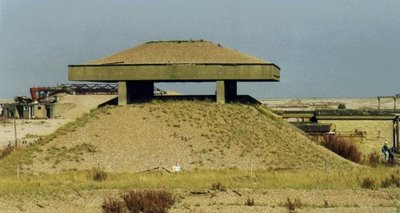
A geometry of bombs, inscribed into the planet


[Images: Landscape design through interventionist Aristotelianism (action-at-a-distance): Utah’s test bombing ranges. You need airborne explosives that inflict damage in the exact patterns of the royal gardens at Versailles. The Air Force Corps of Landscape Engineers. Launch missiles at the moon and Angkor Wat appears inscribed into the lunar surface. You bomb Kew Gardens – and it turns into Longwood Gardens. Bombing landscapes with new landscapes. (These photos via Pruned – via Polar Inertia. See also: Tree Bombs and Digging with Bombs)].

Boullée Balloon


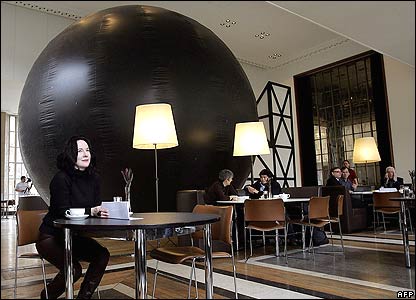
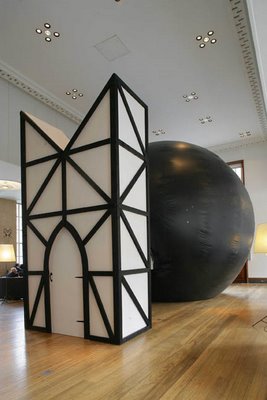
[Image: “The world’s first inflatable folly is displayed at the headquarters of the Royal Institute of British Architects in London, England.” Hint: it’s not the woman sitting front-left. BBC].

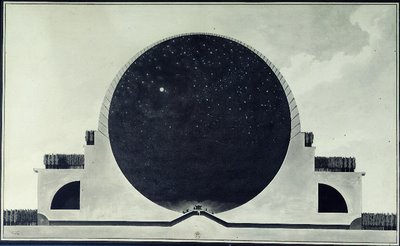
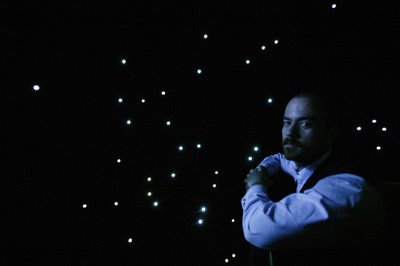
In 1784, utopian designer and speculative architect Etienne-Louis Boullée designed a Cenotaph for Newton, or tomb for Isaac Newton. It was ridiculously huge, its dome pierced by small holes to shine as new constellations, illuminating visitors from above with artificial stars.


[Image: Etienne-Louis Boullée; more here (including a cool triangular version)].

Not to be outwitted by their fanciful neighbors across the Channel, however, Britain now has “the world’s first inflatable folly,” on display at the Royal Institute of British Architects.


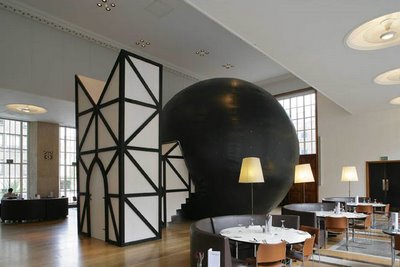
Modeled after Boullée’s Cenotaph and named for a song by Joy Division, In a Lonely Place gives us a “7 meter inflated black sphere punctured by a half-timbered structure. Inside, a stair leads up to a viewing platform, from where the surrounding void is broken by small pinpricks of light, made by transparent panels cut into the sphere.”


These, too, are constellations – of a different kind: they’re maps to the stars of Hollywood, terrestrial residences of artificial stars, a Californian pantheon to guide us through the night.


Designed by FAT, the folly is up till 2 May 2006, so check it out! And you can see photographs of the folly under construction here.
Meanwhile, one of the first things this made me think of for some reason is a tool that may not even exist, but what I want to call a surgical balloon: you open up someone’s body (in a surgical context), insert the balloon, expand it, and this lifts away the surrounding tissue so that a safe operation can take place. I have no idea if this really exists, but it sounds quite useful.
So what I’m thinking is: could architects design small buildings, in the form of surgical tools, that are temporarily erected inside people’s bodies? A hip replacement that looks remarkably like the Barcelona Pavilion, for instance – or a medical device that references Boullée. Small versions of Boullée’s cenotaph begin appearing everywhere, in surgical theaters, worldwide. Inflated inside people’s bodies. Hissing.
The Boullée Balloon. It might happen.

[All unlabeled images in this post come courtesy of Sam Jacob/FAT].

Return to Arbonia


The Arbonian Sea is back in the news – and it’s got Hollywood written all over it:
“Geologist Dereje Ayalew and his colleagues from Addis Ababa University were amazed – and frightened. They had only just stepped out of their helicopter onto the desert plains of central Ethiopia when the ground began to shake under their feet. The pilot shouted for the scientists to get back to the helicopter.” [extreme close-up; words inaudible]
“And then it happened: the Earth split open. Crevices began racing toward the researchers like a zipper opening up. After a few seconds, the ground stopped moving, and after they had recovered from their shock, Ayalew and his colleagues realized they had just witnessed history. For the first time ever, human beings were able to witness the first stages in the birth of an ocean.”
[title screen]


[Image: Anthony Philpotts].

However, ocean is a blatant exaggeration; it’s a sea, really – the Arbonian Sea. It will simply pry off the Horn of Africa, and form a kind of parallel Red Sea in the space left behind. It’s not destined to be a new Indian Ocean, or a new Atlantic. Even a Mediterranean, for that matter.


[Image: Dereje Ayalew/Addis Ababa University].

Yet every time geologists return to study the area, “new crevices are discovered. Fumes as hot as 400 degrees Celsius (752 degrees Fahrenheit) shoot up from some of them; the sound of bubbling magma and the smell of sulphur rise from others. The larger crevices are dozens of meters deep and several hundred meters long. Traces of recent volcanic eruptions are also visible.”
This is all screaming for a BLDGBLOG field-trip. (Funders be in touch!)


[Image: Asfawossen Asrat].

The whole region, called the Afar Triangle, is “sinking rapidly. Large areas are already more than 100 meters (328 feet) below sea level. For now, the highlands surrounding the Denakil Depression prevent the Red Sea from flooding these areas, but erosion and tectonic plate movement are continually reducing the height of this natural barrier.”
So if the next James Bond is worth its snuff it will feature a crazed geotechnic engineer bulldozing new flood paths through those highlands, ready to flood the valley… Where Britain has some kind of outpost… A space program… A germ warfare lab…
Or maybe it’s Bond doing the bulldozing…


[Image: Tim Wright/University of Oxford].

In any case, the Denakil – or Danakil – Depression sounds like paradise to me. Not only does it have the hottest average temperature on earth – it “tops 34°C every day of the year and soars to 55°C in the summer” – but it is chock full of “geological treats.” For instance, New Scientist tells us, a “splendid shield volcano more than 50 kilometres wide called Erte Ale occupies much of the depression. The volcano is one of the few in the world with an active lava lake. Nearby, volcanic smoke holes have created crystal pools, lava cones called hornitos and colourful structures formed from sulphur, halite and other minerals. Elsewhere the floor is littered with marine reefs, silt plains and ancient shorelines.”
Add all to that the nearby Arbonian Sea, and it seems a good time to be terrestrial, indeed.

(Thanks, Alex!)

Priest’s Grotto

[Image: Caver Chris Nicola looks at markings left in Priest’s Grotto; National Geographic Adventure/Peter Lane Taylor].

“In the spring of 1944,” we read, “a group of 38 Ukrainian Jews emerged weak and jaundiced from a cave they’d used for nearly a year to escape the horrors of the Holocaust.”
Caver Chris Nicola rediscovered this story 13 years ago, after exploring Ukraine’s Gypsum Giant cave systems. “While there, during an expedition into the tenth longest cave in the world, his team came across two partially intact stone walls and other signs of habitation.” Learning about the Jewish families who had used these caves for survival, “Nicola grew determined to learn how people with no prior caving experience or specialized equipment were able to live in such a hostile environment for so long.”
So Nicola returned with a photographer, Peter Lane Taylor, and he learned more of the story.
The Holocaust refugees’ “first stop was Verteba, a well-known tourist cave where the families spent their first six months. There, the Jews struggled to find enough water and suffered from the toxic buildup of smoke from their cooking fire. Then on May 5, 1943, after narrowly avoiding capture at the hands of the Gestapo, the families relocated to a previously unexplored cave located beneath land owned by a local parish priest. It was called Popowa Yama, or Priest’s Grotto, and it would be the Jews’ refuge from the Holocaust for the next 344 days.”
They lived without sun for more than a year.
“At the surface, Priest’s Grotto is little more than a weedy hole in the ground amid the endless wheat fields stretching across western Ukraine. A short distance away, a low stand of hardwoods withers in the heat and is the only sign of cover for miles around.” Here, “there’s nothing to indicate that one of the longest horizontal labyrinths in the world lies just underfoot.”
The story is almost unbelievable. For instance, “one of the survivors, only four years old at the time, said she remembers playing with a bright, shining crystal in the cave. One of the largest crystals in the world is close to their campsite inside Priest’s Grotto, and chunks of it will sometimes fall to the ground. When we saw the crystal, we realized that that was where she used to play.”
Or: “They had few candles, so light was limited to three short periods each day. After enough time spent wandering in the dark, they memorized the feel of the cave floor on their bare feet. It was like directions in braille.”
The inside of the earth, lined with language.

[Thanks to Neddal for the tip!]

Thousand Mile Colosseum

The Los Angeles freeway system is one of the most carefully filmed locations on the planet. The total number of cameras permanently dedicated to watching it can only be estimated; and the fate of those uneventful films is almost ritualistic: temporary storage, then erasure.
But occasionally there’s some action – and the true magic of the system begins.


LA’s unacknowledged cinema – its highway network – was the focus of a recent article, by Tad Friend, in The New Yorker. During the OJ chase of 1994, Friend writes, “from the cameras above, the customary vantage for tracking the city’s televised pursuits, you could see that this most sprawling and motorized of our great metropolitan areas is a huge web that is easily apprehended from the air – some forty police and TV helicopters keep busy doing just that – and that it is not the roadways but their surveillance that never ends.” (My emphasis). Or, as Mike Davis writes in City of Quartz: “thousands of residential rooftops have been painted with identifying street numbers, transforming the aerial view of the city into a huge police grid.”
In other words, whether operated by FOX, CNN, or the LAPD, traffic helicopters give Los Angeles an urban coherence that few drivers and pedestrians may ever understand – till they see it on TV.


Within those surveilled streets – what Friend calls LA’s “public stage, its Colosseum” – there have been as many as 5,596 car chases in one year (2004). Yet this should surprise no one: LA’s “ten million occupants are all ceaselessly trying to go very different places by very elaborate routes that gum up everyone else’s very elaborate routes. So the two people who stole a big rig filled with mixed melons last July and then led police on a four-hour meander around the 5, the 605, the 215, and the 15 freeways were, by local standards, behaving logically. And as for the trucker a few years back who fled deputies after a traffic collision, drove his eighteen-wheeler through the fence surrounding Long Beach Airport, overturned it on the main runway, set the cab on fire, and then ran away without any clothes on – well, fair enough, really.”
As a transportation technique, or genre of driving, the chase is an entirely sensible use of the LA highway system. In some ways that’s what it’s built for. “This is as much city planning,” Friend writes, “as it is producing – a vision of a metropolis knit together by speed and spectacle.”


[Image: David Maisel, from the Oblivion series].

What’s even more interesting is that the LAPD have begun to change their tactics of pursuit, including radio communication strategies, so as not to bring undue televisual attention upon the chases, the chasers, or the chased themselves – who often see these high-speed extravaganzas as a kind of initial public offering, or debut role, a break-out performance watched by captivated millions.
There is even a burgeoning visual style or cinematography associated with this tele-vehicular art form: “The frame of the pursuit – a cropped shot of an anonymous vehicle moving at ominous speed through a featureless landscape – has not been updated since the genre began.”


[Image: OJ Simpson’s infamous white Bronco; in a parallel universe, ruled by Philip K. Dick, this image would be used as the next American flag].

Meanwhile, whole subsidiary industries have arisen on the fringes of the car chase scene. Wired, for instance, writes about James Tatoian, who is “developing a system that uses microwave energy to interfere with microchips inside cars. Once the chip is overloaded with excessive current, the car ceases to function, and will gradually decelerate on its own.”
Then, in the slightly Orwellian field of “pursuit management” – a growth industry, I’m sure – StarChase LLC has developed a GPS dart system that consists of “a tracking projectile with a miniaturized GPS receiver, radio transmitter, power supply and a launcher which can be hand-held or mounted on a police car.” Shoot this thing at a fleeing car – and you can track it via satellite. (More here).
Yet another way to manage pursuits? As Tad Friend writes: “Within fifteen years or so, when all new cars will be equipped with OnStar-type security systems, the LAPD hopes to be able to override disobedient drivers using the quintessential weapon of the video age: a remote control.”
There’s even a “Pursuit Intervention Technique, or PIT,” which basically sets a fleeing car spinning – because a police car has just rammed into it.


[Image: A different kind of intervention technique].

In any case, what interests me here is not police pursuit technology in and of itself, but the fact that it has slowly become a regular feature of American urban life. Even more, the car chase, though illegal, irresponsible, and dangerous, is also one of the most logical responses to the American landscape: if you build “nine hundred miles of sinuous highway and twenty-one thousand miles of tangled surface streets” (Tad Friend) in one city alone, you’re going to find at least a few people who want to put it to use.
Add that to uncountable thousands of cameras installed there on lightposts, or carried by helicopters throughout the sky – the endless cinema of the everyday, an anthropologist’s dream – and anyone driving in LA right now is literally only moments away from celebrity. Go a little further, a little faster – and fifteen minutes after you read this post, I might be watching you on TV.
Be sure to wave.

[Note: Perhaps this is needless to say, but if you go whizzing off into la la land and drive your car through a house – it ain’t the fault of BLDGBLOG. Buckle up. And you can find more of this here].

Faucets of Manhattan

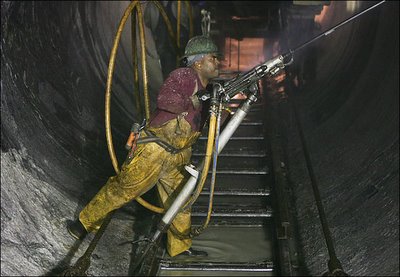
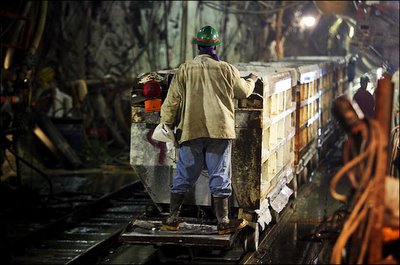
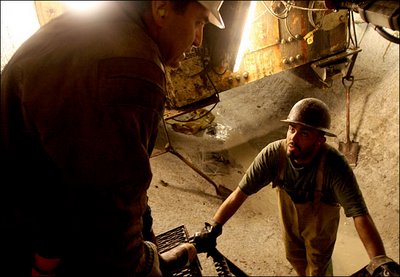
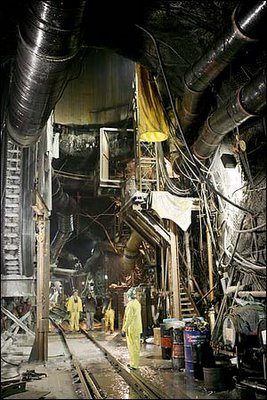
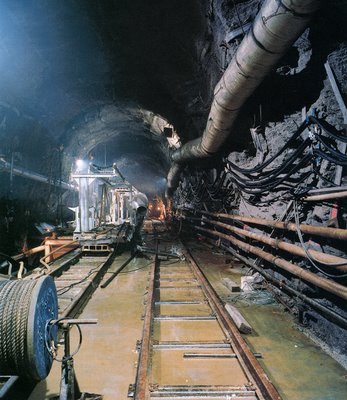
“About 600 feet deep in the bedrock that supports Midtown Manhattan,” we meet “a 450-ton tunnel-boring machine known as the Mole.”
The Mole is “digging City Tunnel No. 3 far beneath Manhattan’s street level, part of a 50-year, $6 billion project to upgrade New York City’s water system.”

[Image: By Ozier Muhammad for The New York Times].

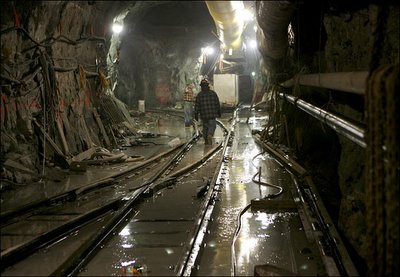
As the New York Times describes, this is actually the “second phase of City Tunnel No. 3, a 60-mile tunnel that began in the Bronx in 1970 and is scheduled for completion in 2020. By then, the tunnel will be able to handle the roughly one billion gallons of water a day used in New York City that originates from rural watersheds to points throughout the city.” And though the tunnel “is one of the largest urban projects in history, few people will ever see it. But beginning next week, many New Yorkers will certainly feel and hear the construction.”

[Images: By Ozier Muhammad for The New York Times].

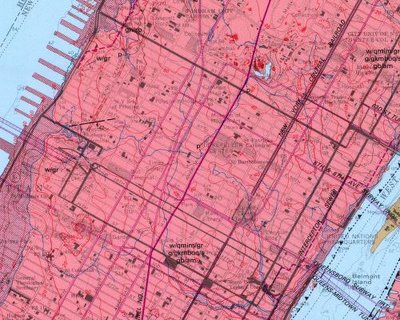
The speed of the excavation process “varies based upon the hardness of the rock it encounters. The task of determining what type of rock lies in its path falls to Eric Jordan, a geologist hired by the city. By drilling down and hand-picking rocks from the tunnels, Mr. Jordan has created a precise map of the type of rock under Manhattan. His involvement in the tunnel project makes his geologist friends jealous. ‘For a geologist,’ he said, ‘this is like going to Disneyland.'”
Jordan’s “precise map” of Manhattan bedrock would indeed be something to see; but until then, we can make an educated guess about the rock his tunnel will find by turning to Richard Fortey.
In his highly recommended book, Earth, Fortey visits Central Park. First you notice the skyline of towers, he writes. “Then you notice the rocks. Cropping out in places under the trees are dark mounds of rock, emerging from the ground like some buried architecture of a former race, partly exhumed and then forgotten… That New York can be built so high and mighty is a consequence of its secure foundations on ancient rocks. It pays its dues to the geology. This is just a small part of one of those old seams that cross the earth… relics of a deeper time when millennia counted for nothing.”

[Image: By Ozier Muhammad for The New York Times].

John McPhee picks up this lithic line of thought in Annals of the Former World. Archipelago New York, he writes, is made of “rock that had once been heated near the point of melting, had recrystallized, had been heated again, had recrystallized, and, while not particularly competent, was more than adequate to hold up those buildings… Four hundred and fifty million years in age, it was called Manhattan Schist.”
Of course, we can also turn to the U.S. National Geologic Map Database, and find our very own bedrock maps –


– which, awesomely, include Times Square, Carnegie Hall, Rockefeller Center, and the Museum of Modern Art, all floating above a sea of solid Manhattan Schist.
In any case, the new tunnel being dug to power the faucets of Manhattan are supplements to the pharaonic, 19th-century Croton hydrological network that keeps New York in taps (including the now derelict, yet Historically Registered, Old Croton Aqueduct). You can read about the Croton Dam, for instance, here or here; and there’s yet more to learn about the Croton project, including how to follow it by trail, here.

[Image: Photograph by Robert Polidori, from “City of Water” by David Grann, The New Yorker, September 1, 2003].

Finally, in 2003 The New Yorker published an excellent article by David Grann called “City of Water,” about, yes, City Tunnel No. 3. I’ll quote from it here briefly before urging you to find a copy at your local library and read it for yourself.
Until Grann actually accompanied the tunnel workers – called sandhogs – underground, he “had only heard tales of New York City’s invisible empire, an elaborate maze of tunnels that goes as deep as the Chrysler Building is high. Under construction in one form or another for more than a century, the system of waterways and pipelines spans thousands of miles and comprises nineteen reservoirs and three lakes. Two main tunnels provide New York City with most of the 1.3 billion gallons of water it consumes each day, ninety per cent of which is pumped in from reservoirs upstate by the sheer force of gravity. Descending through aqueducts from as high as fourteen hundred feet above sea level, the water gathers speed, racing down to a thousand feet below sea level when it reaches the pipes beneath the city.”
Two main tunnels, he writes – and, thus, City Tunnel No. 3.
But I’ll stop there – after I point out that toward the end of the ludicrously bad Die Hard III, Jeremy Irons temporarily escapes the less than threatening eye of Bruce Willis by driving out of Manhattan through similar such aqueducting tunnels.

(For more tunnels: See BLDGBLOG’s London Topological or The Great Man-Made River; then check out The Guardian on London’s so-called CTRL Project, with a quick visit to that city’s cranky old 19th-century sewers, the “capital’s bowels”… Enjoy!).

The Island of New Ephemera


[Image: Tourist guide to New Ephemera, Amanda Spielman].

This is an amazing idea. A tourist brochure – for a fake destination – is printed on glossy paper, then distributed in the New York subway system. Confused would-be tourists leaf through the brochure, “intrigued to learn that this island city’s leading industries are winemaking and bookbinding, and that it features a Vegetation Museum, the world’s largest flea market, ‘Pools of Certitude,’ and a natural feature known as the Subterranean Honey Baths.”
46% of its citizens are secular humanists.
Yawning commuters look in vain for flights or cruises, any way to get there at all…
Designed by Amanda Spielman, the brochure is “an aesthetic cross between McSweeney’s and Edward Tufte,” writes Metropolis. See for yourself by downloading the complete PDF.


[Image: Tourist guide to New Ephemera, Amanda Spielman].

Perhaps a small series of BLDGBLOG tourist PDFs coming soon: a rough guide to the neotropical manmade archipelago of… whatever I decide to call it.

(Thanks, Scott! See also Brand Avenue‘s brief look at the island utopia).

San Francisco Bay Hydrological Model

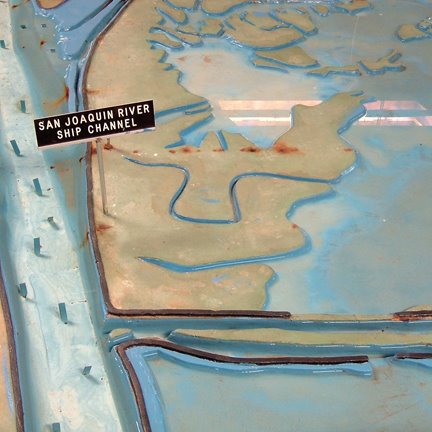
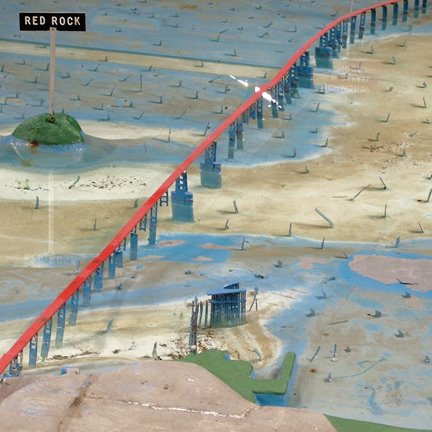
In Sausalito, CA, near a 7-11, one finds the San Francisco Bay Hydrological Model.


The Bay Model was built in 1957 by the Army Corps of Engineers; it is “over 1.5 acres in size and represents an area from the Pacific Ocean to Sacramento and Stockton, including: the San Francisco, San Pablo and Suisun Bays and a portion of the Sacramento-San Joaquin Delta.” Which means it’s larger than two American football fields. (I think).


The Model served “as a scientific research tool from 1958-2000 to evaluate circulation and flow characteristics of the water within the estuary system,” allowing Army Engineers “to simulate currents, tidal action, sediment movement and the mixing of fresh and salt water. Pollution, salt-water intrusion, barrier and fill studies were a few of the important research projects that have been undertaken at the Bay Model.”
It’s not in the greatest condition, and the faded primary color scheme leaves something to be desired, but the model is no less fascinating for that; any chance you get to walk the shores of a microcosm is a good chance to do some thinking.


If I may briefly quote William Blake

To see a world in a grain of sand
And a heaven in a wild flower
Hold infinity in the palm of your hand
And eternity in an hour

– I’ll then point out that the Bay Model exists within its own timezone: in the world of the Model, one day passes every 14.9 minutes. 30 full days elapse every 7.2 hours. Complete tidal cycles run 3.8 minutes. You can practically feel yourself aging in the presence of this copyscape, its wetlands and alluvial braids of artificial rivers running through fields of pumps and power cords.
Look closely and you’ll see a “Tide Hut” where little gods of the Model enact catastrophe and unleash floods upon the surrogate world spread out before them. Look closer, and you’ll see damage from a “hundred years of waves, subsidence, and boat wakes” – which, in Model time, is almost exactly one human year.


But I soon got to thinking about the politics of architectural models. Imagine what would happen, for instance, if some Navy SEALS raided a cave in Afghanistan and found the Bay Model sitting there: what on earth does al-Qaeda want with San Francisco’s water supply? FOX News screams. Or a model of Greater London’s Thames hydrology, complete with flood gates, Barriers and overflow sewers, which is one thing if it’s in the possession of Tony Blair, and quite another if found in the basement of, say, Abu Hamza or even Timothy McVeigh.
What were they trying to do with it?
It’s the politics of architectural models: an object of scientific curiosity in one person’s hands is an issue of national security in another’s.
Or: simulacra as a threat to national security.
A plot for a new Philip K. Dick novel, or a film by Charlie Kauffman, then came to mind: a man, perhaps a young Al Pacino, breaks into the Bay Model in the middle of the night. He barricades himself inside, turns on the power, and starts flooding the model, demolishing bridges, rerouting estuarial confluences. He jumps up and down, causing modelquakes, and then accelerates the tides, obliterating Golden Gate Park under the force of a single wave.
He calls all the local newspapers and takes responsibility for the disasters now befalling San Francisco outside; but what disasters? they ask, and he thinks they’re conning him, denying his rage, because he’s read William Blake and St. Thomas Aquinas and he believes that everything he throws at that simulacrum there before him will have effects in the real world…
Because it’s all building up to one moment, see, the big moment when he decides to flood the Bay Model’s model of the Bay Model, opening up a rift in the universe and blasting him head-first through the macrocosm.
Until the police break-in…

(Thanks to Chad for the tip, and to Nicola for coming with me!)

BLDGBLOG Goes To California…


Well, BLDGBLOG has taken to the road, now typing to you from California. 10 days in LA, Death Valley, Owens Lake, San Francisco… back March 8th, assuming my plane doesn’t crash. Till then, in lieu of regular posting, I’ve put together a table of contents for new readers, old readers, bored readers, impatient readers – so click around, see what interests you, leave comments, forward to others, have fun. And if you have tips for what to do out here, of course, leave a comment below… Thanks!


Dismantling Gothic cathedrals arch by arch, on the beaches of an equatorial island!
The world’s largest diamond mine!
Rollerskating alone at night through subterranean knots!
A seed vault to avert planetary apocalypse!
Listening to the arched foundations of London instrument!
A man exactly reproduces his old apartment using colorful nylon sheets!
Weird geometries in the Kansas farmscape!
Slow landscapes of silt and the J.G. Ballard who loves them!
The lost gods of Europe hurl spheres at each other in space!
Valves, drains, and tunnels in the self-connected topology of underground London!
Entire cities snowing diamonds from Baroque domes!
Is that architecture or just a soundtrack hovering in space?
Helicopter photographs in the sububs of self-similarity!
The 7 New Wonders of the World!
Southeast London transformed into a maze of rooftop gardens!
A temporary public park – complete with bench and parking meter!
Lunar electricity!
The poet Shelley sets sail for a volcanic archipelago made entirely of glass!
A London superstadium full of ring magnets will capture the Northern Lights!
Beautiful maps!


The churches of Christopher Wren, transformed into a geomagnetic harddrive!
The World Trade Center was actually a gigantic tuning fork!
Jurassic park, Russian conservation style!
James Bond thwarts a San Franciscan attempt at tectonic warfare!
Slum dwellers and modular parasites of the urban world, unite!
An abandoned island off the coast of Japan!
Unearthly landscapes swarming with alien bacteria!
The suburbs: raw mounds and earthworks, before construction arrives!
Extraterrestrial life rained down on India!
The internal volume of Notre-Dame, Paris, carved into the surface of the moon!
Meat!
The landscape architecture of Hell, its subsurface faults and magmatic geology!
Why not live inside your garage?
Is that a suburb growing out of your spine, or are you happy to see me?
3000km of concrete tunnels installed beneath the deserts of Libya!
The robotic, neverending cinema of Los Angeles traffic control!
A house of landslides, filled with geese!
Hypnotic films of motorway orbitals now available on DVD!
Measuring astronomy – solstice and stars – with a city modeled on Stonehenge!
Unbelievable maps and diagrams of interstellar astral incidence!


Then we hiked alone for a thousand years, and we renamed all the constellations!
The averaged images of suburban ennui!
Food! Cake!
Have you seen this hull before?
New Arctic seaways promise Lovecraftian visions to come!
On the colors of dismantled landscapes, photographed from the air!
Famous architecture, blurred!
Photographs of Chernobyl, including an abandoned alphabet!
Morocco double-exposures!
The Earth in 7.5 billion years!
Fossilized cities!
The art of reforesting continents through tree bombs!
The deserts of the world are musical instruments!
Venice resonates with voices!
Huge and amazing maps of California hydrology!
The city as an avatar of itself!
The wonderfully weird, self-observing urban world of CCTV!
Sci-fi instant cities built above working limeworks pits!
The abandoned malls of Chicagoland!
WWII British sound mirrors used to musicalize mountain storms!


All hell is breaking loose in middle America!
San Jellocisco!
Catching near-earth asteroids using a gigantic baseball mit!
If you’ve got nothing else to do, why not go camping in an abandoned mine?
Inbred, zombified ex-idealists stumble through pressurized undersea utopias, listening to Mozart!
Biking through glass tunnels suspended above metropolitan Toronto!
An inflatable hotel – in deep space!
Folk maps of Brooklyn’s Gowanus Canal!
Cool bridges!
Houses, churches, places to hang: it’s the afterlife of the Quonset hut!
A man jumps from a balloon, free-falls 20 kilometers through the stratosphere, and captures the whole thing on film!
King Kong!
Complicated volcanic pipe networks will extrude cathedrals directly from the earth!
Huge, interconnected white towers in the middle of Beijing!
Arches National Park, Manhattan branch!
Will the International Space Station soon be turned into a sculpture gallery?
An Indonesian mine and the technicolor stalactites it will form in a million years!
In a wilderness of mirrors we lost our own reflections!
Recording the secret music of bridges!
Amazing tree houses by Andrew Maynard!


That should hopefully last you a week… but don’t forget the other posts, below – especially the Mars rover film.
I’ll be back!

Skyscraper Futures: Infected Design

Among the finalists for eVolo’s recent design competition on the future of the skyscraper was Loren Supp. Having met Loren two years ago, I thought I’d get back in touch with him and ask a few questions about his project.


[Image: Loren Supp, Shanghai Vertical Marketplace, close-up of top floors].

First, some historical context: “In 1950 there were 86 cities in the world with a population over one million,” Mike Davis writes; “today there are 400, and by 2015, there will be at least 550. Cities, indeed, have absorbed nearly two-thirds of the global population explosion since 1950 and are currently growing by a million babies and migrants each week. The present urban population (3.2 billion) is larger than the total population of the world in 1960. The global countryside, meanwhile, has reached its maximum population (3.2 billion) and will begin to shrink after 2020. As a result, cities will account for all future world population growth, which is expected to peak at about 10 billion in 2050.” It seems obvious that this global hyper-urbanization will transform our species in unpredictable ways.
Which is where Loren comes in. The skyscraper, he says, has become “the only viable architectural response” to such a future – but only after “a complete re-thinking of skyscraper iconography” has taken place. The “stacked plate mentality,” in other words, “is about to go out the window.”


[Image: Loren Supp, Shanghai Vertical Marketplace, close-up with project display boards].

Loren’s project is a “vertical marketplace” for central Shanghai. To generate its biomorphic structure and vaguely botanical contours, Loren “mapp[ed] the city’s market economy” using “fluid dynamics software,” which produced a complex diagram that “would have been impossible just a few years ago.” The building is thus designed to fit into its “dynamically-constructed context.”
The building works as “an alleviation of the single-layer congestion that defines the horizontal cityscape. If you have ever been to Shanghai, one of the lasting impressions you take back is of the city’s congested market economy. People sell everything, everywhere. The ultimate result of this phenomena is forced localization.”


[Image: Loren Supp, Shanghai Vertical Marketplace, close-up].

Design-wise, Loren says, the “only space made is that which is necessary. Uniting these ‘exploded plates’ with the market circulation that created them completes the skyscaper.”
Here, then, Loren’s thinking what I’m thinking: “Can the project actually be built? That question will be answered through the same technological construct that allowed its design process. Complex formal architectures can, and will, be facilitated by the logic used in the software to visualize them. The terminology of isoparm, NURBS, and SubD, are infecting (and altering) the construction process, and the future of the skyscraper will inevitably depend upon them.”
So, perhaps some future questions for Loren in another post: Could there be such a thing as a prefabricated skyscraper? What might it look like? Could these towers be shortened – then clustered – yet still achieve the same urban effect? What about a single-family home – a whole suburb – of Shanghai Vertical Marketplaces? What would that look like…?
For more of Supp’s project – and many interesting others – stop by eVolo. Meanwhile, check out these frightening plans for a kilometre-high skyscraper in Kuwait; and take another look at the Beijing Boom Tower and the future urban-modular

(Originally spotted at Archinect).