A Minor Architectural History of Ice Islands

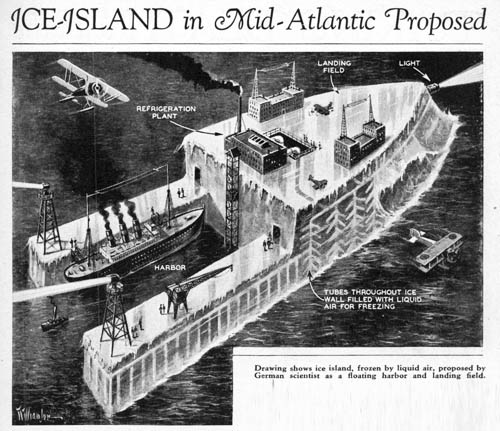
[Image: “Drawing shows ice island, frozen by liquid air, proposed by German scientist as a floating harbor and landing field”; via InfraNet Lab].

InfraNet Lab‘s new post on artificial ice islands—and the architectural use of ice as a building material for things like roads, drilling platforms, remote airstrips, and more—is absolutely fascinating and a must-read. Don’t miss it.

More on ice islands coming soon!

#glacier #island #storm

By way of a quick update, several fantastic new posts have joined this week’s ongoing series of linked conversations, part of the Glacier/Island/Storm studio at Columbia’s GSAPP.

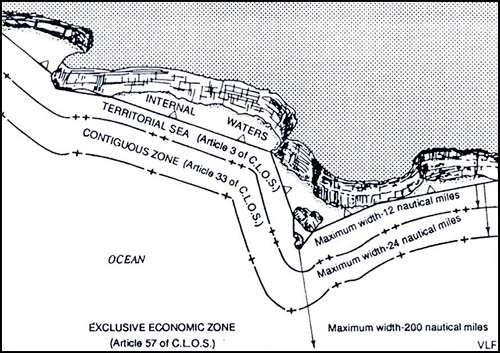
[Image: Map showing a straight baseline separating internal waters from zones of maritime jurisdiction; via a456].

Here is a complete list so far, featuring the most recent posts and going backward in temporal order from there [note: this list has been updated as of February 26]. By all means, feel free to jump in with comments on any of them:

—Nick Sowers of UC-Berkeley/Archinect School Blog Project on “Super/Typhoon/Wall

—Stephen Becker and Rob Holmes of mammoth on “saharan miami,” “translation, machines, and embassies,” and “islands draw the clouds, and glaciers are wind-catchers

— Mason White, Maya Przybylski, Neeraj Bhatia, and Lola Sheppard of InfraNet Lab on “Particulate Swarms

—David Gissen of HTC Experiments on “A contribution, a mini-review, a plug

—Enrique Ramirez of a456 on “Baselines Straight and Normal

InfraNet Lab on “Islands of Speculation/Speculation on Islands: Spray Ice” (nice comments on this one)


[Video: #climatedata by by Michael Schieben; via Serial Consign].

—Greg J. Smith of Serial Consign on “Glacier/Island/Storm: Three Tangents” (interesting comments developing here)

mammoth on “Thilafushi” and “The North American Storm Control Authority” (enthusiastic comments thread on the latter link)

—Tim Maly of Quiet Babylon on “Islands in the Net” (interesting comments also developing here)

—Nicola Twilley of Edible Geography on “The Ice Program” (great comments here, too!)

mammoth on “A Glacier is a Very Long Event” (another interesting comment thread)

InfraNet Lab on “LandFab, or Manufacturing Terrain

—Nick Sowers on “Design to Fail

Finally, I was excited to see that Ethel Baraona Pohl and César Reyes Nájera have jumped into the conversation, adding their own thoughts over at dpr-barcelona; and Alexander Trevi of Pruned has also supplied a Glacier/Island/Storm-themed guide to his own archives in this hashtag switchboard. And that’s in addition to some ongoing posts here on BLDGBLOG.

It’s been a great week for new content, I think, and all of the above are worth reading in full.

Ornamental Forensics

[Image: Photo by Andy Marshall of Foto Facade from his awesome Flickr set Beverley Minster Hoodmould Carvings].

Continuing, briefly, with the ideas presented in the previous post, I wanted to add two more things:

1) Could ancient astronomical events also have been recorded in architectural ornament (not just in paintings or poetry)? In other words, somewhere beneath the overgrown vines of some Indiana Jones-like complex in the Cambodian rain forest—or carved into the solid rock of a minor cathedral near Dijon—is a bas-relief depicting a star gone nova six hundred years ago. This astral disaster left no other record than that. Previously unknown celestial events could thus be pieced together through stone carvings found as far apart as a village church in Russia and a temple on the Deccan Plateau—or even stars in stained glass windows. So is there an architectural equivalent to the appearance of Halley’s Comet’s in the Bayeux Tapestry? A previously unknown meteor shower historically recorded in a chapel’s stone vault?

2) What about epidemiological history as recorded in architectural ornament? Of course, there are already dozens of examples of medical historians determining, through close readings and reinterpretations of literary document, that such and such a king or character must have been suffering from syphilis or a brain tumor or lead-induced dementia. But I’m specifically interested here in how medical symptoms might have taken on ornamental form. Perhaps, in the writhing Gothic forms of church facades—in those old carved faces depicting humans hybridized with angels and demons, plants and animals, minerals and gods—we might yet discover the symptomological clues of some horrifying medieval plague or outbreak. You travel to a remote mountain village in Macedonia to study vernacular church-building traditions only to find a shunned building on the edge of town whose ornamentation borders on the grotesque—and you soon realize that you’ve discovered not just an architectural masterpiece but evidence of a forgotten disease, similar to Ebola, that had otherwise gone unrecorded. At the very least, this would make for an awesome potboiler or short novel, that I would absolutely love to write (attention, publishers!).

My point, though, is to ask if there are any real-world examples of architectural ornament in which something like an unknown astronomical event, or a disease forgotten by the modern world (weird bodies on a stone frieze in northern India). If so, how might these strange carving be subject to the same type of analysis as explored in the previous post?

I sense a new historical field here—called ornamental forensics—just waiting to happen.

The Star Archive

[Image: Perseids Meteor Shower, August 11, 1999; photo by Wally Pacholka, courtesy of NASA].

In an earlier post, I looked at the possibility that the paintings of Vincent Van Gogh might include a very physical archive of 19th-century meteorological events, with sand, dust, pollen, and other airborne particulates from the days Van Gogh painted en plein air now trapped for all art history inside the vibrant swirls of his canvases.

Adam, from Design Under Sky, then left a comment saying that this unintentional archive of sand already exists, with or without such speculation: “Sand was used as an ink blotting material and remnants are often still found in manuscripts today.” Every library is thus also a museum of sand.

But I completely failed to mention an article that has fascinated me for more than a year now; I believe I originally found it via Andrew Ray of Some landscapes.

In a feature for COSMOS Magazine called “Sky detectives,” we read that “forensic astronomers… are seeking clues to historical events embedded in artworks and literature.”

[Image: Halley’s Comet—upper right—passes through the Bayeux Tapestry].

In other words, similar to the idea of geomythology—in which ancient tales of floods or vengeful fire gods can be re-interpreted in light of newly found evidence for catastrophic tsunamis or volcanic eruptions—”forensic astronomers” look for more celestial clues. Things like Halley’s Comet burning through the night sky of the Bayeux Tapestry will catch their eye, or supernovas as depicted in Native American rock art.

These details, hidden in plain sight, can be used to indirectly piece together long-gone astronomical events.

The following very long quotation gives at least some idea of how extraordinary the results can be; it’s like something out of Minority Report:

Donald Olson, a physics professor at Texas State University in San Marcos, U.S., has used similar techniques to help art historians pin down details of famous paintings. In 2000, for example, he found the location at which Vincent van Gogh created one of his last paintings, The White House at Night.

Knowing that van Gogh painted it in mid-June, and the direction in which the house faced, Olson was able to determine that a bright star in the painting was mostly likely the planet Venus, which would have been prominent at the time.

Two years later, Olson used a similar process with another van Gogh painting, Moonrise. That painting depicts the full moon rising behind an overhanging cliff in southern France. Historians knew the work was made sometime in 1889, and haystacks in the foreground indicate that the time of year is somewhere around harvest season.

Olson’s team hunted down the location and, with a bit of astronomical detective work, determined that there was only one date on which the Moon rose in the right place: 13 July 1889. Since van Gogh once said he never worked from memory and always painted what he saw, this was probably the date on which he started painting Moonrise.

Here, I’ll reveal a secret fantasy of mine: at one point during the film Jaws, there is a night scene during which a meteor suddenly lights up the sky overhead. The characters are out at sea when zoooooom: a flash goes by, from one end of the screen to the other.

Every time I see that scene I wonder what the flash was, and, more importantly, where it went: if something later crashed down into the sands of North Africa, or hit a cliff in Arizona, or splashed into the ocean waters much further out at sea. Or simply burnt up into dust and fiery particles.

[Image: Rock art possibly depicting a supernova. Photo by John Barentine, Apache Point Observatory, courtesy of SPACE.com].

But what if someday you find a meteorite and you somehow piece together evidence for when it fell to earth—and you find that it was during the summer that Steven Spielberg filmed Jaws. You find out exactly where they filmed Jaws, and you keep digging deeper, and then, finally, there it is: some fantastic piece of irrefutable evidence that proves you have just discovered the very object that once flew through the sky in a film seen by countless millions of people around the world. Jaws, after all, is the seventh-highest grossing film of all time.

It’s archaeo-astronomy via Hollywood film history.

In any case, as you will see in the “Sky detectives” article, our forensic astronomers begin reading nothing less than The Odyssey, looking for astronomical clues (“…the poem describes Odysseus steering his boat by the positions of the constellations Boötes and the Pleiades [which] establishes the date as early spring…”).

But as they start putting Homer’s descriptions of the constellations, and the precise order and time of year in which Odysseus saw those constellations, into their weird software that maps the movement of the earth and our nearby planets through 49,000 years of history… my hair began standing on end.

All these astronomical clues—in ancient poetry, famous paintings, and the overlooked skies of film history—simply waiting to be deciphered.

Food Shape City

[Image: Courtesy of Flickr-user humain, via Urban Omnibus].

Varick Shute of Urban Omnibus has posted a great interview with Nicola Twilley of Edible Geography and Sarah Rich about their collaboration on the Foodprint Project—and, specifically, the Foodprint NYC event coming up this weekend at Studio-X.

The interview discusses urban food-distribution networks, the cultural and nutritional effects of food-vendor carts, the geographic distance from “farm to table,” food-contamination scares, what Sarah describes as “the ways in which food and eating behaviors influence the physical shape of the city,” Nicola’s interest in “cupcake shops as indicators of gentrification,” and much more. Be sure to check it out in full—and consider coming to the event on Saturday.

MAP 002: Quarantine

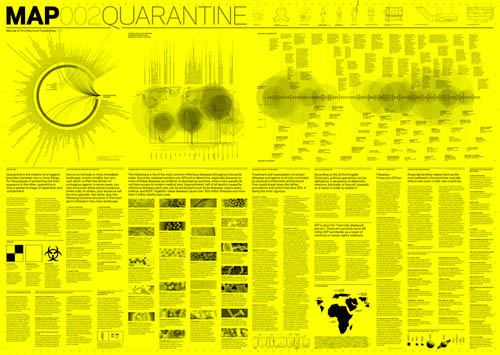
[Image: MAP 002: Quarantine by David Garcia].

Architect David Garcia’s MAP project—the Manual of Architectural Possibilities—has been mentioned here before, which makes me all the more excited to announce that the next issue of MAP will not only be themed around quarantine but it will be on display as an offical part of the Landscapes of Quarantine exhibition opening next month at Storefront for Art and Architecture.

This installment, which features Garcia’s speculative designs for projects like a “Zoo of Infectious Species,” a “Domestic Isolation Unit,” and an “Instantly Quarantinable Farm,” will also once again include an introductory text by Sir Peter Cook.

[Image: MAP 002: Quarantine by David Garcia].

Garcia will in town for Storefront’s Landscapes of Quarantine opening party, on Tuesday, March 9, so be sure to come by, buy a copy of MAP 002: Quarantine for yourself, and meet the man in person.

Excised Islands / Gourmet Cocktail

Tim Maly of Quiet Babylon and Nicola Twilley of Edible Geography have both jumped into the Glacier/Island/Storm blogathon unfolding this week with posts about, respectively, questions of island sovereignty, national borders, data havens, geo-preservation and more, and, at Edible Geography, specialty ices developed for the boutique cocktail trade.

[Image: The Okinotori Islands—or are they reefs? Image via Tim Maly].

Tim’s post—which you should read in full—brings to mind recent moves by the Australian government to “excise” distant islands so as to prevent illegal immigrants from reaching what would otherwise legally recognized as Australian land.

The whole legislative exercise falls somewhere between a managed retreat of territorial sovereignty and a particularly Kafka-esque interpretation of Zeno’s paradox.

In Kafka’s short story “A Message from the Emperor,” for instance, we read that an imperial messenger, instructed to deliver the dying emperor’s final wish to a recipient far away, finds himself unable to travel anywhere at all. Indeed, as he struggles to make his way through endless crowds and palace antechambers, fighting his way toward a destination that was, at best, unclear, “how futile are all his efforts,” we read.

He is still forcing his way through the private rooms of the innermost palace. Never will he win his way through. And if he did manage that, nothing would have been achieved. He would have to fight his way down the steps, and, if he managed to do that, nothing would have been achieved. He would have to stride through the courtyards, and after the courtyards through the second palace encircling the first, and, then again, through stairs and courtyards, and then, once again, a palace, and so on for thousands of years.

Now reverse this. Imagine someone—a subject of the empire—trying to force his or her way back to the center, trying against overwhelming odds to reach the very epicenter of sovereign power, but utterly unable to succeed.

There is always another courtyard to cross; always more rooms to run through.

Now imagine this being played out on a South Pacific archipelago, where you are up against a sovereign state that insists on “excising” bits and bobs of its outer territory in order to sabotage your own best efforts to get somewhere. You step onto one island, secure in what you think is arrival, only to be told that, no, this is not yet Australia. You are both here and not here. This island is us—but it is also something we have legally abandoned.

So you move on to the next island—and the next, and the next.

The territorial complexities of sovereign governance thus rapidly spiral into clouds of uncertainty.

[Image: Map of Christmas Island].

According to The Age, an Australian newspaper, “the Howard government removed about 4,600 islands from the migration zone in 2005, preventing boat people who land there from accessing Australian law and claiming asylum in Australia.” The “migration zone” referred to here includes Christmas Island, which now—in 2010—falls into a strange grey zone of legality; from the perspective of an arriving immigrant, it both is and is not Australia.

This is what architect Ed Keller might call the political science fiction of excised island terrain.

I’m reminded of China Miéville’s recent novel The City & The City, in which differently controlled but spatially overlapping urban territories have been marbled into and through one another; you can physically stand in two cities at once, yet only legally be present in one at any given time.

Now blow Miéville’s strange in-and-out status up to the scale of a South Pacific archipelago and you have something approximating the spatial logic of Australian territorial law as applied to commonly used immigration routes.

Read the actual, island-excising Parliamentary documentation here.

[Image: Photo by Melissa Hom for New York Magazine].

Nicola Twilley, meanwhile, studies “detailed instructions for artificial glacier construction,” suggesting that “vernacular Himalayan glacier grafting techniques” might actually “have the potential to revolutionize the cocktails of tomorrow.”

In other words, artificial glaciers grown and maintained by specialty cocktail bars could be produced to order, made to include “orchid flowers, raspberries, or espresso beans,” Nicola writes, thus creating “flavor-accented glaciers.” These could then be chopped down into “berry-studded chunks,” rough cubes that supply “the perfect finishing touch for a Brownie Cognac or Irish coffee.”

“The theatrical potential of custom artificial glaciers,” she jokes, “might be second only to the champagne fountain.”

[Images: Photos by Melissa Hom for New York Magazine].

These are only the two most recent posts in a week full of linked conversations exploring the Glacier/Island/Storm studio at Columbia University. Here is a list of those relevant posts, if you’re interested:

Edible Geography: The Ice Program
Quiet Babylon: Islands in the Net
BLDGBLOG: Vincent Van Gogh and the Storm Archive
BLDGBLOG: Geothermal Gardens and the Hot Zones of the City
mammoth, a glacier is a very long event
InfraNet Lab, LandFab, or Manufacturing Terrain
Nick Sowers, Design to Fail
Vincent Van Gogh and the Storm Archive

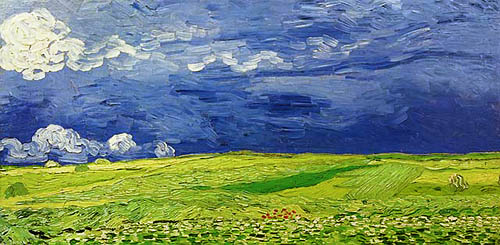
[Image: Vincent Van Gogh, “Wheatfields under Thunderclouds” (1890)].

One of many books I’ve been referring to quite often these days, both in personal conversations and during desk-crits with my students, is Michael Welland’s Sand, newly released in paperback.

I’ll be mentioning many things from his book throughout the coming days and later; for now, I simply want to call attention to a comment Welland makes about Vincent Van Gogh‘s habit of painting en plein air—that is, outside, with fresh paint, in the windswept meadows and fields near the Mediterranean, where dust storms were an expected part of an afternoon.

This regional meteorology often resulted in sand grains being blown onto Van Gogh’s still-wet canvases—and thus becoming a permanent part of art history.

Indeed, in some cases, Welland writes, citing Van Gogh’s own letters, the sand could get so dense and accumulate so thickly that he would have to scrape preliminary images from the unfinished canvas and start again. That intrusive terrestrial presence—pieces of the very thing his paintings were meant to represent—was thus removed.

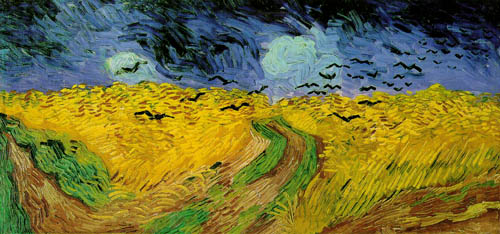
[Image: Vincent Van Gogh, “Wheatfield with Crows” (1890)].

More interestingly, though, passing meteorological events of the 19th century left behind what we might call aerial fossils: traces of violent wind patterns and minor climatologies that have been frozen into place on the surface of plein air paintings.

The result is a kind of storm archive—an unintentional core sample of 19th-century weather—housed in museums around the world. Squint long enough, perhaps, and beneath those swirling mists and pixelations you will see traces of the Sahara, of building dust, of pollen, of the wheat-sprouting soil of the region, all recorded for good measure through time.

Like some unexpected variation on Jurassic Park—in which it is not the DNA of dinosaurs extracted from ancient amber that we use to reconstitute a missing being—perhaps an army of art historians and scientists, equipped with microscopes and tweezers, could pull from the surface of every painting by Vincent Van Gogh a catalog of lost weather systems, mapping the moving sands of his era.

#GlacierIslandStorm

Geothermal Gardens and the Hot Zones of the City

[Image: “Reykjavik Botanical Garden” by Andrew Corrigan and John Carr].
In a fantastic issue of AD, edited by Sean Lally and themed around the idea of “Energies,” a long list of projects appeared that are of direct relevance to the Glacier/Island/Storm studio thread developing this week. I want to mention just two of those projects here.

[Image: “Reykjavik Botanical Garden” by Andrew Corrigan and John Carr].
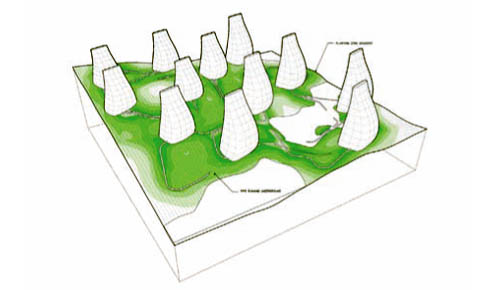
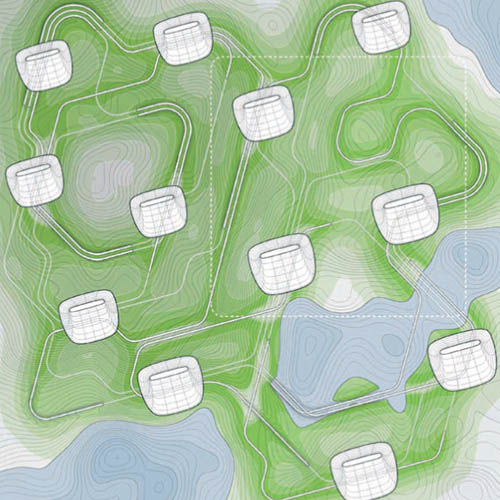
For their “Reykjavik Botanical Garden,” Rice University architecture students Andrew Corrigan and John Carr proposed tapping that city’s geothermal energy to create “microclimates for varied plant growth.”

“Heat is taken directly from the ground,” they write, “and piped up across the landscape into a system of [pipes and] towers.”

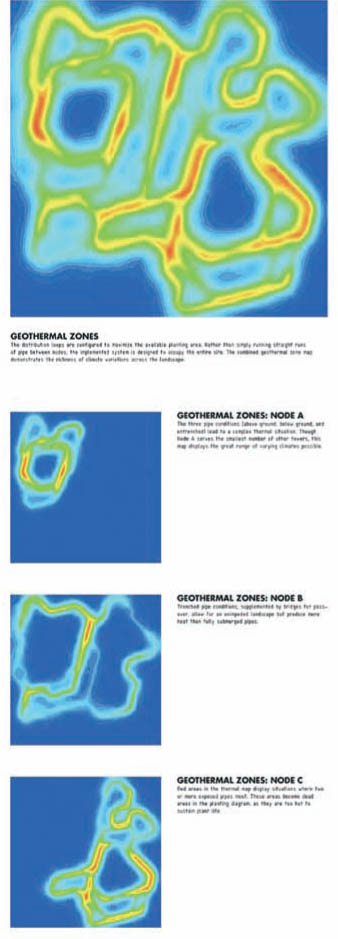
Zones of heat radiate out from the pipes, creating a new climate layer with variable conditions based on their number and proximity to each other. These exterior plantings are mostly native to Iceland, but the amplified environment allows a wider range of growth than would normally be possible, informing the role and opportunity of this particular botanical garden. Visitors experience growth never before possible in Iceland, and travel through new climates throughout the site.

Amidst “hydroponic growing trays and research laboratories,” and sprouting in the climatic shadow of complicated “air-intake systems,” a new landscape grows, absorbing its heat from below.

[Image: “Reykjavik Botanical Garden” by Andrew Corrigan and John Carr].
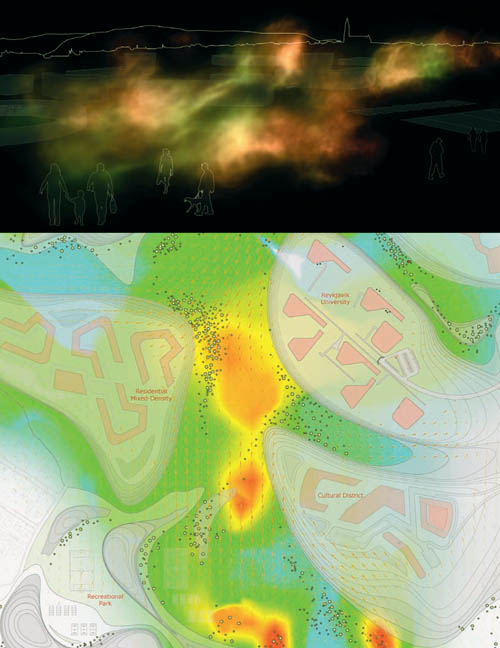
The climate of the city is altered, in other words, literally from the ground up; using the functional equivalent of terrestrially powered ovens, otherwise botanically impossible species can healthily take root.

This domestication of geothermal energy, and the use of it for purposes other than electricity-generation, raises the fascinating possibility that heat itself, if carefully and specifically redirected, can utterly transform urban space.

[Image: Produced for the “Vatnsmyri Urban Planning Competition” by Sean Lally, Andrew Corrigan, and Paul Kweton of WEATHERS].
A variant on this forms the basic idea behind Sean Lally’s own project, produced with Andrew Corrigan and Paul Kweton, for the Vatnsmyri Urban Planning Competition (a competition previously discussed on BLDGBLOG here).

Their design also proposes using geothermal heat in Reykjavik “to affect the local climatic conditions on land, including air temperature and soil temperature for vegetative growth.” But their goal is to generate a “climatic ‘wash'”—that is, an amorphous zone of heat that lies just slightly outside of direct regulation. This slow leaking of heat into the city could then effect a linked series of hot zones—or variable microclimates, as the architects write—that would punctuate the city with thermal oases.

Like a winterized inversion of the air-conditioned cold fronts we feel rolling out from the open doors of buildings all summer long, this would be pure heat—and its attendant humidity—roiling upward from the Earth itself. The result would be to generate a new architecture not of walls and buildings but of temperature thresholds and bodily sensation.

Indeed, as David Gissen suggests in his excellent book Subnature, this project could very well imply “a new form of urban planning,” one in which sculpted zones of thermal energy take precedence over architecturally designated public spaces.

Of course, whether this simply means that under-designed urban dead zones—like the otherwise sorely needed pedestrian parks now scattered up and down Broadway—will be left as is, provided they are heated from below by a subway grate, remains, for the time being, undetermined.

This is all just part of a much larger question: how we “renegotiate the relationship between architecture and weather,” as Jürgen Mayer H. and Neeraj Bhatia, editors of the recent book -arium: Weather + Architecture, describe it. The Glacier/Island/Storm studio will continue to explore these and other abstract questions of climate and architectural design throughout the spring.

An amplification of processes that already occur

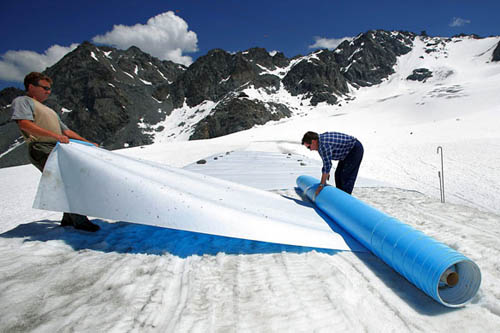
[Image: Glacier-protection services in the Swiss Alps; photo by Olivier Maire/Epa/Corbis, via the Guardian].
Several posts in our Glacier/Island/Storm blog week are already up and working it:

Nick Sowers, Design to Fail: In which we read about tree-bombing Guam, the unintended reuse of abandoned military artifacts, global climate change as national security threat, and how all architects should plan for the failure of their most grandiose ideas.

InfraNet Lab, LandFab, or Manufacturing Terrain: In which we read about “volcanic heroism,” desert islands, “politically anomalous artificial land fabrication,” and a brief history of dredging in the Florida Everglades (perhaps vaguely related: Prosthetic Delta).

mammoth, a glacier is a very long event: In which we read about the self-altering internal torque of metamorphic glaciers, salt farms, shell middens, the ecological redesign of an abandoned landfill, accretionary geographies, and much more.

The title of this post, meanwhile, comes from mammoth, as cited above. It was also chosen as way of pointing out that, while this week pretends toward the status of symposium—that is, multiple blogs with different backgrounds all pursuing a shared suite of themes and references at the same time for a limited period—it is, in reality, no more than what already happens in the deep chains of internet conversation everyday. I write a post referring to something on Pruned; Pruned perhaps saw something tweeted by Ballardian or Alexis Madrigal; the link in question might have come from the New York Times or even Metafilter; and the endlessly marbled laminations of successive re-linking never cease to accumulate. That’s how things are; that’s simply what happens. This is thus just an amplification of processes that already occur.

(There may or may not be Twitter updates throughout the week using the #glacierislandstorm hashtag, as well).

Glacier / Island / Storm Online

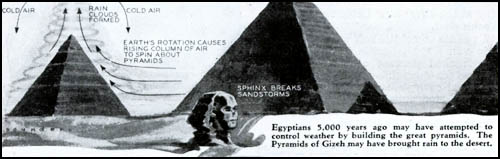
[Image: From Modern Mechanix, thanks to a tip from Nicole Seekely].

For the next five days, if everything goes as planned, BLDGBLOG and eight other architecture, design, and technology blogs will be engaged in a series of linked posts and ongoing conversations about themes relevant to the “Glacier/Island/Storm” studio at Columbia University this Spring.

In the broadest terms, we will be exploring the architecture of large-scale natural processes; more specifically, this means studying artificial glaciers; organically-grown archipelagos and other artificial reef technologies; and the unintended climatic side-effects of architecture, including the possibility of “owning the weather.”

[Image: From Modern Mechanix].

The participating blogs are a456 (Enrique Ramirez), Edible Geography (Nicola Twilley), HTC Experiments (David Gissen), InfraNet Lab (Mason White, Maya Przybylski, Neeraj Bhatia, and Lola Sheppard), mammoth (Rob Holmes and Stephen Becker), Serial Consign (Greg J. Smith), Soundscrapers/UC-Berkeley Archinect School Blog Project (Nick Sowers), and Quiet Babylon (Tim Maly).

For my own part, I’ll be posting on a wide range of themes directly related to the studio, including summaries of visiting expert lectures and class field trips to local scientific institutions; but I will also be offering my own speculative thoughts on the matter. Also, in addition to each blogger commenting on one another’s posts when possible, or simply following up with their own response-posts, I will be maintaining a list of relevant links to keep the whole thing flowing.

So my students and I are off on a field trip for the rest of the day, but I will begin putting up posts this evening. Feel free to join in, leave comments, suggest further readings, and more. Thanks!