Celestial Detector

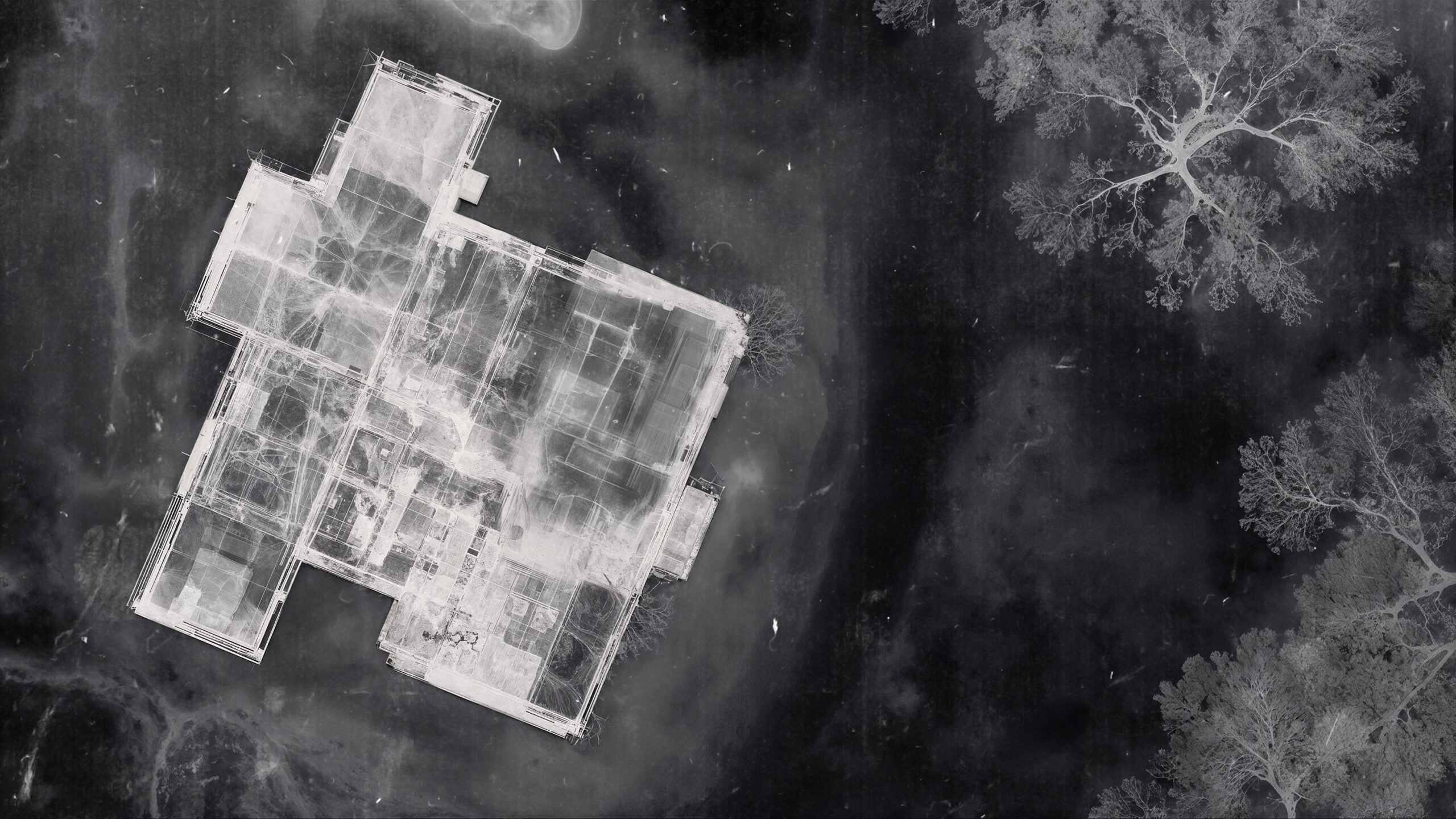
[Image: View larger! From “Celestial Detector,” 2025 Lisbon Architecture Triennale; all text by Geoff Manaugh, all images by John Becker/WROT Studio.]

I had a new piece of short fiction commissioned by the 2025 Lisbon Architecture Triennale that was just published last week over at e-flux.

The theme of the Triennale this year is “How Heavy is a City?” To address that, I wrote about a fictional German physicist named Wendell Brandt. During the Cold War, Brandt proposed using cosmic particles—known as muons—to spy under the Berlin Wall.

[Image: From “Celestial Detector,” 2025 Lisbon Architecture Triennale; all text by Geoff Manaugh, all images by John Becker/WROT Studio.]

Although Brandt (and the story’s first-person narrator) is entirely fictional, muon tomography—or muography—is a real visualization technique.

Muons are constantly passing through all of us—through our skin and bones, our cars and buildings, through the mountains and landforms around us. They are so small, moving so quickly, that they have little interaction with matter. We never feel them, though they are inside our muscle and bone; we never see them, though they pass through our pupils and optic nerves.

Although muons are everywhere, they are surprisingly few in number: every second, fewer than ten muons pass through an area the size of your palm, literally just a handful. With the right instrumentation, however, the passage of muons can be recorded, like light on a digital sensor, which means that, given enough time, muons can be used to create images. Similar to an X-ray, the resulting “muographs,” as they are known, reveal otherwise inaccessible voids inside even the densest of materials.

Muography allows people to peer inside dense materials and structures, from cathedrals and hydroelectric dams to Mayan temples and Egyptian pyramids. Or, of course, entire neighborhoods in Cold War Berlin.

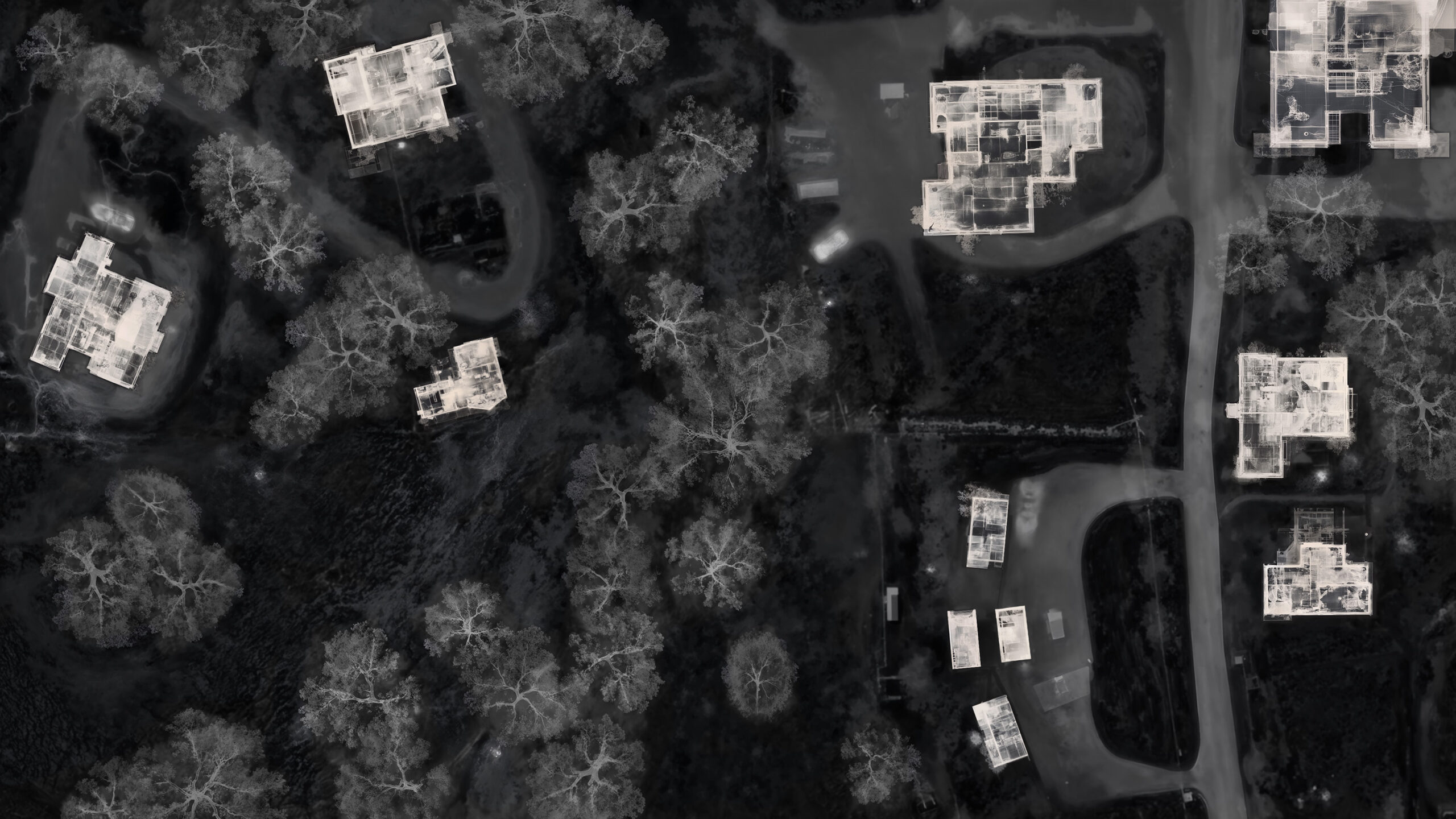
[Images: From “Celestial Detector,” 2025 Lisbon Architecture Triennale; all text by Geoff Manaugh, all images by John Becker/WROT Studio.]

Brandt’s experiment in celestial espionage took advantage of an abandoned church near the Berlin Wall where, funded by the U.S. Department of Defense, he installed his first detector. As the data came in, however, Brandt became obsessed with exactly who he was spying on—perhaps even old friends and family members, now isolated in East Berlin by the construction of the Wall.

In a project notebook I obtained through a Freedom of Information Act request, I found that Brandt had used several pages as a personal journal, reflecting on his experience developing muographic techniques in Berlin. The notes—strangely, written in English, as if he had hoped his American sponsors would someday read them—suggested a scientific curiosity gradually becoming more philosophical. Whether muons could image strategically important military features gave way to speculation about families living in apartments nearby, about the quiet lives of fellow Germans separated by the Wall—people who, he believed, he would never meet face to face. All he would know of them were these shadows and blurs, etched by cosmic particles on secret electronics in the deep.

Brandt’s fixation with capturing the lives of strangers, using particles from space, led him onward from there to a series of increasingly ambitious scientific experiments. These included, after the fall of the Wall in November 1989, a purpose-built architectural facility for rigorously measuring the passage of muons.

[Images: From “Celestial Detector,” 2025 Lisbon Architecture Triennale; all text by Geoff Manaugh, all images by John Becker/WROT Studio.]

Although there is much more to the (fictional) story, Brandt’s experiments culminated in a massive lab constructed beneath a remote California town, within the San Andreas Fault.

[Image: From “Celestial Detector,” 2025 Lisbon Architecture Triennale; all text by Geoff Manaugh, all images by John Becker/WROT Studio.]

Although his scientific goal there was to see if muography could be used to image large-scale terrestrial phenomena, such as a moving tectonic fault, Brandt began to notice, within the data, the outlines of the town above, down to individual houses and rooms—even, over the course of fifteen years, specific pieces of furniture showing up in the resulting scans.

Once again, Brandt was looking into the lives of strangers from below, using particles from space.

[Image: From “Celestial Detector,” 2025 Lisbon Architecture Triennale; all text by Geoff Manaugh, all images by John Becker/WROT Studio.]

The story itself, I hope, is worth reading in full, but the visuals are a huge part of it. Those were all produced by John Becker of WROT Studio, a frequent collaborator of mine (for projects like the “Institute for Controlled Speleogenesis” and 3D-printing concrete bees).

John put together some spectacular depictions of architecture as imaged using muons, including short AI-generated film sequences and a larger animation that will be screened in Lisbon at the Triennale next month.

[Image: View larger! From “Celestial Detector,” 2025 Lisbon Architecture Triennale; all text by Geoff Manaugh, all images by John Becker/WROT Studio.]

The story was at least partially inspired by my old friend Lebbeus Woods, whose fictional projects—including his proposal for an unmade film called “Underground Berlin”—are never far from my mind.

Check it out, if you get a chance.

(Thanks to Nick Axel of e-flux for editorial guidance, and to Ann-Sofi Rönnskog and John Palmesino of Territorial Agency for commissioning the story in the first place.)

Star Forts, Mines, and Other Maastricht Subterranea

I was in Maastricht, Netherlands, for a couple nights last week, mostly as a way to break-up my trip across the Atlantic and thus help get over jet-lag before attending an archaeology conference (where I currently type this).

I went specifically to Maastricht, however, because it’s home to an astonishing number of subterranean sites, from 800-year-old limestone mines and 17th-century star fortifications to NATO defense bunkers. I basically checked into my hotel then disappeared underground for the rest of the visit.

Here are some pics.

My morning started here, at the entrance to the Casemates Waldeck, a labyrinth of defensive earthworks complete with tunnels, counter-mine tunnels, barracks, and firing positions. Large parts of the system were then later repurposed as civilian air-raid shelters during WWII.

The geometric logic of the forts was—among other things—to lure enemy attackers in over cliff-like artificial drops and ridges, thinking they were on their way to the heart of the city. However, this simply trapped them between huge brick walls, directly in front of disguised gun emplacements, many of which were deliberately aimed at stomach-height to maximize suffering.

If you go through the door seen in the above photographs, meanwhile, you end up inside a bewildering system of multi-level tunnels weaving around for kilometers beneath the outer edge of the city.

Because the city has expanded and grown over the centuries, whole neighborhoods now sit atop these structures; if you live in Maastricht, you might very well have disused military fortification tunnels running under your basement.

What’s more, not all of the tunnels are mapped—which means that some are neither maintained nor stabilized. Apparently, seasonal floods have led to sinkholes above, as streets partially collapse into the system.

And that’s just one of many, many underground sites you can tour.

The next place I headed was called the Zonneberg Caves—which are not natural caves, but a colossal limestone mine—and I honestly can say I would spend entire weeks down there.

I’m just randomly typing facts from memory, because I’m on a break from a conference and want to get these photos up, which means I will almost certainly get a few details wrong, but I believe they said that “only” 80 or so kilometers of these ancient limestone mines remain from more than 200, and that the first shafts were cut in the 13th century.

The mines extend all the way over the international border into Belgium. The Belgian tunnels are apparently closed to the public, yet people sneak into them all the time.

There are 20th-century artworks painted on the walls, much older graffiti etched directly into rock, and massive corridors extending off on all sides into darkness.

If you’re into the underground and ever have an opportunity to spend more time than a tour down there, I would recommend it without any hesitation—and I will be deeply, deeply jealous.

The site is even complete with a little church altar.

Bear in mind, this is all still the same day.

The next site I went to was accessed through a locked metal door in the rock (pictured above). This system, known as the North Caves, is actually physically connected to the Zonneberg Caves, although it would take an hour or more to get between them underground. Like I say, I would go back there and wander around in a heartbeat.

The added interest of this latter system is that parts of it were used during WWII to house paintings by the Old Masters, protecting them from Nazi plunder and stray Allied bombs alike.

At the end, you go into a place called “the Vault” to see where Rembrandts and other paintings were hung while war waged above.

Finally, after many hours underground, I walked outside—and the first thing I saw was this rainbow. A cheesily enjoyable end to a fantastic day.

If you’re tempted to see any of these places yourself, and you hope to do so legally, check out Maastricht Underground for potential tours.

[All photos by Geoff Manaugh/BLDGBLOG.]

Mineral Hurricane

I recently had the pleasure of attending a press preview of the new documentary Architecton, directed by Victor Kossakovsky and released last week by A24.

Surreally, the screening I attended was held inside a Cedars-Sinai medical-imaging center in west Los Angeles. Seeing this particular film, with its intensely granular focus on the geological underpinnings of the built environment, amidst diagnostic tools designed for peering inside the human body seemed strangely appropriate.

I imagine that, if you were simply to wander into a room where Architecton was playing, it would very likely appear to be a film about geology: about rocks and mountains, quarries and mines, and the raw streams of matter that create and emerge from them.

There is an extraordinary early sequence, for example, from which the stills in this post were taken, where Kossakovsky captures a landslide. We watch as increasingly large rocks, from sand to gravel to room-sized blocks to immense boulders, all flow downhill in slow motion, crashing into one another, exploding, ricocheting, and splitting apart.

It looks for all the world like an oceanic phenomenon—a series of waves, not a solid planet at all, as if the Earth has begun to boil and heave with liquefaction.

The sequence then fades into what I believe is an aerial drone shot of the same landslide, but the visuals here become almost astronomical in their power and beauty, as if Architecton had somehow captured a proto-planetary storm of partially aerosolized rock. It looks like you’ve woken up inside the asteroid belt—or perhaps what J.M.W. Turner would have depicted if he had traveled in space. Not landscapes but nebulae.

There is something so elemental, even infernal, in this sequence, verging on the cosmic: glimpsing how the Earth itself was assembled through a billion-year maelstrom of mineral hurricanes, spherical landslides, and weather systems made entirely of geology.

Later, the camera lingers over detonations in the walls of strip mines. We watch rocks being bounced and agitated on conveyor belts, wet with leachate and acid. At one point, the camera stares into a minimalist doorway, cut like an Etruscan tomb, through which rocks tumble to be processed as abyssal red embers glow.

It’s just a mine, of course, but Kassakovksy has made it look like an alchemical complex, a brutalist oven in which all things planetary can be melted and enhanced, sluiced off and purified, distilled into a purely economic form. It is brute oceanic metallurgy.

It’s these early sequences that I could have watched literally for hours. It was also these scenes that felt so perfect for the unlikely setting in which the film was being screened that day, knowing that, as we all sat there, people in the rooms around me were getting CT scans, MRIs, and X-rays.

But the movie takes a more architectural turn here, increasingly focused on buildings and cities, on archaeological sites and ruins. We see residential towers in Ukraine, for example, ripped open by Russian missiles and drone-bombs, and then earthquake-damaged apartments undergoing demolition and clearance, followed by landfill-dumping operations so large they look like attempts at terraforming.

These are intercut with the film’s only speaking sections, where we watch architect Michele De Lucchi supervise the construction of a small rock circle in his garden. A light snow falls and hazy mountains are visible in the background. The scenes are meditative and calming.

At one point, De Lucchi’s circle is visually rhymed with an all-too-brief aerial glimpse of what I believe is the Richat Structure in Mauritania, continuing the film’s play on form and organization, as if rocks have within them a natural capacity to resemble storms and hurricanes—as if everything we believe to be is solid is, in fact, made of vortices and waves.

And this is all perfectly enjoyable; I was mesmerized.

But the film ends on a strange note. Despite appearing—to me—to be a documentary about the Earth, geology, and elemental form—about the human relationship with matter and our attempts to control it—Architecton concludes with a somewhat head-spinning turn in which the director himself appears on screen and asks De Lucchi, in person, why humans now construct such ugly buildings.

The question felt totally out of the blue to me and, frankly, irrelevant to the rest of the documentary. Either I had mis-understood everything I’d seen leading up to that point or perhaps Kassakovksy had felt pressured to deliver some sort of easy takeaway, an interpretation or rhetorical question that critics could discuss after viewing.

Speaking only for myself, what I wanted to discuss as I walked out of the cinema was not whether we should build fewer glass towers in Milan, but whether or not we understand what the Earth really is; whether landslide dynamics repeat, in miniature, the formational mechanics of rocky planets in the early solar system; or whether our cultural—and, yes, architectural—encounters with rock, especially in the form of mines and quarries, might force us to reevaluate how we define humanism in the first place. Some people think literature makes us human, but what if it’s actually metallurgy?

In the end, it was as if someone had created a 100-minute-long Rorschach test, composed of extraordinarily beautiful imagery of landslides and rocks, only to spring out from behind a screen and tell us that, this whole time, he had been thinking about classical architecture.

Nevertheless, the film is worth checking out—and I’d recommend doing so in a theater while you can, for the sheer scale of what Kassakovksy depicts.

(Thank you to A24 for providing the stills that appear in this post.)

Seer

A few weeks ago, The Economist looked at the growing problem of “ubiquitous technical surveillance” in the field of espionage. It describes the difficulty of maintaining a rigorous or believable cover story, for example, when genealogy websites might be consulted by adversarial border agents to verify that a potential spy is who she says she is, where internet cookies and undeleted search histories might reveal a hidden identity, or, of course, when fitness trackers, smartphones, and other networked devices specifically exist for the purpose of recording our current locations and recent activities. We now pay to be tracked, then seek self-awareness in the data.

I’ll admit, however, that I was expecting the Economist article to go into a bit more detail about the ubiquitous tech part of its headline. That is, we are living through the rise of an immersive, real-time, omnipresent environment of always-on sensors that are now coextensive both with urban space and with modern transportation infrastructure, from airports to ride-sharing apps. The article does refer to techniques such as “retroactive surveillance,” whereby an intelligence agency, investigative team, or police authority can spool backward in time, so to speak, following every move you made prior to arriving at a particular moment or destination; but, again, I think there’s more to be said about the fact that the built environment itself is, for all intents and purposes, becoming a gigantic archive, at all scales, forensically recording every event that occurs within it, with few or no options for opting out.

The recent story of the Coldplay concert kiss-cam is only one superficial example of how commercial experiences are now all but premised on the possibility of being archived, from the cameras in strangers’ pockets to all-seeing eyes like the one that caught a cheating couple mid-embrace. Indeed, being caught on camera is often presented now as one of the main highlights of attending a concert or sports event in the first place: looking up through a haze of light and anonymity to see your own face on a gigantic screen, then raising your arms and cheering, because the lottery of public surveillance has found you, momentarily pulling you out of the crowd and giving your life a taste of communal validation. For three seconds, you are the star. This is ubiquitous technical surveillance as both promise and thrill.

Again, though, cameras and such like are only the most superficial recording technologies at work. Recall that underground fiber-optic cable networks can also be tapped as seismic sensors, recording vehicle traffic and pedestrian footfall (and, in some cases, private conversations) or that smartphone accelerometers, networked microphones, and even self-driving vehicles are now recording not just our facial expressions but our vibrations and bodily movements.

To this can be added much longer-term recording processes, something I’m exploring in a new book project, whereby our everyday activities also often, if unintentionally, leave behind archaeologically legible electromagnetic traces. The ubiquitous technical surveillance The Economist discusses becomes intergenerational. A single campfire in a field somewhere can leave a magnetic trace in the soil that lasts centuries, even millennia.

It is often presented as a reason for nihilism or melancholy, that our lives are ultimately fleeting, insubstantial, and almost certainly destined for oblivion, leaving behind nothing to remember or memorialize us; but I think there’s a much stranger fate taking shape at the moment, which is that, no matter what we do, it is as if we cannot disappear. We can always be found. We, in a sense, cannot be left behind; we will always be remembered and carried along with everyone else—a statement that perhaps once inspired reassurance and comfort, even cultural cohesion, but increasingly feels like an authoritarian threat.

geo/acc

Slag heap debris on the English coast has apparently been fusing into a new kind of sedimentary rock.

A team of geologists studying the beach recently “found a series of outcrops made from an unfamiliar type of sedimentary rock. The beach used to be sandy, so the rock must have been a recent addition. It was clearly clastic, meaning it was composed of fragments of other rocks and minerals (clasts) that have been cemented together in layers. On closer inspection, they found that the clasts were derived from the slag heap.” Based on inclusions of trash amongst the sediments, such as a discarded coin, some of this rock could not have been more than 36 years old.

It’s accelerated geology, part of what the researchers describe in their resulting paper as “a rapid anthropoclastic rock cycle,” one where a new class of geological material is “forming over decadal time scales rather than thousands to millions of years.”

These new coasts are likely forming elsewhere in the world, New Scientist adds: “Slag waste is a global phenomenon, and it is probably being turned to rock anywhere it comes into contact with ocean waves.” Let’s go find and map some more! The anthro-littoral, or geology itself as an archaeological artifact.

Crusted scablands of industrial coral, bulbous and pockmarked, herniate into the sea, long after the creatures who forged those materials have gone.

Architectural Dressage

You’ve likely already seen the large complex of buildings in Shanghai that was picked up as a single block and walked to an adjacent site by a phalanx of miniature robots. Then walked back into place again.

The 432 individual machines used for the move were “actually omnidirectional modular hydraulic jacks that are capable of lifting around 10 tons each,” New Atlas explains. “Sensors monitor pressure, vibration, and alignment while a centralized AI control unit coordinates the balance and movements into a synchronized crawl.”

It’s easy enough to imagine these technologies being permanently built into the urban fabric someday, allowing buildings to relocate for large construction projects or even to dodge flash floods; or demented emperors requiring all their court’s buildings to be mobile, with urban-scale choreographers designing elaborate birthday fetes of architectural dressage; or even that—given how these robots were allegedly installed, involving an earlier sequence of “remote-controlled robots that can move through narrow corridors and doorways,” all guided by a virtual 3D model of the entire complex—some wild new form of whole-building heist becomes possible. Send in the robots; jack the building up; steal it.

[Animation via Core77.]

Uncontrolled Remains

I find landfill chemistry weirdly fascinating, particularly the idea that untold millions of tons of garbage being stored in giant, artificial landforms—or simply buried underground like false geological deposits—might be inadvertently catalyzing chemical processes we neither understand nor know how to stop. I was thus excited to see a long investigation of this topic in Bloomberg last week, led by journalists Laura Bliss and Rachael Dottle.

At the Chiquita Canyon Landfill here in greater Los Angeles, a disquieting smell—not to mention strange medical issues—has been tormenting local neighbors for years. But there is “no simple solution,” we read, “because what’s driving it is something buried beneath the waste: a complex and dangerous chemical reaction whose very nature is in dispute.”

The side-effects of that complex chemical reaction include elevated, sometimes “scorching,” underground temperatures and the production of Dantean landscape scenes above: “In early 2022 a closed section in the landfill’s northwest corner began overheating, eventually reaching temperatures above 200F (93C). That’s nearly 40% hotter than the federal EPA’s standard for landfill operations. As the waste slowly cooked, it belched out toxic gases, elevating nearby levels of hydrogen sulfide, carbon monoxide and benzene, which can damage DNA and cause leukemia after enough exposure. Large amounts of leachate (basically, trash juice) built up and bubbled, boiled and even shot into the air like geysers.” The belch as landscape phenomenon.

The article is worth reading in full, and goes into much further depth about all of this. One important point is the potential role played by new types of material waste, including lithium-ion batteries, vape pens, electric toothbrushes, and other electronic goods whose presence might be at least partially to blame for rising subterranean temperatures in landfills across the United States.

But what continues to interest me about this overall problem, and why I’m posting about landfills again, is something more abstract than just waste-management practices or oxygen-content regulations in the disposal industry: we continue to create things we don’t know how to get rid of, objects whose attempted destruction only empowers them and materials whose burial makes them harder to control.