Fabricate

[Images: (top to bottom) Projects by Asbjørn Søndergaard , Marta Malé-Alemany, Wes Mcgee, and Nat Chard, courtesy of Fabricate].

Fabricate is the place to be in London next month, when a group of “pioneers in design and making within architecture, construction, engineering, manufacturing, materials technology and computation” all descend on the Bartlett School of Architecture for a two-day exchange of techniques and ideas.

As the conference organizers explain, topics “will include: how digital fabrication technologies are enabling new creative and construction opportunities, the difficult gap that exists between digital modeling and its realization, material performance and manipulation, off-site and on-site construction, interdisciplinary education, economic and sustainable contexts.”

[Image: A project by Amanda Levete Architects, courtesy of Fabricate].

Speakers include Philip Beesley, Neri Oxman, Nat Chard, Mette Ramsgard Thomsen, Matthias Kohler, Mark Burry, and many more. Follow their Twitter feed for further updates, and check out the conference website for information on attending.

In this context, I’m reminded of the “giant 3D loom” that’s been invented to “weave” parts for a “supercar.” More specifically, it’s “a high-tech circular loom, guided by lasers, that can weave 3D objects.”

The “supercar” in question, made by Lexus, “is being used as a test bed for newly-designed parts made from carbon fibre and plastic. Compared to steel or aluminium, it makes the car stronger and lighter but producing these components is much more time-consuming: only one car is currently being assembled per day.”

According to Lexus, 3D weaving technology reduces the volume of materials used by 50 per cent and increases their strength. The automated process should also make it easier to produce a large volume of parts in the future. They hope to use this machine, and other carbon fibre manufacturing technologies, to create more efficient cars.

Or more efficient buildings.

Get one of these circular superlooms in London for the Fabricate conference; Lexus can offer some corporate sponsorship to make it worthwhile, and you can weave a new structure in its entirety each day, unleashing this hypnotic race of machine-spiders and their laser-assisted loom.

Also, check out this video:

New industrial shapes emerge from a slow cyclone of threaded metal. Future silks for future objects.

In any case, if you’re in London on 15-16 April, be sure to check out Fabricate, and, if you see the organizers, tell them you read about it on BLDGBLOG.

The Factors of Futuring

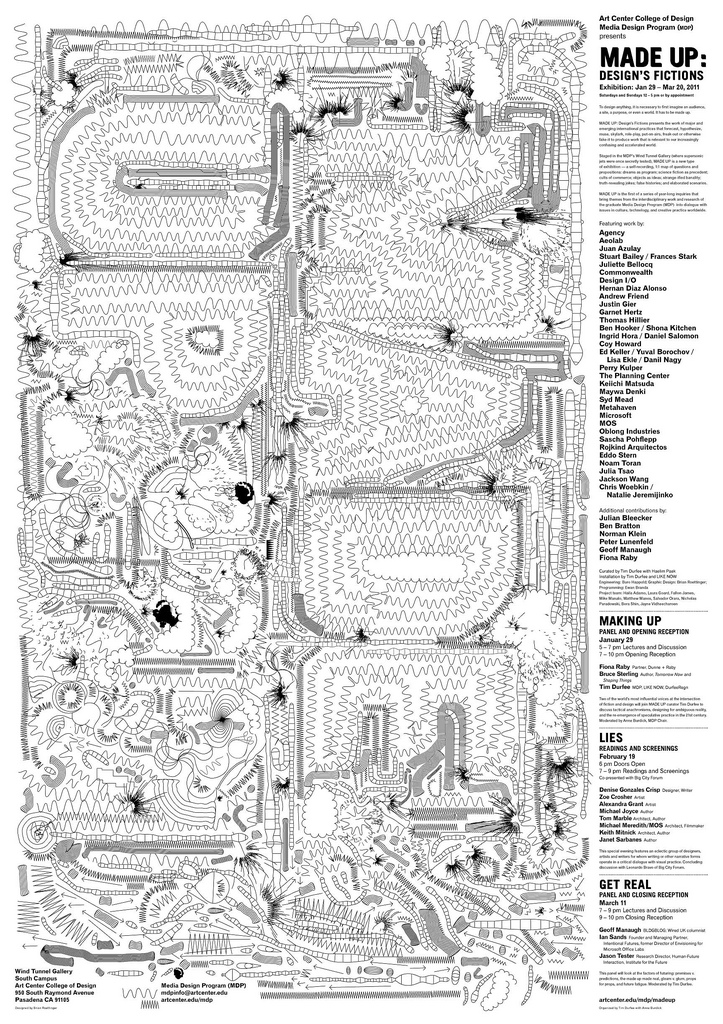
[Image: The poster, designed by Brian Roettinger, for MADE UP: Design’s Fictions; view larger].

For those of you near Pasadena tomorrow evening—Friday, 11 March—the Art Center College of Design will be hosting a panel discussion at 7pm called “Get Real.” It features Jason Tester from the Institute for the Future, Ian Sands from Intentional Futures, and myself.

We’ll be discussing what the Art Center describes as “the factors of futuring: promises v. predictions, the made up made real, gleam v. glum, props for props, and future fatigue.”

Our panel coincides with the closing of an exhibition there called MADE UP: Design’s Fictions. Curated by Tim Durfee, MADE UP “presents the work of major and emerging international practices that forecast, hypothesize, muse, skylark, role-play, put-on-airs, freak-out or otherwise fake-it to produce work that is relevant to our increasingly confusing and accelerated world.” Among many other projects, it includes work by Protocol Architecture and Thomas Hillier, both first seen here on BLDGBLOG.

So if you’re in the neighborhood, it’s free and open to the public, and it all kicks off at 7pm; here’s a map.

The Robot and the Architect are Friends

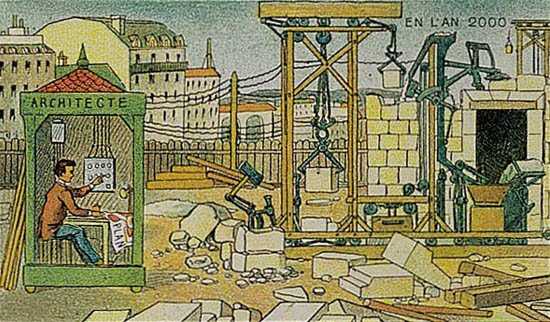
[Image: The architect and his construction robots by Villemard].

In 1910, French artist Villemard produced a series of illustrations depicting what life might be like in the year 2000, including an architect and his robotic construction crew.

In an article published last summer in Icon, called “The Robot and the Architect are Friends,” Will Wiles wrote that Swiss architects Gramazio & Kohler “have a vision: architecture using robotics to take command of all aspects of construction. Liberated from the sidelines, the profession would be freed to unleash all its creative potential—all thanks to its obedient servants, the robots. But first, architects must learn the robots’ language.”

[Image: Courtesy of Icon].

It all sounds deceptively easy at first: the architects have merely to program their robotic arm “to pick up a brick and place it, and then to repeat the process with variations. When this program runs, the result is a wall.”

The machine itself moves with the clipped grace we associate with robotics, performing neat, discrete actions that contain within them an assortment of fluid swivels and turns. These quick-slow, deliberate movements are hypnotic. It’s beautiful to watch but, because it moves in a way that looks animal while being unlike anything we know in nature, there’s something in it that’s inescapably unnerving.

Given multiple robots, sufficient bricks, complex instructions, and enough time, “extraordinary forms” can result, patterned and pixellated, brick-by-brick.

[Image: “Pike Loop” (2009) by Gramazio & Kohler].

“Considering the revolutionary potential of their work,” Wiles writes, “you might expect a note of utopian zeal from the pair.” He quickly adds, on the other hand, that, “if you want dazzling Wellsian predictions, delivered with glittering eyes, of future armies of architect-controlled mechanoids transforming the world, you’ve come to the wrong place.” Gramazio & Kohler’s vision is, instead, “understated, modest, [and] reasonable.”

Nonetheless, some combination of Villemardian enthusiasm—airborne tennis!—with rigorous architectural robotics, and perhaps even with emerging new brick designs and a new generation of 3D printers, is an enticing vision to pursue for the future of building construction.

(Villemard image originally seen via Selectism, thanks to a tip from Jon Bucholtz. Earlier on BLDGBLOG: Flying Robotic Construction Cloud).

Weather Architects of the Year 2050 A.D.

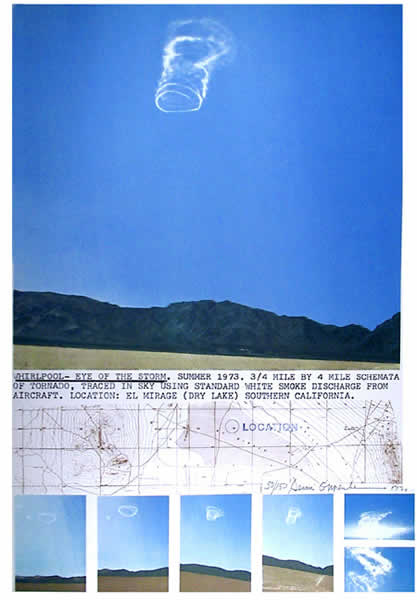
[Image: “Whirlpool” (1973) by Dennis Oppenheim].

Artist Dennis Oppenheim’s “Whirlpool” project, from the summer of 1973, sought to create an artificial tornado on the bed of a dry desert lake in Southern California. It was intended as a “3/4 mile by 4 mile schemata of tornado,” the above image explains, “traced in [the] sky using standard white smoke discharge from aircraft.”

As the Telegraph describes it:

Employing one of [Oppenheim’s] characteristic quasi-scientific methods, the piece was created by issuing radio instructions to an aircraft which discharged a liquid nitrogen vapor trail. The aircraft began by flying in revolutions measuring three quarters of a mile in diameter. Subsequently the pilot was instructed to repeat this manoeuver but, with each revolution, he was made to reduce the size of the diameter of the circle and lose height—and it is no mean feat controlling a plane according to these specifications. The operation had to be repeated three times before the desired whirlpool effect was achieved.

In a short story called “The Cloud-Sculptors of Coral D,” J.G. Ballard envisions a tropical atoll where the residents have learned to “sculpt” clouds in the sky, listening to Wagner over loud speakers and using specially engineered gliders and flying techniques.

“Lifted on the shoulders of the air above the crown of Coral D,” Ballard writes, “we would carve seahorses and unicorns, the portraits of presidents and film stars, lizards and exotic birds. As the crowd watched from their cars, a cool rain would fall on to the dusty roofs, weeping from the sculptured clouds as they sailed across the desert floor towards the sun.”

They are part aesthetic object, part weather system.

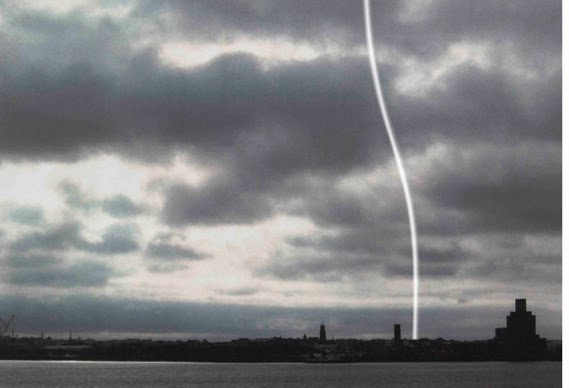
[Image: “Column” by Anthony McCall, courtesy of Creative Review].

Both of these came to mind this weekend when I read that artist Anthony McCall is planning to create something called “Column” in Liverpool, to coincide with the London 2012 Olympics. It will be “a spinning column of cloud a mile high,” as Creative Review describes it, “visible across the North West region throughout the Olympic year.”

Made of cloud and mist, this “swirling micro-climate” will be “created by gently rotating the water on the surface of the Mersey and then adding heat which will make it lift into the air like a water spout or dust devil.”

We’ll have to see how it actually works out, of course, but the idea that cities might soon deploy large-scale specialty weather-effects—that is, permanent climatological megastructures—instead of, say, Taj Mahals or Guggenheim Bilbaos as a way of differentiating themselves from their urban competition is a compelling one.

The future weather-architects of 2050 A.D. In-house climatologists spinning noctilucent clouds above Manhattan.

Cathedral Scan

Artist Blake Carrington turns Gothic cathedrals into sound.

As Carrington explains it, his project Cathedral Scan—which will be performed live on Thursday, March 3, in the basilica of St. Patrick’s Old Cathedral in New York City—”translates the architectural plans of Gothic cathedrals into open-ended musical scores via custom software. Treating the plans as a kind of map, in the live performance Carrington navigates through them to create diverse rhythms, drones and textures.”

Groups of scanners filling the sonic spectrum may act in synch, forming a single harmonically-dense rhythm, or they may scan the plans at different speeds, resulting in complex polyrhythms. Each plan is treated as a modular score, with a distinct rhythm and timbre of its own. Also, by varying the speed and intensity of each scanning group, drone-like sounds may emerge based on the “resonant frequency” of the black and white plan.

Coming out later this month, March 2011, is an album version, on which Carrington’s work is “edited from a live concert in a large church space, and combines the direct signal created in software with the immense natural reverberation of the performance space.”

The video embedded above consists only of the “direct signal”—that is, “without spatial acoustics”—recorded during a concert in Montréal back in October 2009.

Of course, it’s difficult not to wonder what this might sound like applied to radically other architectural styles and structural types, from, say, the Seagram Building or the Forth Bridge to underground homes in Cappadocia. Further, it would be interesting to see this applied not just to plans or sections—not just to architectural representations—but to three-dimensional structures in real-time. Laser scans of old ruins turned from visual information to live sound, broadcast 24 hours a day on dedicated radio stations installed amidst the fallen walls of old temples, or acoustically rediscovering every frequency at which Mayan subwoofers once roared.

If you’re in NYC, be sure to check out Carrington’s concert.

(Thanks to Christophe Guignard, Sublamp, and Blake Carrington for the tip! Earlier: Listening to a machine made entirely from windows)

Modular Advances

[Image: Constructing with BeadBricks by Rizal Muslimin, courtesy of Brickstainable].

The winners of this year’s Brickstainable design competition were announced last week, and two of the technical award-winners are actually quite interesting.

[Images: BeadBricks by Rizal Muslimin, courtesy of Brickstainable].

I’m particularly taken by a submission called BeadBricks by Rizal Muslimin, described as able to facilitate the design of microclimates “in and around buildings” by allowing variable levels of porosity in the facade. BeadBricks could thus allow architects “to modulate the environmental factors including sunshine, wind, thermal mass, and evaporative cooling.”

The system, Muslimin explains, consists of “two bricks (A and B) with four basic rules that can generate shape in one, two and three dimensional space.” Further, “the bricks are decorated with a pattern that can generate various ornaments by rotating them along its vertical or horizontal axis.”

[Image: Constructing with BeadBricks by Rizal Muslimin, courtesy of Brickstainable].

The overall technical winner is also worth checking out: the EcoCeramic Masonry System, a “Recombinant and Multidimensional” molded terracotta brick devised by Kelly Winn and Jason Vollen.

[Image: The EcoCeramic Masonry System by Kelly Winn and Jason Vollen, courtesy of Brickstainable].

As Brickstainable describes it, their brick system “showcases the ability to look at new ceramic-based wall assemblies. Strategies include thermal dynamics, self-shading, moisture reduction, hydroscopic, evaporative, and termite behavior studies.”

[Images: The EcoCeramic Masonry System by Kelly Winn and Jason Vollen, courtesy of Brickstainable].

Meanwhile, a related project comes to us from designer Dror Benshetrit, who recently invented his own modular system, called QuaDror. On the other hand, it’s not really a “brick”; Fast Company describes it as “a structural joint that looks a little like a sawhorse, but can fold flat, making it both stunningly sturdy, remarkably flexible, and aesthetically pleasing.” Check out the video:

The suggested uses for QuaDror “include support trestles for bridges, sound buffer walls for highways, a speedy skeleton for disaster or low-income housing, and quirky public art.”

All in all, I would love to see more exploration with all three of these ideas, and I look forward to seeing all of them utilized in projects outside the design studio.

(Thanks to Thomas Rainwater for the tip about QuaDror and to Peter Doo for keeping me updated on Brickstainable).

Pay-As-You-Go Urbanism

[Image: By San Rocco].

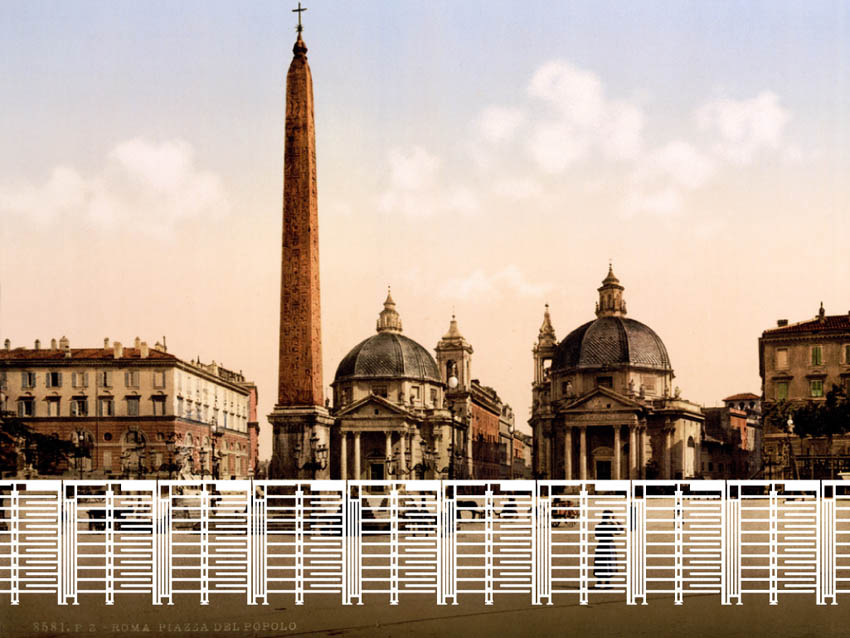
In December 2010, San Rocco, an Italian magazine dedicated to contemporary spatial culture, produced the two images seen here. They were created in response to a move by the Italian Minister of the Interior to extend an anti-hooliganism ban—originally intended as a way to protect the city from violent sports fans—and using it, instead, as a means for spatially preventing “political rallies.”

San Rocco have thus shown both Venice and Rome closed off behind museum-like turnstiles and security barriers, or what the magazine calls “efficient technological devices to regulate access to public space.”

[Image: By San Rocco].

Even divorced from their political context, though, these images are provocative illustrations of another phenomenon: that is, the museumification of urban space, particularly in Venice, a city steadily losing its population.

The idea that we might someday see the urban cores of historic European cities simply abandoned by residents altogether and turned, explicitly, into museums, surrounded by pay-as-you-go turnstiles, does not actually seem that far-fetched.

(Spotted via Critical Grounds).

Architectural Potential Energy

[Image: From the forthcoming Pamphlet Architecture #32 by Stasus].

The forthcoming Pamphlet Architecture #32, on the theme of “resilience,” will be authored by Matt Ozga-Lawn and James A. Craig of Stasus, a young design firm based in Edinburgh and London.

[Images: From the forthcoming Pamphlet Architecture #32 by Stasus].

The pamphlet, which will explore a series of post-industrial sites in the city of Warsaw—”a desolate area of disused freight rail tracks, commercial lots, gasometer buildings and other industrial apparatus,” as the architects describe it—is more explicitly narrative than the other pamphlets that have been most recently published.

“The scope and intent of our book,” Stasus writes, citing such influences as Piranesi and Andrei Tarkovsky’s film Stalker, “is to highlight the importance of forgotten landscapes in our cities and the potentialities that can be extracted from them.”

A sprawling, unplanned city centre threatens a desolate landscape that still embodies many resilient aspects of the city. In many ways, the “value” of this landscape, though barren, could be said to exceed that of the new centre. The profound additional meanings inherent to a disused rail track in Warsaw, for example, eclipse the meanings inherent to a city block of financial skyscrapers. Rather than replace or erase these attributes, we aimed to augment the resiliency of the meanings that were embodied in every element of the landscape we stumbled across. As our design process progressed this methodology spread to every aspect of our thinking.

Within this urban landscape “on the edge of oblivion,” as they describe it, “frozen, awaiting the imminent state of transition from one state to the next,” they focused on a series of found objects and particular locations—a kind of readymade architectural forensics of the city.

[Images: From the forthcoming Pamphlet Architecture #32 by Stasus].

Their chosen strategy seems to have arisen directly from a course taught at the University of Edinburgh by professor Mark Dorrian.

As Dorrian himself explains, his students were urged “to set aside all familiar hierarchies, and recognize that dust, a discarded piece of paper or a scratch on the floor is as important as a window, cornice, column or door. We are in a situation in which everything counts—or at least in which we can discount nothing.” Overlooked minor objects, apparently without use, and peripheral spaces of the city, apparently without residents, were thus taken as central to the course’s architectural intentions.

[Images: From the forthcoming Pamphlet Architecture #32 by Stasus].

For their part, Stasus interpreted this design brief as requiring the use of narrative in order to help them reveal their site’s future spatial possibilities. In their own words:

Once identified, the design process takes the form of a testing and investigation of the properties inherent to these existing landscapes of possibilities. The more resistant certain elements are to transformation, deletion, or manipulation, the more they are worked into the design process and become adapted within and integral to design “outputs.” The approach is therefore vastly different from a blank-paper methodology. Rather than creating our own clearing for design work, we aim to identify the most resilient elements within our field of exploration. These may be meanings passed through material context, implied mythical narratives, incidental connotations, historical and pre-historical implications.

“Our design process could therefore be described as an investigation of the resilient qualities of that which exists, a navigation of resilient landscapes,” they summarize.

And it is the work that came out of that course that thus forms the conceptual backbone for the work that will soon appear as Pamphlet Architecture #32.

[Images: Derelict landscapes and optical devices scaled up to the size of megastructures, by Stasus].

In his introductory essay for the pamphlets, Dorrian suggests that Stasus’s work “draws upon the strange imagined half-lives of obsolescent and anachronistic things” that are “charged with the future.”

Put another way, abandoned objects, locations, and spaces have a particular kind of architectural potential energy, a lack of precise definition that allows them to hover somewhere between promise and realization; however misleading it might actually be, then, dereliction implies a unique capacity for transformation—an ability to assume radically new spatial characteristics in the future—whilst simultaneously presenting what we could describe as fossils of an earlier world, one that has long since disappeared or ceased to operate.

[Images: From the forthcoming Pamphlet Architecture #32 by Stasus].

In any case, I’ve included some preliminary images from the pamphlet here, as well as some project images by Stasus; for more, check out Stasus’s website and keep your eye out for the Pamphlet itself, which I assume will be out sometime in the autumn.

Castle of Shadows

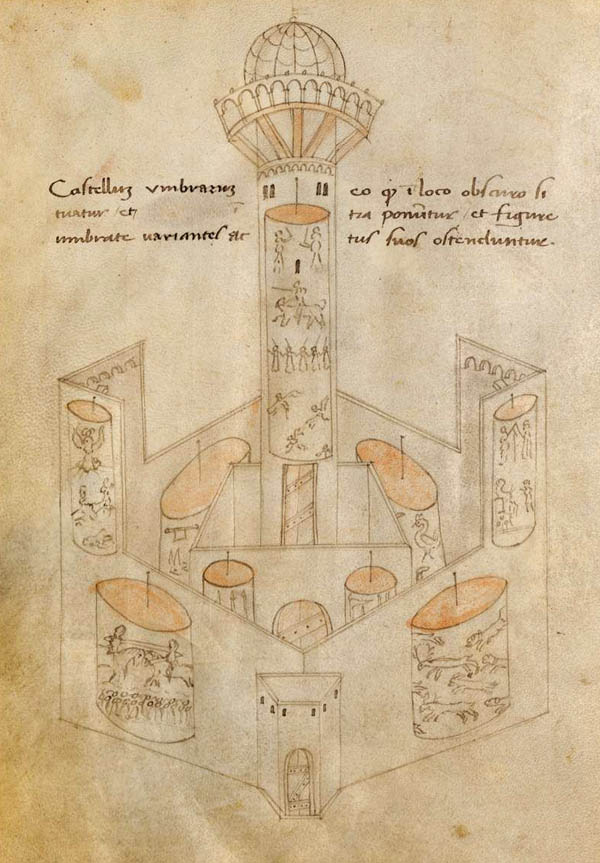
[Image: Giovanni Fontana’s 15th-century “castle of shadows,” from a paper by Philippe Codognet].

In a book published nearly 600 years ago, in the year 1420, Venetian engineer Giovanni Fontana proposed a mechanical construction called the Castellum Umbrarum, or “castle of shadows.”

Philippe Codognet describes the 15th-century machine as “a room with walls made of folded translucent parchments lighted from behind, creating therefore an environment of moving images. Fontana also designed some kind of magic lantern to project on walls life-size images of devils or beasts.” Codognet goes on to suggest that the device is an early ancestor of today’s CAVE systems, or virtual reality rooms—an immersive, candlelit cinema of moving screens and flickering images.

Calling All Agents

Here’s a quick rundown of some things you might want to attend, participate in, write for, keep your eye on, etc.
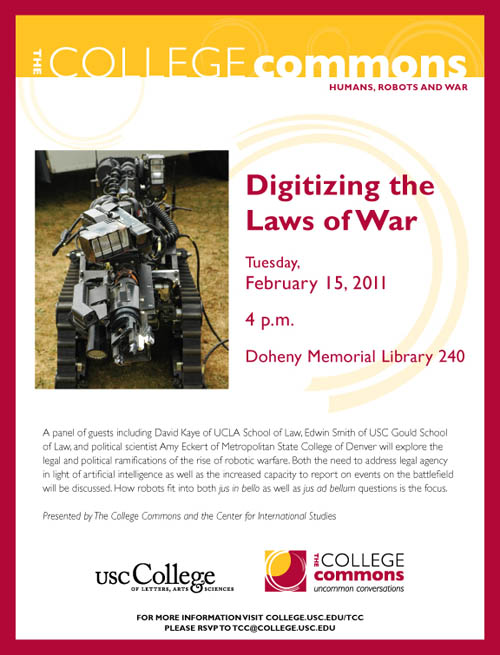
1) The discussion series Humans, Robots and War continues at 4pm this afternoon with “Digitizing the Laws of War” at USC: “A panel of guests including David Kaye of UCLA School of Law, Edwin Smith of USC Gould School of Law, and political scientist Amy Eckert of Metropolitan State College of Denver will explore the legal and political ramifications of the rise of robotic warfare. Both the need to address legal agency in light of artificial intelligence as well as the increased capacity to report on events on the battlefield will be discussed. How robots fit into both jus in bello as well as jus ad bellum questions is the focus.” A sequel of sorts takes place on April 7: “Robotics, Warfare and Humanity.”

2) Also today, at 7pm, at the Arid Lands Institute in Burbank, Vinayak Bharne and Dilip da Cunha will participate in The Agency of Water: Scarcity, Abundance, and Design in Dialog, lecturing on, respectively, “Urbanism, Infrastructure & the Urban Water Crisis: Perspectives from Asia & the American Southwest” and “Negotiated Landscapes: Mississippi, Bangalore, and Mumbai.”

3) As mentioned before, a forthcoming collection called Making a Geologic Turn, edited by Friends of the Pleistocene, is seeking contributions about, among many other things, how “contemporary artists, popular culture producers, and even philosophers are adding new layers of meaning and sensation to [the] ‘geologic.'” Abstracts are due March 1, 2011.

4) The Heart of Texas Boundary Retracement takes place March 3-5, 2011, and it sounds fascinating: it “will be a modern-day search for original survey corners. (16 CEUs) By utilizing county record information, GLO field notes, working sketches and aerial photos, the original surveys can be positioned within a small search area. Licensed State Land Surveyors will be party chiefs to guide you through the process using information found on the ground. This area has not been bulldozed, chained or root plowed like many of the ranches in Texas, therefore providing a rare opportunity to find several of the original corners.” The boundary retracement will take place on Wulff Cedar Creek Ranch, the geographic heart of Texas.

5) Thresholds 40 “invites projects, ideas, and beliefs in a variety of media, including scholarly papers, visual work, and philosophical treatises, that explore the dangerous and messy theme of the socially conscious project.”
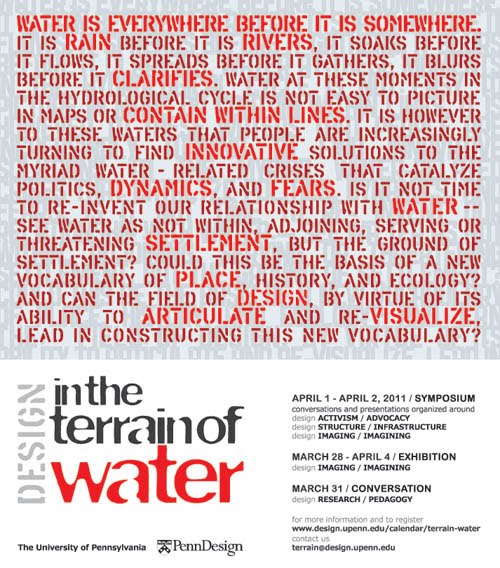
6) Speaking of water, meanwhile, on April 1-2, 2011, the University of Pennsylvania will be hosting a symposium called In the Terrain of Water: “Water is everywhere before it is somewhere. It is rain before it is rivers, it soaks before it flows, it spreads before it gathers, it blurs before it clarifies. Water at these moments in the hydrological cycle is not easy to picture in maps or contain within lines. It is however to these waters that people are increasingly turning to find innovative solutions to the myriad water-related crises that catalyze politics, dynamics, and fears. Is it not time to re-invent our relationship with water—see water as not within, adjoining, serving or threatening settlement, but the ground of settlement? Could this be the basis of a new vocabulary of place, history, and ecology? And can the field of design, by virtue of its ability to articulate and re-visualize, lead in constructing this new vocabulary?” Check out their site for more information.

7) “The Ambience conference focuses on the intersections and interfaces between technology, art and design. The first international conference in the Ambience series was held in Tampere, Finland in 2005. In Tampere 2005, the basic theme was ‘Intelligent ambience, including intelligent textiles, smart garments, intelligent home and living environment.’ In Borås 2008, it was ‘Smart Textiles—Technology & Design’ and, in Borås 2011, it will be the new expressional crossroads where art, design, architecture and technology meet: digital architecture, interaction design, new media art and smart textiles.” Abstracts for a special issue of Studies in Material Thinking are due by April 1, 2011.

8) From June 22-23, 2011, catch Tunnel Design & Construction Asia 2011 in Singapore.

9) “We are seeking contributions from all disciplines to an American Studies essay collection on Dirt. Dirt is among the most material but also the most metaphorical and expressive of substances. This collection hopes to bring together essays that explore how people imagine, define, and employ the various concepts and realities of dirt. What does it mean to call something dirty? How do we understand dirt and its supposed opposite, cleanliness? How do we explain the points at which we draw the line between clean and dirty, what we embrace and what we refuse to touch? Drawing on multiple disciplines we hope to uncover and foreground the (often unconscious) centrality of the metaphors and actualities of dirt to U.S. cultures, values, and lived experiences.” Essays are due December 11, 2011.

(Thanks to Nicola Twilley, Javier Arbona, Jeremy Delgado, Catherine Bonier, and Mette Ramsgard Thomsen for the tips!)

Buy a Tube Station

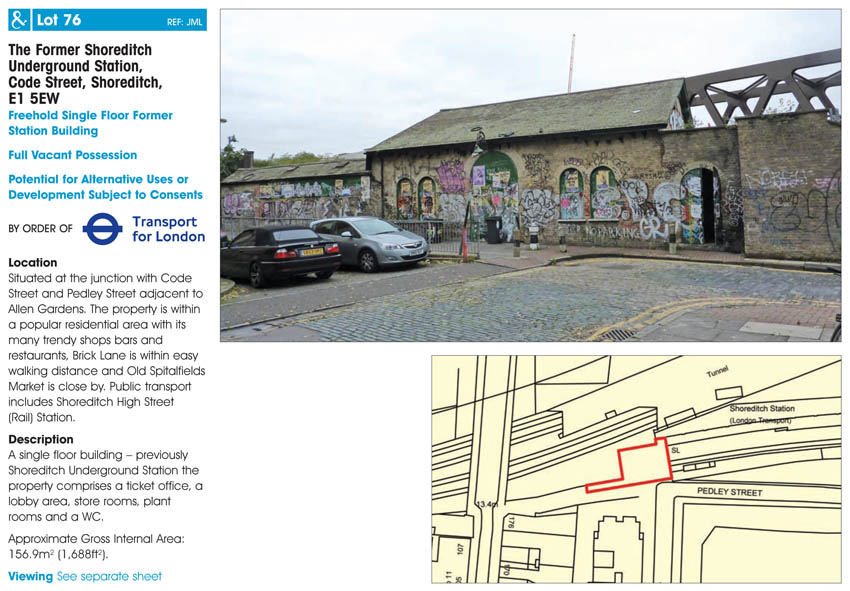
For those of you in London, today was your last opportunity to stop by the old Shoreditch Tube Station for a scheduled viewing: the whole thing is up for sale, listed at £180,000.

[Image: The old Shoreditch Tube station is for sale; image and property info courtesy of Andrews & Robertson].

“Situated at the junction with Code Street and Pedley Street adjacent to Allen Gardens,” the auctioneers explain, “[t]he property is within a popular residential area with its many trendy shops, bars and restaurants.” For instance, “Brick Lane is within easy walking distance and Old Spitalfields Market is close by.”

The single-floor building, pictured above, courtesy of the auctioneers, “comprises a ticket office, a lobby area, store rooms, plant rooms and a WC.” Owning a former Tube station with an address on Code Street would be an amazing thing, indeed. BLDGBLOG would move its offices there in a heartbeat.

(Thanks to Jim Stephenson for the tip! Earlier on BLDGBLOG: Buy an Archipelago, Buy a Map, Buy a Torpedo-Testing Facility, Buy a Fort, Buy a Church, Buy a Silk Mill).