Real Estate From Above

[Image: From Real Estate – 100 Aerial Drawings by Heman Chong].

For his project Real Estate – 100 Aerial Drawings, artist Heman Chong “collected satellite pictures of Singapore.” He then “traced out” one hundred buildings “from a bird’s-eye view” (or satellite’s-eye view), mounting the images in red on white to match the colors of Singapore’s flag.
The result is architectural form abstracted from its terrestrial setting, turned into nothing but shape. Each image even vaguely resembles some alien craft out of Space Invaders – a game whose title is an apt metaphor for real estate development as such.

[Images: From Real Estate – 100 Aerial Drawings by Heman Chong].

Japanese sound artist Toru Yamanaka then composed five really nice little soundtracks for the project’s website; each soundtrack loops after roughly a minute (or so), and the first three, in my opinion, are the best. Melancholic machine-drones and urban noise intersecting.
The buildings range from structural archipelagos scattered across large urban sites –

[Image: From Real Estate – 100 Aerial Drawings by Heman Chong].

– to perfectly Euclidean shapes; some even look like corporate logos –

[Image: From Real Estate – 100 Aerial Drawings by Heman Chong].

– emblazoned on the planet, as if some firm would design their HQ specifically to be viewed by satellite. Future facades, in the age of Google Earth.

(A brief interview with Heman Chong here; and thanks to Melissa for the tip!)

Freezone

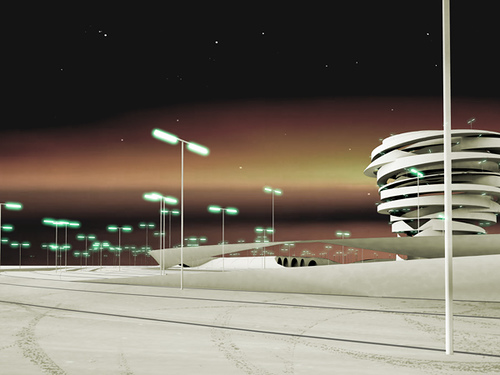
[Image: freezone, by Stanza. According to the project brief, “each unit allows for peace and quiet inside an information free zone.” It’s “the holiday destination of the future.” You can’t be spammed, virused, phoned, emailed, tracked – aside from the fact that your location is rather public – or RFID’d, etc. You could be RPG’d on the other hand… It’s secession from the dataworld, via utopian architecture. More projects, including velodrone, where traffic jams “trigger audio visual light displays of generative music.” (Spotted at WMMNA)].

Quick list 2

[Images: Raytheon’s flying antenna-blimp (via Defense Tech), and an “11.2-kilometer tunnel [being dug] through a mountain more than 2,400 meters high in Central Ecuador”/ENR].

Raytheon is working on “a radar antenna that spans the length of a football field.” Even better, it flies: “The airship, remaining essentially motionless, could hover for long periods above the jet stream at altitudes of 65,000 to 70,000 feet, with the antenna transmitting on UHF and X-band.”
Going in the opposite direction, a German firm is drilling one of the deepest tunnels in the world – though it is also one of the highest. The tunnel is simultaneously “under more than 900 meters of earth” and “more than 2,400 meters high,” passing through the mountains of central Ecuador. As Engineering News-Record reports, the geology is immensely complicated there and the tunnel has already collapsed twice; it is part of a much larger hydroelectric power scheme for the Ecuadorian Andes.
Fascinatingly, to secure loose rubble inside the tunnel – including cracks in the walls and ceiling – the project engineers “inject” the mountain “with resins and foam to consolidate the mass and stabilize it.”
So what new veins of weird geology will Andean hikers stumble upon in a few ten million years…?

[Image: The tunnel’s route/ENR].

Another tunnel back in the news is NYC’s City Tunnel No. 3, explored several months ago on BLDGBLOG, and photographed beautifully by Stanley Greenberg.

[Image: City Tunnel no. 3; photo by Sewell Chan/New York Times].

Meanwhile, Japan is working on a 30-year weather forecast via the Earth Simulator – not an Amsterdam-based performance artist but one of the world’s fastest supercomputers. The Earth Simulator “occupies a warehouse the size of four tennis courts in Tokyo,” and scientists want to use it “to map the routes taken by typhoons, heatwaves and droughts, and potentially spare millions from death and disease.”
Then there’s this near-perfectly arranged photograph – of GWB speaking on an empty airport tarmac – which rewards sustained analysis. The transnationally geometric infrastructure of power:

[Image: From the NYTimes – though I now can’t find the article].

On the other hand, here is the geometry of war:

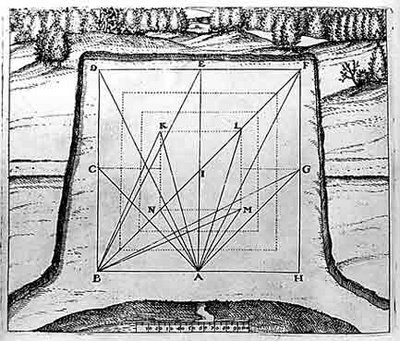
The mathematicians of the Renaissance applied their geometry to all manner of practical disciplines – from navigation and surveying to cartography and perspective. They aimed to demonstrate the usefulness of geometry as well as its ingenuity and certainty, and to associate it with action, achievement and progress. Many new instruments were designed in this context, as the collections of this museum amply demonstrate.

[Image: “A system of fortification and its protagonist.” Courtesy of the Museum of the History of Science, Oxford].

Developments in the art of warfare in the late 15th and 16th centuries provided another outlet for geometry, and the mathematicians were quick to respond by devising techniques, designing instruments and writing books. Heavy guns manufactured in single metal castings were longer, capable of more accurate fire, and were adjustable in elevation. Consequently, gunners needed instruments to measure both the inclination of the barrel and the distance to the target, together with a means of relating these two measurements. Geometers offered a variety of solutions to these problems, as well as designs for fortifications to withstand attack from the new artillery.

Emphasis mine. Here is a list of images – but don’t miss the elevated fortress or this spiky precursor to the Pentagon.

[Image: A geometrical town survey; courtesy Museum of the History of Science. (Via)].

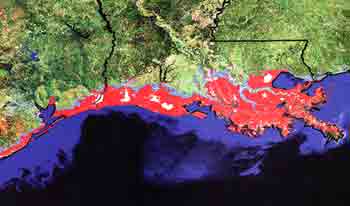
Finally, as this was meant to be a quick list… 1) The earth’s volcanoes are singing: “High-powered computers are being used to convert seismic readings from Mount Etna in Sicily and Tungurahua in Ecuador into audible rumbles, roars, beeps, and even piano music. The technique, known as ‘sonification’, is used to help people detect patterns in complex data.” 2) The United States is being genetically en-golf-coursed by “creeping bentgrass,” a genetically-modified grass immune to commercial pesticides; it was designed to make golf courses easier to maintain and more lush underfoot. Now it will destroy you. 3) The unexpectedly impressive landscape architecture firm EDAW wants the Los Angeles River to include “a Class I bicycle path in and along the Arroyo Seco Channel between the communities of Highland Park and Cypress Park.” EDAW’s Gulf Coast Mapping Study is also well worth a look (here’s a PDF).

[Image: “The red areas, including New Orleans, lie less than four feet above sea level and could be threatened by storm surges, flooding , and rising sea levels.” Courtesy EDAW].

4) This is great – Dennis Dollens uses “Bio-observation and Software Growth as an approach to conceptualize and demonstrate growing architectural elements such as canopies and columns.” Via WorldChanging. 5) This is ridiculous.

(Earlier: Quick list 1).

The endgame, the absent, the void

For a variety of reasons, I found myself re-reading an interview I published on Archinect a few months ago with photographer David Maisel – and I really am so enamored with Maisel’s work, and so interested in almost everything he has to say, that I thought I’d just post a quick reminder here for anyone who may have missed the interview when it first went up. At the very least, the images are stunning – but Maisel himself is also a thoughtful, funny, remarkably perceptive guy, so the interview itself, I think, justifies a second look.
Here, then, are some teasers, including images and quoted excerpts. If your interest is piqued: here’s the actual interview.

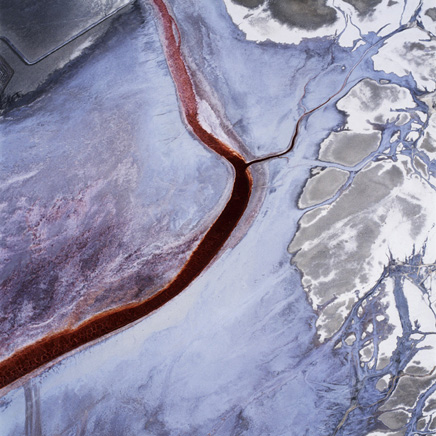
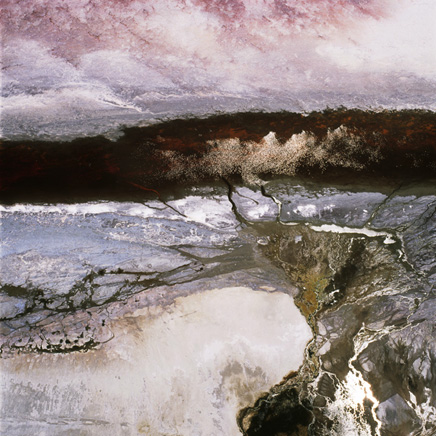
9823-4[Image: David Maisel, from The Lake Project].

Maisel is perhaps best-known for his aerial photographs of Owens Lake, California. As cinephiles will no doubt remember, Owens Lake was drained in the early 20th century to water the lawns of suburban Los Angeles (a notorious act of hydrological theft that found its way into American mythology through Roman Polanski’s film Chinatown). Owens Lake is now a Dantean wasteland, one of the most toxic sites in North America:

The only moving things are the dust devils that coalesce and spin in the afternoon heat, swirling white towers of cadmium, arsenic, sulfur, chlorine, iron, calcium, nickel, potassium, aluminum, chlorine. The lakebed emits 300,000 tons of such matter every year; thirty tons of it arsenic, nine tons of it cadmium. We had dreamed of building cities, fields of glittering towers, urban fantasies meant to house our hopes of progress; now we seek out dismantled landscapes, abandoned, collapsing on themselves. Rather than creating the next utopia, we uncover the vestiges of failed attempts, the evidence of obliteration.

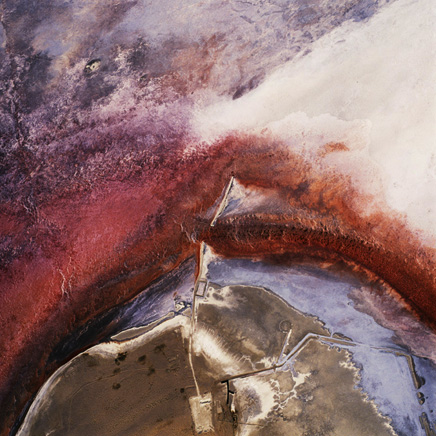
9277-1[Image: David Maisel, from The Lake Project].

From the interview:

“For the most part, I’m interested in landscape images not merely for what they look like, but for what they make us feel, and for what they might represent metaphorically. I’ve also wanted my pictures to take the viewer to places and sites they’ve never seen before, with a resulting sense of alienation or displacement. I’m less interested in being warm and fuzzy than in being harsh and cruel! [laughter] Those possibilities don’t exist when looking at the familiar.”

Elsewhere in the interview, Maisel explains how he is interested “in extreme scale, in boundlessness and formlessness, in desolation and landscapes of ruin.” In the process, he uses photography to expose “the undoing of things, the endgame, the absent, the void. I’m drawn to aspects of the sublime, and to a certain kind of visceral horror, and in a sense I am using my landscape imagery in order to get to that feeling, as much or even more than I am documenting a specific open-pit mine or cyanide leaching field or clear-cut forest. And I’ll readily admit that my work may not hold up very well from a documentary standpoint.”

9821-119828-12[Images: David Maisel, from The Lake Project].

The rest of our conversation covers Californian hydropolitics, the line between architecture and photography, “replicant” landscapes, the dusty fate of human remains, Iceland, The Drowned World by J.G. Ballard, Mars rovers, 9/11, and the aesthetic power of sterility.

(Note: To read more about Ballard’s The Drowned World, see BLDGBLOG’s first post of 2006: Silt).

10 Mile Spiral

[Image: 10 Mile Spiral, “A Gateway to Las Vegas,” by Benjamin Aranda and Chris Lasch].

In their recent and immensely enjoyable book Tooling, New York-based architects Benjamin Aranda and Chris Lasch propose, among other things, a “10 mile spiral” that will “serve two civic purposes for Las Vegas”:

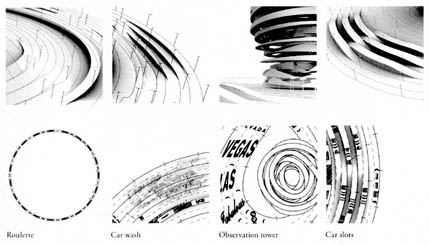
First, it acts as a massive traffic decongestion device… by adding significant mileage to the highway in the form of a spiral. The second purpose is less infrastructural and more cultural: along the spiral you can play slots, roulette, get married, see a show, have your car washed, and ride through a tunnel of love, all without ever leaving your car. It is a compact Vegas, enjoyed at 55 miles per hour and topped off by a towering observation ramp offering views of the entire valley floor below.

An aerial view of the spiral, in all its gas-guzzling glory, wound up like a snake on the periphery of the city:
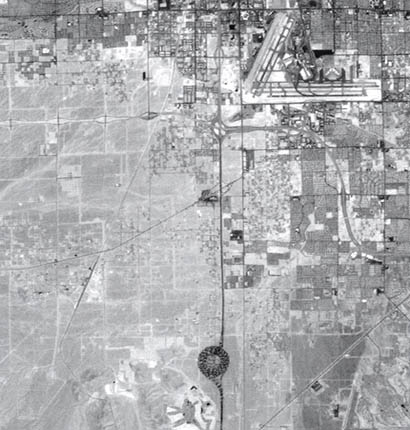
[Image: Aranda/Lasch, from Tooling].

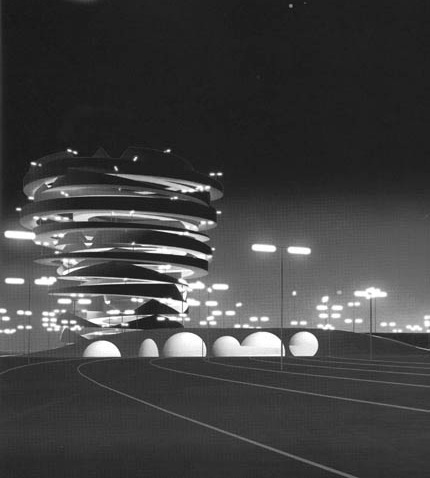
Drivers will enter this vertical labyrinth of concrete, approaching a whirligig-like compression of the desert horizon and gradually lifting off into the sky. It’s a kind of herniation of space through which you could theoretically drive forever. (Given enough gasoline).
The spiral itself is beautiful –
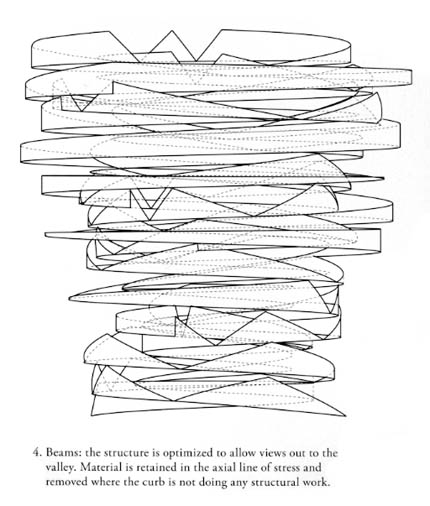
– and absurd. Its form was generated algorithmically as “a helix whose radius varies randomly as it climbs and then falls back down to the valley floor.” The structure’s “intersection points” are then located, acting as stress-sites “through which the structure’s loads are channeled to the ground.”
It’s an internally buttressed Futuro-Suprematist cathedral to cars.
[Image: Aranda/Lasch, from Tooling].

At the end of the book, Aranda/Lasch note that every project featured in Tooling was “constructed through simple steps, repeated over and over until something of substance was revealed”:

These steps are usually straightforward geometric transformations – short sets of rules that we develop – sometimes to build a custom tool that had not yet existed, but more often to better understand the forms we wish to make. Tapping the number-crunching power of the computer opens up new design possibilities and gives us the capacity to grow and proliferate structures that we otherwise could not, but probably more important is deciding when to curb their growth, cut their shape, or stop using them altogether.

In this regard, their architectural projects have much more in common with, say, the calculation-dependent music of Autechre than with anything explicitly spatial – unless that space is the coiling inward voids of conch shells, perhaps, or the strangely mathematical scaffolding of radiolaria.
At some point, Aranda/Lasch add, all the algorithmic tools they themselves used will be made available to anyone else who wants to explore them; to see if that’s happened yet, check this website in a few months’ time.
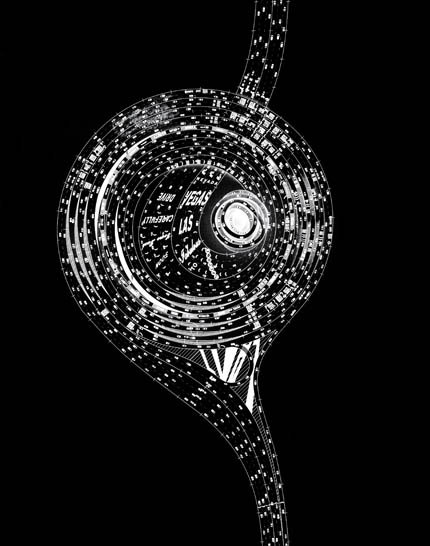
[Image: The spectacular glowing interior of that which has no outside: it’s the 10 Mile Spiral from above, at night, lit from within by automobiles. Aranda/Lasch, from Tooling].

I can’t end this post, however, without quoting J.G. Ballard; it’s like a nervous tic, seeing so many roads – and out comes Concrete Island, Ballard’s now-classic novel about an architect trapped by a car crash in the “compulsory landscaping” of Greater London’s excess motorways: “In his aching head the concrete overpass and the system of motorways in which he was marooned had begun to assume an ever more threatening size. The illuminated route indicators rotated above his head, marked with meaningless destinations.”
The man falls prey to thirst, insomnia, delirium: “Gazing up at the maze of concrete causeways illuminated in the night air, he realized how much he loathed all these drivers and their vehicles.”
The man then searches for “some circuitous route through the labyrinth of motorways” – but finds none. He is trapped, a new Crusoe of roads, “alone in this forgotten world whose furthest shores were defined only by the roar of automobile engines… an alien planet abandoned by its inhabitants, a race of motorway builders who had long since vanished but had bequeathed to him this concrete wilderness.”
Leading me to wonder: what new futures of human experience could arise in the 10 Mile Spiral?
[Image: Aranda/Lasch, from Tooling].

(For more on Concrete Island, see BLDGBLOG’s own Concrete Island, in which those same quotations appear. Then, after you’ve express-ordered your own copy of Tooling – because any book with a chapter called “Computational Basketry” should be required reading – you can visit Benjamin Aranda’s and Chris Lasch’s work at the University of Pennsylvania’s Non-Linear Systems Organization, where they were recently research Fellows).

Inflatable Infrastructure

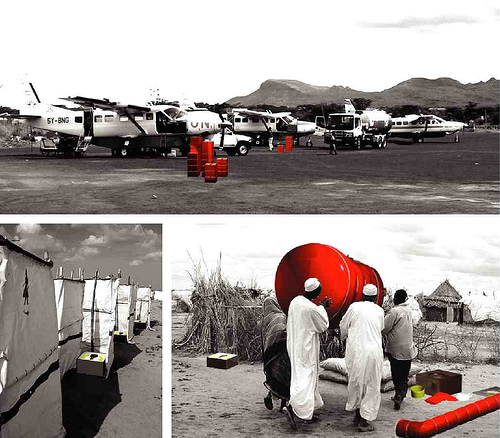
Blowup/Breakdown is an inflatable, biodegradable septic system that addresses sanitation and environmental issues at disaster relief and refugee camp sites. Fabricated using polyactide polymer (PLA) – a novel bioplastic – the Blowup/Breakdown system safely and ecologically isolates, treats and disposes of faecal waste in emergency situations minimizing human and environmental contact with harmful contaminants.”
Just don’t over-inflate it…

Studiocycle_DeployDesigned by Studiocycle – and a runner-up at this year’s Metropolis Magazine Next Generation awards – the inflatable septic infrastructure has “a useful life of approximately two years.” After that time, the whole system “biodegrades into carbon, water and biomass allowing both its components and contents to safely assimilate into the surrounding soil and cause minimal environmental damage to the campsite.”
This 10.3mb PDF will tell you much, much more – including technical specs on air pumps, folding gaskets, and structural rings.

Urban Design Review

I’m pleased to announce that the Summer 2006 issue of the Urban Design Review has been released; it’s also the first issue for which I served as Senior Editor. There will be many more to come.

The issue includes some fantastic work. You’ll find an amusing – and much-needed – analysis of New York Times Magazine real estate ads, written by Brand Avenue’s own Chris Timmerman; Charles Jencks’s Iconic Building is reviewed by Michiel van Raaij, the latter being one of today’s most uncannily sharp-eyed critics of iconic architecture (van Raaij’s blog is worth a long visit); David Haskell gives us an essayistic look at urban event places, reviewing architectural attempts “to make the city a perpetual festival”; and, among many other texts – including short interviews with both Charles Jencks and Mike Davis – you’ll find an interview with Jinhee Park and John Hong of SINGLE speed DESIGN. SsD is now relatively well-known for their work on the ingenious Big Dig House, a single-family home built from old Boston highway parts. The Big Dig House was reviewed three days ago in USA Today.
From SsD‘s own description of the project:

As a prototype for future Big Dig architecture, the structural system for this house is almost wholly comprised of steel and concrete from Boston’s Big Dig, utilizing over 600,000 lbs of recycled materials. Although similar to a pre-fab system, the project demonstrates that subtle, complex spatial arrangements can still be designed and customized from pieces of the I-93 offramps: Varying exterior and interior planes create an ascending relationship from ground to roof as large upper-level plantings blur interior and exterior relationships.

UDR is published by David Haskell’s Forum for Urban Design. (David is also Founder and Editor-in-Chief of Topic Magazine).
So check it out.

Antarctic Unearthly

[Image: ©Renae Baker].

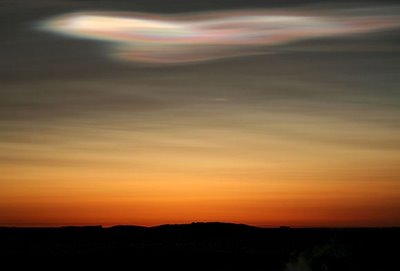
“Some of the coldest temperatures on Earth brought a rare cloud formation to the skies over Antarctica,” SF Gate reports. “Meteorological officer Renae Baker captured spectacular images of the nacreous clouds, also known as polar stratospheric clouds, last week at Australia’s Mawson station.”

[Image: ©Renae Baker].

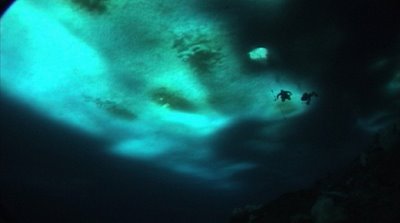
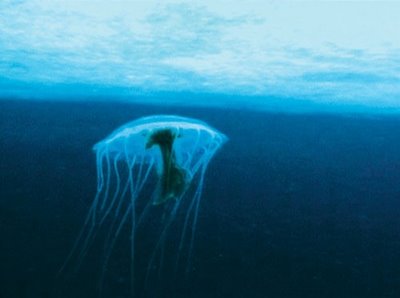
Meanwhile, Wired introduced us last month to Werner Herzog’s forthcoming science fiction film, The Wild Blue Yonder, which uses the undersea Antarctic seascape as a stand-in for liquid extraterrestrial environments.

[Image: Werner Herzog/Wired – many more photos here].

“Instead of spending millions on Spielberg-style effects, Herzog went low tech and high geek,” Wired writes. “He spliced together documentary footage from NASA and the National Science Foundation’s US Antarctic Program. He created ‘characters’ from documentary-style scenes with actual physicists and astronauts.”

[Image: Werner Herzog/Wired].

Apparently, whilst viewing “mesmerizing images of ethereal jellyfish and swarms of crystalline microorganisms mingling in a cobalt twilight beneath a 20-foot-thick sheet of ice,” Herzog instinctively felt: “This is not our planet.” (One assumes the sentiment should, in Herzog’s case, be taken literally).

[Image: Werner Herzog/Wired].

The film “opens with a wide shot,” Wired explains: “A vast, vaulted ice canopy stretches over the horizon as two human silhouettes descend through a glowing portal into the dim indigo void. They fan out weightlessly, their breath echoing like whispers in an empty cathedral. Something approaches – a speck, silently swelling into what looks like a translucent bullet lined with undulating fringes of silk. The creature hovers in close-up, then darts away in a cascade of ice shards; dissonant music fades, then swells as the humans forge farther into the blue-green deep.”

[Image: NOAA – who, elsewhere, presents us with the literature of abysses].

That “blue-green deep,” however, is also an uncanny incubator of evolutionary weirdness. The deep sea octopus, for instance, first made its appearance in Antarctica’s waters: “Australian researcher Dr. Jan Strugnell of Queen’s University Belfast and the British Antarctic Survey says the formation of ocean currents around the continent millions of years ago provided the right conditions for ocean creatures to evolve,” the Australian Broadcasting Corporation reports.
Amazingly, deep sea octopi appear to register, in their genes and anatomy both, the continental make-up of plate tectonics at the time of their earliest evolution – think of it as forensic landscape history at a biological remove: “About 34 million years ago, Antarctica separated completely from South America, with the opening up of Drakes Passage. This allowed the Antarctic Circumpolar Current to form, which insulated the continent and allowed it to get really cold. As cold water is more oxygen rich than warm water, oxygen from Antarctic waters would have been able to then diffuse into the deep seas along with Antarctic octopuses, which then evolved into deep sea octopuses. ‘The opening of the Drakes Passage fits in with evolution of the group,’ says Strugnell.”
Which leads me to wonder if a specific mountain range in Africa – or Asia, for that matter – catalyzed an exact and specific thousand-year microclimate in which simian ingenuity could last across sufficient generations that some group eventually opposably-thumbed its way toward a larger brain. Or a certain valley, a specific rain corridor, a particularly comfortable belt of well-grassed savannahs – these landscapes could afford the time and space in which specific organisms would gradually develop themselves and evolve.
Writing this, of course, I realize how obvious it is that that’s exactly what did happen; but, then, assuming someday we discover the exact mountain (or gorge) that helped produce a rain-shadow that helped produce a climate that helped produce a fertile niche in which tool-using hominins could hang-out long enough to discover gods, writing, and warfare, shouldn’t that specific landmark receive some kind of protected, even vaguely familial, status? The Ur-mountain.
What if it’s been turned into a copper mine?
Or if there is no such thing?
Reversing the question, of course, could you bulldoze, plow, till, and plant your way toward some wild mega-landscape specifically engineered – topographically, climatically, acidically, and so on – based upon how it will catalyze the evolution of new species in a hundred thousand years’ time? Landscape architecture as a distant subset of genetic engineering: planting your garden based on what cross-hybridized evolutionary outgrowths may someday appear – but doing this on a continental scale, and with a time-frame of eons. Landscape futures, indeed.
Werner Herzog can film the design process.
A species will look back at its originary landscape, like an octopus drifting through Antarctic waters, overwhelmed with strange feelings of gratitude.

(Big thanks to Bryan Finoki for the Antarctic clouds article!)

Lunar urbanism 7: Being post-terrestrial


[Image: “The Alliance to Rescue Civilization differs from other so-called doomsday projects. It envisions a lunar base where, in the event of global catastrophe, humans could carry on, protecting DNA samples of life on Earth and maintaining a bank of human knowledge.” They will all be avid readers of BLDGBLOG].

“What kind of feeble doomsday would leave London safe and sound?” the New York Times asked this morning. Indeed.
After all, any doomsday deserving of the word would surely destroy London – as well as every other city along with it. Perhaps even the whole planet.
Thankfully, then, there’s the so-called Alliance to Rescue Civilization, or ARC. According to the New York Times, ARC is “a group that advocates a backup for humanity by way of a station on the Moon replete with DNA samples of all life on Earth, as well as a compendium of all human knowledge – the ultimate detached garage for a race of packrats. It would be run by people who, through fertility treatments and frozen human eggs and sperm, could serve as a new Adam and Eve in addition to their role as a new Noah.”
It’s interesting to read Biblical metaphors in the context of what amounts to science fiction, I have to say; at the very least, this raises the question of what officially banned Catholic heresies might once have existed – whose practitioners were all burnt at the stake for simply having reimagined the Bible as a kind of space opera written by Isaac Asimov. Emerging from the desert is a machine, full of light, called The Transubstantiator. Satanic anti-churches of dark matter spiral through magnetic voids…
In any case, the “mission” of the Alliance to Rescue Civilization is, in their own words, “to protect the human species and its civilization from destruction that could result from a global catastrophic event, including nuclear war, acts of terrorism, plague and asteroid collisions. To fulfill its mission, ARC is dedicated to creating continuously staffed facilities on the Moon and other locations away from Earth. These facilities will preserve backups of scientific and cultural achievements, and of the species important to our civilization. In the event of a global catastrophe, the ARC facilities will be prepared to reintroduce lost technology, art, history, crops, livestock and, if necessary, even human beings to the Earth.”
The near impossibility of choosing exactly what “species [are] important to our civilization” is an issue for another day.
Finally, the idea of building a post-terrestrial earth surrogate that will save – or even mischievously re-direct – the human future is nothing new; a somewhat similar project, for instance, is Asteromo, Paolo Soleri’s space-based drifting utopia, an artificial asteroid within which astral pilgrims will breed.

(Earlier: Lunar urbanism 6, Lunar urbanism 5, Lunar urbanism 4, Lunar urbanism 3 – and so on).

Altering Antarctica


[Image: Courtesy of NASA’s Earth Observatory].

There are a wide variety of overlooked and forgotten ways in which humans participate with, and alter, the biological systems around them. A few seeds, trapped in the soles of our shoes, can cross oceans with us in airplanes, bringing gardens, and weeds, and parasite species, to the other side of the earth; trace amounts of infectious diseases can cling to our clothes and decimate livestock several nations away; snakes, rats, spiders, mosquitoes – all can easily ride the ships and planes of globalization.
Our economy is crowded with invasive stowaways intent on surviving elsewhere – even if survival means irretrievably altering the new host environment.
In other words, travel itself can be something of a biological activity: we do the migratory work of other species for them. We take them with us. Importations of even the smallest microbe can sufficiently alter an ecological niche, opening it up to further changes – then compounding over time into whole new landscapes. What would happen naturally is accelerated: a thousand years in a decade.
It shouldn’t surprise us, then, to learn that strange things are afoot in Antarctica.

(To read more, you’ll have to visit WorldChanging – for whom this post was originally written).

A Sketch for London

For an exhibit during last month’s London Architecture Biennale 2006, curator Matteo Cainer invited “architectural studios from outside the UK (…) to sketch a visionary project for London.” Graphic speculation about another London yet to come, Cainer hoped, would “further consolidate architecture’s role in imagining a future for the city”:

Architects have been invited to take an outsider’s view, and as such submit a sketch for an imaginative project in the city of London. They are free to choose a site and focus, whether addressing issues of planning, landscape, infrastructure or building. The central challenge remains what it has been for centuries: to make architecture a vessel for new and controversial ideas. Gathering together architects with sketches, and critics with words, will entice visitors into a theatre of architectural imagination where a wide range of daring projects, conceived by some of the most inventive and newly emerging architects, come together in a panorama of architecture’s current potential and promise. This will in turn create a platform for discussion and a critical examination of today’s approach to architecture.

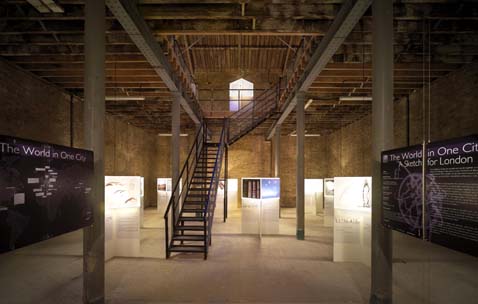
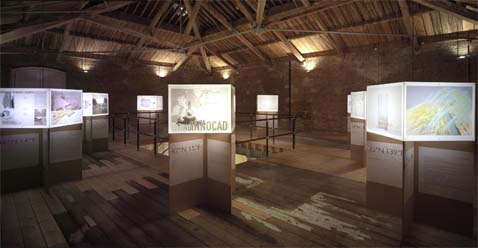
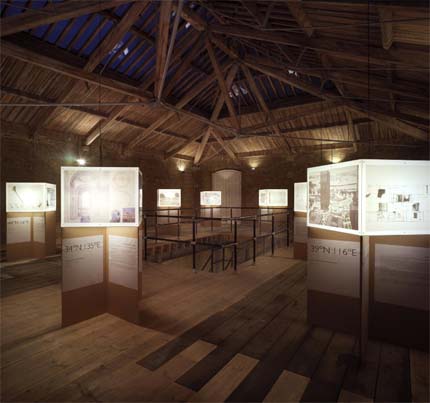
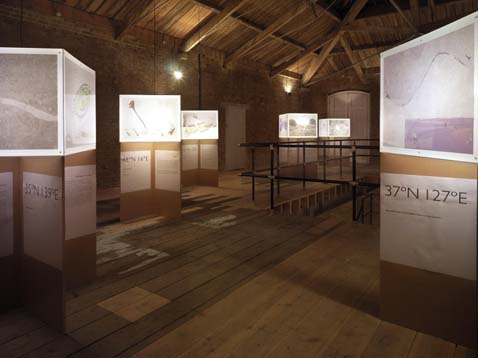
The result was The World in One City – A Sketch for London, an exhibit beautifully designed by Cainer’s own Design Research Studio at Fletcher Priest Architects.

[Images: ©Chris Gascoigne].

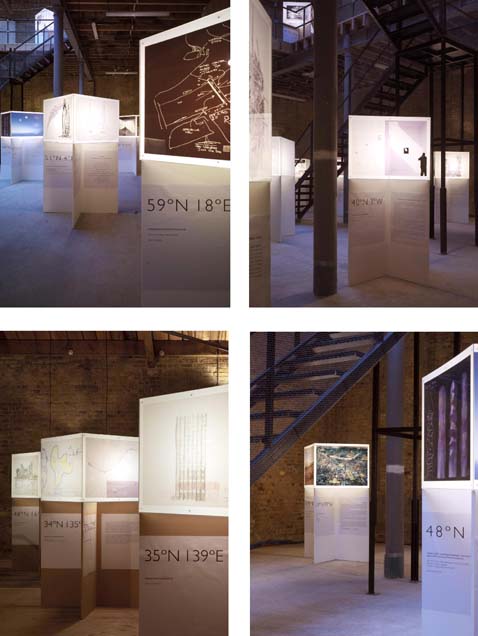
After emailing Cainer expressing interest in the exhibit itself and in the architectural projects it featured, he responded with a PDF from which these images were taken. Here we see interior shots, offering a glimpse of the show’s dominant theme: coordinate points of latitude and longitude, geographic sites of architectural speculation.

[Images: ©Chris Gascoigne].

“The show tries to move beyond the current scene, dominated by cyberspace and video simulation,” Cainer explains, “and beyond the familiar client restraints and the fashion parade of magazines.” Instead, the exhibit’s purpose is to focus on “the ‘sketch’ as the fulcrum of architectural imagination. Concepts and subsequent sketches are often underestimated: sketching is not only practical but also essential; it is the quickest, most accessible way for generating ideas.”

A website for the show is in the works, as well as a publication.
Finally, let me just add that the idea for this exhibition is totally fantastic, and that every city in the world, frankly, should perform this kind of imaginative self-reflection at least once every few years. By openly speculating about conjectural urban futures – whether those include pedestrian malls, blimp-aquariums, or even insanely ambitious green roof projects – residents of cities everywhere can be reminded that their own urban environment is an ongoing project, and that everyday life itself can be upgraded, reprogrammed, better designed. After all, the architectural future is just a few words and sketches away.