Quick list 5: Energy, tunnels, landscape, and ruin

[Image: By Nicolai Grossman, of Photon Detector fame].

Like some weird cross between the Bible, William Blake, and a botanical Finding Nemo, the British landscape is alive with plants that escaped from gardens: “About one-quarter of plants sold to ornamental gardeners since the 1800s have escaped, and 30 per cent of these are firmly established in the English countryside.” It seems these inadvertant landscapes-at-a-remove could actually have been financially predicted; historical researchers “found that the odds of escape increased with how widely available and inexpensive a given plant was at the time.” Leading me to wonder if a similar approach, today, could be used to plot prices of wildflowers, garden herbs, and domestic tree species against the projected future landscape of Ohio, say, or Brecon, Wales: price-maps as a subset of future landscape geography.
Speaking of future landscapes, New Scientist‘s look at an earth without humans was republished and discussed everywhere last week – but, in case you missed it, here’s a link. From the article: “Left once more to its own devices, Nature would begin to reclaim the planet, as fields and pastures reverted to prairies and forest, the air and water cleansed themselves of pollutants, and roads and cities crumbled back to dust.”

[Image: A related graphic, from the Times Online].

Further: “If tomorrow dawns without humans, even from orbit the change will be evident almost immediately, as the blaze of artificial light that brightens the night begins to wink out. (…) The loss of electricity will also quickly silence water pumps, sewage treatment plants and all the other machinery of modern society.”

The same lack of maintenance will spell an early demise for buildings, roads, bridges and other structures. Though modern buildings are typically engineered to last 60 years, bridges 120 years and dams 250, these lifespans assume someone will keep them clean, fix minor leaks and correct problems with foundations. Without people to do these seemingly minor chores, things go downhill quickly.

Of course, ten years ago New Scientist offered a very similar look at what would happen if London was abandoned to the marshes and earthworms. “Within the first year,” we read, “dandelions and other weeds begin growing in the gutters and emerge from the cracks caused by frost and flooding in concrete, paving slabs and walls.” Fair enough. “Within five years,” however, “roads, pavements parking places and the great squares of the city are carpeted with weeds and a rich turf of clover.” Then, an “understorey of grasses and shrubs gradually spreads over the city. As the soil layer builds up, deeper-rooting plants take hold. Trees start to grow and their roots smash through what’s left of the pavement and tarmac,” until the whole of London looks more like Angkor Wat, or the lost city of Z, than it does Notting Hill. Etc. etc.
The article’s parting shot: “In a flood plain like London’s, inundation of foundations and natural soil movements would leave very few buildings standing after 1000 years. By that time, both the oak and the floodplain forests would be mature and the rubble of Canary Wharf would have sunk into the marsh.” (See Silt for more on a flooded London).
Speaking of ruined cities, meanwhile, Pruned introduces us to a new boring machine – that is, a new machine that bores tunnels. Quoting from both Pruned and the project brief, the machine’s designer, we learn, hopes:

[to] deploy a robot to cities devastated by an earthquake, whereupon this “burrowing robot negotiates through the unstable rubble and solid earth, creating an interred, inhabitable structure from recycled debris. The raw system left behind by the robot provides a basic framework for shelter, infrastructure, and structural stability in an upheaved landscape. The resultant system is a landscape of interconnected spaces ready for human colonization.”

The machine would look like this:

[Image: From The Reinterred City].

There are many more images available at the project’s Flickr page.
Whilst pondering that mechanism, don’t forget that the Pamphlet Architecture 29 submission process is still open. So get published. And whilst you’re pondering that, don’t miss this year’s Next Generation competititon, sponsored by Metropolis:

The 2007 Next Generation® prize will finance the development of a bright idea that focuses on ENERGY, its uses, reduction, consumption, efficiencies, and alternatives. (…) On your own or in teams we invite you to submit work on urban plans, buildings, interiors, products, landscapes or communications design. The winner will receive $10,000 to realize his or her idea, and will be featured in Metropolis magazine.

One place you could start: is thorium the clean energy source of the future…?
Returning to William Blake – who once declared that “Energy is Eternal Delight” – the November 2006 issue of Wired features a fantastic article about Darren Aronofsky’s new film, The Fountain. In the article, author Steve Silberman describes how Aronofsky, determined to represent galactic space without the use of computerized special effects, came upon the work of Peter Parks, “a marine biologist and photographer who lives in a 400-year-old cowshed west of London”:

Parks and his son run a home f/x shop based on a device they call the microzoom optical bench. Bristling with digital and film cameras, lenses, and Victorian prisms, their contraption can magnify a microliter of water up to 500,000 times or fill an Imax screen with the period at the end of this sentence.

Having then constructed their own kind of universal microcosm, using “yeast, dyes, solvents, and baby oil, along with other ingredients they decline to divulge,” these DIY home f/x producers filled the end of Aronofsky’s film with “galactic clouds and pillars of dark matter that look like nothing else in science fiction.”

[Image: From The Fountain].

Such an approach gives The Fountain‘s grand finale “a handwrought quality that evokes the luminous etchings of William Blake.”
Turning our eyes away from space, toward the center of our own planet, we read that the “first known organisms that live totally independently of the sun have been discovered deep in a South African gold mine. The bacteria exist without the benefit of photosynthesis by harvesting the energy of natural radioactivity to create food for themselves.” They apparently “live in ancient water trapped in a crack in basalt rock, 3 to 4 kilometres down.”
Speaking of energy and the center of the earth, it’s never too late to revisit Manhattan’s (only?) geothermally powered townhouse:

[Image: From the Wall Street Journal].

According to the Wall Street Journal, the building’s “unusual geothermal energy system provides heating, cooling and hot water. Pipes extend about 1,400 feet into the earth, where the temperature is always about 52 degrees… The pipes transfer energy to the house, where two-layer-thick concrete exterior walls, filled with thermal materials, trap the energy and distribute it.”
Finally, part of Turkey’s new Marmaray Rail Tube Tunnel, set to open in 2010, will cut beneath the Bosporus strait.

0[Image: A visualization of project specifics; from New Scientist].

The Marmaray rail link “will not only be the deepest underwater tunnel ever constructed,” it “will also pass within 16 kilometres of one of the most active geological faults in the world.” Indeed, “the abutting plates move about 2 to 3 centimetres relative to each other every year.” However, using “flexible joints made from thick rubber rings reinforced by steel plates,” the central section, passing under the waters between Europe and Asia, will hopefully survive any major quakes. Or hopefully not, if you like disaster/rescue films.
Much more information available at, yes, New Scientist. (Thanks, Bryan!)

[Earlier: Quick list 4 and so on].

Overnight in the sleep-pipes

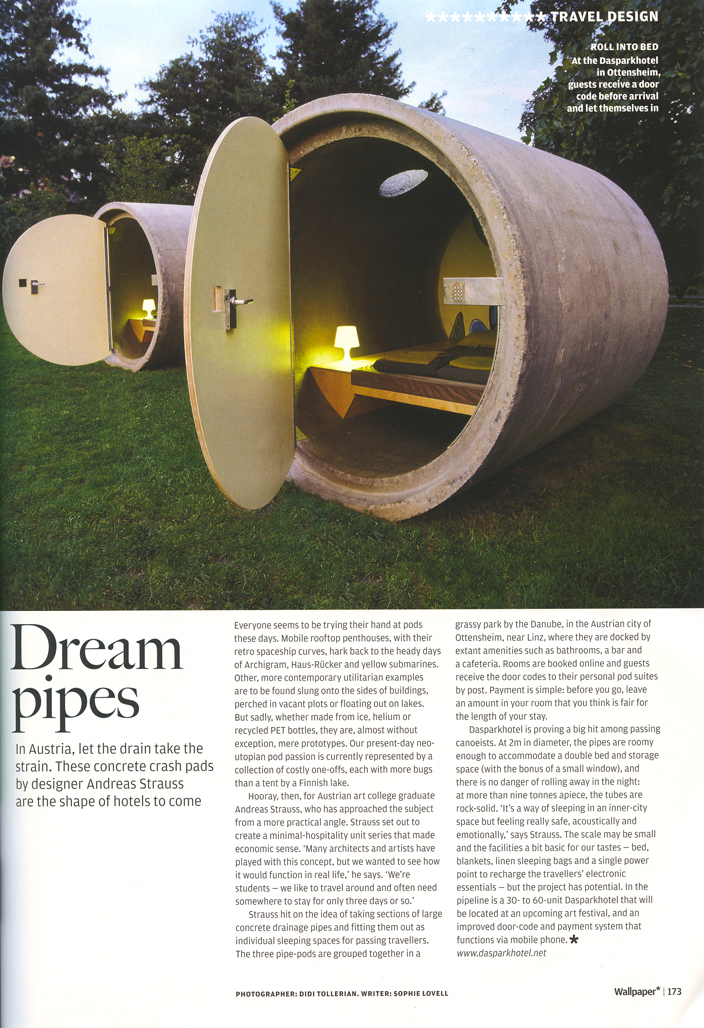
Austria’s relatively new dasparkhotel is an inn “constructed from repurposed, incredibly robust drain pipes.”


Each pipe’s Zen-like “external simplicity,” we’re told, “surrounds an unexpectedly comfortable interior – full headroom, double bed, storage, light, power, woolly blanket and light cotton sleeping bag. All other hotelery devices (toilets, showers, minibar, cafe, etc) are supplied by the surrounding public space.” Which means you piss in the bushes…?
In any case, dasparkhotel uses “simultaneously functional and comfortable concrete sleep-pipes” – or architecturally repurposed drains – to “offer the chance to experience a place in a totally new way.”


According to Wallpaper, the hotel is “a big hit among passing canoeists.”

(Via Archinect).

How An X-Ray Looks


As many of you will no doubt know, I interviewed photographer David Maisel back in March for Archinect. As it happens, Maisel has a new show of photographs opening up this weekend at the Paul Kopeikin Gallery in Los Angeles (6150 Wilshire Boulevard), and he’ll be at the gallery tomorrow night, October 21st, from 6-8pm.
The show consists of shots from Maisel’s series Oblivion: reverse-printed aerial views of Los Angeles. As Maisel explains in the Archinect interview, Oblivion “was realized in a post-9/11 time period, so seeing the urban world from the air simply was not the same as it might have been a few years earlier.” Further:

Getting permission to fly over the city was fraught with difficulty; the possibility of an airplane somehow turning the urban fabric into the site of an Armageddon-esque conflagration was implicit. At the same time, the meaning of “looking” within an urban environment has changed; it’s now more akin to an act of surveillance. Who gets to look? Who controls the gaze? Who controls the information seen? Who is or is not permitted to photograph the railroad tracks, the subway station, the public building? Is it unlawful to do so without permission? And who, or what entity, is given the power to grant such permission? By what authority is that bestowed?


Elsewhere, on his own website, Maisel adds: “Certain spatial fears seem endemic to the modern metropolis, and Los Angeles defines this term in ways that no other American city can approximate. This amorphous skein of strip malls and gated developments, highway entrance and exit ramps, lays unfurled over the landscape like a sheet over a recalcitrant cadaver. Surely the earth is dead beneath the sheer weight and breadth of this built form?”


Finally, Oblivion is simultaneously being released in book-form by the Nazraeli Press. There, in an essay accompanying Maisel’s photographs, author William L. Fox (the same William L. Fox discussed here) suggests that the tonal inversion so apparent in the Oblivion series works to disrupt the”circuitry of the city”:

The skyscrapers of downtown are now axonometric figures in a virtual reality, as if displayed in a Computer Aided Design program, and the course of the Los Angeles River is indistinguishable from those of the freeways. The oblique view… lays out a city as elaborate as that of a Persian carpet, yet it is as white as if it had been incinerated. What presumably is a blown-out, overexposed sky above the hills in the background is instead a black void that glowers over the city. It’s how an X-ray looks, how we imagine the military sees the monochromatic world when surveilling it at night. It’s as if we are seeing what the artist refers to as a “shadowland,” a place previously unobserved that coexists with its sunstruck version.

So come out if you can, meet David (and possibly meet William Fox?), and potentially even meet me, though I’ll just be there as a spectator. It should be a good night. Bring your friends, your Romans, your countrymen – as well as a few bucks so you can buy a signed copy of the book.

Project Blackbox


Sun has announced their Project Blackbox: a modular, prefab, stackable, shipping container-based, portable supercomputing and data storage warehouse – ideal for pirate utopias.
“After today,” they say, “you’ll never look at an ordinary shipping container quite the same way again. Project Blackbox is a prototype of the world’s first virtualized datacenter – built into a shipping container and optimized to deliver extreme energy, space, and performance efficiencies.” Project Blackbox is “a glimpse into the fast, cost-effective datacenter deployments coming in the near future.”
Somewhat incredibly, “[t]he Project Blackbox prototype is a computing powerhouse capable of hosting a configuration that would place it among the top 200 fastest supercomputers globally.”


Outdoing Archigram – who once dreamed of air-lifting whole prefab command/control systems into the wild, where, at the push of a button, computerized instant cities and other “plug-inscapes” could take form – Sun continues:

Project Blackbox packages compute, storage, and network infrastructure capabilities into scalable, modular units outfitted with state-of-the-art cooling, monitoring, and power distribution systems. Customers will be able to order a variety of standard and custom configurations of systems, storage, networking, and software. Housed in a standard 20-foot shipping container for maximum flexibility, Project Blackbox will be easily transported using common shipping methods. Simple hookups for water, AC power, and networking will enable customers to quickly deploy Project Blackbox upon delivery.


I’ve ordered eleven.

(Via Boing Boing).

Antarctica’s Underground Sphere-Cathedral

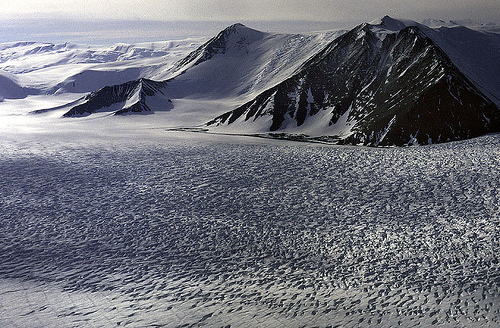
In his book Terra Antarctica – previously discussed here – author William L. Fox takes us to an Antarctic field research city called, appropriately, Pole. This geodesic-domed instant city is built on Beardmore glacier – which, Fox writes, is “a ferocious uphill maze riven with thousands of crevasses,” where high-speed winds are caused not by weather in any real sense of the word, but by “dense cold air sliding off the interior toward the coast via gravity.”

16[Image: “Beardmore Glacier, slicing its way through the Transantarctic Mountains.” Via Glaciers of the World].
Pole itself is an agglomeration of Jamesway huts, “corrugated metal tunnels” slowly blown over with snow, and the massive geodesic dome for which the city has become most famous. The dome is not precisely architectural, on the other hand: “The station is more like a raft floating on a very slow moving sea of ice two miles deep than a traditional building footed on the ground.”
It is structure imposed upon frozen hydrology: the insufficiently modeled glacial surface undergoes complicated deformations, thwarting all attempts to achieve longterm stability. It’s a kind of ice seismology.
In any case, one of the most interesting aspects of the whole thing is actually found below the city, in Pole’s so-called “sewage bulbs.” To quote at length:

Water for the station is derived by inserting a heating element – which looks like a brass plumb bob 12 feet in diameter – 150 feet into the ice and then pumping out the meltwater. After a sphere has been hollowed out over several years, creating a bulb that bottoms out 500 feet below the surface, they move to a new area, using the old bulb to store up to a million gallons of sewage, which freezes in place – sort of. The catch is, the ice cap is moving northward toward the coast (and Rio de Janeiro) at a rate of about an inch a day, or 33 feet per year. That movement means that the tunnels are steadily compressing; as a result, they have to be reamed out every few years to maintain room for the insulated water and sewage pipes. Because each sewage bulb fills up in five to six years, they’re hoping – based on the length of the tunnel and the number of bulbs they can create off it (perhaps even seven or eight) – this project will have a forty-year lifespan. Ultimately, in about the year A.D. 120,000, the whole mess should drop off into the ocean.

Rather than sewage bulbs, however, why not use the same technique to melt spherical chambers of a new, inverted cathedral one thousand feet below the Antarctic surface, a void-maze of linked naves and side-chapels moving slowly down-valley with the glacier…? Rather than a church organ, for instance, you’d have the natural music of the ice itself, a glacial moan of augmented terrestrial pressures. The whole system could be sanctified, renamed Vatican 2, and new saints of ice could win Bible study grants to reside there, in thick parkas, reading Thomas à Kempis over three-month stays. A new religious movement – called glacial mysticism – soon results.
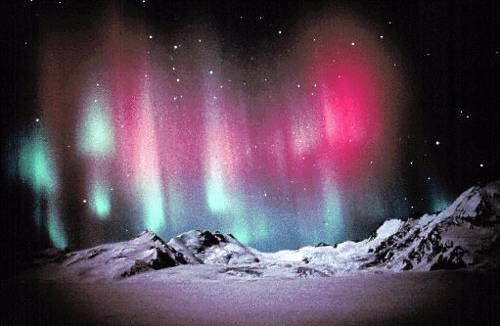
Unearthly, geometric, the voids of this new ecumenical church might even burn reflectively inside with the aurora australis.

4bg[Image: The aurora borealis – yes, the Northern, not Southern, Lights. Sorry. Via NASA].
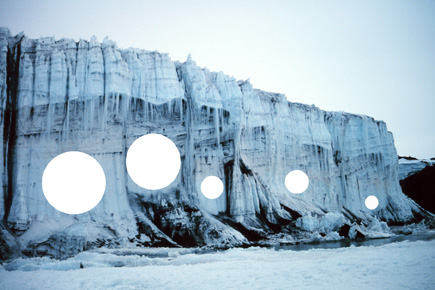
A hundred thousand years later, the cathedral reaches the sea, where its vast internal voids are broken open and revealed in the glacial cliff face. Sections of nave and pulpit can be found floating in the water, sculpted rims of prayer-domes drifting north in the smooth surfaces of icebergs. Here and there a complete chapel; elsewhere a crypt, its tombs’ chiseled inscriptions melting slowly in the sun.
Some future group of Argentine architectural students will then take a field-trip there, sketchbooks in hand, and they’ll spend two weeks back-mapping the precisely measured structure to its original, geometric clarity.

[Image: The BLDGBLOG glacial cathedral, adapted from this photo, ©Michael Van Woert/NOAA NESDIS/ORA].

Another hundred thousand years later, there’s no trace of the cathedral at all.

$5.4 billion

[Image: Stuyvesant Town and Peter Cooper Village, from the New York Times].

“Jerry Speyer, a real estate investor who controls some of [New York City’s] most prominent icons, like Rockefeller Center and the Chrysler Building, signed a deal today to buy 110 apartment buildings along the East River in Manhattan for $5.4 billion,” the New York Times reports. “The unremarkable brick buildings are set among trees and fountains on 80 acres of some of the most valuable land in the country.”

As one rumor flying around the BLDGBLOG offices here would have it, four of the buildings are to be set aside from all future resale and permanently locked; what goes on inside will be revealed by a series of horrifying documentaries aired on MSNBC in A.D. 2023…

That, or Mr. Speyer will die of a heart attack within two years and bequeath the whole site to an unsuspecting nephew – whose Romantic sensibilities will lead him to expel all tenants, then fence off the whole area against public intrusion; he will thereafter wander alone through 80 acres of abandoned tower blocks, wearing a hood, watching autumn leaves accumulate, writing the occasional sonata… When the rest of New York – and the world – is devastated by an outbreak of bird flu, this lone heir will survive on tomatoes and grains grown in his own small greenhouse, drinking his way through a cellar of wine, shooting rats, looking out across the rooftops of his own derelict city – upon the other derelict city that now surrounds him.

The exceptions

[Image: ©Frederic Chaubin, Wedding Palace (Tbilisi, Georgia, 1985). Last month, PingMag ran a short interview with photographer Frederic Chaubin. Chaubin has spent the last several years documenting Soviet-era architecture in post-Soviet nations, with a focus on the odd, the unique, and the eccentric. “If you see the photographs all together in a small space like here, you might feel like there are quite a lot of these buildings around, but actually there are very few of them. You have to imagine that if you go to each Russian town you will only find one or two very special buildings there. But most of them are very boring and look very similar, and those here are the exceptions.” I just like the above building, really].
Clearing Manhattan

The New York Times last week introduced us to a “giggling guru” named Maharishi Mahesh Yogi. In addition to laughing quite a lot, one of his apparent goals “is to rebuild the world according to Vedic principles. He has called for the demolition of ‘improperly oriented’ buildings, believing them to be toxic, and includes among them the United Nations and the White House. There are proposals for New York and Paris to be cleared to make way for 3,000 marble peace palaces. (His organization operates such palaces in Bethesda, Md., Lexington, Ky., Houston and Fairfield.) Maharishi is also convinced that every country’s capital is wrongly located. In India and America, his organization has bought land near what it calls each country’s ‘brahmastan’ – or the geographical and energy center. The future capital of the United States would be Smith Center, Kan., population 1,931.”

(Thanks, David! Also at Archinect).

Return of the Helicopter Archipelago

Several months ago, BLDGBLOG featured a collaboration with Leah Beeferman, a Brooklyn-based artist and the graphic designer for Cabinet magazine. That project was the Helicopter Archipelago.

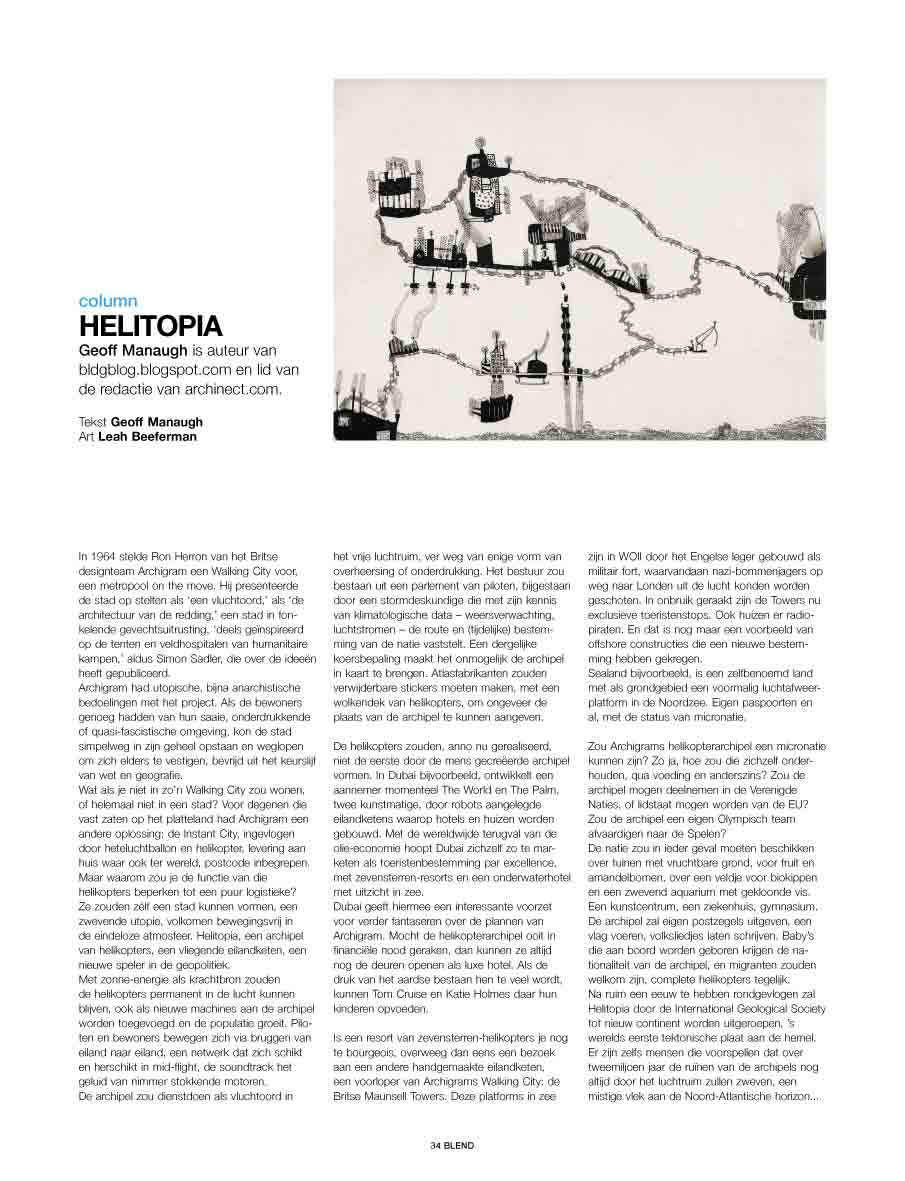
Blend 11The Archipelago was first published in Blend, however, a Dutch arts & culture magazine; and, having recently gotten hold of some PDFs from Blend‘s design team, I thought I’d post a quick glimpse of the page spread. (Sharp-eyed readers will notice that the text is in Dutch).
So, in case you missed it the first time round, the helicopter archipelago is an independent micronation of solar-powered helicopters, a flying island chain:

A kind of flying Hawaii, or anti-gravitational Micronesia, with tanned deck-hands leaping across aerodynamic tailfins to the soundtrack of ceaseless enginery, the helicopter archipelago would act as an escape hatch from traditional, nation-state sovereignty. Its government would be a parliament of pilots, led by experts in storms, whose access to climatological data – future weather, air speed, barometric pressure – would determine the nation’s route and direction.
Never leaving the international airspace of unregulated trade winds, the archipelago would be impossible to map. Atlas-makers and manufacturers of globes will simply include a pack of removable stickers, featuring small clouds of helicopters, to approximate the country’s location…

Further:

Once the archipelago is aloft for more than a century, the International Geological Society will declare it a flying continent, the world’s first airborne tectonic plate.
Some speculate that, two million years from now, the archipelago’s ruins will still hover in the sky: a ghostly blur across the north Atlantic horizon…

In any case, you can read more at the original post – whilst also stopping by Leah Beeferman’s website to see her other work, including drawn circuits and these assorted architectural explorations. In the latter link, don’t miss Leah’s “box factory” (2005) and “built” (2004).
Meanwhile, I have five or six more columns from Blend to republish here, so expect to see those in the next few weeks.