The Hills Have Eyes

[Image: An installation of work by photographer JR on the walls of a Rio favela].

“Undercover photographer” JR – who makes “photo galleries out of our streets” by exhibiting his work in public, as posters – has taken his exhibition strategy a step further. “What is at stake here,” he writes, referring to this change in tactic, “is the assessment of the possibilities of intervention in different environments.”
Amongst these environments are the favelas of Rio de Janeiro – however, here, these “possibilities of intervention” clearly include more opportunities for his work to gain greater exposure.

[Image: Work by JR in Rio].

I have a variety of reactions to this.
My first thought upon seeing these photos was actually that it was quite an interesting visual transformation of the favela. The realization that the Cubist surfaces of a mountain subcity might be transformed, through fragmentary glimpses of representational art – these shard-like pieces of larger works that only add up from certain angles, as if in parallax – seems to be a discovery worth taking further.
However, at least two problems open up here: are you visually transforming the ghetto so that those who live in the city below no longer have to look up and see themselves surrounded by blight? They will see, instead, a hot new contemporary artist on display?
Or could you visually augment the favela in a way that positively impacts both the self-image of, and the quality of life for, the people living there while not erasing the presence of that ghetto from the visual awareness of the central city dwellers? Perhaps there could even be something that looks, I might say, just as bad from the outside, but that nonetheless benefits the people living within.
So the question is: who is this art really for?
Because there’s actually a third player involved in all of this: the international art market, where these sorts of guerrilla exhibition strategies now increase one’s chances of canonization (and coverage on blogs).
Less critically, though, I’m also curious here about the use of representational art.
So often we’ve seen the walls of favelas repainted with primary colors and such like, in an attempt to beautify or, to be more sinister about it, visually correct an otherwise offensive built environment. However, using the faceted hillsides of a favela as a kind of gemlike canvas for representational art actually seems to open up more interesting possibilities.
Could you paint, or glue a poster of, all 200,000+ frames from a new film onto the surfaces of distant buildings? And treat the city as a kind of cinematic installation, a cubist filmography in which walking around is a form of experiential editing? You could live inside a fight scene, or in the closing credits.
Or perhaps you could hike to the top of Buena Vista Park here in San Francisco and look out toward the high-rises of downtown – and see a photograph, installed anamorphically across the rooftops of different buildings, only correctly visible from this precise location (but what if that photo… is a Coke ad?).
Perhaps the future of Cubism is not in some painter’s studio somewhere but in the ten million unexplored, minor surfaces of the city.
I’m reminded here of the (admittedly abstract) work of Felice Varini – and wondering what he might do, given a hillside with ten thousand surfaces all visible from multiple angles.
Finally, though, there are the eyes: in these images, you are being looked at in return. But who is meant to identify with this? Are these the eyes of the favela dwellers looking out upon a city they cannot access, as if to shame those more privileged residents? Or, as the poor wander home at night up steep streets, are these the eyes of the world looking down at them in judgmental scrutiny?
Again, though, there is a third class of people involved here. Perhaps these eyes aren’t looking at the favela at all, and they aren’t looking down at the city below.
They are looking out at the international art market, hoping for coverage in magazines and blogs, looking for their real, intended audience: the people who will see these photographs, at home, around the world. The city is merely their blank wall and host.

(Thanks to Adrian Giddings for the tip!)

The Wave Motors of California

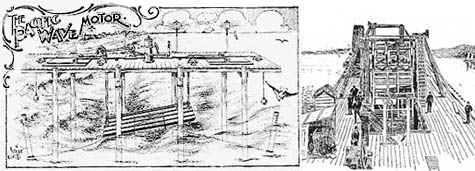
Still embedded somewhere in the shores of California, buried by more than a century of sand, are lost hydroelectric machines.

[Image: The Pacific Wave Motor, via the San Francisco Western Neighborhoods Project].

Deep in the prehistory of green energy technologies now being researched by Alexis Madrigal for his forthcoming book, there is a whole series of devices intended to generate power from the sea.
Precursors of today’s interest in tide power, these were “wave motors” and mechanized basins that turned the coast into a series of timed catchment reservoirs. The landscape itself became a machine.
One of the earliest patents filed for such technology was by Oakland resident Henry Newhouse in 1877. The purpose of his machine was “[t]o utilize the tide for a water-power,” his patent text read, as quoted by the San Francisco-based Western Neighborhoods Project, “and preserve a continuous power by means of the arrangement of a reservoir to catch the water at high-tide, and a discharge-basin to let the water out at low tide and shut it out while the tide is rising.”
Like something designed by Smout Allen, tunnels would be drilled through littoral rockfaces, even as natural bays were both expanded and reinforced. The coastline is soon a linked sequence of valves through which the tides can flow, generating electricity as they pass through a maze of elevated waterwheels and pumps.
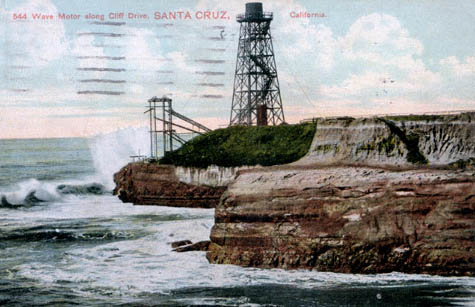
A great example of this type of wave motor comes to us from “the Armstrong brothers”; it was built on the coast of Santa Cruz in 1898. Quoting the Western Neighborhoods Project‘s description of that project:

The Armstrongs’ wave motor, an oscillating water column, was built inside the cliff. They had dug a thirty-five by six foot hole into the side of the cliff that ran to a level below low tide. From there another tunnel connected it with the ocean. Inside of the thirty-five-foot well was a pump, and attached to that a 600-pound float. When the waves crashed on the shore, they forced water through the tunnel and up the well, lifting the float, opening the valve and filling the pump. As the water receded, the well water would fall, dropping the pump and the float. The valve would close and the piston, under the weight of the float, forced the water through a pipe to a tank on the hill.

Certain to puzzle future archaeologists, “The only part of the wave motor that remains today is the thirty-five-foot deep well in the cliff.”
In other words, what now appear to be eroded cliffs and chipped coastal plateaus are actually derelict machine parts from the 19th century.

[Images: The Santa Cruz Wave Motor, originally from Scientific American; via John Haskey].

Take Adolph Sutro’s “Aquarium” project, eventually subsumed into his larger quest to create the Sutro Baths: Sutro’s “tide machine was built inside the rocky bluff at Sutro Cove that was then being referred to as ‘Parallel Point’.”

From a natural shelf 17 feet above mean tide level, a catch-basin was built to catch water from three directions. A canal, 8 feet high and 153 feet long with a downwards slope of 3 feet in a hundred carried the ocean water from the catch-basin to the settling basin on the beach. The settling basin, built of cement and of rock taken from boring the canal, was 80 feet long, 40 feet wide and 10 feet deep. It held 250,000 gallons.

One might say that these “wave motors” were a kind of prosthetic stratigraphy upon the surface of the earth; left to their own devices, perhaps in a million years they’d even fossilize.
In other examples of this phenomenon, however, the machines weren’t embedded into the geology of the landscape; they were instead constructed, Constant-like, offshore on wooden piers.

[Image: Constant’s New Babylon… reimagined as an offshore wave power farm].

“Most notable” of these designs, we read, “was the Starr Wave Motor of Redondo Beach which began construction in 1907. It was a large project that hoped to supply power for six counties. In the end, the enormous machine collapsed in 1909 because of the flimsy construction of the pier on which it was attached.”
As the Western Neighborhoods Project continues, this was actually just one of many of “the wave motors of southern California.”
Included amongst that sub-class were the Wright Wave Motor of Manhattan Beach (built in 1897), the Reynolds Wave Motor of Huntington Beach (built in 1906) and the Edwards Wave Motor of Imperial Beach (built in 1909). “The Wright Wave Motor is the only one of these Victorian era wave motors still in existence,” we read; however, incredibly, it is now “buried in the sand at the foot of the present pier in Manhattan Beach.”
How fascinating to think that beneath the sand are strange devices long since forgotten by the general public; a retiree out for a stroll one day with a metal detector receives incredibly strong signals from a certain stretch of forlorn coastline – only to begin excavating, slowly and over the course of many months, a monumental hydroelectric machine for which no documentation can be found.
The site is soon renamed Machine Bay – and excavations continue for more than a decade.

[Images: A postcard featuring the Santa Cruz Wave Motor; via John Haskey].

In any case, the very real possibility of generating electrical power from the ocean is something I would absolutely love to see happen – and I would be particularly excited to see California, with its 100 years of research precedence, assume global leadership. As the Western Neighborhoods Project writes, “In California the idea of power from the ocean has been pursued since the 1870s. Experiments have taken place as far south as Imperial Beach near the Mexico border and as far north as Trinidad, in Humboldt County.” And, today, interest in wave-generated electricity only seems to be gaining in strength.
For instance, gubernatorial candidate and San Francisco mayor Gavin Newsom has gone on record, in an op-ed for the Huffington Post, writing that we should “power America with ocean energy.” He even cites the working landscapes of Adolph Sutro; Sutro, San Francisco’s 24th mayor, “recognized the power of San Francisco’s waves,” Newsom writes, “building a wave catch-basin that he hoped to one day turn into a wave-powered ‘overtopping’ system near Cliff House.”
But Newsom also seems to be cultivating a vision in which San Francisco assumes a new position of centrality in the national debate over energy independence – and it would all be based in tides. He writes:

Today in San Francisco, we’re not just talking about ocean power, we are advancing its actual implementation. We have submitted an application to the federal government to develop an underwater wave project off San Francisco’s Ocean Beach that could generate between 30MW and 100MW of power. And we are actively working to develop a tidal power demonstration project in the San Francisco Bay that demonstrates the promise of technologies that capture tides.

I’m all for this, frankly. As Alex Trevi suggests in his post San Francisco As It Will Be (a response to the climage-change-inspired Bay Area design competition Rising Tides), there is an extraordinary amount of machinic innovation to be found in reimagining the region’s hydrology (from Trevi’s “Golden Gate Dam” to his idea for mobile sewers).

[Images: Via the Western Neighborhoods Project].

In fact, the very idea that, somewhere over the hills to the west of us here in San Francisco, there is a sequence of machines plugged into the oceanic itself, is extraordinarily inspiring.
In the process, the dynamic hydroelectric capacity of the sea – if it could replace inland, coal-burning power plants – would revolutionize the geography of power generation in the United States.
Could San Francisco be the next Houston?
Who knows – but a new landscape of electrical substations harvesting gigawatts of coastal electricity from the shores of California, and then delivering it to the Rocky Mountains and beyond, would not only be a more “sustainable” future for power generation, it would be a technologically amazing feat that verges on Romanticism, plugging directly into the elemental.
I could open my own power plant, the BLDGBLOG SeaBattery™, available on the microscale.

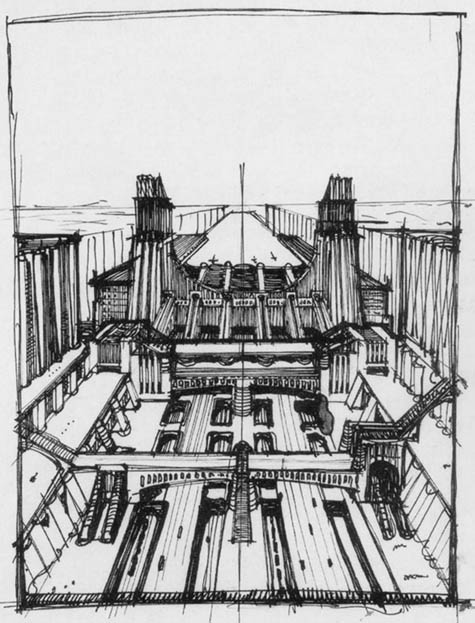
[Image: Antonio Sant’Elia‘s hydroelectric-like vision of a Città Nuova; now imagine the Los Angeles River redesigned by Sant’Elia…].

So while the idea of an architect-designed national power grid – for instance, OMA’s plan for a European wind farm – is easy to ridicule as being frivolous, superficial, and distracting, I find it nonetheless quite brilliant to wonder what Antonio Sant’Elia, for instance, might do with a massive Pacific Wave Motor Complex looming somewhere on the coast of Los Angeles or out on some isolated cliffside near Santa Cruz.
After all, if architectural design can make people excited about, and financially interested in, future energy sources, then isn’t the comparatively small extra expense of getting an architect to design pieces of that future landscape worthwhile? One needn’t claim that infrastructure will save the architectural profession – it won’t – while pointing out, unironically, that wave motors are fun to sketch.
I would personally be quite happy to see stylized tide machines take shape in the sea – future archaeological presences there amongst rocks and hills, lost in fog one morning only to reappear at sunset against a backdrop of cresting waves.

[Image: Sant’Elia’s Città Nuova; alternatively, imagine a future Hydroelectric Monastery designed by Peter Zumthor in which monks of water live surrounded by technical equipment, timing their valves with tides, calculating lunar wave algorithms, opening silent gates at night while the rest of the world sleeps].

Until then (if such a day comes), detailed exploration of these derelict motors left corroding in the sand – remnant machinescapes of artificial holes and tide pools, amongst the drowned foundations of forgotten piers – absolutely must continue.
At the very least, I can see an incredible Pamphlet Architecture produced about these lost mechanisms, with sketches and photographs, maps and stratigraphic diagrams in which inexplicable machines appear, several feet below ground.
A Graham Foundation-funded cartography of abandoned coastal machines hidden in the sands of premodern California.
It all seems straightforward enough: we could start that archaeology now – while planning more of such installations for the future.

(Thanks to Alexis Madrigal for the tip!)

A man, unexcited by his own possessions and increasingly confused as to why he collected all these things in the first place, decides to hire someone else to live amidst his books and clothes, DVDs and framed photographs, so that he can learn how another person might more intelligently put it to use.
Perhaps, then, he thinks, he’ll come to appreciate what he owns.
So he submits an ad to Craigslist, interviews dozens of candidates, and soon settles on a one-time professional actor who has since fallen on hard times. They negotiate a one-year contract; catering details are worked out; bank transfers are made. The man’s girlfriend even agrees to take part, as she had once been a fan of the actor’s films.
Then, on a warm summer day, this new man moves into the house.
Overseen by a network of surveillance cameras, he settles into a life amongst the possessions of another. He establishes a breakfast routine, eating from the owner’s tableware, and he familiarizes himself everyday with the material nooks and crannies of another person’s life history, that sediment of souvenirs and home decoration that has developed over time.
The owner, meanwhile, insufficiently awed by the experience of watching someone impersonate himself – wearing his clothes, reading his books, watching his videos, flipping through his college photo albums – finds himself slowly accumulating more possessions. One day he simply gets tired of watching this actor make love to his girlfriend – so he buys a novel to read. But then he finishes that novel.
So he buys another one.
He then ruins a shirt one evening, tearing it on a kitchen implement – so he buys a new shirt. But it comes with 50%-off of a second shirt (so he buys two).
Etc.
Gradually, the memory of those previous possessions – there on film being held by an actor – begins to fade. He no longer misses his girlfriend, and what was once a distracting labyrinth of things that, long ago, lost their attraction becomes something even less meaningful than that.
Soon, he is just watching an expensive folly: a man he doesn’t know, interacting with objects that mean nothing to him.
When it becomes clear that no moment of reconciliation is on its way – no point at which he will learn to love the things he’s accumulated over a lifetime – he simply abandons the project altogether.
He leaves the house and everything in it to the actor, and he waves goodbye to his now ex-girlfriend – who has since fallen in love with his surrogate.
And he walks away.

Future Babel

[Image: The Age of Civilization by Jan Soucek].

Nearly three years ago, in an email I have subsequently misplaced, a reader sent in some scans he had made of a book about Jan Soucek, a Czech artist whose work consists, it seems, almost entirely of elaborate architectural fantasies.
The one image that really stood out for me, and that I’ve just rediscovered here today in the many, many files of images stored on my computer, is called The Age of Civilization: it features the ruined walls and eroding arches of a Brueghelian Tower of Babel, subsequently built over and subsumed beneath future rings of urban growth.
Very little can be found about Soucek online; from what I can gather, though, he was born in 1941 (which means he is not the other Jan Soucek who pops up a lot whilst Googling) and he has participated in “numerous exhibitions in Czech Republic, Germany, Switzerland, Yugoslavia, Rumania, Bulgaria, Austria, France, USA and Belgium.”
A slightly larger version of this very painting was also uploaded to Flickr two years ago – perhaps by the same person who initially sent me the scan (the image description, oddly, mentions BLDGBLOG).

Urban Islands

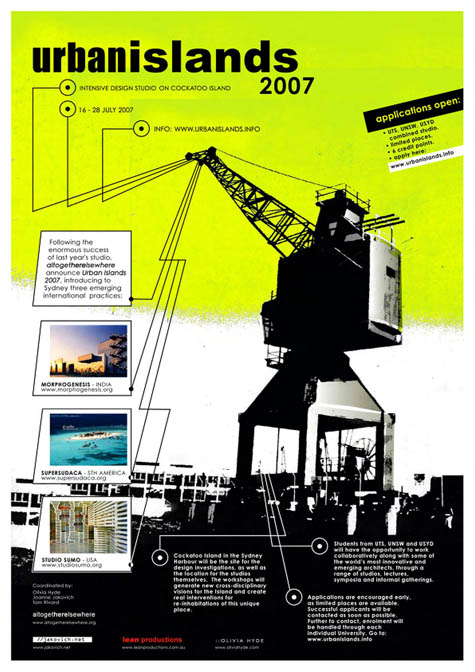
[Image: For a few heady weeks I actually thought I was going to be teaching at this thing… but no more. Alas. Still, though, how can you resist applying for a two-week architectural design studio in Sydney, Australia, themed around the spatial rehabilitation of a semi-derelict, post-industrial island, complete with “early convict settlement structures” and heavily incised sandstone foundations? More information, including how to apply, available here; larger, though low-res, version of the flyer available here. Have fun!].

Terrain Deformation Grenades

Something I mentioned the other day in my talk at the Australian National Architecture Conference – and that came up again in Peter Wilson‘s conference summary – was the game Fracture by LucasArts.
Specifically, I referred to that game’s “terrain deformation grenades” (actually, ER23-N Tectonic Grenades).

[Image: A screenshot from Fracture, courtesy of LucasArts].

The game’s own definition of terrain deformation is that it is a “warfare technology” through which “soldiers utilize specialized weaponry to reshape earth to their own strategic advantage.” In an interview with GameZone, David Perkinson, a producer from LucasArts, explains that any player “will be able to use a tectonic grenade to raise the ground and create a hill.”

He will also be able to then lower that same hill by using a subsonic grenade. From there, he could choose to throw another tectonic to rebuild that hill, or add on another subsonic to create a crater in the ground. The possibilities are, quite literally, limitless for the ways in which players can change the terrain.

Other of the game’s terrestrial weapons include a “subterranean torpedo.”
In any case, if you were at the conference and want to know more about either the game or its implications for landscape design, I thought I’d post a quick link back to the original post in which I first wrote about this: Tactical Landscaping and Terrain Deformation.
While we’re on the subject, though, it’d be interesting if terrain deformation weaponry not only was real, but if it could be demilitarized… and purchased at REI.
You load up your backpack with tectonic grenades, head off to hike the Appalachian Trail – and whenever the path gets boring, you just toss a few bombs ahead and create instant slopes and hillsides. An artificial Peak District is generated in northern England by a group of well-armed hikers from Manchester.
In other words, what recreational uses might terrain deformation also have – and need these sorts of speculative tools only be treated as weaponry?
If Capability Brown had had a box of Tectonic Grenades, for instance, England today might look like quite different…

Unbuilt Australia

[Image: The unbuilt Australian World Exposition (1972); read the PDF for more].

Having just returned from Melbourne, and preparing to go back to Sydney in July, I’ve got Australia on the brain.
Amongst the huge variety of things I’ve come across in the last few days while researching Australian architecture is the AA Prize for Unbuilt Work – particularly the historical series “Unbuilt Australia,” published by Architecture Australia.

[Image: “Perth as it Should Be” (PDF)].

There are some great stories here, ranging from early plans for “Perth as it Should Be” (check out the PDF) to an under-known, September 1950 sketch by Le Corbusier for the redesign of Adelaide (worth viewing the PDF in full).
Did Corbu’s speculative plans Down Under reveal ideas that he would later go on to build in Chandigarh?

[Image: Corbu’s Adelaide (PDF)].

One of my favorite unbuilt projects from the series is one that was, in fact, partially implemented: Edwin Codd’s Industrialised Building ’74 project, a prefabricated, modular classroom intended for deployment throughout rural Queensland.
“These schools with flat roofs were slab-on-ground buildings with long axes running east–west on a 1.2-metre module, steel-framed with trusses spanning 10.8 metres at 4.8-metre centres,” Don Watson writes in a brief article (read the PDF). Each structure was “naturally ventilated,” he continues, as well as “strongly coloured: steel framing blue, doors red and distinctive funnel-like downpipes yellow.”
In fact, I’ve been running into more and more plans lately for modular, prefab, easily-deployable instant classrooms – so perhaps a future post is in order, exploring some of those more interesting ideas.

[Image: Edwin Codd’s prefabricated Queensland classrooms (PDF)].

Other projects from the series include a “Venetian ‘City of Hope'” (PDF), a new Australian Parliament House (PDF), a look at something called Hackney Modern (PDF), and the “Dream City of Mackay” (PDF), Karl Langer’s excessively rational plan for a sub-tropical garden city.

[Image: Karl Langer’s “dream city” of Mackay (PDF)].

It’s a brilliant series, and it would be extremely interesting to see this reproduced elsewhere – from a regular look at “Unbuilt London” to a series of articles about unrealized Colonial-era plans for U.S. cities. “Unbuilt Philadelphia,” “Unbuilt Savannah,” “Unbuilt Washington D.C.”
Check out the rest of the series at Architecture Australia (scroll down).

The Rentable Basement Maze

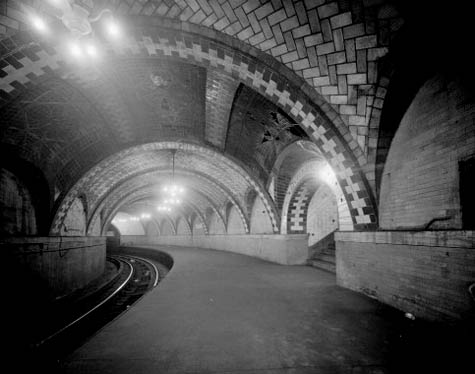
[Image: The subterranean vaults of Manhattan, seen here in City Hall station, which closed in December 1945; photo by David Sagarin (1978), via the Library of Congress, Prints and Photographs Division, Historic American Engineering Record of the Heritage Conservation and Recreation Service].

A city with an abandoned underground train line, one that cuts beneath some of the nicest townhouses in the city, develops an unexpected new real estate idea: renting out temporary basements in the form of repurposed subway cars.
Access stairs are cut down from each individual house till they connect up with the existing disused train tunnels below; each private residence thus becomes something like a subway station, with direct access, behind a locked door, to the subterranean infrastructure of the city far below.
Then, for a substantial fee – as much as $15,000 a month – you can rent a radically redesigned subway car, complete with closets, shelves, and in-floor storage cubes. The whole thing is parked beneath your house and braked in place; it has electricity and climate control, perhaps even WiFi. You can store summer clothes, golf equipment, tool boxes, children’s toys, and winter ski gear.
When you no longer need it, or can’t pay your bills, you simply take everything out of it and the subway car is returned to the local depot.
A veritable labyrinth of moving rooms soon takes shape beneath the city.

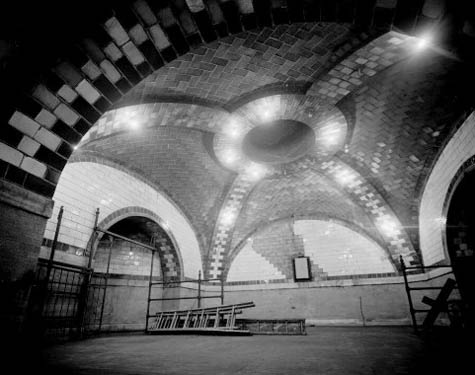
[Image: The great Manhattan underdome, photo by David Sagarin (1978), via the Library of Congress, Prints and Photographs Division, Historic American Engineering Record of the Heritage Conservation and Recreation Service (which includes many other incredible photographs of that subway line)].

Within a few years, the market matures.
You can then rent bar cars, home gyms, private restaurants, cheese caves, wine cellars, topless dancing clubs, recording studios, movie theaters, and even an aquarium. You can’t sleep in the middle of the night and so you wander downstairs to look at rare tropical fish, alone with fantastic webworks of coral beneath a slumbering metropolis.
Bespoke planetarium cars are soon developed; you step into your own personal history of the sky every night as the clanking metal of distant private rail switches echoes in the tunnels all around you, basements unlatching and moving on through urban darkness.
Shoe storage. Rare book libraries. Guest bedrooms. Growing operations. Swine flu quarantine facilities.
The catalog of newly mobile subterranean architectural typologies comes to include nearly anything the clients can imagine – or afford. Rumor has it, a particularly wealthy widower on the Upper West Side of Manhattan has whole exhibitions from the American Museum of Natural History parked beneath his house when the Museum closes at night; he goes down in his slippers, and he looks at dinosaur skeletons and gemstones as he thinks about his wife.
But then the economy crashes. The market in rentable basements dries up. The lovingly detailed personalized cars that once trolled around beneath the city are dismantled and sold for scrap.
Within a generation, the very idea that people once had personal access to a migratory maze of temporary rooms far below seems almost impossible to believe.

The Parallax View

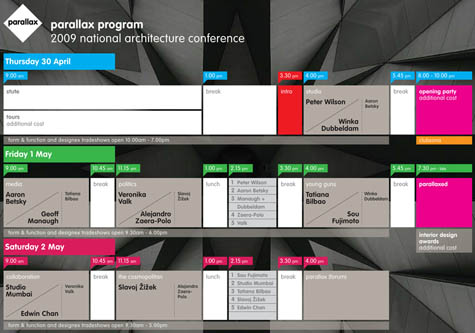
If you happen to be in Melbourne, Australia, this weekend, I will be speaking at Parallax, the Australian National Architecture Conference.

My subject will be architectural media, broadly speaking, in a dual session co-hosted with Aaron Betsky:

The role of the media in disseminating architectural theory and practice has been debated as long as media has engaged with architectural practice and production. These debates – pitting access to information against authenticity of mediated versus real experience – have become even more complex in the contemporary environment where magazines are joined by blogs, YouTube, Facebook and web alerts.
We are interested in the veracity of these various forms of media and in the types of architectural activity and architects they promote. Will architectural tendencies change as modes of media evolve? How are the two related?

In addition to myself and Betsky, the conference also features Tatiana Bilbao, Sou Fujimoto, Alejandro Zaera-Polo, Veronika Valk, Winka Dubbeldam, Bijoy Jain from Studio Mumbai, Edwin Chan, Peter Wilson, and, last but not least, Slavoj Žižek.
This is in addition to a number of other speakers who will be leading workshops throughout the conference. For instance, I’m also scheduled for a workshop – again, on “Architectural publishing: The future” – with Winka Dubbeldam and Andrew MacKenzie, editor-in-chief of Architectural Review Australia.
Finally, I’ll also get to meet, after nearly five years of emails, the legendary Mr. Marcus Trimble from Super Colossal. This will be at a live design critique hosted in a Melbourne pub Friday night; other judges include Slavoj Žižek, Aaron Betsky, Edwin Chan, Bijoy Jain (Studio Mumbai), Veronika Valk, and Peter Wilson, and it will all be moderated by Leon van Schaik.
While I’m at it, let me add that I’m also excited to meet architect Andrew Maynard, as well as Simon Sellars from Ballardian.
So while my time in Melbourne will be short, unfortunately – and hopefully swine flu-free – if you happen to be around this week, it’d be nice to meet.
Regular posts will resume shortly…

This Diseased Utopia: 10 Thoughts on Swine Flu and the City

[Image: “People wear surgical masks as a precaution against infection inside a subway in Mexico City, Friday, April 24, 2009.” Photo by AP Photo/Marco Ugarte].

1) In his under-appreciated novel Super-Cannes, easily amongst his best, J.G. Ballard explored the psychological, sexual, and even epidemiological implications of landscape design. This is “the secret life of the business park,” Ballard writes.

At one point the book’s narrator is speaking with the corporate director of Eden-Olympia, a planned live/work community in southern France. The director somewhat off-handedly refers to medical research that the narrator’s own wife, a doctor, has been performing: “She’s running a new computer model,” the director says, “tracing the spread of nasal viruses across Eden-Olympia. She has a hunch that if people moved their chairs a further eighteen inches apart they’d stop the infectious vectors in their tracks.”

Perfectly calibrated down to the inch – or perhaps the millimeter – modern space itself becomes a kind of medical regime, its bare white rooms an antiviral treatment that we mistake for interior design.

Just as our city streets are wide enough to accommodate the turning radius of a specific class of passenger vehicle, our office cubicles, kindergarten playrooms, courts of law, and university lecture halls could be measured against the infectious vectors of specific pathogens.

In the geometry of objects around us are the outer infectious edges of diseases we no longer suffer from; we have literally designed them out of modern space, denying their ability to spread.

2) You go to the Salone del Mobile next year in Milan and discover that the CDC has unexpectedly released a new line of furniture. Each piece varies just slightly from the rest, in that their measurements have been dictated not by human comfort, international rates of shipment, or even by industrial timber specifications, but by the distances medically necessary to maintain between yourself and others in order to avoid respiratory infections.

The common flu is now a dining table measured exactly against the reach of sneezes; SARS is a cubicle lined with an industrial felt that absorbs all coughs; pneumonia is a bar stool, hand-crafted from white pine, with a circumference of rails to prevent people getting too close.

3) The recent outbreak of swine flu in and around Mexico City and the U.S. border region, is “suspected of killing at least 60 people,” the BBC reports. In fact, the outbreak “has the potential to become a pandemic,” according to Margaret Chan, current director of the World Health Organization.

Chan has “confirmed the virus was an animal strain – a mixture of swine, human and avian flu viruses,” which the BBC points out “is a classic ‘re-assortment’ – a combination feared most by those watching for the flu pandemic.”

[Image: Like the beginning of a zombie horror film, we read – via Twitter – “SWINE FLU SPREADING, CANNOT BE CONTAINED” (via @alexismadrigal)].

It’s interesting to note, however, that swine flu, unsurprisingly, comes from “close contact with pigs” – that is, spatial proximity between humans and their livestock.

Swine flu, we could say, is a spatial problem – an epiphenomenon of landscape.

I’m reminded here of a point made recently by geographer Javier Arbona. Referring to the increasingly popular and somewhat utopian idea that, in the sustainable cities of tomorrow, agriculture will have returned to its rightful place in the city center, Arbona asks: “Did everyone think that so much lushness and farming envisioned in the city aren’t going to open up new Pandora’s boxes of infectious diseases and sanitation problems as we come into contact with more manure, more bacteria, and more wild animals that we urbanites are not at all ‘naturalized’ to?”

It’s an important question. After all, it’s incredibly easy, reading about sustainable cities, urban agriculture, and even the locavore movement, to conclude that chickens, pigs, cows, etc., have all been removed from the urban fabric as part of a profiteering move by Tyson and Perdue.

But there were very real epidemiological reasons for taking agriculture out of the city; finding a new place for urban farms will thus not only require very intense new spatial codes, it will demand constant vigilance in researching and developing inoculations. Few people want to see burning piles of livestock in Times Square or Griffith Park, let alone piles of human corpses infected with H5N1.

Indeed, one of the most prevalent, if mundane, reasons why avian flu has become a “global threat” to humankind, as Mike Davis refers to it in his book Monster At Our Door, is space: it sounds like a joke, but people are living too close to their chickens (or their pigeons, as the case may be).

Avian flu, foot-and-mouth disease, swine flu: if these are spatially activated, so to speak, and spread through certain unrecommended proximities between humans and animals, then urban design’s medical undergirding is again revealed.

The space around you is no mere architectural stylization; it is a strategy of containment. The modern city would thus not only be a place to live – it would also be a functioning medical instrument.

[Image: From “Change of Heart: Rethinking the Prescriptive Medical Environment” by Marina Nicollier].

4) This brings to mind Marina Nicollier’s final thesis project at Rice University, wherein she explored the medical effects of architectural design.
Part of her project dealt with the history of sanitarium architecture and, from there, the health implications of modern architecture. She wrote:

Popular ideas about what constitutes a healthy environment gave rise to many of the components that became the formal trademarks of modernism – the flat roof was devised as a means to provide additional sunning surfaces for tubercular patients; while the deep verandas, wide private balconies, and covered corridors served as organizational tools to isolate contagious patients from the general staff.

In other words, at its origins, modern architecture was a kind of medical prescription – not a pill you swallowed but an environment you surrounded yourself with.

Nicollier continues:

Visits to these establishments were prescribed, as were the conditions and durations of the exposures themselves. Today, of course, there is ongoing research to determine how and to what extent environmental factors such as temperature, natural and artificial light, and sound affect our health, and despite there having been some interesting conclusions, it is still an area of research that requires more investigation and exploratory trials.

This idea, of controlled exposure to specific architectural forms, makes the equation between built space and medical treatment explicit.

How, then, might we expand and re-apply this research to whole cities in an era of swine flu and SARS?
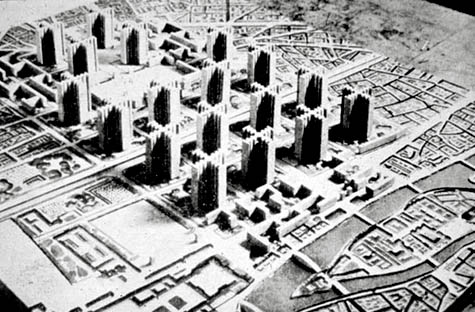
[Image: Le Corbusier’s Plan Voisin for Paris].

5) The medical aspects of utopia seem under-explored in contemporary urban literature. Here, utopia could be retheorized as the city where no one gets sick. Through microbe-resistant building materials and a precisely measured anti-contagious spatiality, perhaps, your metropolis might even cure you.

Utopia becomes a hospital ward the size and shape of a city.

Perhaps BLDGBLOG should sponsor a new urban design competition in which only medical doctors can participate. Design your vision of the healthy city, these doctors will be told; what urban forms will result?

Briefly, I’m reminded of BLDGBLOG’s 2006 interview with Mike Davis. Referring, again, to his book Monster At Our Door and its exploration of biosecurity, I asked Davis: “What would a biosecure world actually look like, on the level of architecture and urban design? (…) Do you see any evidence that the medical profession is being architecturally empowered, so to speak, influencing the design of ‘disease-free’ public spaces?”

Davis replied that this was “exactly how Victorian social control over the slums was defined as a kind of hygienic project – or in the same way that urban segregation was justified in colonial cities as a problem of sanitation. Everywhere these discourses reinforce one another.”

Further:

Davis: Just as the Victorian middle classes could not escape the diseases of the slums, neither will the rich, bunkered down in their country clubs or inside gated communities. The whole obsession now is that avian flu will be brought into the country by –

BLDGBLOG: A Mexican!

Davis: Exactly: it’ll be smuggled over the border – which is absurd. This ongoing obsession with illegal immigration has become a one-stop phantasmagoria for… everything. Of course, it goes back to primal, ancient fears: the Irish brought typhoid, the Chinese brought plague. It’s old hat.

The fact that this week’s swine flu outbreak originated in Mexico seems doubly interesting in this context.

You can check out the interview for the rest of Davis’s answer – but I still think the question of urban biosecurity deserves more architectural attention.

If the Centers for Disease Control could design a city, what would it look like? Could there be a medical equivalent of Baron Haussman or Robert Moses?

What is medical urban design?

[Image: Robert Moses stands above a model of the city he would create; via Wikipedia].

6) Producing a disease-free city, of course, requires the proper design tools.

Via Twitter (@qimet888), I was pointed toward a demonstration program: Dynamical Network Design for Controlling Virus Spread.

The clunkily-named program “shows the dynamics of the spread of the SARS virus in Hong Kong’s 18 districts when the optimal resources allocation is used.”

In the simulation, the color green represents an infection-free district, that is, one in which the number of infected people is smaller than one. For infected districts, shades of red are used to indicate the level of infection. Darker red means that there are more infected people in the region and lighter red means that fewer people are infected. The viewer can see that the virus is stopped very quickly using the optimal design: the regions quickly turn green regardless of the initial conditions.

The implication seems clear: toggle your parameters – move people, buildings, walls, hospital wards, sewers, etc., around until you find the right combination – and your city itself might help to eradicate disease.

It would “stop the infectious vectors in their tracks,” as Ballard wrote.

[Image: Of SARS and the city: from Wolfram’s Dynamical Network Design for Controlling Virus Spread].

7) Why not turn this into a game?

Design the ultimate disease-free city: SimCity: Dark Winter, Urban Outbreak, or even a biomedical version of Settlers of Catan. Your goal is to redesign a city in real-time in order to extinguish a burgeoning plague epidemic. Perhaps SOM could sponsor it – and own rights over the winning results – in an attempt to corner the market in infection-free city planning.

You could even reverse the game’s moral order and require players to create the ideal city for disease transmission: whoever kills off their entire game’s population in the shortest period of time wins. The all-time winner infects the world in less than a second.

8) All of this occurs as I’ve been reading Steven Johnson’s book The Ghost Map. The book consistently raises the issue of public health as an urban design concern – and, at the risk of repeating myself here, it would seem like epidemiology should be a vital part of all city planning courses. Spatial epidemiology, in fact, seems so interesting, and so important, that I’m almost tempted to go back to school for it.

A great final thesis would be a series of test landscapes – epidemiological prototypes – in which hypothetical diseases run their course against a landscape of airlocks and plastic sheeting, chairs moved 18″ further apart, walls erected where there once were screens, and sewers buried another three feet deeper underground. Pushed too far, one of the resulting landscapes becomes completely abiological, incapable of supporting life, sterilizing everything through the design of space alone.

In any case, Johnson’s book is an impressively multi-scalar look at how apparently simple urban design decisions can produce very tragic effects in indirect arenas, elsewhere. Add to this demographic information about who lived where in London at the time, the economics of things like 19th-century water delivery, and the changing nature of medical treatment, and you get a fascinating look at how certain cities either cultivate or effectively stop the spread of diseases.

In the face of very real medical concerns, I might suggest that designing our cities according to historical expectations – let alone according to the spatial needs of the automotive industry – has never seemed quite so arbitrary.

[Image: The sewers of Paris as photographed by Nadar; taken from an article by Matthew Gandy].

9) With apologies for a brief personal anecdote, I was in Paris for a week in the fall of 1997; having just read Foucault’s Pendulum for the second and third times, respectively, earlier that summer – somewhat inexplicably, I’ve read that book nine times now – I decided to take a tour of the Paris sewer system.

My “tour group,” such as it was, consisted solely of myself and another American backpacker, who had just finished reading The Coming Plague by Laurie Garrett a few nights before. Doing so apparently made him obsessed with cancer; it was the only thing he talked about.

As the two of us walked through the unbelievable stench of Parisian wastewater, watching used condoms float by and rats crawl away in the darkness ahead, and while we listened to the slightly bemused narration of our female tour guide, the backpacker began telling me about the possible viral nature of cancer, the incurability of certain forms of the disease, and the inevitability that most of us would, in the end, develop it.

Strolling around through fecally-contaminated vaults beneath the city, discussing the history of urban sanitation amidst unhinged speculations about the possibly infectious nature of certain types of cancer, I could joke that the tour’s end didn’t come fast enough, but I was fascinated.

Between experiential urban infrastructure, Victor Hugo’s subterranean chase scene in Les Misérables, and an overwhelming desire to spray myself with deodorant, it nonetheless could have been the ideal setting for a walking salon, so to speak, a conversational meeting of the minds about disease and the city.

Call it The Dante Project™: get doctors from around the world together in Paris every year for a series of long strolls through the well-sewered underworld. Swine flu, cholera, H5N1, cancer, AIDS, ebola: never again will they be as viscerally reminded of what they’ve devoted their lives to cure.

10) In the end, then, what spatial form might a medical utopia take, and how could it be architecturally realized?

In 50 years will you be walking around the edges of the city with your grandkids when one of them asks: Why are these buildings out here, so far away from the rest?

And you’ll say: They’re here because of swine flu. We redesigned the city and our diseases went away.

Super Powers Activate

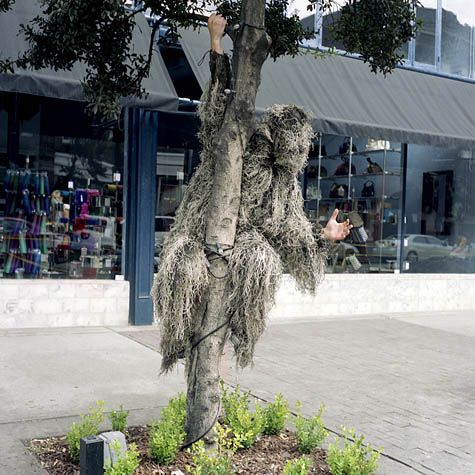
[Image: “I’m Spanish Moss!” Photo by Ian Aleksander Adams, from his series Gray Days].

After reading BLDGBLOG’s post last month about those peculiar moving landscapes known as ghillie suits, photographer Ian Aleksander Adams got in touch with a photograph he took last year.

“I remember running into someone last Halloween in Savannah, GA,” Adams wrote. “I looked confused and he yelled ‘I’m Spanish Moss!’ and jumped into a tree – I was quick enough to get a shot, which ended up in my last book.”

The photo, above, is part of Adams’s series Gray Days.

(Thanks, Ian!)