Deep-water city-states

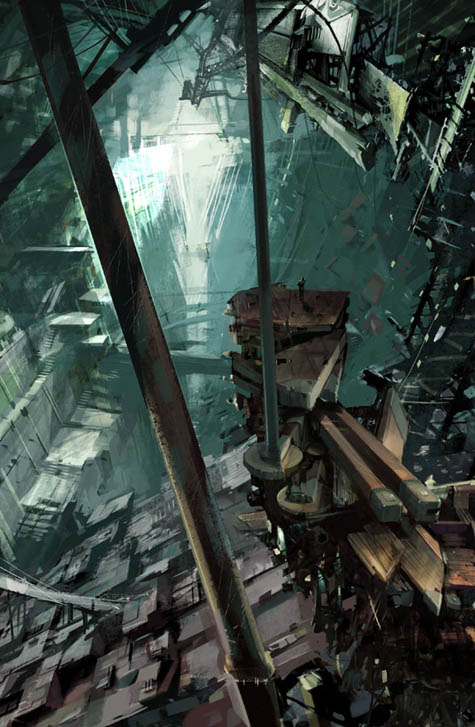
[Image: Illustration by Holl Liou, courtesy of Wired].

Wired reports on “a small team of Silicon Valley millionaires” who hope to develop “a new option for global citizenship: A permanent, quasi-sovereign nation floating in international waters.”
They call this practice seasteading.

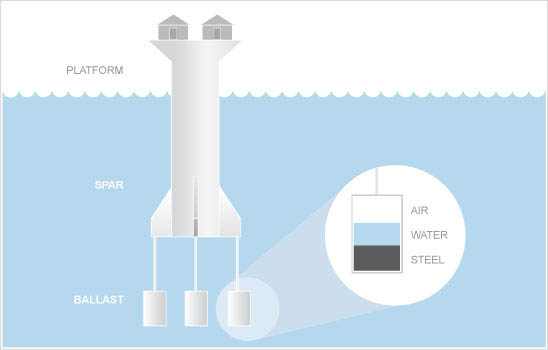
The seasteaders want to build their first prototype for a few million dollars, by scaling down and modifying an existing off-shore oil rig design known as a “spar platform.” In essence, the seastead would consist of a reinforced concrete tube with external ballasts at the bottom that could be filled with air or water to raise or lower the living platform on top. The spar design helps offshore platforms better withstand the onslaught of powerful ocean waves by minimizing the amount of structure that is exposed to their energy.

Build enough of these spar platforms and you’ve got yourself a “deep-water city-state.”
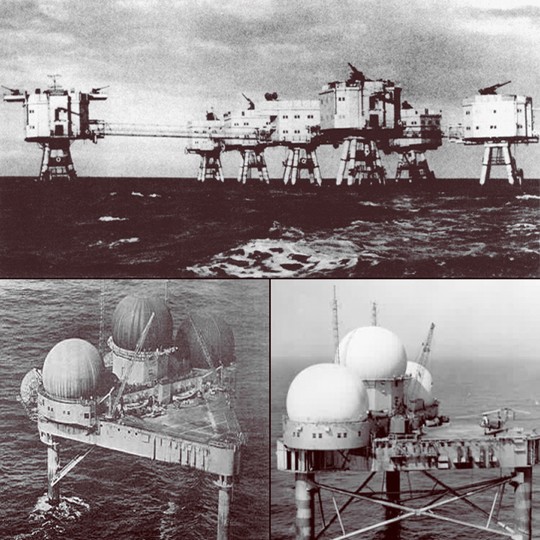
The group’s 300-page book on the managerial practicalities of running “modular seastead groups” references everything from Sealand, the offshore micronation, to the Texas Tower, to houseboats, to the dangers of tropical storms.

[Images: The Maunsell Towers (top), unmentioned by the libertarian seasteaders, and the Texas Tower (bottom)].

They touch on the political and economic circumstances involved in steading the high seas, including SOLAS, the International Convention for the Safety of Life at Sea, and UNLOS, the United Nations Law of the Sea. They mention the process of buying a Flag of Convenience, in which hopeful microsovereigns can “shop around for a country that has the least objectionable laws and rates, and count on the seller’s apathy to minimize restrictions. A seastead is potentially high-profile, and if it proves a serious embarrassment to a registrar it may lose its flag.”
The seastead’s power storage needs are then discussed in terms of electrochemical batteries, gravity batteries, and supercapacitors, and the production of this power will, the authors presume, come from wind and solar systems, and even one or two fuel-powered generators. Of course, there’s also the power of the sea to consider – and the authors’ “favorite” method for harvesting “wave power” is something called Isaac’s Wave Pump.

[Image: Tapping into oceanic motion with BioPower Systems].

In any case, one can fantasize forever about endless small changes in the construction of a functioning seastead. (Note to Chronicle Books: publish an architectural guide to seasteading; it’ll be a huge hit on Father’s Day).
What interests me here, aside from the architectural challenge of erecting a durable, ocean-going metropolis, is the fact that this act of construction – this act of building something – has constitutional implications. That is, architecture here proactively expands the political bounds of recognized sovereignty; architecture becomes declarative.
The stakes for design have gone up, in other words. It’s not just a question of producing better loft apartments, for which you can charge an extra $300,000, or of perfecting the art of luxury kitchen space; it’s a question of designing architecture for extreme conditions and, should your architecture survive, thus opening up room for a new form of what might be called post-terrestrial sovereignty, i.e. governance freed from landed terrain.
Which is not to be confused with advocacy of the project; I just like discussing its political side-effects: architecture becomes wed with, indeed inseparable from, a political project. It is construction in the service of constitutionality (and vice versa).
Wed with oceanic mobility, the architecture of seasteading doesn’t just aesthetically augment a natural landscape; it actually encases, or gives physical shape to, a political community. It is architecture as political space in the most literal sense.

The Digital Replacement of the Natives

[Images: Garmin GPS devices].

“For their recent trip to Namibia,” a short blurb in Wired magazine explains, “Greg and Anja Manuel packed light: PowerBars, clothes, and a Garmin GPS loaded with Traveler’s Africa version 8.02, a user-generated map brimming with 50,000 points of interest. That last item meant they didn’t have to hire an experienced guide.”
Fair enough. The map looks beautiful, the idea is cool, and, within two or three trips, the GPS device does indeed save money; however, I can’t help but wonder what this might foretell for local economies, all over the world, based on guided tourism. For instance, a small group of American tourists comes through your village, eating PowerBars and looking at handheld GPS devices. They don’t go to any restaurants; they don’t ask any questions of anyone; perhaps they don’t even rent a hotel room.
For all economic purposes, it’s as if they were never there. They were more like surreal poltergeists wearing Vasque boots, reading Jonathan Safran Foer on a Kindle.
What better way to avoid meeting Namibians! Just use their electrical grid to recharge your gadgets, pay no taxes, and leave.

[Images: Three examples of maps displayed on Garmin GPS devices].

I’m left imagining the inverse of this situation, of course, in which a small group of Namibians shows up in London. They ask no questions, eat at no restaurants, and avoid all hotels – before going off to wander round the countryside, sleeping in tents. It would all seem rather mysterious.
In any case, do handheld technologies mean that we’ll soon be digitally replacing the native populations of the Third World, never needing them again for guidance, travel advice, or even insights into medicinal plantlife? You fly down to the Amazon to try ayahuasca, but you don’t hire any local shamans or native botanists because you’ve got everything you need to know already saved on a 300GB iPod – as if that might be the atomized fate of the West in general: desperately seeking visions, alone in the wild, surrounded by portable gadgetry.
“Your tradition is right here,” the tourist says, holding his Garmin GPS loaded with Traveler’s Africa version 8.02 over the heads of impoverished villagers. “I don’t need you anymore.”
Next year, someone gives you a small handheld device with an interestingly honest tagline.
Go Everywhere, it says. Meet No One.

Mountain Monuments

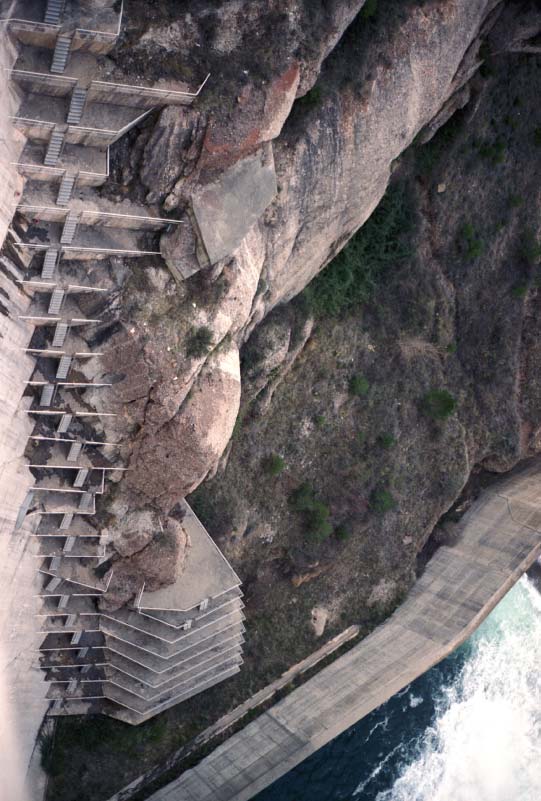
[Image: From the series the water, the dams, the landscape by photographer Eduoard Decam].

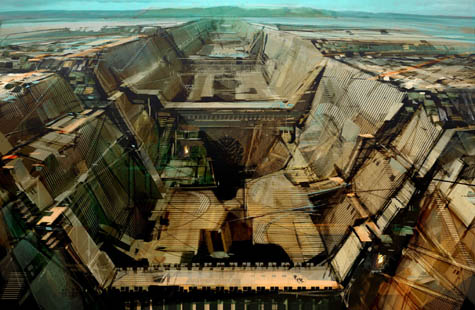
Eduoard Decam is a Barcelona-based French architect whose photographic project the water, the dams, the landscape won an EDF Foundation award back in 2006. The images in the series document massive hydrological installations in the Pyrenees Mountains of northeastern Spain, turning dams and spillways into abstract monuments, like some new piece of mountain infrastructure designed by Superstudio.
As Decam himself explained to A10 magazine: “I do not see the dam as a technical element in the mountain, but as part of the mountain, as a landscape.”
Personally, I’m just blown away by the terraced stairways we see in the image, above; it’s like some ultramodern update to the monastic retreats of Meteora, or perhaps even a new stage in Guild Wars.

(Spotted in A10, issue #19).

Botanical Otology

Alex Metcalf’s Tree Listening Installation is a small electronic listening device built for eavesdropping on the inner acoustics of trees.

[Image: “Peach Tree in Flower in Orchard” by J.E. Fee].

How does it work? The device is placed on the trunk of a given tree and then connected to as many as ten sets of headphones, which hang down from the tree’s canopy. Botany becomes your iPod.
“This allows the public to listen ‘live’ to the sound of water being pulled up from the roots to the leaves through the xylem tube,” Metcalf writes.
As he explained in an interview with the Guardian last week: “The technology for this is usually invasive. You bore into the tree and take away a section, then seal in a listening device. The thing about my device is that you don’t have to cause any damage, and you can listen to any tree, anywhere, any time – plus you can do it long term. Cutting a hole in a tree means you are wounding and infecting it, which will affect the recording.”
The “device” in question is a small and somewhat unassuming metal cone that looks more like an 18th-century otological device. You hold it up against the side of the tree – like an FBI roving wiretap on the natural world – and listen in…
But could you broadcast this? A pirate radio station pops up one evening after dinner time in the distant suburbs of west London – and it turns out that an eccentric old couple living on a large plot of land near Windsor Great Park have begun broadcasting their trees. It’s soon an international sensation, and a great hit with cover bands; you go down to the Cafe du Nord one night to hear live music, but the band, visibly drunk, gets lost in a three-hour rendition, using only acoustic guitars, of the sound of young sessile oak trees.
Oddly, you’re the only one there who enjoys it – legs crossed, beer in hand, listening intently.

Deep in the basement of an ancient tenement on Second Avenue in the heart of midtown New York City, I was fishing

Last summer, on the extremely short-lived blog Urbablurb – which only managed five posts before dying, yet still remains interesting today – we read about the little-known phenomenon of people fishing in the basements of Manhattan.

[Image: A map of the lost rivers of Manhattan, via Urbablurb].

Urbablurb quotes from The New York Times:

We had a lantern to pierce the cellar darkness and fifteen feet below I clearly saw the stream bubbling and pushing about, five feet wide and upon its either side, dark green mossed rocks. This lively riverlet was revealed to us exactly as it must have appeared to a Manhattan Indian many years ago.
With plum-bob and line, I cast in and found the stream to be over six feet deep. The spray splashed upwards from time to time and standing on the basement floor, I felt its tingling coolness.
One day I was curious enough to try my hand at fishing. I had an old-fashioned dropline and baited a hook with a piece of sperm-candle. I jiggled the hook for about five minutes and then felt a teasing nibble. Deep in the basement of an ancient tenement on Second Avenue in the heart of midtown New York City, I was fishing.

The lost rivers of Manhattan are real; hundreds of streams and whole wetlands were paved over and filled so that the roots of buildings could safely grow. But whether or not you could ever fish in them – and this whole thing sounds like Dr. Seuss to me – is the subject of a post on the also now defunct blog, Empire Zone. There, a commenter informs us that fishing for eyeless carp in the underground cisterns of Istanbul is something of a national past-time.

Alas, we also learn that, as to the question of “whether any carp could be found swimming under Manhattan today,” the answer, sadly, is no.

But how much would I love to find myself in New York City for a weekend, perhaps sent there by work to cover a story – when the phone rings in my hotel room. It’s 11pm. I’m tired, but I answer. An old man is on the other end, and he clears his throat and he says: “I think this is something you’d like to see.” I doubt, I delay, I debate with myself – but I soon take a cab, and, as the clock strikes 12am, I’m led down into the basement of a red brick tenement building on E. 13th Street.

I step into a large room, that smells vaguely of water – and six men are sitting around an opening in the floor, holding fishing poles in the darkness.

(Also on Urbablurb: Who is Jack Gasnick?).

Vertical House

[Image: Vertical House by axis mundi architects].

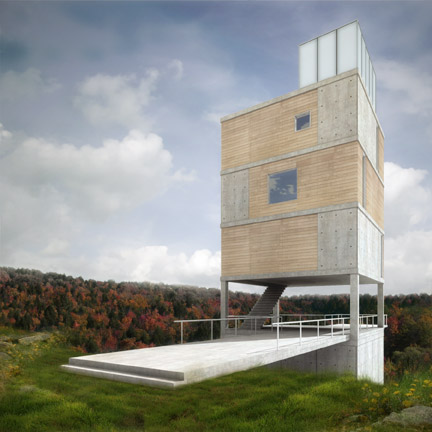
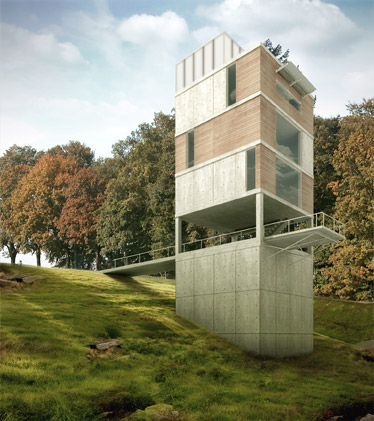
Here are two views of a proposed mountain house for a site in Smugglers Notch, Vermont, by New York architects axis mundi.
“Entry is via a long and dramatic bridge to a viewing platform from which one ascends a staircase into the house,” the architects’ website explains. Kitchen, dining room, living room, and master bedroom are encountered in sequence as one moves upward through the structure.

[Image: Vertical House by axis mundi architects].

You eventually arrive at an “open air garden… situated on the roof.”

The intention is that over time the house will become considerably lush as vines grow down from the roof, in effect making the house into a modern ruin.

The wood cladding you see is teak on a concrete and steel frame.
Give that thing wider corner posts, run the utilities and services down through through them, and you’re good to go. Install a portaledge or two, and the house gets even better.
Then, three hundred years from now, refugees from a half-flooded Manhattan – that city all but destroyed by an unspecified disaster – make their way north to find the house still standing and covered in a thick labyrinth of vines, home to migrating tropical birds. They clear themselves a place to sleep amidst the dust and vines, and stay for nearly two weeks – before heading further inland, toward the ruins of Montreal, still fleeing whatever unknown fate awaits those stuck in that city down south.
Another hundred years and the building collapses, forming a debris field of wood, metal, and concrete across the hillside, washing down to nothing over decades of rain.

The Architecture of Ascent

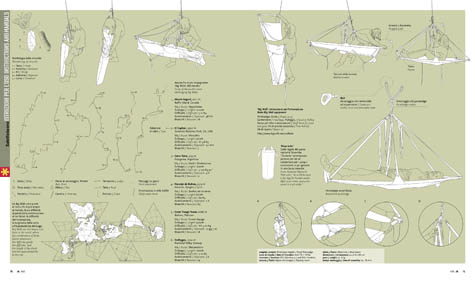
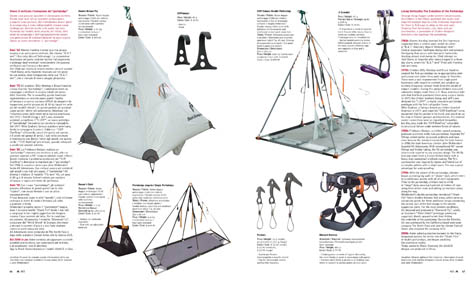
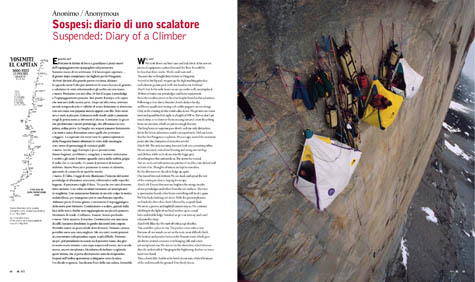
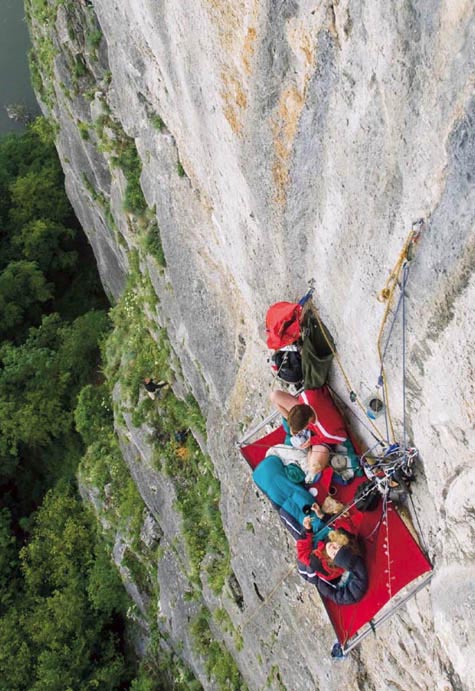
In what would merely have been an article about camping equipment in almost any other situation, revamped Italian architecture magazine Abitare recently took a fascinating look at portable mountain climbing shelters.

[Image: From an article by Jonathan Olivares, in Abitare; view much larger!].

Viewed architecturally, these examples of high-tech camping gear – capable of housing small groups of people on the vertical sides of cliffs, as if bolted into the sky – begin to look like something dreamed up by Archigram: nomadic, modular, and easy to assemble even in wildly non-urban circumstances. This is tactical gear for the spatial expansion of private leisure.
There are about a million implications here – including, at the very least, the question of whether or not architects should be involved in designing tents for North Face or for REI. If Zaha Hadid can design desk lamps and Frank Gehry, jewelry – and Michael Graves, teapots – then why can’t, say, Jean Nouvel design a new series of outdoor recreational equipment, including tents, portaledges, platforms, and hammocks?
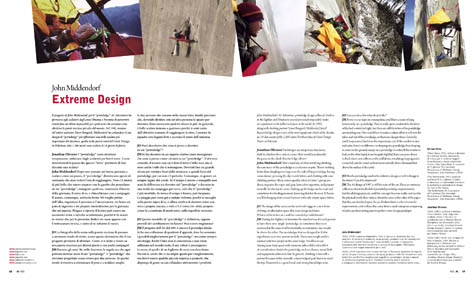
In fact, Jonathan Olivares, the author of the piece, describes the invention of the portaledge as follows: “Drawing from hammocks, cots, tents and sail construction, a generation of climber-designers invented a new typology: the portaledge.” As such, the portaledge already has a fascinating design genealogy – one that includes the B.A.T. tent, the LURP, so-called “Cliff Dwellings” equipment, and tube-framed, waterproof tepees – but get some architects involved with this and see what happens.
Unless, of course, this is yet another case where architects have fallen behind the other design fields, too obsessed with accurately quoting Gilles Deleuze to notice that the world has been revolutionized. All sorts of amazing new tools, techniques, materials, shapes, and spaces were being framed and even mass-manufactured out there, for decades, but architects were all cooped up, underlining things for each other in the library.

[Image: Another spread from Abitare, an article by Jonathan Olivares; view larger!].

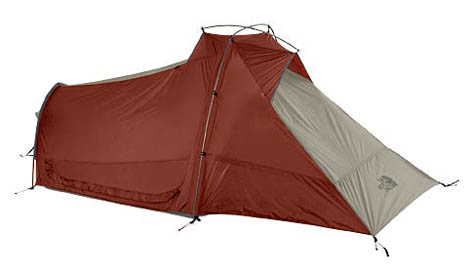
In any case, I suppose one could say that this tent, below, the Dyad 22 by North Face, looks vaguely like some sort of microlight architectural folly designed by Neil Denari for the beaches of Southern California –

[Image: The Dyad 22 by North Face].

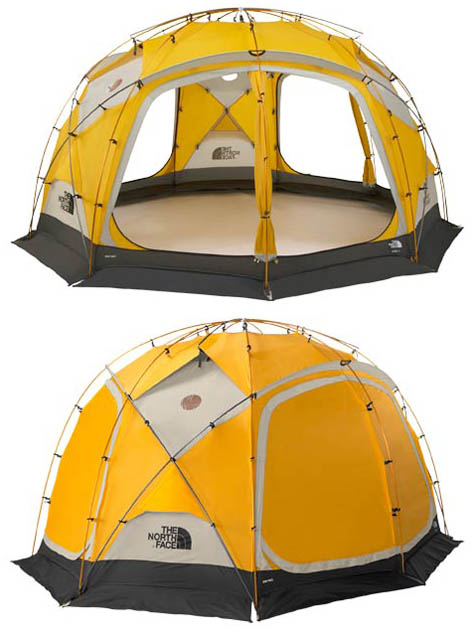
– and these tents, the Domes 5 and 8, also by North Face, look like, say, Buckminster Fuller in collaboration with Shigeru Ban. Or: if Buckminster Fuller and Shigeru Ban came together to franchise the design of London’s Serpentine Pavilion one summer, perhaps this is what they would make.
Leading to the question: are tents an example of franchise architecture?

[Image: The Dome 5 and Dome 8 by North Face].

So why aren’t architects involved, as far as I’m aware, in the portable, modular architecture market known as high-end camping gear?
You ascend to the top of Mt. Everest… sleeping in a tent by Greg Lynn. Your sleeping bag is by OMA. Your best friend is comfortably slumbering beside you in a tent designed by LOT-EK.

[Images: Two spreads from Abitare; view larger: top and bottom].

But Abitare‘s article also implies something like the opposite of what I’ve written above: in other words, if high-tech camping gear used for vertical mountain ascents is actually a form of architectural technology, and thus worthy of being covered and critiqued by architecture magazines, then architects themselves should find more uses for such gear in their designs.
Rather than design camping gear, then, they should design with camping gear, filling private homes and office high-rises with unexpected tent-like rooms and rapidly deployed nylon conference facilities. You carry your boardroom around in your briefcase, installing it up on the roof when summer allows.
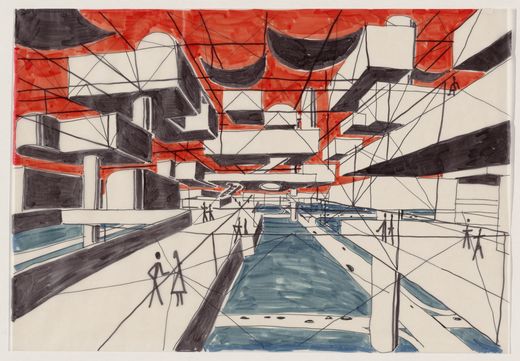
Or, perhaps, you construct a 21-story bare steel frame somewhere on an empty lot in New York City. It has no walls or floors; it is just a vast and abstract grid of I-beams, welded throughout with anchorage points. Using portaledges and tents, the inhabitants of this empty frame, like people from a fever dream by Yona Friedman or Constant, come in and colonize the structure, installing themselves at odd angles with carabiners and clips, bungee cords and tactical ropes, paying rent only on the spatial volume that the resulting structures occupy. $10 per cubic foot.
The grid – the structure – is taken care of. Architecture becomes nothing but the process of designing better tents. Flexible interiors. Sewn space.
So is high-tech 21st century camping gear exactly what the 1960s architectural avant-garde had been looking for? The portaledge as vertical utopia.

[Image: Spatial City by Yona Friedman: “The framework was to be erected first, and the residences conceived and built by the inhabitants inserted into the voids of the structure.” Courtesy of the Museum of Modern Art].

To a certain extent, though, this reminds me of my experience just last week as a judge for the Design Village 2008: Mission to Mars competition, photographs of which can be found here. With some obvious exceptions, that contest gave us the tent as avant-garde – and even extra-planetary – architecture. In one case, it was the tent as full-fledged micronation, flirting with new definitions of political sovereignty.
Perhaps 2009 will be the year tent design explodes across architecture schools, worldwide.
Given zero insurance liability, then, could you arrange for a new, annual architecture competition, sponsored by REI, the point of which is to ascend Yosemite‘s Half Dome or El Capitan using only home-made, microlight portaledge technology? If you fall, you lose. You have to make it to the top within seven days – and you have to stay there for another three.
Then you have to make it back down.

[Image: From Abitare; view larger].

All these instant cities of tents and portaledges, moving up and down mountainsides around the world, like Walking Cities, the urban condition gone nomadic – the new, vertical suburb, till now so architecturally underexplored.

(Original articles curated by Anniina Koivu. With huge thanks to Fabrizio Gallanti from Abitare for emailing me the page spreads!)

Space as a Symphony of Turning Off Sounds

In David Toop’s classic book Ocean of Sound – something I cite repeatedly here on BLDGBLOG – we read about a musical performance that, by accident of circumstance, became a process of turning off all sources of noise within a building.

[Image: Felix Hess assembles similar sound machines, next to a photo of an unrelated concert hall].

For an installation of fifty specially made “sound creatures” – little interactive robots “inspired by the communication eco-system of frog choruses,” Toop writes – experimental musician Felix Hess insisted that there be no “extraneous sounds” in the concert hall. Hess’s miniature sound performance required absolute silence, or else the machines would not function.
Toop then quotes a lengthy description of the creatures’ set-up:

We had imagined that the foyer, on an afternoon when nothing was being held there, was extremely tranquil, but not even one of them began to call out in response to any of the others. So first we turned off the air conditioner in the room, and then we turned off the one on the second floor. Then we turned off the refrigerator and the electric cooking equipment in the adjoining cafe, the power of the multi-vision in the foyer, and the power of the vending machine in a space about ten metres away. One by one we took away these continual noises, which together created a kind of drone there… Hess was very interested in this and said things like, “From now on maybe I should do a performance of turning off sounds.”

It’s amazing to think, of course, that anything could pick up, and even respond to, sounds that subtle; but it’s also quite incredible to imagine one’s own acoustic awareness of architecture as a process of subtraction.
You could even turn it into a game:

1) You are sitting on a stage, wearing a blind-fold.
2) Every electrical device in the building around you is on.
3) Suddenly, you detect a slight difference, a vague change in sonic pressure somewhere, as if an extremely distant mosquito has been swatted – a spot of silence, as it were, has appeared in the room.
4) “Toaster, fourth floor!” you call out – and you’re right. Someone turned off the toaster.
5) You win a trip to France.

In any case, it’s easy to imagine Hess and his assistants finding this process much more difficult than they’d imagined. At one point in the afternoon, then, with only hours to go before the doors open, they have to step across the street and turn off the appliances in a nearby high-rise – and then next door, to a block of flats, and then down the road to the neighborhood hospital. Still nothing.
Gradually they go on to turn off the entire world, street by street, city by city, in an ever-expanding ring of total silence.
The world becomes a sonic sculpture from which sources of background sound are constantly removed.
Finally, twenty-five years from now, as the very last radio is unplugged in a distant house in Tanzania, the “sound creatures” sitting with Felix Hess on stage begin singing.

Game/Space: An Interview with Daniel Dociu

[Image: Daniel Dociu. View larger! This and all images below are Guild Wars content and materials, and are trademarks and/or copyrights of ArenaNet, Inc. and/or NCsoft Corporation, and are used with permission; all rights reserved].

Seattle-based concept artist Daniel Dociu is Chief Art Director for ArenaNet, the North American wing of NCSoft, an online game developer with headquarters in Seoul. Most notably, Dociu heads up the production of game environments for Guild Wars – to which GameSpot gave 9.2 out of 10, specifically citing the game’s “gorgeous graphics” and its “richly detailed and shockingly gigantic” world.

Dociu has previously worked with Electronic Arts; he has an M.A. in industrial design; and he won both Gold and Silver medals for Concept Art at this year’s Spectrum awards

To date, BLDGBLOG has spoken with novelists, film editors, musicians, architects, photographers, historians, and urban theorists, among others, to see how architecture and the built environment have been used, understood, or completely reimagined from within those disciplines – but coverage of game design is something in which this site has fallen woefully short.
[Image: Daniel Dociu; view larger!].

So when I first saw Daniel Dociu’s work I decided to get in touch with him, and to ask him some questions about architecture, landscape design, and the creation of detailed online environments for games.

For instance, are there specific architects, historical eras, or urban designers who have inspired Dociu’s work? What about vice versa: could Dociu’s own beautifully rendered take on the built environment, however fantastical it might be, have something to teach today’s architecture schools? How does the game design process differ from – or perhaps resemble – that of producing “real” cities and buildings?

Of course, there are many types of games, and many types of game environments. The present interview focuses quite clearly on fantasy – and it does so not from the perspective of game play or of programming but from the visual perspective of architectural design.

After all, if Dociu’s buildings and landscapes are spaces that tens of thousands of people have experienced – far more than will ever experience whatever new home is featured in starchitects’ renderings cut and pasted from blog to blog this week – then surely they, too, should be subject to architectural discussion?
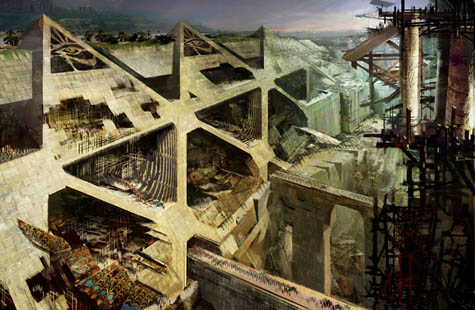
[Image: Daniel Dociu; view larger!].

Further, at what point in the design process do architects themselves begin to consider action and narrative development – and would games be a viable way for them to explore the social use of their own later spaces?

What would a game environment designed by Rem Koolhaas, or Zaha Hadid, or FAT really look like – and could video games be an interesting next step for professional architectural portfolios? You want to see someone’s buildings – but you don’t look at a book, or at a PDF, or at a Flickr set of JPGs: you instead enter an entire game world, stocked only with spaces those architects have created.

Richard Rogers is hired to design Grand Theft Auto: South London.

Of course, these questions go far beyond the scope of this interview – but such a discussion would be well worth having.
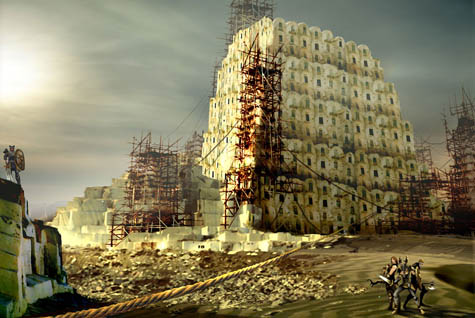
[Image: Daniel Dociu; view larger!].

What appears below is an edited transcript of a conversation I had with Daniel Dociu about his work, and about the architecture of game design.

• • •
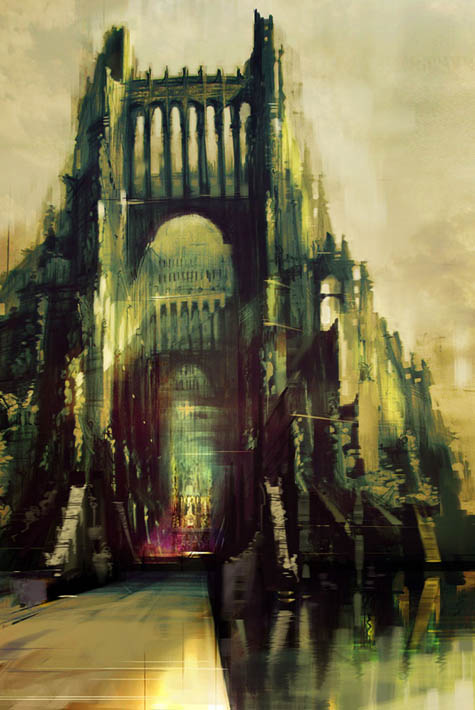
[Image: Daniel Dociu; view larger!].

BLDGBLOG: First, I’d love to hear where you look for inspiration or ideas when you sit down to work on a project. Do you look at different eras of architecture, or at specific buildings, or books, or paintings – even other video games?

Daniel Dociu: Anything but video games! [laughs] I don’t want to copy anybody else.

Architecture has always made a strong impression on me – though I can’t think of one particular style or era or architect where I would say: “This is it. This is the one and only influence that I’ll let seep into my work.” Rather, I just sort of store in my memory everything that has ever made an impression on me, and I let it simmer there and blend with everything else. Eventually some things will resurface and come back, depending on the particular assignment I’m working on.

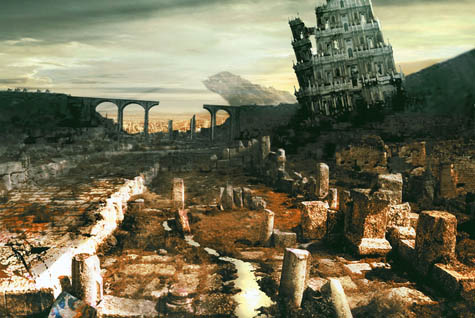
But I look back all the way to the dawn of mankind: to ruins, and Greek architecture, and Mycenean architecture, all the way up to the architecture of the Crusades, and castles in North Africa, and the Romanesque and Gothic and Baroque and Rococo – even to neo-Classical and art deco and Bauhaus and Modernist. I mean, there are bits and pieces here and there that make a strong impression on me, and I blend them – but that’s the beauty of games. You don’t have to be stylistically pure, or even coherent. You can afford a certain eclecticism to your work. It’s a more forgiving medium. I can blend elements from the Potala Palace in Tibet with, say, La Sagrada Família, Antoni Gaudí’s cathedral. I really take a lot of liberties with whatever I can use, wherever I can find it.
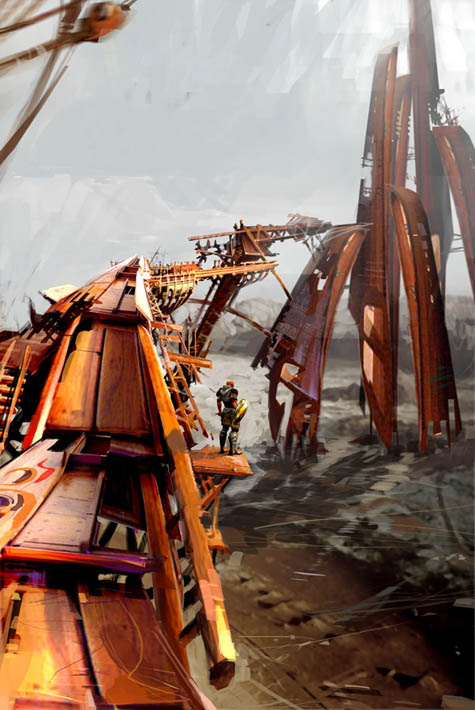
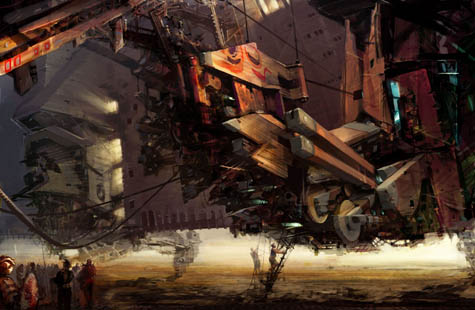
[Images: Daniel Dociu; view larger: top, middle, and bottom].

BLDGBLOG: Of course, if you were an architecture student and you started to design buildings that looked like Gothic cathedrals crossed with the Bauhaus, everybody outside of architecture school might love it, but inside your studio –

Dociu: You’d be crucified! [laughs]

[Image: Daniel Dociu; larger!].

BLDGBLOG: No one would take you seriously. It’d be considered unimaginative – even kitsch.

Dociu: Absolutely. That’s probably why I chose to work in this field. There’s just so much creative freedom. I mean, sure, you do compromise and you do tailor your ideas, and the scope of your design, to the needs of the product – but, still, there’s a lot of room to push.
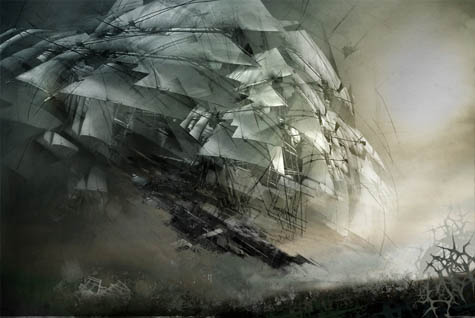
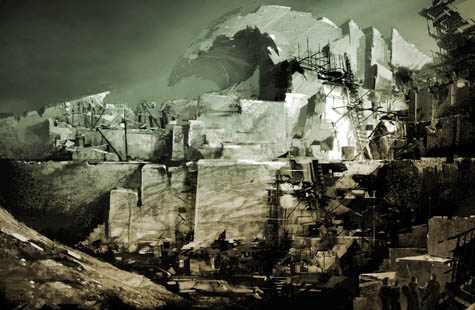
[Images: Daniel Dociu; view larger: top and bottom].

BLDGBLOG: So how much description are you actually given? When someone comes to you and says, “I need a mine, or a mountain, or a medieval city” – how much detail do they really give before you have to start designing?

Dociu: That’s about the amount of information I get.

Game designers lay things out according to approximate locations – this tribe goes here, this tribe goes there, we need a village here, we need an extra reason for a conflict along this line, or a natural barrier here, whether it’s a river or a mountain, or we need an artificial barrier or a bridge. That’s pretty much the level at which I prefer for them to give me input, and I take it from there. Most of my work recently has been focusing around environments and unique spaces that fulfill whatever the game play requires – providing a memorable background for that experience.

[Image: Daniel Dociu; view larger!].

BLDGBLOG: So somebody just says, “we need a castle,” and you go design it?

Dociu: Usually I don’t put pen to paper, figuratively speaking, until I have an idea. I don’t believe in just doodling and hoping for things to happen. More often than not, I think about a sentiment or an emotion that I’m trying to capture with an environment – and then I go back in my mind through images or places that have made a strong impression on me, and I see if anything resonates. I then start doing research along those lines. Only once did I have a pretty strong formal solution – an actual design or spatial relationship, an architectural arrangement of the elements – before that emotion crystallized.

But do I want something to be awe-inspiring, daunting, unnerving? That’s what I work on first – to have that sentiment clarify itself. I don’t start just playing with shapes to see what might result. Most of my work is pretty simple, so clarity and simplicity is important to me; my ideas aren’t very sophisticated, as far as requiring complex technical solutions. They’re pretty simple. I try to achieve emotional impact through rather simple means.
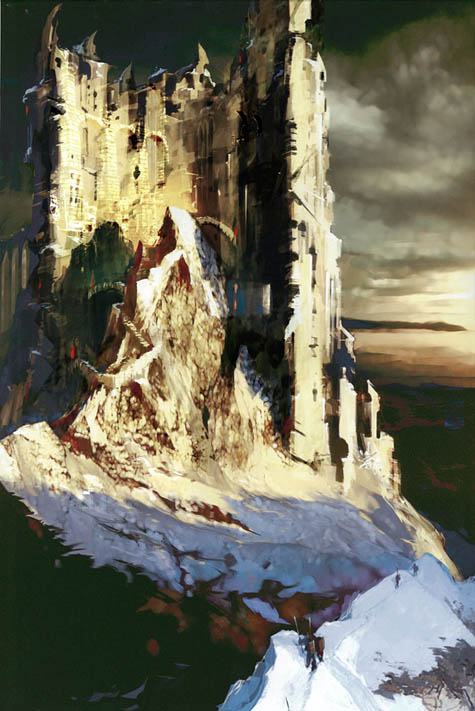
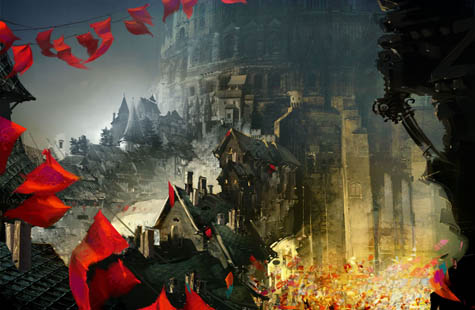
[Images: Daniel Dociu; view larger: one, two, three, four, five, and six].

BLDGBLOG: Do you ever find that you’ve designed something where the architecture itself sort of has its own logic – but the logic of the game calls for something else? So you have to design against your own sense of the design for the sake of game play?

Dociu: Oh, absolutely – more often than not.

To make an environment work for a game, you have to redesign your work – and I do sometimes feel bad about the missed opportunities. These may not be ideas that would necessarily make great architecture in real life, but these ideas often take a more uncompromising form – a more pure form – before you have to change them. When these environments need to be adapted to the game, they lose some of that impact.

[Image: Daniel Dociu; view larger!].

BLDGBLOG: I’d love to focus on a few specific images now, to hear what went into them – both conceptually and technically. For instance, the image I’m looking at here is called Skybridge. Could you tell me a little bit more about that?

Dociu: Sure. The request there was for a tribe that’s been trying to isolate itself from the conflict, and the tensions, and the political unrest of the world around it. So they find this canyon in the mountains – and I was picturing the mountains kind of like the Andes: really steep and shard-like. They pick one of these canyons and they build a structure that’s floating above the valley below – to physically remove themselves from the world. That was the premise.

I wanted a structure that looked light and airy, as if it’s trying to float, and I chose the shapes you see for their wing-like quality. Everything is very thin, supported by a rather minimalist structure of cables. It’s supposed to be the habitat for an entire tribe that chooses to detach themselves from society, as much as they can.
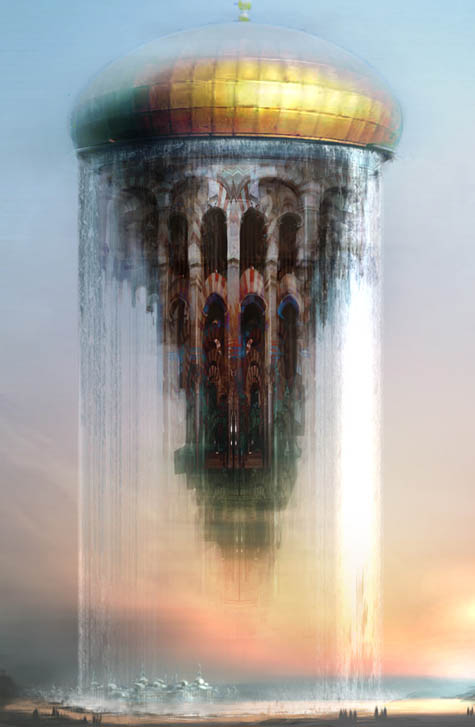
[Image: Daniel Dociu; view larger!].

BLDGBLOG: You’ve designed a lot of structures in the sky, like airborne utopias – for instance, the Floating Mosque and the Floating Temple. Was there a similar concept behind those images?

Dociu: Well, yes and no. The reasons behind those examples were quite different. First, floating mosques were my attempt to deal with what is a rather obnoxious cliché in games – which is floating castles. Every game has a floating castle. You know, I really hate that!
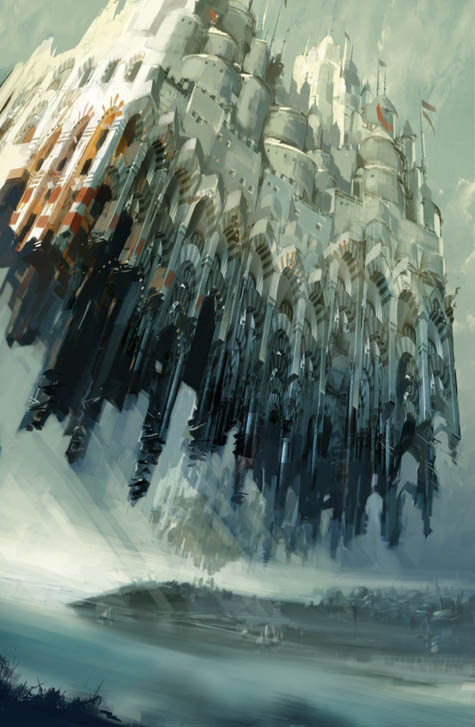
[Image: Daniel Dociu; view larger!].

BLDGBLOG: [laughs] So these are actually your way of dealing with a game design cliché?

Dociu: I was trying to find a somewhat elegant and satisfying solution to an uninteresting request.
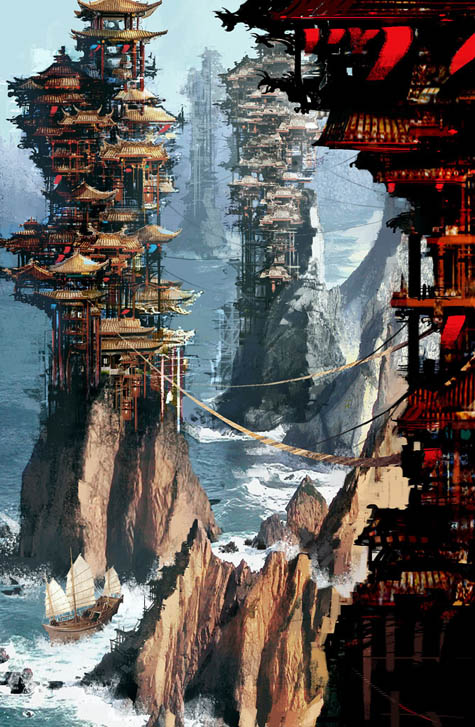
[Image: Daniel Dociu; view larger!].

BLDGBLOG: And what about Pagodas?

Dociu: The story there was that this was a city for the elite. It was built in a pool of water and it was surrounded by desert. Water is in really high demand in this world, but these guys are kind of controlling the water supply. The real estate on these rock formations is limited, though, so they were forced to build vertically and use every inch of rock to anchor their structures. So it’s about people over-building, and about clinging onto resources, and about greed.

That doesn’t touch on the game in its entirety – but that’s the story behind the image.

[Image: Daniel Dociu; view larger!].

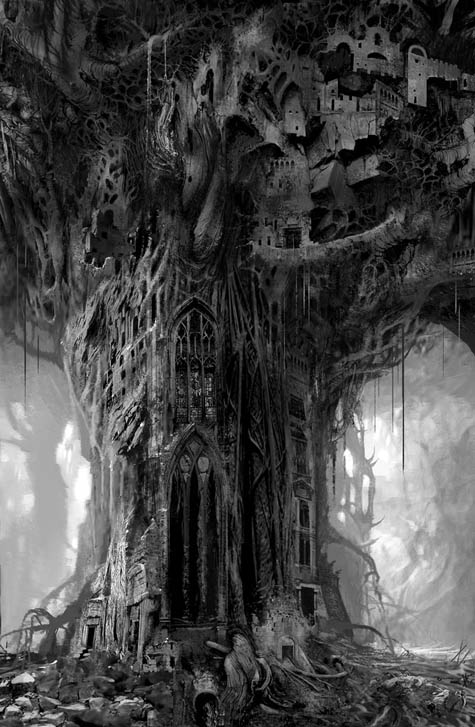
BLDGBLOG: Finally, what about the Petrified Tree?

Dociu: That was part of another chapter in our game. We thought that there should be some kind of cataclysm – or an event, a curse – that turns the oceans into jade and the forests into stone. We had nomads traveling the jade sea in these big contraptions, like machines.

So the petrified forest was a gigantic forest that got turned into stone, and the people who were happily inhabiting that forest had to find ways to carve dwellings into the trees: different ways of shaping the natural stone formations and giving them some kind of functionality – arches, bridges, dwellings, and so on and so forth. It was a blend of organic and manmade structures.

At that particular point in time, quite a few of my pieces were the result of my fascination with the Walled City of Kowloon. I was really sad to see that demolished, and this was kind of my desperate attempt to hold onto it! I was incorporating that sensibility into a lot of my pieces, knowing it was going to be gone for good.
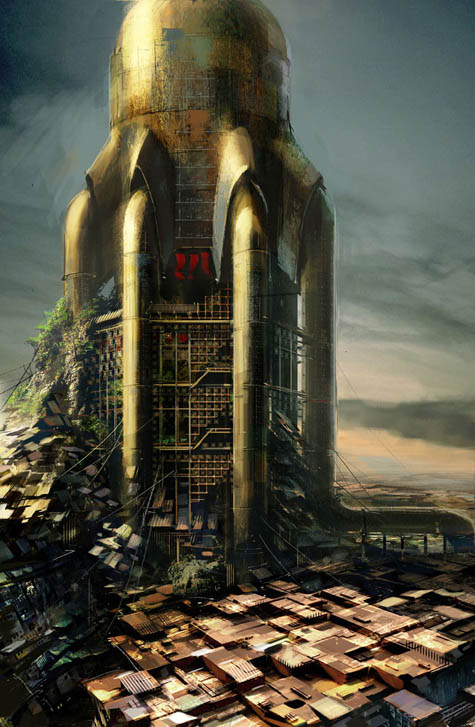
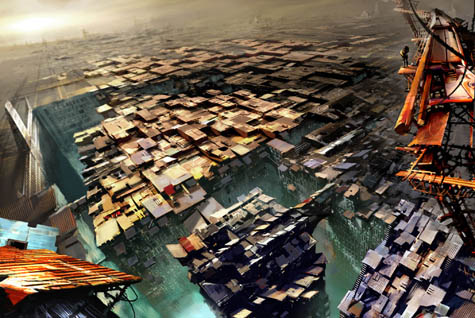
[Images: Daniel Dociu; view larger: top and bottom].

• • •

Thanks again to Daniel Dociu for taking the time to have this conversation. Meanwhile, many, many more images are available on his website – and in this Flickr set.
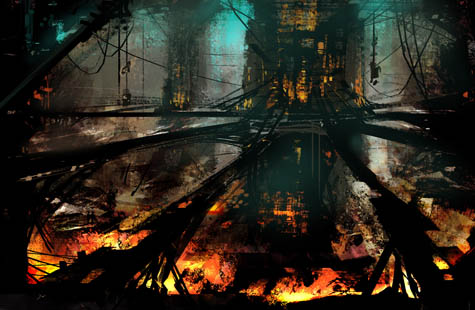
[Image: Daniel Dociu; view larger!].

(Daniel Dociu’s work originally spotted on io9).

Hotels in the Afterlife

[Image: From Sinai Hotels, by Sabine Haubitz and Stefanie Zoche of Haubitz+Zoche].

Vienna’s Architekturzentrum will be hosting a new photography show, opening this Wednesday, April 24, called Sinai Hotels.
With images by Sabine Haubitz and Stefanie Zoche of Haubitz+Zoche, the show looks at “the concrete skeletons of five-star hotel complexes” abandoned on Egypt’s Sinai Peninsula.
They are resorts that never quite happened, then, with names like Sultan’s Palace and the Magic Life Imperial. This makes them “monuments to failed investment.”

[Images: From Sinai Hotels, by Sabine Haubitz and Stefanie Zoche of Haubitz+Zoche].

The hotels now look more like “architectonic sculptures” in the desert, the photographers claim, or derelict abstractions, as if some aging and half-crazed billionaire had constructed an eccentric sculpture park for himself amongst the dunes.

[Images: From Sinai Hotels, by Sabine Haubitz and Stefanie Zoche of Haubitz+Zoche].

The billionaire goes for long walks at night alone amongst the ruins, sweeping dust from recent sandstorms off windowsills and open doorways.
At night, when the stars come out, different constellations are framed by unglazed windows, as if justifying these concrete forms from above with the poetic force of celestial geometry.

[Image: From Sinai Hotels, by Sabine Haubitz and Stefanie Zoche of Haubitz+Zoche].

Or, for that matter, five years from now these deserted monuments simply disappear – but because they’ve been put to use, finally, enwrapped with drywall and plaster, fitted out with drapes and marble floors, and you can sleep inside them for $300 a night, never even dreaming that these hotels were once ruins, temporarily abandoned to the sand and only recently reclaimed.
The empty swimming pool is now full – and you dive into it, unaware that you’re more like a ghost than a tourist, haunting the afterlife of these sites in bleaching sunlight.