
 [Image: Courtesy of London Basement].
A story of buried digging machines made something of an unexpected splash over at New Statesman this week, quickly becoming their weekend’s most-read article.
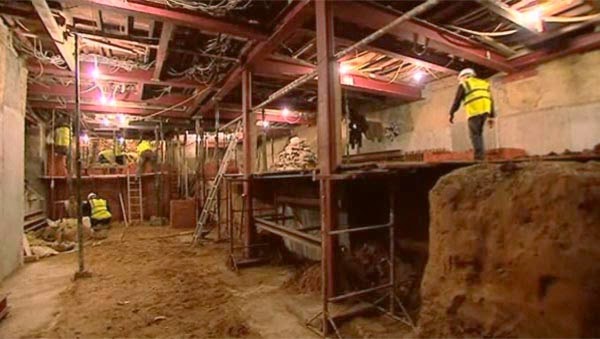
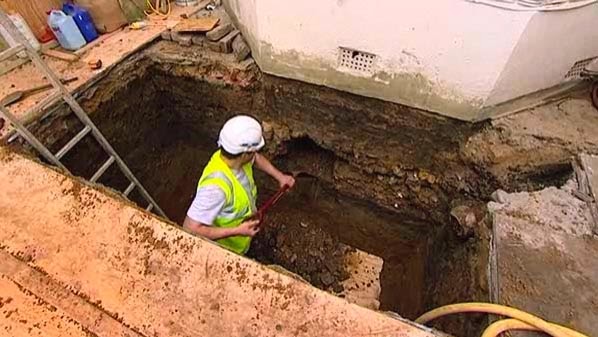
It turns out that all those elaborate basements and artificial show caves built for Londons’ nouveau riche have led to an interesting spatial dilemma: contractors are unable to retrieve the excavation equipment they used to produce all those huge underground extensions in the first place, and they have thus developed a technique for simply abandoning their machines underground and burying them in place.
London is thus becoming a machine cemetery, with upwards of £5 million worth of excavators now lying in state beneath the houses of the 1%. Like tools invented by M.C. Escher, these sacrificial JCBs have excavated the very holes they are then ritually entombed within, turning the city into a Celtic barrow for an age of heroic machinery.
What will future archaeologists make of these interred devices, densely packed in earth and left behind in unmarked graves?
 [Image: Courtesy of London Basement].
As we explored here on BLDGBLOG six years ago, deep below the mansions and row houses of the city’s wealthiest residents, colossal cave adventures are taking shape: massive swimming pools, TV rooms, personal gymnasia, full-scale cinemas, and whole subterranean flats are being constructed in order to side-step strict historic preservation laws on the earth’s surface.
Pioneered by firms such as the appropriately named London Basement, these massively expanded homes now feature “playrooms and cinemas, bowling alleys and spas, wine cellars and gun rooms—and even a two-storey climbing wall,” the Guardian reported in 2012. “It is leading to a kind of iceberg architecture, a humble mansion on the surface just the visible peak of a gargantuan underworld, with subterranean possibilities only limited by the client’s imagination.”
As the architect of one such mega-basement explained, “We analyzed the planning laws and realized that they cover everything about the surface of the ground, but nothing beneath it. There was nothing whatsoever that could stop us from drilling all the way down to the south pole.”
 [Image: Courtesy of London Basement].
Those grand old piles you see lining the streets of Belgravia thus might hide vertically sprawling domestic labyrinths and basement mazes down in the soil and clay beneath their ever-growing foundations, as home ownership fractally expands downward into the planet by way of waterproof geotextiles and carefully buttressed retaining walls.
However, these vast catacombs are by no means uncontroversial and might yet see their era come to an end due to local frustration with the disruption caused by construction crews and because of ever-growing municipal fees and penalties.
Until then, though, this abyssal impulse is surely approaching the inevitable point where we will see a private home legally redefined as a mine, a site of excavation closer in spirit to the extraction industry than private housing.
(Thanks to Martin John Callanan, Peter Flint, Paul Black, and Nicola Twilley! Meanwhile, if you like this, you might also like Subterranean Machine Resurrections)

 [Image: From the Ellensburg Daily Record, June 16, 1914].
 [Image: An otherwise irrelevant photo of people ballroom dancing, via