Star Garden

[Image: Building the International Thermonuclear Experimental Reactor; ©ITER Organization].

An artificially excavated limestone pit in the south of France will soon host star-making technology, New Scientist reports. “If all goes well,” the magazine explains, in a few year’s time the pit will “rage with humanity’s first self-sustaining fusion reaction, an artificial sun ten times hotter than the one that gives our planet life.”

[Image: Building the International Thermonuclear Experimental Reactor; ©ITER Organization].

Reaching that point, however, requires an ambitious reformatting of the entire site, seemingly the very limit of landscape architecture: a kind of concrete garden that produces stars.

As the project now stands, construction involves inserting a supergrid of rebar into the quarried pit, securing the limestone walls with concrete foundation work, then pouring seismically-stabilized plinths that will support the so-called International Thermonuclear Experimental Reactor (or ITER) upon completion.

[Image: Checking plinths at the International Thermonuclear Experimental Reactor, as if Peter Eisenman’s Holocaust Memorial in Berlin could be repurposed for building stars. Photo ©ITER Organization].

Superficially—i.e. they’re both in France and they both involve limestone—I’m reminded of the Crazannes Quarries project by Bernard Lassus, for which cuts, sections, “artificial rock formations,” shaped cliffs, and other designed geologies were introduced into and through the side of a French road. In effect, Lassus milled a new, powder-white landscape from the limestone.

But the ITER project seems to take the ambitions of Crazannes and turn them up to a nearly overwhelming degree: using a (to be clear, all but unrelated) landscape design process to produce moments of stellar combustion on the earth. It’s like an undeclared monument to Giordano Bruno—or, for that matter, to Aleister Crowley. A quarry in which we’ll build stars.

In any case, nestled there in its semi-subterranean, mine-like site and buzzing inside with radiation-resistant robot elevators, each “about the size of a large bus,” the ITER will recreate, again and again, “the process that powers the sun and most other stars. At extremely high temperatures, hydrogen nuclei will fuse to form helium, spitting out more energy than the process consumes, something that has never yet been achieved by a human-made device.”
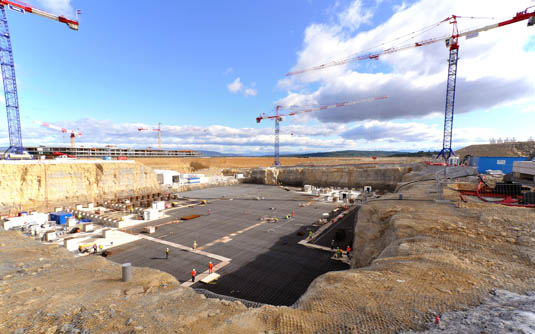
[Image: A blanket of rebar is installed inside the pit at the International Thermonuclear Experimental Reactor; ©ITER Organization].

The photos seen here—reproduced in accordance with ITER‘s image-use policy—shows the site work in action: quarrying, gridding, pouring, smoothing, and stabilizing, in preparation for the birth of new heavens.

[Images: Building the International Thermonuclear Experimental Reactor; ©ITER Organization].

More images are available at the ITER website.

Spaces on Spec

A few opportunities for those of you looking for new outlets:

1) Kerb, the journal of landscape architecture from RMIT University in Melbourne, is publishing its 20th issue, on “speculative narrative” and other “fictional dispositions” in the field of landscape design. Submissions are due May 4.

[Image: Kerb 20].

Read more on their website.

2) Spend three weeks in a renovated cotton mill in the woods of upstate New York, drawing, projecting, building, and discussing architecture. Arts Letters & Numbers, run by the Cooper Union’s David Gersten, “is conceived of as: an architecture, a theater, a film, a drawing, a conversation, an action, a reenactment and a school, all inside each other.” The workshop will begin “by drawing in the landscape with the elements; fire, air, water, and earth. These explorations will be a starting point for an evolving conversation between inside and outside, between fire and film, water, theater, air, drawing, earth and architecture. The entire site will be used to explore these interactions and develop amplifying exchanges and unpredictable questions.”

[Image: The cotton mill].

There will be daily seminars, visiting lecturers, near-continuous workshops, and don’t forget “great food.”

The photos below document a related workshop, also run by David Gersten, held in Aarhus, Denmark; while the space in upstate New York presents a different set of possibilities for work and display, a similarly immersive approach will be followed.

[Image: Photos from Aarhus Arc, led by David Gersten].

Applications are due May 1, and the workshop itself runs July 7–28. More information is available on the workshop website.

3) The newest issue of The State dives into the spatial imagination of “speculative geographies.”

We welcome submissions around the theme of “Speculative Geographies,” and encourage experimentation with form, transmedia, and (web)site-specific installations; critical texts, interrogative narratives, slow journalism, sensuous net-artwork, moving or still images, psychogeographic mappings, place hacking, manifestos and conversations, among others. Because of the nature of The State, please do not feel restricted by the above; please feel free to alternatively submit a wall of text.

Submissions are due April 30.

[Image: Urban Animal].

4) The Animal Architecture Awards are back with a look at the “urban animal.”

Urban areas are quickly becoming the densest concentrations of human life on the planet and with that comes the well documented positive and negative impacts to local biodiversity and ecologies. But humans are not the only urban animals—squirrels, pigeons, mice, rats, crows, raccoons, beetles etc.—all species identified as synanthropes—that “live near, and benefit from, an association with humans and the somewhat artificial habitats that humans create around them.” These are highly-urbanized non-human animals and our potential design partners.

Accordingly, “Animal Architecture wants your ideas about how synanthropic design can reshape, expand and redefine the context of urban thought and space.”

Register by May 13—and check out a few submissions to last year’s Animal Architecture Awards here on BLDGBLOG.

5) Finally, for those of you Down Under, Open Agenda is seeking “text and graphic based proposals that seek to develop research through architectural design” specifically from “graduates from a professional Australian or New Zealand degree [program] in architecture in the last ten years.” Register by May 27th.

[Image: Open Agenda].

Good luck!

Tunnel Plug

[Image: The plug, courtesy of Homeland Security’s Resilient Tunnel Project, via Wired UK].
The U.S. Department of Homeland Security’s “Resilient Tunnel Project” has come up with a prototype 35,000-gallon “plug,” or “enormous inflatable cylinder,” in the words of PhysOrg.com, one that is “tunnel-shaped with rounded capsule-like ends” and “can be filled with water or air in minutes to seal off a section of tunnel before flooding gets out of control.”

The idea is to prevent underground floods from taking down whole subway systems or otherwise destroying subterranean logistical networks, such as telecom cables (or Chicago’s infamous abandoned coal-delivery tunnels).

The plug itself is made from tear-resistant fabrics—including liquid-crystal polymers—that can expand around irregular surfaces and objects, producing, in effect, an impassable blockade. As Wired UK points out, this means the plug could also be used as a quarantine barrier, stopping the passage of chemical or biological agents.

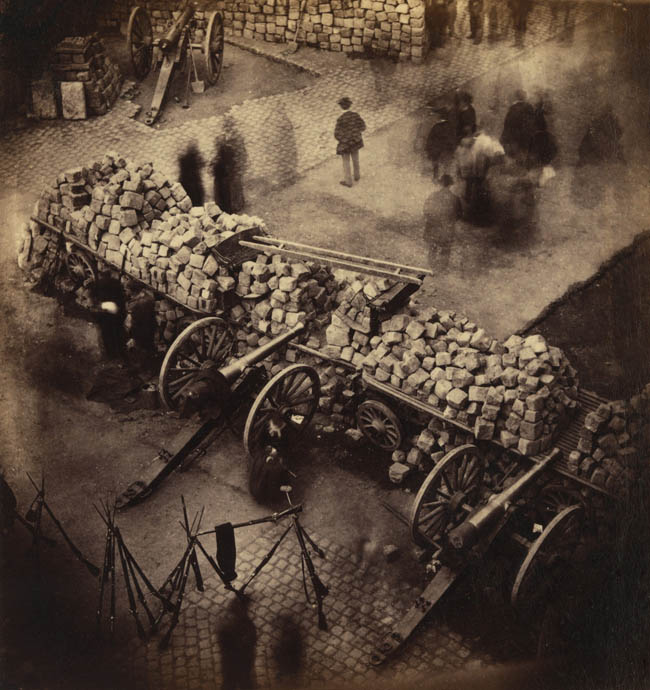
On an unrelated note, meanwhile, I’m looking forward to receiving a review copy of The Insurgent Barricade by Mark Traugott next week, and, in the context of that book, this “enormous inflatable cylinder” could take on other, aboveground roles, such as intervening in and impossibly redirecting urban movement (both in the name of security and insurgency). To put this in somewhat absurd terms, what might the Paris Commune have looked like, for instance, had its participants used giant, knife-proof inflatable objects, like revolutionary sausages blocking access to whole streets?

[Image: Paris barricade made from cobblestones (1871), photographed by Pierre-Ambrose Richebourg, via Wikipedia].

In any case, whether or not these or other such “plugs” will be permanently installed, like automotive airbags, inside underground infrastructure is yet to be decided; but it seems quite likely that affordably fabricated, inflatable barriers will become regular architectural safety features of a subterranean system near you.

Making Waves

While looking for an image for the previous post, I found these videos of a lake or lagoon being opened up after intense rain so that the water flows out to sea—creating, within minutes, powerful rivers of water that can be surfed for what seems like the whole afternoon.


The first one, above, in which the channel is excavated by hand, is probably more interesting for its literally hands-on, DIY hydrology, but the second video’s resulting torrent of black rolling water, visible at the 3:22 mark—


—is incredible. Just some eye candy for a Thursday afternoon.

Desert of the Real

[Image: Photo by M. Scott Brauer, via ScienceDaily].

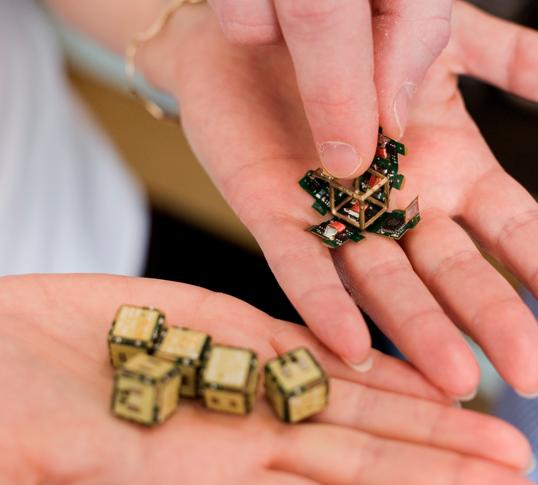
Researchers at MIT’s Distributed Robotics Laboratory is working on so-called “smart sand,” which would allow for the “spontaneous formation of new tools or duplication of broken mechanical parts.” Current prototypes of the substance—essentially, large cubes, seen in the photograph above—operate by way of “rudimentary microprocessors inside and very unusual magnets” on their edges, as ScienceDaily explains.

A heap of smart sand would be analogous to the rough block of stone that a sculptor begins with. The individual grains would pass messages back and forth and selectively attach to each other to form a three-dimensional object; the grains not necessary to build that object would simply fall away. When the object had served its purpose, it would be returned to the heap. Its constituent grains would detach from each other, becoming free to participate in the formation of a new shape.

Outlining what this might actually look like, should the Distributed Robotics Lab succeed at implementing their vision, ScienceDaily suggests you “imagine that you have a big box of sand in which you bury a tiny model of a footstool. A few seconds later, you reach into the box and pull out a full-size footstool: The sand has assembled itself into a large-scale replica of the model.”

You can read more at the Distributed Robotics Laboratory news site; but it’s too tantalizing a scenario to pass up mentioning other, much larger-scale possibilities for this technology, especially a scenario where “smart sand” has, as it were, escaped into the wild. Imagine whole deserts of this stuff, magnetically self-assembling into temporary sandstone cities, walls, and hills, a landscape of shifting urban forms you have to travel through, map, or settle. Like a deleted scene from Invisible Cities as rewritten by Magnus Larsson.

[Image: Kaleidoscope Ridge, Arizona (1982), photo by James Blair, courtesy of National Geographic].

Wandering tribes armed with mysterious handheld magnetic technologies reach into the sides of dunes and pull out whole buildings—where they proceed to sleep for the night before moving on the next day, their instant villages dissolving at dawn, “returned to the heap,” as ScienceDaily would say.

Or—perhaps in some future game brought to you by BLDGBLOG and Big Robot—you have to battle your way forward through infinite sandstone buildings that rise up, one after the other, like endless violent waves rolling as far as the eye can see, a desert of shapes lurching and unbuilding themselves toward you, forever. You jump through doors, up stairways, over walls, never advancing forward more than a few feet at a time, blinded by clouds of sand crashing on all sides, always another building ready to rise up out of the moving dunes and block you.

Caves of New York

[Image: “Caves for New York” (1942) by Hugh Ferriss].
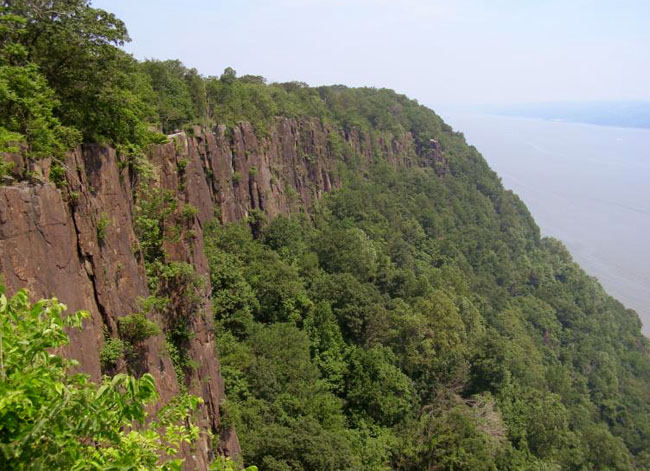
After writing the previous post—about Hong Kong’s impending infrastructural self-burial in the form of artificial caves beneath the island city—I remembered an image by Hugh Ferriss, preeminent architectural illustrator of the early 20th century, exploring huge air-raid shelters for New York City carved out of the rock cliffs of New Jersey.

“These shelters were to be 30 meters high and 60 meters wide and cut into the cliffs of the Hudson Palisades along the New Jersey side, and were to house planes, factories and hundreds of thousands of people,” Jean-Louis Cohen recounts in the recent book Architecture in Uniform: Designing and Building for the Second World War.

[Image: The New Jersey Palisades, via Wikipedia].

While this, of course, never happened, it’s a heady thing to contemplate: an alternative New York City burrowed deep into the geologic mass of New Jersey, a delirium of excavation heading west, away from these islands at risk from wartime annihilation, in a volumetric Manhattanization of empty bedrock.

Burying Bits of the City: Hong Kong Underground

Several months ago we looked at a network of artificial caves being built beneath Singapore that will, upon completion, extend the city’s energy infrastructure under the Pacific seabed; and, back in 2010, we took a very brief look at huge excavations underneath Chicago, courtesy of a feature article in Tunnel Business Magazine.

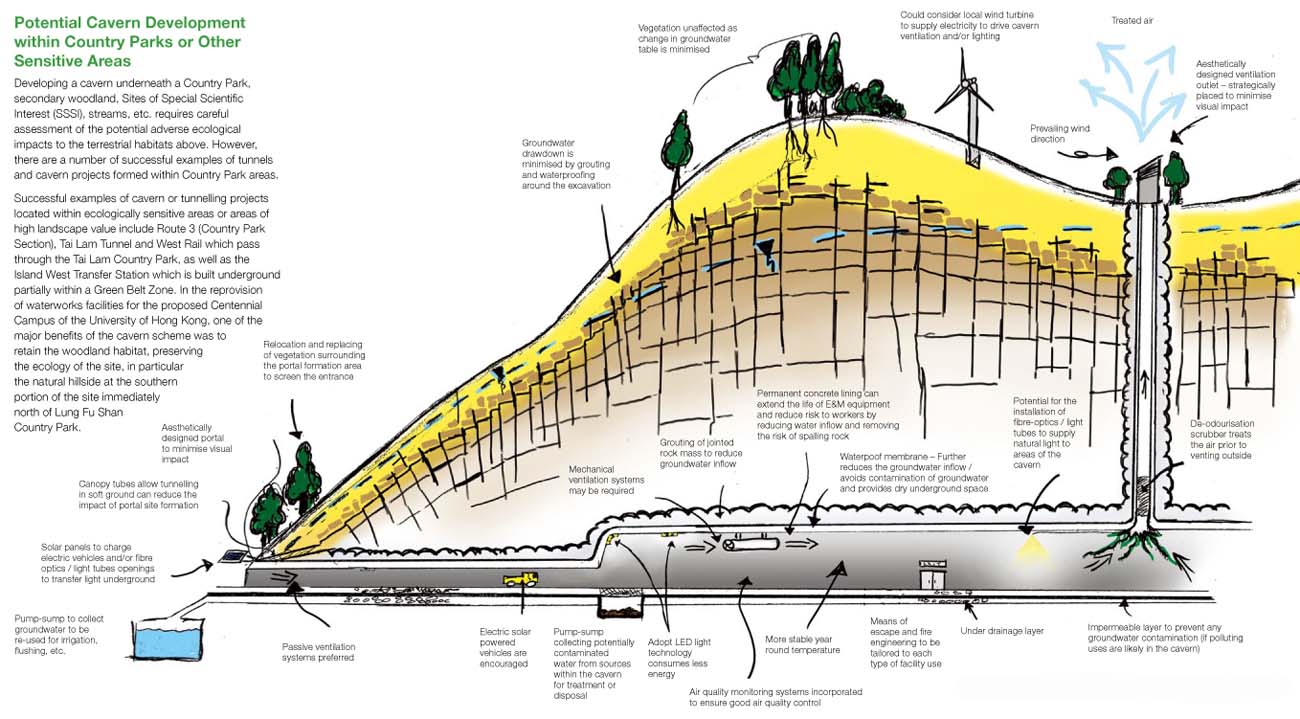
Now, according to the South China Morning Post, civil engineers in Hong Kong are exploring the possibility of developing large-scale underground spaces—artificial caves—for incorporation into the city’s existing infrastructure. In the full text of the article, available online courtesy of Karst Worlds, we read that the Hong Kong government “is moving towards burying bits of the city—the unsightly ones—in underground caverns, freeing up more land for housing and economic development.”

[Image: From the Enhanced Use of Underground Space in Hong Kong].

This is part of a larger undertaking called the Enhanced Use of Underground Space in Hong Kong initiative, a study, backed by Arup, that “would give the government a basis for policy guidelines to encourage cavern developments for both public and private sectors.” Private-sector caverns beneath the city!

[Image: From the Enhanced Use of Underground Space in Hong Kong; view bigger].

Specifically, city engineers “will begin by identifying suitable rock caverns to house 400 government facilities that can be relocated, notably the not-in-my-backyard utilities disliked by nearby residents.” These include “sewage treatment plants, fuel storage depots, refuse transfer stations and columbariums.” The University of Hong Kong, for instance, recently “hid a saltwater reservoir in an artificial cavern next to its Centenary Campus, in a project that cost HK$500 million”; these are referred to as “water caverns.”

Inspired by the fact that “caverns have been used as wine cellars, data centres and car parks in Finland and other countries,” Hong Kong’s Secretary of Development, Carrie Lam, has “called Hong Kong’s rock formations a ‘unique geological asset‘ and urged the city to take caverns into consideration.”

[Image: From the Guide to Cavern Engineering].

The awesome scale of some of the proposed excavations can be seen in this animation, where, at roughly the one-minute mark, we dive underground and begin to fly through linked 3D models of future freshwater reservoirs. A related PDF outlines a new landscape category—the Strategic Cavern Area—wherein “a strategic area is defined as being greater than 20 hectares in area and having the ability to accommodate multiple cavern sites.” (The idea that your neighborhood might be declared a Strategic Cavern Area, and thus cleared of its building stock, brings to mind a student project featured on BLDGBLOG last month, the “Lower East Side Quarry” by Rebecca Fode).

[Images: From the Guide to Cavern Engineering].

Sadly, we missed an opportunity to participate in a Hong Kong-based cave-design contest—its deadline was September 2011—called the “Rock Caverns—Unlimited Creativity” competition: “Competition entrants are required, with their unlimited creativity, to propose ideas related to the potential usage of underground space in Hong Kong.” A detailed design guide, called the Geoguide or Guide to Cavern Engineering, was published, and it remains available in full online.

This booklet is nothing less than a builder’s guide to artificial caves. As Chapter 4 helpfully explains, for instance, “In common with other complex constructions, the design of a large underground space is an iterative process where a series of factors influence the final result,” with prospective cave-designers required to use “numerous iterative loops” to create “a cost-effective cavern installation.” The rest of that chapter goes on to explore cavern cross-sections, layout, shape, rock bolts and pattern bolting, and even intra-cave pillars, all of which should find their way into an architecture school design studio somewhere soon.

[Image: From the Guide to Cavern Engineering].

In any case, while I feel compelled to point out the obvious—that a high-tech labyrinth of artificial caves dug beneath the rocky hills of an over-urbanized tropical archipelago is an incredible setting for future films, novels, and computer games—I should also mention, more prosaically, that Hong Kong’s impending subterranean expansion will doubtless offer many lessons relevant to cities elsewhere, as public-private underground partnerships increase in both number and frequency, with space-starved global mega-cities turning to partial self-burial as a volumetric infrastructural solution to the lack of available surface area.

Room and Billboard

[Image: The Billboard House by Apostrophy].

A project featured on designboom a few weeks ago explored the architectural possibilities of billboards: the Billboard House by Apostrophy is a “residential prototype that combines the concept of outdoor media with housing.” As such, it recalls earlier projects, such as Single Hauz, squeezing domestic space into an unlikely structural situation.

[Image: The Billboard House by Apostrophy].

Apostrophy’s house was installed and debuted at a fair in Bangkok, serving as a demonstration project, or proof of concept; it is transportable by truck, so, in theory, it can move between urban sites, being reattached to different masts in whole other neighborhoods and cities, while one of its facades remains operational as a revenue-generator for residents, displaying ads or other media content (it could also be a kind of live-in outdoor cinema for traffic jams).

[Images: The Billboard House by Apostrophy].

In any case, here are some shots of the interior, which features your standard modern amenities, including things like hydroponic gardens, a partially outdoor dining room, and space for storing bikes.

[Images: The Billboard House by Apostrophy].

More images and diagrams can be seen over at designboom.

BeetleCam


I’m increasingly interested in the rise of remotely controlled, semi-autonomous and/or fully autonomous camera systems as the future of landscape photography—using drones, for example, as a technical and aesthetic solution to various problems of landscape representation. So I was immediately intrigued by the BeetleCam project—an “armored robot,” in the words of New Scientist, designed by London-based photographer Will Burrard-Lucas—if only because of the weird comedy of watching lions, in the video embedded above, aggressively interact with a wheeled device they don’t otherwise understand.

But photographers sending machines into (or above) previously inaccessible spaces and scenarios will only become more common, whether it’s into the center of “a pride of feasting lions,” as Burrard-Lucas has done, into a leaking nuclear power plant, or, for that matter, down into the tiniest pipes and wires of a building, in a kind of architectural angioplasty, as worm-like endoscopic camera-drones learn to crawl and squirm inside the city, documenting places humans might not ever have been.

Demolition Composites

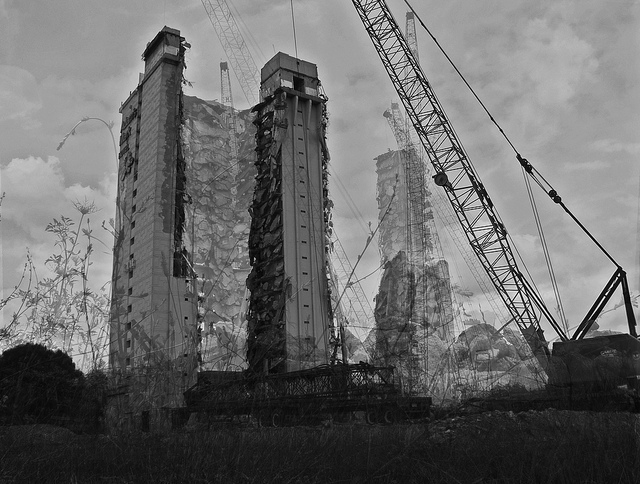
[Image: Composite photograph by Andrew Evans].

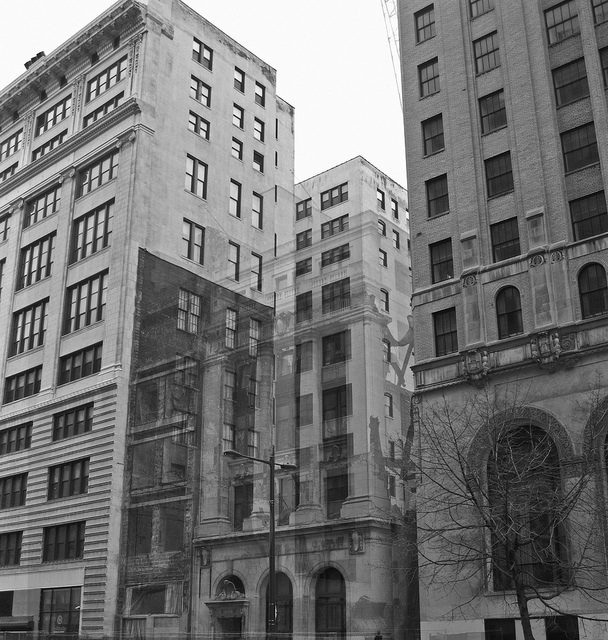
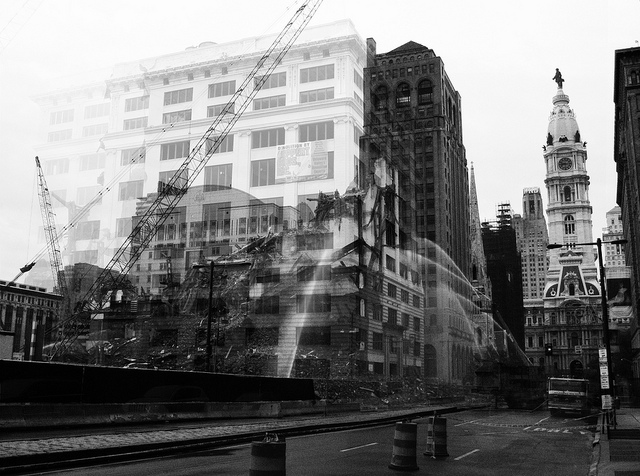
Andrew Evans, previously featured on BLDGBLOG way back in 2007, recently got in touch with some composite photographs taken of demolition sites in Philadelphia.

If you look closely through the layers, you can see remnant images of wrecked interiors.

[Image: Composite photograph by Andrew Evans].

And, on the edge of the city, ruined buildings stand like ghosts guarding an urban perimeter that keeps expanding, the city always flinging more pieces of itself further into what used to be woods and streams in a spectral ballet of cranes and skyhooks.

[Images: Composite photographs by Andrew Evans].

So we could roam the streets and suburbs holding cameras, like architectural PKE meters, tracking the profiles of erased buildings, earlier roads, forgotten districts, even entire islands entombed beneath airports, scanning sites for lost towers and halls that once stood there, twisted interiors still hovering somewhere in memory and broken rebar.

See a few more demolition composites over at Andrew’s Flickr page.

Off to India

[Image: The Chand Baori stepwell, courtesy of Wikipedia].

Just a quick note that I will be in India without a computer for the next two and a half weeks, visiting stepwells, cave temples, the 18th century astronomical garden of Jantar Mantar, hill forts (including Mehrangarh), the Water Palace (or Jal Mahal) in Jaipur, and more, and I will thus be offline until late March. Unfortunately, this also means that I will be unable to moderate new comments or reply to emails; please be patient, though, and I will get to all that when I return. Meanwhile, feel free to visit the BLDGBLOG archives, through the extensive list of previous posts in the lefthand column. I’ll be back…