The Long River


[Image: “Chongqing XI” by Nadav Kander, winner of the 2009 Prix Pictet; courtesy of the Prix Pictet].

Speaking of the Prix Pictet, the winner of the 2009 prize was Nadav Kander for his project Yangtze, The Long River. It’s an amazing group of images.

From Kander’s artist statement:

The Yangtze River, which forms the premise to this body of work, is the main artery that flows 4100 miles (6500km) across china, traveling from its furthest westerly point in Qinghai Province to Shanghai in the east. The river is embedded in the consciousness of the Chinese, even for those who live thousands of miles from the river. It plays a significant role in both the spiritual and physical life of the people.

Kander “photographed the landscape and people along its banks from mouth to source”—a daunting task, for, as Kander points out, “more people live along its banks than live in the USA, one in every eighteen people on the planet.”


[Image: “Chongqing VII, (Washing Bike)” by Nadav Kander; courtesy of the Prix Pictet].

Part of Kander’s visual goal was “showing humans dwarfed by their surroundings. Common man,” the photographer adds, “has little say in China’s progression and this smallness of the individual is alluded to in the work.”

The images featured in this post have the feel of a film set—more cinematography than photography—as if Kander has unknowingly captured a mise-en-scène, some wrongly cut dramatic moment, unfolding on the river banks.

Actors, perhaps unsure of their larger narrative role, seem overwhelmed by their infrastructural surroundings.


[Image: “Chongqing IV (Sunday Picnic)” by Nadav Kander; courtesy of the Prix Pictet].

The stage set-design theories of Edward Gordon Craig come to mind. Craig was an early 20th-century stage set designer (and son of an architect), whose “architectonic scenery,” according to M. Christine Boyer, foregrounded architectural backdrops so strongly that his props ultimately became the only on-stage action an audience was meant to watch.

Craig “proposed that a stage in which walls and shapes rose up and opened out, unfolded or retreated in endless motion could become a performance without any actors,” Boyer writes. “The stage thus became a device to receive the play of light rhythmically, creating an endless variety of mobile cubic shapes and varying spaces. Deep wells, stairs, open spaces, platforms, or partitions created a stage of complete mobility, which Craig believed appealed to the imagination.” It is a stage devoid of actors, in other words, just large pieces of equipment moving about according to the rules of their own choreography.

What happens, then, if this depopulated dramaturgy becomes blown-up to the scale of national infrastructure?

In one sense, this perfectly empty landscape into which humans try vainly—and at great emotional cost—to situate themselves is the hallmark of J.G. Ballard. We might even specifically ask, looking at Kander’s photos: when will a Yangtze River-based rewriting of Ballard’s Concrete Island come along, exploring these spatial questions?

Concrete Island, of course, is Ballard’s 1974 novel about a London motorist—as it happens, an architect—who is stranded on his way home by a car accident. Freeing himself from his ruined vehicle at sundown, he finds himself trapped beneath the yawning arches of the motorway, stranded in a peripheral world of drainage culverts, ascent ramps, sliproads, and storm tunnels, a kind of urban blindspot (read Mike Bonsall’s awesome forensic archaeology of London’s Westway, a spatial interrogation of the built environment in order to discover where Ballard’s novel was meant to be set).

With no rescue in sight, Ballard’s architect is left to fend for himself, surrounded by gigantic pieces of urban infrastructure whose purpose now seems oddly counter-human; he is “alone in this forgotten world whose furthest shores were defined only by the roar of automobile engines… an alien planet abandoned by its inhabitants, a race of motorway builders who had long since vanished but had bequeathed to him this concrete wilderness.”

I’m left wondering: who is the J.G. Ballard of contemporary China? Nadav Kander‘s photographs—many more of which can be seen at the Prix Pictet site—are an enticing glimpse of what a Ballardian sensibility might create there.

Igneous Hydrology: Landscapes on Demand


[Image: “Scene J3” from Snow Management by Jules Spinatsch, courtesy of the Prix Prictet].

I was reminded, via an old post on Pruned, of an amazing series of photographs by Jules Spinatsch called Snow Management; Snow Management was deservedly short-listed in 2008 for the Prix Prictet.

With those images, Spinatsch documents the infrastructure of snow control—and outright terrain manufacture—at an Alpine resort, including the labyrinths of retaining fences and the individual pieces of equipment that make snow creation and large-scale, though ephemeral, landscape-sculpting possible.


[Image: “Scene D6” from Snow Management by Jules Spinatsch, courtesy of the Prix Prictet].

In a way, these scenes are like a big-budget variation on Sergio López-Piñeiro’s idea, discovered via Mammoth, of a snow park or whitesward. López-Piñeiro’s own photographic documentation of urban plowing practices—that is, the deliberate reshaping of snow piles into an ephemeral, new, seasonal topography—is an attempt, he writes, “to show how standard plowing techniques can become creative tools for generating winter landscapes.” López-Piñeiro continues:

The white parks that I envision could be easily constructed: plowing master plans would carefully locate the snow mounds, and the resulting designs would artistically exploit the spatial conditions defined by these usually overlooked piles of snow.

In winter, an artfully shaped snow landscape could become a “whitesward”—underscoring the now obscured potential for plowing to positively transform public space. Such a white landscape could be considered a “snow observation ground” to encourage people to appreciate the snow and its accumulation, and to dispel the negative impressions and experiences that our combative approach has produced.

Ski resorts, with their huge array of technical devices and machinic subfamilies all geared toward—indeed, specifically invented for—the purpose of creating new landscapes below the thermal boundary at which their engineered shapes will liquify, become extraordinary experiments in terrain-generation on a massive scale. They are a kind of igneous hydrology: the controlled freezing of matter into artificial forms.

More images from Jules Spinatsch’s spectacular series are available on his website, and the Snow Management series itself can also be downloaded as a 3.2MB PDF.

Empire


[Image: From Empire by Andy Warhol, courtesy of the Museum of Modern Art].

Tomorrow at noon here in New York City, a musical event that I would love to attend kicks off: 8 solid hours of sound, providing a live accompaniment for Andy Warhol’s Empire—a film notorious for its one, unchanging shot of the Empire State Building.

Hanno Leichtmann, Andrew Pekler, and, most exciting at least for me, Jan Jelinek—who, bizarrely, I once introduced myself to at WMF in Berlin—will be providing the music.

The Museum of Modern Art describes Empire as follows:

Empire consists of a single stationary shot of the Empire State Building filmed from 8:06 p.m. to 2:42 a.m., July 25–26, 1964. The eight-hour, five-minute film, which is typically shown in a theater, lacks a traditional narrative or characters. The passage from daylight to darkness becomes the film’s narrative, while the protagonist is the iconic building that was (and is again) the tallest in New York City. Warhol lengthened Empire‘s running time by projecting the film at a speed of sixteen frames per second, slower than its shooting speed of twenty-four frames per second, thus making the progression to darkness almost imperceptible. Non-events such as a blinking light at the top of a neighboring building mark the passage of time. According to Warhol, the point of this film—perhaps his most famous and influential cinematic work—is to “see time go by.”

That live soundtrack/concert/event, which kicks off at Le Poisson Rouge, is just one small part of an amazing, multi-day musical event called Unsound. Unsound features several audio heroes of BLDGBLOG, including Tim Hecker, Ezekiel Honig, Moritz von Oswald, Vladislav Delay, and even Levon Vincent, among many more.

In fact, after a long day spent touring the involuted subterranea of Kentucky’s Mammoth Cave back in 2001, Nicola Twilley and I drove home listening to Vladislav Delay’s Entain, our car creaking over the hollow roof of an earth below us, its caverns hidden beneath overgrown bedrock, sinkholes perhaps waiting on either side of the highway, heading northwest over collapse-prone mineral logics toward Chicago.

Post-Conflict Architecture and Design

Volume magazine is hosting a conference this coming May about what they call “the Architecture of Peace.” Part of this will be assembling “an inventory of inspiring projects for (post-)conflict territories”—and they’re hoping that you will get involved.

Are you an architect, designer, urbanist or community leader? Have you developed a project that aids to channel social relationships in a more peaceful way? Then get in touch with Volume. Send a short description to info@archis.org with the subject “AoP projects call,” and we will endeavour to include it in our conference material, providing a unique overview of projects of this kind.

From post-military landscape remediation projects to transborder community exchange programs, from conflict gardens to films, from anti-gang territorial initiatives to bunker recycling services, from museums of slave history to a cartography of divided cities, I would imagine there is a huge range of ideas and examples out there to explore.

Quick Links 4


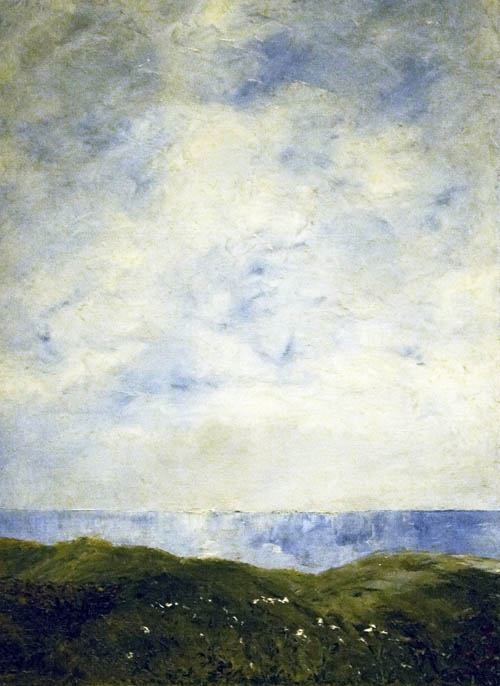
[Image: August Strindberg, Coastal Landscape II; via Andrew Ray’s excellent blog Some landscapes].

I’m horribly behind in my Quick Links… so here are fifteen:

1) New York Public Library | Life at the library: The New York Public Library’s live-in superintendents
2) Quiet Babylon | Woven Spaces
3) L.A. Times | Household chemicals linked to reduced fertility
4) Telegraph | Two thousand year old Roman aqueduct discovered
5) GOOD | The seed industry’s scary consolidation
6) Vague Terrain | Graffiti Markup Language
7) Amundsen-Scott South Pole Station | About those tunnels… and even more about those ice tunnels
8) Related: mammoth | The City Beneath the City
9) Still related: WNYC | Journey to the Center of Manhattan and the Westside Tunnels

10) Still related! Scientific American | Mining for Algae: Could Abandoned Mines Help Grow Biofuel?
11) InfraNet Lab | Student Works: Trawling the Thames and Post-Peak Phosphorous
12) Speaking of InfraNet Lab, pick up a copy of -arium: Weather + Architecture (for instance, via Amazon)
13) Behance | Strange Worlds
14) The Onion | Stoner Architect Drafts All-Foyer Mansion
15) DARPA Strategic Technology Office | Comprehensive Interior Reconnaissance

And one to grow on: Alison Arieff | Space: It’s Still a Frontier

(Some links via @nicolatwilley, @maudnewton, @eatingbark, Archaeology News, Archinect, and possibly elsewhere. Quick Links 1, 2, and 3).

Three Trees

1) And then there was computational wood.

For his master’s thesis, produced last year under the direction of Timo Arnall, Matt Jones, Jack Schulze, Lennart Andersson, and Mikael Wiberg, designer Matt Cottam directed this short video about a technique for growing electrical circuitry inside the trunks of living trees. Just inject the right trace metals, Cottam’s mad scientist narrator explains, do some more techno-magic, and simply let the wood grow…

If only it were true. But the day will come, my t-shirt will read, when all the trees around us are computers.

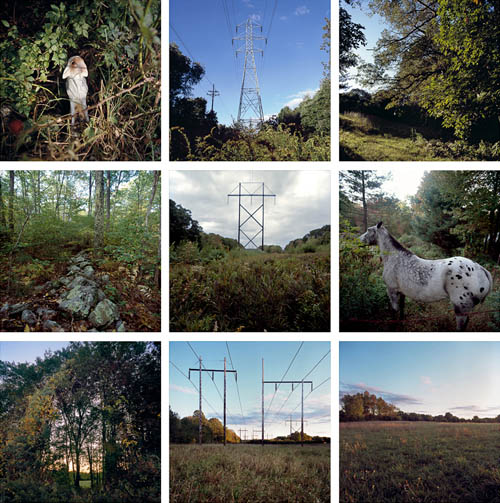
2) While researching blackouts for a seminar I am teaching this winter at Pratt, I stumbled on a strange anecdote from The New York Times, published back in 1986, about a plant physiologist at the Brooklyn Botanic Garden who was seeking a way to end the risk of “trees crashing down on power lines” (a major source of power interruptions).


[Images: All photos by Adam Ryder, from On the Grid].

“One of the things we’re looking at,” the scientist explained, “is something that will directly retard the growth of trees”—that is, chemicals “that interfere with the basic growth hormones.” He was trying to develop, he adds, “a mild chemical” that would deliberately slow tree growth, “and instead of spraying we’re injecting [it] directly into the tree.”

Who knows where that research has now led them, twenty-four years later, but I’d suggest someone might want to mail them a copy of The Death of Grass. ASAP.


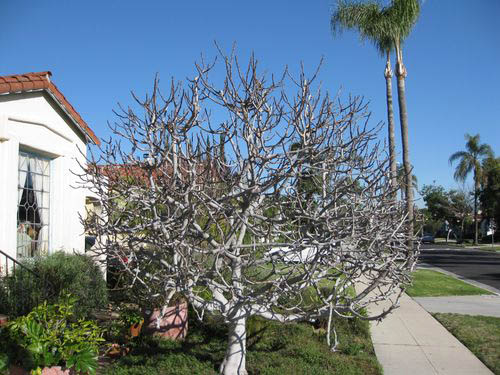
[Image: A fig tree grows in Los Angeles; photo by Pieter Severynen].

3) While going back through old bookmarks this morning, I rediscovered Tree of the Week, a series of articles run by the Los Angeles Times. The overall project could be described as a botanical cartography of the city: a catalog of Angeleno trees.

This week’s tree is the “highly productive fig“; last week’s was the Blackwood Acacia. With regard to the latter tree, Pieter Severynen, the series author, writes: “Given its negative properties it should be clear that a description of this tree, or for that matter any tree of the week, does not imply an endorsement to plant. Instead it is offered as a means to learn more about the existing trees that make up the fascinating urban forest surrounding us in the Southland.”

The “fascinating urban forest surrounding us in the Southland” includes the Weltwitschia, the “picturesque Aleppo pine,” and, of course, among many others, the apple, a tree genetically sculpted over the millennia through “hundreds of accidental and deliberate cross-hybridizations” around the world, Severynen writes.

Anyone interested in exploring the urban forests of Los Angeles would do well to check out the fruit maps of Fallen Fruit, who have discovered in the seemingly random dispersal of fruit trees around Silver Lake the remnant outlines of long-forgotten orchards; but if your curiosity goes further afield than L.A., the absolutely fantastic book Wildwood, by the late Roger Deakin, has truly unforgettable descriptions of walnut harvesting in Kazakhstan, old-growth Eastern European forests filled with war ruins and shrapnel, and Deakin’s own backyard in England. It is often astonishingly beautiful—and it also Deakin’s last major work.

Plan for Sky

“Did you know,” the original caption for this image asks, “barium releases in space in 1969 caused an artificial aurora?”


[Image: Courtesy of NASA].

Perhaps cities like Montreal and Stockholm—even L.A., watching auroras torque and fold over the black waters of the Pacific—should simply hire small fleets of barium-carrying orbital vehicles to keep the skies interesting all winter long.

Book Tower


[Images: House in Venice, California, by Bureau AA; photos by Larry Underhill].

This small and breezy house in Venice, California, designed by Robert Choeff and Krystyan Keck of the Bureau of Architectural Affairs, was completed in April 2009.


[Image: House in Venice, California; photo courtesy of Bureau AA].

The house’s transparent polycarbonate cladding, used to “expose the interactions” of the building elements, makes the house function like “a structural X-ray,” we read in a recent issue of Mark Magazine.

Tight quarters, a tight budget and further restrictions—including a height limit and required setbacks—navigated the architects toward their design solution: a 54-square-meter trapezoid perched above the existing structure on steel stilts, topped by a roof deck with views in all directions.

I’m reminded here of Francois Perrin’s Guest House for an Anthropologist, itself also very biblio-intensive: both are houses of exposed wood and polycarbonate, with lots of things to read.


[Image: House in Venice, California, by Bureau AA; photo by Larry Underhill].

The interior of the house seems solidly locked in place: “the upper story has no doors,” we read, “and its only piece of freestanding furniture is the dining table. Lean work desks and kitchen counters hug the perimeter, and built-in storage spaces double, discreetly, as screens.” This includes the bookshelves.

“Where there isn’t cabinetry and Sheetrock,” Mark Magazine adds, “there’s a window.”


[Images: Courtesy of the Bureau of Architectural Affairs].

I would feel compelled to add curtains, I’m afraid, and I would probably be a bit nervous with all those books over my head during an earthquake, but with a few minor adjustments I might put in an order for one, too, please…

pavilion.net


[Image: Pole Dance, P.S. 1 competition-winning design by SO-IL].

I have to admit to being less than overwhelmed by the annual P.S. 1 competition—aka the Young Architects Program—as well as by the annual Serpentine Pavilion in London, but this year’s P.S. 1 winner, by Brooklyn-based SO-IL, looks pretty amazing.


[Image: Pole Dance, P.S. 1 competition-winning design by SO-IL].

Although it will be nothing but a sea of bungee-anchored soccer nets and wobbly fiber-glass poles—with some colored balls thrown overhead as mobile ornaments—the structure has the feel of being the framework for an emerging game, an obscure sport whose spatial rules are yet to be determined.

As the architects themselves explain in their initial proposal, “On discovery of its elasticity, visitors engage with the structure, to envision games, test its limits or just watch it gently dance.”


[Images: Pole Dance by SO-IL].

Put another way, if Yona Friedman were to become president of FIFA, perhaps this would be the weird new playing field he might develop.


[Image: Pole Dance by SO-IL].

The view from the street, of tall poles gently swaying amidst nets, will also be interesting to see.

While you’re on SO-IL‘s website, check out their proposal Party Wall, as well as their well-weathered documentation of a garden shed in Belgium.

Lunar Archaeology


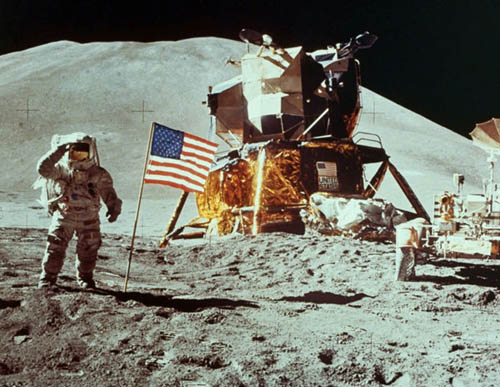
[Image: Humans creating a future archaeological site on the moon].

In a meeting today in Sacramento, commissioners might vote to register items left behind on the moon by Apollo astronauts “as an official State Historical Resource,” the L.A. Times reports.

After all, “California law allows listing historical resources beyond the state’s borders—even if it’s more than 238,000 miles away.”

Some of the 5,000 pounds of stuff Neil Armstrong and Buzz Aldrin abandoned at Tranquility Base was purposeful: a seismic detector to record moonquakes and meteorite impacts; a laser-reflection device to make precise distance measurements between Earth and the moon; a U.S. flag and commemorative plaque. Some was unavoidable: Apollo 11’s lunar module descent stage wasn’t designed to be carted back home, for instance.

“They were told to jettison things that weren’t important,” anthropologist Beth O’Leary, “a leader in the emerging field of space heritage and archaeology,” tells the newspaper. “They were essentially told, ‘Here’s eight minutes, create an archaeology site.'””

If the Apollo site does become, incredibly, a California state landmark, this decision will open a legal path for the location to be recognized as an official UNESCO World Heritage Site. This, in turn, will help protect it from vandalism during “unmanned trips to the moon by private groups, and even someday by tourists.” While the implied vision of Indiana Jones, Astronaut, is an exciting one, the idea that the State of California could someday have historical jurisdiction—or something like it—over a fragment of the moon’s surface seems genuinely astonishing to me. Perhaps we could even have it declared part of Los Angeles County—the first offworld municipal exclave.

Texas and New Mexico also have plans to “place the items on historic registries” later this year, we read.

Our Lady of the Rocks


[Image: Via montenegro.com].

Somehow this morning I ended up reading about an artificial island and devotional chapel constructed in Montenegro’s Bay of Kotor.

“In 1452,” we read at montenegro.com, “two sailors from Perast happened by a small rock jutting out of the bay after a long day at sea and discovered a picture of the Virgin Mary perched upon the stone.” Thus began a process of dumping more stones into the bay in order to expand this lonely, seemingly blessed rock—as well as loading the hulls of old fishing boats with stones in order to sink them beneath the waves, adding to the island’s growing landmass.

Eventually, in 1630, a small chapel was constructed atop this strange half-geological, half-shipbuilt assemblage.


[Image: Via Skyscraper City].

Throwing stones into the bay and, in the process, incrementally expanding the island’s surface area, has apparently become a local religious tradition: “The custom of throwing rocks into the sea is alive even nowadays. Every year on the sunset of July 22, an event called fašinada, when local residents take their boats and throw rocks into the sea, widening the surface of the island, takes place.”

The idea that devotional rock-throwing has become an art of creating new terrain, generation after generation, rock after rock, pebble after pebble, is stunning to me. Perhaps in a thousand years, a whole archipelago of churches will exist there, standing atop a waterlogged maze of old pleasure boats and fishing ships, the mainland hills and valleys nearby denuded of loose stones altogether. Inadvertently, then, this is as much a museum of local geology—a catalog of rocks—as it is a churchyard.

In fact, it doesn’t seem inaccurate to view this as a vernacular version of Vicente Guallart‘s interest in architecturally constructing new hills and coastlines based on a logical study of the geometry of rocks.

Here, the slow creation of new inhabitable terrain simply takes place in the guise of an annual religious festival—pilgrims assembling islands with every arm’s throw.