How the Other Half Writes: In Defense of Twitter

With the caveat that this post doesn’t have much to do with architecture, but with the further caveat that I will be speaking about media – specifically online media – next week at the Australian National Architecture Conference, I thought I’d offer a few thoughts here about Twitter.
Inspired in this specific instance by Maureen Dowd’s brain-dead editorial in yesterday’s New York Times, but also by the obvious glee with which so many people have denigrated the note-taking value of Twitter, it seemed like time to address the subject. Ever since a friend of mine once claimed – very late and after many drinks – that “Twitter is the death of humanism,” I’ve been regularly thinking about how a simple note-taking technology could inspire such apparent dread in so many people.

First, on the most obvious level, Twitter needs to be differentiated from what people write on Twitter. The fact that so many people now use Twitter as a public email system, or as a way to instant-message their friends in front of other people, is immaterial; Twitter is a note-taking technology, end of story. You take short-form notes with it, limited to 140 characters.

The clichéd analogy here has been with Japanese haiku, but perhaps we might even reference the Oulipo: in other words, Twitter means that you are writing, but you are writing within constraints.

Second, the comparison I often make here is with ball-point pens.
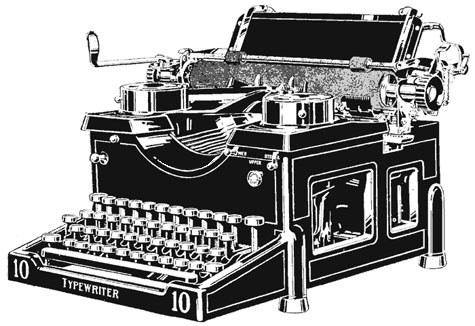
Imagine a world where everyone uses typewriters: they write novels, manifestos, historical surveys, and so on, but they do it all using typewriters.
Now the ball-point pen comes along. People use it to write down grocery lists and street addresses and recipes and love notes. What is this awful new technology? the literary users of typewriters say. Ball-point pens are the death of humanism.

Nevermind, of course, that you can use ball-point pens to write whatever you want: a novel, a screenplay, epic poems, religious prophecy, architectural theory, ransom notes. You can draw astronomical diagrams, sketch impossible machines for your Tuesday night art class, or even work on new patent applications for a hydrogen-powered automobile – it doesn’t matter. You can draw penises on your coworker’s paycheck stub.

It’s a note-taking technology.
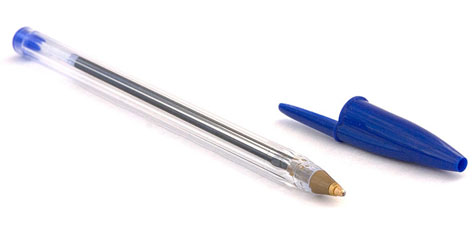
Who cares if people use ball-point pens for writing down phone numbers and movie times, or even drawing little hearts on someone else’s notebook in the middle of English class? It doesn’t mean that they hate literature.
Similarly, who cares if someone uses Twitter to say that they’re bored, or to list what they ate last night? It doesn’t mean the barbarians are at the gates.

This leads to a third point, which is that, according to Dowd’s own absurd logic – she describes Twitter as something “for bored celebrities and high-school girls” – well, first of all, who says high-school girls aren’t supposed to write? And why is it anyone else’s business if a bored person, who happens also to be famous, decides to share random thoughts with the world?

However, what very much bothers me about this attitude toward Twitter is something else: if you were to go around the United States reading the handwritten diaries of, say, high-school girls or adolescent boys or even well-read college students, you would find equally inane chattering: “I feel fat today.” “Can’t wait for summer in Boca! But I need new shorts.” “My history professor is HOT.” “I hate holidays. Christmas at home is so boring.”

Are you really going to tell me that the average contemporary, hand-written diary is any more interesting than that? In fact, one could easily argue that private, paper-based journals would be volumetrically much worse than Twitter in their sheer scale of self-obsession.

Yet the anti-Twitter crowd doesn’t appear to oppose the use of personal journals during adolescence. For instance, will Dowd soon also be writing an editorial that excoriates lonely teenagers for writing down their thoughts on paper? After all, she bizarrely implies, “high-school girls” shouldn’t be allowed access to new forms of writing technology, so she must have been apoplectic when cheap pens and affordable notebooks first arrived in the office supply store: suddenly anyone, even blonde girls, could be writers.
This strange and somewhat disturbing resistance to seeing other people writing was encapsulated quite well, I’d suggest, in a question submitted last month to ForYourArt, referring to the fact that people were using Twitter during Postopolis! LA.

A concerned reader wrote in:

Can you please explain to me why people sitting next to each other twittering into cyberspace is SO much more important than sharing ideas with the people beside them??? Does twittering really expand, engage ideas and other opinions – or does it further isolate people from the communities right next to them???

The only way these questions would make any sense at all is if this person also hates people who use notebooks in public – indeed, if this person looks down upon public note-taking of any kind. Does she also have a problem with someone taking photographs – or producing other, non-textual forms of event documentation – or is there just something particularly inexcusable about the desire to make textual records of a live event?

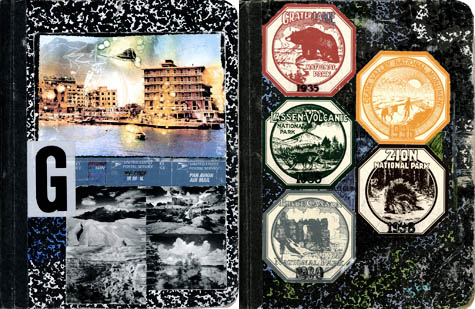
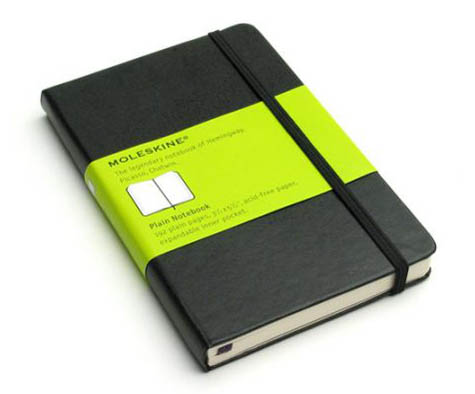
If I attend a public lecture but I start to jot things down in a Moleskine, it would seem that only a particularly virulent form of social fascism would ask me to put that notebook down and begin “sharing ideas” with the people next to me.

No thanks – I’d rather write, actually.
Again, I fail to see any clear distinction between someone’s boring Twitter feed – considered only semi-literate and very much bad – and someone else’s equally boring, paper-based diary – considered both pro-humanist and unquestionably good.

Kafka would have had a Twitter feed! And so would have Hemingway, and so would have Virgil, and so would have Sappho. It’s a tool for writing. Heraclitus would have had a f***ing Twitter feed.

Finally, and perhaps most importantly of all, now that the other half writes – all the jocks and high-school girls and video store employees and D-list celebrities – it seems comparable only to a kind of police action that the people who once thought they were the chosen writers, that they were this generation’s idea-smiths, are now so up in arms.

Those other people – those everyday people who weren’t supposed to have thoughts, who aren’t known for reading David Foster Wallace or Dostoevsky or James Joyce, those overlooked people from whom we buy groceries, who fix our cars, clean our houses, and vote differently than we do – weren’t supposed to become writers.

Now that suburban housewives in Missouri are letting their thoughts be known via Twitter, it’s as if writing itself is thought to be under attack, invaded from all sides by the unwashed masses whose thoughts have not been sanctioned as Literature™.

In many ways, I’m reminded of Truman Capote’s infamous put-down of Jack Kerouac: “That’s not writing, it’s typing.”

So there seem to be quite a lot of assumptions at work here, with so many class, political, and even gender implications for who is allowed to speak, who we are meant to listen to, who can write, how they are permitted to do so, in what social contexts writing is meant to occur, and what topics can be legitimately addressed by others, that I’d hope a much longer discussion about this might someday take place. Until then, we get Maureen Dowd.

So Twitter is very obviously not the answer to everything, and it never should have been portrayed that way; but it also very obviously is not the death of humanism.

Twitter is just another option for people to use when they want to take notes – and it’s no more exciting than that, either, to be frank. It’s a ball-point pen.

Get over it.
Space/Drive

While packing up the apartment here and getting ready not only for another move but for an impending flight to Melbourne, I keep stumbling upon interesting old news clippings, quotations, and articles that I’ve saved, printed out, or otherwise written down in a notebook somewhere.

This afternoon, for instance, it was a short piece from New Scientist, originally published back in September 2008.

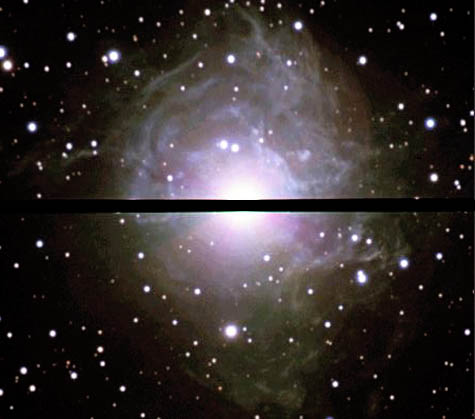
[Image: The Cepheid Variable RS Pup].

Apparently, all those stars out there might be something more than mere heavenly bodies.

That is, “the galactic equivalent of the internet,” if there is such a thing, might take the form of manipulated stars. What kind of stars? Cepheid variables, or “stars that vary regularly in brightness.”

This regular dimming and brightening could be used as a way both to encode and broadcast information.

From the article:

Crucially, these “Cepheid variables” are so luminous they can be seen as far away as 60 million light years. Jolting the star with a kick of energy – possibly by shooting it with a beam of high-energy particles called neutrinos – could advance the pulsation by causing its core to heat up and expand, [some scientists] say. That could shorten its brightness cycle – just as an electric stimulus to a human heart at the right time can advance a heartbeat. The normal and shortened cycles could be used to encode binary “0”s and “1”s.

The implication here is that hundreds of stars might already be “a galaxy-spanning internet” put into service by intelligent, nonhuman species.

The print version of the article differs a bit from the online one, and I’m quoting the print version here: “There are over 500 cepheids in the Milky Way, and countless more in nearby galaxies, so data could be shuffled around as in a computer network.”

Overlooking some of the more basic questions here – such as why on earth is this kind of cannabinoid speculation being printed in a science magazine? – the idea that information is being relayed back and forth, from star to star, as if inside some vast celestial harddrive, raised at least my eyebrows.

What messages, or fragments of messages, might we be witnessing every night? And if there are no messages, yet we transcribe those flickering astral patterns nonetheless, what unexpected literatures of deep space might we think we’ve been translating?

(Earlier on BLDGBLOG: Planet Harddrive).

And the Pulitzer goes to…

Someone hooks a building’s mechanical systems up to Twitter so that it can tell people things about itself – like when to expect the next elevator, at what point certain lightbulbs need to be replaced, which floors need mopping, and what its general maintenance schedule might be.

But, instead, it goes AI on the world.

It starts to complain about unappreciative guests and loud neighbors; it wistfully remembers former residents from years gone by. There was that rainy afternoon last summer, it writes, when that woman from the fourth floor got on an elevator…

It tweets at midnight, and at 2am, and as people come and go for lunch. It gets lonely. It makes things up sometimes; people laugh and re-tweet it.

It’s just a dumb little building somewhere in an overlooked city in America – but it has thoughts. And soon it wins the Pulitzer Prize.

Atmospheric Intoxication

[Image: Photo by Jonathan Brown. Brown reviewed the launch on his blog, Around Britain with a Paunch, writing that he and his friends “mingled in the mist, like shadows on the set of Hamlet”].

Note: This is a guest post by Nicola Twilley.

A former boutique storefront in London has become the temporary home for a pop-up bar with a twist: 2 Ganton Street is currently the U.K.’s “first walk in cocktail.” Created by Bompas & Parr (known for their earlier experiments with glow-in-the-dark jello and scratch & sniff cinema), the “Alcoholic Architecture” bar features giant limes, over-sized straws, and most importantly, a gin-and-tonic mist.

Lucky ticket-holders (the event has now sold out) are equipped with plastic jumpsuits and encouraged to “breathe responsibly” before stepping into an alcoholic fog for up to 40 minutes – long enough to inhale “a fairly strong drink,” according to Wired UK.

The Guardian noted that “as far as taste goes, this is the real deal,” with some mouthfuls of air “sweeter with tonic and others nicely gin-heavy.” Sam Bompas explained to Wired that they chose to vaporize gin and tonic (rather than, say, an appletini) because of its “nice smell, botanical flavours and freshness.” St. John Ambulance volunteers are on hand, though the only reported casualties so far seem to have been hairstyles – victims of “gin-frizz”. The Guardian concluded that, “With no sentient ice cubes able to confirm it, one can only assume that this is what the inside of a G and T feels like.”

[Image: Antony Gormley’s Blind Light, 2007, courtesy of the artist and Jay Jopling/White Cube, London, ©Stephen White].

The project was inspired by Antony Gormley’s Blind Light, a fog box installed at the Hayward Gallery in 2007. Bompas & Parr, who describe their world as operating in “the space between food and architecture,” worked with the same company, JS Humidifiers, to adapt and install the ultrasonic humidifiers that create the thick, gin-based fog.

Though even typing “thick, gin-based fog” makes me feel a bit queasy, the experiment does seem to provide a perfect instantiation of London’s social history, the city’s prevailing damp, and its dense population. If the project is recreated elsewhere, perhaps local conditions will shape the installation: a freezing hail of neat vodka will form a layer of crystals on fur hoods and boots at a cavernous underground bar in Moscow; or a refreshing rum-and-coke mist will cool sunburned spring-breakers in the overcrowded hotel rooms of Daytona Beach.

[Image: JS Humidifiers].

Of course, the architectural manipulation of humidity is not limited to alcohol. As JS’s website boasts: “For precise control of humidity and temperature, extreme outputs, specialist construction for controlled environments or unusual control, whatever the requirement JS will design and manufacture a solution.” Existing clients for these bespoke humidification systems apparently include medical device manufacturing, offshore oil exploration, firearms production, specialist printing, pharmaceutical production and automotive manufacturing. It seems clear that custom atmosphere solutions are a product with endless applications: migrating from industry to art to retail, with the next step being high-end custom interior design for the very rich.

It can only be a matter of time before wealthy individuals are able to wake up to vaporized coffee, maintaining their multi-tasking edge by inhaling caffeine for that last half-hour of sleep, while the riders of Hollywood stars will routinely specify custom dressing rooms bathed in a fine mist of light-diffusing, age-defying elixirs.

[Other guest posts by Nicola Twilley include The Water Menu, Dark Sky Park, Park Stories, and Zones of Exclusion].

Sand/Stone

For an ambitious landscape design project, Magnus Larsson, a student at the Architectural Association in London, has proposed a 6,000km-long wall of artificially solidified sandstone architecture that would span the Sahara Desert, east to west, offering a combination of refugee housing and a “green wall” against the future spread of the desert.

[Image: From Magnus Larsson’s Dune: Arenaceous Anti-Desertification Architecture].

Larsson’s project deservedly won first prize last fall at the Holcim Foundation’s Awards for Sustainable Construction held in Marrakech, Morocco.
One of the most interesting aspects of the project, I think, is that this solidified dunescape is created through a particularly novel form of “sustainable construction” – that is, through a kind of infection of the earth.
In other words, Larsson has proposed using bacillus pasteurii, a “microorganism, readily available in marshes and wetlands, [that] solidifies loose sand into sandstone,” he explains.

[Image: From Magnus Larsson’s Dune: Arenaceous Anti-Desertification Architecture].

Larsson points out the work of the Soil Interactions Lab at UC-Davis, which describes itself as “harnessing microbial activity to solidify problem soils.”
But the idea of taking this research and applying it on a megascale – that is, to a 6,000km stretch of the Sahara Desert – boggles the mind. At the very least, the idea that this might be deployed for the wrong reasons, or by the wrong people, in some delirious hybrid of ice-nine, J.G. Ballard’s The Crystal World, and perhaps a Roger Moore-era James Bond film, deserves further thought.
An epidemic of bacillus pasteurii infects all the loose sand in the world, forming great aerodynamic fins and waves in a kind of global Utah of glassine shapes.

[Images: From Magnus Larsson’s Dune: Arenaceous Anti-Desertification Architecture].

Clarifying the biochemical process through which his project could be realized, Larsson explained in a series of emails that his “structure is made straight from the dunescape by flushing a particular bacteria through the loose sand… which causes a biological reaction whereby the sand turns into sandstone; the initial reactions are finished within 24 hours, though it would take about a week to saturate the sand enough to make the structure habitable.”
The project – a kind of bio-architectural test-landscape – would thus “go from a balloon-like pneumatic structure filled with bacillus pasteurii, which would then be released into the sand and allowed to solidify the same into a permacultural architecture.”

[Image: From Magnus Larsson’s Dune: Arenaceous Anti-Desertification Architecture].

The “architectural form” of the resulting solidified sandscape is actually “derived from tafoni,” Larsson writes, where tafoni is “a cavernous rock structure that formally ties the project back to notions of aggregation and erosion. On a conceptual scale, the project spans some 6,000km, putting it on a par with Superstudio’s famous Continuous Monument – but with an environmental agenda.”

[Images: From Magnus Larsson’s Dune: Arenaceous Anti-Desertification Architecture].

I’m reminded of Michael Welland’s recent book Sand. There, Welland describes “how deserts operate” (he compares them to “engines” of mechanical weathering); he points out that you can still find “sand-sized fragments of steel” on the D-Day beaches of Normandy, war having left behind a hidden desert of metal; and he mentions that the UK now maintains “the world’s first database of sand” – but that it’s used “specifically for police forensics.”
Welland’s descriptions of sand dune physics are particularly memorable. He writes, for instance, that an avalanche is really a sand dune being “overwhelmed by the huge number of very small events” on its surface, and that these “very small events” unpredictably lead to one decisive moment of cascading self-collapse.

[Image: A photomicrograph of sand grains].

Fantastically, though, and more relevant to this post, he then compares the internal structure of sand dunes to Gothic cathedrals: the grains of sand piled high form “microscopic chains and networks… in such a way that they carry most of the pressure from the weight of the material above them.” This is the architecture of sand:

These chains seem to behave like the soaring arches of Gothic cathedrals, which serve to transmit the weight of the roof, perhaps a great dome, outward to the walls, which bear the load.

Briefly, though, this image can be sustained through Welland’s descriptions of the great ergs, or sand seas, of today. These dune seas “are tangibly mobile, ever changing,” Welland writes, “but there are larger areas of ergs past that are now fixed by vegetation.”

Most of today’s active sandy deserts are surrounded by vast stretches of old stabilized dunes, formed as the trade-wind belts and arid regions expanded in the cold, dry climate of the last ice age and immobilized as the climate changed. However, continuing shifts in the climate may bring these fixed ergs, granular reserves awaiting activation, back to life.

He mentions the Sand Hills of northwestern Nebraska, “formed originally from the debris of the glacial erosion of the Rocky Mountains.”

The hills were stabilized eight hundred years ago but have had episodes of reincarnation since: a long drought toward the end of the eighteenth century resuscitated dunes on the Great Plains, whose activity caused problems for the westbound wagon trains decades earlier.

But if sand dunes are Gothic cathedrals, and if those dunes can come back to life, the resulting image of resuscitated Gothic cathedrals moving slowly over the American landscape is almost too incredible to contemplate.

[Images: From Magnus Larsson’s Dune: Arenaceous Anti-Desertification Architecture].

Larsson’s project descriptions maintain this somewhat hallucinatory feel:

I researched different types of construction methods involving pile systems and realised that injection piles could probably be used to get the bacteria down into the sand – a procedure that would be analogous to using an oversized 3D printer, solidifying parts of the dune as needed. The piles would be pushed through the dune surface and a first layer of bacteria spread out, solidifying an initial surface within the dune. They would then be pulled up, creating almost any conceivable (structurally sound) surface along their way, with the loose sand acting as a jig before being excavated to create the necessary voids. If we allow ourselves to dream, we could even fantasise about ways in which the wind could do a lot of this work for us: solidifying parts of the surface to force the grains of sand to align in certain patterns, certain shapes, having the wind blow out our voids, creating a structure that would change and change again over the course of a decade, a century, a millenium.

A vast 3D printer made of bacteria crawls undetectably through the deserts of the world, printing new landscapes into existence over the course of 10,000 years…

[Image: From Magnus Larsson’s Dune: Arenaceous Anti-Desertification Architecture].

Larsson goes on to contrast his method with existing vernacular techniques of anti-desertification:

Traditional anti-desertification methods include the planting of trees and cacti, the cultivation of grasses and shrubs, and the construction of sand-catching fences and walls. More ambitious projects have ventured into the development of agriculture and livestock, water conservation, soil management, forestry, sustainable energy, improved land use, wildlife protection, poverty alleviation, and so on. This project, apart from utilising a completely new way of turning sand into sandstone, incorporates all of the above. Inside the dunes, we can take care of our plants and animals, find water and shade, help the soil remain fertile, care for the trees, and so on. In this way, it’s an environmental project that hopefully provides an innovation for other architects/builders to use and copy time and time again.

The following images show us the lab-based biochemical practices through which a landscape can be lithified. However, for me at least, these photos also come with the interesting implication that rogue basement chemists of the future won’t be like Albert Hofmann or Ann & Alexander Shulgin; the heavily regulated underground rogue chemistry sets of the 21st century will instead synthesize new terrestrial compounds, counter-earths and other illegal geosimulants, rare earth anti-elements that might then catalyze a wholesale resurfacing of the world through radical landscape architecture.
Which leads me to ask: where is landscape architecture’s Aleister Crowley, Madame Blavatsky, or even John Dee? Mystics of terrestrial form, hacking the periodic table of the elements inside makeshift labs.

[Images: Synthesizing rare earth compounds – bioterrestriality; from Magnus Larsson’s Dune: Arenaceous Anti-Desertification Architecture].

In any case, Larsson’s “solidified dunes,” we read, would also “support the existing Green Wall Sahara initiative: 24 African countries coming together to plant a shelterbelt of trees right across the continent, from Mauritania in the west to Djibouti in the east, in order to mitigate against the encroaching desert.”

[Images: From Magnus Larsson’s Dune: Arenaceous Anti-Desertification Architecture].

Clearly having thought through the project in extraordinary detail, Larsson then points out that the structure itself would generate a “temperature difference between the interior of the solidified dunes and the exterior dune surface.” This then “makes it possible to start building a permacultural network, the nodal points of which would support water harvesting and thermal comfort zones that can be inhabited.”

[Image: The view from within; from Magnus Larsson’s Dune: Arenaceous Anti-Desertification Architecture].

Eventually, then, a 6000km-long wall of permaculturally active, inhabited architecture will span the Sahara.
Check out more images in this Flickr set for the project, or read a bit more about the project over at the Holcim Foundation.

Space-Based Storm Control

[Image: From a February 2006 patent application by SolarEn, proposing that terrestrial weather systems might be controlled by mirrors in space].

It was reported yesterday that a California solar energy firm – SolarEn – hopes soon to construct “orbiting solar farms” that will harvest electricity in space.
Each “farm” would be “a set of solar panels in outer space that would beam enough clean energy back to Earth to power half a million homes and could one day potentially help save the planet,” according to the Guardian.
SolarEn’s specific plans are to put “an array of solar panels around 22,000 miles above the earth’s equator using existing rocket technology, and then convert the power generated into radio-frequency transmissions. The radio waves would be beamed back down to antennae in Fresno, California and then converted into electricity and fed into the regular power grid.”
The images you see here, however, are from a patent application SolarEn filed back in February 2006, with quite a different purpose in mind.

[Images: From SolarEn‘s February 2006 patent application].

Using a complicated geometry of spaceborne mirrors – seen in the diagrams below – in tandem with meteorological tracking technology, this device would give SolarEn the ability to control the weather.
Or, as the patent application itself explains, it would be a “Space-based power system and method of altering weather using space-born energy”:

Power system elements are launched into orbit, and the free-floating power system elements are maintained in proper relative alignment, e.g., position, orientation, and shape, using a control system. Energy from the space-based power system is applied to a weather element, such as a hurricane, and alters the weather element to weaken or dissipate the weather element. The weather element can be altered by changing a temperature of a section of a weather element, such as the eye of a hurricane, changing airflows, or changing a path of the weather element.

Weather control has become a topic of near-constant interest for me. As I suggested the other night in my talk at the SVA – and as I also explore in The BLDGBLOG Book – weather control could very well be the future of urban design; in other words, cities might very realistically attempt to engineer specialty microclimates – similar to Beijing‘s Olympic efforts at weather control last summer – as a new means of attracting new residents and future development.
What’s fascinating about SolarEn’s proposal is that it seems entirely possibly that, for instance, Dubai, attempting to recapture the international imagination, might put into orbit a private, geostationary solar farm with which that city could not only power its delirious experiments in beach refrigeration and large-scale air-conditioning, but actually create a new climate for the city.

[Image: A geometry of mirrors in space, from SolarEn‘s February 2006 patent application].

That, of course, or it’s just Real Genius all over again: after all, why use this technology only for stopping hurricanes when you could melt an opposing army’s tanks or even assassinate someone through a brief application of solar overload? We’ll just militarize Apollo, bringing astronomical power down upon our enemies, causing storms of fire in distant cities, evaporating reservoirs, and turning glaciers into roaring torrents of weaponized floodwaters.

[Image: From SolarEn‘s February 2006 patent application].

In an endlessly fascinating article published two years ago in The Wilson Quarterly, historian James R. Fleming describes – among many other things – how a “weather race with the Russians” was fought on the level of climatological R&D between the U.S. and U.S.S.R. during the Cold War.
For instance, “In the 1940s,” Fleming writes, “General George C. Kenney, commander of the Strategic Air Command, declared, ‘The nation which first learns to plot the paths of air masses accurately and learns to control the time and place of precipitation will dominate the globe.'”
Indeed, the U.S. military ultimately hoped that it might learn how to “alter the global climate for strategic purposes,” something which not only involved “using weather as a weapon of warfare,” but “using controlled precipitation as a delivery system for biological and radiological agents.” You could snow anthrax, say, onto the streets of belligerent cities unaware of the infections drifting down from above.
But perhaps all they need is a strange new constellation of mirrors – a remote-controlled blur of light that moves against the stars it’s surrounded by – to hurl typhoons against China or destroy a whole civilization’s agricultural base from above.
Toward the end of his article, Fleming asks:

Assume, for just a moment, that climate control were technically possible. Who would be given the authority to manage it? Who would have the wisdom to dispense drought, severe winters, or the effects of storms to some so that the rest of the planet could prosper? At what cost, economically, aesthetically, and in our moral relationship to nature, would we manipulate the climate?

Of course, having said all that, I don’t mean to imply that SolarEn’s weather control system is some kind of paranoiac Doomsday Device; but anyone who learns to stop – or, more to the point, conjure up – hurricanes from space will nonetheless be sitting on an unimaginably powerful technology.

(Via Alexis Madrigal – who signed a contract for his first book yesterday. Congrats, Alexis!)

Surface/Structure/Fold

[Image: An absurdly beautiful photo of laser-cut steel by Elijah Porter, a student at the Yale School of Architecture].
Elijah Porter, a student at the Yale School of Architecture, has a great Flickr set up called Material Formation in Design. It features several awesome examples of how strategic cutting can transform a solid surface into a porous structure.
In the specific case of the image featured above, you’re looking at what might be called subtractive origami, wherein diamond-shaped cuts have introduced foldability and mesh into a solid sheet of steel.
How interesting to think that, with just the right geometry of cuts and slices, you could activate the otherwise overlooked – or even unknown – baroque possibilities of a given material. You could even hold annual slice-design competitions, where students and mathematicians from around the world get together to display their secrets of cutting; one at a time, they program precise geometries into a laser-cutting machine, and whoever thereby achieves the most complex form, or the largest volume of folded space, wins.
Huge, 8′ x 8′ sheets of steel are turned into spheres and waveforms, in a kind of arabesque of wounding through which metal becomes lace.
One year, a student from Amsterdam blows everyone away by introducing just one, incredibly complex cut… and the whole sheet rolls up to the size of a one-inch ball.
Or you obtain a truck-mounted laser and a grant from the Graham Foundation, and you proceed to cut a new, gridded faultwork into the bedrock of the continent – perforation on the scale of whole landscapes – so that the geography you’re standing on simply folds up and disappears.
Check out the rest of Porter’s Flickr set here.

The BLDGBLOG Book

I was on pins and needles all morning knowing that my doorbell would ring, that there would be a bicycle courier standing there waiting for me – and that he or she would then hand me my very first copy of The BLDGBLOG Book.
And it arrived! It’s real, it’s in my hands – and it looks fantastic.

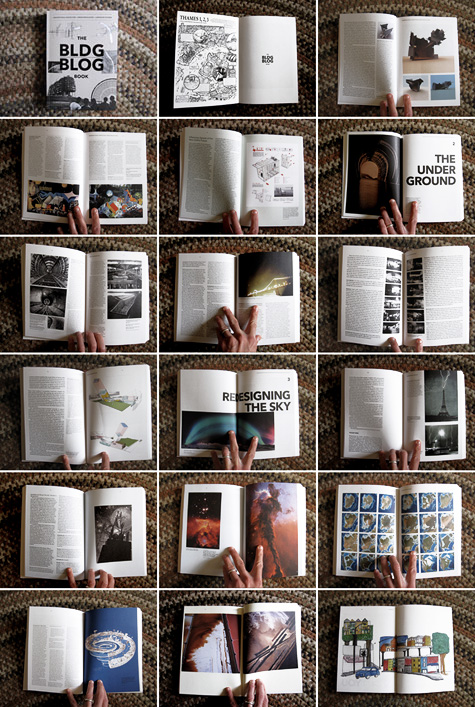
[Image: The BLDGBLOG Book, published by Chronicle Books, designed by MacFadden & Thorpe, and illustrated by Brendan Callahan. Visible here are images by Joe Alterio, Alex Dragulescu, Sir Peter Cook/Archigram, Lateral Architecture, Michael Cook, Stanley Greenberg, Alexis Tjian, myself, Joel Sanders, Örvar Atli Þorgeirsson, NOAA et al., Lebbeus Woods, NASA et al., Ron Blakey, the USGS, David Maisel, and Brendan Callahan].

So amazing to see this thing in real life!
From a series of Microsoft Word documents, to an ever-changing suite of PDFs, to a year and a half of long, long nights editing more than 125,000 words’ worth of content, it’s now bound, inked, and sitting here looking around at the world it tried to describe.
And there’s so much to say about it, I don’t even really know where to begin.
It’s got five major chapters and a huge bibliography; it’s got interviews, full-color photo spreads (by Simon Norfolk! David Maisel! Edward Burtynsky! Ilkka Halso! Bas Princen! and more!), as well as original illustrations by my colleague at Dwell, Brendan Callahan; it’s got maps and plans and architectural sections; it’s got renderings; it’s got 19th-century British ruin paintings, W.G. Sebald, and J.G. Ballard; it’s got FAT, geology, and rogue tunneling machines; it’s got urban farming, icebergs, archaeology, and Archigram; it’s got a saddle-stitched paperback binding that can open up flat, as well as multi-colored paper and an awesome use of a changing page grid; it’s got two original comic strips by BLDGBLOG (my first!), drawn by Joe Alterio and printed on the inside covers; it’s got runaway climate change, undersea cathedrals, artificial reefs, lost cities, oceangoing utopias, and the Chinese Olympics; it’s got injected landforms, spray-foam monuments to the nuclear power industry, Gustave Doré’s black and white visions of the underworld, and the architecture of Gothic horror; it’s got blimps, retractable villages on the British coast, the San Andreas Fault, underground warfare in the mountains of Afghanistan, and a short interview with Alex Trevi (among so many other interviews! dozens! from Sir Peter Cook, Sam Jacob, and DJ /rupture to Lebbeus Woods and Mary Beard); it’s got exploding stars, simulated mountain ranges on Venus, Mars habitats, and a quantum tomb for Albert Einstein; it’s got Minsuk Cho, China Miéville, Christopher Wren, Frederick the Great, and Paradise Lost.
Man, I’m so excited and so genuinely pleased to see this thing in person after such an incredibly long time putting it together.
Check out some spreads here – and feel free to order the living crap out of this thing on Amazon.com, Amazon.ca, and Amazon.co.uk, or simply go straight to the source and pick up a copy through Chronicle Books themselves. Also, how incredibly interesting is it for me to see, on Amazon.com, which books customers “also bought,” from Eyal Weizman to 306090 and Neal Stephenson. It’s good company to be in!
So expect more information about the book over the next two months, including voluminous and genuine thank yous for all the people who helped put it together – from my editor, Alan Rapp, and my designers, MacFadden & Thorpe, to everyone who contributed the book’s eye-popping range of 300+ images – as the actual publication date approaches.
But, for now, I just couldn’t let today go without mentioning how happy I am to see this thing. Hello, book.

Subject

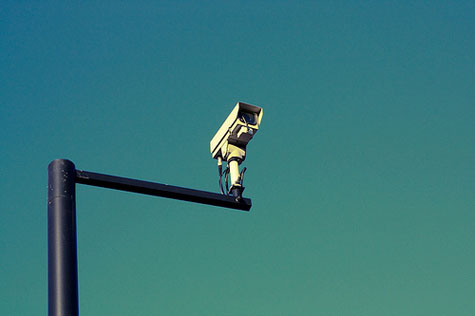
[Image: CCTV by (or perhaps via?) Charbel Akhras; check out Akhras’s blog for more].

You go home to visit your parents in a gated community built 15 years ago in the midst of what used to be virgin pine forest. As a teenager you ran there at night, before the other houses were constructed, when the only visible lights were the stars above and your parents’ house, self-reflecting in the waters of an artificial lake.

Amidst hills and rocks – most of which have been tastefully arranged – there are now cul-de-sacs and a members-only health club, 18 holes of golf and a 4-star restaurant that specializes in Gulf shrimp.

But, standing above all of it now, interspersed throughout the development on tall steel poles painted green to blend in with the well-trimmed forests around them, are surveillance cameras.

They watch parking lots, intersections, driveways, and golf paths; they look down along diagonals at the lobby of the clubhouse restaurant, at the tables inside, and at the various corridors leading to the indoor pool and weight room.

Alarmed by their sheer quantity and concerned that a wave of petty crime has perhaps broken out, you are instead reassured that these cameras are not here because of crime – not at all – but because a new private development outside Dubai wants to study how Americans live.

These camera feeds are reality TV for them; whole parties get together on Tuesday nights to watch an American suburb: BMWs parking in flower-lined driveways, teenagers mowing lawns, groups of two or three women jogging together in the morning as the sun comes up.

This is a research project by overseas developers, your dad explains, cresting a hill in his car beneath an especially well-populated mast of cameras, as formerly rural hills roll away for miles in the distance, and everyone in the neighborhood receives $1,500 a year for participating.

Narrative Planetarium

Before his talk last week at Postopolis! LA, Matthew Coolidge, director of the Center for Land Use Interpretation, joked that someday he should bring a laser pointer up there to the roof deck and give a new lecture, pointing out specific offices visible around us in the nighttime sky.
That afterhours galaxy of Xerox machines and elevator shafts, paper-covered desks and meeting halls, would all be explained, room by room, from the artificially grassed crown of the Standard Hotel.
And though both of us laughed, I think it’s an amazing idea.

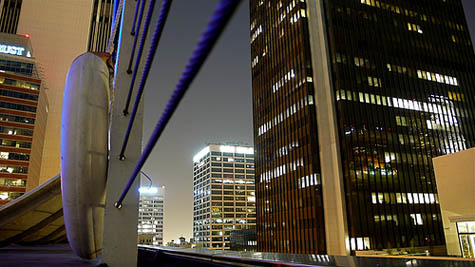
[Image: The view from Postopolis! LA; photo by Dan Hill].

Standing up there in the darkness, looking at bank towers and real estate investment firms, individual offices lit from within (and even whole hallways, stretching horizontally into the sky before disappearing into themselves through a trick of perspective), the 16th, 17th, and much-higher stories of the city all visible to us like an architectural section, you could narrate a kind of local micro-history of nighttime spaces in LA.
It wouldn’t be giving a lecture so much as becoming a planetarium.
“In that building over there,” Coolidge might say, pointing his laser at a window four blocks distant, “the man who invented Technicolor once worked; and in that office over there” – pointing yet further, to One Wilshire, visible from the pool side of the building – “the internet traffic through which you’re able to write this post passes everyday.”
And so on.
The woman who first dreamt up and mapped the flight paths of intercontinental passenger airplanes over LAX once ran a property law services firm in that office, just barely visible with a laser pointer down there.

[Images: The artificial astronomy of downtown Los Angeles, as seen during Postopolis! LA; photographed by Dan Hill].

Or perhaps it could be a new form of immersive storytelling: local novelists stop by every third Friday of the summer months and, in the darkness, using laser pointers, they invent family dramas, murder mysteries, political thrillers, and end-of-the-world catastrophes, all the while pointing to specific rooms and halls within which the action takes place – even the specific computer monitor, visible in someone’s unblinded window, where plot-defining government secrets are thought to be stored…
Alternative fictions of the city.
In a way, I’m reminded of the brilliant Access Restricted program, curated by the Lower Manhattan Cultural Council (the final edition of which is April 28). Access Restricted is a “free nomadic lecture series that opens rarely visited and often prohibited spaces in Lower Manhattan to the general public” – meaning that certain offices, lobbies, meeting rooms, and even whole buildings directly relevant to the lecture taking place inside them are temporarily opened up for public visitation.
But imagine a rooftop version to this, a kind of Rooftops Restricted: you take a roof somewhere in midtown Manhattan and you give it to Paul Auster for the night, with a microphone in one hand and a laser pointer in the other, with 10 or 15 people camped out in sweaters all around him.
Next week, it’s Jonathan Lethem; the week after that, Joseph O’Neill.
You generate a new ad hoc literature for the city, a narrative planetarium that radiates stories outward from the rooftops into the city.

Nocturnal Projections

[Image: A dream of freeways above the city, at Postopolis! LA; I believe this was from Ted Kane‘s presentation. Photo by Dan Hill].

One Postopolis!, a minor car accident, and 500 miles later, I’m back in the rain of San Francisco. I owe a huge thanks to everyone who came out for the event last week, from my fellow bloggers (Bryan, Jace, David A./David B., Régine, and Dan) to Joseph Grima and the crew of Storefront for Art and Architecture, by way of ForYourArt, who found us the venue, organized several daytrips, and brought the whole thing into real time.
Thanks not only for coming along to see it unfold, but for sticking with us through microphone feedback, near-freezing rooftop temperatures, and the odd delay. If you get a chance, definitely visit the websites of the people who presented to learn more about their work; you can find links here.