Soundtracks for Architecture

A few comments at the end of a recent post reminded me of something from David Toop’s Ocean of Sound, an excellent and highly recommended survey of “sonic history,” focusing on ambient music, post-Debussy.


Roughly midway through Toop’s book we find this review by composer Paul Schütze: “Recently listening to Thomas Köner’s Permafrost,” Schütze writes, “I found that by the end of the disc my sense of aural perspective was so altered that the music seemed to continue in the sounds around me. Tube trains passing beneath the building, distant boilers, the air conditioning, and the elevator engines had been pulled into the concert. This effect lasted for about forty minutes during which I could not get anything to return to its ‘normal position’ in the ‘mix’ of my flat.”
What would have been yet more fascinating, however, is if Schütze had been wrong. What if the disc, in other words, had still been playing – and he didn’t live anywhere near the Tube, nor did his building have elevators…? What if those subtle and distant architectural sounds had actually been part of the CD?
This would be music as the illusion of architecture.
You could move into a house without a basement – so you purchase this CD, or download these tracks, and you uncannily achieve the sonic effect of having more floors below you. Or perhaps you want an attic, or even a next-door neighbor: you would buy soundtracks for architecture, architecture through nothing but sound.
For instance, think of the Francisco López album, Buildings. Buildings is “a work composed entirely of sound fragments López procured while wandering around big buildings in NYC,” recording the “sounds of elevators, air conditioning systems, cables, pipes, air ducts, boilers, clocks, thermostats, video cameras, and so on.” (You can actually listen to a brief excerpt).
So instead of an addition, or a home renovation – you would commission a piece of music; and for as long as that music is playing, your house has several thousand more square-feet… and a Tube line nearby… and distant boilers…

(With thanks to Dan Hill at City of Sound for pointing me toward Buildings).

House for a river ecologist

There’s an interesting competition afoot to design a house for an ecologist, specifically “a live/work dwelling for an ecologist in residence at the U.S. Fish and Wildlife Service (FWS),” in Shephedstown, West Virginia, on a site near the Potomac River measuring 350′ x 250′.


“The ecologist in residence, a fictitious position, will be an annual fellow who will receive a stipend and expenses to live and conduct research on site and in the field.” Such research will include “working with others to conserve, protect, and enhance fish, wildlife, and plants and their habitats for the continuing benefit of the American people.” Some ideas? I think we should try learning from Dubai, and build the house underwater: the ecologist can then go to sleep watching fish swim by. Or the house should be partially floating, with reinforced glass foundations through which terrestrial and aquatic events can be observed. And it needs a roof garden.
And maybe it could do this:


[Image: Holl House by Andrew Maynard].

A lot more information, including maps and images, can be downloaded from the AIA competition homepage. Registration deadline is 1 March 2006, however – so be quick.

Your Hidden City

I’ll be serving as a jury member for Your Hidden City, a photo contest sponsored by Tropolism. So submit early, and submit often…
Tropolism’s official press release for the contest reads as follows:

bridging.jpg

“After a week of very subtle buildup, Tropolism is pleased to announce the first open-sourced architectural contest, Your Hidden City.

The contest is simple: post your photos (with a caption) to our public Flickr pool (or email them to us for posting), and our jury will select their favorites in five categories. The winners will be posted to Tropolism.

The theme of the contest is uncovering the Hidden City, your Hidden City, the one you see every day. It may be in plain sight of everyone else, but it is your eye that finds the extraordinariness in a particular street corner, a unique stair, a crazy intersection, a visually arresting approach, or a particular tree in the city. The photographs can be of a beautiful (and perhaps unpublished) park, or as simple as the sun hitting a particular building at a particular time of day. Please include a caption, or a Flickr annotation, about what makes it extraordinary to you. The entries should have one thing in common: they demonstrate, to you, the pleasure of living in the city.

The jury is a set of bloggers who write about architecture, urbanism, and landscape design. They are:
• Lisa Chamberlain of Polis, who also covers real estate for the New York Times
• David Cuthbert of architechnophilia
• Geoff Manaugh of BLDGBLOG
• Shawn Micallef of Toronto Psychogeography Society Blog
Miss Representation
• Jimmy Stamp of Life Without Buildings

The 5 Categories are:
• Best Hidden Place
• Best Density
• Best Natural/Urban Overlap
• Best Unofficial Landmark
• Best Building

We will keep the contest open until March 10, 2006, and post winners the week of March 20. Good Luck!”

A Natural History of Mirrors

In his book Crystallography, poet Christian Bök describes “a medieval treatise on the use of mirrors.” This treatise, Bök tells us, suggests that when two mirrors reflect one other, the endless abyss of mirrors-in-mirrors created between them might form a kind of spectral architecture.


Further, Bök’s alleged medieval treatise says, “any living person who has no soul can actually step into either one of the mirrors as if it were an open door and thus walk down the illusory corridor that appears to recede forever into the depths of the glass by virtue of one mirror reflecting itself in the other. The walls of such a corridor are said to be made from invulnerable panes of crystal, beyond which lies a nullified dimension of such complexity that to view it is surely to go insane. The book also explains at length that, after an eternity of walking down such a corridor, a person eventually exits from the looking-glass opposite to the one first entered.”

Treatise’s author, according to Bök, “speculates that a soulless man might carry another pair of mirrors into such a corridor, thereby producing a hallway at right angles to the first one, and of course this procedure might be performed again and again in any of the corridors until an endless labyrinth of glass has been erected inside the first pair of mirrors, each mirror opening onto an extensive grid of crisscrossing hallways, some of which never intersect, despite their lengths being both infinite and perpendicular.”

The author of this hypothetical treatise warns, however, that one could become “hopelessly lost while exploring such a maze” – for instance, “if the initial pair of mirrors are disturbed so that they no longer reflect each other, thus suddenly obliterating the fragile foundation upon which the entire maze rests.”

In which case whole crystal cities of mirrored halls, in right-angled topologies of non-self-intersecting self-intersection, would simply disappear – along with anyone exploring inside them.


A kind of rogue experiment might ensue, aboard the International Space Station: an astronaut, crazed with loneliness, sets up two mirrors… and promptly escapes into a hinged labyrinth of crystallized earth-orbiters, his radio crackling unanswered in the control panel left behind.

The birds


[Image: Keith Kin Yan/Overshadowed].

While researching my post for Inhabitat – on light pollution and other forms of photonic trespass – I came across this account of the Tribute in Light, those blazing towers of floodlit clouds and sky used by Manhattan to memorialize the fallen World Trade Center: “The beams were visibly filled with birds for their entire height, looking like clouds of bugs. Their twittering was audible. There were so many birds, it was impossible to track any one individual for any length of time. I did see one bird that circled in and out of the uptown beam six times before I lost track.”
The birds, in other words, had been fatally mesmerized, often spiraling thereafter to the ground – or into the windows of nearby buildings. A kind of bird-tornado.


[Image: Keith Kin Yan/Overshadowed].

This circular disorientation of birds – winged animals thrown athwart by the optical effects of architecture – also makes an appearance in W.G. Sebald’s Austerlitz. Here, the narrator recounts a friend’s visit to the new Bibliothèque Nationale in Paris: “The four glazed towers themselves, named in a manner reminiscent of a futuristic novel… make a positively Babylonian impression on anyone who looks up at their facades and wonders about the still largely empty space behind their closed blinds. (…) And several times, said Austerlitz, birds which had lost their way in the library forest flew into the mirror images of the trees in the reading-room windows, struck the glass with a dull thud, and fell lifeless to the ground.”
Other species, killed by the mirrored archives of national history.
None of which is meant to imply that I didn’t enjoy the Tribute in Light – without it, in fact, I would not have eaten roast pigeon for three weeks…
In any case, perhaps this could serve as a new form of avian predation, a duck-hunter’s paradise: you build a well-lit public memorial – then throw open some nets.
Conversely, of course, the birds might obliterate the city. Hitchcock’s revenge. I’m reminded of the beautifully descriptive title of an old (and fairly awful) song by Coil: Red Birds Will Fly Out of the East and Destroy Paris in a Night.
Against whose murderous flocks Paris deploys a mirrored library…

The light’s bright trespassing


[Image: A house that “sits in front of a baseball/soccer field in the small town of Amenia, New York,” and whose owners probably don’t sleep too well; photo by David Allee].

With apologies for BLDGBLOG’s recent silence – very few posts in at least as many days – I also want to point out something I’ve written for Inhabitat, and which went up today, about light pollution, urban astronomy, the mating habits of glowworms, hunting by floodlight and some photographs by David Allee.
And I’ll start posting again on BLDGBLOG soon…

Soil Maps of Asia


[Image: The fractal soilbeds and hydro-geological basins of northern Maharashtra, a merge of these two maps].

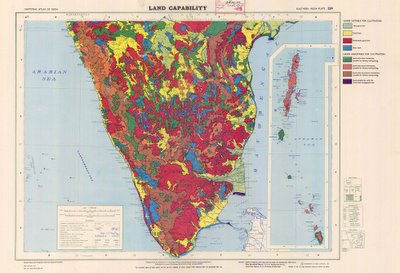
I recently stumbled upon “the soil maps of Asia” – not just some soil maps, mind you, or merely a few soil maps: these are the soil maps of Asia, originally produced under the direction of the Thematic Mapping Organisation. Leaving me to wonder if they take special orders.
In any case, these maps are amazing:


[Image: The soils and terrestrial capabilities of central India, a merge of these two maps. See also this eye-popping 3.5MB version of the right-half of that image].


[Image: The soils of Gujarat; a merge of these two maps].


[Image: Soil map and land capability of southern India, including the Andaman Islands; see also this 2.5MB version].

Here, the Thematic Mapping Organisation explains its own origins, complete with avant-garde uses of English grammar: “The first national Atlas of India in Hindi popularly known as Bharat Rastriya Atlas having a multi-colour maps with a scale of 1:5 million portraying a comprehensive physical and socio-cultural structure of the country was published in 1957 and was acclaimed the world over as a unique publication. Consequent upon the success of as Bharat Rastriya Atlas, the organization has decided to prepare an ambitious project containing 300 plates. It covers all the aspects of the land, people, economy of the country. This atlas is being issued in 8 volumes, which is available for sale.”
Finally, for those of you with a lot of time to kill: you can search equally colorful and totally mind-boggling soil maps of Africa (2000+), Canada, Central and South America, including the Caribbean (as well as hydrological maps of the Amazon River), Europe (here’s the UK), the rest of Asia, and the United States.

(Earlier on BLDGBLOG: The topographic map circus. Further note: I just discovered [12 Feb 06] that Cartography, the weblog of the Canadian Cartographic Association, featured these soil maps back in January).

The Great Man-Made River

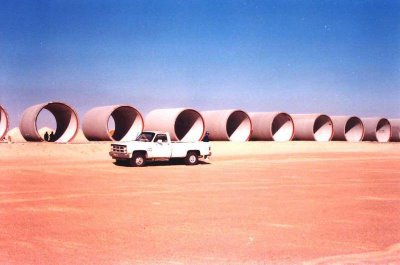
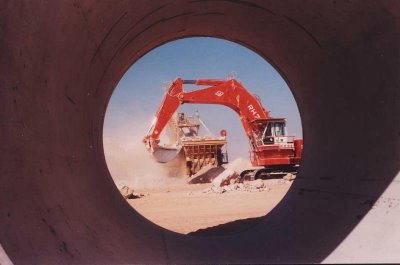
Libya’s Great Man-Made River is “an enormous, long-term undertaking to supply the country’s needs by drawing water from aquifers beneath the Sahara and conveying it along a network of huge underground pipes.”

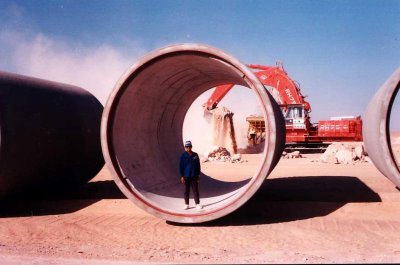
[Images: The concrete skeleton of Libya’s future river, the “8th wonder of the world,” being trucked into place; photographed by Jaap Berk].

Not only does Libya bear the distinction of holding the world record for hottest recorded temperature (136º F), but most of the country’s terrain is “agriculturally useless desert” that receives little or no rainfall. The Great Man-Made River may not even successfully irrigate Libya’s governmentally-specified agricultural zones, but due to the region’s complete “absence of permanent rivers or streams” – and because the country’s “approximately twenty perennial lakes are brackish or salty” – the River’s expected 50-100 year lifespan is at least a start.

Indeed, Libya’s “limited water is considered of sufficient importance to warrant the existence of the Secretariat of Dams and Water Resources, and damaging a source of water can be penalized by a heavy fine or imprisonment.” George Orwell would perhaps call this watercrime.

However, I have to say that the prospect of spelunking through the Great Man-Made River’s subterranean galleries in 125 years, once those tunnels have dried-up, makes the brain reel. Imagine Shelleys of the 22nd century wandering through those ruins, notebooks in hand, taking photographs, footsteps echoing rhythmically beneath the dunes as they walk for a thousand kilometers toward the sea…

Yet some are skeptical of the project’s real purpose. Precisely because the Great Man-Made River consists of “a stupendous network of underground tunnels and caverns built with the help of Western firms to run the length and width of the country,” some consultants and engineers “have revealed their suspicion that such facilities were not meant to move water, but rather to conceal the movement and location of military-related activities.” The fact that water is flowing through some of the pipes, in other words, is just an elaborate ruse…

In any case, the Great Man-Made River Authority – “entrusted with the implementation and operation of the world’s largest pre-stressed concrete pipe project” – is already seeing some results.

The network will criss-cross most of the country –

– and Phase III is under construction even as this post goes online.

Meanwhile, for more information on deep desert hydrology see UNESCO’s International Hydrological Programme or even Wikipedia.

Of course, you could also turn to J.G. Ballard, whose twenty year-old novel The Day of Creation is: 1) not very good, and 2) about a man who is “seized by the vision of a third Nile whose warm tributaries covered the entire Sahara.” That river will thus “make the Sahara bloom.” The book was modestly reviewed by Samuel Delany, if you want to know more.

On the other hand, I would actually recommend Dune – assuming you like science fiction.

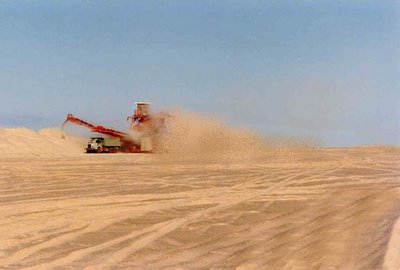
[Image: A new river is born, excavated from the surface of the desert: soon the pipes will be installed and the currents will start to flow…].

Desert Planet


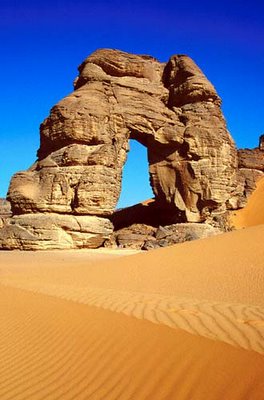
[Image: A satellite view of “two huge sand dune seas in the Fezzan region of southwestern Libya.” These are “sprawling seas of multi-storey sand dunes known as ‘ergs’. The Erg Ubari (also called Awbari) is the reddish sand sea towards the top of the image. A dark outcrop of Nubian sandstone separates the Erg Ubari sand from the Erg Murzuq (also called Murzuk) further south.” See earlier for more satellite imagery].

Mineral TV and the Archipelago of Abandoned Shopping Malls

“A mediaeval cathedral was a sort of permanent and unchangeable TV programme that was supposed to tell people everything indispensable for their everyday life, as well as for their eternal salvation.” So says Umberto Eco, speaking at the Bibliotheca Alexandrina, Egypt, 2003.

[Image: Cathedral at Bourges, by Arnaud Frich].

This makes me wonder if everyone on Earth could take everything they know and carve it into a cliffside somewhere – or a mountain – sculpting all that rock into a cathedral; and, then, if they could take that hulking monolith of information and minerals and break it off, launch it into orbit, send it drifting through space… It’d be a kind of moving table of contents for the human species. A knowledge-object.
Would that have a better chance than NASA’s so-called Golden Record, that got sent out with Voyager, of explaining the Earth and human history to distant civilizations?

[Image: NASA’s Golden Record, “intended to communicate a story of our world to extraterrestrials.” The record is really “a 12-inch gold-plated copper disk containing sounds and images selected to portray the diversity of life and culture on Earth,” including the sound of “surf, wind and thunder, birds, whales, and other animals,” and a signed letter from then-president Jimmy Carter. A Menudo video was reportedly removed at the last minute].

Or, instead of demolishing old buildings, perhaps we should detach them from the Earth’s surface and send them into space as lessons for alien species. Like that Michael Crichton novel. You could learn about the Earth by studying its architecture – because the planet flings buildings everywhere. Constantly.
Archipelagoes of abandoned shopping malls pulled slowly toward distant planets. There goes the Mall of America…
A new film directed by Jerry Bruckheimer.