Architectural Tetris


A new block of flats on the edge of Copenhagen, designed by Bjarke Ingels and Julien De Smedt of PLOT, was toured, analyzed, and photographically documented in last month’s issue of Metropolis. The article is by Tom Vanderbilt, a writer whose career I find well worth following. (Here’s his book).
The article will tell you a lot more about the project than this brief and hurried post will – but, basically, the building is like a huge game of architectural Tetris, with a bewildering variety of interlinked floorplans. Specifically, there are “76 floor plans in 221 units,” Vanderbilt writes, “with none repeated more than a dozen times and well over a dozen of them unique.” Further, he says, “flipping through the sales booklet, which has pages of unit plans, is like reading the assembly blueprints for some massive urban machine with interlocking component parts.”
So what does it look like? First, here are some 3D shape-diagrams for the “V block” of the building; they almost look like proteins – enzymes of European domesticity.


Below is the “M block.”


As Vanderbilt explains, the “V” and the “M” building shapes only entered into the design process after the architects “experimented with any number of permutations, the totality of which – collected on a display board – looks like some strange alphabet. They eventually settled on fashioning the south-facing block into a V and the north-facing block into an M. ‘By bending the shapes,’ Ingels says, ‘you open up the maximum toward the two canals, which ensures that the apartments, instead of just looking at one another, all have orientation toward the landscape.’ It also ensures that both evening and morning sun can enter the courtyard. The move shatters what would be a dense rectilinearity into a kind of crystalline parallax-view refraction of light and circulation.”
The whole complex was also finished with very tastefully bold, solid neo-Modernist colors. These eye-popping central corridors will, at the very least, wake you up every morning as you stumble out the door for work.


Finally, a note to property developers: “all 221 units sold out in three weeks, 80 percent on the first day.”
Good design pays.
Read more in Metropolis.


Fire Maps of Africa


[Image: NASA’s Earth Observatory points us to this incredible series of images, showing the southward migration of agricultural fires across Africa over the course of 2005: “Season after season,” they explain, “year after year, people set fire to African landscapes to create and maintain farmland and grazing areas. People use fire to keep less desirable plants from invading crop or rangeland, to drive grazing animals away from areas more desirable for farming, to remove crop stubble and return nutrients to the soil, and to convert natural ecosystems to agricultural land. The burning area shifts from north to south over the course of the year, in step with the coming and going of Africa’s rainy and dry seasons.” Of course, if you want to know – or see – more, this page has an eye-popping quantity of global fire maps, spanning no less than six years and offered in three levels of resolution. While you’re at it, then, check out the somewhat less exciting MODIS Active Fire Mapping Program or the so-called Web Fire Mapper. Pyro-cartographers, rejoice].

Living batteries and the wire garden


“Bacteria can be persuaded to produce wire-like appendages that conduct electricity,” New Scientist reports. These wires are shown in the image, above: a bio-geometrical tangle.
“A deficit of metal atoms in the close vicinity of the bacteria can cause a bottleneck,” we read, “so the proliferation of nanowires allows the bacteria to consume more fuel.” In other words, the bacteria can use these metal atoms as structural parts of their own “bodies,” as they interact with and metabolize the immediate environment – in which case, does this constitute a kind of living metal? That simultaneously doubles as an electrical appliance?
“Now a study by Yuri Gorby of Pacific Northwest National Laboratories in Washington State, US and colleagues reveals that several other kinds of bacteria produce similar nanowires.” And in ten years’ time, your own dear son will start sprouting extension cords… You can plug Hoovers into him.
Meanwhile, Gorby studies something called biogeochemistry.
So will the electrical network installed in the walls of your house become a living thing someday, an organism of light and electricity, made of wires, prone to growing so you have to prune it back on Saturdays, a new chore – electro-topiary? Or you’ll grow whole gardens of the electrically self-modified, vines and ivy coiling through the undergrowth, lit up like Christmas lights, shining.
Wire gardens.

Archigram: The Restaurant


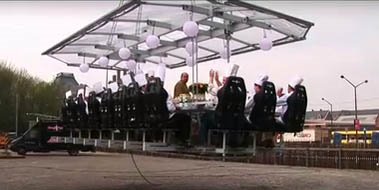
A Belgium events-planning firm, optimistically called Fun Group, has designed a restaurant – or board meeting, or conference room, or work-desk – in the sky. It’s a space, it’s a thrill-ride, it’s a spectacle – it’s 7,900 euros for 8 hours. (That link is a PDF).
So, first, you’re strapped into your seat, then hauled into the sky by a crane –


– where you’re dangled, securely, over Vespas and the glass facades of European modernism.


But lest you forget your Marxist theories of industry and labor, it all boils down to this guy –


– who can pretty much hold you hostage up there while you snack on crudites and drink endless glasses of Rioja, unaware that the tide has subtly turned…


Meanwhile, all images above are actually screen-grabs from this short film, produced by Fun Group; watch for the stickers that advertise Fun Group’s apparent parent company, or perhaps a mere co-sponsor, Benji Fun.
Coming soon? A building with no structure at all, the whole thing consists of unconnected rooms moving through the sky in unpredictable whorls, swinging crane to crane, everyday, every morning, a constellation of event-spaces casting shadows on the dull corporate plaza next door. The CEO as adventure tourist. Whole motorways lifted by crane into the sky, rerouting the M3 to Paris.
Or a bridge is temporarily delinked from the roads that lead to it – and turned into a flying restaurant…
Buildings that incorporate helicopters. The airplane as architectural extension into the stratosphere. More gondolas.
Etc.

(Via spurgeonblog and Springwise).

Mud Mosques of Mali

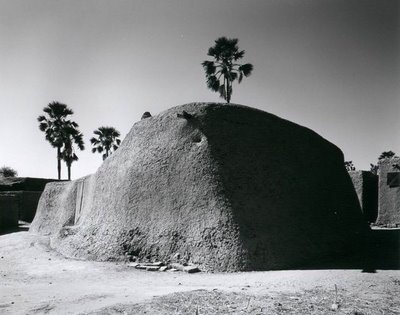
[Image: Tambeni Mosque; Sebastian Schutyser, 2001].

Belgian photographer Sebastian Schutyser spent nearly four years photographing the mud mosques of Mali. A collection of 200 such black & white photographs is now online at ArchNet.

The project “began in 1998,” Schutyser explains: “For several months I traveled from village to village by bicycle and ‘pirogue’, navigating with IGN 1:200.000 maps. The inaccessibility of the area made me realize why this hadn’t been done before.”

[Images: (top) Noga Mosque, (bottom) Tenenkou Mosque; Sebastian Schutyser, 2001].
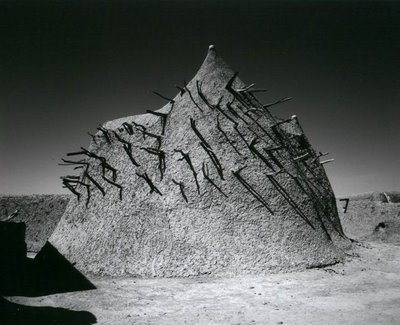
Within a few years, however, and over a period lasting roughly till the Spring of 2002, Schutyser managed “to travel faster, and reach the most remote parts of the Inner Delta. To increase the documentary value of the collection, I worked with 35mm color slides, and photographed every mosque from different angles. Whenever I encountered a particularly pretty mosque, I also photographed it on 4-5 inch black & white negative, to add to the ‘vintage’ collection.”

[Images: (top) Sébi Mosque, (bottom) Tilembeya Mosque; Sebastian Schutyser, 1998].
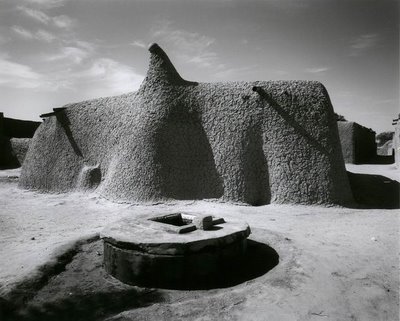
“With 515 mosques photographed,” Schutyser writes, “this collection shows a representative image of the adobe mosques of the Niger Inner Delta. Advancing modernity, and a lack of appreciation for this ‘archaic’ approach to building, are serious threats to the continuity of this living architecture.”

I might also add that each building is a kind of ritually re-repaired ventilation machine capable of generating its own microclimate: “During the day,” ArchNet explains, “the walls absorb the heat of the day that is released throughout the night, helping the interior of the mosque remain cool all day long. Some structures, for example, Djenné’s Great Mosque, also have roof vents with ceramic caps. These caps, made by the town’s women, can be removed at night to ventilate the interior spaces. Masons have integrated palm wood scaffolding into the building’s construction, not as beams, but as permanent scaffolding for the workers who apply plaster annually during the spring festival to restore the mosque. The palm beams also minimize the stress that comes from the extreme temperature and humidity changes typical of the climate.”

Finally, each tower is “often topped with a spire capped by an ostrich egg, symbolizing fertility and purity.”

Schutyser’s images have been collected in a beautiful book, co-written with Dorothee Gruner and Jean Dethier, called Banco: Adobe Mosques of the Inner Niger Delta.

[Image: Sinam Mosque; Sebastian Schutyser, 2002].

(All images in this post are ©Sebastian Schutyser).

New Maps of Impervious Surfaces


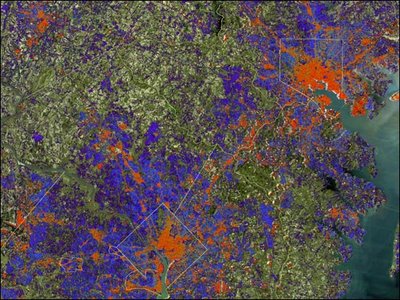
[Image: Apparently, “space-based maps of buildings and paved surfaces, such as roads and parking lots, which are impervious to water, can indicate where large amounts of storm water runs off.” In other words, these new cartographic tools can be used to predict where urban flash floods might flow – hydrology at a distance. The map you’re looking at, above, shows the Baltimore-Washington metropolitan area (in false-color). Here’s a massive 4.2MB version. Courtesy NASA/Earth Observatory].

Lake Loss

A lake has disappeared: “Four sinkholes beneath a 285-acre lake in central Florida, and one in a nearby ridge, caused the lake to drain completely earlier this month, flooding two nearby homes and killing wildlife. An engineering firm in Lakeland, where Scott Lake is located, is repairing the damage.”

[Image: Scott Lake, minus Scott Lake. (Via)].

In the process, engineers have concluded that “a permanent plug must be installed in the throat of the sinkhole to stop the water drain. The lake shoreline, parts of which have sunk into the sinkhole, must also be restored. The firm must also determine how to refill the lake.” Good luck!

This, of course, reminds me of Lake Peigneur, Louisiana. There, an oil-drilling crew accidentally punctured the upper dome of a salt mine located directly beneath the lake in which the crew had been stationed:

Texaco, who had ordered the oil probe, was aware of the salt mine’s presence and had planned accordingly; but somewhere a miscalculation had been made, which placed the drill site directly above one of the salt mine’s 80-foot-high, 50-foot-wide upper shafts. As the freshwater poured in through the original 14-inch-wide hole, it quickly dissolved the salt away, making the hole grow bigger by the second. The water pouring into the mine also dissolved the huge salt pillars which supported the ceilings, and the shafts began to collapse… Meanwhile, up on the surface, the tremendous sucking power of the whirlpool was causing violent destruction. It swallowed another nearby drilling platform whole, as well as a barge loading dock, 70 acres of soil from Jefferson Island, trucks, trees, structures, and a parking lot. The sucking force was so strong that it reversed the flow of a 12-mile-long canal which led out to the Gulf of Mexico, and dragged 11 barges from that canal into the swirling vortex, where they disappeared into the flooded mines below.

Perhaps now the mines will become a scuba-diving park…

BLDGBLOG Goes to Paris…

I’ll be out of range for a while, only back and posting after the 9th or 10th of July. BLDGBLOG, in other words, is off to Paris… Till then, here’s an updated Table of Contents of the site; if you’re either new to BLDGBLOG or have simply forgotten this site’s previous half-lives: now’s your chance to click around. So I’ll be back. And the Parisian visit is relatively tightly scheduled (it’s work-based), but if you have any tips, let me know!


Wherever you go, bring your own subway entrance!
Should we use cloned meat to pave interstate highways? Or build whole cathedrals out of organ transplants?
The hidden valve chambers and underground hydro-works of New York City, photographed by Stanley Greenberg! More Manhattan tunnels, blasted straight through schisty bedrock!
Slum warfare, William Gibson, Ridley Scott, geopolitical “holes” and ecological footprints – it’s an interview with Mike Davis! And here’s part two!
A flying micronation made entirely of solar-powered helicopters!
Hurling Taj Mahals into the sky!
The lost city of Z! Albinos, lost maps, dead Brits and miles and miles of unexplored jungle!
Where will Niagara Falls be in a million years? And will London be more than a mile beneath the surface of the earth, buried in muck?
Living amidst highway flyovers – or, in this case, directly on them!
Why is today’s architectural criticism so boring?
A group of 38 Ukrainian Jews escaped the Holocaust by living inside a cave system for several years!


Huge cubes of carbonic glass have taken over the world’s landscape!
Architectural conjecture meets Parisian sci-fi noir!
Houses that aren’t houses at all – they’re disguised electrical substations!
Supercomputers, rivaling God, housed in deconsecrated chapels!
Offshoring labor, literally – using a permanently anchored tax haven off the coast of Los Angeles! Or this ship, moored for so long it becomes architecture!
A Shopper’s Guide to Urban Catastrophe! And we didn’t forget you, vegans!
Bored? Why not read this travel guide to an island that doesn’t exist?
A Mexican library made from reused airplane hulls!
The gleaming, inhuman garages of Branislav Kropilak!
Flying hotel rooms! In silver shiny blimps!
Robo-Qibla™ meets the Gyro-Mosque® – in deep space!


Can we melt down London and use it as ink to print new cities?
Blueprints for rebuilding America’s National Parks – arch by bolt by nail!
Tour the San Francisco Bay Hydrological Model!
The icebergs of war!
The planet, re-mapped according to airplane passengers and tractor imports!
Deliberately manufacturing storms in your garden!
The abandoned Ballardian world of WWII bunker archaeology!
Mind-blowing tectonic maps of ancient North America as the continent slowly takes its present form!
Tatlin’s Tower!
A musical machine made entirely from windows!
It’s “a static, mineral accumulation of all the movements that had constituted their blind existence“!


London, mapped by the emotions of its inhabitants!
Cinematic urbanism!
Are the skyscrapers of Shanghai generating dangerous weather?
Spend the night in an eclipse camp!
Unbelievable photographs of the perfect vortex!
Labyrinthine plaster casts of ants’ nests!
Films of those ants leaving phero-chemical trails!
A huge, inflatable sphere that turns earthquakes into music! More tectonic surround-sound!
What strange and secret cities exist beneath Tokyo?
Origami!
A fossil reef stretches from Portugal to Moscow – some say further – but what if the whole thing was eroded by weather over millions of years… to become a huge wind instrument embedded in the rocks of Europe?


Dismantling Gothic cathedrals arch by arch, on the beaches of equatorial archipelagos!
The world’s largest diamond mine!
Rollerskating alone at night through subterranean knots!
A seed vault to avert planetary apocalypse!
Listening to the arched foundations of London instrument!
A man exactly reproduces his old apartment using colorful nylon sheets!
Weird geometries in the Kansas farmscape!
Slow landscapes of silt and the J.G. Ballard who loves them!
The lost gods of Europe hurl spheres at each other in space!
Valves, drains, and tunnels in the self-connected topology of underground London!
Entire cities snowing diamonds from Baroque domes!


Is that architecture or just a soundtrack hovering in space?
Helicopter photographs in the sububs of self-similarity!
The 7 New Wonders of the World!
Southeast London transformed into a maze of rooftop gardens!
A temporary public park – complete with bench and parking meter!
Lunar electricity!
Possibly the longest building on Earth – or at least in Illinois!
BLDGBLOG Presents: the Mars rover film! But bring some Kleenex!
The poet Shelley sets sail for a volcanic archipelago made entirely of glass!
A London superstadium full of ring magnets will capture the Northern Lights!
Beautiful maps!


The churches of Christopher Wren, transformed into a geomagnetic harddrive!
The World Trade Center was actually a gigantic tuning fork!
Jurassic park, Russian conservation style!
James Bond thwarts a San Franciscan attempt at tectonic warfare!
Slum dwellers and modular parasites of the urban world, unite!
An abandoned island off the coast of Japan!
Unearthly landscapes swarming with alien bacteria!
The suburbs: raw mounds and earthworks, before construction arrives!
Extraterrestrial life rained down on India!
The internal volume of Notre-Dame, Paris, carved into the surface of the moon!
Meat!


The landscape architecture of Hell, its subsurface faults and magmatic geology!
Why not live inside your garage?
Is that a suburb growing out of your spine, or are you happy to see me?
3000km of concrete tunnels installed beneath the deserts of Libya!
The robotic, neverending cinema of Los Angeles traffic control!
Plus the real-time participatory surveillance of LA’s freeway system!
A house of landslides, filled with geese!
Hypnotic films of motorway orbitals now available on DVD!
Surreal nighttime photography of Japan!
Measuring astronomy – solstice and stars – with a city modeled on Stonehenge!
Unbelievable maps and diagrams of interstellar astral incidence!


Then we hiked alone for a thousand years, and we renamed all the constellations!
The averaged images of suburban ennui!
Food! Cake!
Have you seen this hull before?
New Arctic seaways promise Lovecraftian visions to come!
On the colors of dismantled landscapes, photographed from the air!
Lego spaceships!
The radio sounds of the earth’s magnetosphere! The meditative drone of urban security gates!
Famous architecture, blurred!
Photographs of Chernobyl, including an abandoned alphabet!
Morocco double-exposures!


The Earth in 7.5 billion years!
Fossilized cities!
The art of reforesting continents through tree bombs!
The deserts of the world are musical instruments!
Venice resonates with voices!
Huge and amazing maps of California hydrology!
The city as an avatar of itself!
The wonderfully weird, self-observing urban world of CCTV!
Sci-fi instant cities built above working limeworks pits!
The abandoned malls of Chicagoland!
WWII British sound mirrors used to musicalize mountain storms!


All hell is breaking loose in middle America!
San Jellocisco!
Catching near-earth asteroids using a gigantic baseball mit!
If you’ve got nothing else to do, why not go camping in an abandoned mine?
Inbred, zombified ex-idealists stumble through pressurized undersea utopias, listening to Mozart!
Biking through glass tunnels suspended above metropolitan Toronto!
An inflatable hotel – in deep space!
Folk maps of Brooklyn’s Gowanus Canal!
Cool bridges!
Houses, churches, places to hang: it’s the afterlife of the Quonset hut!
A man jumps from a balloon, free-falls 20 kilometers through the stratosphere, and captures the whole thing on film!


King Kong!
Complicated volcanic pipe networks will extrude cathedrals directly from the earth!
Huge, interconnected white towers in the middle of Beijing!
A book of the Bible, reproduced as a textual landscape!
Should Mars have its own landscape pictorial tradition? Is this it?
Arches National Park, Manhattan branch!
Will the International Space Station soon be turned into a sculpture gallery?
An Indonesian mine and the technicolor stalactites it will form in a million years!
In a wilderness of mirrors we lost our own reflections!
Recording the secret music of bridges!
Amazing tree houses by Andrew Maynard!


[Note: All photographs in this post (so not the first or last image) were graciously supplied by the hugely talented and exhibition-deserving photographer Nicolai Grossman, whose blog, Photon Detector, is well worth a read, and whose Spacetime Set on Flickr is the source for all these photos. Thanks, Nicolai!]

Quick list 1


[Image: A “bizarre double vortex whirls in the atmosphere above Venus’s south pole.” Courtesy New Scientist SPACE].

There are roughly one million things I want to post about here – but, due to circumstances beyond my control, I’m way too busy to put up anything new. So, in lieu of a real post, yet saving you from another day of staring at Obliteration A.D., here’s a grab-bag of BLDGBLOGian things for your intellectual self-pleasure.
First, don’t miss Inhabitat‘s newly-launched weekly look at Green Building 101. This week’s installment: rethinking location in an era when daily commuting has reduced Americans’ reported number of close friends. For the dark side of eco-urbanism, however, check out this near-catastrophic look at how gangs and serial killers from Los Angeles with no experience of “nature” have turned the nearby National Forest into a kind of murder-plagued wasteland full of corpses. (Thanks, Neddal!) Elsewhere, if you’re near Long Island City, stop by Opolis, a “giant-scale miniature city in 13 blocks by 15 artists” (including Leah Beeferman), open through August. Discover the landscape acoustics of Mars. This device “records smells to play back later,” so perhaps we can make the streets of Paris… smell like Barcelona. Or like oatmeal, for that matter. And if you, too, are addicted to the World Cup, racing to the TV every mid-afternoon to watch ESPN, then here’s an ingenious look at football, John Cage, choreography diagrams, and the labyrinth of steps taken by Argentinian strikers. Meanwhile, The Economist reimagines the Eiffel Tower as a minaret –


– in their recent look at Islam in the cities of Europe; will we someday see a new continent called Eurabia? Finally, read architect Eyal Weizman‘s take on what could be called the military topologics of urban warfare: according to Weizman, for instance, recent incursions by Israeli soldiers have “used none of the streets, roads, alleys, or courtyards that constitute the syntax of the city, and none of the external doors, internal stairwells, and windows that constitute the order of buildings, but rather moved horizontally through party walls, and vertically through holes blasted in ceilings and floors. This form of movement, described by the military as ‘infestation,’ sought to redefine inside as outside, and domestic interiors as thoroughfares. Rather than submit to the authority of conventional spatial boundaries and logic, movement became constitutive of space. The three-dimensional progression through walls, ceilings, and floors across the urban balk reinterpreted, short-circuited, and recomposed both architectural and urban syntax.” (More to be found in this 4.3MB PDF – thanks, Bryan!).
I’ll put up one more post tonight or tomorrow before BLDGBLOG heads off… to Paris. More soon. I hope.

PS: It is apparently safe to dump chemical weapons into landfills.

Earth Surface Machine


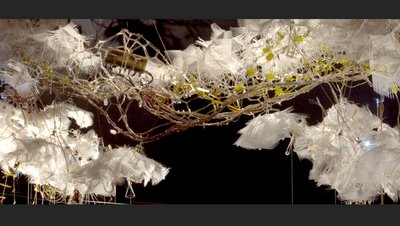
Implant Matrix, we read, is “an interactive geotextile that could be used for reinforcing landscapes and buildings of the future.” It is a responsive latticework that, installed beneath soil, would act as a kind of a terrestrial prosthesis, a local replacement for the earth’s surface. An earth surface machine.


The Implant can also be used, however, as a way to treat “an architectural building skin as a responsive textile,” facilitating “active exchanges with building occupants.” In the process, the machine would exhibit “mechanical empathy.”


Which means what, exactly?
“Mechanical empathy” is described by the project’s designers – Philip Beesley Architect of Toronto – as a kind of architectural eroticism. So if you’re lonely… reach out and touch your house: “The components of this system are mechanisms that react to human occupants as erotic prey. The elements respond with subtle grasping and sucking motions. Arrays of ‘whisker’ capacitance sensors and shape-memory alloy actuators are used to achieve sensitive reflexive functions. The interactive elements operate in chained, rolling swells, producing a billowing motion. This motion creates a diffuse peristaltic pumping that pulls air and organic matter through the occupied space.”


The assembly, in other words, with its micro-mechanical nerve endings, seems to mimic orgasm… Perhaps giving new meaning to earthquakes. (Read more in this PDF).
Two more, decidely cinematic, views of the Implant Matrix:


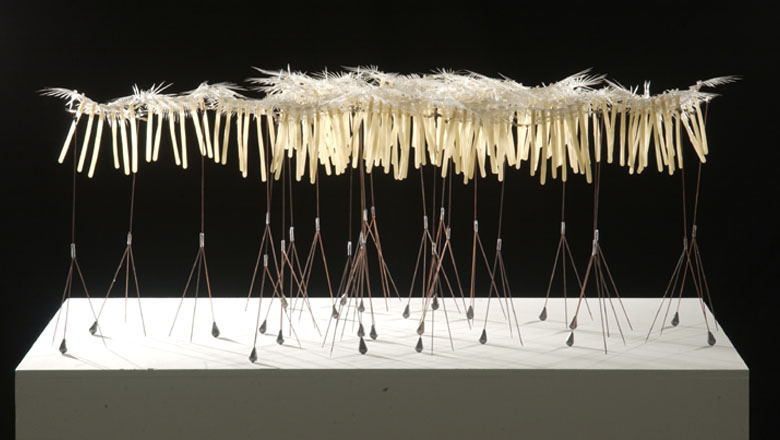
Of course, there is a bewildering array of other such projects by Philip Beesley Architect featured on their website, including Cybele, a kind of rubberized terrain-machine on stilts –


– which, seen from above in this next image, offers its own miniature landscape, another earth surface machine.


Then there’s the hypnotically delicate Orpheus Filter, with its shivering infrastructure of virus-like bladders arranged in hanging constellations and blurred carousels (below).


But you can also see many, many more interactive machine-sculptures – like the William Burroughsian Orgone Reef, the amazing Hiving Quilt, or even the Reflexive Membrane, which looks like some sort of artificially intelligent alien surgical device – over at Philip Beesley Architect’s online gallery. Then you should hire them to design something for you.

(Abstractly related: Strandbeestmovie. With huge thanks to Eric Bury for the tip! And… I just saw that Tropolism also featured the Implant Matrix, so check out their coverage for a bit more).