Architectural Dissimulation

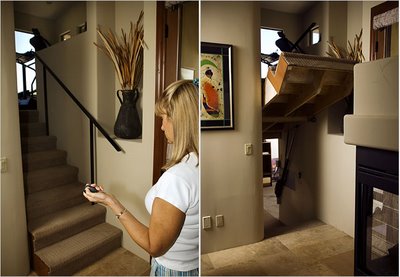
[Image: “Louise Kircher raises the staircase in her home in Mesa, Ariz., to reveal the secret room behind it.” Mark Peterman/New York Times].

“On a recent Saturday morning,” The New York Times writes, “Cami Beghou, 13, pushed the right side of the tall, white bookcase that is built into one of the powder-pink walls in her bedroom. The bookcase, holding rows of books, a stuffed dachshund and a volleyball, silently swung outward, revealing a tiny, well-lighted room. Containing a desk, a chair and a laptop computer, it serves as her study area.”
Apparently, the family gets a kick out of fooling people – it’s suburban normality in an age of architectural dissimulation: “When the home inspector came by to examine the house, our builder shut the bookcase, hiding the room. The inspector went up and down the stairs a couple times – he knew that something was unusual – but he couldn’t figure out what was there.”

[Image: “David Lee of Plano, Tex., got a bookcase door to hide the mess of his workroom, but also because he had wanted a secret room, he said, ‘since watching Scooby-Doo way back when.'” Misty Keasler/New York Times].

And therein lies a Kafka novel for the suburban twenty-first century, in which a real estate appraiser from a national bank is sent to a small town in the cloudy hills of central Pennsylvania to find that all the houses he’s meant to review are similarly unusual: the outsides are bigger than the insides – or vice versa – and indoor corridors trace around what should be whole wings the man can never find. He returns to his small room at the Comfort Inn every night, and, in between watching endless Bruce Willis films on the hotel television, he begins sketching out the neighborhood from memory…
Then he realizes something…
In any case, The New York Times adds that these secret rooms in suburbia have become increasingly popular: “The Beghous’ architect, Charles L. Page, who is based in Winnetka, said he had designed seven other houses with hidden rooms since 2001, after designing none in his previous 40 years as a residential architect. ‘Absolutely, there has been an increase,’ said Timothy Corrigan, an architect and designer in Los Angeles, who noted that he has been practicing for 12 years but was not asked to design a secret room until four years ago. Since then, he has created five.”
Unfortunately, there is no mention of whether anyone has commissioned secret rooms accessible only from other secret rooms – M.C. Escher, Architect, perhaps – or complete, non-intersecting houses built in parallel to each other on the same small lot. Otherwise inconceivable geometries in home improvement form. Knotville.

(Via Archinect).

A chance to put his theories into practice

“The peculiar thing about England,” J.G. Ballard tells Simon Sellars of Ballardian.com, in a long, casually humorous, and interesting new interview, “is that we’re so densely populated. When I say there’s nothing to do except go shopping, that’s almost the truth. You know, you can’t climb into your car and drive off into the wilderness. Shopping is all we have.”

[Image: J.G. Ballard, photographed by Paul Murphy; via Ballardian.com].

In a discussion of Ballard’s most recent novel, Kingdom Come – which Ballard himself describes as “a full-frontal attack on England today” – we read how “the gap between rich and poor is widening to such an extent that, particularly in London, it’s begun to shift the whole demographic. The middle class, the people who sustain modern society – the nurses, junior doctors, teachers, civil servants and so on – are being forced out because vast sums of money are pouring into the housing market and distorting it. Gated communities are springing up everywhere, and the moment they can, people are opting for private medicine, private teaching, private hospitals – cutting themselves off from the rest of society, and that’s not a healthy development.”
Landscape urbanism, car crashes, Harvard psychiatric publications, Playboy magazine, human autopsies, and the quiet fascism of British shopping malls: it’s an interview worth the read.

(For more of J.G. Ballard here on BLDGBLOG, see Concrete Island, Bunker Archaeology, and Silt, in particular).

City of the Pharaoh

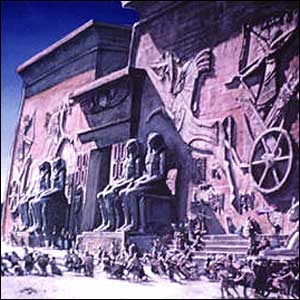
[Image: Cecil B. DeMille’s not yet lost city – the set of The Ten Commandments, during filming].

“In 1923,” we read, “pioneer filmmaker Cecil. B. DeMille built the largest set in movie history for his silent (and early Technicolor) epic, The Ten Commandments. It was called ‘The City of the Pharaoh.'”
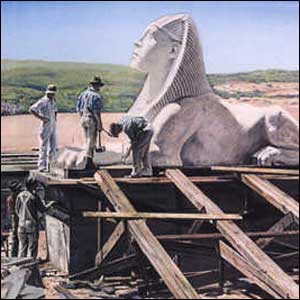
Constructing DeMille’s instant city was no half-effort: “Sixteen hundred laborers built hieroglyph-covered walls 110 feet tall, flanked by four statues of Ramses II and 21 sphinxes, 5 tons each. DeMille populated his city with 2,500 actors and extras, housing them in tents on an adjacent dune.”

[Image: A scene from The Ten Commandments, via NPR].

Not one to leave his creation around for others to use in their own cinematic ways, “DeMille ordered that the entire edifice be dismantled… and secretly buried. And there it lay, forgotten, for the next 60 years,” eventually becoming known as the “lost city of Cecil B. DeMille.”
But then, in 1983, “a group of determined film buffs – inspired by a cryptic clue in DeMille’s posthumously published Autobiography – located the remains of the set. (…) They brought in ground-penetrating radar to scan the sands, and hit pay dirt: the dune-entombed remains of DeMille’s dream.”

[Image: The lost city, via NPR].

Peter Brosnan and John Parker – the “film buffs” mentioned above – arrived at the site to find themselves “in a field of plaster statuary… [T]here had been big storms, and more set was uncovered than had been seen in 30 years.” They thus proceeded with the excavation… about which more can be read here.
Meanwhile, something about this story reminds me (very vaguely) of Skara Brae, a 4000-year old Stone Age village uncovered not by archaeologists but by an especially violent seasonal storm on the far west coast of Scotland.
“In the winter of 1850,” Orkneyjar tells us, “a great storm battered Orkney. Nothing particularly unusual about that, but on this occasion, the combination of Orkney’s notorious winds and extremely high tides stripped the grass from a large mound known as Skerrabra. The storm revealed the outline of a series of stone buildings that intrigued the local laird, William Watt of Skaill. So he embarked on an excavation of the site.”

[Image: Skara Brae, via Orkneyjar].

Orkneyjar goes on to explain that, “[b]ecause of the protection offered by the sand that covered the settlement for 4,000 years, the buildings and their contents are incredibly well-preserved. Not only are the walls of the structure still standing and alleyways roofed with their original stone slabs, but the interior fittings of each dwelling give an unparalleled glimpse of life as it was in Neolithic Orkney.”
In any case, combine Skara Brae and DeMille’s lost city – then add a few ten thousand years – and you get future archaeologists uncovering, by accident, with the help and assistance of an unseasonal storm, the outlines of a buried city. Washington D.C., say, or perhaps Springdale, Utah. Thing is, these future archaeologists conclude that the city wasn’t an actual dwelling place, not a real place to live – they discover far too many parking lots, for instance, and can’t believe anyone would willingly live surrounded by those things – instead, they think, the city had been a monumental film set.
Excavations continue – leading to the controversial conclusion that human civilization in North America was really a massive piece of performance art, from sea to shining sea – a cinematic installation upon the plains – and so whatever film had been made there must surely still exist…
Thus begins a whole new, Paul Austerian chapter of future archaeology – in which they hunt for the lost and secret films of a buried North America.

(Thanks, Juke!)

Edinburgh

In a (very) short story called “The Antipodes and the Century,” author Ignacio Padilla describes “a great Scottish engineer, left to die in the middle of the desert, [who] is rescued by a tribe of nomads.” Upon recovery, the engineer soon “inspires” his saviors “to build an exact replica of the city of Edinburgh in the dunes.”

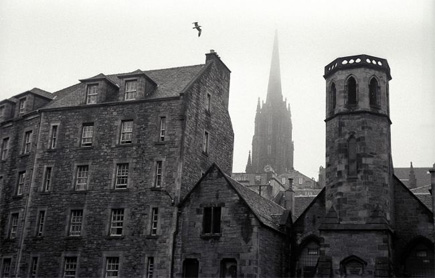
edinburgh[Image: Edinburgh, as photographed by Jim Webb in 2002].

There, “amidst the rocks of the Gobi,” Padilla writes, Kirghiz nomads are taught “the exact height that Edinburgh Castle must attain, the precise length of the bridge that connects the High Street with Waverly Station, the correct calculations necessary to establish the perimeter of Canongate Cemetery, [and] the true distance between the two spires of St. Giles’ Cathedral.”
With that knowledge – and with lots of rocks – they construct “an elephantine fortress of streets, bridges, and windows.” It is “a shimmering haze of towers” that blends in architecturally with the inferior mirages of the desert horizon.
Until it is buried by a sandstorm, then, this new, replicant Edinburgh functions as “a kind of global map in the very heart of the Gobi Desert,” we read, “a vague though tangible diorama of the cosmos, its center a replica of the Scottish capital.”

(See also Huangyangtan: or, Tactical geoannexation, Part II, at Pruned).

Quick list 4

Tomorrow morning BLDGBLOG rolls itself out upon the American interstate highway system to make its slow way over to the apocalypse of Los Angeles – via Chicago, Denver, Boulder, and Springdale, Utah, where a few pints of Polygamy Porter and some long hikes in Zion National Park strongly beckon – all the while hoping to maintain some sort of regular posting schedule, as I have about 2.173 billion things I want to tell everyone about.

First off, British architect Norman Foster “has been enlisted by the King of Jordan for his most grandiose project yet – a canal carved through the desert to rescue the Dead Sea from environmental disaster.” Foster’s plan “is to carry sea water from the Gulf of Aqaba to replenish the Dead Sea, which has shrunk by a third over the past 50 years and faces total evaporation.” The water will travel through a “sequence of canals and pipelines,” moving “down through the arid Arava valley in southern Israel and Jordan to the salt lake at the lowest point on earth, 415 meters below sea level.”
We wish him luck – then we refer you to the great man-made river of Libya.

Elsewhere, metallic, alcohol-detecting flowers have been “grown in a laboratory in China.” These “spectacular flower-like nanostructures” are each “made up of bundles of nanorods 15nm wide. They were made by blasting a zinc-containing solution with ultrasound.”
This bouquet even conducts electricity: “To make a sensor the researchers wired up two patches of the flowers into a circuit.”
Next up: the flowers escape and cross-breed with uranium, forming an unkillable flowering alloy that soon decimates New York City. Within ten years, the cities of North America resemble a metallized return to the Jurassic era, complete with bio-iron vines and moving fogs made entirely from electricity…
As you ponder that fate, check out Architecture Radio‘s podcast of a talk by Steven Ehrlich, an architect based in Culver City, Los Angeles; then give a listen to AR‘s earlier lecture by border-crossing architect Teddy Cruz. Then, while your ears recover, this video-tour of a data storage warehouse is worth a minute or two of your time.
Equinix Internet Business Exchange centers, we see, “serve as core hubs for critical IP networks and Internet operations worldwide.” They are huge, air-conditioned warehouses full of humming CPUs and bundled cables, watched over by CCTV.

With direct access to more than 200 networks, including all of the top global Tier 1 networks, Equinix’s network-neutral IBX centers and services overcome the limitations of existing data center, network and Internet operations through direct interconnection to the largest aggregation of networks for unmatched service diversity, flexibility and reliability. At Equinix, customers can directly access the providers that serve over 90% of the world’s Internet networks and users.

The NSA will soon stop by.

christiankerriganFinally, Christian Kerrigan wants to grow a living ship from the trees of Kingley Vale forest: “By controlling the manipulation of refined armatures, calibrating devices and designed corsets,” Interactive Architecture dot Org reports, “the system is capable of controlling the growth of a ship inside the forest. The ship will grow over a period of two hundred years and will exist as a hidden architecture inside the trees.”
In other words, using hinged networks of cables and steel restraining belts, the growing branches of trees can be forced to assume the shape of a masted ship.
Is it the self-pruning future of architecture…?

christiankerrigan2christiankerrigan4We wish him luck, as well.
More soon… And I’ll try to keep posting from the road.

(Earlier: Quick list 3, et cetera).

Design in the World

Over on Archinect, I’ve posted a lengthy interview with Detlef Mertins, Chair of the Architecture Department at the University of Pennsylvania.

[Image: Detlef Mertins; photograph by Kristine Allouchery].

There we discuss the changing nature of architectural education: what teaching strategies, points of reference, and technologies (such as robotic assembly and 3D printing) can be used most effectively in the classroom. We go through everything from Mies van der Rohe vs. Toll Brothers to the use of algorithms in architectural design; from LEED certification and green building practice to comic books, Archigram, and the use of narrative fiction in student presentations.
On algorithms, for instance, Mertins remarks that the ongoing controversy over whether or not to use mathematics as a generator of architectural form overlooks the fact that reliance on algorithms is simply part of a long “tradition of architects seeking to learn from nature’s capacity to produce forms, patterns and structures of extraordinary beauty and functional prowess. Algorithmic design taps into a giant reservoir of mathematical models already at work in the processes that constitute the universe. In that respect, it’s still a form of mimesis.”

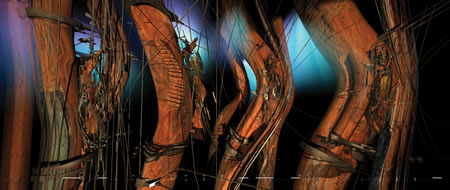
[Images: Student work from the University of Pennsylvania – in this case, a project by Justin Coleman, Amy Johnson, Jaime Lee, and Herman Mao, from their 3rd Year course with professor Cecil Balmond. See Archinect for more].

It’s a good interview, if I do say so myself. For me, as well, it comes with the well-timed realization that if someone as intelligent, articulate, patiently deliberative, and simply good humored as Detlef Mertins can survive the city of Philadelphia, then there may still be hope for our species…
So check it out – and feel free to leave comments on BLDGBLOG if you have any reactions or further thoughts, especially if you’re a student (or faculty member) at Penn.

Signals of salvation

The answer to your prayers is just a phonecall away: “After Hurricane Jeanne destroyed their steeple, members of the Crossroads Community Church didn’t know where they would find the money to replace it. So they prayed for an answer. But they never expected it would come in the form of a cell phone tower. Businessman Paul Scott, who specializes in building disguised or ‘stealth’ cellphone towers, approached leaders of the church last year with the idea of building a 120-foot-tall tower in the form of a blue-gray metal cross. Concealed inside the top portion of the main pole would be antennas used by Sprint, Nextel and Metro PCS.”

(Thanks, Steve! Elsewhere: Pruned explores cellular infrastructure).

Cistern

McMillan Reservoir, in Washington D.C., “is one of the largest undeveloped tracts in a capital invaded by convoys of construction cranes.”
Why is it undeveloped?
“The reason lies beneath the grass.”

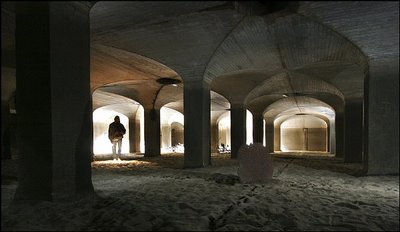
[Image: “The arches that form the catacombs beneath the McMillan Reservoir were crafted from unreinforced concrete, which means they couldn’t support construction above them.” Photo by Robert Reeder for the Washington Post].
“Below ground,” we read, “are 22 massive catacombs built from concrete that formed the city’s main water filtration system at the turn of the last century. Potomac River water, fresh from Great Falls, arrived at the plant and was filtered through underground cells lined with sand dumped by mule-drawn wagons. Clean water emerged and was piped into homes across the city, including the White House.”
Now, however, these catacombs once dedicated to purity and filtration lie derelict and half-collapsed upon themselves in the soil – and are so otherwise useless that they’ve been proposed as a possible home for a new monument to dogs killed in wartime.
“Passersby don’t know what to make of the property in its current state. It looks like flat farmland, studded by 20 brick silos that once stored sand for the filtration. Several old pump houses, the glass long blown out of their windows, sit silently. Some of the catacombs have collapsed, but others give a sense of a great subterranean world, where shafts of daylight stream down from manholes in the grass above and cast ribbons of white on sand that still lines the floor. In the quiet, one can imagine the sound of water lapping against the concrete columns that support the catacomb and form archways every 12 feet.”

(With a much-belated thanks to John Sands for the tip! Earlier: Walking over a valve chamber outside the Brooklyn Academy of Music).

Architect of strings

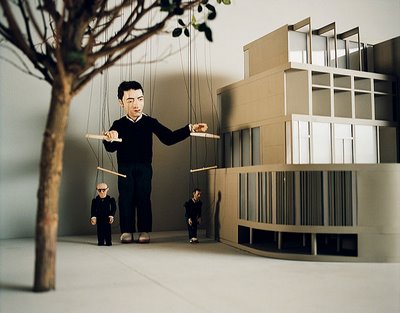
[Image: Pierre Huyghe’s Celebration Park – closing soon at a Tate Modern near you – includes “a filmed puppet musical telling the story of Le Corbusier’s struggle to satisfy a commission from Harvard University.” The show is on view till September 17th – but I haven’t seen it; I just like the image, above, discovered via this week’s Artkrush].

Container Home Kit

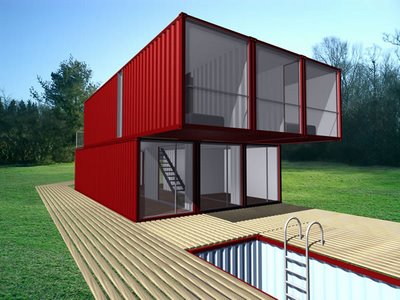
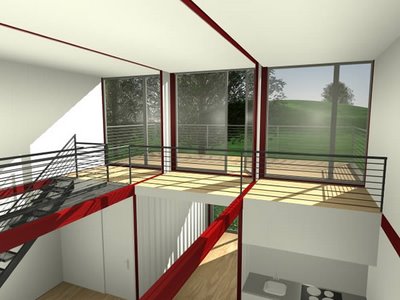
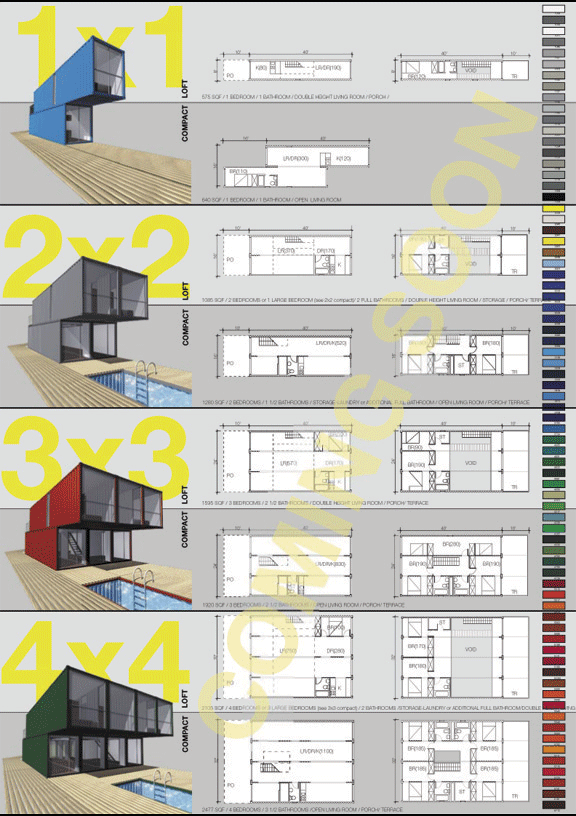
Back in July, LOT-EK announced their Container Home Kit, a prefab, do-it-yourself assembly unit that “combines multiple shipping containers to build modern, intelligent and affordable homes. 40-foot-long (13.00m) shipping containers are joined and stacked to create configurations that vary in size approximately from 1,000 to 3,000 square feet (90m2 to 270m2).”
Watch the video.

“Each container is transformed [by] cutting sections of its corrugated metal walls,” they explain. “Incrementing the amount of containers allows the house to expand from a 1 bedroom to a 2, 3, and 4 bedrooms home. The landscaping around the houses uses additional containers to configure a swimming pool, a pool house/tool shed and a car port. CHK™ houses can be disassembled and reassembled elsewhere.”
Here’s a poster-sized PDF to guide you through the options, including several dozen external colors:

LOTEK_Contain_CatalogI want a bright yellow one that I’ll park somewhere in Los Angeles, serving as both BLDGBLOG’s new home office and as a space for public architectural lectures. Archinect, Pruned, Subtopia, and Inhabitat will open up similar containers next door; then Edgar Gonzalez, gravestmor, and The Dirt will move in. Soon, a color-coded microcity of container high-rises, run entirely by architecture and design bloggers, will appear – a media complex for the 22nd century, covered in satellite dishes, winning grants and producing documentaries – eventually awarded urban landmark status from the Californian government.
things magazine and The Kircher Society will set up shop. Ballardian. Abstract Dynamics. MoCo Loco. And so on.
We’ll serve too much wine, issue counterfeit passports, discuss seismology and the structural fate of the avant-garde – then design, in secret, an archipelago of hovercrafts the exact size and shape of Hawaii.
Then we’ll invade Hawaii.

(Elsewhere: Architect’s Newspaper and BusinessWeek. Earlier: LOT-EK’s library of airplanes).