Bauhaus Pyramid

The German town of Dessau, home of the Bauhaus, may someday construct its own Great Pyramid.
“The pharaohs may have set the standard,” the Telegraph reports, “but German entrepreneurs are hoping to challenge Egypt’s pre-eminence in monumental self-indulgence by building the world’s largest pyramid.”

The Telegraph somewhat cynically continues, explaining that this “improbable plan is based on the belief that people will pay to have their ashes encased in the concrete blocks used to construct the monument.”
If that does turn out to be the case, however, then these German entrepreneurs “will be rich beyond the wildest dreams of even the most ambitious pharaoh.”

The blocks are expected to be up to one cubic metre in size and, given that the volume of the completed pyramid is likely to be in excess of 40 million cubic metres, it could ultimately bring in £13.2 billion.

Almost literally unbelievably, we read that an “international jury” will select the Pyramid’s final design – and that the jury “will be headed by the Dutch architect Rem Koolhaas.”
In any case, the concrete structure itself – why not granite? let’s please build huge structures out of stone again – would act as a “memorial site” for people “of all nationalities and religions.”
You don’t actually have to be buried there, meanwhile; you can “opt to have a memorial stone placed instead.” Your stone can even be “designed with any number of colors” – instantly transforming the Great Pyramid into a badly weathered mountain of tinted concrete, cracked and stained more and more every winter as it stands in the heart of an east German floodplain.
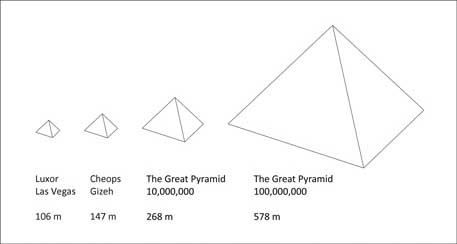
Still, the entrepreneurs are optimistic:

The Great Pyramid will continue to grow with every stone placed, eventually forming the largest structure in the history of man.

So how large is large?
The original plans called for “an overall height of some 1,600ft,” the Independent reports, “but the proposal has already been dramatically scaled down. The revised plans are for a pyramid of some 492ft.”
1) What does Michiel think of this? 2) Will it cause earthquakes?

(Thanks, John!)

Sound Field

[Image: The internal structure of maple leaves, via Wikimedia].

In 1997, Japanese composer Mamoru Fujieda released a CD called Patterns of Plants. The album featured “melodic material” that Fujieda developed using the “surface-electrical potential” of plant leaves.
In other words, he transformed leaves into sound.
You can hear excerpts from Patterns of Plants at the iTunes store.
Bear in mind, however, that you’re not really listening to the electrical circuitry of amplified plantlife; the music is pretty stylized. We read, for instance, that every track combines “alternate tuning systems (just intonation, Pythagorean) with traditional instruments of China and Japan (sho, koto and the ancient 25-stringed zither, the hitsu),” creating a “bizarre and fascinating mixture of European Medieval music, the traditions of Asia and modern science.”
In fact, Fujieda’s musical translation of plantlife – sonatas encoded in cell structure and root – is similar to work done by composer Yuji Dogane. Dogane is known for creating a device called the Ecological Plantron. Dogane’s Plantron “measures the minute electrical changes which flow across the surface of the leaves of plants, and changes them into sounds.”

[Image: A leaf, via Wikipedia].

In any case, I was reminded of Fujieda’s music today after reading a short article about the relationship between plantlife and sound in this week’s issue of New Scientist.
There we read that Korean scientists “claim to have identified two genes in rice that respond to sound waves.” These would be “sound-sensitive genes” – or “sound-responsive genes” – and they “could be attached to other genes to make them respond to sound too.”

The genes rbcS and Ald became more active at 125 and 250 hertz and less active at 50 hertz. As both are known to respond to light, the researchers repeated the tests in the dark and found that the two genes still responded to sound.

Though these results “have been greeted with profound scepticism” by other researchers, if the tests can be repeated they’d indicate “that sound could be an alternative to light as a gene regulator.”
It’s not photosynthesis, then, but audiosynthesis. Geneto-acoustic biology.
Even more interesting – and I absolutely love this:

If the researchers are correct, they say their discovery could enable farmers to switch specific crop genes on and off, such as ones for flowering, by blasting sound into the fields.

Which leaves me wondering if, someday, there might be whole warehouses full of hybridized crops growing vigorously in darkness, with B-flat droning from unseen speakers.
Somewhere below, in a soundproof lab, scientists subject single seeds to six thousand hours of shifting frequencies, synthesizing vitamins, coaxing corn into wheat. It’s industrial agri-alchemy.
You break-in, unaware of what the building really is, only to switch on your flashlight, terrified by the constant thunder, to see a thousand stalks of corn vibrating in rows all around you…
The ground is shaking and the air is full of pollen.

[Image: Pollen, via Wikipedia].

Will we grow tomorrow’s crops inside recording studios?
Or, ten years from now, you stumble upon vast fields of barley stretching off to the horizon, and there are weatherproof speakers placed every three hundred feet, emitting F-sharp – though the exact sound they’re playing has been patented.
You can hear the farm ten miles away.
Might sound – or infrasound – have as great an impact on genetic mutation as ultraviolet radiation from the sun?

[Image: A field of barley, via Wikipedia].

And what of our genes, perhaps shaken into new configurations by exposure to the rarest of frequencies? Are we genetically affected by sound?
Further, might there be a civilization somewhere whose “music” is really a complicated form of genetic stimulation? For every concert you attend, you become something other – acoustically moving through new forms of alteration.

Robot City

South Korea plans to build a whole city from scratch dedicated to the robotics industry.

SciFi.com reports that the appropriately named Robot Land will “have all sorts of facilities for the research, development, and production of robots, as well as things like exhibition halls and even a stadium for robot-on-robot competitions. The $530 million project should get underway sometime in 2009.”

Korea.net adds that the city’s industrial output will have an “emphasis on so-called service robots that can clean homes and provide entertainment.”

Now we just have to wait till the city secedes from South Korea; it then achieves a kind of limited national sovereignty; it seats a robot-ambassador at the UN; its Artificially Intelligent offspring form a Parliament, or a Ministry of War; they manufacture cannons and other violent forms of propulsive enginery, filling the sky with drones; and then human history becomes interesting again.

We’ll read future Machine-Iliads, magnetically engraved on self-aware harddrives as the robots roll toward war with Beijing…

Single Hauz

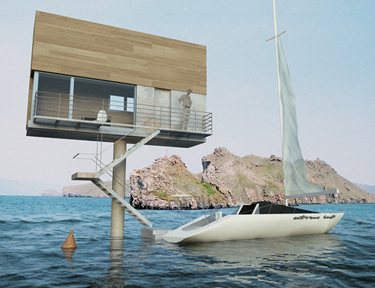
[Image: The Single Hauz by front architects].

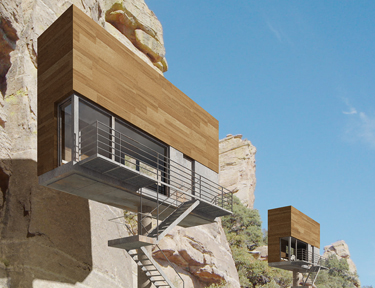
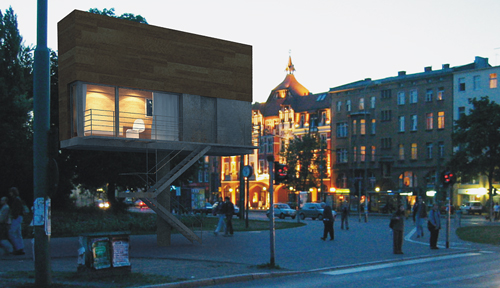
Like an inhabitable billboard, the Single Hauz – by Poland’s front architects – proposes cantilevering domestic living space from a central mast. The house can then be installed above a variety of ground conditions, from the middle of a meadow to an urban core.
Personally… I’d put it in a lake.

[Images: The Single Hauz by front architects].

The cool thing is that I’ve actually spent the last 11 months of my life staring up at some of the Herculean billboard structures out here in Los Angeles; they tower over intersections on streets from Venice to Sepulveda and often seem as large as houses.
But how much weight could a billboard carry?

[Image: The Single Hauz by front architects].

Could you build a house up there?
Could you use the mast-and-cantilever model for other types of architectural structures, whether those are single-family houses – whole cul-de-sacs lined with modernist billboard homes! – or even restaurants and public libraries?
The Single Hauz shows how beautiful the effect could be.

[Image: The Single Hauz by front architects].

For more projects by front architects, check out their website (though I couldn’t find any information in English).

(With huge thanks to a commenter named munditia, who first pointed out this project to me).

Hello. Welcome to my squash cave.

The urban surface of London is no longer interesting enough for the ultra-rich; they’re thus building downward.

As the Times reported this past weeked:

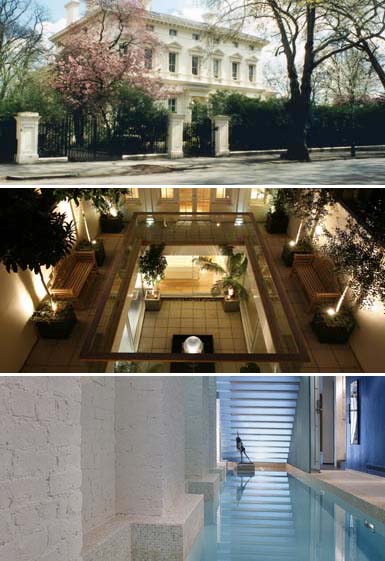
A Roman bath, a cinema for two dozen friends, even a subterranean tennis court—the super-rich are transforming their London homes, even if it means digging dozens of feet undergound.

The article goes on to describe how many of London’s most financially advantaged residents, including oil tycoons and Indian steel magnates, have been “seeking permission to excavate under the garden… making space for a three-storey garage with car stacker, a swimming pool, a gym and a private home cinema.” There are even “walk-in showers with waterproof television screens and glass walls that turn opaque with the press of a button, and cost £1,000 per square metre.”

It’s the urge toward subterranean architectural eccentricity, and it’s transforming the very Earth beneath London.

[Images: London houses and their subterranean extensions; all photos via the Times].

For instance, we learn that “billionaire Russian oligarchs, private-equity traders and hedge-fund managers are engaged in a multimillion-pound game of one-upmanship as they vie with each other to dig ever bigger, wider and deeper extensions.”

Indeed, “London’s super-rich are digging down and building outwards and upwards—and making use of the latest, priciest technology to do it.”

Digging also helps them to avoid strict conservation laws, as the houses they’ve been extending into the Earth are usually listed structures: “Most houses now have more space below ground than above it, due to stringent planning regulations.”

There are even “high-end builders,” for whom business is booming, “who frequently dig down as far as 50ft to create new floors, basements and swimming pools, while the original house is propped up on giant steel pillars.”

There’s also quite a market for “adjustable-height swimming pool[s]” built far underground:

At the flick of a button—because everything is remote-controlled—the bottom can be raised or lowered by a giant hydraulic jack, forming a deep swimming pool for the heavyweight millionaire or a toddler-friendly paddling pool for his offspring.

Which is nothing:

One home in north London even has a bespoke chute covered in a special slippery paint, which enables the owner, who loves swimming first thing in the morning, but hates the fuss of dressing, to step out of bed and slide straight into the water a couple of storeys below.

Meanwhile, “a secretive hedge-fund tycoon” recently submitted a 168-page planning application within which he’s requesting permission to build “a 16ft-deep swimming pool with high board”—among many other things—which, of course, will be underground.

“The super-rich are no longer demanding just luxury goods,” we read; “they’re demanding a luxury lifestyle experience.”

So while bored twentysomethings read Le Corbusier over and over again in roundtable discussions led by professors who would rather be elsewhere, the underworld of London is calling…

Read more at the Times.

(Thanks, Nicky! Earlier on BLDGBLOG: London Topological and Derinkuyu, or: the allure of the underground city).

Find a lake, float out to the center, build a house

[Image: Fishermen on Lake Tanganyika, via Wikipedia].

“The matted growths of aquatic plants fringing its shores are cut off in sections, and towed to the centre of the lake. Logs, brushwood, and earth are laid on the floating platform, until it acquires a consistency capable of supporting a native hut and a plot of bananas and other fruit trees, with a small flock of goats and poultry. The island is anchored by a stake driven into the bed of the lake; and if the fishing become scarce, or should other occasion occur for shifting his domicile, the proprietor simply draws the peg, and shifts his floating little mansion, farm, and stock, whither he chooses.”

—John Geddie, The Lake Regions of Central Africa: A Record of Modern Discovery (Edinburgh, 1883), as quoted by Giles Foden in Mimi and Toutou’s Big Adventure: The Bizarre Battle of Lake Tanganyika

(Thanks, Valerie!)

Post-residential Venice

While packing up the apartment for our move to San Francisco, I keep coming across articles I’ve clipped from newspapers and magazines, even whole chapters of books, that I obviously once meant to write about for BLDGBLOG…

[Image: J.M.W. Turner, The Dogana and Madonna della Salute, Venice, 1843; for more, see Tate Britain].

One such article, published nearly a year ago today, proclaims that Venice, Italy, may soon become “a tourist ghost town.”

Venice is on course to become a city virtually without residents within the next 30 years, turning it into a sort of Disneyland – teeming with holidaymakers but devoid of inhabitants… The city may then become a museum, to which, as La Repubblica remarked, it would be “normal to charge entry”.

Other cities for whom this fate could be very, very interesting, if culturally ill-advised? Detroit and the New York borough of Manhattan.
In any case, as the BBC describes this phenomenon:

At night Venice sometimes resembles an empty museum, a ghost town.
After [11pm], when the day trippers have all left and the restaurants and bars are closed, the waterways and calles – narrow streets that intersect the islands upon which Venice is built – are almost deserted.
Tomorrow another 60,000 people will arrive – and depart.

This vision – of Venice, populated only by the odd night security guard and a few absent-minded curators – surely sets up a far more interesting future storyline than Night in the Museum ever hoped to be.

(Earlier on BLDGBLOG: Venice Resonator).

Conspiracies of Demolition

In what seems like a deliberate attempt at conspiratorial double-entendre, the New York Times reports this morning that an “Obscure Company Is Behind 9/11 Demolition Work.”

[Image: The South Tower of the World Trade Center on 9/11; photographer unknown].
This obscure company, we read, is the John Galt Corporation, and they were “hired last year for the dangerous and complex job of demolishing the former Deutsche Bank building at 130 Liberty Street, where two firefighters died last Saturday.”
Wait a minute – what was all that about “9/11 Demolition Work”? Isn’t there an implication in that phrase that 9/11 was –
Well, no.
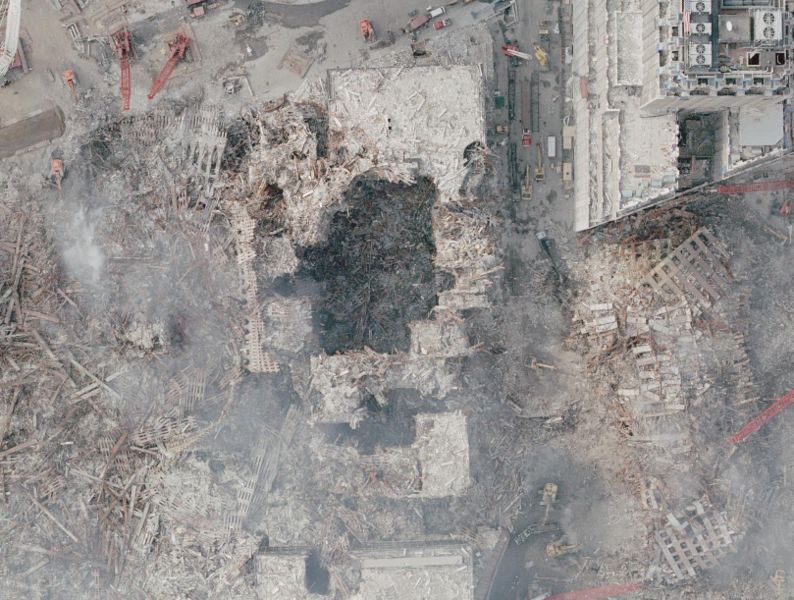
130 Liberty Street, you see, was heavily damaged by the collapse of the World Trade Center towers on September 11; it’s being dismantled because of this.
That apparently makes it “9/11 Demolition Work” – besides, the cryptic headline sells more papers.

[Image: An aerial view of Ground Zero, taken on September 23, 2001, by NOAA’s Cessna Citation Jet. Via Wikipedia].

What’s interesting, nonetheless, is that the John Galt Corporation “has apparently never done any work like [this],” the New York Times reports.
“Indeed, Galt does not seem to have done much of anything since it was incorporated in 1983.”

Public and private records give no indication of how many employees it has, what its volume of business is or who its clients are. There are almost no accounts of any projects it has undertaken on any scale, apart from 130 Liberty Street. Court records are largely silent. Some leading construction executives in the city say they have never even heard of it.

The CIA masquerading as a demolition services firm in New York City!
Well, the article doesn’t say that – but it does parse through some of the complicated financial superstructures within which the John Galt Corporation operates (including distant ties to the Gambino crime family).
The John Galt Corporation is thus a kind of administrative straw man, a legal way “to insulate the assets of a parent company from the enormous potential liabilities of demolition work.”
Indeed, demolition is a legally complex undertaking; one need only read the last few chapters of Jeff Byles’s Rubble to understand the subtle vicissitudes of the growing industry.
In any case, the Times article goes on to say that New York state and its corporate partners experienced a lot of “difficulty” in “attracting any contractors interested in, or capable of, performing the novel and high-profile job” of demolishing 130 Liberty Street.

It is not hard to understand why most contractors – particularly during a building boom, when they can pick and choose work – would balk at doing a job involving hazardous materials under microscopic regulatory scrutiny for a governmental client whipsawed by demands that demolition go faster (so that ground zero redevelopment could proceed) and slower (to ensure that contaminants were not released into the neighborhood).

But I want to go back to the original motivation for this post: the world of legally shady demolition firms operating in the maze of high-rises and vacant lots, warehouses and Jersey docklands, of New York City. After all, there are so many potential novel plots in this set-up, I can hardly believe it.
There’s the Nicolas Cage/National Treasure 3 version: the John Galt Corporation is actually a front for some rogue group of foreign archaeologists – because there is something inside the building… and they need to recover it.
There’s the Loose Change version: 130 Liberty Street contains far too much chemical evidence that thermite really was used on 9/11 – and so the John Galt Corporation was brought in by Langley to clean up the job…
There’s the Ghostbusters/Grant Morrison version: the building is not a building at all… it is a valve, built directly above the Pillar of Manhattan, and it is only there as a way to vent subterranean steam. The John Galt Corporation is really a team of Columbia-trained paranormal investigators…
Anyway, obscure NYC demolition firms seem like a remarkably underused resource for contemporary novels and films; in fact, it’ll be interesting to see if demolition firms, post-9/11, take on a kind of conspiratorial aura, with unclear connections to investors in suburban DC… somehow showing up before major terrorists attack… starring Denzel Washington…
Read more about John Galt at The New York Times.

(Interesting note: John Galt is the name of a character in Ayn Rand’s Atlas Shrugged).

The Fold

[Image: An example of origami tesselation, turning surface to structure, called “Count?” by Christine Edison – whose other work is simply unbelievable: check out “Triad back backlit,” for instance, or this set of her “favorite tesselations.” While you’re there, don’t miss “New Years Eve Tess” or “Blue Snowflake Tess.” Christine also has a blog where you can click around on other spectacular examples of folds and pleats to your heart’s content. Spotted via Eric Gjerde, who recently published a short booklet explaining how you, too, can produce similar foldings of local paper-space… Architects would do well to study origami’s spatial densification].
(Earlier on BLDGBLOG: Paper Topographies: 1, with some stunning work by Eric Gjerde himself).

Airborne Geology

One of several interesting things I’ve found in Alan Weisman’s new book The World Without Us is his rhetorical approach to the industrial burning of fossil fuel.

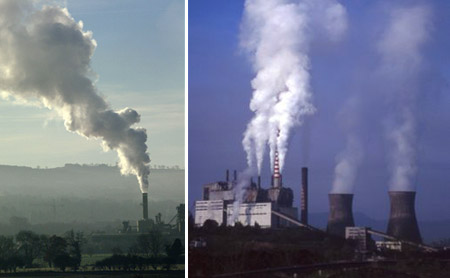
He refers to burning oil and coal as a way of “tapping the Carboniferous Formation and spewing it up into the sky” – that is, it’s “carbon we have mined from the Earth and loaded into the air.”
Or: geology gone airborne.

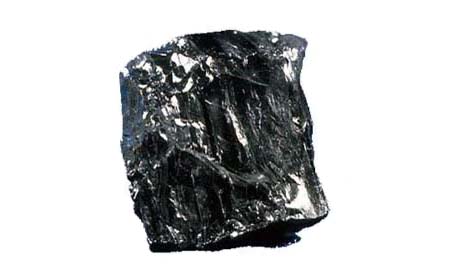
[Image: A glimpse of the Carboniferous Formation, or coal awaiting its own secular ascension; via].

Because of this unintentionally aero-geological project, Weisman writes, “[a]mong the human-crafted artifacts that will last the longest after we’re gone is our redesigned atmosphere.” After all, that atmosphere now has a very large chunk of the Earth’s surface floating around inside it, storing sunlight and heat.

[Image: Coal – before being “loaded into the air” through burning].
The word Carboniferous, meanwhile, refers to huge, continent-spanning deposits of coal that first began forming roughly 300 million years ago, in the appropriately named Carboniferous Period. Coal is formed from the compression, burial, and slow cooking of biological matter: old tropical forests and other organisms thus transform into an energy-intense geological formation.
In addition to the burning of oil – itself an ancient, carbon-based biological deposit – it is the combustion of all this coal that has fueled our ongoing industrial revolution.
In the process, Weisman implies, humans have achieved something extraordinary: the installation of a geological formation in the sky.

Looked at this way, it should come as no surprise that the Earth’s climate is now changing.
Its air is full of geology.

(Also in reference to The World Without Us – a very uneven but still fascinating book – see BLDGBLOG’s earlier post about the accidental discovery of underground cities in Cappadocia).