Tectonic Real Estate

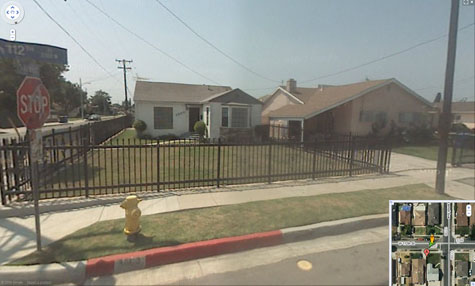
[Image: The epicenter: 3300 W. 112th Street].

…and another earthquake has shaken Los Angeles, at very nearly the same spot as Sunday night’s temblor. This one was epicentered at 3300 W. 112th Street, beneath this lovely, detached, single-family house in Inglewood.
See this earlier post for more thoughts on urban tectonic events in an era of Google Street View (and don’t worry: I won’t post about every single earthquake that strikes L.A.).

Bed, Bath, and Beyond

I’m in the final hours of an unexpectedly complex move, so it could easily be another 36 hours before I can post again. Which is too bad, because there is an incredible amount of interesting news to report, from unexpected terrestrial rearrangements in Alaska to the agricultural world’s “fledgling movement to grow food crops in closed, sustainable environments,” by way of 3D printers outputting artificial sandstone, a two-year old story about archaeological playing cards for U.S. soldiers in Iraq, storms of airborne cocaine blowing through Spanish cities, the next chapter in large-scale California real estate, and The $50 and Up Underground House Book.
But I’ve got a whole kitchen to pack…

The House of Memory and Automata

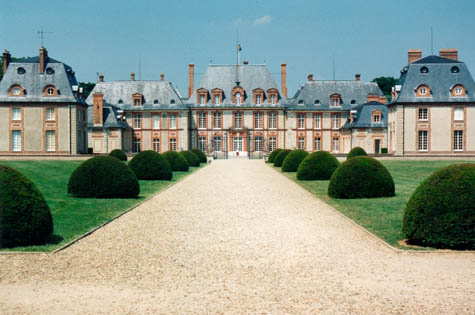
[Image: The Château de Breteuil in the Île de France].

For a variety of reasons, I’ve been thinking about a business trip to Paris that my wife and I took back in July 2006.
At one point we visited a château in the Île de France, northwest of the city, arriving by bus in the early afternoon for a private home tour with the palace’s long-time family owners. It was the Château de Breteuil.
The de Breteuil family history included one Louis de Breteuil, a minister for Louis XIV, the Sun King, and, according to the château’s own website, “a contemporary of Charles Perrault.”
Perrault, who otherwise had no biological or genetic connection to the family, as far as I can tell, was the author of several now famous children’s stories, fairy tales featuring characters from Puss in Boots and Tom Thumb to Little Red Riding Hood.
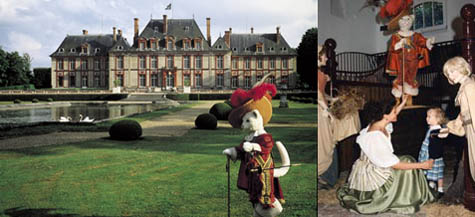
However, my wife and I were both stunned and slightly amused to discover that those fictional creations have now “taken up residence in the Château de Breteuil,” as the website explains. “They enliven the stables, the fruit storeroom, the washhouse and all the other places which still illustrate the daily life of times gone by.”
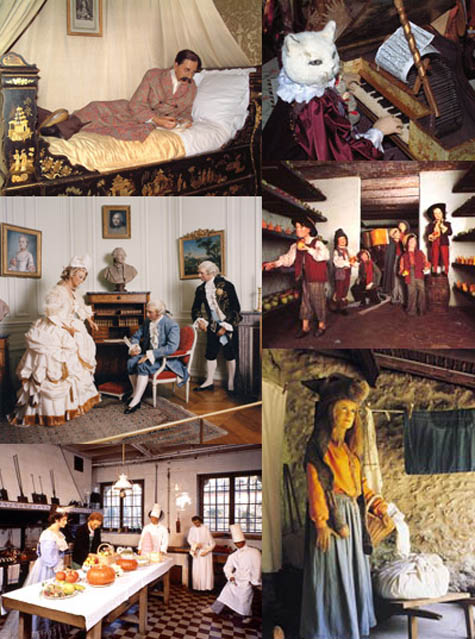
What this means on a practical level is that the building is full of facially realistic wax statues and animatronic stand-ins, representational surrogates that now and forever act out scenes both from Perrault’s fictional tales and from the de Breteuil’s own family history.

[Image: The wax stand-ins of Château de Breteuil; in the upper left corner is Marcel Proust].

As the de Breteuils themselves explain, you will “learn a lot of things about the life of our ancestors” through your encounter with these family doubles – and, perhaps best of all, “you will see a bathroom such as you have never seen before.”
I want to add very quickly that our hosts were both personable and gracious, and this perhaps explains why I didn’t post about the experience at the time; but it has also grown no less surreal with age. It also seems possible now to highlight the utter strangeness of this place, and its very particular mnemonic agenda, without belittling the residents.
But it was very strange.

[Image: Puss in Boots stands before the Château de Breteuil].

For instance, in a detail that would sound made up under any other circumstances, Henri de Breteuil, a late 19th-century scion of the blood line, personally “provided the inspiration for French writer Marcel Proust’s character Hannibal Breaute who bears the same initials ‘HB’.”
There is thus a wax statue of Marcel Proust – that arch-memorist whose entire literary career was an act of recollection, bringing radiant history back to the murky surface of the present – reclining on a day bed, preserved in one of the home’s many sunlit chambers.
If you go back two images in this post, Proust is the mustachioed man in the upper left corner. He lies there everyday, representing himself.
There are so many layers of memory, inheritance, and psychoanalytic attachment going on here that it seems almost impossible to articulate. What would Jonah Lehrer make of such a place, I wonder – or, for that matter, Sigmund Freud?
This strange hybridizing of family history with characters from classical fairy tales seems like a deliberate “use of enchantment,” as Bruno Bettelheim might say – mythologizing one’s own genetic lineage even as it makes explicit the narrative and psychoanalytic power of those increasingly distant ancestors.
You live in a mansion full of animated statuary – where those statues are the people who created you.
In some ways, though, I also had the distinct feeling that I had stepped into a variant screenplay for Blade Runner, as directed by Stanley Kubrick: Blade Runner‘s wounded maker of surrogates incorrectly edited into the penultimate scene from 2001, in which astronaut Dave Bowman awakens to a bedroom full of Louis XVI furnishings, with all of his friends and family transformed into mythic wax figures and talking machines.

Earthquakes on Street View

[Image: A 5.0 earthquake his Los Angeles less than an hour ago – and the epicenter can be seen on Google Street View].

A 5.0 4.7 earthquake hit Los Angeles less than an hour ago – and, aside from the fact that it was remarkably close to my old neighborhood and I hope no one was injured, it seems to be the first earthquake I know of where you can see the epicenter on Google Street View.

[Image: The semi-suburban origins of a seismic event].

The U.S. Geological Service gives us a Google Maps option for viewing tonight’s earthquake reports, but what’s extraordinary is that you can zoom all the way down to the urban surface to see that this earthquake actually had an address: it was epicentered at 3706 W. 106th Street.
Perhaps you could even send it postcards.
Imagine, though, owning the building centered directly over the earthquake that destroys your whole city… And imagine the weird derived value such a property might hold in the future for disaster enthusiasts.
You go to purchase a small house at 3706 W. 106th Street in Los Angeles – only to find that you’ve been outbid, by several orders of magnitude, approaching $50 million, by an earthquake enthusiast in Japan. He or she has gone around the world purchasing epicenters, strange plots of land in the middle of nowhere that have no apparent use or distinction other than that they figure into the unfolding seismic history of our planet’s surface.
It’s an otherwise unknown subculture that has remained camouflaged within the international property market.

The Enemy by Design

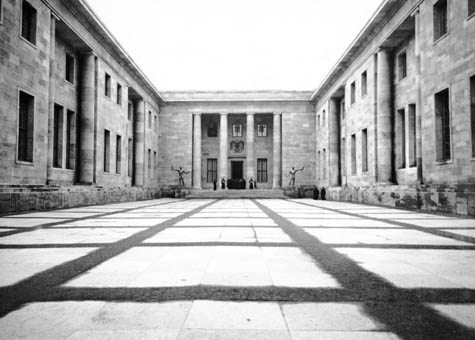
[Image: The Berlin Reich Chancellery, designed by Albert Speer].

Jim Rossignol’s recent guest post about the architecture of “evil lairs” reminded me of a brilliant vignette from Deyan Sudjic’s 2005 book The Edifice Complex.
In a chapter called “The Long March to the Leader’s Desk” – a virtuoso example of architectural writing, and easily the best chapter in the book – Sudjic describes how Emil Hácha, Prime Minister of what was then Czechoslovakia, came to visit Adolf Hitler in his Albert Speer-designed Reich Chancellery in Berlin.
The Chancellery – Hitler’s “evil lair,” if you will – proved so psychologically overpowering that Hácha, “a short man in his late sixties with thinning and receding hair,” according to Sudjic, suffered a heart attack and very nearly died after walking through it.

[Image: Hitler’s office in the Chancellery].

Quoting Sudjic at length:

Hácha was white faced, anxious, and dizzy as he made his way across the entrance lobby, completed just eight weeks earlier. He was exactly the kind of visitor the Chancellery was designed for. If ever architecture had been intended for use as a weapon of war, it was here. The grandeur of the Chancellery was an essential part of Hitler’s campaign to browbeat Hácha into surrender. Beyond the courtyard, itself a kind of summation of the Nazi state, was an elaborate sequence of spaces inside the Chancellery, carefully orchestrated to deliver official visitors to Hitler’s presence in a suitably intimidated frame of mind. After a quarter-mile walk, visitors were left in no doubt of the power of the new Germany.

Indeed, Sudjic suggests that Hácha experienced the building “like a spelunker, moving from one giant underground cavern to another, never sure exactly where he would find himself, or what he would have to confront next, as an intimidating and bewildering sequence of spaces unfolded in front of him.”

Past the chancellery guards and out of the way of the floodlights, [Hácha was led] across the porch and into a windowless hall beyond, its wall inlaid with the pagan imagery of mosaic eagles grasping burning torches garlanded with oak leaves, its floors slippery with marble. There was no furniture, nor even a trace of carpet to soften the severity of the hall. (…) Under the hovering glass and the massive marble walls, the bronze doors at the far end of the hall shimmered and beckoned and threatened. Visitors were propelled down its length as if being whirled through a wind tunnel. As Hácha walked, he was aware of his heart accelerating in rapid fluctuating beats.

At this point, Hitler’s Chancellery begins to sound like the boss level of a particularly unnerving video game:

The hall that they walked through was thirty feet high. On the left a parade of windows looked out over Voss Strasse, and on the right were five giant doorways, each seventeen feet high. They stopped at the central pair of double doors, guarded by two more SS men in steel helmets. On a bronze scroll above the door case were the initials AH.

Even here, at the very door to Hitler’s study, Speer’s spatial theatrics weren’t finished.
Passing through those gigantic doors, Hácha found himself standing at one end of a 4000-square-foot room, surrounded by “blood-red marble walls.” At the other end, in front of a fireplace, was “a sofa as big as a lifeboat, occupied by Joseph Goebbels and Hermann Göring” – and nearby was Hitler, seated at his desk.
Incredibly, “To walk from the door to the desk took a nerve-wracking full minute.”
By that point, though, Czechoslovakia’s fate was sealed: Hácha’s will collapsed as soon as Göring began to describe the Nazis’ military capabilities, and he suffered a heart attack.
Not before signing his country over to Hitler, of course – “a humiliation that he had ample time to reflect on,” Sudjic writes, “during his endless walk back through the marble and mosaic halls of the Chancellery.”

Evil Lair: On the Architecture of the Enemy in Videogame Worlds

[Note: This is a guest post by Jim Rossignol].

Game developers are unconstrained in their designs for the enemy. Such designers will be punished with poor sales, not death in the gulag, if their designs for the overlord are unpopular. They could go anywhere with the homes of evildoers: halls of electric fluorescence, palaces carved from corduroy, suburban back yards.

And yet, in spite of this freedom, most videogame designers choose to make a definite connection to familiar – or real-world – architecture. Perhaps they think that the evil lair must emanate evil. There’s surely no room for ambiguity with videogame evildoers: the gamer needs to know that it’s okay to aim for hi-score vengeance.

[Image: From World of Warcraft].

Conveniently, evil already has a visual language. Put another way: I have seen the face of evil, and it is a caricature of gothic construction. There’s barely a necromancer in existence whose dark citadel doesn’t in some way reflect real-world Romanian landmarks, such as Hunyad or Bran Castle. The visual theme of these games is so heavily dependent on previously pillaged artistic ideas from Dungeons & Dragons and Tolkien that evil ambiance is delivered by shorthand. (Of course, World of Warcraft‘s Lich King gets a Stone UFO to fly around in – but it’s still the same old prefab pseudo-Medieval schtick inside). Where the enemy is extra-terrestrial, HR Giger‘s influence is probably going to be felt instead.

[Images: (top) Bran Castle, (bottom) Hunyad Castle, all via Wikipedia].

But, I suspect, these signposts – or the ways in which game designers architecturally represent evil – are becoming too much a part of our everyday imaginative discourse to remain affecting. They’ve begun to lose their danger. The connection with the inhumanity that makes the enemy so thrilling has started to fade via over-familiarity.

Where the evil lair becomes a little more interesting is when its nature is ambiguous – but nevertheless disturbing. Half-Life 2‘s Citadel is an example of this. The brutal gunmetal skyscraper that looms over a nameless Eastern European city, below, appears deeply threatening. But, like everything else in the Half-Life 2 universe, it is unexplained. It does not seem inherently evil. The structure moves and groans; it is a machine of some kind. It is something constructed and mechanical, rather than the clear manifestation or emanation of an evil force. The Citadel is not a fire-rimmed portal to hell, nor a windswept ruin. Nor is it a volcano base. It could even be somehow utilitarian. In fact, it’s reminiscent of the real Moscow’s own television tower.

It is, perhaps, even incidental to the scourge that Half-Life‘s denizens face: alien infrastructure. It is only later, as the plot uncoils the inner architecture of the Citadel, that you come to realise that it is the enemy: the lair of an alien force that must, ultimately, be destroyed.

[Image: From Half-Life 2].

Where the lair is itself the enemy, games are able to excel.

This is the case in both System Shock and System Shock 2, the finest of SF horror games. Both are set aboard spacecraft, but these spacecraft are also the “bodies” of the enemy: SHODAN, a malevolent Artificial Intelligence that controls each vessel.

In a provocative climax of virtuality-within-virtuality, the final act of System Shock 2 is to enter into the cyberspace realm of the AI and defeat SHODAN inside the graphical representation of her own programming. The evil lair is within the mind of the enemy – a motif repeated even more literally in Psychonauts, a game about exploring the physically manifested psyches of various bizarre characters.

[Image: From System Shock 2].

More interesting visually, and far more ambiguous in its delivery of the evil lair, is the underwater city of Rapture, in Bioshock. The designers of this game (some of whom also worked on the System Shock series) poured the early part of the twentieth century into their designs, creating opulent, decaying, Art Deco corridors down which the genetically-enhanced super-human player goes thundering, searching for the enemy.

The ostentation of the city’s innards suggests that the city’s objectivist overseer, Andrew Ryan, must be the enemy we seek. He has, after all, created himself an entire city with a single, over-arching theme: a trademark act of the all-powerful videogame nemesis. Yet, as the story unfolds, it becomes clear that, although you will inevitably kill Ryan, his architecture tells you nothing about the nature of the enemy you face. Indeed, the true enemy has nothing to do with the stylised nature of this lair at all.

[Image: Channeling Ayn Rand, Andrew Ryan’s city banner announces “No Gods or Kings. Only Man.” From Bioshock].

But perhaps the most extraordinary and unearthly of evil videogame architectures are the wandering colossi of Shadow of the Colossus. Great, living structures, lonely behemoths, that stride magnificently across the game world. These sad, shaggy giants of stone and moss must be climbed and slain by the hero, often via use of the surrounding environment of ancient ruins and meticulously designed geological formations. Lairs within lairs.

[Image: From Shadow of the Colossus].

Of course, monsters are presumably evil, but the reality of the colossi remains ambiguous for much of the game. When the game is up, the player-character suffers a terrible price for destroying these strange, animate monuments. It is one of the few videogames in which the protagonist dies – horribly and permanently – when the game is over. It is a game where destroying the evil lair might well have been the wrong thing to do. And yet it is all you can do.

Such is the inexorable, linear fate of the videogame avatar.

[Jim Rossignol is a games critic for Offworld, an editor at Rock, Paper, Shotgun, and the author of the fantastic This Gaming Life: Travels in Three Cities. A full-length interview with Rossignol will appear on BLDGBLOG next week].
Infantospatialism, or: adventures in crib design

A new installation at MASS MoCA brings experimental architecture, avant-garde spatiality, and oddly structured dream narratives to kids.

[Image: CRIBS by Matt Bua, as photographed by Kevin Kennefick for MASS MoCA].

CRIBS by Matt Bua is a “Kidpspace exhibition” at this sprawling, industrial-warehouse-turned-modern-art-museum in northwestern Massachusetts.
While CRIBS itself features “an overloaded crib complete with hanging mobiles, recorded ‘lullabies,’ and the bars that keep the infant safe,” the exhibition’s second part, …To CRIBBAGE, is a kind of spatial escape act: the crib has come alive and is climbing out a nearby window: “To escape the chaos of the cluttered future that encroaches on it, the crib must breech the gallery walls, pouring itself down on the museum’s entrance below.”
Child-sized visitors can, in turn, crawl inside it: “This piece of crib can be entered outside the museum to experience the collaborative ‘building game’ Bua calls Architectural Cribbage, a game in which he encourages others to start constructing their own small-scale visionary spaces.”
The dinosaur spine-like spaces created by this apparently sentient crib-structure – it’s Lebbeus Woods meets Lincoln Logs by way of vertebrate biology – would seem rather nightmarish from a child’s perspective, I’d imagine, but there’s also a spatial honesty to that. After all, one of the earliest architectural spaces that a modern human being experiences is a small, enclosed space, locked behind bars – so cribs aren’t necessarily reassuringly womb-like environments.
In fact, I don’t mean to show up 100 years late to the child-rearing game here, but surely there has been some architectural writing about the formative psychological influence that such cribs might have?
At the very least, this sounds like an amazing article for Volume magazine: Jeffrey Inaba and Benedict Clouette visit the world’s largest crib designers and manufacturers – in Holland, the States, Canada, Japan – and, amidst on-the-spot New Yorker-style reportage direct from the factory floors (the milling machines, the workers, the design team and their tables full of Macs), they show multiple photographs of different crib spaces. Dimension, color, material choice, layout. It’s the crib as primordial space research.
Pair this, then, with a series of short interviews with development psychologists – and even neurophysicians who have taken research into spatial perception and the infant brain into uncharted realms – and you’re talking National Magazine Award, baby! Damn. I’d read that.
Matt Bua’s CRIBS is on display at MASS MoCA till September 7, 2009.

Landscape Deflation Exercises

[Image: A stunning and very nearly unbelievable glimpse of land subsidence in California’s agricultural heartland; image courtesy of the U.S. Geological Service. “Signs show approximate land levels over the years,” we read at the New York Times. “Groundwater pumping has caused some areas to sink 50 feet.” Now do this as a landscape design exercise: selective deflation of the earth’s surface. Create domes and valleys, sunken gardens that dimple the earth from below.].

Simulant Youth

[Image: Youth storm a building; photo by Todd Krainin for the New York Times. The rest of Krainin’s slideshow should not be missed].

The Boy Scouts of America apparently have a youth anti-terrorism training program here in California, partially dedicated to simulated border patrol exercises.
“The Explorers program,” as it’s called, “a coeducational affiliate of the Boy Scouts of America that began 60 years ago, is training thousands of young people in skills used to confront terrorism, illegal immigration and escalating border violence – an intense ratcheting up of one of the group’s longtime missions to prepare youths for more traditional jobs as police officers and firefighters.”
This training, we read courtesy of The New York Times, “can involve chasing down illegal border crossers as well as more dangerous situations that include facing down terrorists and taking out ‘active shooters,’ like those who bring gunfire and death to college campuses.” The kids, toting compressed air guns styled to look like heavy weaponry, even once “raided” a simulated marijuana-growing operation. “I like shooting them,” a 16-year old Scout named Cathy Noriega said, referring to said guns. “I like the sound they make. It gets me excited.”
These and other replicant crime scenes spill out across private backyards temporarily donated for the purpose of youth-officer training. This deliberately militarized new spatial order of well-run simulations – including “building[s] rigged with tripwire, alarms and ‘poison’ gas” – seems to fall somewhere between immersive game, after-school program, sports training, and indoctrination exercise.
The slideshow is worth a view.

Early Man Site

One of the more unique road signs you’ll see between L.A. and Las Vegas is one that announces the nearby presence of an “Early Man Site.”

[Image: The excavation pit at Calico; photo by D. Griffin].

“One of the most controversial archaeological sites in the Western Hemisphere,” we read, courtesy of the Calico Early Man Site website, “is located in the Mojave Desert of California, near the town of Barstow. The site, in low hills east of the Calico Mountains, displays evidence for the presence of tool-making humans in the Americas some 200,000 years ago, far earlier than any Western Hemisphere site that has been accepted by the majority of the archaeological community.”
Though no human remains have ever been found there, and the stone tools themselves are suspiciously rocklike, “It is hoped that [the region] may someday reveal early human remains, becoming America’s Olduvai Gorge.”
“The history of this site dates back to 1942,” the Bureau of Land Management explains, “when amateur archaeologists discovered what they believed to be primitive stone tools in this area. Fragments were embedded in the sediments of the shoreline of an ancient Pleistocene Era lake, called Lake Manix.”
Incredibly, famed anthropologist Louis Leakey once worked at the site – though his wife, Mary, was apparently so unconvinced by its early dating that she tried to prevent Louis’s excavations at Calico from being published.

[Image: A Calico Cutter – but is it a rock or a shaped tool?].

The phrase “Early Man Site,” in and of itself, also interests me, in all of its politically incorrect self-assuredness. There appears to be only one other “official” Early Man Site in the world, and that’s a UNESCO World Heritage Site in Indonesia. Aside from these two places, the phrase is simply used as a descriptive term for definable areas of prehistoric anthropological settlement.
But the seeming incongruity – the quasi-Ballardian nature – of seeing an Early Man Site so close to the American highway system (between L.A. and Vegas, no less) would not sound real if you had invented it.
Looking into this strange coincidence of American roadworks and ancient humanity further, I soon discovered that Caltrans – the California Department of Transportation – actually maintains a series of ongoing archaeological projects, including an official Archaeology Branch. They study landscape phenomena such as “the ruins of linear structures” (i.e. “road ruins”).
There is even a Caltrans guide for how to identify a prehistoric site.

San Francisco As It Used To Be

[Image: The astonishingly far inland dune-sea at 16th Avenue and Strawberry Hill in San Francisco, approximately 109 years ago, before being engridded and buried by homes (via); this seems to give an interestingly San Franciscan spin to the old, May ’68 idea that, beneath our streets and paving stones, we will find the beach (or the desert, as the case may be)].