IceLink / Land Bridge / Yesterday

[Image: From “IceLink: Occupying the Temporal Seam” by Lateral Office].

In their submission to the recent competition to design a bridge across the Bering Strait – the Bering Strait Connection – Toronto’s Lateral Office proposed “IceLink: Occupying the Temporal Seam.”
Lateral Office, of course, are also the brains behind the excellent blog InfraNet Lab, as well as the designers of both the Air Unit and the awesome Runways to Greenways plan proposed for Iceland – and IceLink is no less interesting than either of those.

[Image: From IceLink by Lateral Office].

First, for those of you who did not see the original call for projects, the Bering Strait Connection described itself as a “project attempting to connect two continents”:

In a wide sense, it includes building a tunnel or a bridge at both ends of the strait, extending [the] existing railways of the United States and Russia, and laying a world highway around the coasts of the world, which requires a massive amount of construction.

Architects were asked to design “a peace park with a bridging structure using the two islands, Big Diomede and Little Diomede at the Bering Strait,” and a “proposal of how to connect two continents.”

[Image: From IceLink by Lateral Office].

In response to this, then, Lateral proposed: “1) a tunnel/bridge hybrid that runs along the international date line and accumulates diplomatic programs, and 2) a seasonal ice park that harvests ice floes into a global water vault.”
A global water vault: it’s ideas like this that make me love architecture.

[Image: From IceLink by Lateral Office].

So the site, of course, would straddle two very different timezones: that is, both today and tomorrow (or today and yesterday). If I wasn’t living in a temporary apartment right now, and thus without access to my books, I would quote from Umberto Eco’s intellectually pessimistic novel The Island of the Day Before. There, we read how a shipwrecked scientist repeatedly fails to come to grips with the temporal (and epistemological) fact of his maritime abandonment along the international date line.
But, perhaps to the benefit of my readers, I can’t.
Instead, let me also mention The Cryptographer, a novel by Tobias Hill. While it would be hard actually to recommend the book, it’s nonetheless worth mentioning Hill’s use of the international date line as an origin point for a currency-destroying computer virus: the Date Line Virus. Hill’s Date Line Virus spreads westward with the ticking of the clock – or the turning of the earth – erasing digital savings and scrambling all systems of measured economic value.
That is, the world’s entirely computer-based monetary system, hour by hour, goes mad.
Clearly, then, from even only these two examples, the narrative possibilities – and intellectual stakes – of the international date line are fairly interesting to draw on. Or, for instance, check out this factoid, from that well-known source of scientific accuracy, Wikipedia:

For two hours every day, at UTC 10:00–11:59, there are actually three different days observed at the same time. At UTC time Thursday 10:15, for example, it is Wednesday 23:15 in Samoa, which is eleven hours behind UTC, and it is Friday 00:15 in Kiritimati (separated from Samoa by the IDL), which is fourteen hours ahead of UTC. For the first hour (UTC 10:00–10:59), this phenomenon affects inhabited territories, whereas during the second hour (UTC 11:00–11:59) it only affects an uninhabited maritime time zone twelve hours behind UTC.

For two hours, in other words, there are three different days happening on the earth simultaneously.
But what about the spatial possibilities of the international date line?
How can this strange temporal fissure in the planet’s political and cultural landscape be taken advantage of architecturally?

[Image: From IceLink by Lateral Office].

IceLink, its designers write, without much surprise, “seeks to capitalize and highlight [the Strait’s] unique geography, climate, and context.” However, they add, “The intent here is less to impose a new landscape in this context than to emphasize the sublime conditions already existing. Currently, the Bering Strait is a seasonal barometer of the impacts of climate change. The intent with this scheme is to offer spaces with which to reflect on the correlation between natural environments and their occupation.”
This is where we come to the project’s “two primary infrastructural elements: a tunnel-bridge link and an ice park.”

[Image: From IceLink by Lateral Office].

The so-called “Bering Link” half of the project would consist of “bundled infrastructures,” the architects explain; these infrastructures would span a distance of 85km, from Dezhnev, Russia, to Wales, Alaska. In the process, the Bering Link would skirt the Diomede islands, and even travel north-south atop the date line for 4km.
Alongside this would be a series of new buildings, “concurrent with the international date line.”

Public and cultural programs intermittently rise above the bridge while research and education programs hang below the rail/road. Significant programs include a new United Nations headquarters, World Water Council headquarters, an Arctic Museum, and extensive oceanographic and meteorological facilities.

It’s a little hard to believe that the United Nations would move its headquarters to the middle of the Bering Strait – after all, thriller-reading Christians know that they’ll soon be moving it to Baghdad – but it’s a pretty ingenious move to put the World Water Council headquarters out there.
Why?
Here we come to the second half of Lateral’s project: the “Bering Ice Park,” a kind of floating archive and index of global climate change:

Sea ice is often trapped between the Diomedes prior to drifting northward. The new park seeks to enhance and highlight this phenomenon. The Bering Ice Park will cultivate, collect and distribute ice floes. The extent of the park is defined by the Diomedes coastlines facing the international border and date line as well as natural ocean currents movement north.

I’m reminded of BLDGBLOG’s earlier look this month at the terroir of drinking water, in a guest post by Nicola Twilley: might specially cultivated Date Line Water™ from Lateral’s Bering Ice Park someday arrive on the tables of high-end restaurants the world over?
As it happens: no. The project described here did not manage to find a place amongst the finalists of the design competition.
To see what did make the cut, take a look at the results over at Bustler.
Bloomsday

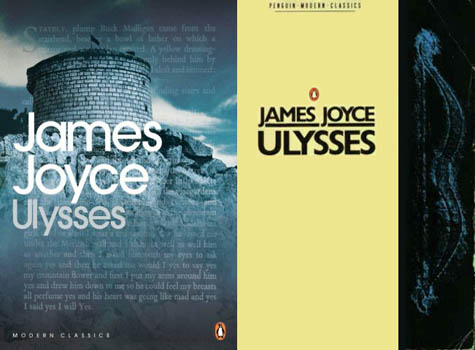
Yesterday, as James Joyce fans will know, was Bloomsday: June 16th. The day Leopold Bloom made his famous walk around Dublin in Joyce’s 1922 novel Ulysses.

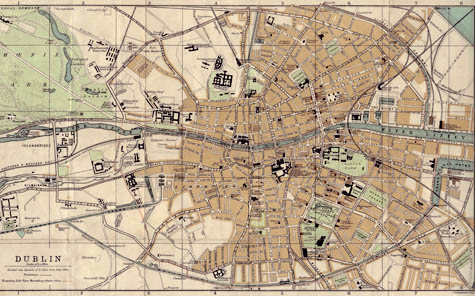
[Image: Street map of Dublin].

Ulysses – considered something of the ultimate in literary modernism, as much for its mythical remaking of everyday life as for its often impenetrable abstraction, presaging Joyce’s later linguistic kaleidoscope, Finnegan’s Wake – was, for me, utterly transformed when my brother suggested that it was actually an attempt at descriptive realism.
That is, should you want to describe a man’s walk around the city in as detailed and realistic a way as possible, capturing every minor event and instant, then you would have to include the circumstances of that walk in their often bewildering totality: every fragmentary thought process, directionless flight of fancy, and irrelevant detail noticed along the way, via a million and one dead-ends. Things remembered and then forgotten. Deja vu.
That daydream you had early today? That was, Ulysses suggests, part of the infrastructure of the city you live in.
The city here becomes a kind of experiential labyrinth: it is something you walk through, certainly, but it is also something that rears up mythically to consume the thoughts of everyone residing within it.
To say that Ulysses, then, is one of the most realistic urban novels ever written surely sounds like a joke to anyone not connected to academia – yet, once the apparent absurdity of such a statement wears off, it seems utterly ingenious.
After all, how do you map the city down to its every last conceivable detail? And what if cartography is not the most appropriate tool to use?
What if narrative – endlessly diverting narrative, latching onto distractions in every passing window and side-street, with no possible conversation or observation omitted – is the best way to diagram the urban world?
In such a constellated wealth of minor points, “realism” becomes a useless haze – like listening to every conversation at a party simultaneously. And that’s before you add internal monologues and descriptive details from the pubs and sidewalks all around you.
In any case, there are many secondary points to make here. For instance, I’d actually suggest that the narrative position just outlined actually describes not a person at all but a surveillance camera – that is, the Ulysses of the 21st century would actually be produced via CCTV: it would be Total Information Awareness in narrative form.

But the whole point of this post was actually to ask two things:
1) What if Ulysses had been written before the construction of Dublin? That is, what if Dublin did not, in fact, precede and inspire Joyce’s novel, but the city had, itself, actually been derived from Joyce’s book?
At the very least, this would be an awesome proposition for a design studio: read Ulysses and then design the city it describes… The differing responses would be fascinating.
Further, this raises the question of whether a city has ever been built, directly inspired by a work of fiction. Of course, you could stretch the term fiction a bit, and say that those fundamental fictions of a nation’s founding myths might have inspired a city – or an historic preservation district – or perhaps you could even say, as if channeling Michael Sorkin, that the city’s zoning code is itself a monumental act of narrative modernism.
But what about an actual novel? If you can take, say, Moonraker by Ian Fleming and turn it into a film – that is, Moonraker, directed by Lewis Gilbert – then could you also take a novel – here, Ulysses – and turn it into a city?

2) If you fed Ulysses into a milling machine – that is, if you input not a CAD file but a massive Microsoft Word document containing the complete text of Ulysses – what might be the spatial result? Would the streets and pubs and bedrooms and stairwells of Dublin be milled from a single block of wood?
What if you fed Ulysses through a 3D printer?
Oddly, I’m reminded here of something that has long fascinated me: quipu, the so-called knot language of the Inca. Quipu, to make a very long story short, is a way of braiding strands of animal hair or colored yarn together, using specific types of knot; these knots, arrayed in specific orders, thus communicate things to others – whether that’s accounting information or perhaps even cultural myths.
It was a form of writing, in other words, although its words were 3D shapes.
As a brief aside, the possible paranoias of a quipu translator have always seemed particularly stunning to me: for instance, someone over-immersed in the world of Andean knot-languages becomes convinced that, in the drooping symmetry of a basketball net or in the shoelaces of strangers walking past on the street, there might be written messages: epic poems, secret codes, unintended diary entries.
Instead of Freudian dream-analysis, you perform quipu knot-analysis, even examining the micro-fibers of strangers’ clothing for hidden meanings… (It’s worth mentioning that this exact idea actually appears in the unwatchably annoying film Wanted).
In any case, I mention quipu here because I can’t even believe how cool it would be if 3D printers might someday be used to create word-objects: little amorphous and abstract three-dimensional shapes that aren’t just works of art, they are a new form of writing.
Like quipu, they are 3D linguistics: words in space.
The idea here that all those high-end design items you see lining the shelves of boutique shops in downtown Milan or Moscow or Manhattan are actually strange new, highly literal forms of communication, makes the mind reel.
Spy films of the future! MI6’s man in Havana goes into a specialty cookware shop where the salt and pepper shakers are not at all what they seem…
Or, inspired by Alfred Hitchcock, the FBI begins leaving little figurines in empty hotel rooms, knowing that the next guest will be an undercover informer – and those abstract statuettes left behind in the cupboard actually encode the next location of rendezvous…
And so on.
So the point of this long tangent is this: if you fed Ulysses through a 3D printer, what might the resulting shapes be?
What if the unexpected blobs and shapes could be considered a translation of the novel?

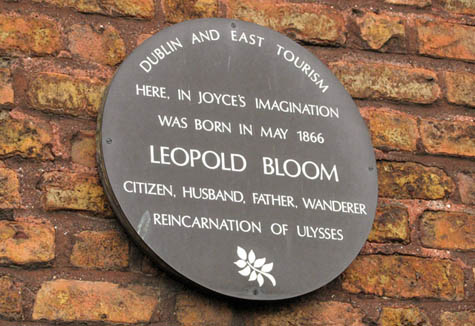
[Image: Historical maker for the birthplace of Leopold Bloom in Dublin].

Inspired by Bloomsday, then, it seems well-timed to ask not only how our cities can best be mapped – and if narrative is, in fact, the ideal cartographic strategy – but what other physical possibilities exist for narrative expression. Put another way: what if James Joyce had been raised in an era of cheap 3D printers?
After all, given the possibilities outlined above, we might even someday be justified in concluding that Dublin itself is a written text, and that Ulysses is simply its most famous translation.

A Parking Lot to Last 16,000 Years

Perhaps proof that J.G. Ballard didn’t really die, he simply took an engineering job at MIT, scientists at that venerable Massachusetts institution have designed a new concrete that will last 16,000 years.

Called ultra-high-density concrete, or UHD, the material has so far proven rather strikingly resistant to deformation on the nano-scale – to what is commonly referred to as “creep.”

This has the (under other circumstances, quite alarming) effect that “a containment vessel for nuclear waste built to last 100 years with today’s concrete could last up to 16,000 years if made with an ultra-high-density (UHD) concrete.” (Emphasis added).

So how long until we start building multistory car parks with this stuff? 16,000 years from now, architecture bloggers camped out for the summer in rented apartments in Houston – the new Rome – get to visit the still-standing remains of abandoned airfields, dead colosseums, and triumphal arches that once held highway flyovers?

16,000 years’ worth of parking lots. 16,000 years’ worth of building foundations. Perhaps this simply means that we’re one step closer to mastering urban fossilization.

(Thanks, Mike R.!)

#skyfail

Like an inversion of J.G. Ballard’s first novel, The Wind From Nowhere – in which winds blow to hurricane strength around the world, flattening cities, decimating civilization, and making readers wonder why the book wasn’t simply written as a short story – it seems that winds across the continental U.S. are slowing down.

[Images: Three covers from J.G. Ballard’s first novel, The Wind From Nowhere: “London and New York reduced to rubble,” the cover on the right side reads, “as nature goes mad”].

As The New York Times reports, “wind speeds in the United States have dropped 15 to 30 percent over the course of about 30 years.” There is absolutely no reason to assume that this trend will continue at the same pace – but, should it, the winds of America would come to a stand-still within just four or five generations.
One of the suspected reasons behind this atmospheric deceleration is climate change, the NYT explains:

As polar regions warm faster than the Equator… the temperature difference between them – and the pressure differential – shrinks. And, lower pressure differences mean slower winds.

Of course, it shouldn’t be surprising, meanwhile, that, “in scattered pockets of the country, wind speeds have risen.” These sorts of changes are rarely homogenous: a cooling trend in one spot is matched by a warming trend in another; the death of breezes in one location is counteracted by increased number of hurricanes elsewhere.
Nonetheless, how interesting to speculate what might happen if the atmosphere gradually did fail, falling still, forming the aerial equivalent of a glacier: hazy and unmoving, polluted and heavy, a kind of anti-hurricane with no less deadly effects in the long term. Certain plants would no longer pollinate. International travel, by both sea and air, would become unpredictable. The use of fossil fuels would skyrocket.
I do wonder, then, if Ballard, given another few years in which to write, might have tried out this kind of anti-storm scenario, describing a world without aerial movement. The death of the sky.

Building Storm

Adventures in home foreclosure continue: empty homes in the U.S. hurricane belt run the risk of becoming “wind-propelled debris.”

As the Associated Press reports, “communities at the epicenter of the nation’s housing crisis are coming to realize that this year’s hurricane season, which began this month, represents yet another pitfall.” In other words, “hurricanes could make hazards of thousands of foreclosed-upon houses” – turning those homes into airborne projectiles. Building-storms.

After all, the AP asks, “who will secure all the foreclosed homes if a storm does approach?”

It must be an eery feeling, I’d suspect, when you realize that all those empty houses sitting around you might someday be weaponized: latent storms of wood and vinyl siding just waiting for the moment when they can pick up and whirl through the streets, like something out of Transformers 3.

But do you tear the houses down in advance of a storm that might never arrive? Or do you surround your own home with vast nets and deflection shields for protection against inevitable debris?

Ironically, as Steve Silberman – who first sent me this link – points out, there is simultaneous interest in using these very foreclosed homes as hurricane shelters. As the Florida Courier points out, this idea, if implemented, would also “address a source of concern among emergency specialists in Florida: the growing number of vacant homes that could be splintered into construction debris by a hurricane if no one secures them with shutters and plywood.”

When the ruins begin to sing

[Images: Three aerial photos of suburban Arizona by Daquella Manera, used through a Creative Commons license].

Malfunctioning fire alarms going off inside foreclosed homes have become a major distraction for fire departments in suburban Arizona, according to ABC15 News.
Fire fighters, however, cannot legally enter a property unless they see smoke or have obtained the owner’s permission. But in an era of bank ownership and rampant foreclosure, even finding the owners can take weeks.
The result is that “neighbors have to listen to the alarm until the battery dies, which can take days.”
First we were surrounded by ruins, and then those ruins began to sing.

(Thanks to Steve Silberman for the link!)

Acqua Veritas

The city of Venice has begun to rebrand its tap water, calling it Acqua Veritas, in an attempt to woo both residents and tourists away from the environmental hazards (and waste collection nightmare) of bottled water.
After all, Italians are “the leading consumers of bottled water in the world,” the New York Times reports, “drinking more than 40 gallons per person annually.” Further, “Venice’s tap water comes from deep underground in the same region as one of Italy’s most popular bottled waters, San Benedetto” – so turning Venetians on to the miracles of the tap (and setting an example for cities elsewhere) is clearly overdue.
However, as we saw earlier on BLDGBLOG, in a guest post by Nicola Twilley, bottled water now sits on the cusp of becoming as pretentious as the wine industry, complete with a developing vocabulary for taste preferences and even an emerging geography of aquatic terroir. In other words, it will be hard to break the Duchampian habit of seeking water in a bottle. Why Duchampian?
Because bottled water is the ultimate readymade object; I’d even suggest that Marcel Duchamp very nearly discovered the bottled water industry when he first captured 50 cc of Paris Air, in an artwork of the same title, back in 1919.

[Image: Marcel Duchamp, 50 cc of Paris Air (1919), courtesy of the Philadelphia Museum of Art].

It’s hard not to wonder what might have happened had Marcel Duchamp been alive just slightly later, and able to exhibit his artwork alongside – or even simply to hang out with – Andy Warhol; combine the readymade object with Warholian mass reproduction, substitute pure glacial water for Paris air, and perhaps today we’d all be drinking L’Eau de Duchamp.
In any case, if cities around the world engaged in marketing campaigns similar to this one in Venice, however tongue-in-cheek it may be, might people finally regain interest in their own municipal water supplies?
Croton Silver: The Taste of Manhattan™.

(Vaguely related: The next bottled water industry? Chinese Air Bars).

Serving Space

Tom Vanderbilt – author of the excellent book Survival City: Adventures Among the Ruins of Atomic America, as well as the recent Traffic, and subject of a short but interesting interview in The BLDGBLOG Book – has a long article out in the The New York Times Magazine about the architecture (and energy implications) of large-scale data centers.
This is the world of “increasingly large, powerful, energy-intensive, always-on and essentially out-of-sight data centers” that now dot the global landscape.
What is this new type of space? “Call it the architecture of search,” Vanderbilt writes: “the tens of thousands of square feet of machinery, humming away 24/7, 365 days a year – often built on, say, a former bean field – that lie behind your Internet queries.”
Such buildings often blend in with the everyday urban landscape. For instance, Vanderbilt describes “NJ2, a data center located in Weehawken, N.J., just through the Lincoln Tunnel from Manhattan.” It is “an unmarked beige complex with smoked windows”; inside it “hum the trading engines of several large financial exchanges.”
The interesting thing here is that the machines stored inside NJ2 are stored there so that they can be as close as possible, geographically, with other machines: the ones that handle trades on Wall Street. Spatial proximity, in this case, cuts down on information-relay time, thus enabling large-scale financial processes to unfold nearly in real-time.
We might say, then, that the built environment you see here – the distances between buildings and their urban or geographical locations – is thus an articulation not of architectural theory or of the stylistic assertions of one particular architect, but of the processing power of today’s supercomputers.
Future changes in processing speed might then ramify outward to further tweak the built environment.
Vanderbilt explains that when the Philadelphia Stock Exchange moved its computers north, into NJ2 – a distance, we read, of 80 miles – they saved three milliseconds on every trade. Lest we laugh that off as the spatial equivalent of obsessive-compulsive disorder, we’re told that “it is estimated that a 100-millisecond delay reduces Amazon’s sales by 1 percent.”
It’s an awesome article – check it out if you get a chance.

Whoever Rules the Sewers Rules the City

UCLA’s cityLAB has launched a new design competition called (somewhat lamely) WPA 2.0, where the WPA refers to the Works Progress Administration. But the competition itself looks cool.
Its tagline? Whoever Rules the Sewers Rules the City.
It’s a call for new visions of urban infrastructure:

We encourage projects that explore the value of infrastructure not only as an engineering endeavor, but as a robust design opportunity to strengthen communities and revitalize cities. Unlike the previous era, the next generation of such projects will require surgical integration into the existing urban fabric, and will work by intentionally linking systems of points, lines and landscapes; hybridizing economies with ecologies; and overlapping architecture with planning.

Sounds good in the abstract, but what are they specifically looking for? Quite a range:

This notion of infrastructural systems is intentionally broad, including but not limited to parks, schools, open space, vehicle storage, sewers, roads, transportation, storm water, waste, food systems, recreation, local economies, “green” infrastructure, fire prevention, markets, landfills, energy-generating facilities, cemeteries, and smart utilities.

Judges include Stan Allen, Cecil Balmond, Elizabeth Diller, Walter Hood, Thom Mayne, and Marilyn Jordan Taylor – two of whom (Allen and Diller) I’m proud to say that I’ve served I’ve been on design juries with in the past.
Here’s the competition brief as a downloadable PDF. Read more at the competition website – and good luck!

The Great Lakes Paleolandscapes Project

[Image: Evidence of an ancient hunting site; photo by John O’Shea, courtesy of ScienceDaily].

In archaeological news, evidence of an ancient human settlement, including “caribou-hunting structures and camps,” has been found deep beneath the waters of Lake Huron.

“More than 100 feet deep in Lake Huron,” ScienceDaily reports, “on a wide stoney ridge that 9,000 years ago was a land bridge, University of Michigan researchers have found the first archaeological evidence of human activity preserved beneath the Great Lakes.”

Of course, this goes rather well with our earlier look at the so-called “Lake Michigan Stonehenge.”

In any case, it sounds like the Great Lakes need their own version of the North Sea Paleolandscapes project, an unbelievably interesting archaeological program, run by the University of Birmingham, that hopes “to rediscover Doggerland, the enigmatic country which once linked the Yorkshire coast with a stretch of Continental Europe from Denmark to Normandy but which now lies beneath the North Sea.”

(Spotted via Archaeology Magazine).

The Hollow Hills

In a quick read through the consistently – and often amazingly – interesting links supplied by Archaeology Magazine, I came across an example of what is easily one of my favorite nonfiction plot twists: someone discovers that what they thought was a natural hill somewhere on their family property is actually an extremely ancient building.
It has an interior, perhaps even underground corridors linking to other, nearby hills.
It is not the surface of the earth, in other words, but a piece of architecture. Your backyard, to this way of thinking, might actually be a roof; you simply have to discover a way inside the building deep below.

[Image: The artificial hill at Cuween, an Orkney burial cairn, perhaps anticipating by thousands of years the architecture of Vicente Guallart; photos by Sigurd Towrie of Orkney Jar].

In this case, we read, a farmer in the Orkney Islands of northwest Scotland, while plowing a relatively untouched field on his family land, uncovered a Neolithic chambered tomb just sitting there beneath the soil.
It was a room – and suddenly he had access to it.
“The structure itself is neat drystone construction,” a local archaeologist explains, and “the wall curves round tightly and is beehived in by corbelling at the top. On the opposite side to the wall is a space topped by lintels, and indeed it was breaking one lintel that caused the site to be found. It’s early days yet, but it may be a Neolithic chambered cairn, some five or six thousand years old.”
Of course, readers of The BLDGBLOG Book, finally published this week in the United States, will recognize this same idea from the beginning of that book’s “Underground” chapter (where the discovery of a tomb now known as Crantit Cairn is described in slightly fictionalized form). The bare bones of that story, however, are worth repeating here: one day, back in 1998, we read, a farmer “decided to plough [his] field in a different direction to normal – a seemingly insignificant decision that led to the discovery of what was hailed as one of ‘the greatest archaeological finds of recent years.'”
Specifically, “While ploughing, the tractor disturbed the roof of the tomb, dislodging a roofing slab. The slab fell to reveal a hole and daylight streamed into the underground chamber for the first time in millennia.”
With today’s penchant for green roofs and other forms of “vegitecture,” one wonders if similar such experiences might become exponentially more common in the distant future; two kids, playing around in the garden, pull a stone up from the flowerbed only to discover that they are standing atop the main gallery of a science museum constructed back in 2009 A.D.
Zork Begins.
In fact, as I mentioned in my lecture at the School of Visual Arts in New York back in April, a similar sort of idea made a cameo appearance in The Day After Tomorrow. There, we watch as Dennis Quaid and his two colleagues are hiking across a rapidly forming glacier – only for one of them to crash through a skylight into the snow-buried mall below.
It was not a glacier at all, in other words, but an unrecognized architectural form.
In any case, perhaps the great human adventure of the year 45,000 A.D. will not be in outer space at all, but a terrifying Dantean super-tour through the deeply buried cities of our present age. People stumble through this seemingly endless underground labyrinth, spanning nearly the whole surface of the globe, utterly unaware of who created these buildings and why.
In this context, old Celtic/Britannic myths of the Hollow Hills take on an especially interesting architectural resonance. I’m yet further reminded of many bunkers in the hills around San Francisco; seen from one side, these buildings appear to be mere mounds covered with gravel and weedy vegetation, like a gently rolling, even bucolic American landscape – but, from the other side, you find that they have heavily rusted metal doors…
The implication here, that you could open a door and walk inside a manmade earth, where the hills around you are actually the roofs of old buildings, will never cease to amaze me.