Subeconomic Space

[Image: Photo by Richard Mosse, from Time magazine].

Photographer Richard Mosse, who BLDGBLOG has interviewed in the past and who is one of many participants in this autumn’s “Landscapes of Quarantine” design studio, has just published a new series of photographs in Time magazine documenting the flow of goods into and out of the Gaza Strip.

This economic flow is literally underground, however, as it passes beneath the supervision of both Israel and Egypt, through a network of often quite sophisticated tunnels; channeled under pressure through tiny pores, it exhibits a surprisingly low viscosity, we might say.

“The tunnels vary in size and scale,” journalist Abigail Hauslohner explains in the accompanying article. “Some are fragile dirt shafts; others feature wide, wood-reinforced passageways.” There are, according to the users and builders of these spaces, “hundreds of tunnels—some weaving right over one another at different depths—that are mostly used to import commercial goods that range from food and baby formula to computers and even cars.” Livestock is frequently herded across the border, through electrically lit tunnels, sometimes uphill.

“Centered around the town of Rafah,” Hauslohner explains, these tunnels “are virtually the only way that goods have reached the residents of the tiny territory since 2002, when Hamas took control of it and Israel imposed a blockade on the its land and sea borders.”

[Image: Flexible infrastructure: “The tunnels’ electric and phone systems are a study in improvisation,” we read; photo by Richard Mosse, from Time magazine].

The required physical infrastructure for these constructions spills out to include “warehouses that sell the tools used to physically shape the tunnel industry: shovels, rope, pulleys and electrical cords, plus pickaxes, hammers, nuts, bolts and screws in all sizes. The industry of making the tunnels is a booming business on its own.”

In the following image we see “tunnel heads,” where the subterranean structures breach the Earth’s surface and allow exit or entry.

[Image: “Dirt from the digging litters the landscape,” Time explains. “The smugglers say that Israel’s blockade gives them no choice. Says one Rafah shopkeeper, ‘Even if Israel destroys all of the tunnels entirely, I’m quite sure that the they will only be dug again and again.'” Photo by Richard Mosse, from Time magazine].

Check out the rest of the photographs over at Time; but be sure to browse through Mosse’s own website for some other, incredible work.

Cities of the CDC

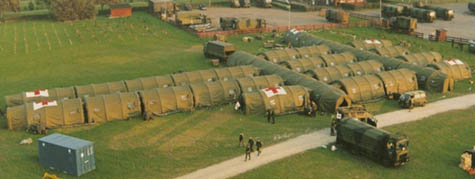
[Image: A mobile, military field hospital and medical instant city].

If you happen to be in Montreal this week, I will be giving a lecture tomorrow night at the Canadian Centre for Architecture. I have to admit to being a long-time fan of the CCA, so it’s quite a thrill to be speaking there. The lecture is free and open to the public, it’s on Thursday, October 22, and it kicks off at 7pm; it’s called “Cities of the CDC.”

For the most part, I’ll be addressing the topics of urban form, epidemic disease, and the spatialization of public health, by way of my recent research into spaces of quarantine.

The point is to look at a number of questions, including: What might have happened, architecturally speaking, if Archigram, when it came time to design their Instant Cities, had teamed up with the CDC?

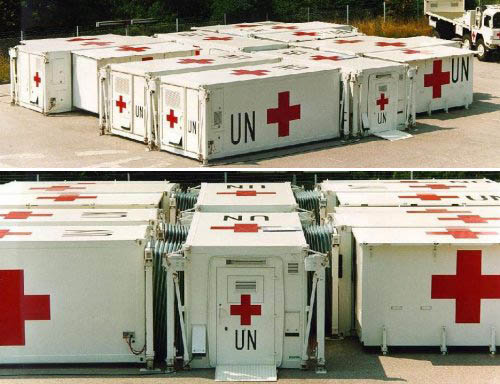
[Image: A modular, “containerized” field hospital complex by the Red Cross and UN].

Put another way, what might have been the result if the CDC had been asked to design a planned city like Masdar, and not Norman Foster? Is there such a thing as a medical utopia? And how do our cities help to shape the diseases that infect us?

Along with this will be some new, previously unpublished material taken from the ongoing series of quarantine interviews that I’ve been doing with Edible Geography.

In any case, if you’re in Montreal tomorrow night, be sure to say hello!

The Emperor’s Castle

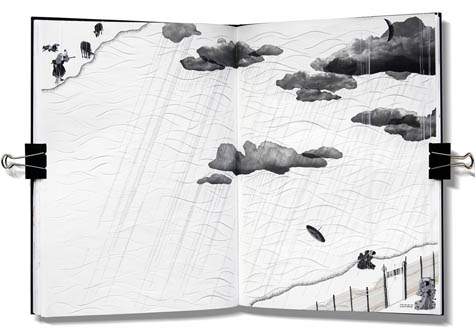
[Image: Image 1, “Eternal Punishment,” from The Emperor’s Castle by Thomas Hillier].

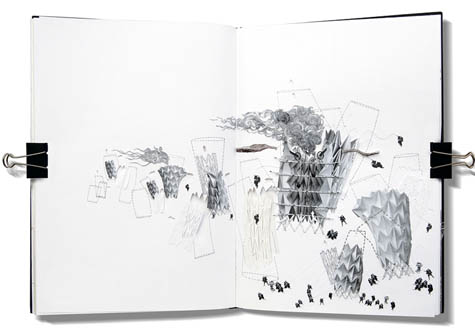
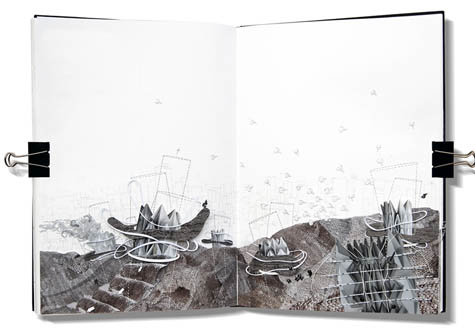
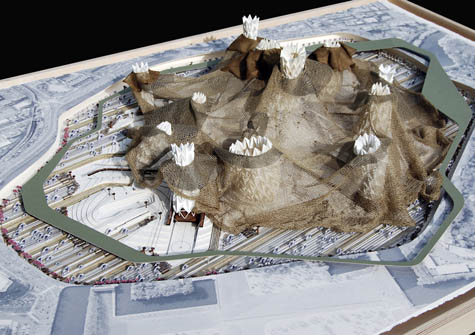
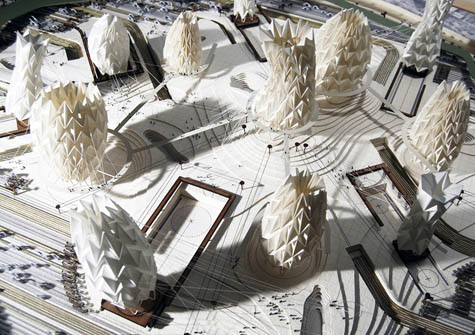
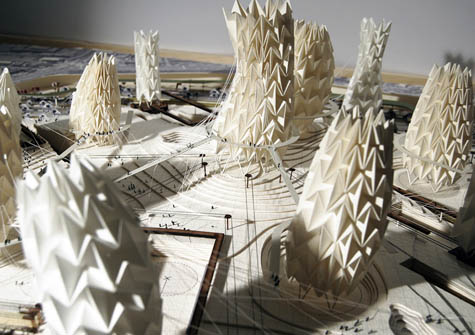
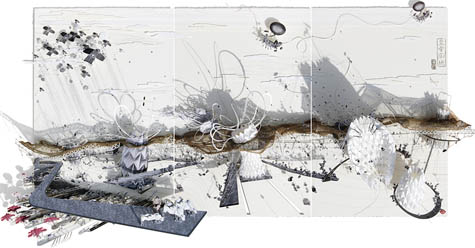
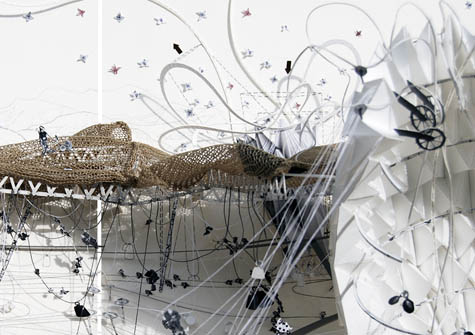
For his student thesis project at the Bartlett School of Architecture, Thomas Hillier produced an immersive narrative world, complete with origami-filled hand-cut book pages and an elaborate model of the story’s architectural landscape. Hillier’s project was called The Emperor’s Castle and it was inspired by the work of Japanese printmaker Hiroshige.

The Emperor’s Castle originates from a mythical and ancient tale hidden within a woodblock landscape scene created by Japanese Ukiyo-e printmaker, Ando Hiroshige. This tale charts the story of two star-crossed lovers, the weaving Princess and the Cowherd, who have been separated by the Princess’s father, the Emperor. These characters have been replaced by architectonic metaphors creating an urban theatre within the grounds of the Imperial Palace in central Tokyo.

The result is astonishing; the images here have been presented in order, so you can follow the flow of the tale, with descriptive text supplied by Hillier. I would advise, however, that you also check out the Flickr set I put together for the project, where much larger versions of these images (and more text) are available.

The first two images, Hillier says, are taken from his “research storybook.” They are hand-cut paper collages, and they show us “two acts from a series of five that illustrate and explore the narrative structure of the tale.” The scenes thus supply “a series of clues, which can inform the future architectural proposition.”

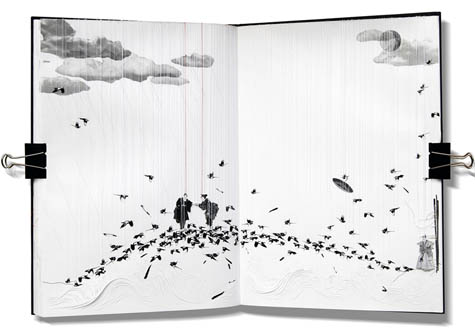
[Image: Image 2, “The Last Meeting,” from The Emperor’s Castle by Thomas Hillier].

As Hillier writes:

Image 1 (Act 3, Eternal Punishment) illustrates the Emperor’s anger over his daughter’s relationship with a cowherd. He separates the couple, placing them back in their original locations. The Emperor wanted to be sure they would never meet again, so he closed the castle and opened the heavens. Rain fell, causing the castle’s moat to flood, creating an island of the castle surrounded by a deep and swift lake unassailable by any man.
Image 2 (Act 5, The Last Meeting). Seeing the sadness of their friend, the Princess, the birds and animals came together to decide how to stop the torrent of her tears. So the sky became black as all the magpies and crows, with their wings spread wide, formed a bridge across the lake. When the Princess realizes what the birds have done, she stops crying and rushes across the feathery bridge to embrace the Cowherd and renew their pledge of eternal love.

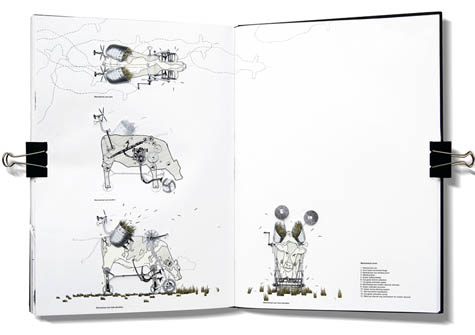
The next three images “are hand-cut exploratory paper collages” illustrating “the architectonic character transition” through which the story’s human figures are transformed into pieces of architecture.

In a way, it’s the Hypnerotomachia Poliphili as retold for Late Edo Japan.

[Images: Image 3, “The Emperor’s Origami Lungs”; Image 4, “The Princess’s Knitted Canopy”; and Image 5, “The Cowherd’s Mechanical Cow-cutters”; from The Emperor’s Castle by Thomas Hillier].

From Hillier’s project text:

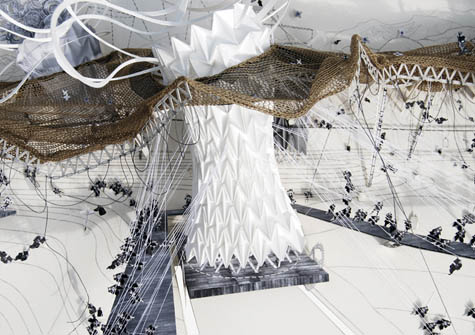
Image 3 (The Emperor’s Origami Lungs). The Emperor’s lungs come alive through differing gestures and surface transformations based on geometrical tessellations adopted from origami crease patterns. The lungs imitate the motion of breathing through expansion and contraction creating a bellowing volume that allows the Emperor to project his emotions both visually and audibly. They rise and fall, creating a bobbing motion, which produces a rippling affect onto the surrounding skin. The severity of these ripples will depend on the anger of the Emperor, and can cause the newly knitted areas of skin to become loose and break, stopping the Princess from ever reaching the cow herder.
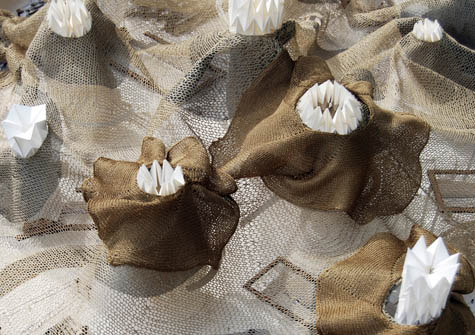
Image 4 (The Princess’s Knitted Canopy). The Princess, a flexible, diaphanous knitted membrane, envelopes the spaces below and is fabricated using the surrounding ‘Igusa’: a natural rush material used in the fabrication of tatami mats. Igusa expels a soothing scent as the skin undulates, which is said to calm body and mind. This scent acts as a perfume of remembrance to the cow herder and his time spent running hand in hand through the meadows with the Princess.
Image 5 (The Cowherd’s Mechanical Cow-Cutters). The cowherd has been reinterpreted architecturally as the grass band, which wraps the perimeter of the site, encompassing the Emperor’s lungs and Princess’s knitted skin. Embodying the cowherd are the mechanical cows, which act as wind-up grass-cutting devices that constantly wander the grazing land, cutting the grass and fanning the aroma towards the Princess as a reminder of the cowherd. These cows are waiting and hoping for the moment the Princess knits her skin over the mechanical waves towards them, re-enacting the connection between the two star-crossed lovers.

The mechanical symbology of the resulting landscape—with “the Princess’s knitted membrane knit[ting] itself ever larger… to reach the grass parkland perimeter representing the Cowherd”—is outlined in more detail in the project text (again, as seen in the Flickr set).

[Image: Image 6 from The Emperor’s Castle by Thomas Hillier].

The rest of the images—including the full model, above—showcase Hillier’s exquisite craftmanship.

[Images: Images 7, 8, 9, and 10 from The Emperor’s Castle by Thomas Hillier].

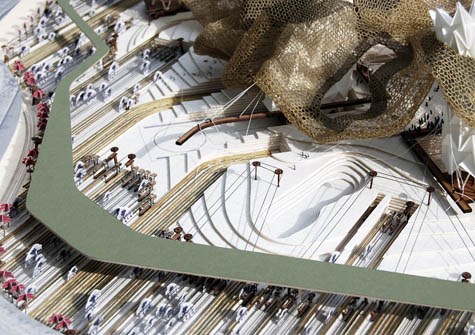
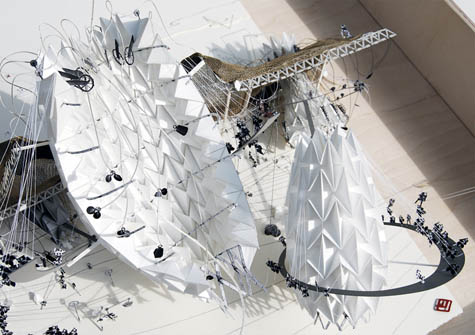
Image 7, above, shows us “the contoured landscape underneath the knitted canopy, exposing the series of connecting walkways that allow the Emperor’s army to run from one lung to another,” while Image 8 reveals “the Emperor’s origami lungs.” Image 9 reveals how those lungs operate; there, we begin to see “the lung movements” of the Emperor, Hillier writes, as they “generate a bellowing volume of air.” This air is then “forced upwards, sending the woven lung collars into a thrashing frenzy, visually increasing the impact of the Emperor’s anger.” In another context, it might be interesting to explore the use of pneumatic metaphors to explore the nature and function of imperial power; but such an essay will have to wait for another day.

Image 10, meanwhile, zooms in on the Emperor’s “Mechanical Moat,” a machine-hydrology that surrounds and delimits the project landscape.

And then we reach the finale.

[Image: Image 11 from The Emperor’s Castle by Thomas Hillier].

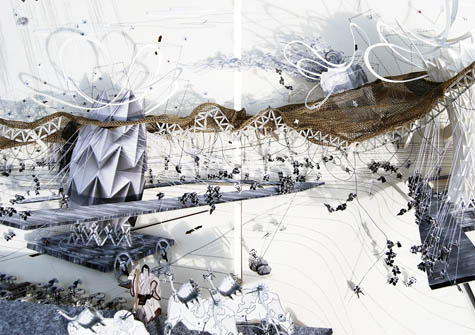
The images below are “the final triptych,” Hillier writes. They offer “a section through the urban theatre [that] illustrates the frenetic ‘life’ of the building. This 1.8m x 0.8m piece is the culmination of all the research and design synthesis carried out above.”

[Images: Images 12, 13, 14, and 15 from The Emperor’s Castle by Thomas Hillier].

Hillier’s project is a beautifully realized example of something I’ve long been curious about—for instance, if a book like Ulysses had been “written” not with a typewriter but with a 3D printer, what sort of architectural world might result? The Emperor’s Castle offers at least one possible answer for how literature could be translated directly into urban and architectural space.

Now reverse-engineer this: take a landscape garden somewhere—or an accidental assemblage of parks, buildings, rivers, and homes—and interpret that setting as if it is literature. Do a reverse-Hillier, so to speak: start with the landscape and extract characters and motivated dramatic actions from the objects placed within it.

In any case, again, check out the Flickr set for more text and much larger images; and don’t miss Johan Hybschmann’s “book of space,” also produced this year at the Bartlett.

The Archaeology of Seclusion

[Image: Photo by Vienna-based photographer Wolfgang Thaler].

Journalist Christoph Hinterreiter recently teamed up with photographer Wolfgang Thaler to document a nuclear bunker called D-0 in what is now Bosnia.

As Hinterreiter wrote in an email:

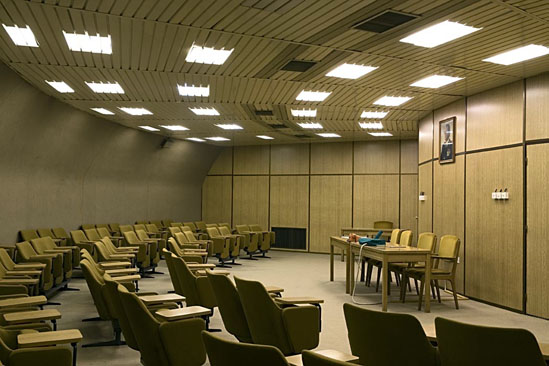
The bunker was the largest structure of its kind, and was for use by the upper echelon of the former Yugoslavia. The premises are still fully furnished and equipped with military apparatus—code books are positioned beside telexes and restrooms are equipped with originally wrapped paper towels. Its construction lasted for 26 years (1953 – 1979) and it cost 4.6 billion USD.

The bunker’s construction required “20,000m3 of excavated material,” Hinterreiter adds, all of which “was secretly transported from the site. A major part was further processed in the nearby JNA quarry and disguised as construction material.”

The photos and text quoted here were originally published in issue #56 of a Croatian magazine called ORIS; they have been reproduced with kind permission of Hinterreiter and Thaler.

[Images: Photos by Wolfgang Thaler].

Reminiscent of the book Waiting for the End of the World by photographer Richard Ross—of which you can see many examples over at GOOD—Hinterreiter and Thaler show us a strangely preserved world of plastic-wrapped couches and vintage telephones, track lighting and glass-framed photographs.

Hinterreiter specifically zooms in on these details for his article in ORIS:

All basic functions are organized in simple metal structures, aligned within a tunnel-like space. In the centre of the horseshoe-shaped footprint lies an elevated block, whose design exceeds purely functional considerations. It is elevated above the rest of the facility and contains interior design components not found elsewhere in the fallout shelter. It was for use by upper echelons of the Yugoslav government. Variously ornamented wall papers, kept in garish colors, cover most walls and arches. Patterns and shades of green vary from room to room and characterize each space. The surface driven spaces provide no clue about the nature of their organization or construction.

It was a kind of subterranean Motel 6 in which guests could wait-out the apocalypse.

[Images: By Wolfgang Thaler].

Such patience would require an extraordinary technical apparatus, however, something that might allow a state of self-imposed quarantine to exist; between the bunker-dwellers and the obliterated surface of the planet above them stood complex networks of ventilation equipment and back-up generators.

[Images: By Wolfgang Thaler].

As Hinterreiter further explains:

Twice a day, air-handling units pump fresh air through a labyrinth of air ducts to maintain 21-23°C temperature at 60-80% humidity. Two transformers are on alternating duty to supply electricity. The water reservoir is filled with potable water from the adjoining Bijela Neretva river. Still modestly filled fuel tanks are ready to supply stand-by emergency generators. Various archaic-appearing mechanical systems would have guaranteed automatic seclusion from the outside world and the engagement of self-sustainable building systems, providing an autarkic survival space for 350 people over a period of months. What was in the event of a nuclear attack supposed to ensure the survival of the political and military elite of the Socialist Federal Republic of Yugoslavia now fills solitary spaces with fresh air and illuminates Cold War military artifacts for visitors, interested in the fiction-like premises of nuclear bunker D-0.

The motivation for building this structure where it is was fundamentally geographical:

The geographic advantage of Bosnia and Herzegovina, being completely surrounded by other Yugoslavian republics, led to the establishment of strategically important industries in the country’s inaccessible valleys. A network of underground control posts, ammunition factories and power plants lies beneath the country.

But then, of course, all geographies come with strategic implications; filling the valleys of Bosnia and Herzegovina with military installations should thus come as no surprise.

[Images: Wolfgang Thaler].

Earlier this week, meanwhile, there was some speculation that perhaps the original Labyrinth at Minos had been discovered; we read in the Independent that “a disused stone quarry on the Greek island of Crete which is riddled with an elaborate network of underground tunnels” could very well be the original site where the myth of a minotaur hiding at the heart of an architecturally elaborate underground space was inspired. The history of these quarry-caves is fascinating (with shades of Raiders of the Lost Ark thrown in at the end):

The caves, which are known locally as the Labyrinthos Caves, consist of about two and half miles of interlocking tunnels with widened chambers and dead-end rooms. They have been visited since medieval times by travellers looking for the Labyrinth, but since Knossos was rediscovered at the end of the 19th century they were neglected, and were even used as a Nazi ammunition dump during the Second World War.

I mention this because the urge to build labyrinths—in stone or in tufa or against the detonations of nuclear war—often seems to transcend those labyrinths’ purported use-value. As Hinterreiter himself might say, constructing a labyrinth of any kind “exceeds purely functional considerations,” sliding off into mythology before too long and adding an oddly sinister veneer to any civilization that pursues it.

In other ways, I’m reminded of stories like Seymour Cray and his obsession with tunneling, or William Gass’s unreadable novel The Tunnel, even the Mole Man of Hackney.

Of course, it would be wrong to over-blur these contexts and ignore the clear, functional purpose of a nuclear bunker; but it’s hard not to wonder about the psychological implications of living underground for extended periods of time or, indeed, what strange impulses might compel a society to seek refuge beneath the surface of the earth—Hinterreiter’s “automatic seclusion from the outside world”—in the first place. This is what BLDGBLOG has previously referred to as “psychology at depth.”

[Images: Wolfgang Thaler].

In any case, the ORIS article ends with a quotation from Paul Virilio. He suggests that the now-purposeless and abandoned bunker pictured here “joins a row of defense installations such as the Atlantic Wall along the French coast or the DEW Line in North America, which are not only heritage monuments of contemporary history. They remain to remind ‘us less of yesterday’s adversary than of today’s and tomorrow’s war’.”

Check out Hinterreiter’s website for even more photos and text.

Safari 7

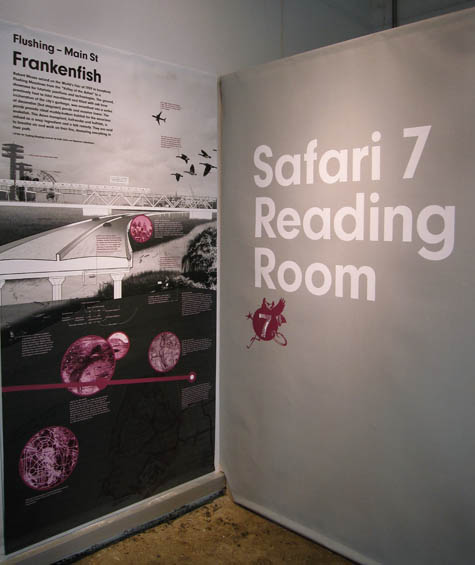
[Image: The Safari 7 Reading Room open now at Studio-X].

Earlier this year, while driving down Highway 5, from San Francisco to Los Angeles, my wife and I passed through huge and endless clouds of butterflies. For a few seconds, the effect was extraordinarily beautiful—even sublime—but, within an instant, our car was covered in tiny corpses: yellow blurs smashing repeatedly against the windshield, leaving a grotesque series of impenetrable smudges. Looking at the other cars around us—not to mention heavy moving trucks and agricultural semis running short-haul routes downstate—it was clear that an all-out slaughter of these migratory butterflies was underway.

What strange irony of the California landscape would lead butterflies to follow a major highway on their seasonal migrations—or what triumph of bad planning would result in that highway being built in perfect alignment with a preexisting animal geography?

Of course, the landscape itself might all but guarantee such an overlap, as California’s central valley offers both Caltrans and Painted Lady butterflies an effective and easy route to from north to south. But what other examples might there be of human transportation infrastructure coexisting with biological routes of passage?

[Images: Gavin Browning of Studio-X shows Nicola Twilley of Edible Geography around the Safari 7 Reading Room].

I’m reminded here of artist Elliot Malkin’s Graffiti for Butterflies project, which—morally or not—sought to create new migration routes for other species using aerosol sprays that only non-human eyes can see.

What paths for animals could we thus build through our cities? Birds following WiFi signals along parallel geographies through the urban canyons our buildings now frame…

Exploring all of these questions, and more, is a cool new exhibition called the Safari 7 Reading Room, which opened last night at New York’s Studio-X. Nicola Twilley, of Edible Geography, and I got to take a tour of the exhibition before it opened with Studio-X’s Gavin Browning.

[Image: A map of the 7 train’s ecological route; from the Safari 7 Reading Room].

The project, developed by Urban Landscape Lab and MTWTF, with a series of podcasts created by architecture students from Barnard & Columbia Colleges, treats New York City’s 7 train as a kind of safari: what creatures live along the 7 line—and what ecosystem does the train route explore?

Oysters, dogs, humans, worms, snakefish, cormorants and germs are some of the species that populate the length of the MTA 7 train. The “Safari 7 Reading Room” is an exhibition that presents a series of 3D maps, audio listening stations, curated reading materials, and a series of large-scale drawings of animal habitats, behaviors and life cycles in relationship to urban culture and history at selected sites along the MTA No. 7 line.

The podcasts, in particular, we read, are meant as way to “reimagine train cars as eco-urban classrooms, inviting travelers to act as park rangers in their city.” You just download the appropriate sound file, pop in your earphones, and the city becomes an immersive wildlife environment within seconds.

[Image: Let’s go on a city safari… From Safari 7].

The city is treated as an environment full of “decomposers” (the 7 line passes by graveyards), “urban coops” (there are gardens and allotments along the way), “Frankenfish” (aquatic life mutationally altered by chemical runoff), dog parks, weed-choked vacant buildings, and more.

It’s a nature tour of New York, using the city’s existing transportation infrastructure as both route and guide—and it’s a fantastic idea.

Vaguely similar things have been done, for instance, in London, where walking tours of the now-buried rivers beneath the city’s surface reveal what present-day geographies inhabit these lost natural worlds today. Of course, there is also Fritz Haeg’s Animal Estates project, which asks us “to consider the animals that we share our cities with, and creates dwellings for animals that have been unwelcome or displaced by humans. As animal habitats dwindle daily,” Haeg continues, “Animal Estates proposes the reintroduction of animals back into our cities, strip malls, garages, office parks, freeways, front yards, parking lots, skyscrapers, and neighborhoods.”

Further, I remember reading in Alan Weisman’s book The World Without Us that many of New York’s subway lines would simply become “rivers” after mere weeks of pumpless-ness (it would only take 36 hours, I believe Weisman wrote, for the entire New York subway system to flood should the pumps truly fail).

This notion that much older ecologies and whole parallel geographies lie waiting beneath our cities, just waiting to self-resurrect and come roaring back to the surface, is something that has long fascinated me. Along these lines, there’s a great quotation from Michael Novacek’s book Terra:

Ecologists often point out that the images of Earth still harboring unspoiled, pristine wild places is a myth. We live in a human-dominated world, they say, and virtually no habitat is untouched by our presence. Yet we are hardly the infallible masters of that universe. Instead, we are rather uneasy regents, a fragile and dysfunctional royal family holding back a revolution.

In fact, I’m now reading Laurie Garrett’s The Coming Plague, and it seems not unrealistic to argue that Novacek’s “revolution” is already underway—only it is being spearheaded by previously unknown diseases.

In any case, I’d be remiss if I didn’t mention one more project in this context: Invisible-5, an eco-geo-socio-enviro-chemical audio tour of California’s Highway 5, the same route where this post began:

Invisible-5 investigates the stories of people and communities fighting for environmental justice along the I-5 corridor, through oral histories, field recordings, found sound, recorded music, and archival audio documents. The project also traces natural, social, and economic histories along the route.

So what other human routes could we explore for their ecologies, the landscapes they coexist with or simply cover? London bus lines, the Chicago El, ferry routes through the Baltic, Beijing’s ring-roads, or perhaps even your own daily commute through the city.

The Safari 7 Reading Room is up at Studio-X until December 31, 2009.

Chemical Archive

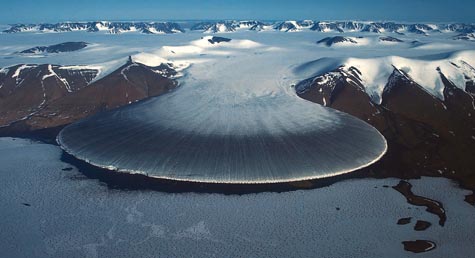
As the world’s glaciers melt, they’ve begun to release an archive of banned industrial substances back into the environment, chemicals that have been locked, frozen, inside the glacial ice for up to thirty years.

[Image: Photo via the Alfred Wegener Institute].

According to Discovery, “many persistent pollutants, including PCBs, dioxins and several chlorine-containing pesticides [such as] DDT” have begun to leach out from melting glaciers in places like Switzerland.

The idea of a poisonous atmospheric archive being unintentionally released—on a global scale—makes me wonder what sorts of news reports we might read in several thousand years’ time, when carbon tombs start to leak their quarantined contents back into the atmosphere. The buried skies of an industrial era, put to pharaonic rest beneath the earth’s surface, will make their operatic reappearance in future human history.

Will hissing vents of carbon dioxide gas be found someday, six thousand years from now, when these specially carved geological resting places of the sky crack open?

I was astounded to read, for instance, two years ago in New Scientist, that “burying carbon dioxide under the seabed is likely to remain controversial because of concerns that it will eventually leak out. However, a team of environmental engineers now claims that these worries are unfounded, and that natural reactions will lock away the carbon dioxide within aquifers for millennia.” For millennia. In other words, a catastrophic release of entombed CO2 will re-enter the atmosphere—and it will do so well within what could still be the anthropological era.

Already, we see lead, DDT, PCBs, and more flowing out from melting glaciers, bringing back a chemical presence that we thought we had effectively regulated. What strange myths of haunted returns and cursed ancestors might we be forced to conjure when these other, more deeply buried elemental forces reappear?

(Spotted via @stevesilberman).

Soft Robots

I’m fascinated by the so-called “chemical robots” program run by DARPA. Its purpose is to create “soft robots”: a “new class of soft, flexible, mesoscale mobile objects that can identify and maneuver through openings smaller than their dimensions and perform various tasks.”

[Image: Video originally seen over at IEEE Spectrum].

These soft machines, DARPA suggests, can be materially realized using “gel-solid phase transitions, electro- and magneto-rheological materials, geometric transitions, and reversible chemical and/or particle association and dissociation.” The idea of a robot that travels via “particle disassociation”—that is, a blurry cloud of “mesoscale mobile objects” that temporarily coalesces into a functioning machine before dissolving again—seems particularly astonishing.

Watch the above video for just one example of a “chemical robot.”

So what would these machines be used for? As DARPA explains: “During military operations it can be important to gain covert access to denied or hostile space. Unmanned platforms such as mechanical robots are of limited effectiveness if the only available points of entry are small openings.”

This is what I imagine Eyal Weizman‘s alter-ego might invent if he went into the robotics business in collaboration with eXistenZ-era David Cronenberg.

I’m specifically reminded of Weizman’s amazing paper, “Lethal Theory” (it is well worth reading the PDF), in which he writes of “microtactical actions” used by the Israeli military as a means of exploring a new domination of the city. The Israeli Defense Force, Weizman writes, has begun strategically retraining itself, in a bid to explore a “ghostlike military fantasy world of boundless fluidity, in which the space of the city becomes as navigable as an ocean.” Soldiers, we read, can now become “so ‘saturated’ within [a city’s] fabric that very few would have been visible from an aerial perspective at any given moment.”

Furthermore, soldiers used none of the streets, roads, alleys, or courtyards that constitute the syntax of the city, and none of the external doors, internal stairwells, and windows that constitute the order of buildings, but rather moved horizontally through party walls, and vertically through holes blasted in ceilings and floors.

This is referred to as “infestation.”

So what if you replaced the living human soldiers with swarms of “soft robots,” capable of squeezing themselves, roach-like, through even the smallest opening? As Weizman terrifyingly suggests later in the paper: “You will never even understand that which kills you.”

Or perhaps we could find a more civilian use, we might say, for these soft machines, and send tens of thousands of them—a storm of flexible swarm-organisms shifting their shapes and flocking—outfitted out with GPS and radar, into the earth, traveling downward via faultlines, where they can map the spheroidal puzzle of our planet.

(Thanks to Alex Trevi for the tip!)

Dormitorium

[Image: From Dormitorium].

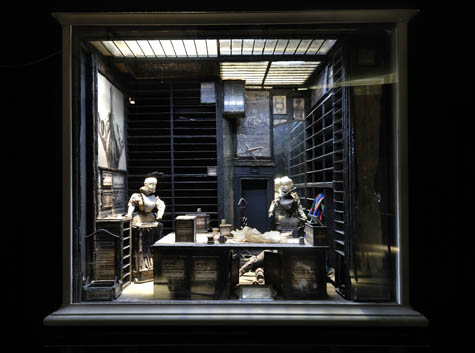
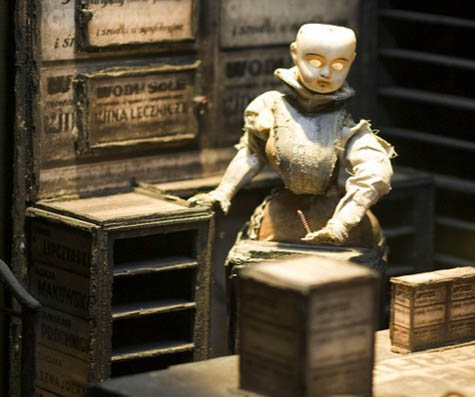
Today is your last day to see Dormitorium, an exhibition of interior sets from films by the Brothers Quay, on display now at Parsons in New York City. Dormitorium, we read, “explores the macabre fantasy world of twin brothers Stephen and Timothy Quay through the highly detailed miniature sets of their influential stop-motion animations.”

The dean of academic programs at Parsons adds:

This exhibition gives our students an opportunity to see how the Quay brothers create intricate fantasy worlds, from set design to finished film through their compelling engagement with literature, their command of sound and lighting design, their uncanny use of focus, color and texture, as well as their mastery of digital editing processes.

The show is open till 6pm today, and you can find more info here.

[Image: From Dormitorium. Photo by Morbid Anatomy; see more photos here].

Tangentially, I am reminded of an article from the most recent issue of Mark Magazine about the models and dioramas of Ronan-Jim Sevellec. Sevellec explains the making of his miniature boxed scenarios to Mark:

The first phase of my work consists of setting together a certain number of elements. That may be furniture or scenery items, but it’s mostly insignificant and mostly at random. This is my way of setting traps to catch images of latent inner dreams. A really accurate picture of what my efforts will finally result in remains unclear to me. It does reveal itself, but only progressively, until the day I realize that nothing more is to be added. At that moment, I make up my mind and seal the front with a glass panel.

While I could perhaps do without the “latent inner dreams” to which Sevellec refers, his basic idea of timing – that there is an intuitive moment at which a created miniature world has reached a state of completion – is a compelling one.

You hit a certain point at which you can seal off a microcosm and move on.

[Image: From Dormitorium].

Finally, how much do I love the use of the word “dormitorium” in the Quay Brothers’ exhibition title? What would normally refer simply to university housing becomes an extraordinary codeword for a laboratory of sleep.

(Thanks to Ed Keller for the tip!)

Phantom City

[Image: Museum of the Phantom City by Cheng+Snyder for the Van Alen Institute].

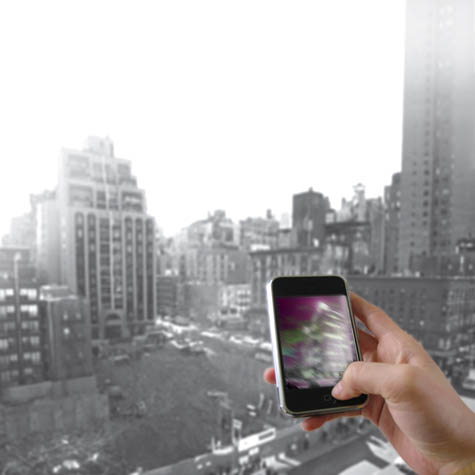
A fantastic new iPhone app by Irene Cheng and Brett Snyder has come to market in New York City this autumn. Sponsored by the Van Alen Institute, Museum of the Phantom City is “a public art project that allows individuals to browse visionary designs for the City of New York on their iPhones.”

Users can view images and descriptions of speculative projects ranging from Buckminster Fuller’s dome over midtown Manhattan, to Antonio Gaudi’s unbuilt cathedral, to Archigram’s pop-futurist “Walking City,” all while standing on the projects’ intended sites.

In other words, you go around the city, iPhone in hand – a kind of architectural dowsing rod held in front of you – discovering the traces of buildings that never were (perhaps even fragments of a city yet to come).

Proposals by Buckminster Fuller are suddenly as real as the Empire State Building – after all, they’re both pictured right there on your iPhone…

[Images: Screen shots from Phantom City by Cheng+Snyder].

As the New York Times wrote this morning:

A mile-high dome shades Midtown Manhattan, an airport floats off Battery Park, Harlem is enveloped in a hulking megastructure literally lifting residents out of poverty, and the tallest building in the world, continuously under construction, sprouts from ground zero, growing without end.

“It’s the city that never was but could have been,” said Irene Cheng, an architectural historian. “Sort of an alternate future.”

Without mining the architectural avant-garde and its history of impossible projects, and before you even get to things like science fiction films and comic books, and as you hold yourself back from exploring the spatial reserves of ancient myth and urban legend – weird tunnels beneath midtown, World War II bunkers, secret apartments of the rich and famous – you can simply tap the ongoing economic recession for architectural content.

It would be easy enough, in fact, to put together a tour of building projects that never made it past the recession – New York’s so-called “Lost Skyline” – or, for that matter, of the buildings that never made it past the Depression.

You walk past a certain corner on the Upper West Side and your iPhone starts to ring: you’re being called by a missing building… Absent structures detected in a wireless blur, leaving messages for you (complete with call-back number).

Electromagnetic voice phenomena in architectural form.

[Image: Screen shot from Phantom City, featuring Superstudio’s Continuous Monument].

On one level, of course, it’s worth asking whether or not it’s a problem that all of these new and exciting visions for 21st-century urban life are only accessible to people rich enough to afford iPhones – but, on another level, why not use the tools that exist, no matter how expensive they might be, in order to try out new models for historical and spatial exploration?

Caving, for instance, requires caving equipment – and not everyone can afford to stock up. But that’s no reason to stop exploring the underworld.

At a conference in Turin earlier this summer, I was on a panel with Bruce Sterling and Nicolas Nova, where Nova asked this exact question. Having just shown us all a series of slides in which new ways of interacting with, and learning about, the city had been suggested, he pointed out that most of these things required an iPhone. But do we really want to build and promote the city of tomorrow, if it’s effectively inaccessible to a particular class of consumers?

Yet, one could argue, this is exactly what we’ve done with cars; the spatial needs of the automobile industry have shaped our cities far more than the cultural and economic – and possibly even neurological – needs of those cities’ inhabitants.

So will iPhones do to urban information what cars have done to the streetscape?
[Image: The iPhone at work, detecting the Phantom City].

In any case, back in 2008, in a post that now seems remarkably dated, I suggested that Google Maps should come with a “sci-fi layer” – that is, a layer that would document where in your city certain events had taken place or certain structures had stood in a work of fiction. For instance, the building that Robert Neville’s dog runs into in I Am Legend or the trainyard from Escape From New York, the apartments from Make Room! Make Room!, the high-rise penthouse from The Day After Tomorrow

Those are Manhattan-centric examples, of course, and drawn only from science fiction, but this could easily be expanded to include landscapes and structures elsewhere, from the deserts of the Empty Quarter to central Paris, and it could include other genres, from the poems of John Ashbery to Howl to The Great Gatsby.

You could even have a “mythology layer” – roaming around Scandinavia, tracking Thor or digging for the roots of Yggdrasil – or a “theology layer”: you go to Israel and your iPhone short-circuits from the laminations of charged geography around it. Pillars of salt, sacred basements, dead walls and abandoned forts.

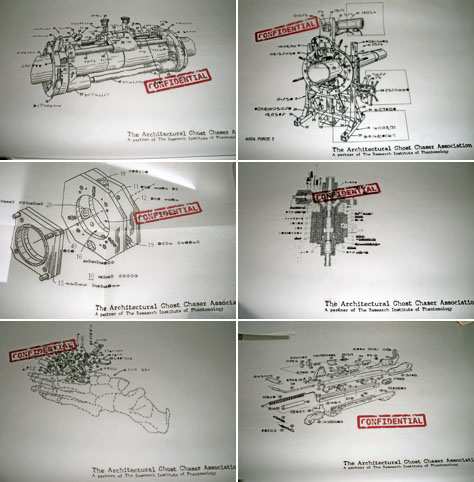
In fact, I’m further reminded of a project produced this past summer by Sally Hsu, one of my students at Urban Islands down in Sydney. Hsu came up with something she called the Research Institute of Phantomology, a fake historical research society whose specially-invented machines could detect missing buildings: structures that had been demolished and lost to history. You could use these throughout the Sydney Harbor – or specifically on Cockatoo Island, where our studio was set – in order to trace the architectural remains of history.

One of those devices, according to Hsu, was the Architectural Ghost Chaser: it would lead historians directly to the ruins of old buildings in the earth.
[Image: Patent diagrams for an “Architectural Ghost Chaser” by Sally Hsu; Urban Islands 2009].

A tongue-in-cheek proposal, of course – Hsu even made patent diagrams to illustrate it, as well as a fake cover for New Scientist featuring the remarkable device – it nonetheless kicked-off an interesting conversation about demolished buildings, urban archaeology, and the strategies through which we could detect the ruins of the past if physical excavation is not an option. After all, we’ve already got things like ground-penetrating radar – through which we can map and explore an ancient Roman city beneath Wroxeter, England, without digging a single hole – and we’ve even got muon detectors. But imagine discovering new archaeological sites through an iPhone app!

So why not build a tricked-out PKE Meter attuned to architectural space? At the exact intersection of Sally Hsu’s Institute of Phantomology and the iPhone?

In other words, why not create something like the Museum of the Phantom City?

Cheng+Snyder‘s free download opens up a new kind of historical spectating: architectural tourism of the unbuilt. Perhaps someday we’ll be done with monographs, traveling exhibitions, and even senior thesis reviews; we’ll simply upload all our projects into the Phantom City and let the world decide their worth. Crowds of tourists mill about on 13th Street, looking around at the imaginary buttresses of a superstructure you’ve spent three years digitally assembling.

Download the app via the iTunes store and see for yourself.

Manual of Architectural Possibilities

As many people who attended my book launch this past weekend in New York will already know, I had on hand a fantastic new publication by architect David Garcia: the Manual of Architectural Possibilities, or M.A.P.

[Images: M.A.P. by David Garcia].

I had the pleasure of meeting David back in Sweden earlier this month at the ASAE conference; David’s presentation and our subsequent conversation – ranging from the architecture of déjà vu and haunted house novels to the possibility of sonic archives and the work of David Gissen – were more than enough to show that he is pushing forward through some incredibly interesting ideas and is already someone worth keeping an eye on now, not just in the future. He’s even just completed a cool children’s playground in suburban Denmark.

Issue One of M.A.P. – or poster #1, really, as it all unfolds into a double-sided A1 sheet – is about Antarctica.

[Image: M.A.P. by David Garcia].

Open the poster up and there are habitats excavated directly from the ice, their dimensions and size based on the carving radius of industrial digging machines; there are seed archives entombed throughout the polar glaciers, marked only by GPS; there are abandoned airplanes all hooked together into a grounded megastructure and reused as research labs; there is a catalog of snow crystal geometry; and there is a photo-survey of exploratory housing for visiting scientists.

Look for M.A.P. at an architecture bookstore near you, or get in touch with David Garcia Studio directly to order some copies.

M.A.P. #2 – which is, incidentally, open for suggestions – will be about “Archives.” And future M.A.P.s are impossible not to daydream about: a M.A.P. for prisons, gardens, earthquakes, architecture school, the moon…

The Windowless Hall of Tides

[Image: The wastewater treatment plant at Roseville, California, unrelated to the poem discussed below].

For nearly four years now, without access to a good library, I’ve been looking for a poem called “Staines Waterworks” by the English poet Peter Redgrove; it’s impossible to Google and, though I knew I’d actually photocopied it for myself nearly a decade ago, I had apparently lost the photocopies.

But, then, amidst the weird rolling peaks of recovery and amnesia that come with cleaning through your old books and papers in the family basement, I found a sheaf of old photocopies in a box about an hour ago – and inside it was “Staines Waterworks” by Peter Redgrove.

The poem is incredible for a variety of reasons; but its most basic impulse is to describe the water purification plant at Staines, west London (the hometown of Ali G), as a kind of previously overlooked alchemical process.

It is water “in its sixth and last purification” that “leaps from your taps like a fish,” Redgrove writes.

Rainwater gross as gravy is filtered from
Its coarse detritus at the intake and piped
To the sedimentation plant like an Egyptian nightmare,
For it is a hall of twenty pyramids upside-down
Balanced on their points each holding two hundred and fifty
Thousand gallons making thus the alchemical sign
For water and the female triangle.

The poem is a stimulatingly odd collision of occult – many might say openly New Age – symbols and present-day civic infrastructure. In the process, it raises some amazing and fascinating questions of how we might more interestingly interpret the built structures surrounding us.

Redgrove describes the movement of water through its various steps of industrial filtration, saying that it “reverberates… like some moon rolling / And thundering underneath [the] floors,” passing through a “windowless hall of tides.” It is a surrogate astronomy, surging through the replicant gravity of pumps and steel holding tanks.

The processed river water is then decanted, surveilled by automata, and “treated by poison gas, / The verdant chlorine which does not kill it.” Beyond life, it is pushed through “anthracite beds,” where Water meets Earth in an engineered encounter between the elements.

[Image: A wastewater treatment plant in Macao, via Wikimedia, unrelated to the poem discussed in this post].

Later, in what Redgrove might call its fourth purification, the water at Staines flows past an underground structure that resembles “a castle,” complete with “turrets / And doors high enough for a mounted knight in armour / To rein in.” Dials here are read “as though [they are] the castle library.”

There are very few people in attendance,
All are men and seem very austere
And resemble walking crests of water in their white coats,
Hair white and long in honourable service.

Civic water-filtration takes on the air of a Druidic ritual, with bespoke costumes, arcane electrical equipment, and the dull roar of the inhuman echoing both above and below. Thames Water or, for that matter, Brita become strangely occult organizations obsessed with ritual actions and weird geometries, like something out of Aleister Crowley. It is sustainability by way of the B.P.R.D.

Redgrove’s poem – and I refer only to “Staines Waterworks” here, as I am not that familiar with his other work – shows the transformative power of description: give something an unexpected context and whole new, extraordinarily vibrant worlds can be created. This is more important, more lasting, and more interesting than much of what passes for architectural criticism today.

Finally, the baptized liquid at Staines reaches a point of biological and chemical clarity, after which it is re-introduced to the city through a labyrinth of pipework that extends in wild curlicues, a machinic Thames beneath western London. Scalded, filtered, purified, made artificially natural and ready for drinking, it is water born again for future uses.