Star Forts, Mines, and Other Maastricht Subterranea

I was in Maastricht, Netherlands, for a couple nights last week, mostly as a way to break-up my trip across the Atlantic and thus help get over jet-lag before attending an archaeology conference (where I currently type this).

I went specifically to Maastricht, however, because it’s home to an astonishing number of subterranean sites, from 800-year-old limestone mines and 17th-century star fortifications to NATO defense bunkers. I basically checked into my hotel then disappeared underground for the rest of the visit.

Here are some pics.

My morning started here, at the entrance to the Casemates Waldeck, a labyrinth of defensive earthworks complete with tunnels, counter-mine tunnels, barracks, and firing positions. Large parts of the system were then later repurposed as civilian air-raid shelters during WWII.

The geometric logic of the forts was—among other things—to lure enemy attackers in over cliff-like artificial drops and ridges, thinking they were on their way to the heart of the city. However, this simply trapped them between huge brick walls, directly in front of disguised gun emplacements, many of which were deliberately aimed at stomach-height to maximize suffering.

If you go through the door seen in the above photographs, meanwhile, you end up inside a bewildering system of multi-level tunnels weaving around for kilometers beneath the outer edge of the city.

Because the city has expanded and grown over the centuries, whole neighborhoods now sit atop these structures; if you live in Maastricht, you might very well have disused military fortification tunnels running under your basement.

What’s more, not all of the tunnels are mapped—which means that some are neither maintained nor stabilized. Apparently, seasonal floods have led to sinkholes above, as streets partially collapse into the system.

And that’s just one of many, many underground sites you can tour.

The next place I headed was called the Zonneberg Caves—which are not natural caves, but a colossal limestone mine—and I honestly can say I would spend entire weeks down there.

I’m just randomly typing facts from memory, because I’m on a break from a conference and want to get these photos up, which means I will almost certainly get a few details wrong, but I believe they said that “only” 80 or so kilometers of these ancient limestone mines remain from more than 200, and that the first shafts were cut in the 13th century.

The mines extend all the way over the international border into Belgium. The Belgian tunnels are apparently closed to the public, yet people sneak into them all the time.

There are 20th-century artworks painted on the walls, much older graffiti etched directly into rock, and massive corridors extending off on all sides into darkness.

If you’re into the underground and ever have an opportunity to spend more time than a tour down there, I would recommend it without any hesitation—and I will be deeply, deeply jealous.

The site is even complete with a little church altar.

Bear in mind, this is all still the same day.

The next site I went to was accessed through a locked metal door in the rock (pictured above). This system, known as the North Caves, is actually physically connected to the Zonneberg Caves, although it would take an hour or more to get between them underground. Like I say, I would go back there and wander around in a heartbeat.

The added interest of this latter system is that parts of it were used during WWII to house paintings by the Old Masters, protecting them from Nazi plunder and stray Allied bombs alike.

At the end, you go into a place called “the Vault” to see where Rembrandts and other paintings were hung while war waged above.

Finally, after many hours underground, I walked outside—and the first thing I saw was this rainbow. A cheesily enjoyable end to a fantastic day.

If you’re tempted to see any of these places yourself, and you hope to do so legally, check out Maastricht Underground for potential tours.

[All photos by Geoff Manaugh/BLDGBLOG.]

The Atlas of Natural Regions

[Image: “Saint-Valentin, Champagne berrichonne (Centre-Val-de-Loire), 2019, by Eric Tabuchi].

I’ve been enjoying the Instagram account of photographer Eric Tabuchi for quite a while now. Tabuchi is working on an ambitious ten-year photographic project, kicked off in 2017, that he calls The Atlas of Natural Regions, basically a catalog of spatial conditions found throughout France.

The project “aims to create a photographic archive offering a broad overview of the diversity of the buildings, but also the landscapes, that make up the French territory,” Tabuchi explains. “Ultimately, 50 shots will be taken in each of France’s natural regions, geographical and cultural entities that are simple to grasp by their size (a few tens of kilometers).”

It will include 25,000 photographs when it’s done—and I am already excited to see the final exhibition or book when it’s complete. So far, there have been flooded quarries, sports complexes, and emergency training towers, industrial ruins, coastal bunkers, and surreal scenes that resemble something designed by Simon Stålenhag.

Tabuchi’s Instagram account is well worth following, and you can also support his work by purchasing a print.

Assignment Baghdad

[Image: Screen-grab from a YouTube compilation of Desert Storm missile strikes].

In the summer of 2016, I heard an incredible story from a retired Defense Intelligence Agency analyst. It combined architectural history, international espionage, an alleged graduate research seminar in Washington D.C., and the first Gulf War. I was hooked.

According to this story, a graduate class at a school somewhere in D.C. had set out to collect as much architectural information as it could about Saddam Hussein’s Iraq. This meant, at one point, even flying to Europe on a group field trip to visit engineering firms that had done work for Saddam Hussein.

Given the atmosphere at the time, the students most likely thought that their class was an act of protest, a kind of anti-war gesture, meant to help record, document, and even preserve Iraqi architecture before it was destroyed by the U.S. invasion.

Ironically, though, unbeknownst to those students—possibly even to their professor—the seminar’s research was being used to help target U.S. smart bombs. Or, as I phrase this in a new article for The Daily Beast, “there was a reason U.S. forces could put a missile through a window in Baghdad: they knew exactly where the window was. Architecture students in Washington D.C. had unwittingly helped them target it.”

[Image: YouTube].

But then things got complicated.

When I called my source back a few weeks later to follow up, it felt like a scene from a spy film: he said he didn’t remember telling me this (!) before joking that he was getting old and maybe saying things he shouldn’t have. This obviously only made me more determined to find out more.

I called every major school in Washington D.C. I FOIA’d the CIA. I started down a series of rabbit holes that led me from true stories of Gulf War espionage, involving U.S. attempts to collect blueprints for Saddam’s bunkers from engineering firms all over Europe, to a conversation with the head of targeting for the entire U.S. Air Force during Operation Desert Storm.

Along the way, I also kept finding more and more examples of architects and espionage, from Baron Robert Baden-Powell’s incredible use of butterfly sketches to hide floor plans of enemy forts to a 16th-century Italian garden designer who was, most likely, a spy.

[Image: Robert Baden-Powell’s clever use of entomological sketches to hide enemy floorplans, from his essay “My Adventures as a Spy.” See also Mark David Kaufman’s interesting essay about Baden-Powell for the Public Domain Review].

Even Michelangelo gets involved, as his designs for urban fortifications outside Florence, Italy, were secretly modeled in cork and snuck out of the city by an architect named Niccolò di Raffaello dei Pericoli—or Tribolo—in order to help plan a more effective siege (an anecdote I have written about here before).

In any case, I was sitting on this story for the past two years, waiting for my FOIA request to come back from the CIA and trying to set up interviews with people who might have known, first-hand, what I was asking about. The resulting article, my attempt to track down whether such a class took place, is finally up over at The Daily Beast. If any of the above sounds interesting, please click through to check it out.

Finally, of course, if this rings any bells with you—if you took a class like this and, in retrospect, now have doubts about its real purpose—please be in touch.

Amidst the Ruins of Military Replicas

[Image: The Atlantic Wall at Hankley Common, Surrey, UK; Instagram by BLDGBLOG].

After blogging two years ago about the ruins of a simulated fragment of the WWII Atlantic Wall—the notorious Nazi coastal defensive system—now slowly crumbling in the woods of Surrey, I finally had an opportunity to go hike it in person with my wife and in-laws.

[Image: The Atlantic Wall at Hankley Common, Surrey, UK; Instagram by BLDGBLOG].

The ruins themselves are both larger than you’d expect and quite compact, forming a ridge of lichen-covered concrete, jagged with rebar, nearly hidden in the vegetation.

A Dutch family was also there climbing over the ruins, and as we headed slightly further up the hillside into the trees smaller test-obstacles emerged, including “dragon’s teeth” and monolithic cuboids of stained concrete.

[Image: The Atlantic Wall at Hankley Common, Surrey, UK; Instagram by BLDGBLOG].

We arrived during a live Ministry of Defence training exercise, with soldiers wandering out across the terrain, speaking to one another on radio headsets, their movements interrupted here and there by Sunday hikers out for an afternoon stroll.

[Image: A soldier at Hankley Common, Surrey, UK; Instagram by BLDGBLOG].

This led to the surreal scene of seeing fully outfitted military figures crouched down behind shrubbery, holding machine guns, while kids, their dogs, and their grandparents noisily ambled by. It felt like some sort of stage play gone wrong.

[Image: Hiking at Hankley Common, Surrey, UK; Instagram by BLDGBLOG].

Then the soldiers disappeared again over the next ridge and we were left looking out over an empty landscape of heather and gorse, the ruins now behind us somewhere in the thicket waiting for next weekend’s hikers to come by.

Bunker Simulations

[Image: A replica of the Nazis’ Atlantic Wall defenses in Scotland; photo via Stirling 2014].

The continent-spanning line of concrete bunkers built by the Nazis during WWII, known as the “Atlantic Wall,” was partially recreated in the United Kingdom—in more than one location—to assist with military training.

These simulated Nazi bunkers now survive as largely overlooked ruins amidst the fields, disquieting yet picturesque earth forms covered in plants and lichen, their internal rebar exposed to the weather and twisted by explosives, serving as quiet reminders of the European battlefield.

The various wall sites even include trenches, anti-tank ditches, and other defensive works carved into the ground, forming a kind of landscape garden of simulated fortification.

[Image: A replica of the Atlantic Wall in Scotland; photo via Stirling 2014].
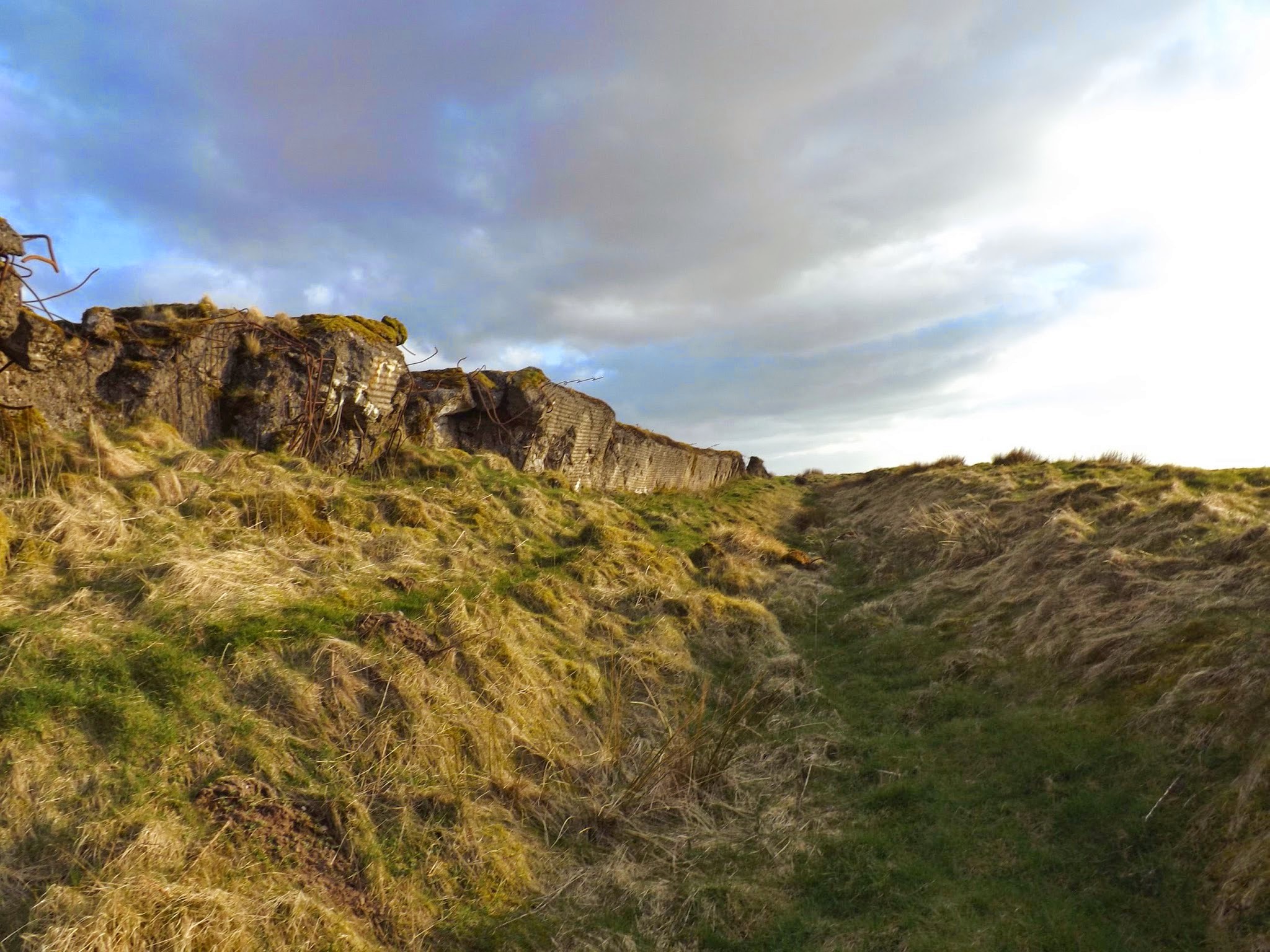
As the Herald Scotland reported the other day, one of these walls “was built at Sheriffmuir, in the hills above Dunblane, in 1943 as preparations were being made to invade Europe. The problem was the Nazis had built a formidable line of concrete defenses from Norway all the way to the Spanish border and if D-Day was to have any chance of success, the British and their allies would have to get over those defenses.”

This, of course, “is why the wall at Sheriffmuir was built: it was a way for the British forces to practise their plan of attack and understand what they would face. They shot at it, they smashed into it, and they blew it up as a way of testing the German defences ahead of D-Day.”

[Image: A replica of the Atlantic Wall in Scotland; photo via Stirling 2014].

It would certainly be difficult to guess what these structures are at first glance, or why such behemoth constructions would have been built in these locations; stumbling upon them with no knowledge of their history would suggest some dark alternative history of WWII in which the Nazis had managed to at least partially conquer Britain, leaving behind these half-buried fortresses in their wake.

Indeed, the history of the walls remains relatively under-exposed, even in Britain, and a new archaeological effort to scan all of the defenses and mount an exhibition about them in the Dunblane Museum is thus now underway.

[Image: A replica of the Atlantic Wall in Scotland; photo via Stirling 2014].

The story of the Scottish wall’s construction is also intriguingly odd. It revolves around an act of artistic espionage, courtesy of “a French painter and decorator called Rene Duchez.”

Duchez, the newspaper explains, “got his hands on the blueprints for the German defences while painting the offices of engineering group TODT, which [had been hired] to build the Atlantic walls. He hid the plans in a biscuit tin, which was smuggled to Britain and used as the blueprint for the wall at Sheriffmuir.”

But Scotland is not the only UK site of a simulated Nazi super-wall: there were also ersatz bunkers built in Surrey, Wales, and Suffolk. In fact, the one in Surrey, built on Hankley Common, is not all that far from my in-laws, so I’ll try to check it out in person next time I’m over in England.

[Images: An Atlantic Wall replica in Surrey; top photo by Shazz, bottom three photos via Wikipedia].

Attempts at archaeological preservation aside, these walls seem destined to fade into the landscape for the next several millennia, absorbed back into the forests and fields; along the way, they’ll join other ancient features like Hadrian’s Wall on the itinerary of future military history buffs, just another site to visit on a slow Sunday stroll, their original context all but forgotten.

(Spotted via Archaeology. Previously on BLDGBLOG: In the Box: A Tour Through The Simulated Battlefields of the U.S. National Training Center and Model Landscape].