Installment Plan

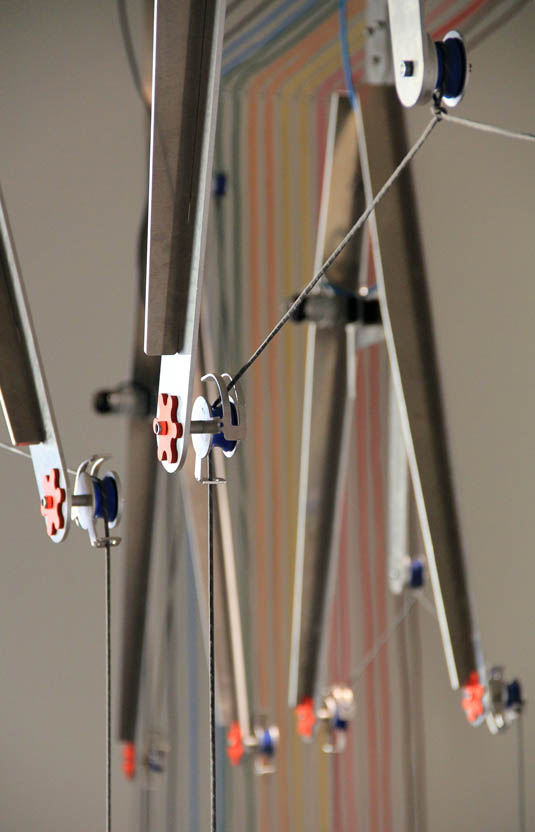
[Image: A mechanical cloud of A-frames from “Surface Tension” by Smout Allen].

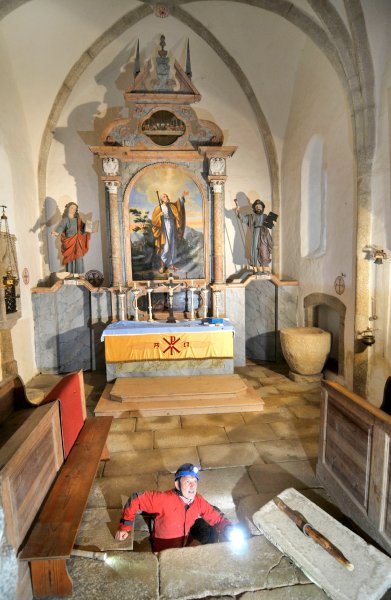
I’ll be posting some photos taken last week during the installation process for Landscape Futures: Instruments, Devices and Architectural Inventions, at the Nevada Museum of Art in Reno. The exhibition opens this Saturday, August 13, and will be up until February 12, 2012.

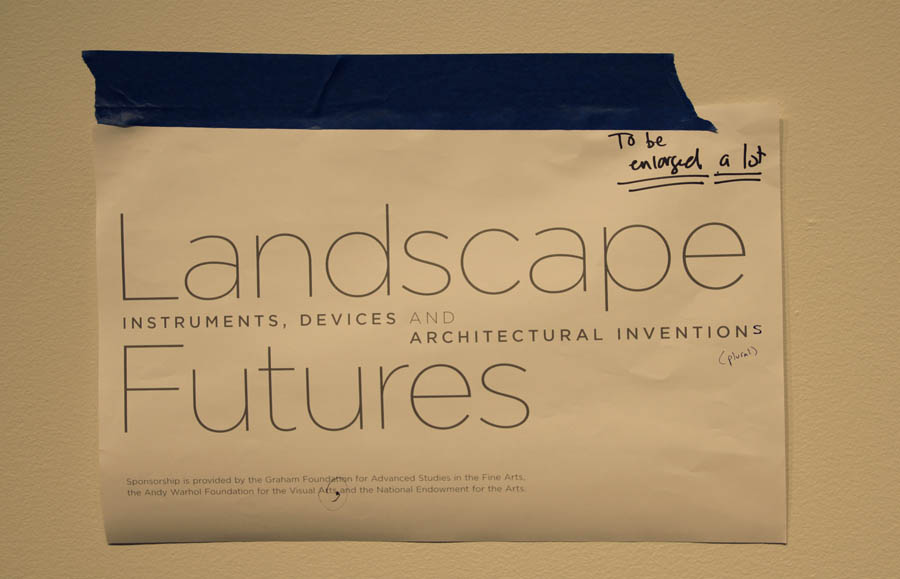
[Image: Landscape Futures, “to be enlarged a lot”].

These are photos I took myself, so they are not professional installation shots; but they should give at least some sense of how the exhibition is taking shape and what you can expect to see in the galleries. See forthcoming posts for more.

Landscape Futures is generously supported by the Graham Foundation for Advanced Studies in the Fine Arts, the Andy Warhol Foundation for the Visual Arts and the National Endowment for the Arts.

The New Robot Domesticity

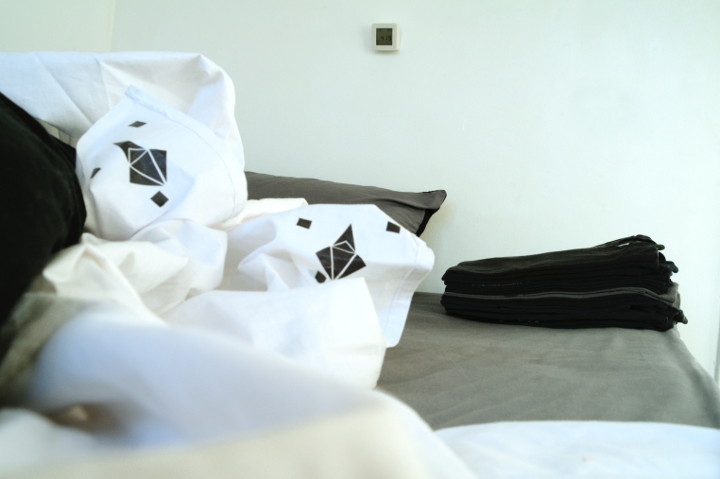
[Image: Optically tagged “robot-friendly bed sheets” from With Robots by Diego Trujillo-Pisanty].

Diego Trujillo-Pisanty, currently a student in the Design Interactions department at the Royal College of Art in London, has looked ahead at how future homes might be redesigned to accommodate domestic robots.

Rather than build entire new forms of architecture, however, Diego suggests that we’ll first begin quite simply: retrofitting our interior environments, in often deceptively small ways, for optical navigation by autonomous mobile home systems. This will primarily take the form of peripheral additions to everyday objects, as well as a new range of optical tags that will allow certain tasks—folding blankets, for instance, or setting the dinner table—to be accomplished much easier by machines.

These tags will define both physical limits and the spatial operations appropriate within them, coding the everyday home environment for the rise of machine intelligence.

[Image: From With Robots by Diego Trujillo-Pisanty].

Homeowners will even help their robots learn through computational games—like Fröbel blocks for machines.

“Every living space is different,” the project description explains, “not only in the architectural layout, but also in the tasks that the tenants require robots to do. For this reason, robots ship only partially programmed so that through a learning algorithm they might adapt to the home they operate in. To accelerate the learning process, special learning tools have been designed to help the robot integrate to a 3D environment.” The photograph seen below “shows a living room after a robot self-training session. We can see it has now mastered the physics of equilibrium. It is also evident that it has mistaken one of the house’s dinner plates which it has broken with robotic precision to complete its piece.”
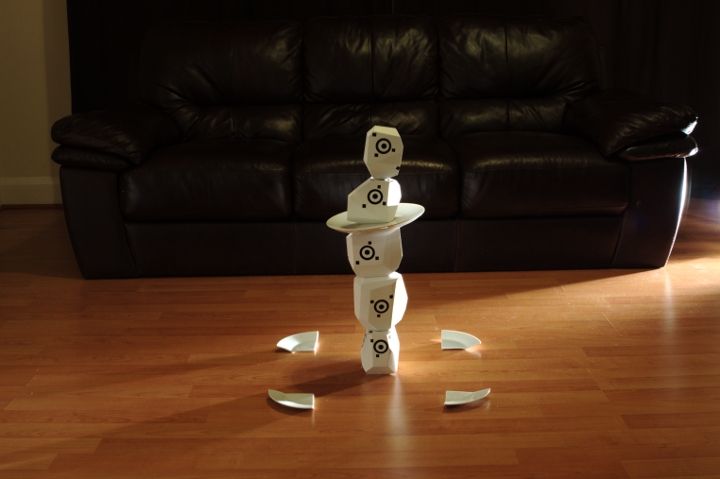
[Image: From With Robots by Diego Trujillo-Pisanty].

“Robot-friendly” handles will also be added to coffee mugs, the project suggests—which then ripples outward, effecting other spatial dimensions of the domestic environment, including where those mugs are stored. Thus, we read, “the cupboards in which these cups rest have also been altered in order to accommodate the robot. Not only are there tags marking the position of objects, but the doors have also been removed as they were not fit for A.I.”
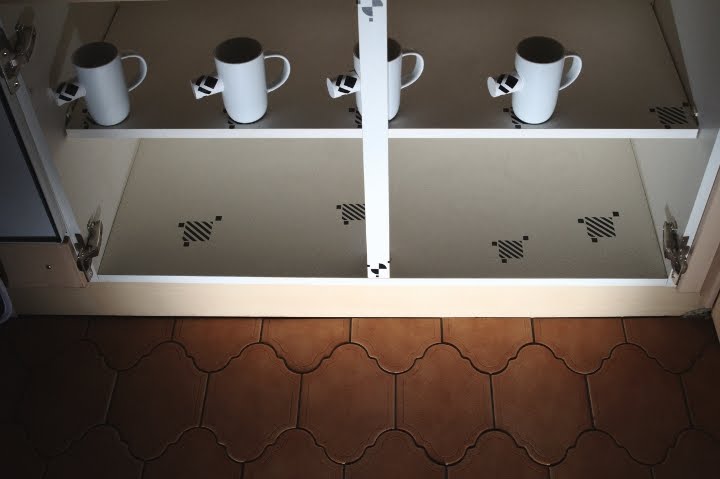
[Image: From With Robots by Diego Trujillo-Pisanty].

Cooking itself will also be altered; the next image seen here “shows how meat has been precisely cut into cubes without leaving any cut marks on the chopping board. The board itself has notches to facilitate robot interaction. In the background the meat package can be seen; it too has been labelled to suggest that the robots operate beyond a single house.”
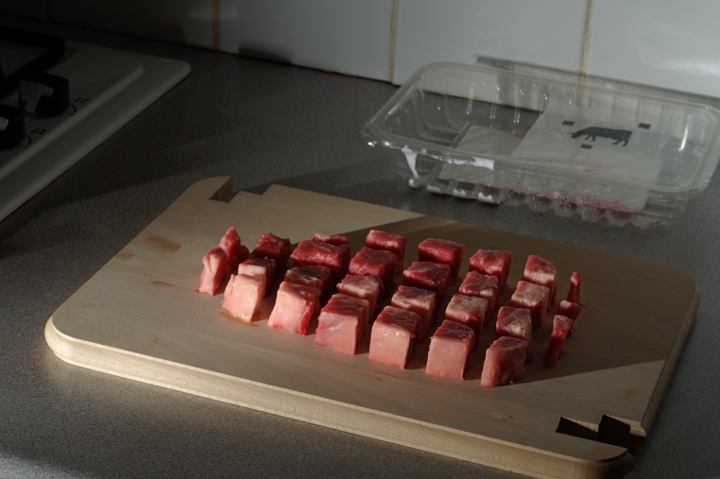
[Image: From With Robots by Diego Trujillo-Pisanty].

In a recent, highly recommended TED Talk, games designer Kevin Slavin discusses how the design of the physical world is being increasingly optimized for algorithms—and one of his central examples is the Roomba self-guided home vacuum cleaner.
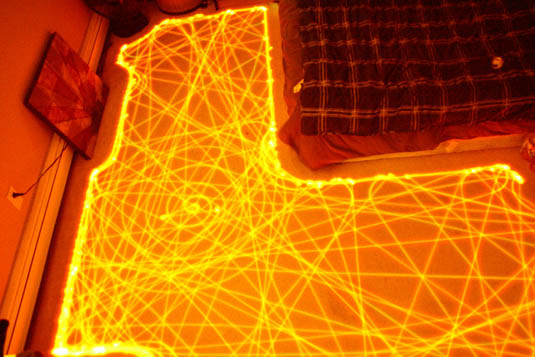
[Image: A Roomba reveals its algorithms in this photo by Signal Theorist, via IEEE Spectrum].

The Roomba, in this context, becomes emblematic of the rise of a new kind of device, one with direct spatial and optical effects on the architecture inside of which it functions.

In fact, it is not difficult to imagine, as both Diego Trujillo-Pisanty’s and Kevin Slavin‘s work suggest, a world in which everyday furniture has been subtly redesigned in order to fit the Roomba’s spiraling subroutines—and not the other way around—or even whole rooms peppered with strange, ankle-high optical tags on certain walls, doors, or objects, used to steer the Roomba this way or that at specific points in its room-cleaning operations.

Like a tomb from Egypt’s Valley of the Kings, our houses will be covered in hieroglyphs—machine-hieroglyphs, not legible as much as they are optically recognizable.

Now scale this up to the size of, say, Wall-E, and you get With Robots: a spatial environment slightly, almost invisibly, somehow off, idealized not for human beings at all, but for the spatial needs of intelligent objects.

Subterranean Machine Resurrections

[Image: Photo by Brian Harkin for The New York Times].

There is clearly a machines-and-robots theme on the blog this morning. I was fascinated last week to read that New York will soon have “its own subterranean wonder: a 200-ton mechanical serpent’s head” buried “14 stories beneath the well-tended sidewalks of Park Avenue.” In other words, a “gargantuan drill that has been hollowing out tunnels for a train station under Grand Central Terminal” will soon become a permanent part of the city, locked forever in the region’s bedrock. It will be left underground—”entombed” in the words of Michael Grynbaum, writing for the New York Times— lying “dormant and decayed, within the rocky depths of Midtown Manhattan.”

The machine’s actual burial is like a Rachel Whiteread installation gone wrong: “In an official ceremony this week, the cutter will be sealed off by a concrete wall; the chamber will then be filled with concrete, encasing the cutter in a solid cast, Han Solo-style, so that it can serve as a support structure for the tunnel. A plaque will commemorate the site.”

“It’s like a Jules Verne story,” the head of construction for NY’s Metropolitan Transportation Authority endearingly remarked. And the machine itself is an alien wonder:

A recent visit to the cutter’s future crypt revealed a machine that evokes an alien life form that crashed to earth a millennia ago. Its steel gears, bolts and pistons, already oxidizing, appeared lifeless and fatigued. A wormlike fan, its exhaust pipe disappearing into the cutter’s maw, was still spinning, its drone not unlike a slumbering creature’s breath.

I’m tempted to write a short story about a cult of Aleister Crowley-obsessed tower dwellers on the Lower East Side, in the year 2025 A.D., intent on resurrecting this mechanical worm, like something out of Dune, goading it to re-arise, pharaonic and possessed, into the polluted summer air of the city. Grinding and belching its way to dark triumph amidst the buildings, now shattered, that once weighed it down, it is Gotham’s Conqueror Worm.

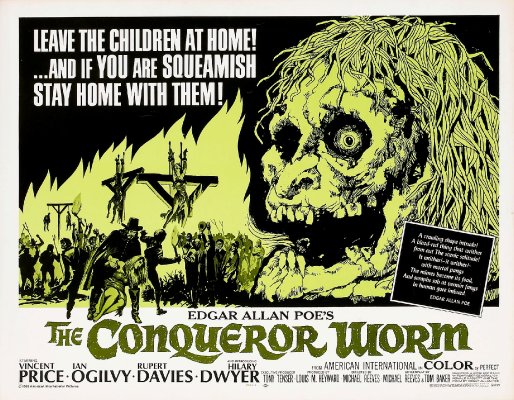
[Image: Promotional poster for the otherwise unrelated film Conqueror Worm, aka Witchfinder General].

But that would be to rewrite something that, to some extent, already exists. In Jonathan Lethem’s recent novel Chronic City, a tunneling machine goes “a little out of control” beneath the surface of New York, resurfacing at night to wreak havoc amongst the boroughs. From the book:

“I guess the thing got lonely—”
“That’s why it destroys bodegas?” asked Perkus.
“At night sometimes it comes up from underneath and sort of, you know, ravages around.”
“You can’t stop it?” I asked.
“Sure, we could stop it, Chase, it we wanted to. But this city’s been waiting for a Second Avenue subway line for a long time, I’m sure you know. The thing’s mostly doing a good job with the tunnel, so they’ve been stalling, and I guess trying to negotiate to keep it underground. The degree of damage is really exaggerated.”

And soon the machine—known as the “tiger”—is spotted rooting around the city, sliding out of the subterranean topologies it helps create, weaving above and below, an autonomous underground object on the loose.

In any case, the entombed drill will presumably outlast the city it sleeps beneath; indeed, if it is ever seen again, it will be a much more geological resurrection. As Alex Trevi of Pruned suggested over email, the machine will be “left there, perhaps forever, and will only surface when NYC rises up in a new mountain range and starts eroding.”

(Thanks to Jessica Young for the reminder about Lethem’s tiger).

Nazca City

[Images: From Ciudad Nasca/Nazca City by Rodrigo Derteano].

we make money not art has posted a short interview with artist Rodrigo Derteano, creator of a project called Ciudad Nasca/Nazca City—a reference to the famed Nazca Lines—in which a semi-autonomous robot tractor has carved a full-scale map of an imaginary city into the Peruvian desert. Watch the video:

The artist remarks that, while sometimes it can be quite melancholy watching the ephemeral geoglyphs of this make-believe robot city disappear a bit each day due to erosion, “most of the time,” he says, “I think it is OK for it to be slowly erased by the wind.”

Perhaps Derteano’s machine secretly built California City.

See more at the artist’s Nazca City blog.

Instruments, Devices and Architectural Inventions

[Image: From The Gray Rush, a new work by The Living, commissioned by the Nevada Museum of Art].

I’m heading up to Reno for the next eight days to install Landscape Futures: Instruments, Devices and Architectural Inventions, an exhibition I’ve guest-curated for the Nevada Museum of Art. I hope to have installation process photos and other glimpses behind the scenes to post later this week.

The exhibition opens to the public on August 13, 2011—although, if you’d like to see the show with participating architects Mark Smout, Liam Young, and David Benjamin, among many others, including myself, consider attending the forthcoming Art + Environment Conference at the Museum, from September 29 to October 1.

Landscape Futures will be on view through February 12, 2012, and was made possible through generous support from the Graham Foundation, the Warhol Foundation, the National Endowment for the Arts, and, of course, through the heroic efforts of the Nevada Museum of Art staff.

Rebooting Massachusetts

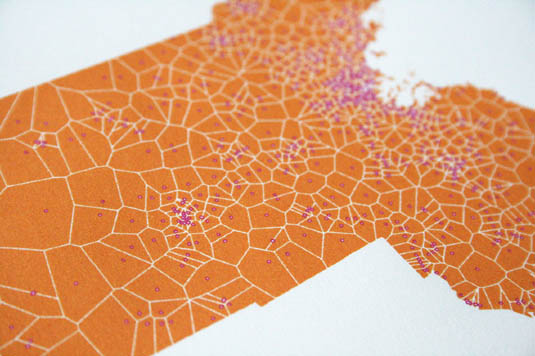
[Image: From Redraw, Reboot by Ryan Sullivan].

Designer Ryan Sullivan recently got in touch with Redraw, Reboot, a series of new maps for the U.S. state of Massachusetts.

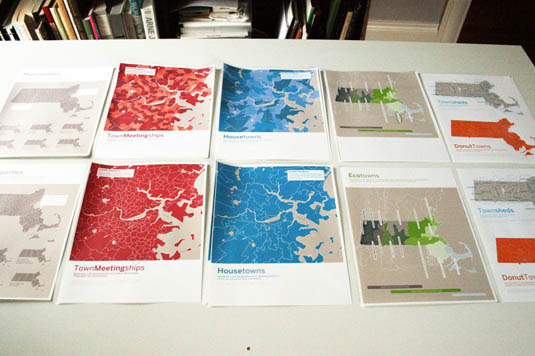
[Image: From Redraw, Reboot by Ryan Sullivan].

Sullivan’s maps “explore new boundaries for municipalities in the Commonwealth of Massachusetts,” he explained. “They range from a John Wesley Powell-inspired watershed map to a Voronoi-driven Dunkin’ Donuts township map.”

[Images: From Redraw, Reboot by Ryan Sullivan].

The project began with a series of questions: What if the official internal boundaries of Massachusetts were entirely erased? “How would we redraw them? And how could new municipal boundaries better align government with our needs today?”

Many of Massachusetts’ town lines were based on geographic features; forgotten disputes among parishes; long-dead landowners’ property lines; and, yes, craven political gamesmanship—this is, after all, the state that invented the gerrymander. Now, as the Commonwealth contends with the politics of congressional redistricting, we realize how arbitrary many of these designations are.

Of course, Sullivan’s suggested replacements are less serious political proposals than whimsical parameters for a surreal new state to come—its jurisdictions defined, for instance, by doughnut consumption—but if we are to redesign the political units through which contemporary governance functions, I suppose you have to start somewhere.

In any case, the images seen here are just a glimpse; they were all originally published in and commissioned by ArchitectureBoston.

Twisty little passages

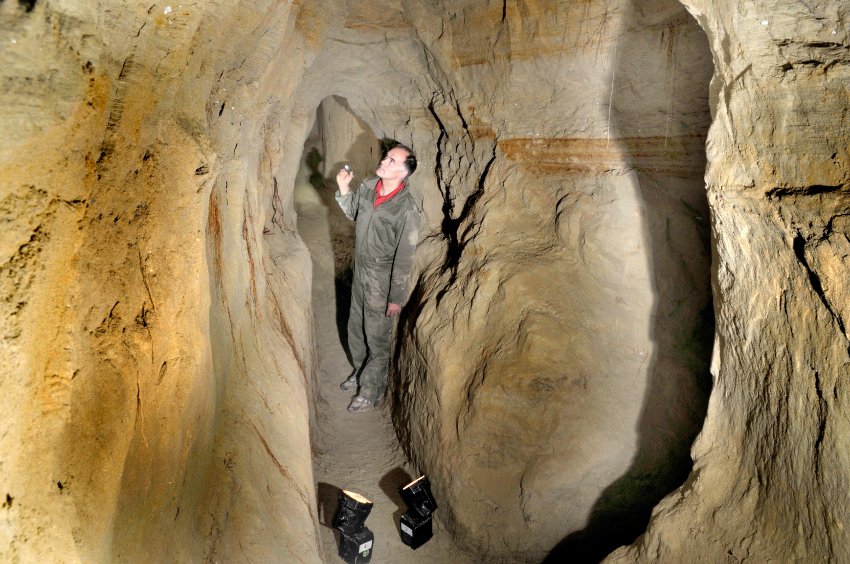
Churchyards and private farmlands throughout the German state of Bavaria are perforated from below by “more than 700 curious tunnel networks” whose “purpose remains a mystery.”

[Image: Photograph by Ben Behnke courtesy of Der Spiegel].

As Der Spiegel reports, “The tunnel entrances are sometimes located in the kitchens of old farmhouses, near churches and cemeteries or in the middle of a forest. The atmosphere inside is dark and oppressive, much as it would be inside an animal den.”

Although the subterranean networks are considered an “extremely unusual ancient phenomenon,” other “small underground labyrinths have been found across Europe, from Hungary to Spain, but no one knows why they were built.”

[Image: Diagram courtesy of Der Spiegel].

Small might actually understate the case: indeed, “the tunnels are often only 20 to 50 meters long. The larger passageways are big enough so that people can walk through them in a hunched position, but some tunnels are so small that explorers have to get down on all fours. The tiniest passageways, known as “Schlupfe” (“slips”), are barely 40 centimeters (16 inches) in diameter.”

[Image: Photographs by Ben Behnke courtesy of Der Spiegel].
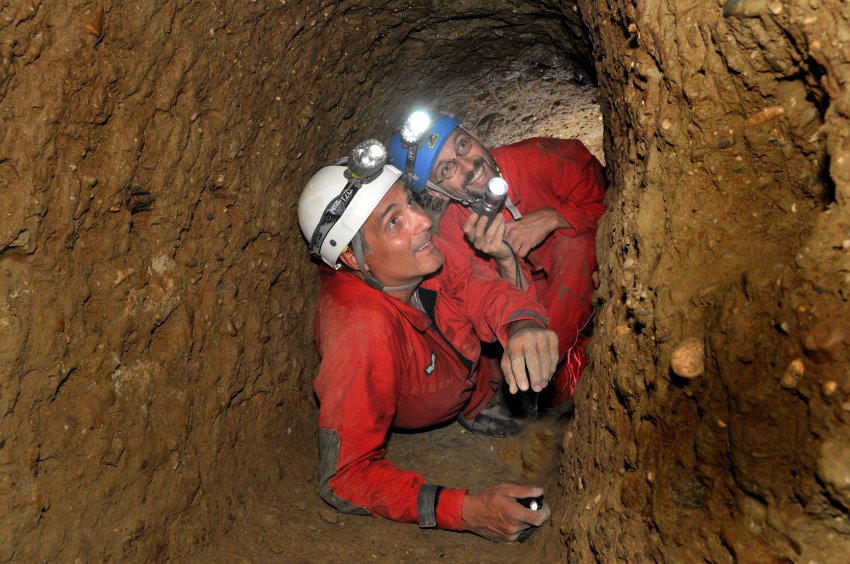
I’m particularly fascinated by examples of these tunnels being found on what is now private property. For instance, a family named the Greithanners, “from the town of Glonn near Munich, are the owners of a strange subterranean landmark. A labyrinth of vaults known as an Erdstall runs underneath their property. It is at least 25 meters (82 feet) long and likely stems from the Middle Ages.” I’m genuinely curious what the legal status of such discoveries might be. If, for instance, you discover someday that your house sits atop hundreds of feet of artificially excavated underground space from the Middle Ages, do your property taxes go up—or down, due to the structural inconvenience of owning land hollowed out from below?

[Image: Reasons to be cheerful; photo by Ben Behnke, courtesy of Der Spiegel].

In any case, Der Spiegel goes on to explain how local archaeologists (who, in order to avoid underground suffocation, once “blew air into a tunnel with a ‘reversible vacuum cleaner'”) have teamed up with engineers to explore these spaces—including a man named Nikolaus Arndt, who earlier in his career helped to build the Great Man-Made River of Libya. For now, the tunnels’ original purpose still remains unclear:

The vaults could not have served a practical purpose, as dwellings or to store food, for example, if only because the tunnels are so inconveniently narrow in places. Besides, some fill up with water in the winter. Also, the lack of evidence of feces indicates that they were not used to house livestock.

There is not a single written record of the construction of an Erdstall dating from the medieval period. “The tunnels were completely hushed up,” says [Dieter Ahlborn, leader of the Working Group for Erdstall Research].

Archeologists have also been surprised to find that the tunnels are almost completely empty and appear to be swept clean, as if they were abodes for the spirits. One gallery contained an iron plowshare, while heavy millstones were found in three others. Virtually nothing else has turned up in the vaults.

The rest of the occasionally bizarre article—one of the locals, for instance, says that sitting alone inside an Erdstall makes him “feel like a Hopi Indian”—is worth reading, though any hope that these tunnels might someday be found to rival the discovery of Derinkuyu should, alas, be put aside. Read more at Der Spiegel.

(Thanks to Derek Upham for the tip!)

Bird’s Eye View

The last time we heard from photographer Gerco de Ruijter, he was photographing tree farms from above using fishing poles and kites; now he’s back, having explored the biological edges of aerial photography by sending a pigeon aloft with a small video camera to perform a kind of animal surveillance of the urban landscape far below.

As Michel Banabila, who composed the music for de Ruijter’s film, explains, “the exhibition Loslaten (Letting Go) is showing two linear video shots made with a small video camera attached to a pigeon. The pigeon is flying over the city of Delft and flies home, following the A13 highway towards Rotterdam.” The bird thus reveals its own geography: tracking artificial landmarks of human infrastructure—the A13—and piecing together its own optical environment in the process.

The pigeon’s technical repurposing here—an animal turned instrument of surveillance—resembles the increasingly ubiquitous throwable UAVs designed by companies like AeroVironment: small-scale, easily deployed, aerodynamically sophisticated, biomorphic landscape photography. As if the Ansel Adams of the future will not use a tripod at all, but will instead release demilitarized machine-flocks of animalistic throw-drones into the skies of spectacular landscapes around the world.

[Images: The Raven throw-drone by AeroVironment, photos courtesy of the U.S. military via Wikipedia].

But what I’ve written so far overlooks a more obvious point, which is that de Ruijter’s work reveals as much about the pigeon holding the camera as it does about the urban forms passing by in a blur below. The pigeon here offers its own kind of autobiography, documenting its own passage through the landscape as it produces this ersatz documentary.

Several years ago, the Center for Land Use Interpretation (CLUI) hosted a small exhibition called On the Farm: Live Stock Footage by Livestock. “In this exhibit,” CLUI wrote, “farm animals show us their point of view through wireless video cameras installed temporarily on their heads and necks by virtuoso animal and plant videographer Sam Easterson. Easterson’s technology enables a cow, a pig, a goat, a chicken, a sheep, and a horse to guide us around their world; what they look at, what catches their attention, how they move through space, and how they relate to one another, on the farm.” More broadly, Easterson’s project sought “to create the world’s largest library of video footage that has been captured from the perspective of animals, plants and the environments they inhabit. The company creates its video footage by outfitting wild animal and plants with ‘helmet-mounted’ video cameras. It also installs micro video cameras deep inside animal and plant habitats.”

Speaking only for myself, however, the results were unwatchable: the footage—bouncing around constantly and never focusing on one single thing, then blurring left and right before colliding with the ground only to slide off trembling around the pasture some more—was literally nauseating and I found myself having to continually look away, as if blinking. Was there something about seeing the world from the perspective of an animal that can make a human sick? Admittedly, the anamorphic stutter-step of de Ruijter’s pigeon film invokes a not dissimilar reaction. (I should add that I believe I was watching Easterman’s pig footage).

[Images: An installation shot from On the Farm: Live Stock Footage by Livestock at CLUI].

Taking a different view—looking at animals on film, as opposed to animals filming—the L.A. Times recently looked at the popular phenomenon of “animal webcams,” trying to understand their human appeal:

From amateur setups near backyard bird nests to elaborate video systems chronicling the daily activities of sharks and polar bears, live webcams of animals show us birth, romance, skullduggery and death — animals behaving like animals 24/7. Birds of prey such as hawks and eagles are particularly popular, but with a little searching, you can watch the day-to-day goings-on of squirrels, meerkats, bears and even chickens. (For you doubters out there, chickens lead lives of endless drama and amusement. Trust me.).

The article’s author, a biologist, warns against too easily interpreting this growing archive of animal footage: “If we convince ourselves that animals reflect our own feelings—nothing more, nothing less—we are cheated of discovering what other species are really like, and we run the risk of homogenizing them into one giant beastly human reflection. What’s more, we often impose our biases on animals, assuming that what we see is what humans do. And then we miss things.”

What, then, can we learn not only about the anonymous pigeon filmmaker let go into the world by Gerco de Ruijter, but about our own urban environment as seen through the pigeon’s surrogate eyes? Perhaps nothing at all, to be honest—but expanding the possibilities for authorship, and giving animals the ability to contribute directly, through film, to a larger project of urban documentation, is a thrilling proposition.

(Earlier on BLDGBLOG: On the Grid. Animal webcam story found via @pruned. See also the now famous “monkey self-portrait“—as well as the old 1980s film Beastmaster—a kind of Krull Lite™—for its own “throwable drone”: a telepathic falcon named Sharak).

L.A. Stunt School

[Image: From L.A. Stunt School (2007) by Catrina Stewart].

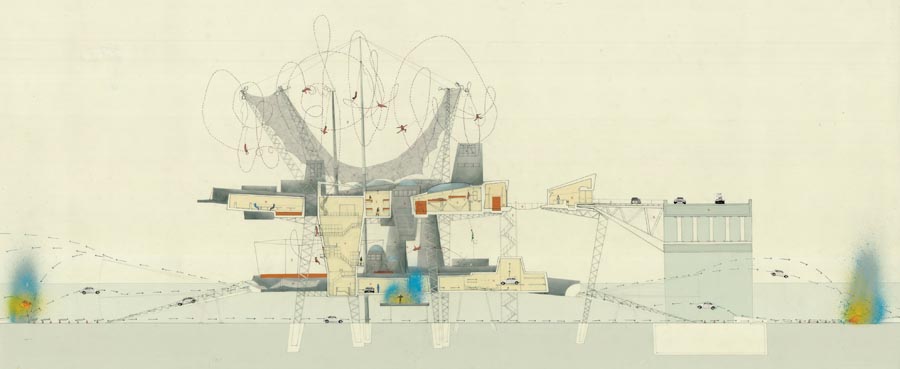
In 2007, Catrina Stewart, then a student at the Bartlett School of Architecture, proposed a stunt school for the city of Los Angeles, complete with ramps, explosions, and airborne students flying on ankle cables over spun webs of emergency netting.

Its premise was simple: to take the most extreme of extreme stunts and give them architectural form, to turn them into repeatable spatial events, and to make the whole thing a campus of accidents deftly avoided at the very last instant. Such a facility would need elaborate platforms for launching you (and your car or motorcycle) skyward; fake glass windows for crashing through; barrels to burn; walls to knock over; rubble to worm you way free from; operating rooms and burn wards for attempts gone sadly wrong; and, of course, cinemas and lecture halls for planning and reviewing a hard day’s work.

L.A. Stunt School was to be a place where actors came to learn and train to simulate fights, car crashes, flying, fire, explosions, etc.,” Stewart explains. “It is sited on the concrete banks of the Los Angeles River, towering over the suburbs on stilts to allow the water to rise and fall without affecting the function of the building. The drawings represent the spaces, but also function to convey the images of a city full of bright lights and ecstatic energy.”

[Image: From L.A. Stunt School (2007) by Catrina Stewart].

Stewart’s explanatory notes for the project are worth reading in full, as she goes on to caution against the idea that architecture should be content to limit itself to speculative work—to so-called paper architecture—notoriously, a Bartlett specialty. The L.A. Stunt School, in particular, she writes, “is largely hypothetical because it is built upon the premise of seduction rather than following the strict rules of construction. Conceptual architecture exists as a means for experimentation and offers inspiration—a different, more playful approach for future constructed architectural projects.” However, her criticism continues, at the end of the day architects “must not forget that if ideas cannot be realized, we cannot improve the lives of those who inhabit the spaces we design. After all, this is why the practice of architecture was invented.”

Personally, I would say that one should not be led to think that a project lacks pedagogical merit simply because it comes with an unusual design brief or narrative; in other words, it doesn’t matter if your project is a rural house for the elderly or a magical mountain complex for human-angel hybrids, what matters is that you, as a student or practicing architect, are able to communicate—in whatever form is most relevant—the spatial potential of this proposed built environment. As a brief experiment, take any classic project by Mies van der Rohe—or Paul Rudolph or Zaha Hadid—and recaption all the images with ridiculous things, like “time travel room,” or “hospital for mechanical insects,” or “astral CCTV compound,” and the strength of the architecture itself (one hopes) will still be visible beneath these rhetorical flourishes. Now imagine the opposite, that your instructor or client has ordered you and your colleagues to design a “hospital for mechanical insects” or an “astral CCTV compound,” and you can see that you needn’t abandon any pretense toward real buildability simply by taking on a speculative, even openly nonsensical, brief.

My point is simply that Stewart is right to question the educational value of an architecture course that seems more heavily invested in narrative than it is in engineering or even in HVAC. But the most narratively straight-forward projects in the world can also be the most badly realized; and the most speculative architect in the world can also be the most technically skilled. After all, if you can’t produce decent sections or plans or animations or models or construction diagrams, then it isn’t the speculative nature of the project you’re working on that’s the problem; and even if your project is intensely speculative, it doesn’t mean you must produce incoherent sections or plans or models or construction diagrams, etc.

What matters is that you know why you are engaged in architectural practice in the first place, and that you then work in such a way as to open up more of those specific opportunities—whether speculative or real, self-indulgent or humanitarian. As such, Stewart’s project description is a refreshing, albeit brief, statement of disinterest in seeing architecture become stuck as nothing but conceptually thrilling special effects on a computer screen or gallery wall. And her L.A. Stunt School is awesome.

(Spotted via the non-Archidose related Archidose Tumblr).

Death and Marriage, Weather and Birds

[Image: Artist Jae Rhim Lee models her “mushroom death suit“; photo by James Duncan Davidson/TED].

Some quick links for a Wednesday evening:

—Artist Jae Rhim Lee has designed a “mushroom death suit,” a posthumous garment impregnated with mushroom spores that will consume the corpse eventually wearing it. As she explains her inspiration, “by trying to preserve the body we poison the living” through the use of formaldehyde as an embalming tool; her suit thus offers “a new way of thinking about death,” to put it mildly. Read a short interview with the artist over at New Scientist. While we’re on the subject of formaldehyde, meanwhile, don’t forget that billionaire David Koch of Koch brothers fame, bankrollers of the Tea Party, owns the paper firm Georgia Pacific, one of the nation’s largest producers of formaldehyde. More to the point, for years Koch had successfully lobbied for formaldehyde not to be listed as a carcinogen, despite all medical evidence to the contrary, because your and your family’s health stands in the way of profitable business expansion. As Koch’s Tea Party knows all too well, using governmental regulation to protect U.S. citizens from being industrially poisoned is not a sign of patriotism, let alone of wisdom or responsibility; it is proof that you obstruct the righteous tide of personal freedom.

—A music critic for the New York Times attends a game at Yankee Stadium—and critiques the sounds he hears there, referring to the new arena as “a comfortable and acoustically lively new concert hall.” What would happen, he asks himself, “if I treated a game as a kind of outdoor musical piece?” And what if everyday public sounds could be subject to music—that is, to audio—criticism?

—Speaking of New York City, 30 July 2011 will see the widespread arrival of a new architectural typology: the pop-up wedding chapel.

Some couples may be married in a chapel made of three-dimensional plywood letters arranged in a circle. Others could find themselves in one composed of interlocking pipes connected with plastic zip ties. Certainly, the couples who marry inside such structures intend to form unions far more permanent than the sites where they will exchange vows.

A design competition sponsored by Architizer and The Knot—a competition which unfortunately ends only 24 hours from now—asks architects “to submit designs for one of two temporary structures to be erected for the day-long ceremony.” Your chapel must:

Be no taller than 10′-0″ above ground
Be no larger than 8′-0″ x 8′-0″
Be non-denominational
Be able to fit 5 people comfortably (1 officiant, 2 witnesses, 2 people getting married)
Be able to withstand windy conditions in the park, and possibly provide rain protection
Be able to be installed and de-installed within 2 hours
Be light enough to install without the need for mechanical assistance (no cranes or forklifts)
Be recyclable if possible [N.b. Why “if possible”? Make it recyclable!]
Not infringe on the paved surface below (no stakes!)
Adhere to NYC building codes
Celebrate the city of NY and the historic passage of the marriage equality act

So get to it! And congratulations to everyone finally able to marry—and congratulations to New York for taking a stand for love.

[Image: Mount Everest, via Wikipedia].

—Is Mount Everest as tall as Nepal says it is? The Chinese don’t think so; they “have argued [that the mountain] should be measured by its rock height. Nepal said it should be measured by its snow height—which is four meters higher.” So which is it? Nepal has responded by organizing “a new survey of Mount Everest to end the ‘confusion’ over the exact height,” the BBC reports, adding that “stations will be set up at three different locations using the global positioning system, and the task of measuring the peak would take two years.”

—A 39-story skyscraper in Seoul had to be abandoned temporarily after it started “to shake violently for 10 minutes” in the middle of the afternoon, for no apparent reason. Turns out, it was all because of a Tae Bo class: “It just happens to be that the vibration set up by the Tae Bo exercises coincided with the resonance frequency unique to the building,” an engineer explains. “When an external vibration hits the resonance frequency of a certain object, the vibration is amplified and causes excess shaking even from slight movement.” See the San Francisco Chronicle for more.

—The Pigeon Keepers of Bushwick by photographer Chris Arnade.

Cave diseases!

[Image: Painting by Andre Sokolov from Drifting on Alien Winds: Exploring the Skies and Weather of Other Worlds, courtesy of Springer].

—And I forgot to link this back in May, only to rediscover it in my bookmarks this morning: Drifting on Alien Winds: Exploring the Skies and Weather of Other Worlds. The fascinating book from which that is excerpted “explores the bizarre weather of alien worlds,” tracking “scientific discoveries from spacecraft, observatories, and laboratories [that] reveal the mysteries of weather across the Solar System.” As the book’s author, Michael Carroll, enthusiastically writes:

In fact, the weather on other worlds is terrifying, inspiring, and baffling. Lightning bolts sizzle through Jupiter’s atmosphere, powerful enough to run a small town for days. Hydrocarbon showers fall on Saturn’s moon Titan, and sulfuric acid rains down on Venus. Snows drift from carbon dioxide clouds on Mars and methane ice crystal hazes on Neptune, where blue storms the size of Earth come and go in a matter of months.

Download this 4.3mb PDF to sample the book’s contents.

(Thanks to Nicola Twilley for the pigeons link and to Nate Berg for the Tae Bo earthquake link).

The house of mechanical animals

The new film Convento documents work by Christiaan Zwanikken, an artist who preserves and literally reanimates dead animals using recycled motor parts and pumps rescued from scrapyards. He then “breeds these new species in a 400-year old monastery in Portugal,” which his family has been restoring for the past 25 years.

[Image: A still from Convento].

As Film Threat describes the process, dead creatures found around the grounds are “turned into new beings” by Zwanikken—for instance, the film shows “a chattering bird skull extended on a metal rotating pole,” and later there are “rabbit skulls on the end of two servos that twist and turn and then unexpectedly bash together, as if they were fighting in the afterlife.” Elsewhere, a “metallic ant sits in an outdoor walkway, head twisting and listening for its next prey,” and all of this is amidst “some of the most beautiful backgrounds you can imagine,” with the monastery perched on a cliffside over a nearby river.

In fact, the film is made unusually compelling precisely by its setting: a monastery (where everyday life was once run like clockwork), a site of moral and religious significance now repurposed to house monstrous animals resurrected as machines.

Not all of the creatures just stand there, however, demonstrating their own ingenuity: Zwanikken has also built an elaborate mechanical donkey that walks around in circles, hauling up buckets of water from the monastery’s well. Indeed, the film’s director, Jarred Alterman, explains why the donkey was his favorite thing to film:

Hundreds of years ago, donkeys were essential creatures for farming. The donkey had to be blindfolded, and it walked in a circle for 12 hours a day, pulling up water from a 15-meter-deep well, probably exhausted from heat. It’s incredible that Christiaan was able to understand the sensitivity and the history and create a mechanical animal that made reference to the importance of the animal, and create an artwork at the same time. It’s more about the animals than it is about robots.

Zwanikken himself elaborates on how these creatures are made:

I like the idea of recycling, so I collect a lot of materials from dumps. But the crucial parts—motors, gears and bearings—I try to buy new so they can be easily replaced. I use servo motors, hydraulics, pneumatics, stepper motors, electromagnetic devices, propellers, water pumps, combustion engines—basically anything that can be used to create movement. To control them, I use microcontrollers, tons of basic stamps, animatronic software, PCs, remote control and custom-built electronics. I salvage a lot of electronic parts from other machines. Most of the creations are stand-alone and have their own little brain that I program. The more complex pieces are interactive and have motion sensors, radar or ultrasonic sensors.

They are part of what Popular Science calls, in an unrelated context, a “new robotic phylogenesis.”

In some ways, I’m reminded of Liam Young’s Specimens of Unnatural History.

[Image: From Specimens of Unnatural History by Liam Young].

Young has written that, “as we stalk the strange and unfamiliar landscapes of robotics, biotechnology and ubiquitous computing, we are beginning to encounter a new form of engineered nature that we are not yet able to categorize.” His taxidermied hybrids thus populate these landscapes, arriving somewhere between technical objects—invented not evolved—and wondrous new organisms, monstrous yet beautiful in their singularity.

Perhaps this is the next nature we all face: reclusive inventors releasing newly assembled drone-animals into forests, lakes, and hunting grounds around the world—as spectacular as they are unearthly—and your children’s children will wake each morning to the dawn chorus of precisely engineered winged machines, exquisite mockeries of birds our generation will be the last to know.

(Liam Young’s Specimens of Unnatural History will be on display as part of “Landscape Futures: Instruments, Devices and Architectural Inventions” at the Nevada Museum of Art, opening 13 August 2011. For a thinly related old post, see The House of Memory and Automata. Convento spotted via Filmmaker Magazine).