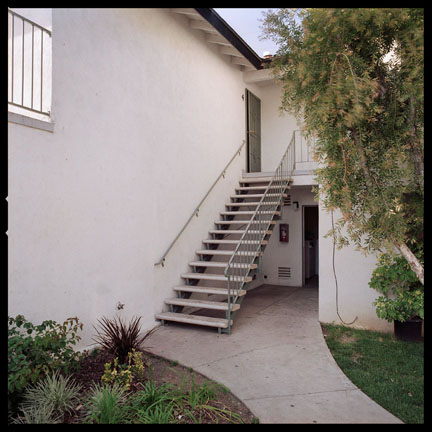
 [Image: Philip K. Dick’s former apartment complex, Fullerton, CA; photo ©Michael Rauner].
In The Visionary State, published last month by Chronicle Books, Erik Davis and Michael Rauner explore the religious landscape of California. The state’s cultural topography, Davis tells us, mirrors the physical terrain, “an overlapping set of diverse ecosystems, hanging, and sometimes quaking, on the literal edge of the West”:
This landscape ranges from pagan forests to ascetic deserts to the shifting shores of a watery void. It includes dizzying heights and terrible lows, and great urban zones of human construction. Even in its city life, California insists that there are more ways than one, with its major urban cultures roughly divided between the San Francisco Bay Area and greater Los Angeles. Indeed, Northern and Southern California are considered by some to be so different as to effectively constitute different states. But that is a mistake. California is not two: it is bipolar.
Indeed, the state is animated from below with “titanic forces implied by its geology,” Davis writes, and a “frontier strand of nature mysticism” long ago took conscious root.
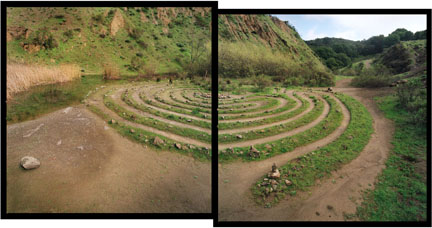 [Image: The labyrinth in Sibley Volcanic Regional Preserve, Oakland; photo ©Michael Rauner].
Over the course of the book, the authors visit California’s “Buddha towns” and Vedantic ashrams, its National Parks and the properties of discontented theosophists. They try to fathom what strange mutations of 21st-century Christianity could produce Jesus, the “OC Superstar,” in whose name compassionate self-sacrifice and divine generosity have been reduced to a grinning statue rather pleased with itself in a well-watered grove of palm trees. They even stop by California’s hot springs, wineries, observatories, and mind labs – without forgetting the dark side of the state, where Charles Manson, “trippy folk songs,” and a psychedelic obsession with “the Now” all meet.
At one point Davis hilariously describes Anton LaVey, author of The Satanic Bible:
Born Howard Levey in 1930, LaVey was less a freak guru than a Playboy-era steak-and-martini man. He hated hippies and LSD, played Wurlitzer organs in strip clubs, and had no interest in mystically dissolving the ego. Though essentially a con man, LaVey had enough psychological frankness and sleazy charm to attract scores to the black masses he held at his house in the Outer Richmond, a place he had, as the song goes, painted black.
Meanwhile, fans of Blade Runner will be pleased to hear that Davis and Rauner visit the so-called Bradbury Building. There, in Ridley Scott’s film, lived J.F. Sebastian, abandoned by everyone and prematurely old, designing his robotic toys.
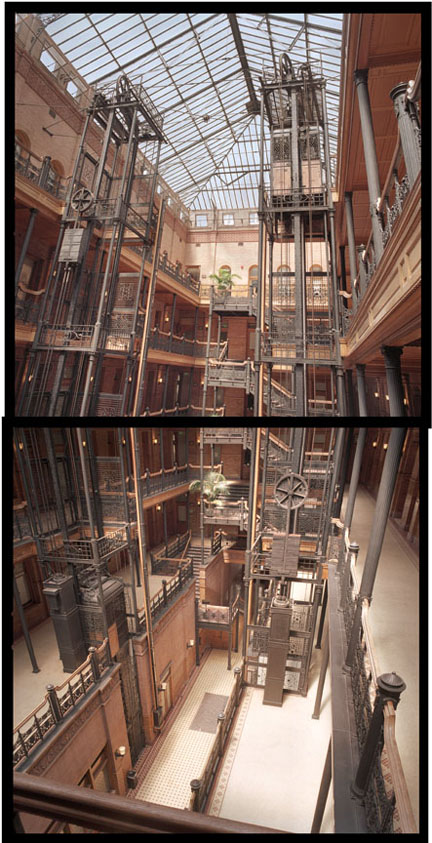 [Image: The Bradbury Building, Los Angeles; designed by George Wyman, the interior of the building “shoots upward toward a gabled canopy of glass, a lattice of light suspended over the delicate wrought-iron trusses that float in the clerestory haze.” Photo ©Michael Rauner].
Though I found the book philosophically adventurous, strangely good-humored, and particularly well-photographed, I will add that my own sense of the sacred – if I can phrase it as such – felt constantly challenged throughout. In other words, almost every time the authors visited a new site, I found myself immediately engaged in a kind of comparative landscape theology, asking: why is this place sacred?
Why on earth would they go there?
After all, is an archaeological site sacred to the Chumash more sacred than a street sacred to Philip K. Dick – or a quarry sacred to the Center for Land Use Interpretation? Or vice versa? What about a site favored by Erik Davis and Michael Rauner themselves, as they performed literally years of research for the book?
Such questions only lead to more of themselves. If the Mormons, for instance, launched a geostationary satellite over the city of Los Angeles, and they used it to broadcast radio sermons, is that precise location in the sky – a square-meter of rarefied air – to be considered sacred? Or is there a holy tide or blessed current that flows through the coves of Big Sur – whose landscape, a “wild harmony of impermanence and beauty,” Davis writes, so stunned the poet Robinson Jeffers? Does that visionary landscape have a correspondingly sacred hydroscape, some undersea world of the dead discussed a thousand years earlier in tribal myths? Can the weather be sacred – or even a particular storm?
And where does the geography of celebrity fit in…?
How do you differentiate between the sacred and the postmodern – and even outright kitsch?
• • •I decided the best thing to do was talk to Davis himself – and so I called him. What follows is a transcript of the conversation.
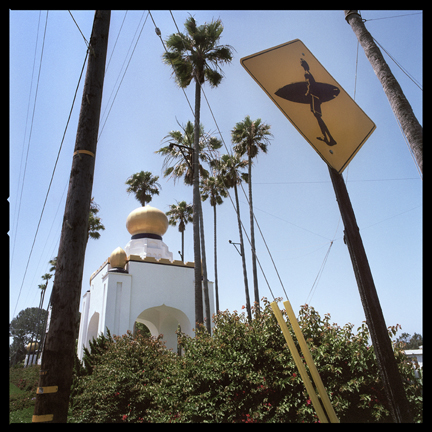
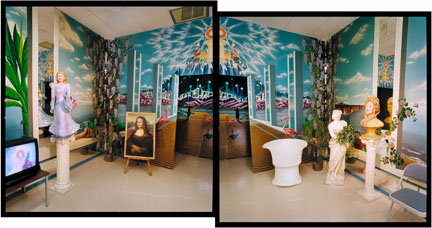
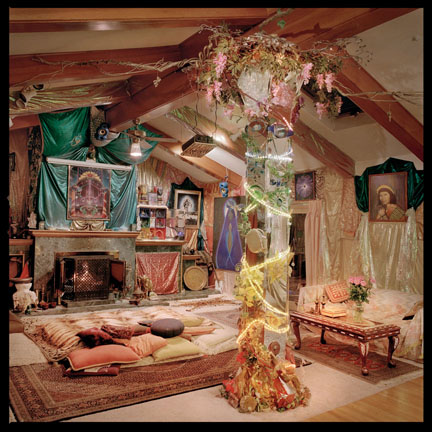 [Images: Swami’s in Encinitas; a room in the Star Center, Unarius Academy of Science, El Cajon; and the Temple Room at Goddess Temple, Boulder Creek. Photos ©Michael Rauner].
BLDGBLOG: What were your criteria for deciding if a location – a building, a landscape, a particular street in Los Angeles – was sacred or visionary? Was your list of sites determined by rigorous historical and anthropological research, or by your own subjective interpretation of the sites?
Erik Davis: It was pretty clear, in an objective sense, where the major points were – the major locations to find. I was looking either for a new religious movement that had some literally visionary quality behind it, or for a novel, visionary development within an older and existing tradition. But there was always a grey area. On that level, I started to go a little bit on intuition – not just picking things that I liked, obviously, but picking things that seemed to complete or expand the story behind the book.
A good example is Luna, the tree that Julia Butterfly Hill sat in. Is it religious, is it spiritual, is it visionary? Even from an anthropological perspective, you’re kind of left wondering about that – but I really felt like there was something powerful in the way the tree came to serve as an update for the story of nature mysticism in California. We actually had to work quite a lot to access Luna – because it’s on private land, and they don’t like people to know where it is – but we did finally get there, and we went to the tree, and we thought, you know: it’s an impressive tree, it’s got these weird braces on it that stabilized it from where somebody tried to chop it down… But around the back side of the tree, there was this hollowed-out, blackened hole – and it was full of little trinkets. People had come, sneaking onto the land, in order to pay homage. There was a Navaho dreamcatcher and a little bodhisattva figure and a teacup and a little glyph of a tree – it was this rag-tag mixture of objects that had transformed the tree into a kind of miniature shrine.
I saw that and I thought: okay, I’m on the right track. [laughs]
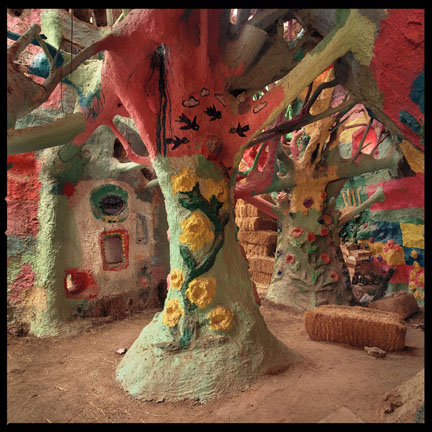 [Image: Tire Tree, Salvation Mountain, Slab City; photo ©Michael Rauner. This, of course, is not Luna].
BLDGBLOG: At one point, you visit Gary Snyder’s zendo, and you mention the Beat Generation in several places throughout the book – but what about visiting a few more locations from the Beats’ literary heyday, like the apartment where Allen Ginsberg wrote “Howl”?
Davis: I tried to keep to things that were as explicitly religious or spiritual as possible – but, you can imagine, we had a long B-list of places we thought we could include. We were constantly asking for more space from the publisher! There are just so many elements that went into it: geography; wanting to keep a balance between urban and rural, north and south, different traditions – Buddhist, Christian, pagan, Native American. There were places that were famous vs. places that weren’t famous – this kind of high/low tension – but there were also things that just came out of the earlier sites. People start telling you stuff.
Like at Watts Towers: one of the guys who worked there was a local, and we started talking about assemblage, and collage, and using different pieces of trash to make art – and he said, Oh, you know, there’s this great place called Self Help Graphics out in East L.A., and I never would’ve found that place if I hadn’t met the guy. So Michael Rauner and I went out there, and it was great.
There were all kinds of synchronicities like that.
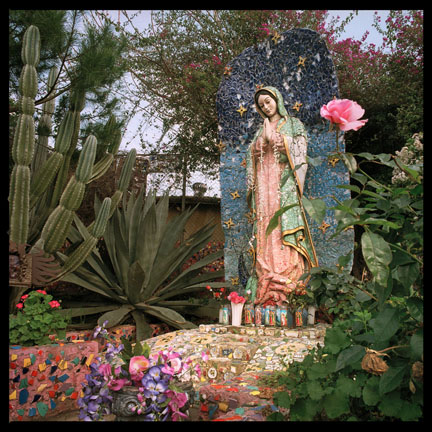 [Image: The Virgin of Guadalupe, Self Help Graphics & Art, East L.A.; photo ©Michael Rauner].
BLDGBLOG: This is perhaps a question more appropriate for J.G. Ballard than it is for The Visionary State, but were you ever tempted to include things like the site where James Dean was killed? Or the exact route driven by O.J. Simpson as he fled the police? For that matter, what if you’d found out that the whole Los Angeles freeway system had been designed by some rogue Freemason – and so all those knotted flyovers and concretized inner-city access routes are really a huge, psycho-spiritual landscape installation? Something between the Blythe geoglyph and the maze outside Grace Cathedral?
Davis: I would have loved that. [laughter] But, you know, the further you go into these weird mixtures of imagination and space, inevitably that kind of thing comes your way. That’s the thing about psychogeography – because, in a way, what I was doing was a kind of relatively gentle psychogeography of the state.
For instance, one thing I really enjoyed seeing was this witch’s map of California, where she’d laid the 7 chakras down onto different regions of the state – and I really wanted to work that in. But as far as the built, modern, commercial, secular landscape of California goes, if I had come across stuff like that – and I’m sure there’s some of it out there – then of course. That wouldn’t surprise me, for one thing – and it would excite me, for another. As I say, we have a long B-list.
 [Image: The Witch House/Spadena House, Beverly Hills; photo ©Michael Rauner].
BLDGBLOG: Finally, where do earthquakes and seismology fit in all this? For some reason, I was expecting the San Andreas Fault to play a much larger role in the book – but you don’t really play that up. Which I actually then preferred.
Davis: You’re right – I didn’t play that too strongly – but it’s definitely there as a kind of psychic twist inside the state. For me, the seismology thing really worked in a more gentle way, and that was by talking about the hot springs. In the hot springs you see how the seismically active underside of California has created an environment where you get natural springs, and those become centers of healing.
When I started out, I thought there were going to be more explicit landscapes to include in the book – like Death Valley, and the San Andreas Fault – but the more we got into it, the more we found there were built structures just screaming out for inclusion. The book ended up shifting subtly toward architecture and the built environment, with the landscape providing the background, as it were, for these more specifically cultural places of spiritual and visionary power.
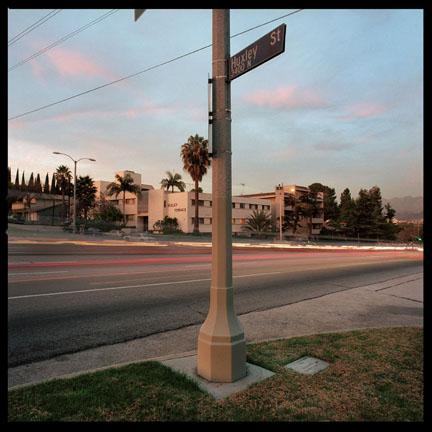 [Image: Huxley Street, Los Angeles, named after Aldous Huxley. By the end of his life, Davis tells us, Huxley had “concluded that people needed to change on an individual psychological level if civilization was going to avoid the disasters he glimpsed on the horizon: overpopulation, high-tech war, ecological catastrophe, and the sort of narcotized totalitarian propaganda depicted with such lasting power in Brave New World.” Photo ©Michael Rauner].
• • •At the book’s end, Davis reconsiders sunset, an event that resets the westward clock to its cyclic eastern origins; it is, he says, “the holiest moment of the day.” But sunset is too easily mythologized: it resets no clocks, and its cycles are not human but
magnetic, thermochemical, turning on an alien timescale that knows nothing of earthly religion.
In the myths that do arise, however, transforming westward motion into something yet more godly and epic, California plays a distinct – and vulnerable – role:
In the American imagination, California’s shores stage both the fulfillment and decline of the West, its final shot at paradise and its perilous fall into the sea. That is why the California dream encompasses both Arcadian frontier and apocalyptic end zone, Eden and Babylon. As Christopher Isherwood put it, “California is a tragic land – like Palestine, like every promised land.”
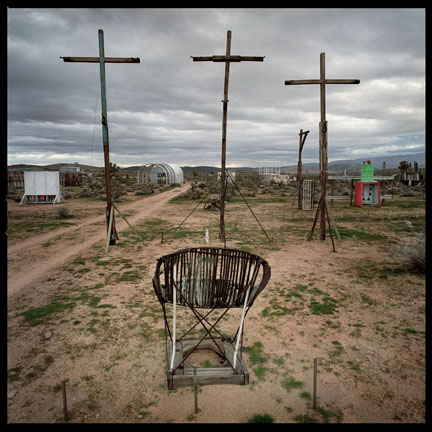 [Image: Noah Purifoy Sculpture Garden, Joshua Tree; photo ©Michael Rauner].
(Thanks to Erik Davis for his time and enthusiasm, and to Michael Rauner for the fantastic photographs. Meanwhile, Erik will be presenting The Visionary State at a number of locations; here’s his schedule of appearances.
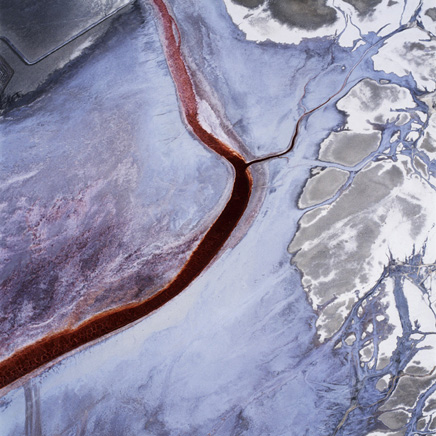 [Image: David Maisel, from The Lake Project].
 [Image: David Maisel, from The Lake Project].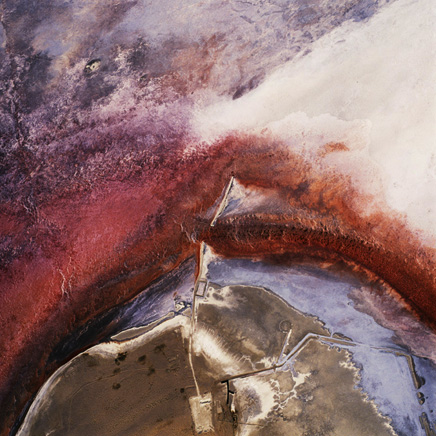
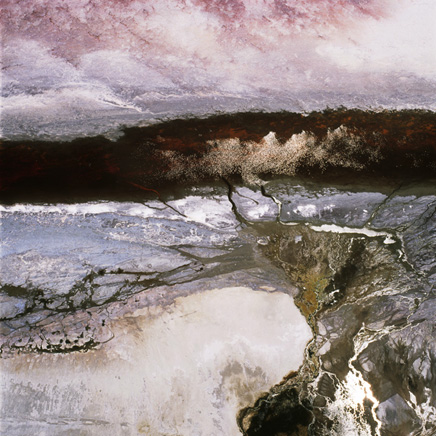 [Images: David Maisel, from The Lake Project].