Chemical Radiance: A review of the film Sunshine

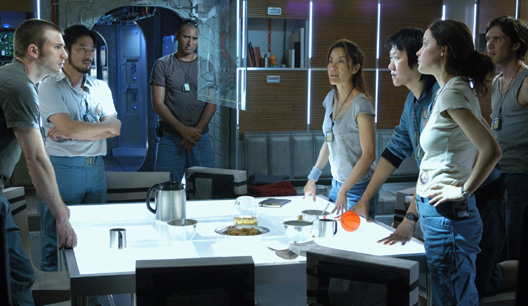
[Image: The cast of Sunshine; courtesy of DNA Films].

I saw Sunshine the other day, so I thought I’d offer a few thoughts about it here. However, please beware that this post gives away key plot details and spoils the end of the film – so do not read this post if you’d like to avoid such knowledge.
In brief, myself and two friends went to see the film together – and we had three totally different reactions. One of us was basically annoyed with it from the very beginning – and a weird plot twist, that I’ll soon discuss, about 5/6ths of the way through the movie, just killed it for him; the other more or less liked everything about the film, even accepting said “weird plot twist” for interesting reasons of his own; and I really liked the film, with several reservations, until, yes, the aforementioned weird plot twist – which basically does the whole thing in for me. In fact, I’m still stunned that this one particular detail ever made it into the script.
In any case, what the film does – and it does this very successfully, in my opinion – is set up an increasingly melancholy sense of psychological isolation as an international crew of scientists, aboard a ship called the Icarus 2, flies toward the Sun. The Sun, we learn, is dying – and so it needs to be restarted with a “stellar bomb” the size of Manhattan. In fact, we learn, the bomb is so big that it contains literally all of the Earth’s fissile material. Once detonated, it will form “a star within a star” – a surrogate astronomy, or Sun-replacement surgery, that will save everyone back on Earth from the perpetual winter in which they’ve been trapped.
Whether or not this would actually work, from the standpoint of an astral physicist, is beside the point; you’re asked to accept this, as the basic plot of the film, and, as far as that goes, I accepted it.
Meanwhile, the visual and conceptual beauty of certain scenes – they witness a transit of Mercury, for instance – is extraordinary. Further, the possibility that they may not make it back to Earth, though still unlikely at the film’s beginning, adds a distinct aura of extinction and exclusivity to everything they see.
No one will ever see these things again.
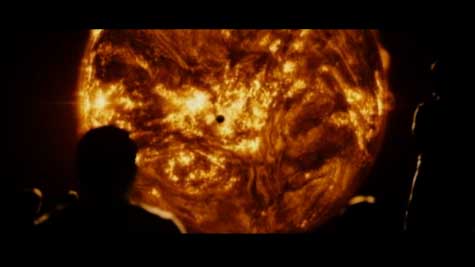
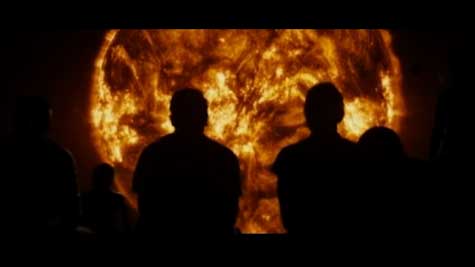
[Images: Screen-grabs from the Sunshine website; courtesy of DNA Films].

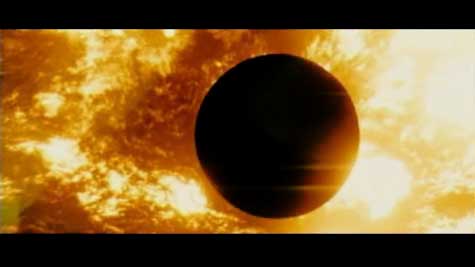
However, as the ship approaches its solar rendezvous, a kind of elemental, alien hostility begins to emerge – not from within the crew members, but from within the Sun itself. Far from being a beneficent source of light in the sky, generously tanning the bodies of we Earthlings below, the Sun is revealed as a monstrous and abiological source of mutative radiation, inhumanly immense, so bright you can’t see it, disintegrating nearly everything that comes near.
One of the crewmembers – the resident psychiatrist – becomes addicted to the star: he can’t stop burning himself with more and more quantities of sunlight, asking the ship’s central computer to increase the unfiltered percentage that is allowed through the observation deck window. With his skin peeling and his mouth hanging open, he nearly disappears into a void made entirely of light – golden, enveloping him on all sides – yet we hear, incredibly, that he’s only receiving 3.1% of the Sun’s natural capacity. 4%, we’re told, would destroy the psychiatrist outright – let alone 50% or 90%, or the Sun itself, unfiltered.
In fact, for me, the film very brilliantly illustrates the paradox that something can be so powerful that the ability to experience it is simply beyond the limits of human life – outside of human experience altogether.

[Image: The sun].

Anyway, if the first 4/5ths or even 5/6ths of the film are about this painfully beautiful, almost evaporative, encounter with an alien and threateningly vast – yet so ironically necessary to life on Earth – stellar object, then the “weird plot twist” that I mentioned above feels as if the ending to another film had been accidentally stitched on in the editing room.
In brief: Sunshine suddenly turns into The Texas Chainsaw Massacre.
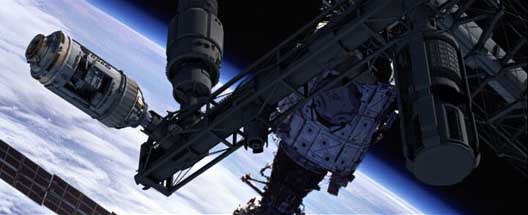
[Image: The ship from Sunshine; courtesy of DNA Films].

It’s as if the film shies away from its own material, unable, or unwilling, to contemplate what might happen if people, aware of their own impending deaths, fly straight into the Sun – an origin point devoid of recognizability – and so they throw a serial killer in, almost literally out of nowhere.
The film could have been stunning: the crew is pared down, one by one, by accidents or oxygen shortages, and even a suicide, until only three or four of them are left. They know that they will never return; they know that they will die unprecedented deaths, obliterated by Apollo, by God, by the Sun – by whatever you want to call it; and they are terrified by that rapturous undoing, unable to narrate their final experience for anyone back home, truly cut off yet almost psychedelically alive in this moment of solar contact…
But that’s not how the film ends.
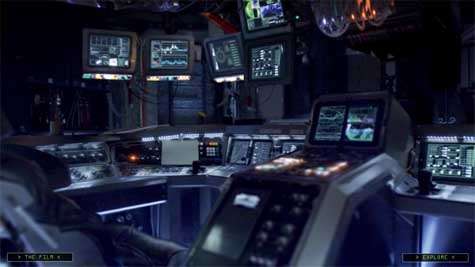
[Image: The flight deck from Sunshine, in a screen-grab from the film’s website; courtesy of DNA Films].

Midway through Sunshine, a distress beacon is heard. It’s from the mission before their mission – the one that failed. That ship – called Icarus 1 – disappeared nearly seven years ago, somewhere in the irradiated gulf between Mercury and the Sun.
In a decision that, I’ll concede, is necessary for certain things to come but is still so ridiculous as to make viewers question the competence of the entire crew – the last great hope of humanity! – they decide to deviate their mission in order to find the lost ship.
Lo! They find the lost ship.
Lo! They know exactly how to dock with it, despite – for obvious reasons – never having practiced anything of the sort.
Lo! Unbeknownst to them, the captain of the Icarus 1 is still alive – and he hides out on the Icarus 2, escaping notice. Like a comic book superhero, he’s survived seven years alone on a disabled spaceship floating between Mercury and the Sun – without being pulled in by that star’s gravity. As if serving simply to make the film’s existential themes explicit, he has also pre-recorded an angry and completely unhinged theological rant about God’s Will and the absurdity of Man trying to restart the Sun.
Even more unbelievably, it turns out that this guy isn’t malnourished, semi-skeletal, or even psychologically catatonic: no, after seven years alone, eating hydroponic carrots in space, he’s become a superstrong, sunburnt Hercules, capable of lifting two crewmembers at a time with one arm whilst chasing everyone else down and murdering them with a mechanized surgical scalpel.
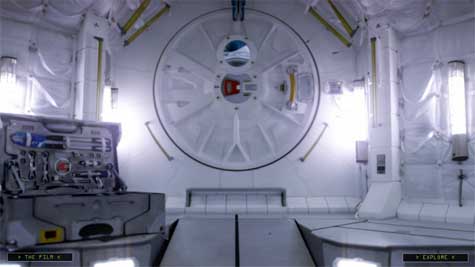
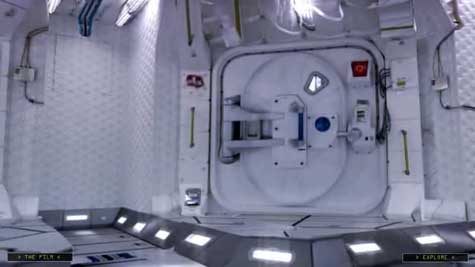
[Images: Two views of the airlock from Sunshine, in screen-grabs from the film’s website; courtesy of DNA Films].

Where did this come from?
And why?
At the risk of wildly exaggerrating the philosophical depth of the first 5/6ths of the film, this seems roughly akin to throwing in a serial killer for the last three chapters of Thus Spoke Zarathustra – Nietzsche is chased through the claustrophobic rooms of his mountain home – or adding the Son of Sam to the grand finale of the Tao Te Ching.
In any case, can you really be so scared of your own premise – the unwitnessed and lonely deaths of an oxygen-starved crew as they fly into the Sun, toting a “stellar bomb” the size of Manhattan (talk about mythological plotlines!) – that you have to add Freddy Krueger?
Even worse, the film had already established by then that no one would survive. The film had already established that the Sun was a source of great attractive power, far beyond the mere pull of gravity, and that it was possible to become hypnotized by, even addicted, to the very thing that would later annihilate you – and that this death would be more horrible than human pain can describe, yet something of such exquisite agony, and so spectacular, something uniquely sublime in the history of human experience, that you would actually want to feel it.
You would fall toward roiling continents of hydrogen and light, and you would be utterly consumed by your destination.
It would have been the science fiction film of the decade! An instant classic.
Instead, just when everyone has settled in for the ending, waiting for that golden burn, our mutant Hercules of unlimited arm strength appears, creeping up behind people in the dark and knifing them in the spine.
How could you cheat the audience and the characters out of the philosophical glory of solar absorption? Sunshine would practically have been a religious text, a near classic work of speculative philosophy exploring what it means not just to die but to be completely obliterated, atomically consumed in chemical radiance by the same two-faced point of origin that makes life on Earth possible in the first place.
Imagine if the Chandogya Upanishad ended not with the nature of time, space, life, and astronomy – but with an ax murderer.
Or Siddhartha: the Buddha is inexplicably hunted by an escaped convict with a chainsaw… (That sounds kind of fun, actually).
Does this mean that I am comparing the film Sunshine to the Chandogya Upanisad? Well… I suppose I am, out of over-enthusiasm – but I am also saying that Sunshine wildly misses that mark. Instead of going for cinematic magnificence, and it was well on its way to arriving there, it takes a disastrous step back – and reveals itself as a cheap, quasi-1990s space-horror misfire.
Was the knife-wielding lunatic evidence of tampering by the studio? In other words, did the film’s producers demand more of a predictable impact? Or did Alex Garland write that guy into the original script? If so, why? Were the filmmakers pleased with the final result? Were they so unhappy with the idea of flying their own crew into the Sun that they added an interstellar He-Man, sunburnt and stronger than Arnold Schwarzeneggar?
Or was the knife-wielding lunatic a way to screen the filmmakers themselves from the imaginative power of their own subject matter?
Was there something about the premise itself – total absorption by a featureless, golden void – that forced them to retreat, and to insert something that they and, they hoped, the audience could recognize?
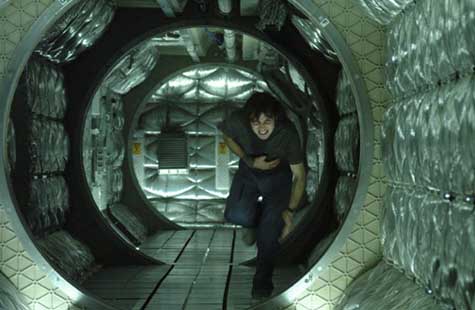
[Image: Cillian Murphy runs from a knife-wielding, sunburnt lunatic in Sunshine, a screen-grab from the film’s website; courtesy of DNA Films].

Like I say, if the film hadn’t already been on its way to the final credits, with no need for such a plot twist, I could perhaps have accepted the chromosomally damaged avenger. If it had been the ship’s resident psychiatrist, for instance, psychotically consumed by the Apollonian power of astral radiance, at least it would have been neat and tidy – if still clichéd.
But since we were already on our way into the Sun, already past the point of even thinking that the crew might return home, already accepting the fact that everyone in the film would die heroic, astronomically unprecedented deaths, why did we need the murderous accelerant of a Sun-addled stowaway?
That does nothing more than rob the film of its poetic grandeur – so that the filmmakers could safely turn their back on philosophy and create Leviathan in zero-G.

(Thanks to Christopher and Michael for seeing the film with me – and for listening to me rant about all of the above for nearly two hours. Meanwhile, if you completely disagree with this review, please jump in and convince me otherwise. Earlier on BLDGBLOG: The Oxygen Garden).

Proper Project Orientation

[Image: A wonderfully disorienting image, called Proper Project Orientation, by Vancouver-based photographer Bill MacEwen – an image so spatially evocative, with its labyrinth of scaffolding, ladders, surfaces, and stairways – a horizontal universe of painterly self-connectedness – that I’d rather not reveal what the photo actually is. Is it a billboard, re-designed by Lebbeus Woods? Or a painting? Perhaps it’s a drive-in cinema after an atom bomb has hit… It’s better just to stare and enjoy – while viewing the original photo here. (Thanks, Bill!].

Little Earth

[Image: Little Earth by London Fieldworks].

Speaking of surrogate earths, the science-minded arts group London Fieldworks has a project, from 2004, called Little Earth.
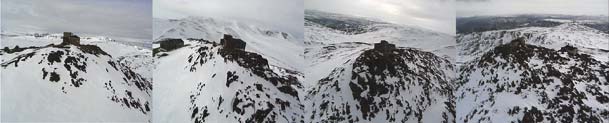
Little Earth was a “four channel synchronised video installation with surround sound,” featuring scenes “shot on Haldde Mountain in the Norwegian Arctic, Ben Nevis in Scotland, and on the island of Svalbard, with computer animations of the Earth’s magnetosphere modeled by the Leicester Radio & Space Plasma Physics Group.”

[Image: Another glimpse of Little Earth by London Fieldworks].

The Independent refers to these latter projections as being “an animated sequence of the Earth enmeshed within its magnetic field lines, which trail off into the solar system.”
Here are some video stills of the project.

[Images: Film stills from Little Earth by London Fieldworks].

Meanwhile, London Fieldworks also produced a short publication about the project; the book includes essays on art, meteorology, and physics.
But I was interested to see that the project is at least partly about Norwegian scientist Kristian Birkeland. From the project’s website:

The Little Earth project identifies two physicists, C.T.R. Wilson and Kristian Birkeland, as significant contributors to ‘big science’. Both researchers were stationed at mountaintop observatories studying natural phenomena at the end of the 19th-century. They relied on naked-eye observation and simple instruments in extreme environments and were perhaps the last of the natural philosophers. Associated with the mountaintop experiences of Wilson and Birkeland are two celebrated machines: Wilson’s famous ‘cloud chamber’ and Birkeland’s lesser-known ‘terrella’. The instruments promoted understanding of phenomena at the micro and macro scale – signaling new frontiers for exploration.

Among many other reasons, this caught my eye because Birkeland and his “terrella” – which London Fieldworks describe as an artificial “plasma universe” – were the subject of one of the very first BLDGBLOG posts… a post which, in an almost freakish coincidence, I was re-reading just this morning, several hours before I discovered Little Earth (via we make money not art).
It’s an old post, so it’s strangely formatted and a little over-casual, but it’s also one of my favorites – so check it out if you get the chance.
And if London Fieldworks sounds like an interesting group, you’ll be pleased to know that there are several other cool projects described on their website.

(Note: Little Earth spotted over at we make money not art).

The Oxygen Garden

[Image: The Oxygen Garden, from Sunshine; courtesy of DNA Films].

The sci-fi film Sunshine – which finally opens in the United States tomorrow – includes a set called the Oxygen Garden.

[Image: The Oxygen Garden, from Sunshine; courtesy of DNA Films].

As the film’s official website explains: “Oxygen production is vital for manned long-term space flight.” Accordingly, “a long-term mission should have a natural, unmechanical way of replenishing its oxygen supplies.”
Making a few visual references to NASA’s early experiments with “space gardens” – and to other artificial landscapes, such as Biosphere 2 – the film’s artistic team thus wired together a network of plants, aeration devices, cylindrical grow chambers, and hydroponic vats.

[Image: The Oxygen Garden, from Sunshine; courtesy of DNA Films].

The Garden is “one of the most interesting sets” in the film, the website claims, “as the cold, clean ‘spaceshipness’ is juxtaposed with the wild, dirty nature – this is the only set where there is anything ‘green’. All of the plants you see on the set are real, there’s not one plastic fern in there at all. When you walk in you are immediately struck by how the set smells. It smells alive.”

[Image: A close-up of the Oxygen Garden, from Sunshine; courtesy of DNA Films].

I have to admit to a certain fascination with surrogate earths: those portable versions of our planet, and its climate, that pop up everywhere from hydroponic gardens, terrariums, and floating greenhouses to complex plans for manned missions to the moon.
If only for the purpose of growing vegetables, how can we use technology – fertilizers, UV lights – to reproduce terrestrial conditions elsewhere, in miniature?
Under rigorous interpretations of, say, The Bible or The Koran, would this be considered a sin?

[Image: A glimpse inside the Oxygen Garden, from Sunshine; courtesy of DNA Films].

And, finally, what does it mean that the earth itself can enter into a chain of substitutions – a whole economy of counterfeits and stand-ins, referring, through simulation, to a lost original – only to produce something so unearthly as a result?

Sponsored Living

Last month I received a press release announcing that Park Fifth, a new condo development here in Los Angeles, has started to offer 5-year memberships in the local Museum of Contemporary Art to anyone who buys a home in the high-rise.
These memberships come as part of an elite residential package, complete with “generously sized balconies or terraces,” a few “entertaining areas” scattered throughout the building, and even some “rooftop pools” – all in what will soon be “the tallest residential building west of Chicago.”
In other words, a little art will come with your luxury.

From the press release:

Much in the same way that MOCA has become a culturally inspiring part of Downtown Los Angeles, Park Fifth intends to weave exquisite taste and a luxurious artistic atmosphere throughout its entire development while giving a spacious, yet Californian feel to it.

The project manager of the building then speculates that “homeowners who are attracted to the bold, modern architecture and design aesthetic of Park Fifth will also appreciate the benefits of MOCA membership.”

[Image: A screen-grab from the Park Fifth website].

The reason I’m posting this, though, is not to make fun of the condo project, but because I love the idea of applying fringe benefits to residential real estate. Anything to make people sign on the dotted line.
Your $800,000 condo comes with… a free subscription to The New Yorker. Or maybe a pre-assembled IKEA bookcase full of Penguin Classics.
You get a luxury condo and cultural literacy. Dating has never been easier.
After all, such benefits wouldn’t even cost a developer that much to include. A 5-year Household Membership at MOCA only costs $500 – but folding that into your new $1 million condo purchase has psychological impact: you may have spent that money on something else, for instance, and, this way, you can feel unthreateningly forced into a socially useful lifestyle change.
For instance, you could buy a new home in the suburbs… and get 250 Vintage contemporary fiction paperback books thrown in as a signing bonus. Within two years you’ll know everything there is to know about American fiction at the turn of the 21st century. Your house could even come with a Borders Rewards card. Hell, you could get a free two-year membership in the Microbrewed Beer of the Month club.
Or everyone on your street in the desert outside Phoenix gets a free Smart Car. Residential brand synergies go into hyperdrive.
It’d be like those celebrity goodie bags that people like Leonardo DiCaprio and Tyra Banks apparently get on Oscar night – only it’d be for homeowners. In other words, the developers of your building have partnered with the local small business bureau, so that the 2 bed/1 bath home you and your spouse just bought comes complete with 2 free tickets, every week, to the local cinema – as well as 10% off at the nearby Italian restaurant and a free double espresso on your birthday from the Starbucks in the ground floor lobby.
Or season tickets to the Eagles.
It’s the couponing of the residential experience. Toll Brothers signs a marketing contract with Playboy (NSFW), and so that new bungalow you just bought in the Chartresian labyrinth of cul-de-sacs outside Tuscaloosa comes complete with every single issue of Playboy magazine.
Houses sell out within days and the neighborhood divorce rate skyrockets.

[Image: Another screen-grab from the Park Fifth website].

Or Richard Branson goes into home development: Virgin Homes. Virgin Condos. Thus, you buy a Virgin Flat and you get two free round-trip tickets, every year for five years, on Virgin Airlines. Anywhere in the world.
It’s the future of sponsored living. Corporate residentialism.
Having said all this, I have to admit – or perhaps it’s obvious – that I think offering 5-year memberships at MOCA to all future tenants in the Park Fifth is actually a brilliant marketing move. In fact, at the risk of sounding more enthusiastic than I really am about the commercial possibilities inherent in domestic property ownership, I think fringe benefits of this kind are undoubtedly the future of successful real estate marketing – and that more and more corporate partnerships, between property developers, magazines, airlines, hoteliers, restaurants, book publishers (a free copy of the BLDGBLOG Book for every KB Home customer!), film production companies, beauty products firms, grocery supply chains, health clubs, etc., will wildly proliferate over the next decade. Whether you want them to or not.
Buy your house now – and get a complete line of L’Oreal for Men delivered to your door every three months. And a complimentary ticket to Disneyworld.

To delete this building, press 3

A few weeks ago, I posted about the “typical dream” of a New Yorker, in which said New Yorker one night discovers a whole extra room hidden away somewhere in an otherwise cramped Manhattan apartment – opening up a disguised door, in the back of the closet… and finding a fully furnished 20’x20′ master suite. With a bearskin rug. Or a new bathroom, with gold-plated taps and a trouser press. Or an entire backyard, full of gas grills, hidden behind the living room wall.
The ecstasy of having more space in Manhattan.
I then suggested that someone should go around New York interviewing people who have had this dream – or asking people who have never had this dream to ad lib, describing what sorts of extra rooms and spaces they would most like to find, tucked away behind the limited square-footage of walls and apartment living.
You’d then edit all the responses up into a radio show – and broadcast it live at rush hour, without explanation.
The city goes wild.
Manhattan is full of extra rooms! people scream. There are secret hallways everywhere! People start knocking on walls and rifling through closets, desperately searching for a place of their own. Maybe an undiscovered planetarium in the basement crawlspace.
In any case: we’re now doing it.
We’re making the radio show.

We, in this case, is BLDGBLOG and DJ /rupture (who spoke at Postopolis! last month); we’ll be putting your extra room fantasies on the air…
Specifically, /rup’s got a weekly radio show on WFMU91.1 FM in New York City – and, to collect your dreams, we’ve signed up for a free, joint voicemail account.
It’s voicemail as public recording booth.
So what’s your extra room fantasy? You don’t have to live in New York to answer. If you woke up in the middle of the night and found a door… where would you want it to go?
Call +1 (206) 337-1474 and let us know. If we like your story, we’ll put you – anonymous, woven into a background of music, without explanation – live on the air in New York City, then podcasted around the world and available via MP3.

Meanwhile, there are ten thousand other potential uses for a voicemail account and a weekly radio show.
Over the next few weeks and months, then, DJ /rupture and I will be switching things up: asking new questions and looking for new material. For instance, there’ll be a field-recordings-by-phone project – where someone standing on the Oregon coast can call +1 (206) 337-1474 and record two minutes’ worth of coastal ambiance, which will later be played live on the radio – and a sound-of-your-favorite-bus-stop-as-recorded-by-a-cell-phone project, and a sound-of-your-empty-office-elevator project, and any number of other possibilities.
The sound of migrating geese, recorded by cell phone.
The sounds of 5th Avenue, recorded using every public phone booth on that street – a kind of sonic history of public space.
Maybe even the sounds of famous architectural structures: you’re standing inside an empty room in the Empire State Building – so you give us a call: +1 (206) 337-1474. The volumetric reverb of the Taj Mahal. Summer rain pattering against the windows of the Gherkin.
Or you’re standing on a terrace outside L.A.’s Griffith Observatory, recording the desert wind on an iPhone.
It’s the voicemail account as musical instrument. Field recordings by phone. How to listen to a landscape. Podcasting space. The unexpected future of audio surveillance.

[Image: DJ /rupture, live in France; DJ /rupture – aka Jace Clayton – speaking at Postopolis! (photo by Nicola Twilley)].

So stay tuned to WFMU, 91.1 FM in New York City, on Wednesday nights, to hear the results of the voicemail project – the first voicemail fantasies should appear within two weeks – mixed in with some kickin’ rekkids by the one and only DJ /rupture.

(For a little more about the idea behind this project, see The undiscovered bedrooms of Manhattan).

Cinematically mobile in the curved underworld of greater London

It’s interesting: videos like these – made by Tube drivers in the tunnels under London as they route trains through the stations of the city – became controversial last week… but not for the reason I would have expected.

On Thursday, the BBC reported that “Tube drivers caught video-recording their journey and posting them on the internet could face disciplinary action” – and so my immediate thought was that this was because the videos would compromise Tube security.
In other words, wannabe terrorists would simply study these and other such videos in order to find points of vulnerability in London’s infrastructure: soft spots, weaknesses, CCTV-free zones.
But no: apparently the real worry is that the drivers aren’t paying attention. As one commuter explained to the BBC: “I’ll wait for the next [train] because I feel the driver isn’t focused and not doing what he should be doing.”
After all, instead of paying attention to sudden and inexplicable deviations in the tracks ahead, the driver’s too busy constructing a new subterranean Hollywood-on-Thames, cinematically mobile in the curved underworld of greater London.

(BBC story – and YouTube links – spotted on Metafilter. Earlier on BLDGBLOG: London Topological).

We’d all be living in dams

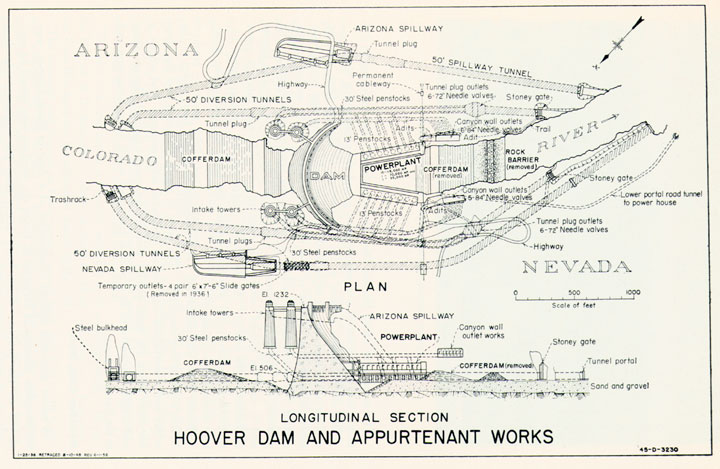
[Image: A “contour map” of Hoover Dam; view bigger].

I’ve found myself in an ongoing thought experiment for the last few months, trying to imagine what it would look like if theoretically non-domestic architectural styles were used to build the houses, or cities, of the future.
There are some obvious examples – designing houses like football stadiums, Gothic cathedrals, military bunkers, or nuclear missile silos – or even like Taco Bells, for that matter, or air traffic control towers – but there are also some less obvious, and far more interesting, possibilities out there.
Dams, for instance.
Why not build your house like a gigantic gravity dam? It wouldn’t have to hold back water – so there’d be no flooding to worry about – and you’d have big windows on either side.
You’d span canyons and have an incredible roof deck.
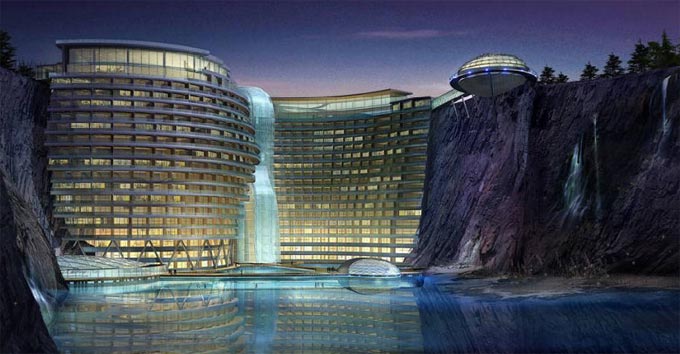
In fact, when I first saw the image, below, posted on The Cool Hunter back in December, I nearly passed out.

[Image: A development in Songjiang, China, via The Cool Hunter].
Alas, it’s not a dam at all, but the inner wall of a quarry (I still like it).
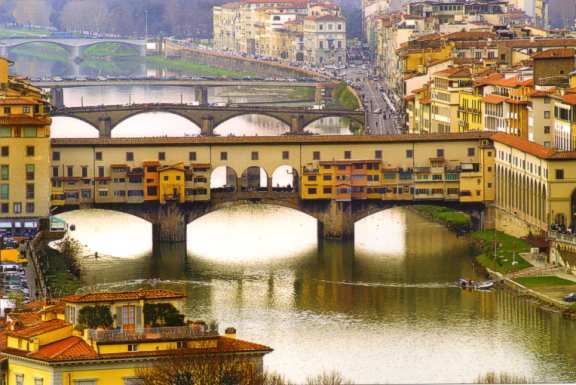
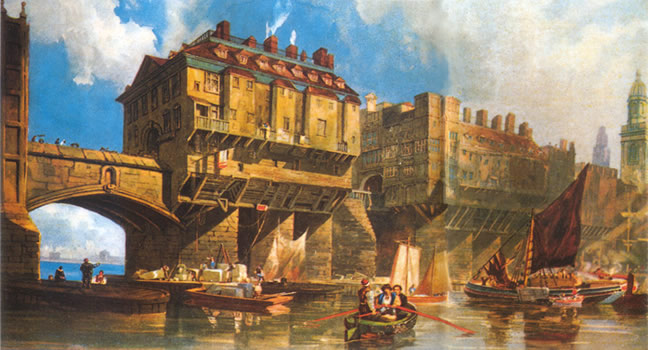
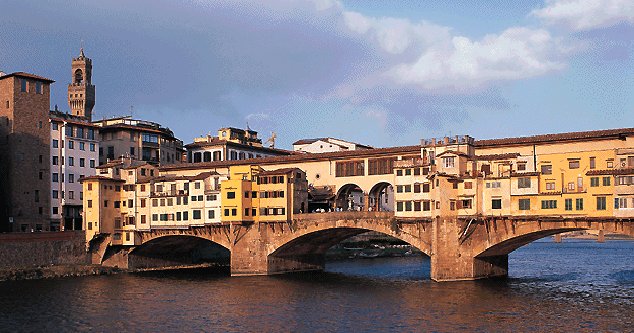
In any case, instead of building habitable bridges, like the Ponte Vecchio in Florence –

[Images: The Ponte Vecchio in Florence].

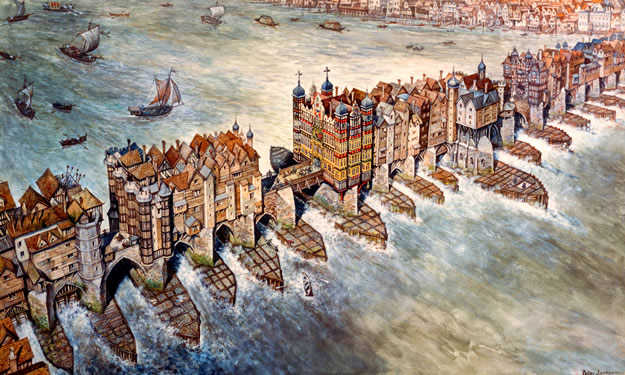
– or the Old London Bridge

[Images: An image of “new houses” built across the river, followed by a spectacular image, by Peter Jackson, of the Old London Bridge itself].

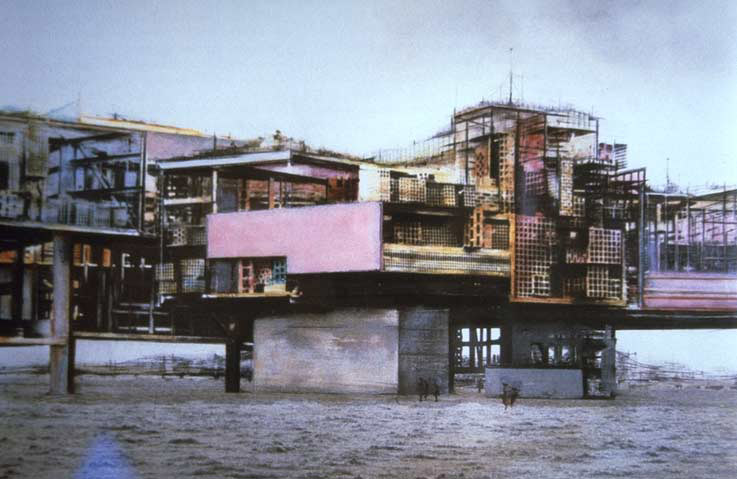
– with the former example surely having been at least a subtle influence on the design of Constant’s New Babylon

[Images: Constant’s New Babylon – not the same as this New Babylon, of course… though that would be interesting].

– you’d build habitable dams.
A whole suburb full of dam-houses, holding back no water. Great arcs of concrete towering over the landscape, full of kitchens. And there’s not a river in sight. Or dozens of micro-dams, only three or four stories tall, forming Oscar Niemeyerian monoliths arranged around a cul-de-sac.
Families barbecue dinner in the backyard, shaded from the late summer sun by volumetric geometries of well-rebar’d slabs – great dorsal fins of engineering, sticking up from the landscape on all sides.

[Image: The “mechanisms” of Hoover Dam; view slightly larger. Imagine living inside a valve, or inside a penstock…].

You’d come home to this!

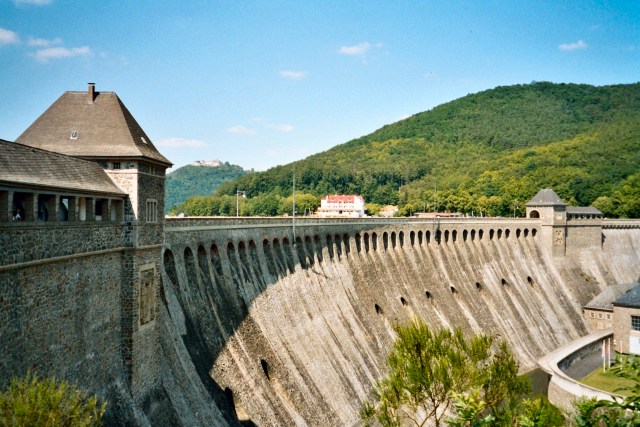
[Image: The Eder Dam on the Edersee, Germany].

Your own little love-nest, nestled between hills – or standing out in the middle of nowhere.
The bachelor pad of the future… is a diversionary dam.
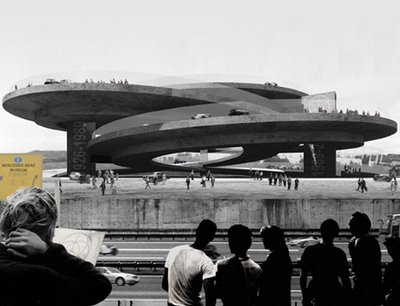
But habitable dams aren’t even the main source of structural ideas that, I think, have been sadly neglected when it comes to designing houses; what really gets me going is thinking about how to use elevated highway ramps as a new form of single-family housing.

[Images: A truly awesome image of an elevated highway-house, architect unknown (if you know, please inform!); and some L.A. freeways, photographed by satellite].
But that will have to wait till another post…

The Island of Forgotten Diseases

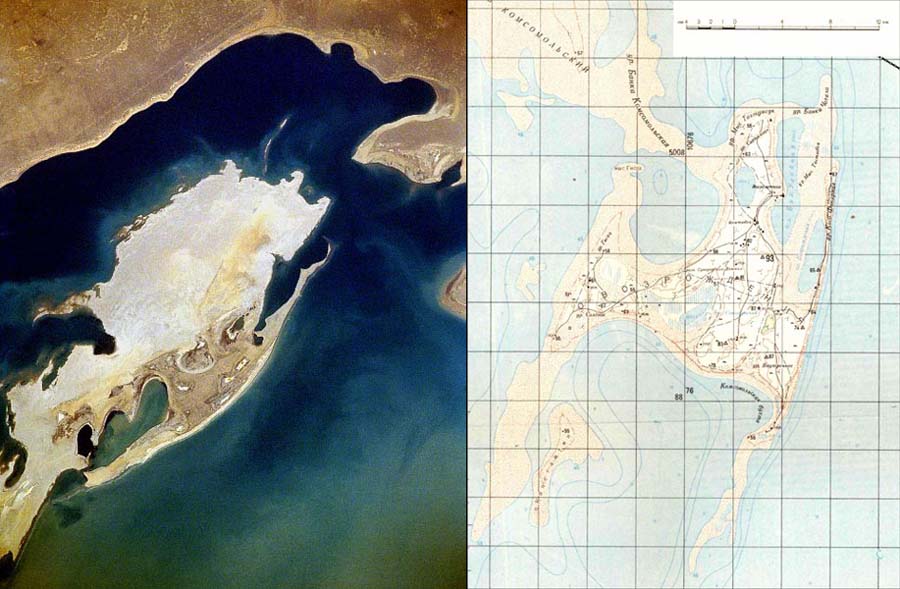
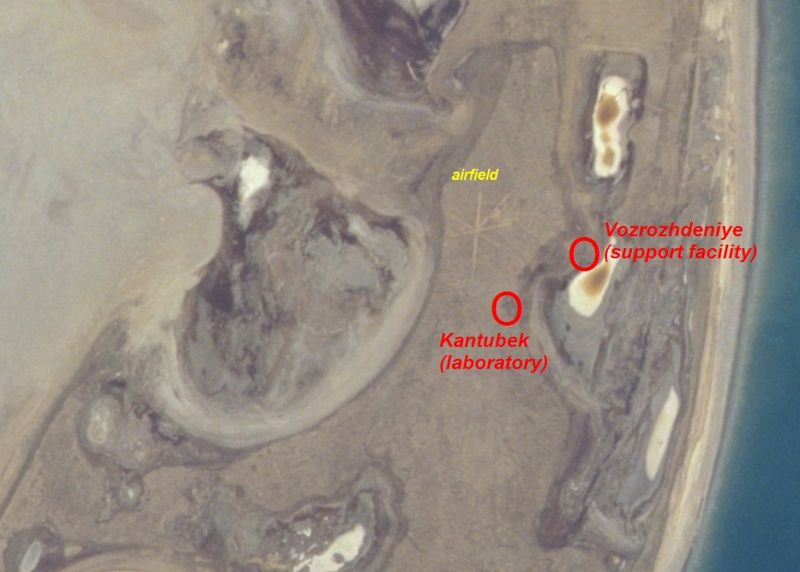
[Images: Vozrozhdeniya Island, via Wikipedia].

On the desolate central Asian island of Vozrozhdeniye – or Vozrozhdeniya – near the south rim of the shrinking Aral Sea, you’ll find “the remains of the world’s largest biological-warfare testing ground.”
As The New York Times reported back in 2002, for nearly four decades Vozrozhdeniye Island was “a practice field for the most hideous kind of warfare.”
The whole site is now abandoned.

Amidst “hundreds of cages designed to hold guinea pigs, hamsters and rabbits,” the New York Times continues, the old Soviet germ labs lie in ruins:
A germproof full-body suit, complete with a glass face mask and an airhose attachment in the back, lies in a corner. An odd smell – ether, chlorine and something indefinable – lingers in the air. Poking out of the rubble are dusty issues of The British Medical Journal and The Journal of Infectious Diseases. It is all surprisingly low tech: nails are everywhere, but no screws. There are books by Marx and Lenin and yellowed, handwritten ledgers that would not seem out of place in a museum devoted to a 19th-century Russian writer.

Despite the island’s pedigree, as a site of weaponized viruses and other unknown contagions, its buildings are now being taken apart by scavengers.
In fact, we’re told, the “only access to the island now is in the company of the scavengers, who say they began stripping the island bare back in 1996.” They’ve now stolen “everything from floorboards to wiring,” and have begun “working on galvanized-steel piping, sealed and towed at a snail’s speed to the mainland shore.”
The real – and much more pressing – question seems to be: what else will these scavengers find on Vozrozhdeniye Island?

When they arrived for last year’s toil, in July, the scavengers discovered that an official U.S.-Uzbek expedition had come earlier in the year and burned down a row of eight warehouses. But much of the contents of the warehouses survived the blaze, including a vast array of test tubes, bottles and petri dishes, some still in their original wrapping. The fire left some half-melted, looking like figures in a Dalì painting, but most are intact underneath a coat of dust.

Like a scene from W.G. Sebald, the actual test site itself is on a nearby plateau. The landscape there is covered with “scrubby trees” that “have leaned into the road,” as there are no cars driving by to stop them. The “range,” as it’s called – where temperatures can apparently reach 120ºF in the summer – is itself lined with “a row of three-foot-high concrete posts at 300-foot intervals, oriented in the direction of the prevailing winds.”

Further on, four poles have been set horizontally on pickets two feet from the ground. Rusty chains hang down, even a few feed troughs. This is where the horses and donkeys were tied up. You can imagine them standing patiently in a row at dusk, when the wind would ease and deadly aerosols would be released. At the highest point on the island, a 40-foot observation tower stands near the foundations of a gutted building. A spindly radio antenna still soars. It was a weather station. From the top of the tower, six dirt roads can be seen stretching in various directions to other test sites. It is all very spare and quiet. The scavengers are silent, too.

Alarmingly, we then read that some of Vozrozhdeniye’s “local rodents” may have been exposed to a super-resilient, weaponized strain of bubonic plague – and that the plague could thus have spread beyond the test range, hopping from flea to flea and following families of rats, just waiting to be passed on to humans.
Bubonic plague, the article quietly notes, already “affects a handful of people each year in Central Asia.”
It’s here that the ongoing risks of the site are made clear: “if a scavenger contracts the plague and makes it to a hospital, he could start an epidemic.”
Worse, Vozrozhdeniye Island is now attracting representatives of the oil industry – who have begun to perform some exploratory drilling. What might they really dig up…?

[Image: An aerial view of Kantubek, an abandoned town on Vozrozhdeniye Island; via Wikimedia].

The implied storylines here for future science fiction, or horror, films is totally out of control – and yet there is still more to learn about Vozrozhdeniye Island.
For instance: it’s no longer really an island.
The Aral Sea, in which Vozrozhdeniye sits, has been evaporating since the 1980s, due to catastrophically mismanaged Soviet irrigation plans – which means that Vozrozhdeniye is now a peninsula.
This otherwise unremarkable geographical shift has frightening implications:

Many of the containers holding the [biowarfare agents] were not properly stored or destroyed, and over the last decade many of the containers have developed leaks. As the Aral Sea continues to recede, the area will eventually connect further with the surrounding land. Many scientists fear that animals will move to the surrounding land and eventually carry these deadly biological agents out.

Such a scenario may sound far-fetched, but it’s worth pointing out that there was, indeed, an outbreak of smallpox in 1971 in the nearby city of Aralsk.
According to “a previously secret Soviet medical report,” which included “autopsy reports, pathology reports, containment tactics, and an official Soviet analysis of the outbreak’s source,” there were 10 cases of smallpox reported in Aralsk alone – after which “officials quarantined the city for weeks.”
In the process, “Homes and belongings were decontaminated or burned.”
Potential novelists or screenwriters might want to start paying attention here, though, because this is a near-perfect plot device.

The person believed to have introduced the virus to Aralsk was a young female ichthyologist who had just returned from a four-week research expedition on the Aral Sea aboard the Lev Berg, a small fishing boat. According to official documents, she was bed-ridden with a fever, headache, and muscle aches aboard the ship beginning Aug. 6, five days before returning to Aralsk on Aug. 11. Before public health officials diagnosed smallpox as the cause of her illness six weeks later, the young woman had exposed her nine-year-old brother, who had exposed others.

Even more interesting, this woman – referred to as Patient 1 – is still alive, and she disputes the official narrative of the outbreak. Nonetheless, it’s now more or less accepted that the woman’s ship must “have strayed too close to [Vozrozhdeniye Island] as smallpox viral particles, alighted on the wind by a Soviet weaponizing additive, floated across the ship’s decks, where Patient 1 netted fish day and night.”
You can read more about the outbreak at the website of Sandia Labs.
Finally, there was even speculation, back in 2001, that Vozrozhdeniye Island may have been distantly involved in the U.S. anthrax attacks.
But I could go on and on. If you want to know more, though, just follow the links, above, or check out CNN – and, if you’re a budding novelist, and you decide to go somewhere with this material, let me know!
And if you’re anywhere near the Aral Sea, beware the wind…

(Thanks to Neddal Ayad for pointing Vozrozhdeniye Island out to me!)