Modeling the Enemy

[Image: “Soldiers in the triumphal entry of Henri II into Rouen in 1550,” engraver unknown, from Mary Beard, The Roman Triumph].

In Mary Beard’s recent book The Roman Triumph, we read the interesting story of conquering armies parading architectural models of the forts they’ve destroyed through the streets of their own home city.

These triumphant returning soldiers would sometimes “carry models of forts captured by the victorious army,” she explains. “Enthusiastic accounts of the procession held these models to be so accurate that the places were ‘easily recognizable’ to the participants in the various battles.” It was about “the success of display no less than the display of success,” she quips.

These parades—called triumphs, in the case of imperial Rome, and the subject of Beard’s book, which falls somewhere between classical history and spatial anthropology—both “re-presented and re-enacted the victory.” A military triumph—the victorious parade—thus “brought the margins of the Empire to its center, and in so doing celebrated the new geopolitics that victory had brought about,” Beard adds. Orphaned objects of victory moved through the conquering city, embattled remnants as diverse as “the beaks of wrecked pirate ships” and “exotic trees”—amidst, of course, the architectural models pictured above. Urban simulations, hoisted high above the crowds in an apotheosis of spatial doubling.

One wonders what such a practice might result in today, on the other hand. What expertise in modeling the enemy might be required in our own era’s case, with military operations now running through drug tunnels, feral cities, and mountain caves, amongst many other such complex terrains?

(Read BLDGBLOG’s two-part interview with Mary Beard, published back in 2007, here and here).

Body Radar, Feral Cities, and Cedric Price, Neanderthal

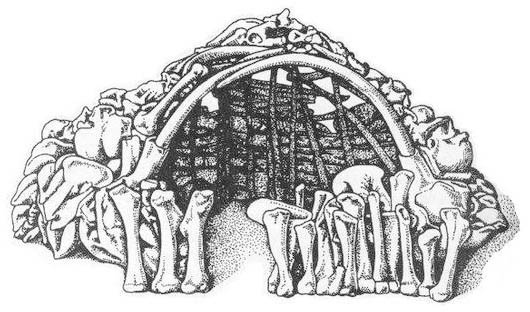
[Image: Mammoth bone hut; unknown illustrator].

It’s been two weeks now since I arrived in Montreal to begin my summer residency at the Canadian Centre for Architecture, where I am also kicking off the “Bloggers in the Archive” experiment.

It’s been fantastic so far, and, in almost every way, is just getting started. After the initial introductory tours and orientations—wandering through “cold vaults” in an obligatory down jacket, looking at children’s architectural toys, seeing Gordon Matta-Clark’s tax returns, learning about “sulfur bricks” baked in cake trays, flipping through 19th-century photographs of Istanbul’s city walls, and, as anyone who follows my Twitter feed might have noticed, going through no less than 17 boxes of archival material from the Underground Space Center Library—I’ll now be able to write about the objects, texts, photos, films, and more that I discover (or am shown) here in the voluminous storage rooms of the CCA.

Expect those posts to begin this week and to continue through the end of July.

[Image: Alessandro Poli, Zeno-research of a self-sufficient culture (1979-80). ©Archivio Alessandro Poli. Photo: Antonio Quattrone. Courtesy of the Canadian Centre for Architecture].

For now, the first five posts that I’ve written for the CCA are up and ready for reading. You can find any new content that I produce for them in one of two ways: either go to the home page itself and click on the Post-It note at the bottom right, or simply bookmark the tag Geoff@CCA. This is all part of the To CCA, From… series. Unfortunately, there is no way to leave comments on the CCA site, but perhaps use the comment thread here for any reactions, positive or negative, to the posts.

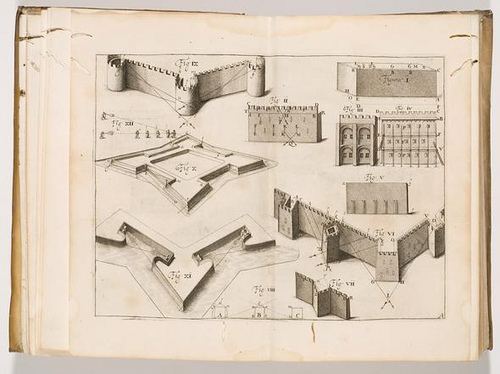
[Image: Unknown engraver, Series of views showing the development of the modern bastion system from its medieval origins, Matthias Dögen (1647), courtesy of the Canadian Centre for Architecture].

Over the past week, then, I’ve looked at urban fortifications and the defensive future of feral cities; through the CCA’s extensive periodicals collection, focusing on a brief comment about the relationship between furniture design and weight-lifting equipment; I’ve taken a behind-the-scenes tour of the CCA’s current exhibition Other Space Odysseys, looking specifically at a fictional encounter between an Apollo astronaut and an Italian farmer; I’ve reviewed the sonic abnormalities of a concert here in Montréal last weekend as part of the MUTEK festival; and, in the most recent post, I’ve taken a look at the paleolithic history of architecture and the prehistoric design possibilities for an Archigram of mammoth bones.

Actual archival research—live-blogging the archive, so to speak—will begin promptly. Thanks again to the CCA for hosting me!

Slow Box

[Image: Slow Box After Image by Shin Egashira].

Shin Egashira, an architect and instructor at the AA in London—and co-author of the amazing pamphlet I mentioned back in April, the Alternative Guide to Portland—has a number of projects that I’d like to write about here, but I’ll limit myself to one: Slow Box After Image, produced in 2000 in Japan.

[Image: Slow Box After Image by Shin Egashira].

The project, Egashira explains on his website, “required the construction of an over-sized camera vehicle (Slow Box) and an archive space (After Image). Slow Box can fit a person inside its wooden structure. It travels across villages with a help of an agricultural tractor.”

It needed up to 30 minutes of exposure time per image, and each exposure produced only one part of the eventual, tiled print—a print that measured no less than 1.5 square-meters. The results—which you can see toward the end of this post—are amazing.

But check out the structure first, its hinged operation seen here in model form.

[Images: Slow Box After Image by Shin Egashira].

The whole contraption, Egashira explains in his book Before Object, After Image: Koshirakura Landscape, 1996-2006, “can flip from a horizontal position (when it is in transit or being used as a darkroom) to a vertical fixed position, which allows one to sit inside and see the inverted image.”

Climbing down into the belly of the camera for the first time as it creaked and shook around me, I felt like an early pioneer about to descend into the depths of the ocean in some kind of prototype submarine. Last waves and smiles to those outside before closing up the hatch and sinking into my own world of muffled sounds and stifling darkness.

Here are some action shots.

[Images: Slow Box After Image by Shin Egashira].

“7 villages showed their interest to collaborate,” the architect adds, “namely, Takakura, Takizawa, Kurokura, Kettou, Seitayama, Funasaka and Koshirakura. The journey was organized as 3-4 days in each village, taking photographs as a form of communication, just us being a group of visitors asking permissions for taking pictures, except the camera that is big and slow enough to be taken seriously.”

Egashira quips that, “Over time we all began to build up a close relationship with the thing as we hauled it daily from one village to the next, in a procession akin to a medieval pilgrimage caravan bearing a precious effigy. How strange it must have seemed to the elderly villagers we visited as an increasingly disheveled troupe of people from all over the world turned up in a slow-moving convoy of car, van and tiny buzzing moped, with the tractor bearing the camera at the centre, raised up high and sheathed in canvases lashed with ropes for protection.”

Some of the resulting images can be seen below.

[Images: Slow Box After Image by Shin Egashira].

“The pictures were eventually displayed in an old hall with tall windows hugh up on a remote hillside,” we read. “Twenty or so large sheets of glass with images showing the people of this quiet corner of Japan, the sepia colour and hazy focus conjuring up anthropological images that could have been taken a hundred years before.”

The installation shots, below, are from the school gym in Kurokawa Village, where the prints were displayed in August 2000.

[Images: Slow Box After Image by Shin Egashira].

Egashira and his students also built a Suitcase Camera in 2003, which is basically what it sounds: an unfolding suitcase-camera on wheels that they hauled, once again, village to village, photographing residents in situ.

The mobile camera device/portable architecture hybrid is a pretty intriguing mix, though, and I would love to see further permutations of the concept. Perhaps something combining the Strandbeest of Theo Jansen with Gigapan, by way of Shin Egashira, to unleash autonomous, roving, bamboo-framed camera-machines that wander town to town through mists and mountains.

On Treasure Riots and a Lust for Holes

At one point in Owen Davies’s recent book Grimoires: A History of Magic Books, we read a short history of pirate treasure, lost gold, forgotten cities, and other “magical” artifacts of early colonial North America and the Caribbean, including what drove people to look for—and believe in—such things.

“America may not have been dotted with the ruined monasteries, castles, stone circles, dolmens, and hill forts that attracted treasure legends across Europe,” Davies writes, “but this did not prevent settlers from creating a new geography of treasure—one based on buried pirate booty supposedly secreted by the notorious William Kidd and Jean Lafitte, lost Spanish gold mines, and ancient Indian treasure.”

The West may have had its gold rush in the mid-nineteenth century but, long before, the countryside of the northeastern Atlantic seaboard was dotted with the exploration of those seeking hidden riches. In 1729 Benjamin Franklin co-wrote a newspaper essay highlighting the “problem,” bemoaning the great number of labouring people who were bringing their families to the brink of ruin in search of “imaginary treasure.” The physical signs of their activity were apparent around and about Philadelphia. “You can hardly walk half a mile out of Town on any side, without discovering several Pits dug with that Design,” Franklin moaned. He took a particular swipe at the role of astrologers, “with whom the Country swarms at this Time,” in promoting such fruitless endeavour.

This “popular preoccupation with treasure hunting,” as Davies describes it, created its own landscape, its “new geography of treasure”: a world of ceaseless, intuitive digging, tunneling downward with nothing at all like historical evidence but invigorated by the strong emotional conviction that something must be down there if only we can take it upon ourselves to look.

On the one hand, it’s fascinating to see that the orphan-like state of a newly liberated proto-United States would result in people so desperate for a sense of history that they might turn their own everyday world into a moonscape of excavations and craters—as if the “popular preoccupation with treasure hunting” was really the perverse acting-out of a society-wide mnemonic condition. History must still be around here somewhere, these excavations seem to say. And so new myths were created, swirling with “Indian treasure,” lost gold mines, secret cities in the mountain West, and stolen imperial fortunes locked away in pirate coves on the storm-sheltered sides of Caribbean islands.
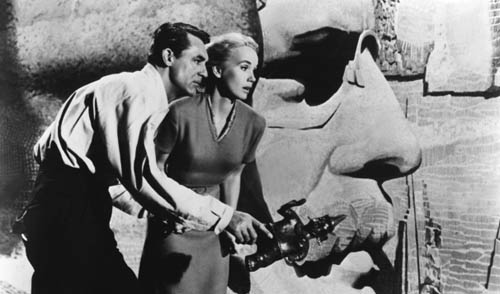
[Image: From North By Northwest].

I might even suggest that Alfred Hitchcock’s film North By Northwest (mentioned earlier) plays with some of these very themes, from its undisclosed imperial secrets hidden inside a Mesoamerican statue to the act of smuggling them through the Rocky Mountains by way of the massive tetrostatuary of Mt. Rushmore, stone totems of ancestral kings.

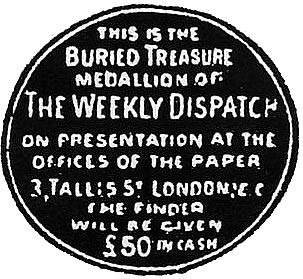
In any case, this urge for treasure—the need to dig—was not in any way limited to North America in its early Europeanization. During the so-called London treasure hunt riots, Londoners tore up properties all over the city “looking for one of 177 prize medallions which a Sunday newspaper called the Weekly Dispatch had planted around the UK.”

The paper used its first issue of the New Year to announce it had concealed a fortune in treasure medallions, the most valuable of which were worth £50 apiece. Each issue would carry a series of clues pointing to the prizes’ locations.

But these locations were incredibly vague, and, many readers thought, the only way to look was simply to start digging holes.

[Image: From Paul Slade, “London’s treasure hunt riots“].

Quoting journalist Paul Slade at great length:

All over London, the story was the same. Crowds gathered outside Pentonville Prison and Islington’s Fever Hospital, blocking the roads and attacking any scrap of loose ground. Hundreds of treasure seekers converged on a Bethnal Green museum and began digging there. One Shooters Hill resident said his area was “infested with gangs of roughs.” Shepherd’s Bush, Clapton and Canning Town were besieged too.

By the time [a 19-year-old Battersea labourer called Frederick Nurse] had his day in court, Luton and Manchester had also been hit. Luton residents seeking the town’s single £10 medallion caused what councillors called “a gross disturbance” to the town in the early hours of Sunday, January 10. A week later, the Manchester Evening News found “some most extraordinary scenes” in its own city.

“From an early hour on Saturday night to late on Sunday night, various parts of the Manchester suburbs were the resort of men, women and children, people of all classes, drunk and sober, who had taken up what they thought to be the real clue to the spot where a medallion worth £25 lay hidden beneath the turf,” the [Manchester Evening News] reported. “They seized upon vacant pieces of land and stretches of roadway, digging and delving until not a foot of the ground lay smooth.” In Blackley, it added, three hunters had arrived simultaneously at the same spot and “settled the matter by a three-cornered fight.”

Indeed, Slade adds, “Wherever the Dispatch‘s promotion touched down, hysterical treasure hunters began tearing up the public highways with knives, shovels, sticks and any other implement that came to hand. If they took it into their head to dig up a private garden or vandalise the local park, they went right ahead and did so. Anyone who protested was bullied into submission… The promotion was less than three weeks old, and already causing chaos.”

This wasn’t even the only such “promotion”—other citywide treasure hunts, albeit resulting in less damage to personal property, were launched at the same time.

[Image: From Paul Slade, “London’s treasure hunt riots“].

The cartoon from January 1904, included above, mocking the state of mind in which even a passing dream might really be an intuitive discovery of a buried treasure’s secret location, seems perfectly pitched here: convince people that there is something out there to be found—hidden gold or lost symbols—and a kind of neurosis for meaning breaks out. Everything is read and over-read, interpreted and over-interpreted. From the public craze for Dan Brown novels to Paul Slade’s “hysterical treasure hunters,” the urge to find something that you think has been hidden from you becomes all-consuming.

Screens, Buses, Kegs, and Cranes

[Image: “Crane Rooms and Keg Apartments” by Aristide Antonas].

Architect Aristide Antonas will be speaking tonight, Tuesday, June 8, at the BauhausUniversität in Weimar, Germany. Antonas’s Flickr set has long been a favorite of mine, as it thoroughly documents his work, which radically reuses existing structures and pieces of mobile industrial equipment, such as cranes, trucks, and buses. In fact, you might recognize his “Crane Rooms” project from ArchDaily.

His “Bus Hotel,” for instance, is a double-decker bus transformed into a mobile, 7-bed hotel.

[Images: “Bus Hotel” by Aristide Antonas].

The “Keg Apartment,” designed in collaboration with Katerina Koutsogianni, continues what Antonas calls his “stable vehicle” series. There, “existing transportation wagons of different types… form rooms that can still move or can function again as movable. They can be used as holiday rooms or as small office places.”

[Images: “Keg Apartment” by Aristide Antonas and Katerina Koutsogianni].

His “Crane Rooms,” mentioned earlier, deserve a look here—

[Images: “Crane Rooms” by Aristide Antonas and Katerina Koutsogianni].

—about which Antonas writes:

Simple concrete foundations and elementary water pools are proposed to be installed in non hospitable beaches or arid hills nearby the sea. The room units form independent cells, they can be covered by tissues during the day; they provide a quality connection to the Internet. The private or public character of each room is regulated by the chosen high of every unit. The high control system is located inside every room. Platforms go up and down following the will of every provisional inhabitant. A bigger screen, related to the bed, serves as a home cinema structure; a small office, a wardrobe and a shower are placed in the same moving platform. A common underground kitchen serves the needs of all the complex; a reverse osmosis desalination plant provides drinkable water to the invisible kitchen and to the units (the water pipes follow the length of the crane).

He also proposes the construction of a “Crane Room Hotel” in which a network of individual units “moving up and down provide summer shelters with changing views.”

[Images: “Screen Wall House” by Aristide Antonas, including a map of possible sites and locations].

I’m more or less just randomly sampling his Flickr page, but “Screen Wall House” also deserves a quick look. Here, from what I can gather, a roofless island camping structure has the ability to expand indefinitely with the addition of further walls. “The walls that form this house are made out of screens,” Antonas writes. “These thin walls arrive by boat and are maintained by the desert place company, which is something similar to a camping set with particular rules. The screens can be added to existing concrete bases. A power engine provides the electricity that is needed for each unit.” The architecture, then, is dependent on the concrete floor plan laid out in advance by the “desert place company”—but one can easily imagine an alternative wall-structure that brings its modular floor plates along with it, thus allowing these flexi-mazes of temporary screens to encompass unprecedented interior spaces without a need for prior planning.

In any case, Antonas will be presenting his work at the Bauhaus-Universität in only a matter of hours; say hello to him if you happen to be there tonight.

Species of Spaces

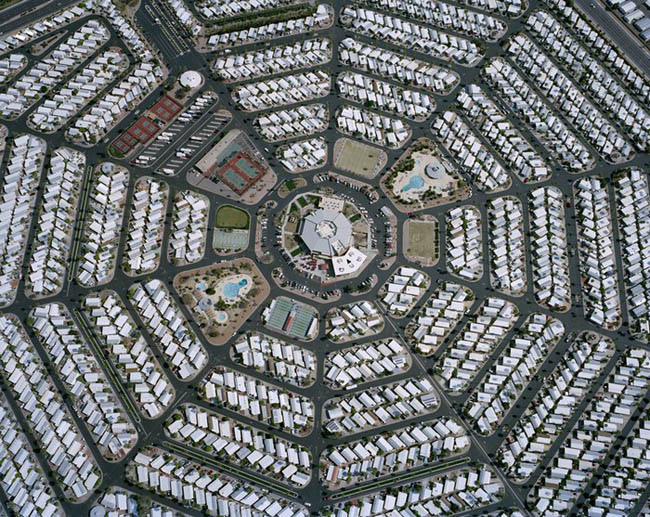
Christoph Gielen‘s aerial studies of suburban land-use patterns can be seen in the new issue of Culturehall, curated by David Andrew Frey around the theme “Future History.”

[Image: “Skye Isle II, Florida” (2009) by Christoph Gielen].

Glyphic, abstract, and typological, Gielen’s chosen land forms span the multidirectional universe of ribbons in the highway structures of Southern California to kaleidoscopic rosaries of Arizona houses.

In his own words, Gielen “specializes in conducting photographic aerial studies of infrastructure in its relation to land use, exploring the intersection of art and environmental politics.”

[Image: “Untitled Arizona III” (2010) by Christoph Gielen].

The results are often stunning, as monumental earth-shields of anthropological sprawl reveal their spatial logic from above. Seemingly drab and ecologically disastrous—even intellectually stultifying—suburbs become complex geographic experiments that perhaps didn’t quite go as planned.

Some of the photos—such as “Sterling Ridge VII, Florida” (2009), below—look genuinely alien, more like conceptual studies for exoplanetary settlements as imagined in the 1950s by NASA.

[Image: “Sterling Ridge VII, Florida” (2009) by Christoph Gielen].

How strange, though, and deeply ironic would it be for a photographic project ostensibly intended to show us how off-kilter our built environment has become—Gielen writes that “he hopes to trigger a reevaluation of our built environment, to ask: What kind of development can be considered sustainable?”—to reveal that the suburbs are, in a sense, intensely original settlement patterns tiled over the landscape in ways our species could never have anticipated? We are living amidst geometry, post-terrestrial screens between ourselves and the planet we walk upon.

Stonehenge at Night, 1944

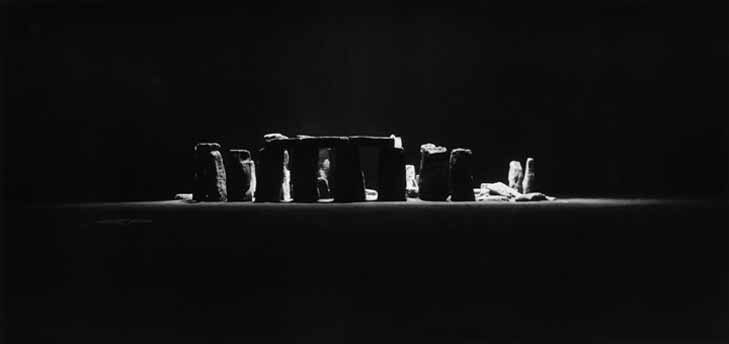
[Image: “Stonehenge at Night” (1944) by Harold Edgerton].

In 1944, Harold Edgerton, one of the forefathers of stroboscopic photography, produced an extraordinary image of Stonehenge. According to the authors of Stopping Time, that image was commissioned specifically as part of a larger military/optical experiment:

Illuminated by a 50,000 watt-second flash in the bay of a night-flying airplane 1500 feet above the ancient monoliths, Edgerton’s pictures of Stonehenge served as a demonstration to the Allied commanders of the potential for nighttime reconaissance photography. Edgerton was on the ground with a folding pocket camera braced on a fence post as the plane flew overhead. Simultaneously, the monument was recorded in perfect detail by a camera in the plane. The target was chosen because it was remote enough to allow the equipment to be tested without arousing unwanted interest.

Edgerton’s photograph was pointed out to me recently by architect Nat Chard after he read an earlier post here about the illuminative possibilities of aerial weaponry—or military chiaroscuro.

But the idea of a stroboscopic light-bay opening up in the base of an aircraft and illuminating scenes of human prehistory from above is breathtaking—as if dropping illuminative ordnance into a world of darkness, far below. Indeed, as a photographic technique, pinpoint-flashes of high-powered aerial lighting would also be something well worth exploring in other archaeo-architectural contexts, from Angkor Wat to the Spiro Mounds. Light-bomb archaeology.

(Thanks, Nat!)

Quick Links 12

[Image: “A 1566 rendering of ‘terrible and curious’ quake damage” in Istanbul; courtesy of the New York Times/Collection Kozak].

Five quick links for a Thursday morning:

1) “AT&T is launching a free wi-fi network for its customers in New York City’s Times Square,” Business Insider explained last week. “This will take a load off AT&T’s battered 3G network, by pushing peoples’ email, web, and app traffic onto wi-fi and off of 3G. And it should speed up downloads for AT&T customers in the area.” I’m reminded of Charles Komanoff’s proposed transportation policy changes for New York City, in which bus rides would always be offered free of charge, “because the time saved when passengers aren’t fumbling for change more than makes up for the lost fare revenue.” In other words, both cases suggest that offering certain urban services for free, at moments of high-intensity usage, often makes much better financial sense than charging for everything, all the time.

2) “In these hard economic times, when much of the country could use a walk in the woods or a night in the mountains or a wade in the river or a picnic by the lake, states across the country seem to be creating obstacles to the great outdoors… Campgrounds are closing, fees are increasing, employees have been laid off.”

3) In a look at impending, and possibly extreme, seismic activity in the Pacific Northwest, Nature writes that “public officials should maybe look at the new numbers and think about this earthquake as a real possibility in the next 50 years.” Watch this video to see what a strong quake hitting Seattle can really look like. This brings to mind the overdue earthquake long expected for Istanbul, “where tens of thousands of buildings throughout the city, erected in a haphazard, uninspected rush as the population soared past 10 million from the 1 million it was just 50 years ago, are what some seismologists call ‘rubble in waiting.'” After all, “expected earthquakes in this region represent an extreme danger for the Turkish megacity.”

4) Genetically Modified Fruit Flies Can Smell Light: “Blue light smells like delicious bananas.”

5) “Exploiting a political crisis, Malagasy timber barons are robbing this island nation of its sylvan heritage, illegally cutting down scarce species of rosewood trees in poorly protected national parks and exporting most of the valuable logs to China,” the New York Times reports. Worse, following a March 2009 coup and the island’s now “weakened and tottering government that is unable—and perhaps unwilling—to stop the trafficking,” the illegal timber trade “has increased at least 25-fold.”

Extra Credit:
a) Register for this competition to design a Lunar Capital City
b) For Robots, By Robots: Japan Plans a Moon Base by 2020

(Quick Links 1, 2, 3, 4, 5, 6, 7, 8, 9, 10, 11, and 12).

Military Chiaroscuro

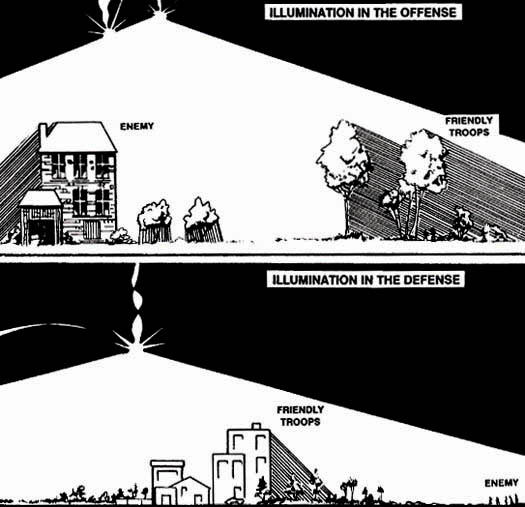
The diagram below explains two simple lighting strategies for use during “military operations on urban terrain,” or MOUT, taken from the U.S. Army’s Infantryman’s Guide to Combat in Built-Up Areas. While there is nothing particularly surprising about an army using light to its advantage, a number of interesting things arise when considering weapons from the perspective of their optical effects.

[Image: “Trip flares, flares, illumination from mortars and artillery, and spotlights (visible light or infrared) can be used to blind [the] enemy… or to artificially illuminate the battlefield,” from An Infantryman’s Guide to Combat in Built-Up Areas].

In another army field manual, for instance, called Tactical Employment of Mortars, the practice of running “illumination missions” using “luminous markers” and “specified amounts of illumination ammunition” is explained, such that mortars become less kinetic weapons used in the destruction of buildings than surprise lighting effects—decentralized chandeliers, so to speak, hurled down from above at high speed.

Indeed, “medium and heavy mortars can provide excellent illumination over wide areas,” whereas with lighter rounds “the illumination lasts for about 25 seconds, and it provides moderate light over a square kilometer. The gunner must adjust the elevation to achieve height-of-burst changes for this round. The best results are achieved with practice.”

One of many reasons I mention this here is because I wonder how these techniques could be de-weaponized and used for the purpose of civilian illumination. You visit a small town somewhere in Scandinavia where night’s fall is disturbingly total, with no street lights of any kind turning on after the sun has long since set; yet people are still out there milling about, even sitting on public benches with books in hand, as if preparing to read in utter darkness. But then a lightburst flashes in the sky above, burning for half a minute or more; and then another; and another, at odd angles, turning the streets and squares below into stroboscopes of moving geometry; and this continues for hours—strange nets of light popping in the air above you—as the city goes about its unexpected nightlife, illuminated by repurposed mortars fired by a light brigade camped out on the urban fringe.

Finally, any discussion of how urban lighting effects can be militarized reminds me of a stunning scene from Anthony Beevor’s retelling of the fall of Berlin during World War II. There, we read of a Russian general who ordered such extraordinary use of spotlights during the Battle of the Seelow Heights that his own soldiers became totally disoriented when the shelling began: massive clouds of smoke and dust rose up into the beams, forming an impenetrable glowing mist that quickly enveloped them, robbing the battlefield of detail. Light came from every direction and no direction at all, in a complete loss of the shadow-casting effects needed to hide their own troops’ movement—a failure, we might say, of military chiaroscuro, or the controlled use of shadows during invasion as seen in the diagram, above.

The Duplicative Forest

Atlas Obscura points our attention to a site in Oregon known as the “duplicative forest.”

[Image: The Duplicative Forest—17,000 acres of identical trees—awaits; photo courtesy of Atlas Obscura].

The poplar trees growing at this 17,000-acre farm are “all the same height and thickness,” we read, “and evenly spaced in all directions. The effect is compounded when blasting by at 75 mph. If you look for too long the strobe effect may induce seizures.”

While this latter comment is clearly a joke, it would actually be quite interesting to see if optical regulations are ever needed for the spacing of roadside objects. If, for instance, the Duplicative Forest really did induce seizures in motorists—but only those driving more than 90 mph, say—thus exhibiting neurological effects, what sorts of spatial rules might need to be implemented? Every sixth tree could be planted off-grid, for instance, in a slight stagger away from the otherwise mesmerizing patterns, or the speed limit could be rigorously enforced using bumps—in which case you would know that, just over the horizon of your car’s speedometer, a strange world of neurobiological self-interference looms, as the world around you threatens cognitive failure in those passing through it at a high enough speed or intensity.

Want to find out for yourself? Consider doing a drive-by.

On an only vaguely related note, meanwhile, fans of Fredric Jameson might recall his spatial analysis of Alfred Hitchcock’s absolutely excellent film North by Northwest—specifically Hitchcock’s use of rhythmically placed, identical trees.

Catch-and-Release Archaeology

[Image: Archaeologists work at Gobero, “the largest graveyard discovered to date in the Sahara.” Photo by Mike Hettwer, courtesy of National Geographic, otherwise unrelated to this post].

Archaeologist Sara Gonzalez, we read, courtesy of an older post on Middle Savagery, “practices what she calls ‘catch and release’ archaeology.” This means Gonzalez “plots all of the artifacts as they are excavated and then reburies the artifacts after analysis.”

While you can apparently read more about her method in this paper, I’m intrigued by the more general idea of systematically reburying things for their later, contrived rediscovery. This sort of behavior seems all but guaranteed to upset the existing stratigraphy of a site—and thus, in fact, be archaeologically usless—but it also sets up an interesting relationship with subterranean artifacts. That is, objects inside the earth enter into a kind of regulated hide-and-seek with surface dwellers.

Anthropologically speaking, I would love to learn more about cultures that have practiced this strangely squirrel-like behavior: burying perhaps quite large-scale things, in a loop bordering on repetition-compulsion, so that someone can unearth them later, thus deliberately leaving traces that future humans might not even know to look for.