The Dark Cities

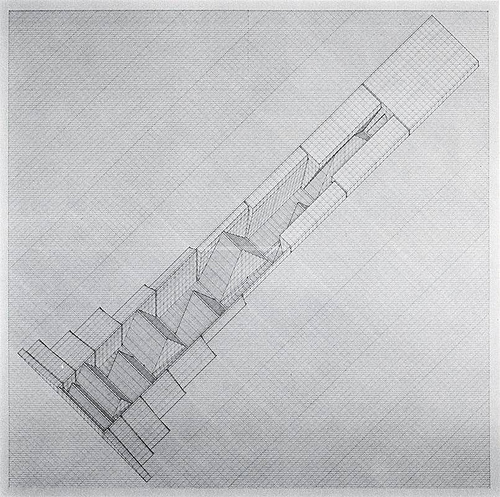
26 years ago, the Guggenheim hosted an exhibition of work by Will Insley, focusing particularly on Insley’s project ONECITY.

[Image: ONECITY by Will Insley; image via The Nonist].

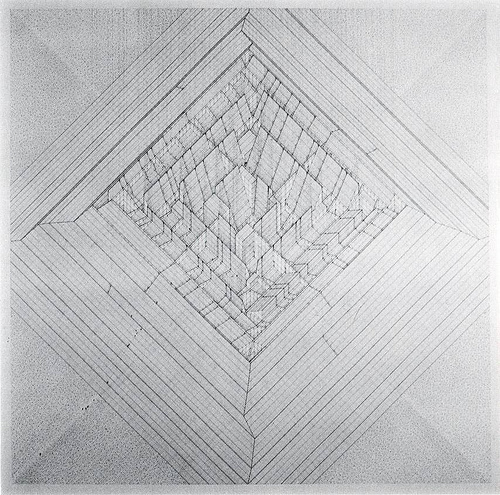
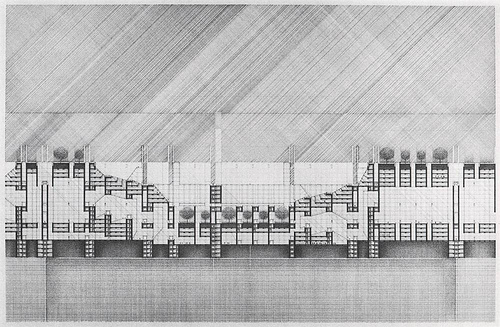
The New York Times described it at the time as depicting an “imaginary labyrinth 650 miles square.” It is “‘situated’ between the Mississippi and the Rockies and consists of many 2 1/2-mile-square structures, each divided into an ‘Over-building’ and an ‘Under-building’ and each containing nine arenas.”

[Images: ONECITY by Will Insley, via The Nonist].

The artist described his own interests as having “very little to do with advanced planning theories of the present” and no relation really at all to the ”utopias of the future, but rather with the dark cities of mythology, which exist outside of normal times in some strange location of extremity.”

[Images: ONECITY by Will Insley].

Courtesy of a comment left a while back on the sorely-missed site The Nonist, we learn that Insley once quipped: “what was absent from the ruin is often less marvelous than we imagine it to have been. The abstract power of suggestion (the fragment) is greater than the literal power of the initial fact. Myth elevates.’” These mythic fragments of a city that never was thus take their artistic power more from suggestion—of possible archaeologies and future extensions, impossible events this civilization of the plains might yet undergo—rather than any sense of intended realizability.

[Images: ONECITY by Will Insley].

Continuing from the New York Times, meanwhile:

It’s clear, however, that the city’s inhabitants are segregated into day people, wholesome types who study at home with their children by means of electronic devices, and night people. “Tattered ghosts in phosphorescent clothing,” the night people sound a lot like the more Felliniesque denizens of the Lower East Side, being given to masks and elaborate makeup; they “mutter a lot” and “often carry around personal abstract structures” that they exchange “according to mysterious rituals.” And while they have homes in the Over-building, they frequently sleep in the cubby holes of the Under-building, ignored by day people going about their business.

ONECITY is a “masonite labyrinth,” the article concludes, complete with “Wall Fragments” that have been “gridded with white or yellow lines and shaped like garment sections waiting to be sewn together.” It’s the city as dystopian clothing that we tailor to fit our future selves. Imagine a dusty third-floor walk-up in the Garment District of Manhattan, where precise plans for megastructures are produced on massive looms, needles and yawn moving to a hypnotic drone in semi-darkness. Architectural invention by way of sewing diagrams.

In any case, you can see a few more images of Insley’s Michael Heizer-like creation of excavations and voids over at The Nonist.

Empty Paris

Pruned posted an image the other day by artist Nicolas Moulin (more of whose work can be seen over at Vulgare). Looking into Moulin’s work further, however, I came across another series he produced a little more than a decade ago called Vider Paris. Here, we see Paris transformed into an abandoned maze of lifeless streets. Every building is sealed shut behind a seamless, Berlin Wall-like concrete monolith.

[Images: From Vider Paris (1998-2001) by Nicolas Moulin, courtesy of Galerie Chez Valentin].

Vider Paris “is a series of computer-altered images of the streets of Paris,” we read in a PDF portfolio of Moulin’s work. “All traces of life are removed from the images: vegetal, urban furnishings, pedestrians, cars, etc.” Further, “all the buildings are sealed with sheets of concrete up to the second floor.”

[Images: From Vider Paris (1998-2001) by Nicolas Moulin, courtesy of Galerie Chez Valentin].

The effect is oddly exhilarating; whether because these images have the appearance of being stills pulled from a much longer video, or simply because of their haunting, Ballardian overtones, Moulin’s vision of an empty Paris seems tailor-made for Hollywood art directors or even for someone sketching out ideas at Thunder Game Works.

A dream of apocalypse, twelve centuries from now, when you wander into the concretized canyons of a Paris with almost no signs of life, its skies grey, the barest trace of weeds growing up through cracks in rain-filled gutters. There are sounds of distant animals rustling, the city’s rhomboid geometries now animated by unpredictable acoustic effects. You see smoke somewhere, but it could be miles away. Looking for clean water, and a place to sleep before the sun goes down, you walk onward into the city core.

(This is now the second post I’ve written from an airplane… flying somewhere over SW Nebraska).

Open

Now that Landscapes of Quarantine is up and open for view—and will be until April 17—we’re off for a quick vacation. The opening night was amazing; thanks to everyone who came out, to everyone who helped set up, and to everyone whose work appears in the show. Thanks, especially, to Glen Cummings of MTWTF for a fantastic exhibition design, and to Josh Hearn and César Cotta for sticking around all week for 3am vinyl installations, multiple coats of paint, and more.

[Image: Outside-in: looking into Brian Slocum‘s panel installation (left) and Jeffrey Inaba’s/C-LAB’s temporary sidewalk pavilions, built from Tyvek and blown air, at Storefront for Art and Architecture; photo by Nicola Twilley].

I’m obviously biased, as the show’s co-curator, but the works on display are awesome. They are:

Pages 179–187 by Joe Alterio
Q-CITY: An Investigation by Front Studio/Yen Ha, Michi Yanagishita, and Joshua Cummings
MAP 002 QUARANTINE by David Garcia Studio
Did We Build The Frontier To Keep It Closed? by Scott Geiger
Field Notes from Quarantine, Katie Holten
Hotel III, Camp II, Lab IV, and Cell V by Mimi Lien
Cordon Sanitaire by Kevin Slavin
Context/Shift, Brian Slocum
Containing Uncertainty, Smudge Studio/Jamie Kruse & Elizabeth Ellsworth
NYCQ by Amanda Spielman & Jordan Spielman
Quick by Richard Mosse
Thermal Scanner and Body Temperature Alert System by Daniel Perlin
Precious Isolation: A Pair of Invasive Species by Thomas Pollman

And, for the opening night party only, Suck/Blow, a pair of sidewalk pavilions constructed from Tyvek and pressurized air, by Jeffrey Inaba/C-LAB with former director of Storefront for Art and Architecture, Joseph Grima.

[Image: Photo by Emiliano Granado].

The show is already getting some great press, such as these articles and previews in Azure, Dwell, Artinfo.com, Fast Company, and SEED. Pruned, mammoth, dpr-barcelona, and Life Without Buildings have also all added interests of their own.

I’ve included a few photos here, meanwhile, but will be posting more about the show once the next few days of travel are done.

I should also briefly add that this is the first post I’ve ever written while flying in a Wifi-enabled airplane—in this case, over the American midwest—riding through invisible geographies of air, turbulence bobbling us side to side in an experiential, transparent plate tectonics of the sky.

[Image: Photo by Emiliano Granado].

So thanks again for coming out for the exhibition opening. Regular posts will resume soon.

[Images: All photos, except the last five (two of which are by Nicola Twilley and Stacy Fisher), by Emiliano Granado (who appears, with tripod, in the final image)].

Flash Quarantine

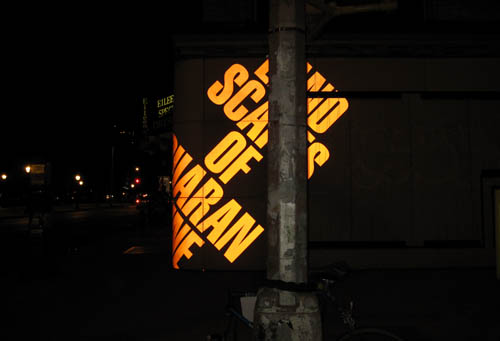
[Image: Landscapes of Quarantine opens tonight, March 9, at 7pm in New York City].

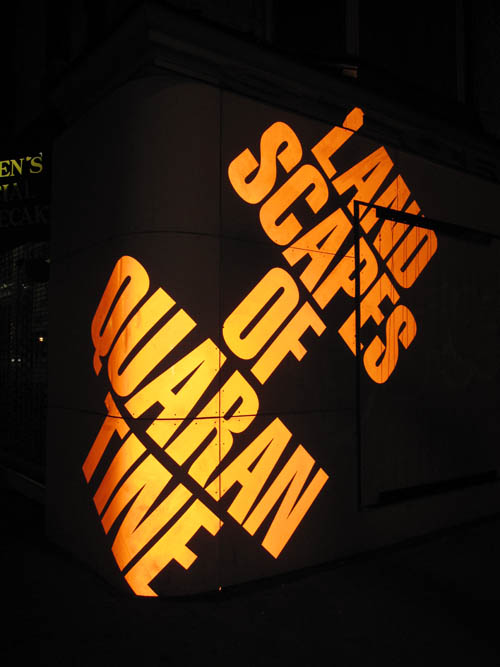
With the help of César Cotta and Joshua Hearn, and based on a design by Glen Cummings, we installed a massive, reflective vinyl wall graphic last night at 2am outside Storefront for Art and Architecture—and it looks amazing. Flash photographs make the city disappear and giant vinyl letters float in space.

[Image: Landscapes of Quarantine in New York City].

Ready or not, then, and half-covered in paint, our jeans ruined, in need of new shoes, dehydrated, our exhibition participants recently returned from Uganda and the eastern Congo with photographs and a film, mounting illuminated comic book manuscripts on the wall, exploring nuclear-waste repositories as symbolic geological centers of a future world, diagramming parallel split cities with quarantine spaces merely an arm’s length away, and opening the facade panels of the gallery to allow bubbles and bulges and Tyvek screens to confuse the outside line with the street, and more, we will be there tonight, unloading dozens of cases of beer donated by Brooklyn Brewery, to celebrate this long project coming together at last in an exhibition space for everyone to see.

Stop by at 7pm tonight, March 9, if you’re around and say hello—or drop in on Storefront for Art and Architecture during its regular opening hours any time before April 17. Orange will after-image through your brain for days to come…

Quick Links 8

[Image: National Geographic: “A spelunker in a glacier cave in Greenland gazes upon colors and shapes that look more like a swirling galaxy than a cave formation.” Photo by Carsten Peter].

Having now spent every available moment of every day for more than a week stuck inside Storefront for Art and Architecture, painting the floors and walls, installing vinyl, coordinating deliveries, sweeping up loose tape and sawdust, and more, I’ve decided to upload a slightly longer than normal cache of links. It might be a few more days before I can post again.

I hope to see some of you at the exhibition opening, though, which takes place Tuesday, March 9, at 7pm: Landscapes of Quarantine.

[Image: The future is not what it used to be: MIT’s thresholds seeks essays on critical futurism].

thresholds 38 | Futures: Call for Submissions: “Whether it is a revolt against the futures of the past or a curiosity towards the unknown, thresholds 38 invites methods, projects, practices and alternative kinds of critique that imagine unorthodox futures that can emerge from within this institution.” Submissions due March 12.

Synthetic Aesthetics | Call for Participants: “We seek participants for a project on synthetic biology, design, and aesthetics. The project will provide funding to bring together scientists and engineers working in synthetic biology with artists, designers, and other creative practitioners.”

Synthetic biology is broadly defined as the design and construction of new biological parts, devices, and systems, and the re-design of existing biological systems for useful purposes. Design is central to synthetic biology, as the living world becomes a product of design and manufacturing choices, rather than evolutionary pressures alone. Thus, it becomes important to ask what role design–and the related concept of aesthetics–play in this burgeoning field. Other forms of engineering and manufacturing work in close conjunction with creative practitioners: structural engineers work with architects; mechanical engineers with product designers. Can synthetic biology benefit similarly from such collaborations?

Applications due March 31.

Open Agenda | Call for Submissions: “Open Agenda is a new annual competition aimed at supporting a new generation of experimental Australian architecture. Open to recent architecture graduates, Open Agenda is focused on developing the possibilities of design research in architecture and the built environment… Open Agenda will award seed funding to three exceptional design research proposals that explore new positions in architecture for critical consideration.” Register by May 1.

[Image: The Niagara Falls without their water, photographed by Flickr user rbglasson, via mammoth].

mammoth | Absent Rivers, Ephemeral Parks: “For six months in the winter and fall of 1969, Niagara’s American Falls were ‘de-watered’ as the Army Corps of Engineers conducted a geological survey of the falls’ rock face, concerned that it was becoming destabilized by erosion. During the interim study period, the dried riverbed and shale was drip-irrigated, like some mineral garden in a tender establishment period, by long pipes stretched across the gap, to maintain a sufficient and stabilizing level of moisture. For a portion of that period, while workers cleaned the former river-bottom of unwanted mosses and drilled test-cores in search of instabilities, a temporary walkway was installed a mere twenty feet from the edge of the dry falls, and tourists were able to explore this otherwise inaccessible and hostile landscape.”

BBC | North Tyneside high street “revived” by fake shop front: “Fake businesses are to be used to lessen the impact of the recession on high streets in North Tyneside… The government-funded project involves colourful graphic designs featuring a range of different shop types, which are either taped inside the windows or screwed to the fascia so they can be removed and reused as required.”

InfraNet Lab | Terrestrial Discontinuities: “…these [energy corridors in the western United States] range from 3,500-feet wide to upwards of 5 miles wide. With these widths, we could almost begin to see these corridors as an ecology in and of themselves—rather than an ecology competing with National Parks, they could become the New National Parks, infrastructural vectors, protected as natural reserves by virtue of their very danger to us.”

Guardian | Greece should sell islands to keep bankruptcy at bay: “Greece must consider a fire sale of land, historic buildings and art works to cut its debts, two rightwing German politicians said today in a newspaper interview that is bound to exacerbate tensions between Athens and Berlin. Alongside austerity measures such as cuts to public sector pay and a freeze on state pensions, why not sell a few uninhabited islands…” It might be ethically wrong, as well as politically dubious, and I have no money, but BLDGBLOG would certainly buy one. The Sovereign Neo-Cyclades.

[Image: Tactical drone seed-bombing, courtesy of Design Under Sky].

Design Under Sky | Ludic Guerrilla Gardening Drone Warfare: “…with recent advancements in augmented reality and virtual gaming, I can’t help but imagine that a new style of drone-based urban landscape replenishment isn’t a far off possibility.”

Post-Traumatic Urbanism | Mediterranean Union: “A [high-speed rail] line running along the Mediterranean littoral is a seemingly impossible idea based in visionary assumptions. After all, it would need to pass through a region mired by instability and fractured by impenetrable borders. Functioning like a conveyor at the scale of continents, it would redistribute flows of people, warping the space-time fabric of an entire region—linking long disputed territories and as yet unformed nations. It would string together a seemingly impossible series of names: Gaza, Barcelona, Beirut, Haifa, Tel Aviv, Cairo. In doing so it would open a conduit between the differential pressures of North Africa and Europe—all this in the context of EU policy that increasingly conceives of Southern Europe as a bulwark against refugees. The political question we asked ourselves is the following one: what are the emancipatory potentials of infrastructure?”

City of Sound | Notes on New Songdo City (Part 1): “…it occurs to me that the logical thing to do would be the greatest engineering project of the next centuries; quite possibly the greatest diplomatic and economic project of the next centuries too, linking Japan with China via Korea via a high-speed rail link across gigantic bridges.”

Spaceinvading | Sandwiched by INABA: “As part of the 2010 Whitney Biennial, Jeffrey Inaba’s firm INABA was commissioned to design a pop‐up café located in the museum’s interior courtyard. The project consists of three large‐scale lanterns that occupy the courtyard’s double‐height space; a 24‐foot long service counter; communal tables; high‐top counters; and ‘droopy’ seat cushions.”

[Image: Project by CJ Lim Image by Squint/Opera for Grant Associates].

SCI-Arc | London Eight Exhibition: “SCI-Arc presents London Eight, curated by renowned English architect Sir Peter Cook. A founding member of the 1960s futurist group Archigram and a visiting faculty member at SCI-Arc, Cook invited five architects who currently teach at the Bartlett School of Architecture, University College London, where Cook was professor from 1990 to 2005, to participate in an exhibition at the SCI-Arc Library Gallery. These architects were then asked to select a ‘protege’ whom they had mentored through their studies at the Bartlett to exhibit alongside their own work in the gallery.” Includes work by Smout Allen, Johan Hybschmann, Marjan Colletti & Marcos Cruz, Yousef Al-Mehdari, CJ Lim, and Pascal Bronner.

Hudson Valley Seed Library | “The Hudson Valley Seed Library strives to do two things: to create an accessible and affordable source of regionally-adapted seeds that is maintained by a community of caring gardeners; and, to create gift-quality seed packs featuring works designed by New York artists in order to celebrate the beauty of heirloom gardening.”

Urban Forest Map | “The Urban Forest Map is a collaborative project among city agencies, tree advocacy groups, and citizen foresters like you to map every tree in San Francisco, which will help protect and expand our urban forests.”

GOOD | Fallen Fruit’s Tree-planting Dreams Are Uprooted In Madrid: “For the last 10 days Fallen Fruit had been scouring the area [around Madrid], leading urban foraging trips to find what other fruit-bearing trees existed in the neighborhood around the city-funded Matadero art space, plotting the best locations for future apples, peaches, plums, pears, and apricots… The plan was to have the trees planted before their final presentation that night, giving the people of Madrid a map to all the public fruit they could eventually eat.”

Cleveland Plain Dealer | Galleria mall is giant greenhouse, raising organic crops in Cleveland: “…by late spring or early summer, there will be fresh tomatoes for sale among the shops and galleries at the downtown Cleveland mall. Very fresh—as in vine-grown in bags and troughs hanging from steel stair banisters and ceiling beams in the shopping center that stretches between East Ninth and East 12th streets.”

[Image: King’s Vineyard, London by Soonil Kim, via Pruned].

Pruned | King’s Vineyard, London: “One can certainly imagine such a network [of aerial vineyards and urban viticultural installations] built to grow others things, such as vegetables, herbs, fruits, cash crops, commercial flowers and plants, with the winery turned into a farmer’s market.”

Independent | Syria’s Stonehenge: Neolithic stone circles, alignments and possible tombs discovered: “Dr. Mason explains that he ‘went for a walk’ into the eastern perimeter of the site—an area that hasn’t been explored by archaeologists. What he discovered is an ancient landscape of stone circles, stone alignments and what appear to be corbelled roof tombs. From stone tools found at the site, it’s likely that the features date to some point in the Middle East’s Neolithic Period—a broad stretch of time between roughly 8500 BC – 4300 BC. It is thought that in Western Europe megalithic construction involving the use of stone only dates back as far as ca. 4500 BC. This means that the Syrian site could well be older than anything seen in Europe.”

New York Times | A Jewish Ritual Collides With Mother Nature: “From Washington to New York State, a series of ‘snowmageddons’ have wreaked a particular form of havoc for Orthodox Jews. The storms have knocked down portions of the ritual boundary known as an eruv in Jewish communities… Almost literally invisible even to observant Jews, the wire or string of an eruv, connected from pole to pole, allows the outdoors to be considered an extension of the home. Which means, under Judaic law, that one can carry things on the Sabbath, an act that is otherwise forbidden outside the house. Prayer shawls, prayer books, bottles of wine, platters of food and, perhaps most important, strollers with children in them—Orthodox Jews can haul or tote such items within the eruv. When a section of an eruv is knocked down by, let’s say, a big snowstorm, then the alerts go out by Internet and robocall, and human behavior changes dramatically.”

Spillway | Why Ambassador, With This Perimeter You Are Really Spoiling Us: “One progresses from queue to queue before entering the building, progressing to slightly higher echelons of security clearance each time depending on the paperwork one has brought with one. Unsmiling police officers with automatic weapons stare at you, and you realize that if you made a dash towards the building itself, you would have to enter an area of open space that designed as a killzone, surrounded by armed representatives of the Metropolitan constabulary. Behind crossfire plaza is the building itself, its generous Scandinavian spaces seemingly as distant as the country you are trying to visit. The contradictions of that space are horribly unsettling, with a strongly dystopian odour: we can see the structures of a democracy retrofitted with the apparatus of authoritarianism. It gives a sense of how far we’ve fallen in 10 years.”

[Image: The “High Houses” of Lebbeus Woods].

Lebbeus Woods | High Houses: “The High Houses are proposed as part of the reconstruction of Sarajevo after the siege of the city that lasted from 1992 though late 1995. Their site is the badly damaged ‘old tobacco factory’ in the Marijn dvor section near the city center.”

Serial Consign | Toronto Sound Ecology: “Toronto Sound Ecology is a web mapping project dedicated to archiving field recordings collected in and around Toronto.”

Some landscapes | Alpine Symphony: “Birdsong, thunderstorms and flowing water are pretty standard, but… would it be possible to move away from the sublime and the picturesque, to convey more unusual settings or simply nondescript landscapes through purely orchestral sound?”

Google Earth Blog | Solving a Murder With Google Earth: “On January 24, 2006, Jennifer Kesse vanished. The police quickly determined that she was abducted, but nothing solid has turned up in the past four years… During this time, users on her site discussed the new events and came to a stunning revelation: using Google Earth’s historical imagery, they found an image from approximately one month after she disappeared. The image seems to show some promising information.”

Related from last summer: Sydney Morning Herald | Mugging suspects snapped by Google Street View: “Dutch police have arrested twin brothers on suspicion of robbery after their alleged victim spotted a picture of them following him on Google Map’s Street View feature.”

National Geographic | Quintana Roo Underwater Cave Project: “Beneath the jungles of the Yucatan peninsula, [Sam] Meacham and his team are exploring and mapping the longest underwater cave system in the world.” See also: Blue Holes Project: “Blue holes can run extremely deep underground, with one Bahamian blue hole exceeding 600 feet (180 meters) below sea level, and contain a series of mazelike passageways going miles in many directions. These cave systems can transition from giant rooms to tiny holes that divers must remove all of their gear in order to squeeze through. To add to the challenge, currents reverse in the ocean caves, making timing of dives critical.”

[Image: Architizer comes to Los Angeles].

Architizer | Los Angeles Launch Announcement: “We are happy to announce that on March 18th, we will be hosting a party in Los Angeles at the new A+D Museum space [at 6032 Wilshire Boulevard]. In partnership with Haworth, Dwell Magazine, LA Forum, SCI-Arc, and BLDGBLOG, the event will be an evening to meet fellow Los Angeleno architects as well as a celebration of Los Angeles architecture culture.” Here is a map. If you’re in LA, stop by and say hello!

[Image: Rendering of the new A+D Museum].

(Some links via @doingitwrong, @javierest, @geoparadigm, @stevesilberman, and possibly elsewhere. Don’t miss Quick Links 1, 2, 3, 4, 5, 6 and 7).

Landscapes of Quarantine

In only six days, with a reception on Tuesday, March 9, “Landscapes of Quarantine” opens at New York’s Storefront for Art and Architecture.

I’m absolutely thrilled to have curated this show, with Nicola Twilley of Edible Geography, and I can’t wait to see it finally open for view. On the other hand, this week is an absolute mania of painting, material deliveries, installation, cleaning, and more, which means I’ll probably be a bit thin on posts for the next few days.
The last four or five months, of course, have seen a wide variety of quarantine-themed interviews and posts here on BLDGBLOG, but it’s worth reminding both myself and others why quarantine is worthy of architectural attention in the first place—as a spatial experience of waiting, isolation, and, often, emotional claustrophobia.

At its most basic, quarantine is the creation of a hygienic boundary between two or more things, for the purpose of protecting one from exposure to the other. It is a strategy of separation and containment—a spatial response to suspicion, threat, and uncertainty. From Chernobyl’s Zone of Exclusion to the artificial quarantine islands of the New York archipelago, and from camps set up to house HIV+ Haitian refugees at Guantánamo Bay to the modified Airstream trailer within which returning Apollo astronauts once waved at President Nixon, the landscapes of quarantine are as varied as they are unexpected.

Each of the works on display in the exhibition responds to some aspect of quarantine, from the “dark math” of triage and the ethical challenge of enforced isolation to the geological timescale of nuclear-waste sequestration. The works range from a wall-sized infographic comparing the infrastructural bubbles inside of which illegally imported orchids and the President of the United States, respectively, live, to a tear-off & take-home short story inspired by the idea of a Quarantine Administration bureaucracy. There are designs for a new, multi-player iPhone game called “Cordon Sanitaire”; field notes and sketches from North Brother Island, the final home of Typhoid Mary; a special issue of David Garcia’s Manual of Architectural Possibilities (M.A.P.); and much more.

The exhibition will be up until Saturday, April 17—but, if you want even more, there will be a series of ticketed, quarantine-themed dinners in early April.

The reception kicks off at 7pm on Tuesday, March 9; it is free and open to the public (and there will be free beer, generously donated by Brooklyn Brewery). I hope to see some of you there!

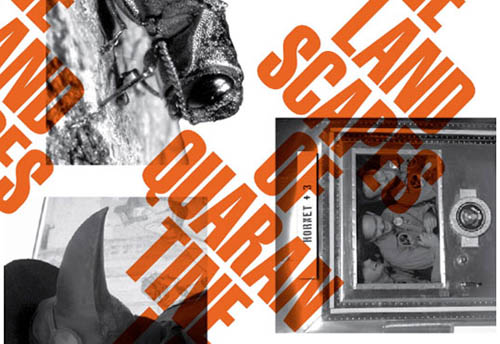
(“Landscapes of Quarantine” poster, flyer, logo, and exhibition was designed by Glen Cummings of MTWTF).

Mercedes-Benz Tornado

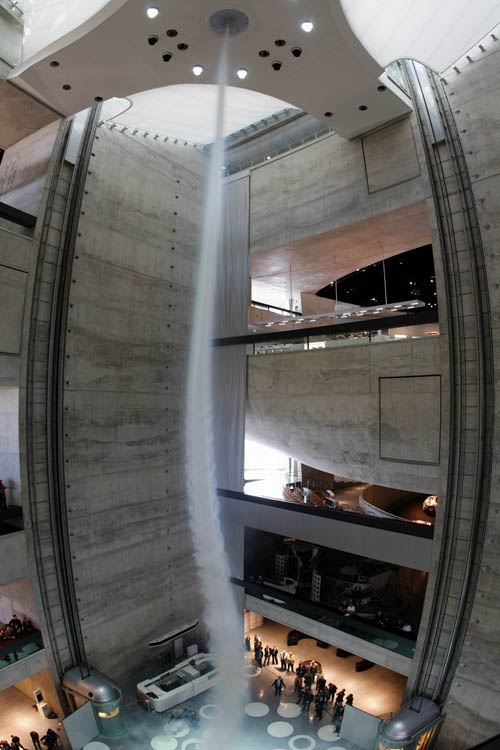
While we’re still on the subject of artificial weather, the Mercedes-Benz Museum in Stuttgart, Germany, designed by UNStudio, can repurpose its internal ventilation system to form an artificial tornado.

[Image: The Mercedes-Benz Tornado; photographer unknown].

“The twister takes around seven minutes to materialize,” Autoblog explains, “and is generated by 144 jets and 28 tons of air. The low pressure area at the center of the tornado works to create a jet stream that draws smoke out of the building’s corridors and funnels it upwards and out an exhaust vent on the roof.” It is also more than 100 feet tall—making it the official world-record holder for the World’s Largest Artificial Tornado.

Watch the video of how it forms:


A reader, Daan Koch, pointed this internal atmospheric feature out to me—the tornado as ornament—adding that this “dramatic way of ventilating an atrium… could be nice for the Guggenheim in New York, as well.” I couldn’t agree more.

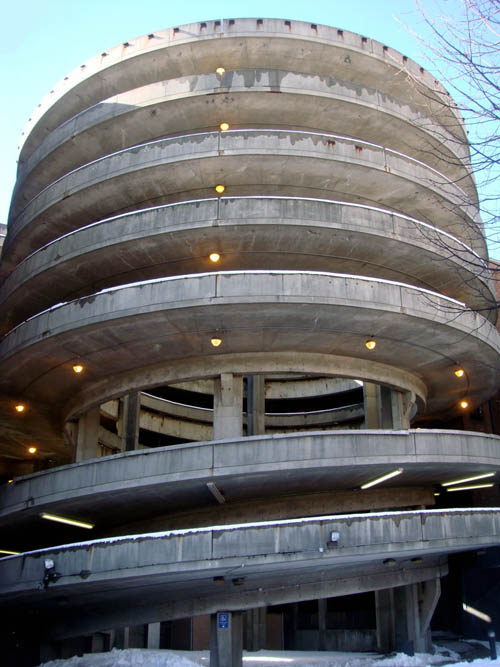
Or perhaps horizontal tornadoes could roll through the New York subway system every night from 2-5am, cleaning out the underworld of its dust and potato chip bags. Perhaps even inside this New Haven parking garage, shown below, with its “fabulous concrete circulation drum” as recently photographed by Charles Holland. Complicatedly angled fans and vacuums suck new wind systems into existence near Yale.

[Image: New Haven parking garage as Tornadodrome; photographed by Fantastic Journal].
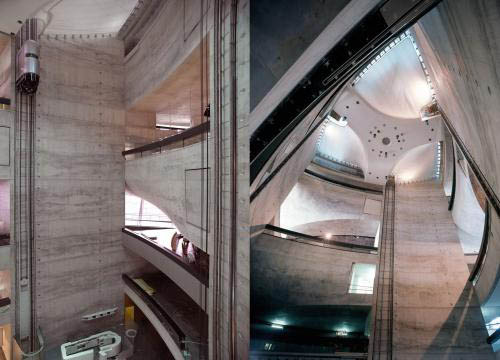
Or your new house in the Chicago suburbs seems absolutely perfect for you and your family—till the first hot day of the year sets in and you turn on the A/C. Some sinister combination of ill-conceived vents and over-tall foyer begins to rope together winds—pulling in air from the living room, from the basement, from the kids’ bedrooms—and within a mere twenty minutes a tornado-strength twister takes visible form.

It then spins for days, suffocating the residents in their sleep by robbing them of oxygen, and lifting their limp bodies into the air, where they turn in lazy circles like pirates drowned at sea. Their bodies dance aloft, as if caught in an aero-spirograph, eerily lit by dim suburban lamplight and visible through the front door windows—a vision of the vortex—accidentally killed by HVAC.

[Images: Two views inside UNStudio’s Mercedes-Benz Museum; photographer unknown].

(Thanks, Daan, for the tip!)

The Architecture of Polar Ice Floes

[Image: Trapped in ice].

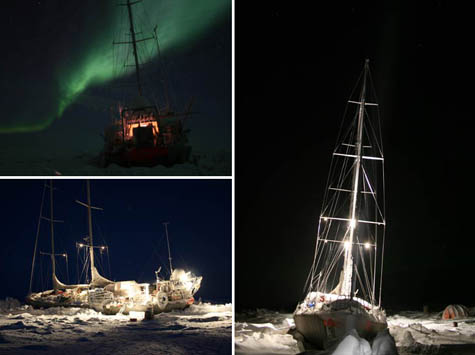
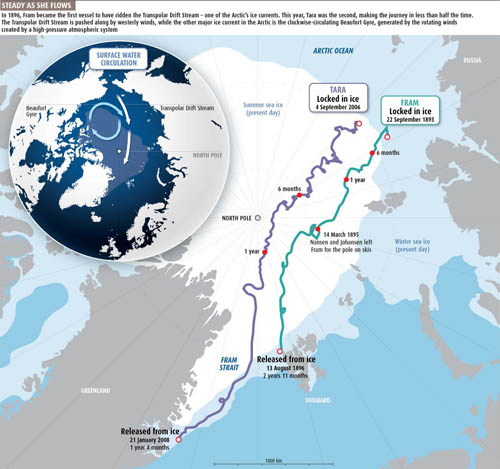
Back in January 2008, a ship called Tara unlocked from the polar ice near Greenland; it had been frozen in the Arctic floes for a year and four months, repeating the journey of the Fram, a Norwegian ship that once drifted across the polar seas, frozen solid in the ice fields, back in 1896.

In both cases, the ships temporarily became buildings, works of architecture wed flush with the landscape surrounding them.

[Images: Photos via Jules Verne Adventures].

As reported two winters ago in the Times:

Visitors to the North Pole in the past 15 months might have happened upon a peculiar sight: a ship, high and dry on the ice pack, her masts upright against the flaming aurora borealis, her bow pointing over the ice sheet, as if sailing on a sea of snow. They might have thought it a polar mirage.

It was, however, the Tara, a mobile building of the Arctic.

In a description so strange I have trouble visualizing it, we read about a “pressure ridge” that moved toward the boat at “super-slow” speeds, threatening everyone on board with destruction:

There was another scare that winter with a “pressure ridge” caused by colliding plates of ice advancing towards the boat. “It was like a frozen wave, moving in super-slow motion—about a centimeter a second,” said [a crew member]. “At one stage we attacked it with picks and chainsaws, but there was no way we could stop it.” It leant over the boat, then suddenly it stopped by itself and “we were released from the pinch,” said [the crew member].

When landscapes attack.

[Image: Map of the Arctic ice routes that brought ships across the sea, courtesy of New Scientist].
But what interests me here is the idea that you could build one thing—a ship—that only becomes what it’s really meant to be—a building—when the circumstances it’s surrounded by undergo a phase change (here, water turning into ice).

The ship’s hull was specifically designed for this, we read in New Scientist; it was “broad, smooth and round so that, rather than being crushed like an egg, the boat would pop up like an olive stone squeezed between finger and thumb, and sit on top of the pack ice. It also featured a lifting centerboard instead of a fixed keel, and removable propellers and rudders. These precautions worked: Tara suffered just a small dent at the stern, and another stretching a metre or so along the hull.”

What might the atmospheric equivalent of this be? Perhaps a planetary probe dropped into the skies of Titan or Enceladus, awaiting some strange aerial phase change to occur on all sides?

And, speaking of other planets, could you ever encounter such extraordinary air pressure—on a gas giant, say—such that solid objects simply become trapped in place, unable to fall any further? The atmosphere beneath them is denser than the metal they are made from.

Like machine-fossils buried transparently in air—or like Arctic ships locked in ice—NASA probes would gradually decay, compressed by nothing but air, under deformational pressures lasting tens of millions of years. Aerial tectonics. Slow weather. Sky glacier.

(Enceladus link via @pruned).

Educational Agriculture

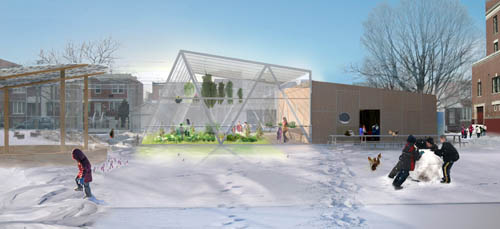
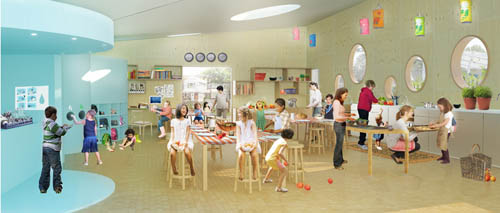
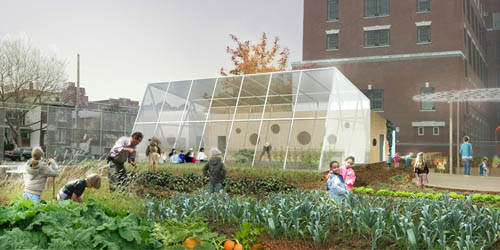
[Image: Edible Schoolyard by WORKac].

Nicola Twilley and Sarah Rich will be hosting Foodprint NYC later today at Studio-X in Manhattan (the event is free and located at 180 Varick Street, Suite 1610; here is a map).

Things kick off at 1pm, as you can see on the Foodprint Project website.

[Images: Edible Schoolyard by WORKac].

The above images, meanwhile, come from the Edible Schoolyard by WORKac. Amale Andraos, co-principal with Dan Wood in WORKac, will be speaking on a panel at 4:30pm today about her firm’s work with nutritional landscapes, educational agriculture, and the future of urban food production.

Edible Schoolyard, specifically, presents “a series of interlinked sustainable systems that produce energy and heat, collect rainwater, process compost and sort waste with an off-grid infrastructure.”

At the heart of the project is the Kitchen Classroom, where up to thirty students can prepare and enjoy meals together. The kitchen’s butterfly-shaped roof channels rain water for reclamation. Connected to one side is the Mobile Greenhouse, extending the growing season by covering 1600sf of soil in the colder months and sliding away in the spring, over the Kitchen Classroom. On the other side is the Systems Wall: a series of spaces that include a cistern, space for composting and waste-sorting, solar batteries, dishwashing facilities, a tool shed and a chicken coop.

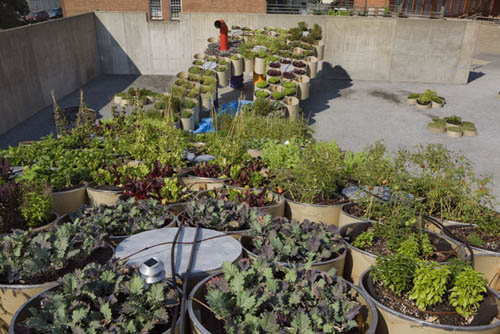
The project, created in collaboration with Alice Water’s Chez Panisse Foundation and P.S. 216, continues the suite of ideas WORKac first explored in their design for Public Farm 1, less a functioning farm, or even a prototype for one, than an intensely spatial art installation ornamented by edible plants.

[Image: Public Farm 1 by WORKac; photos by Raymond Adams].

Joining Amale Andraos on the panel today will be Marcelo Coelho (of “Cornucopia” fame, a 3D food-printer designed with Amit Zoran), Natalie Jeremijenko (of, among many, many other things, the Cross Species Cookbook), and Beverly Tepper (Professor of Food Science at Rutgers and director of the Sensory Evaluation Laboratory). As Edible Geography describes it, “the result will be a speculative and wide-ranging conversation about food security, sensory design, and [the panelists’] hopes and fears for the future of food in New York City.”

That is only the final of four panels; read more about today’s event over on the Foodprint Project website.

Artificial Glaciers 101

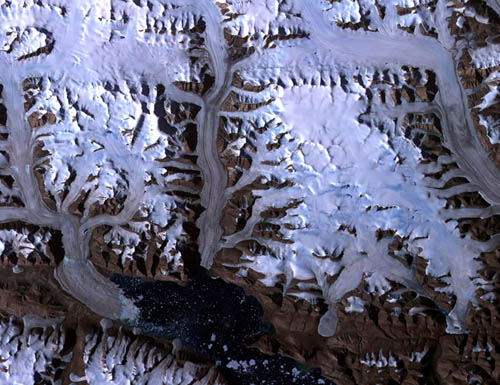
[Image: From Wired Science‘s photo gallery, “Stunning Views of Glaciers Seen From Space“].
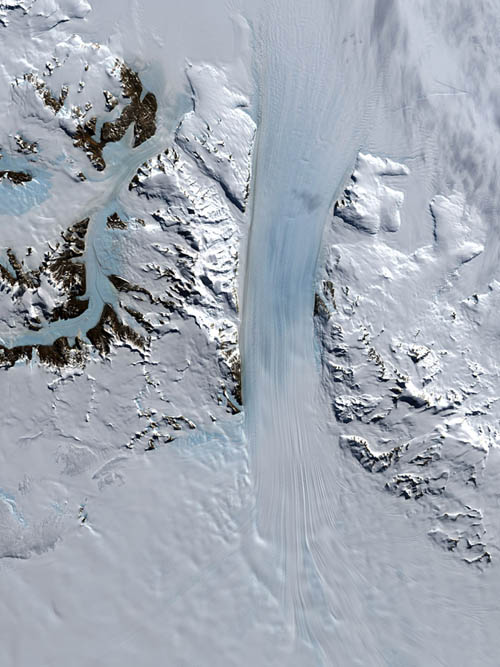
In light of this week’s ongoing conversation, I thought I’d take a quick look at how to build a glacier.

The “art of glacier growing,” as New Scientist calls it, is “also known as glacial grafting.” It has been “practiced for centuries in the mountains of the Hindu Kush and Karakorum ranges,” and it was never about science fiction: “It was developed as a way to improve water supplies to villages in valleys where glacial meltwater tended to run out before the end of the growing season.”

The artificial glacier, then, is simply a traditional landscape-architectural technique that manipulates and amplifies pre-existing natural processes. It is vernacular hydrology writ large.

[Image: From Wired Science‘s photo gallery, “Stunning Views of Glaciers Seen From Space“].
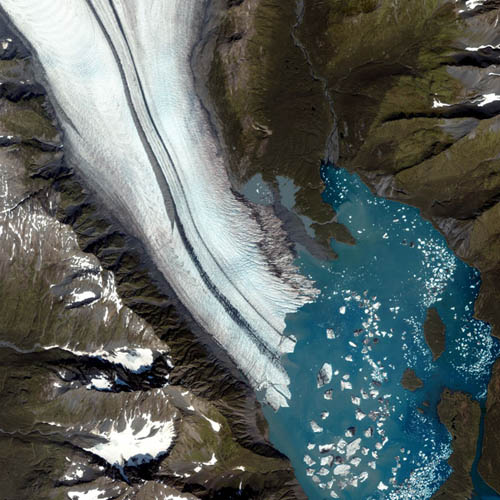
So how do you build an artificial glacier?

First, you need a site, and that site should be mountainous; altitudes higher than 4,500 meters are thermally preferable. From New Scientist:

Once the site is selected, ice is brought to rocky areas where there are small boulders about 25 centimeters across. The rocks protect the ice from sunlight, and often have ice trapped in the gaps between them. This seems to be critical to a successful “planting.”

Also critical is the glacier’s “gender.” Yes, glaciers “have a gender”: “A ‘male’ glacier is one that is covered in stones and soil and moves slowly or not at all. A ‘female’ one is whiter, and grows more quickly, yielding more water.”

After [glacier-growing mountain villagers] have added female to the male ice (traditionally by importing 12 man-loads or about 300 kilograms of the stuff), they cover the area with charcoal, sawdust, wheat husk, nutshells or pieces of cloth to insulate it. Gourds of water placed among the ice and rocks are also critical to a glacier’s chances of forming, according to [artificial-glacier expert, Ingvar Tveiten]. As the glacier grows and squeezes the gourds, they burst, spreading water on the surrounding ice, which then freezes.

Awesomely, the glacier then exhibits complex internal ventilation:

Any snowmelt trapped in the budding glacier also freezes, adding more ice. Pockets of cold air moving between the rocks and ice keep the glacier cool. When the mass of rock and ice is heavy enough, it begins to creep downhill, forming a self-sustaining glacier within four years or so.

Of course, “what’s produced is hardly a glacier in the proper sense,” we’re reminded, “but growing and flowing areas of ice many tens of meters long have been reported at the sites of earlier grafts.”

Let me repeat that: to call these artificial glaciers is a poetic over-statement, as they are much more realistically described as artificially maintained deposits of snow—what I have elsewhere called non-electrical ice reserves. But the thermally self-sustaining nature of these deposits nonetheless makes them susceptible to glaciological analysis.

[Image: From Wired Science‘s photo gallery, “Stunning Views of Glaciers Seen From Space“].
But there are also other, equally lo-fi techniques of glacier-growing.

Elsewhere, we read that “a good artificial glacier costs $50,000,” even though “the materials are simple: dirt, pipes, rocks—and runoff from real glaciers high above.” Importantly, then, but quite obviously, a controlled act of artificial glaciation can only be achieved in regions where there is already water available; you can’t simply snap your fingers and “build a glacier” in a Tucson parking lot.

In any case, this second technique “is remarkably simple”:

Water from an existing stream is diverted using iron pipes to a comparably shady part of the valley and here the water is allowed to flow out onto an inclined mountainside. At regular intervals along the slope of the mountain, small embankments of stone are made which impede the flow of water making shallow pools. At the start of winter, water is allowed to flow into this `masonry contraption’ and as the winter temperatures are constantly falling the water freezes forming a thick sheet of ice looking almost like a thin, long glacier.

All this is done before the onset of winter. During the winter, as temperatures fall steadily, the water collected in the small pools freezes. Once this cycle has been repeated over many weeks, a thick sheet of ice forms, resembling a long, thin glacier.

Again: resembling a long, thin glacier. We’re not talking about monumental, mountain-crushing tectonic formations (yet)—even if I do feel compelled to wax speculative here and suggest that, if these structures do indeed begin “to creep downhill, forming a self-sustaining glacier within four years or so,” then it is not at all unrealistic to assume that, given the right thermal circumstances and the necessary amount of snowfall, you could kick-start glaciation on a macro-scale. This might only mean on the scale of one valley—and not, say, the entire northern hemisphere—but it is an amazing idea that architects could set massive, self-sustaining, tectonically complex structures of ice into motion.

After all, glaciers are very long events, as mammoth memorably put it.

[Image: From Wired Science‘s photo gallery, “Stunning Views of Glaciers Seen From Space“].

To reiterate the simplicity of this latter design process, I want to quote artificial-glacier expert Chawang Norphel, from an interview he did with the IPS:

Glacier melt at different altitudes is diverted to the shaded side of the hill, facing the north, where the winter sun is blocked by a ridge or a mountain slope. At the start of winter (November), the diverted water is made to flow onto the sloping hill face through appropriately designed distribution channels or outlets.

At regular intervals stone embankments are built, which impede the flow of water, making shallow pools. In the distributing chambers, 1.5-inch diameter G pipes are installed after every five feet for proper distribution of water.

Water flows in small quantities and at low velocity through the G pipes, and freezes instantly. The process of ice formation continues for three to four winter months and a huge reserve of ice accumulates on the mountain slope, aptly termed “artificial glacier.”

I emphasize this for two reasons: 1) It’s extraordinarily easy to dismiss the idea of building “artificial glaciers” simply on the basis of the phrase alone. That is, the very phrase “artificial glaciers” sounds pseudo-scientific, impossibly complex, and disastrously fossil-fuel dependent. However, it’s actually a remarkably straight-forward design process, involving thermal site-specificity and vernacular building materials. 2) The idea of “artificial glaciers” also reeks of space-operatic self-indulgence, but the fundamental purpose of these structures is to create a reliable freshwater reservoir (or ice reserve) for rural communities.

We’re not talking about nuclear-powered snow-blowers built and operated by Darth Vader, in other words; we’re talking about rural Himalayan villagers who have learned to reorganize their region’s existing snowpack so as to make it thermally self-sustaining.

Or, as Norphel himself phrases it, “Apart from solving the irrigation problem, the artificial glaciers help in the recharging of ground water and rejuvenation of springs. They enable farmers to harvest two crops in a year, help in developing pastures for cattle rearing and reducing water sharing disputes among the farmers.”

[Image: From Wired Science‘s photo gallery, “Stunning Views of Glaciers Seen From Space“].

Having said that, the design possibilities become truly amazing when you scale this up, from a vernacular aid project to the level of carefully-maintained industrial infrastructure, and when you consider a wide range of alternative reasons for stockpiling ice (and, of course, things go bonkers if you let yourself consider genuinely and deliberately sci-fi-inflected ideas, such as maintaining artificial glaciers at the lunar south pole or using artificial glaciation as a Martian terraforming technique).

In any and all cases here, this makes artificial glaciers a fascinating topic for an architectural design studio—at least in my opinion—and the resulting conversations (and even open disagreements) about this topic have been very much worth the time already.

#glacierislandstorm

Drift Station Bravo

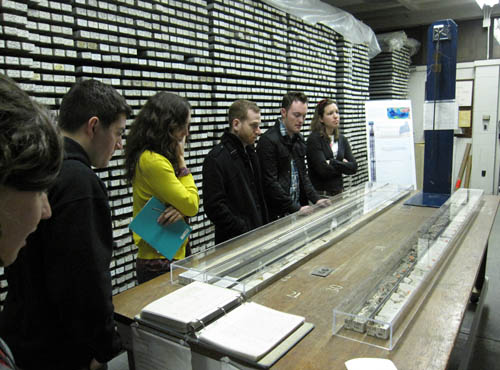
The other day I took my students up to the Lamont-Doherty Earth Observatory for an afternoon of tours through the awe-inspiring Core Lab and for a visit with the Borehole Group; we stopped in at the Lamont-Doherty seismic research station along the way, where we watched our technician-guide create artificial earthquakes with a wooden mallet so that we could watch his digital equipment go to work. It was a great day.

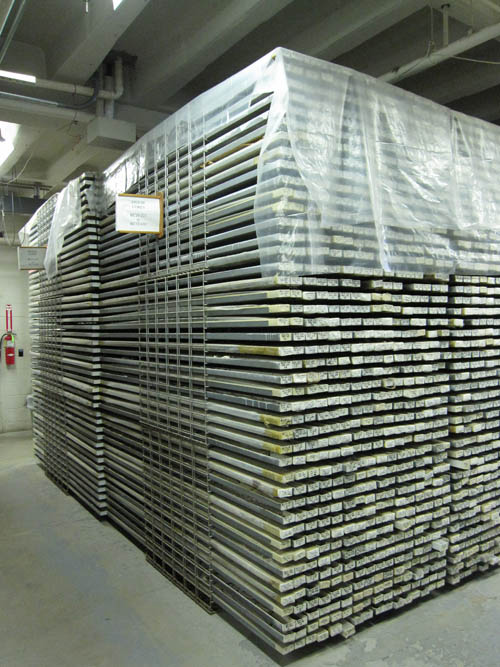
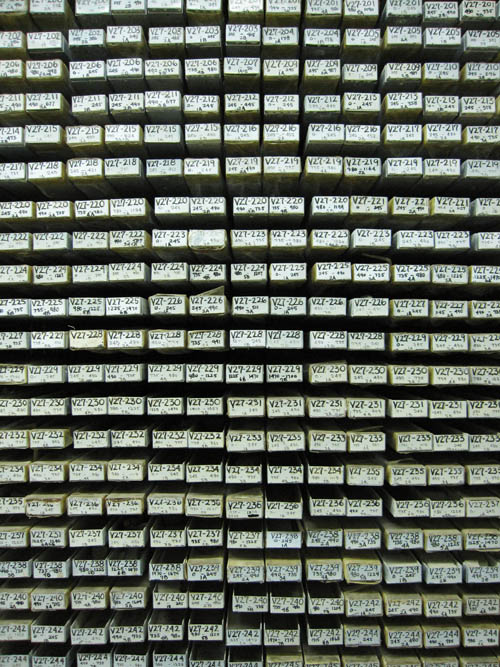
[Images: Inside the Core Lab at Columbia’s Lamont-Doherty Earth Observatory].

While we were in the Core Lab, however (photographs of which you see above), our guide mentioned that many of the older core samples—where a coring device is dropped all the way to the seabed in order to take a large cylindrical sample of geological material back to the surface for archiving and analysis—were taken not from ships but from icebergs.

These mobile islands of ice would be temporarily repurposed, turned into science labs at sea. Researchers would simply ride them till they melted, often quite far south into the waters of the North Atlantic.

I had forgotten about this. Oddly, I have been meaning to post about an old ice island called Drift Station Bravo, used for exactly these sorts of purposes, since the earliest days of BLDGBLOG (in fact, I mentioned Drift Station Bravo in a very old interview with Ballardian).

In light of the Glacier/Island/Storm studio, then, and after our inspiring tour of Lamont-Doherty, I thought I’d briefly recount this awesome story.

[Image: Drift Station Bravo postage cancellation mark, via Polar Philately].

As explained by the Polar Philately page, Colonel Joseph O. Fletcher, commander of an Air Force weather squadron stationed in the Arctic, discovered “a large tabular iceberg… that had broken off the Arctic ice shelf… [and] gone adrift.”

This island of solid ice was soon “codenamed T-1, taken from its original radar designation as a target.” Future “ice islands” were codenamed T-2 and T-3.

On March 19, 1952, the U.S. Air Force led by Colonel Fletcher and some scientists landed on this ice island [T-3] in a C-47 aircraft, setting up a weather observation station. Fletcher established a research station that was manned at this big ice sheet for roughly the next 25 years, despite a grim quote given by the head of the Alaska Air Command at the time, a General Old, who was quoted in a Life magazine article of the time as saying “I don’t see how any man can live on this thing.”

These details seem worth repeating: Fletcher’s weather station was operated on a repurposed but naturally occuring ice island for 25 years.

Fletcher’s Ice Island, and the research station that was located on it, rotated in circles in the Arctic Ocean, floating aimlessly along in the Arctic currents in a clockwise direction. The station was inhabited mainly by scientists along with a few military crewmen and was resupplied during its existence primarily by military planes operating from Barrow, Alaska.

Even better, the island—later renamed “Drift Station Bravo”—was inhabited long enough that it actually got its own postal network.

[Image: Letters postmarked from Drift Station Bravo, via Polar Philately].

Again, from the Polar Philately website:

During the period of active habitation, T-3 covers [basically postage stamps] were serviced, each stamped with a variety of hand-stamped cachets and markings, dated, and often marked with a manuscript notation of the geographic position of the drifting station on that particular day of ops. The T-3/Bravo covers were often cancelled at Barrow or at a USAF base in Alaska, and then placed in the mailstream.

The envelope, in other words, was stamped with the latitude and longitude of the iceberg at the moment of that letter’s departure.

[Image: A postal marking from Drift Station Bravo, via Polar Philately].

Over on InfraNet Lab, we read that ice “has been a strategic building material in the Arctic for the construction of roads, airstrips, housing, and, in the last few decades, as temporary drilling platforms to explore for oil.”

Ice islands are formed by spraying ice into cold air (below 20 degrees F), and layering the ice until it reaches a thickened state. These islands are either grounded at the bottom of the sea floor or are floating structures in deeper waters. Fabricated in just two months, these islands provide enough stability to support exploratory drilling tools including the rig and attendant equipment.

One of many amazing things about Drift Station Bravo, however, is that it was an administratively claimed piece of naturally existing, mobile territory. It wasn’t created in any genuine architectural sense, simply redirected, named, and given its own postal identity.

Given this act of territorial appropriation, and bearing in mind the island’s fundamental state of mobility, what are the implications for its maritime jurisdiction, as Enrique Ramirez explores over on a456?

[Image: A letter from Drift Station Bravo, via Polar Philately].

This becomes a question of immediate geopolitical concern when we consider the fact that Drift Station Bravo and its ilk were actually created in a Sputnik-like reaction to the Soviet’s own very active ice island program. The Soviets “already operated six drifting ice camps of this kind,” we read in a documentary transcript, downloadable as a 27kb PDF, but, “owing to the particular strategic importance and sensitivity of the Arctic Basin, little information from these early Soviet stations had reached the West.”

That same transcript goes on to explain exactly how the U.S managed to architecturally colonize these nomadic ice worlds. Like a vision straight out of Archigram, military civilization on the ice established itself as follows:

…a ski-equipped C-47 landed on the ice and deployed the first team of workers. It included an Air Force Major as camp commander and several soldiers with technical skills who had volunteered for 6 months duty on the ice, plus four of the typical tough and versatile Alaskan construction workers.

Modular buildings, called Jamesway huts, camp supplies, fuels, two small World War II Studebaker tractors, called Weasel, and a small bulldozer, were dropped by parachutes.

I could quote the entire PDF, in fact, as it is easily one of the most fascinating things I’ve read, but a particularly eye-popping detail comes when we read that these researchers deliberately generated earthquakes in the iceberg they lived on: “we generated tiny earthquakes in the ice. The propagation of the compressional waves generated in this way are used to study the elastic properties of the ice.”

The story expands rapidly from here. In an article originally published in the September-October 1966 issue of Air University Review, we read that competitive Soviet drift stations apparently discovered a “second magnetic north pole… located near 80° N and 178° W, with magnetic medians extending across the Arctic Ocean,” and that sulfuric gas fumes from a badly timed undersea volcanic eruption killed at least one unlucky crew member.

The whole thing amazes me, in fact. I don’t know why I’ve been sitting on this story for so long, but it’s nice, finally, to put something up about Drift Station Bravo. How many other icebergs actually had their own postal codes?

(I owe a huge thanks to the Lamont-Doherty Earth Observatory staff for taking my students around their facilities—we had a great time. Thanks!)