Star Wheel Horizon

[Image: From Horizon Houses (2000) by Lebbeus Woods (with additional design and modeling by Paul Anvar)].

After posting a project by Jimenez Lai back in January, Lebbeus Woods got in touch with an earlier project of his own, called Horizon Houses (2000).

[Image: From Horizon Houses (2000) by Lebbeus Woods (with additional design and modeling by Paul Anvar)].

In his own words, the Horizon Houses are “are spatial structures that turn, or are turned, either continuously (the Wheel House) or from/to fixed positions (the Star and Block Houses).

They are structures experimenting with our perception of spatial transformations, accomplished without any material changes to the structures themselves. In these projects, my concern was the question of space. The engineering questions of how to turn the houses could be answered by conventional mechanical means—cranes and the like—but these seem clumsy and inelegant. The mechanical solution may lie in the idea of self-propelling structures, using hydraulics. But of more immediate concern: how would the changing spaces impact the ways we might inhabit them?

These self-transforming, perpetually off-kilter structures would, in a sense, contain their future horizon lines within them, as they rotate through various, competing orientations, both always and never completely grounded.

[Image: From Horizon Houses (2000) by Lebbeus Woods].

Each house in the series thus simultaneously explores the visual nature—and spatial effect—of the horizon line and the vertical force of gravity that makes that horizon possible.

As Woods phrases it, “Gravity is constantly at work on the materials of architecture, trying to pull them to the earth’s center of gravity. An important consequence is that this action establishes the horizon.” However, he adds, “in the absence of gravity there is no horizon, for example, for astronauts in space. It is from this understanding that Ernst Mach developed his theory of inertia frames, which influenced Albert Einstein’s relativistic theory of gravity”—but, that, Woods says, “is another story.”

[Image: From Horizon Houses (2000) by Lebbeus Woods (with additional design and modeling by Paul Anvar)].

The Star House, seen immediately above and below, was what brought Woods to comment on the earlier post about Jimenez Lai; but the other “ensemble variations,” as Woods describe them, while departing formally from the initial comparison with Lai’s own project, deserve equal attention here.

[Images: From Horizon Houses (2000) by Lebbeus Woods (with additional design and modeling by Paul Anvar)].

The circular form of the Wheel House, for instance, literalizes the stationary-but-mobile aspect of the project.

[Image: From Horizon Houses (2000) by Lebbeus Woods].

It also compels the house always to be on the verge of moving again, unlike the jagged, semi-mountainous points of the Block and Star Houses.

[Images: From Horizon Houses (2000) by Lebbeus Woods (with additional design and modeling by Paul Anvar)].

The Block Houses appear to be in a state of barely stabilized wreckage following an otherwise unmentioned seismic event—which is fitting, as the rest of Woods’s descriptive text (available on his website) offers seismicity as a key force and generative parameter for the project. If the earth itself moves, what sort of architecture might embrace and even thrive on that motion, rather than—unsuccessfully—attempt to resist a loss of foundation?

[Image: From Horizon Houses (2000) by Lebbeus Woods].

To say that these buildings thus exist in a state of ongoing catastrophe would be to fixate on and over-emphasize their instability, whereas it would be more productive to recognize that each house rides out a subtle and unique negotiation of the planet—where “the planet” is treated less as a physical fact and more as a gravitational reference point, an abstract frame of influence within which certain architectural forms can take shape.

In other words, the urges and pulls of gravity might nudge each house this way and that—it might even pull them over into a radically new orientation—but the architecture remains both optically sensible against its new horizon line and, more importantly, inhabitable.

[Image: From Horizon Houses (2000) by Lebbeus Woods (with additional design and modeling by Paul Anvar)].

Taken together, this family of forms could thus roll, wander, and collapse indefinitely through the gravitational fields that command them.

[Image: From Horizon Houses (2000) by Lebbeus Woods].

For a bit more text related to the project, see Woods’s own website.

Discipline & Punish: Papillon (1973)

[Image: From Papillon, courtesy of Warner Brothers].

Breaking Out and Breaking In: A Distributed Film Fest of Prison Breaks and Bank Heists—co-sponsored by BLDGBLOG, Filmmaker Magazine, and Studio-X NYC—continued recently with Papillon (1973), directed by Franklin J. Schaffner.

[Image: From Papillon, courtesy of Warner Brothers].

Papillon remains one of my favorite films, since first seeing it as a teenager (though I will come back to that at the end); however, as usual for this series, I will try to limit myself to the spatial and/or architectural themes of at play in the movie.

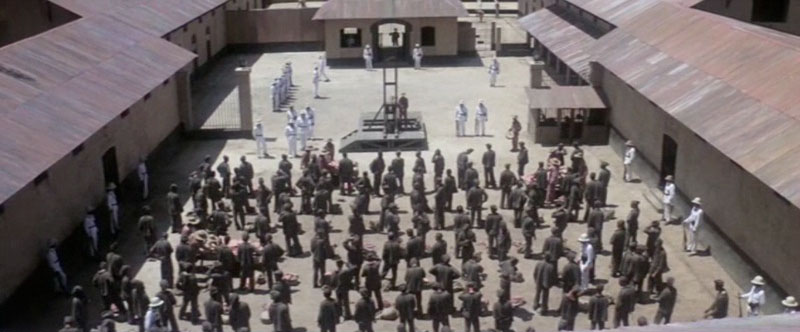
In a nutshell, Papillon tells the story of Papillon (played by Steve McQueen), imprisoned in the overseas penal colony of Caribbean French Guiana, on the northeast coast of South America. Papillon alleges that he is and always has been innocent of his charge (killing a pimp in France); nonetheless, France “has disposed of you,” we hear in booming tones from a man with a walrus mustache in the film’s opening scene. “The nation has disposed of you altogether.”
[Images: From Papillon, courtesy of Warner Brothers].

Papillon and his fellow prisoners are thus relegated to lives of hard labor, to brutal regimes of solitary confinement, and, in the end, either to forced colonization of French Guiana or to a final stretch of unsupervised years of imprisonment on a craggy island surrounded by sheer cliff walls, the prisoners sent there deemed too broken in body, spirit, and will to pose a risk of escape or violence.

[Images: From Papillon, courtesy of Warner Brothers].

Along the way, the carceral gymnastics of the early modern state command the mens’ activities. They arrive at the island on a trans-Atlantic steamer ship, kitted out inside with barred cells and prisoners’ hammocks, its dormitory lined with steam pipes that can be turned on at will to punish the men inside. They are introduced to the guillotine, that disciplinary apparatus of last order of the French state. “Make the best of what we offer you,” an anonymous supervisor says, after the guillotine’s blade has crashed down through a thick stalk of vegetation, demonstrating its raw power, “and you will suffer less than you deserve.”

While on the transport ship, Papillon meets Louis Dega, who has been sent to Guiana for selling counterfeit national defense bonds. “I have no intention of even attempting to escape,” Dega says. “Ever.” He is slightly smiling when he says this, bemusing Papillon, who soon becomes Dega’s paid protection (and long-term friend) in the camps.

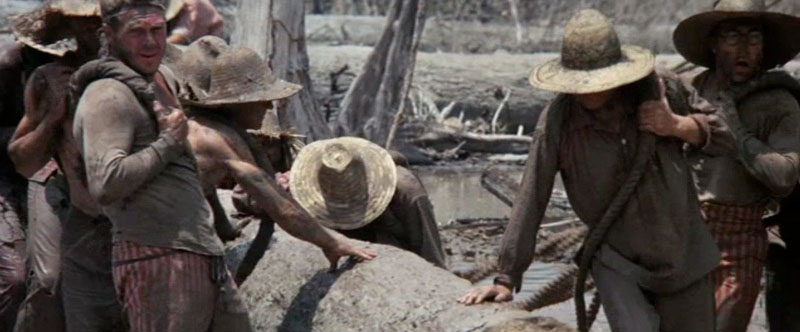
However, learning of that friendship, a prison warden whose family lost their fortune in counterfeit defense bounds, sends Papillon and Dega off together to clear swamps with nothing but ropes and their bare hands.

[Image: From Papillon, courtesy of Warner Brothers].

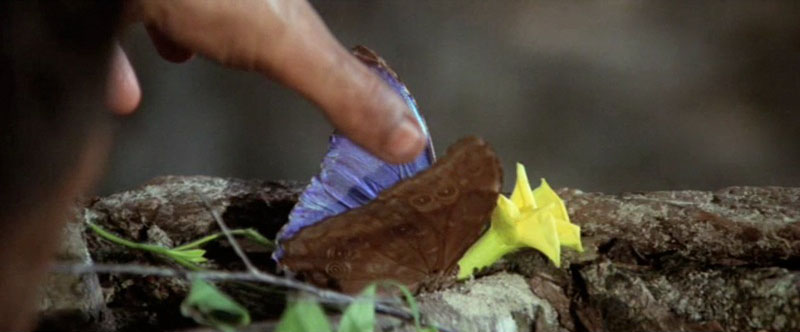
Their various chores soon include the extraordinary scene of prisoners sent out into the jungle to capture exotic butterflies—an activity that is at least doubly ironic. Not only are captives being asked, in turn, to capture rare species (including one prisoner, Papillon, whose very name comes from the butterfly tattooed on his chest), but, in an awesome detail, we learn that these particular butterflies are valuable precisely because the pigment in their wings is used for inking U.S. currency.
[Image: From Papillon, courtesy of Warner Brothers].

That it is Dega who tells us this—the counterfeiter supreme—lends the whole sequence an incredible, if macabre, poetry. But there is also something striking in this revelation of the commodity chain, suggesting that U.S. currency contains the remains of exotic butterflies hunted in the jungle by French prisoners. All objects—even objects that stand for other objects—come from somewhere, including state currency literally printed with the bodies of captives, both human and animal.
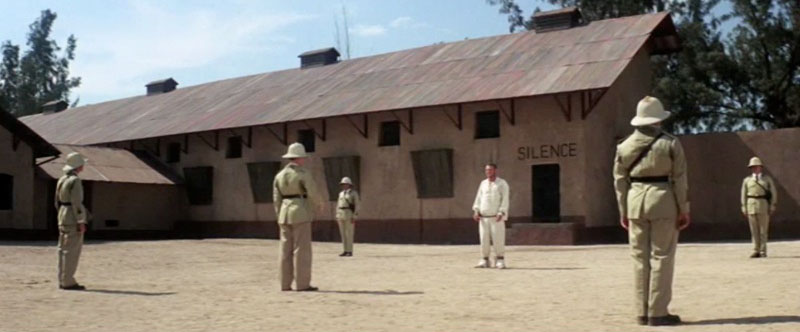
[Image: From Papillon, courtesy of Warner Brothers].

But, after this point, the real imprisonments—and, of course, the escapes—begin.

Papillon attacks a guard to protect Dega from a routine beating, only to be forced to flee into the jungle—diving into the swamp and swimming off into the roots of mangroves—when he realizes that he’ll be shot on sight for his violation (in fact, he dodges bullets as he leaps into the murky waters).

[Image: From Papillon, courtesy of Warner Brothers].

Except, of course, he doesn’t make it; he is turned in by local manhunters (former prisoners turned professional trackers of escapees); and he is introduced to the cell in which a great deal of the film then takes place.

A brief note on the architecture of incarceration in Papillon. The cells have bars instead of roofs, allowing them to be watched from above by roving guards. However, this also means that the cell can be “screened”—that is, its only source of light can be blocked for six months at a time, something that soon happens to Papillon (who is reduced to eating roaches and centipedes in the darkness). The prisoners receive their rations through a small hole near the floor, which pops open everyday at the sound of a whistle (there is no speaking allowed in the facility, helpfully painted with the word SILENCE in black letters on the outside walls). And the prisoners must lean forward and stick their heads through holes in the cell door for things like hair cuts and lice treatments—but also for occasional interrogations by the warden and his guards.
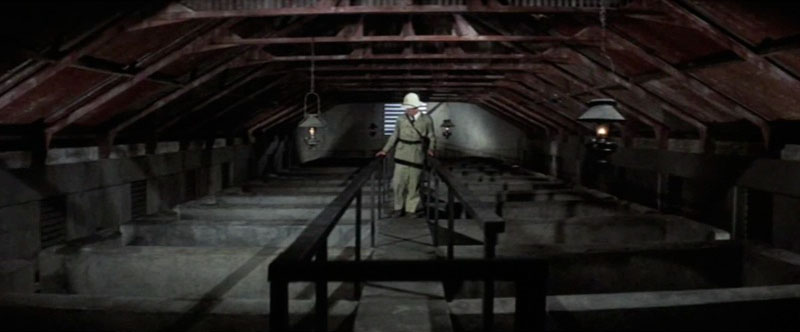
[Images: From Papillon, courtesy of Warner Brothers].

While locked up in darkness, Papillon has a dream in which he confronts a makeshift judge and jury on the beach somewhere back in France. For whatever reason, I have always loved this scene. “You know the charge,” a faceless judge shouts at Papillon. “Yours is the most terrible crime a human being can commit. I accuse you of a wasted life… The penalty is death.” Horrified by the accuracy of the charge, Papillon wanders back the way he came, muttering, “Guilty… Guilty… Guilty…”

[Image: From Papillon, courtesy of Warner Brothers].

In any case, it wouldn’t be Breaking Out and Breaking In if we didn’t soon see some escapes.

Papillon, Dega, and another prisoner called Maturette make a break for it one night over the camp wall. To make an extremely long story short, they must sail to freedom by way of a leper colony and increasingly rough seas; but, arriving safely in Honduras, they’re forced to split up. Papillon runs into the rain forest with a local prisoner they happen to bump into on the beach, and the two of them are then hunted through the jungle by Afro-Caribbean trackers hired by the state. Many more events transpire—booby traps, cliff jumps, pearl-fishing tribesmen—before Papillon makes his way to a convent in a local town center, seeking refuge and forgiveness. However, the church being, in effect, a wing of the state, mistaking ideological correctness for Christian morality, the nuns turn him in. I mention this also to indicate how, in the film, the state works: it relies upon—indeed, it cannot function without—local yet unofficial representatives, people it can hire (trackers) or who it can trust to volunteer (nuns) in the name of state continuity. In other words, the state puts out a call when a gap or blind spot arises, knowing there will always be someone who answers it.

So Papillon is sent back to solitary confinement.

I’ll just make two final points, while admitting that I’ve hardly grazed the surface of the film.

1) Papillon’s final escape comes from Devil’s Island, the aforementioned island of sheer cliffs where even guards are seen as unnecessary, the prisoners physically and mentally exhausted and thus believed to be incapable of investing in the effort of escape. But Papillon one day notices something in the waters of the bay below, a rhythm in the waves that allows for anything thrown into the water to avoid being crushed on the rocks and, instead, be dragged out to sea.

[Image: From Papillon, courtesy of Warner Brothers].

He first experiments with some coconuts—and then, lashing together a makeshift raft, he throws himself into the seventh wave and makes his way to final freedom.
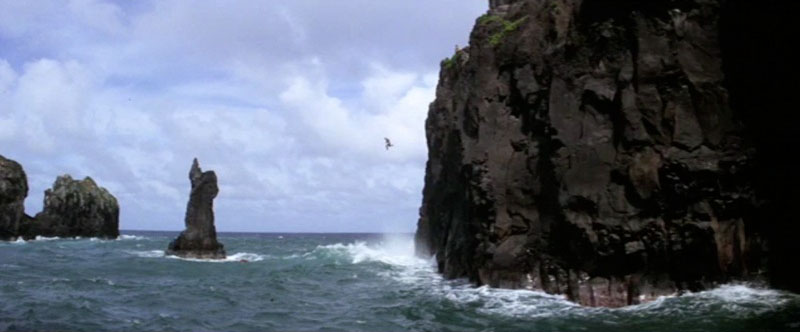
[Image: From Papillon, courtesy of Warner Brothers].

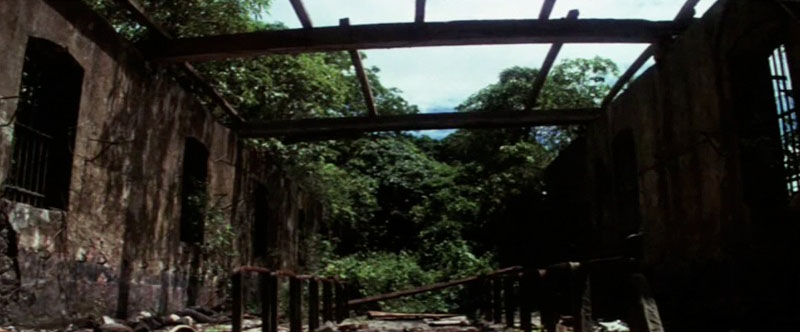
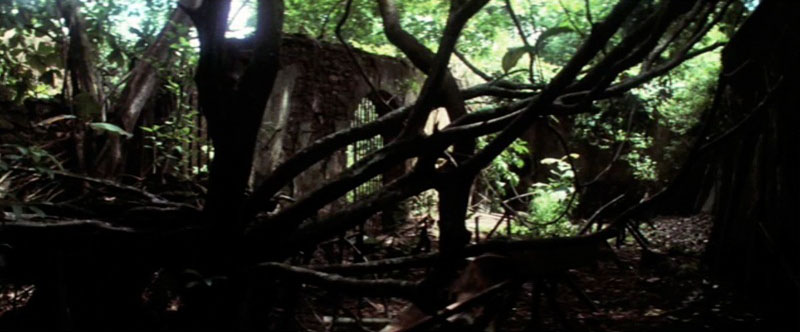
2) The movie closes with one of the most dramatically powerful end title sequences I’ve ever seen. To a haunting soundtrack by Jerry Goldsmith, we’re shown shot after shot of the actual penal colony in French Guiana, left abandoned and rotting in the jungle.

[Images: From Papillon, courtesy of Warner Brothers].

In a sense, these end titles anticipate—and, in many ways, put to shame—much of what we now see today under the guise of “ruin porn,” or photographs of decaying architectural structures.

Regardless of the accuracy of the film’s many dramatic enhancements, the ruined buildings of Papillon have the benefit of context: when the film cuts to the roofless cells and overgrown courtyards of this horrible and violent place of exile, the futility of the entire escapade—the tragedy of anyone caught up in the empty colonial machine—becomes both obvious and crushing. It’s as if no one ever escaped from anything, because there was nothing there in the first place; we’re just left with empty and impotent buildings, dissolved in shafts of light.

[Images: From Papillon, courtesy of Warner Brothers].

By way of a very brief personal anecdote, when I first saw Papillon as a teenager, and the movie came to an end, I realized, stunned, that I had actually seen the ending before.

Back when I was in the 2nd or 3rd grade, Papillon must have been on cable television, scheduled on more than one day for the same early morning time slot, coming to an end just as I got up and prepared to walk to school. There were thus a few days when I turned on the TV only to catch, without knowing what it was and at almost exactly the same moment each time, the film’s final voice-over narrative and these otherworldly shots of a dead prison in the rain forest, like some upstart challenger to Angkor Wat.

[Image: From Papillon, courtesy of Warner Brothers].

Ten years later, watching the film all the way through for the first time, I suddenly realized what it was I’d been daydreaming about in elementary school: the end titles of Papillon.

(Breaking Out and Breaking In will continue in two weeks’ time with the films of Breaking In, and, after I get back from a short trip, I will also continue to post about the Breaking Out series, which continues tonight with Rupert Wyatt’s The Escapist. Full schedule available here).

Mining the Lower East Side

[Image: From “Lower East Side Quarry” by Rebecca Fode; open each image in a new tab for a larger view].

Last month, several students from the Bartlett School of Architecture—studying as part of Unit 11, taught by Mark Smout, Laura Allen, and Kyle Buchanan—came through town for some field trips, workshops, and crits.

At a public event in January, we looked at a huge range of work by all of the visiting students, and a number of the projects—all of them speculative works set in New York City—continue to come to mind. But because of the frequency with which I refer to one of them, in particular, I thought I should post it here.

[Image: From “L.E.S. Quarry” by Rebecca Fode].
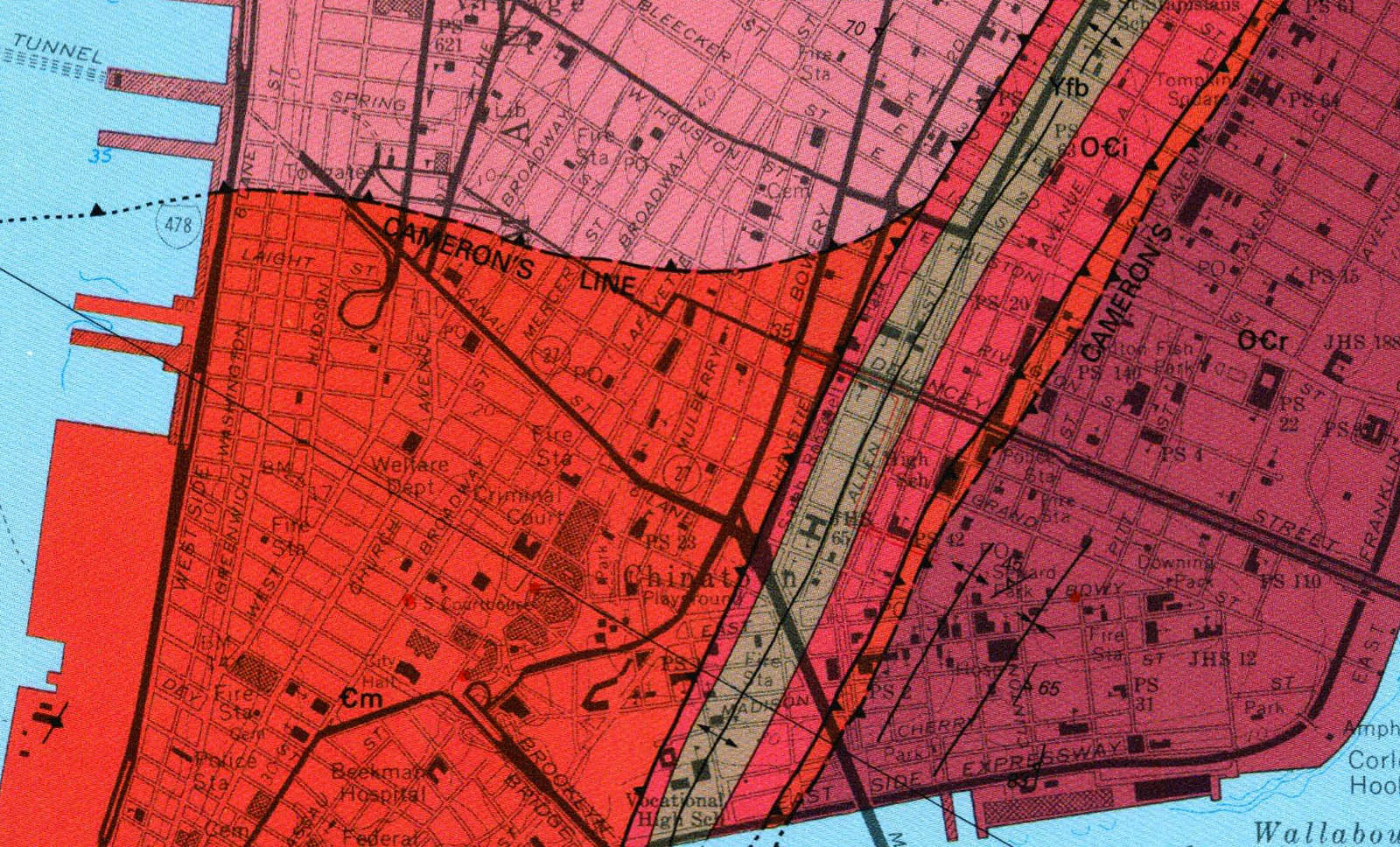
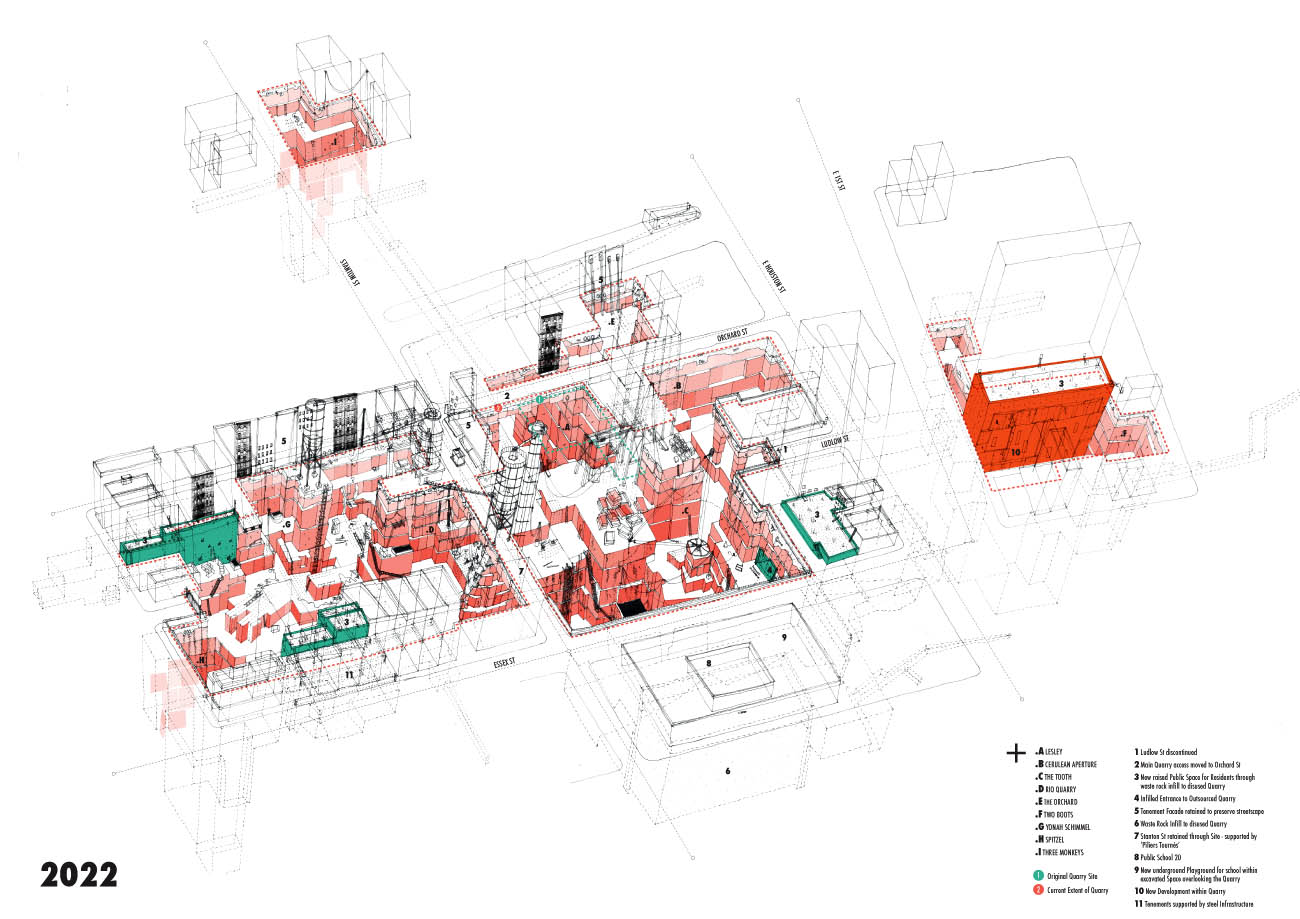
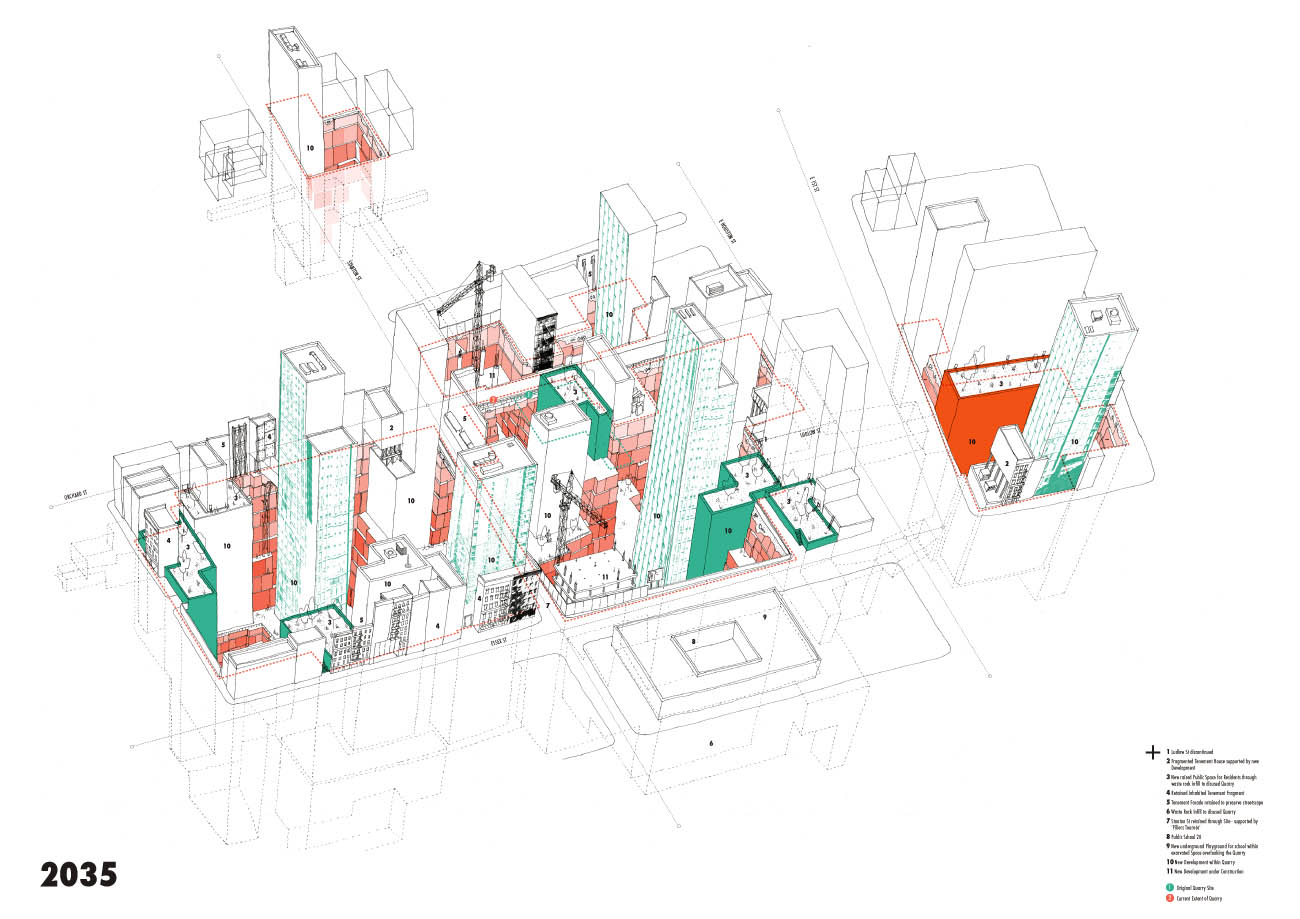
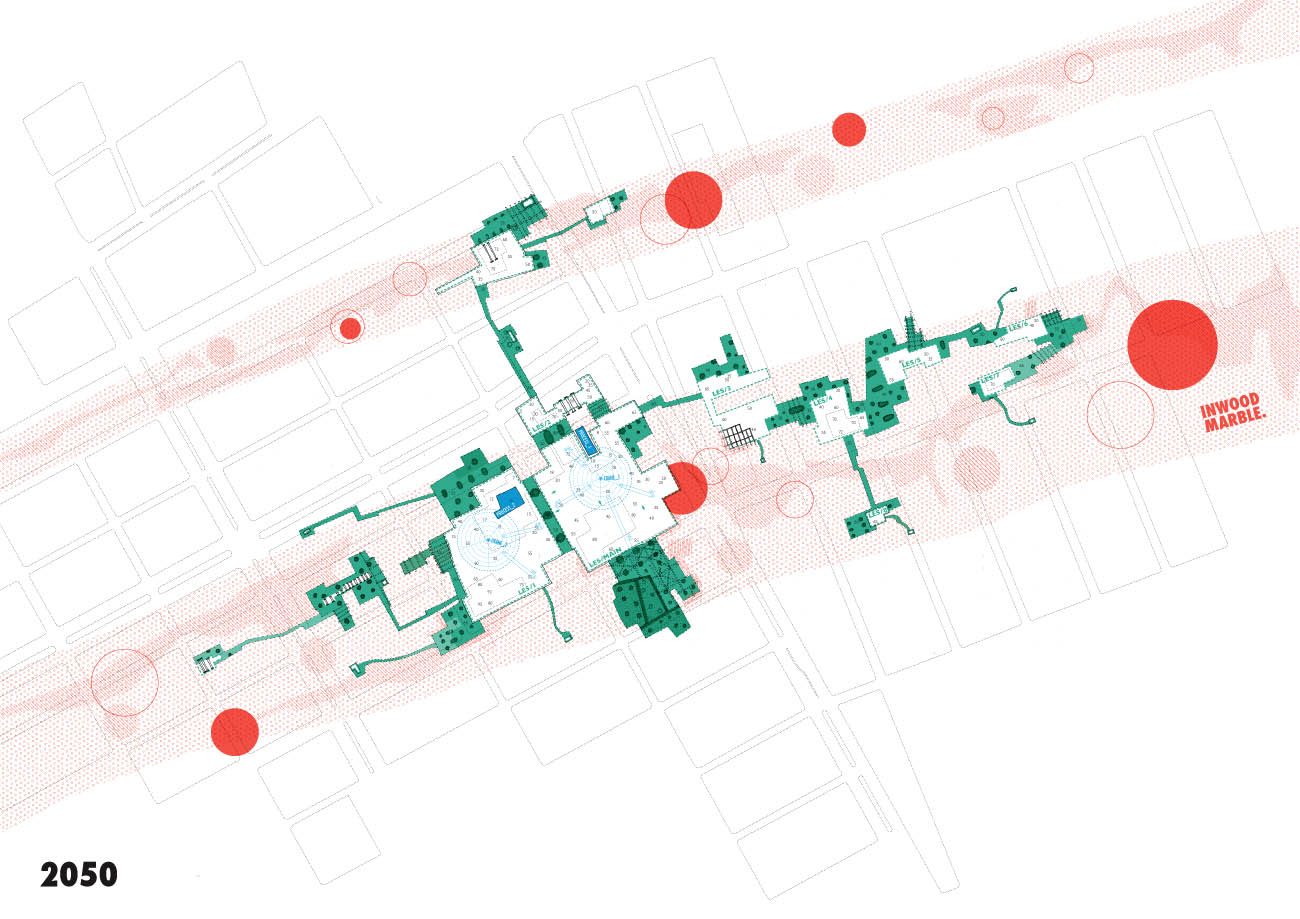
For a project called “Lower East Side Quarry,” Rebbeca Fode outlines an elaborate scenario in which the mineral content of the bedrock beneath Manhattan begins to exceed the exchange value of the real estate built upon it; accordingly, sensing access to untold wealth, residents of a rent-controlled street on the Lower East Side band together to form a rogue mining union.

[Image: Map of Manhattan bedrock, courtesy of the USGS; view larger].
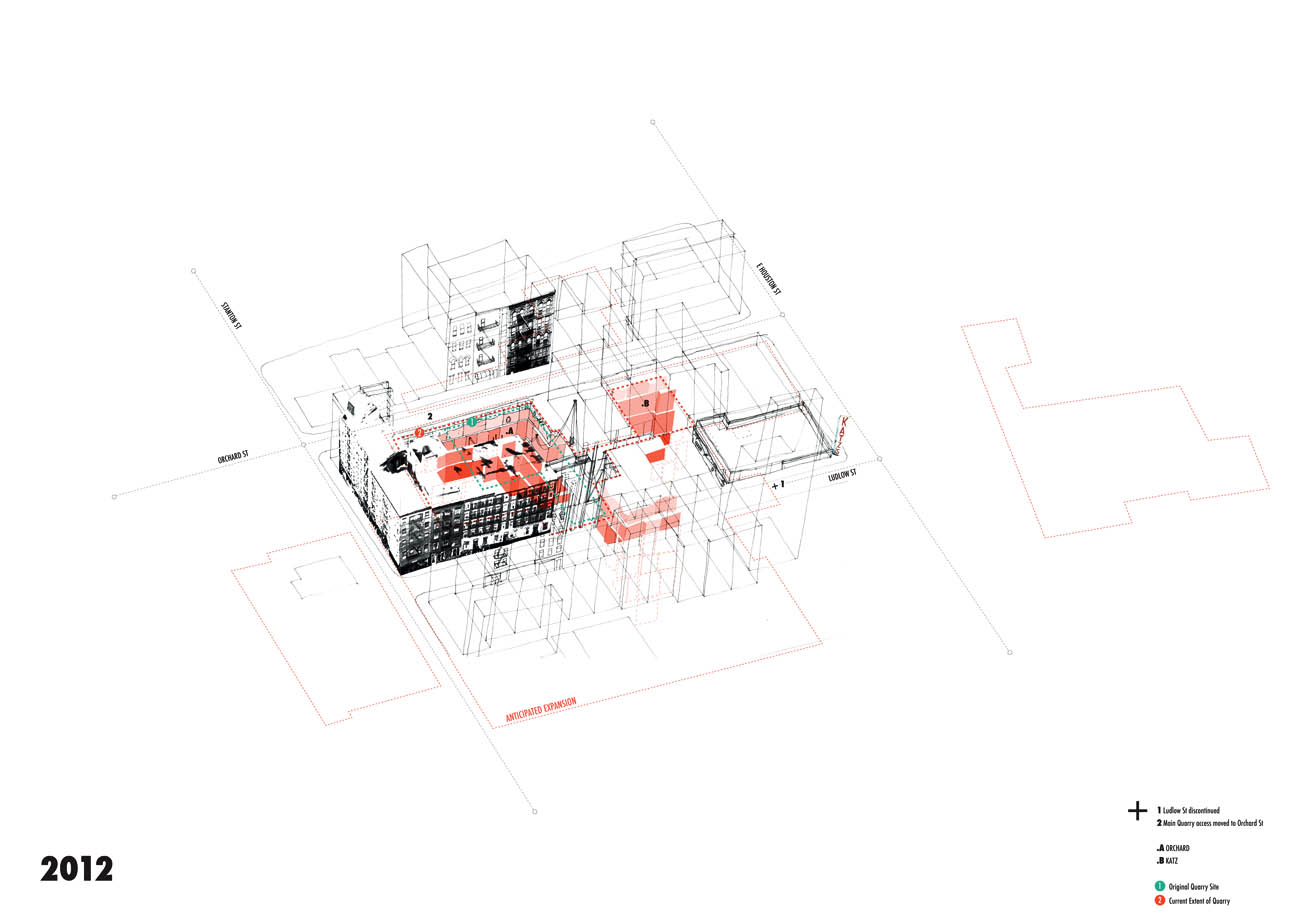
And downward they go, like economically motivated cousins of London’s Mole Man, expanding their cellars beneath the streets with this mythic quarry, beginning in 2012 at a location on Orchard Street, between Broome and Grand; here’s a map.

[Images: From “L.E.S. Quarry” by Rebecca Fode].
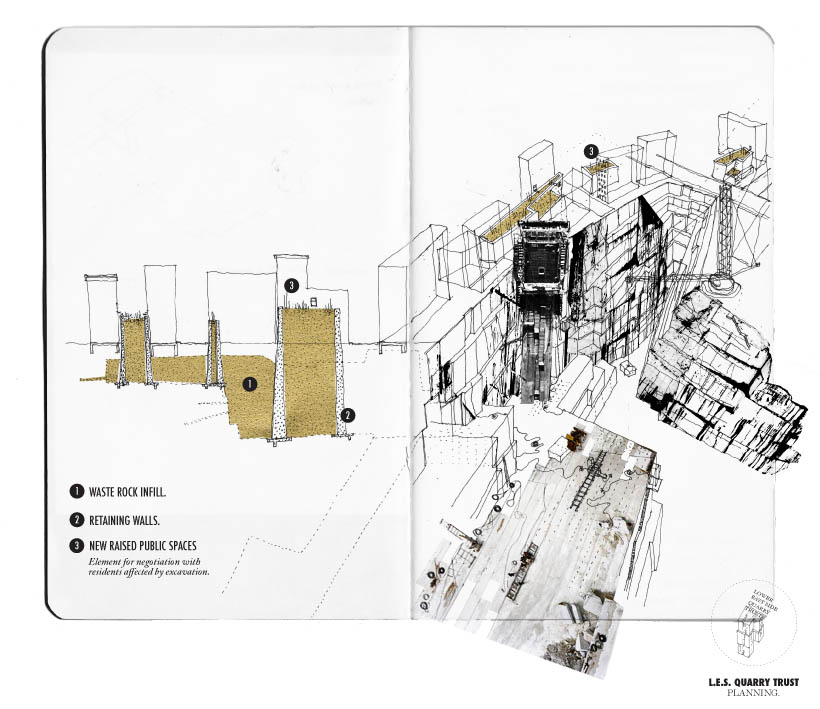
Gradually, over time, the unlicensed and increasingly complicated mineworks expand beneath nearly every building in the neighborhood, following two veins of Inwood Marble that track north-south under the city; the buildings, in turn, are propped up by retaining walls and gantries as the quarry swells below.

[Image: From “L.E.S. Quarry” by Rebecca Fode].
The ground plane thus drops lower and lower each year as the buildings themselves are, in effect, severed from the earth’s surface, coming to stand like circus acrobats on stilts over a neighborhood long ago overlooked—or underlooked?—for the mineral wealth in its foundations.

While the project is a narrative scenario, not a real proposal for an emerging DIY extraction industry, it nonetheless presents an interesting question about mineral rights and the exchange value of geology in a major inhabited area. Should a valuable mineral resource of any exploitable extent be discovered down there in the veins beneath New York City, for instance, could mining become a viable use of the city’s real estate—and, more to the point, what would be the architectural effects of this radical subtraction of the ground plane?

The city of Johannesburg springs to mind. A recent graduate thesis project by Dorothy Tang, at Harvard’s GSD, explored the urban mines that dot Johannesburg’s densely populated landscape (some of the mines have even been hijacked and, later, raided by underground security forces), and Mario Gooden‘s current studio at Columbia’s GSAPP also takes Johannesburg’s porous, unevenly excavated urban fabric as its site.

But what about the bedrock of Manhattan, an island often described in terms of canyons and analyzed as a geologic city? What happens when New York becomes a site of extraordinary excavation and it begins to expand not through fabulous skyscrapers but through sinuous and labyrinthine mines? What happens when mineral rights become as salable as air rights, when the geologic underpinnings of the city can change hands in a heartbeat, always on the verge of being extracted?

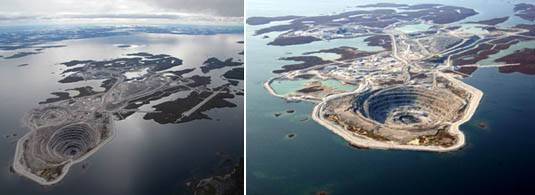
[Image: Canada’s Diavik diamond mine via Wikipedia].

New York could become not unlike Canada’s extraordinary Diavik diamond mine, a hole seemingly in the middle of nowhere with water on all sides, but with some historic neighborhoods, art museums, stock exchanges, and jazz bars propped up above on a numbered grid of bridges shaped like streets.

Ground Environment Déjà Vu

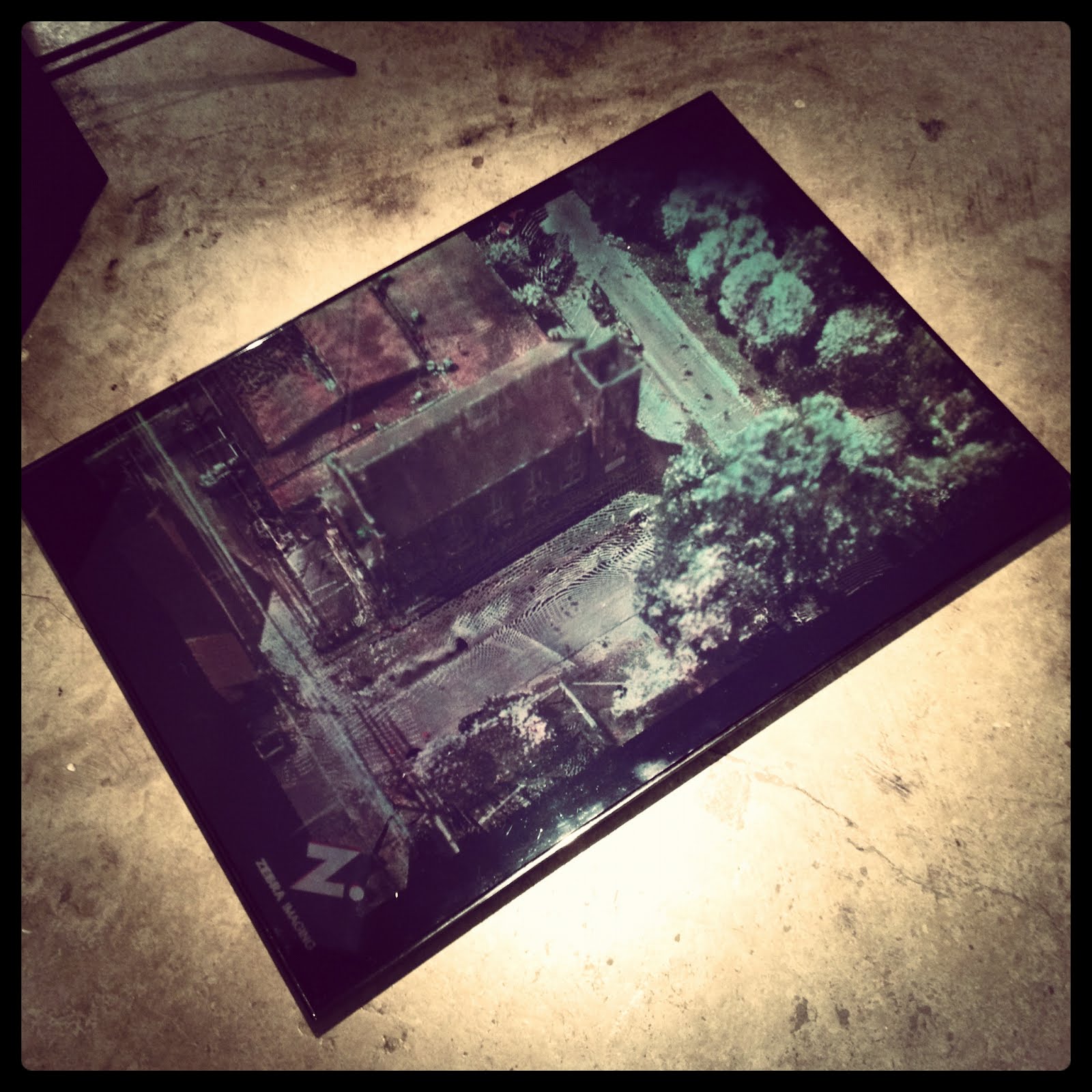
[Image: From the talk by Zebra Imaging at Studio-X NYC; photos by BLDGBLOG].

Last week at Studio-X NYC, we hosted Michael Klug of Zebra Imaging, whose 3D printable holographs I also had the pleasure of covering for the 2012 Year in Ideas issue of Wired UK.

The gist of Zebra’s work can be gleaned from that article, but a few things were mentioned at the event—including Klug’s reference to his company as engaging in a new form of “light control”—that seemed worth recounting here.

[Image: From the talk by Zebra Imaging at Studio-X NYC; photos by BLDGBLOG].

In the second half of his talk, after presenting the difficult physiology of vision and the workings of the human eye, Klug described the cartographic applications of his firm’s work. He showed several examples of streetscapes and building interiors that had been mapped via laser scanners and turned into—that is, printed as—3D holographs. Here, Klug used a military phrase—the Common Operating Picture (or Common Operational Picture)—as he showed us rendered slides of small combat teams attempting to understand an unfamiliar urban environment by way of detailed holographic prints. So this brings me to two points I want to mention:

1) At one point, Klug showed how a complete interior map of a laser-tag facility had been extracted from the movements of a SWAT team sent inside, in a kind of gonzo mapping exercise, to explore the building’s layout. Their movements through space, and the equipment they wore, generated the data for the map. Specifically, if I remember this correctly, sensors mounted with the SWAT team’s gear allowed a complete 3D representation to be created, producing manipulable point clouds of spatial data. The slide, I believe, was labeled “SWAT Team Wayfinding.”

While this, in and of itself, is not technically mind-blowing, the strategy of sending small teams of expeditionary soldiers out into unknown cities and neighborhoods in order to map, from the ground up, any and all routes, anomalies, events, and short-cuts, seems to promise a kind of militarization of psychogeography, as if the Situationist project has been taken up, albeit from an unexpected direction, by ground armies around the world.

[Image: From the talk by Zebra Imaging at Studio-X NYC; photos by BLDGBLOG].

If, as Eyal Weizman has explored, philosophers such as Gilles Deleuze and Félix Guattari have seen their work instrumentalized and turned into tactical diagrams for military strike teams, then we might also look at SWAT teams wandering through laser-tag facilities in the name of 3D cartography as a strange new, technically advanced chapter in Situationist practice—what McKenzie Wark, in his recent book The Beach Beneath the Street, calls a “calculated drifting” through urban space. Situationism means, Wark writes, “not only understanding but living the city otherwise.” The military holograph thus becomes a strange new site where these tendencies (ironically) converge. (Wark will also be speaking at Studio-X NYC this spring, on the evening of Tuesday, April 3).

2) In what was meant as more of an aside, Klug nonetheless said an extraordinary thing: that he and his colleagues have begun joking about what they call “ground environment déjà vu.” This remarkable phrase refers to the feeling that one has already experienced a 3D ground environment—an entire landscape, not just visually but immersively—due to prior exposure via holographs.

On several occasions, it seems, having recently printed holographs of a certain environment, the users of these holographs will experience a new kind of spatial familiarity with what would otherwise be a new location; they are able to know, for instance, accurately and in advance, what will be found around corners, where objects are located in relation to others, and even how far apart things are placed.

[Image: From the talk by Zebra Imaging at Studio-X NYC; photos by BLDGBLOG].

Again, in and of itself, this presents a scenario not hugely different from the assumed familiarity one might develop while looking at photographs of an unfamiliar location, then traveling to that location only to find it strangely recognizable, as if you have spent time there before.

But I’m captivated by the suggestion that new representational technologies—new ways of documenting and sharing spatial information—might come with their own cognitive implications: new memory disorders, new anxieties, new sources of identification or confusion. Put another way, what spatial or topographic disorders already exist—such as vertigo—and do certain representational technologies (like 3D film or even Google Street View) augment these disorders or keep them at bay? To use a somewhat absurd example, simply for the point of illustration, could something like 3D film be used someday as a kind of non-chemical cure for acrophobia? You’re prescribed a certain time of exposure.

Or, more to the point, will we see, in a world where holographic maps are found everyday—in guide books, on walls of subways—a new social concern with “ground environment déjà vu,” an uncanny spatial memory disorder that strikes whenever you encounter the emerging urban phenomenon of the familiar/unfamiliar location?

Autonomous Angels of Maintenance

[Image: Undersea robots guard the internet; image via Wired UK].

In what appears to be a sponsored post, a short article published on Wired UK presents an interesting scene in which semi-autonomous robots protect undersea internet cables from harm—that is, “dexterous robots toil at the bottom of the sea to safeguard the web.”

As the CEO of a company called Global Marine Systems explains, submarine cables “the width of a human hair” support 95% of the world’s internet traffic. Thus, “to cope with the demand for cable repairs,” the company has “invested in a number of remotely operated vehicles (ROVs) at our facility in Portland, Dorset.” They continue:

ROVs act like underwater robots, and are used to locate cable breaks on the seabed… and repair them. Once the ROV is lowered into the sea, a pilot on board one of our cable ships controls it to find the fault location and fix it.

The idea that little machine-guardians at the bottom of the Atlantic Ocean, like mechanical demiurges on the invisible edge of the world, are at least partially responsible for ensuring that this post can be read in Europe is a comforting thought before bed.

HoverMast

[Image: The Sky Sapience HoverMast, via sUAS News].

The Israeli-made HoverMast is a “tethered hovering platform specially designed for small vehicles.” As the consistently fascinating sUAS News explains:

At the click of a button, the system autonomously deploys, rising to heights of up to 50 meters within 10-15 seconds. Secured by a cable, serving as a power supply and wideband data link, the highly stabilized HoverMast [… can also be mounted with sensing gear…] such as electro-optic sensors, laser designators, radar, and sophisticated COMINT and ELINT systems.

While the HoverMast (also called “Sky Sapience”) is currently being pitched to the only market that can afford it right now—that is, state-funded militaries, contractors, and police organizations—the availability of these and other semi-autonomous data gathering systems will continue to increase for the civilian realm (i.e. scientists, designers, artists, cartographers, and, as a lengthy new piece on Australia’s ABC News explores, journalists).

But what are the architectural possibilities for tethered sky masts and other instant cities made from semi-autonomous drone infrastructure? Film sets dramatically gridded with airborne towers, capturing every detail from previously impossible angles; roads appearing in the middle of nowhere, marked only by illuminated HoverMasts popping-up in lieu of street lights; cities in a blackout throwing ad hoc masts of light up into the urban sky; pop-off architectural ornament that rises, tentacular, from rooftops to catch better cell phone signals; and so on.

Where’d the road go?: Cool Hand Luke (1967)

[Image: From Cool Hand Luke, courtesy of Warner Brothers].

Breaking Out and Breaking In: A Distributed Film Fest of Prison Breaks and Bank Heists—co-sponsored by BLDGBLOG, Filmmaker Magazine, and Studio-X NYC—continued last week with Cool Hand Luke (1967), directed by Stuart Rosenberg.

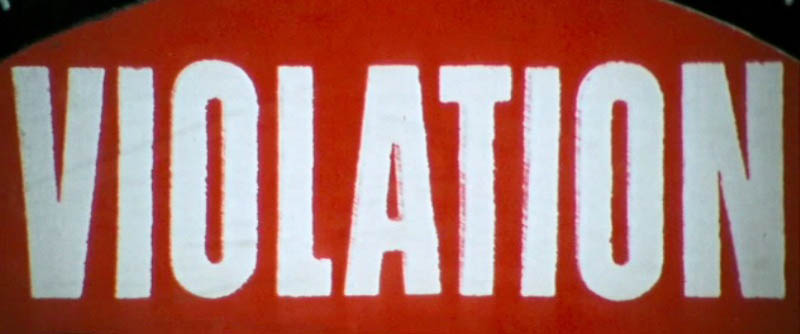
The film tells the story of Luke Jackson, imprisoned for “maliciously destroying municipal property” by cutting the heads off parking meters. The very first word and image of the film is VIOLATION.

[Image: From Cool Hand Luke, courtesy of Warner Brothers].

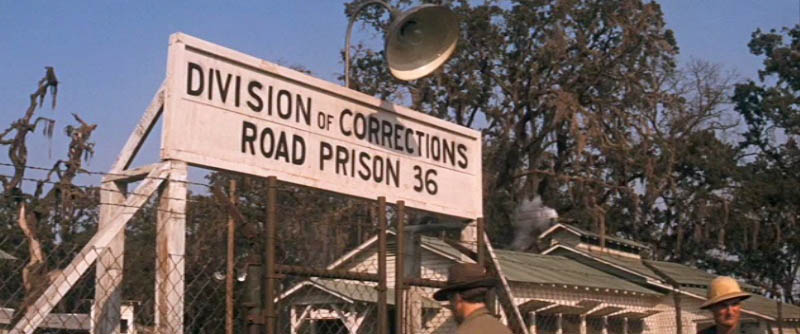
Luke is thus arrested and sent to a work camp in Florida, where he becomes, in effect, part of the country’s emerging national transportation infrastructure, paving rural roads through the Florida swamp.

He is immediately introduced to a new set of limitations. “We got all kinds,” the camp warden announces, referring to the prisoners kept behind fences there in the subtropical heat; but all of them have had to learn how to stay put. To this, the warden adds, “in case you get rabbit in your blood and you decide to take off for home,” you’ll be rewarded with more time in prison and a “set of leg chains to keep you slowed down just a little bit, for your own good. You’ll learn the rules.”

[Image: From Cool Hand Luke, courtesy of Warner Brothers].

Later, Luke meets the camp’s “floorwalker,” a man who keeps watch over the prisoners’ boarding house; the floorwalker unloads an absurd and seemingly endless monologue about how the prisoners can avoid spending “a night in the box,” a small building the size of an outhouse with no pretenses of comfort or hygiene. The list of steps by which to avoid this fate—involving everything from laundry to yard tools—is mind-numbing and absolutely impossible to remember.

When the rest of the camp comes back inside to shower and meet these newly arrived state captives, tension between Luke and the existing group’s ostensible leader, nicknamed Dragline, is established immediately. “You don’t listen much—do you, boy?” Dragline growls, mistaking his own corpulence for an ability to intimidate. Luke barely looks at him in return. “I ain’t heard that much worth listening to,” he mutters. “Just a lot of guys laying down a lot of rules and regulations.”

[Image: The camp; from Cool Hand Luke, courtesy of Warner Brothers].

As such, the film offers an interesting mix of, on the one hand, the surreal impossibility of reasoning with the state and its hired representatives (similar, say, to the writings of Franz Kafka); and, on the other, what seems to be a particularly American breed of libertarianism, one in which even parking meters can be interpreted as “just a lot of guys laying down a lot of rules and regulations,” where all instances of authority are meant to be, if not resisted, than at least publicly mocked and undercut.

[Images: Lucas Jackson meets the blinding lights of the state; from Cool Hand Luke, courtesy of Warner Brothers].

As we’ll see—and this post contains spoilers, for those of you who haven’t seen the film yet—Cool Hand Luke becomes a kind of Trial-like cautionary tale, suggesting that the end result of playfully antagonizing the state can often be repression or death.

[Images: From Cool Hand Luke, courtesy of Warner Brothers].

So Luke, a nonviolent offender, is sent off to pave roads in the heat, clearing weeds and snakes, and otherwise maintaining national infrastructure alongside others in his imprisoned crew. They are, in a sense, tragically ensnared in the geographic project of the state, which seeks to expand ceaselessly into underserved rural areas by means of convict-facilitated construction projects. And thus the nation—brutally, physically, literally—is made.

[Images: From Cool Hand Luke, courtesy of Warner Brothers].

This relentless growth of the well-policed roadway is perhaps the film’s central motif—even above the film’s admittedly more entertaining scenes, such as Luke living up to his own challenge of eating 50 hard-boiled eggs. For instance, in one scene where a particularly manic Luke successfully challenges the rest of his crew to treat the day’s road-paving assignment like a race, they’re left confused and dumbfounded when the tar truck drives away. The inmates are left staring at a STOP sign. “Where’d the road go?” an exasperated Dragline asks, as if they’re now faced with doing nothing.

But that’s precisely it: the only thing left to do is nothing. This recalls how Luke gets his nickname—”Cool Hand Luke”—by bluffing his way to victory in a poker game, holding a hand “full of nothing.”

In any case, Luke responds by laughing at the idiocy of the entire situation. They ran a race against nothing and no one won.

[Image: From Cool Hand Luke, courtesy of Warner Brothers].

For those of you who have seen the film, there is clearly much more in it to discuss that is not spatial or architectural, and I would hope that such a conversation could still take place, either here in the comments or someday with friends; but, given the thematic emphasis of the Breaking Out and Breaking In film series, I’ll focus on just a few more things.

Luke, of course, escapes—three times—but not once, in any long term sense, is he successful, getting hauled back to camp twice in chains.

[Images: From Cool Hand Luke, courtesy of Warner Brothers].

Luke’s various punishments for these attempted escapes grow in severity, suggesting a dark answer to the question proposed by a commenter on an earlier BLDGBLOG post: “How do you design a space to break someone’s spirit? A horrible and unimaginable commission.”

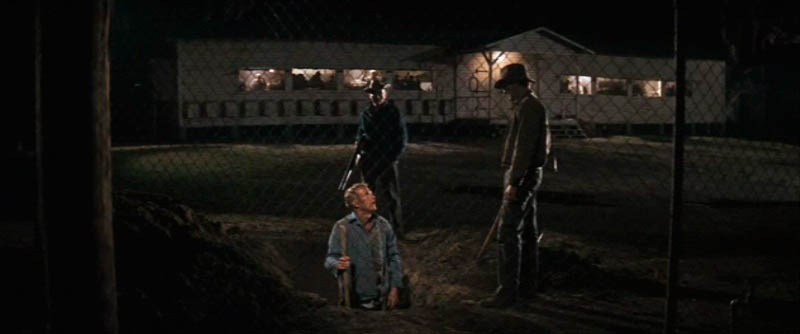
Specifically, Luke first spends “a night in the box” and is then forced—inverting all of the power implications associated with digging, tunneling, and moving dirt that we’ve seen so far in the Breaking Out series—to dig and refill a hole in the prison yard, several times over, effectively breaking his will. At one point he is even pushed back into the hole, as if he has, all along, been digging his own grave.

[Images: From Cool Hand Luke, courtesy of Warner Brothers].

After witnessing Luke’s very audible collapse, his fellow inmates refuse to speak with him after he stumbles back to the bunkhouse, as if Luke’s aura of indefatigability has been permanently smudged by this performance of desperate weakness. The “horrible and unimaginable commission” of breaking his spirit has, it seems, been accomplished.

However, Luke has one more escape in him, driving off unexpectedly in a road-servicing truck and disappearing into the parched landscape seen reflected in the mirrored sunglasses of the silent “boss” (and sharpshooter) who watches over him.

[Image: From Cool Hand Luke, courtesy of Warner Brothers].

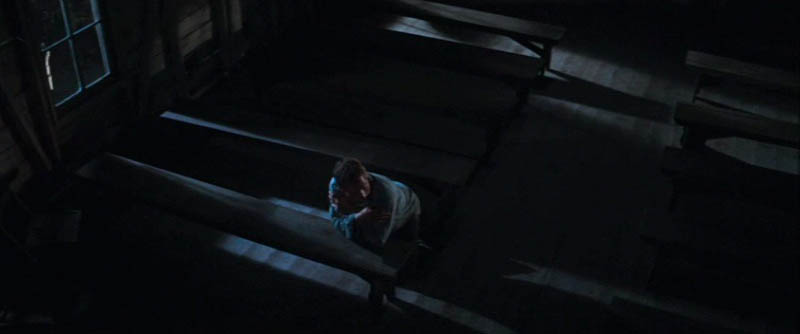
This, then, will be my final point about the film: in what is otherwise an obvious—even hackneyed—scene, played for all its poetic and metaphoric power, Luke finds himself alone in an empty church at night, unsure of where to run to next. In many ways, this is where the film’s Kafka-esque themes are most clearly foregrounded, as Luke, addressing God for the second time in the film, finds himself simply speaking to empty rafters.

The church is silent, just a bunch of a wood and darkness, and Luke realizes, once and for all, that no one will be answering.

[Images: From Cool Hand Luke, courtesy of Warner Brothers].

Again, this is far from dramatically original, but the scene strongly benefits from its proximity to Luke’s earlier solicitations of authority. In other words, Luke rattles the doors of the divine only to find no response—he finds an empty room and silence. But, when he rattles the doors of the state, an altogether different and more mundane body of authority, it responds by crashing down upon him, relentlessly and absolutely, ultimately leading to his death by sharpshooter (inside the door of a church, no less).

What began as a nonviolent prank, cutting the heads off parking meters, ends, in effect, with a death sentence, as Luke’s ongoing antagonism of the state is seen not as a playful engagement with arbitrary authority, but as an offense so grave—a bluff with an empty hand, holding nothing—that Luke’s very existence is, we might say, reneged or cancelled out. And when he calls up to God, he hears nothing.

[Image: From Cool Hand Luke, courtesy of Warner Brothers].

Briefly, I’m reminded of the extraordinary film The Story of Qiu Ju, in which a Chinese villager calls upon the machinations of the state in order to solve a matter of local justice, only to find, to her growing dismay, that she has set into motion something incoherent, lumbering, deaf, and unstoppable.

Only, here, Luke is at the receiving end of something Qiu Ju only witnesses—as if he has snapped the trip-wire of the state, becoming lethally ensnared in a system from which escapes are punishable by death, no matter how trivial the initial offense might be.

[Image: Luke’s apotheosis, ascending above the cross of the roadway; Cool Hand Luke, courtesy of Warner Brothers].

In any case, Cool Hand Luke is, in the end, a strangely affecting film, seemingly more tragic each time I see it; but I’m sure there’s much more to discuss, so feel free to jump in with any thoughts or comments.

(Up next: Breaking Out and Breaking In continues with Cube. Complete schedule available here).

Cropped

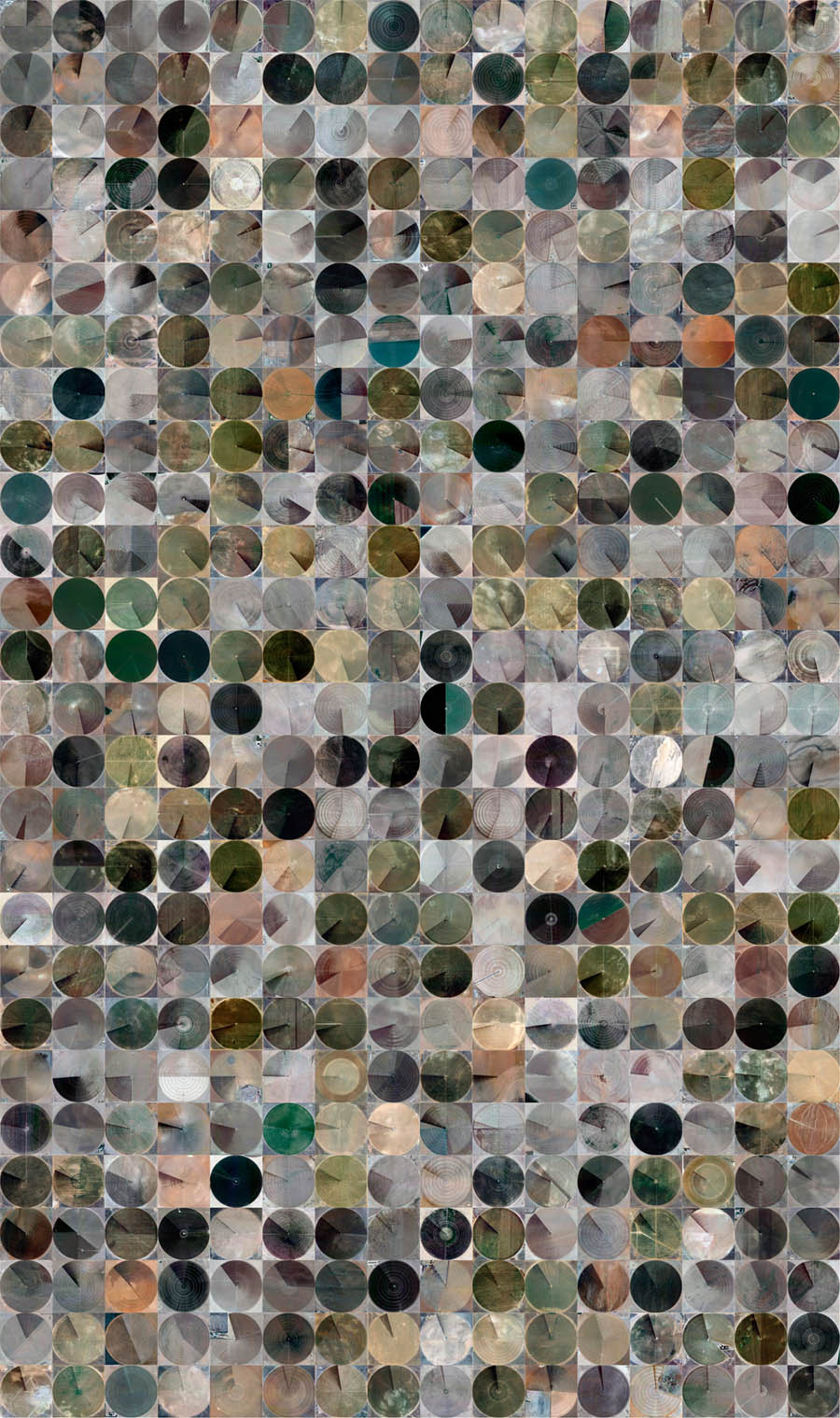
Photographer Gerco de Ruijter—previously seen here for his aerial photographs of tree farms and his pigeon’s-eye-view cinema of the city—has edited together a short stop-motion animation from satellite views of circular crop irrigation systems in the U.S. southwest.

The resulting film seems to promise a strange new form of time-keeping, with the irrigation equipment itself ticking like a stopwatch, but this is never, in fact, realized. Instead, the effect is more like watching a record spinning wildly on its platter, like a planetary-scale version of Bartholomäus Traubeck’s music played from tree rings, where the stylus has been applied to the abstract patterns of human agriculture.

[Image: The source images for Crops by Gerco de Ruijter].

De Ruijter also sent through the source images, above, used as stills—centered and cropped, playing on the film’s title—in the resulting animation.

Forensic Flowers

Two quick botanical stories in the news:

1) A short piece in The Scientist profiles artist Macoto Murayama, who “began applying the computer graphics programs and techniques he had learned while studying architecture at Miyagi University of Education in Sendai to illustrate, in meticulous detail, the anatomy of flowers.”

[Image: A flower by Macoto Murayama, via The Scientist].

Murayama physically dissects flowers in his studio, uncovering what he calls their “hidden mechanical and inorganic elements”; he then “sketches what he sees, photographs it, and models it on the computer using 3dsMAX software, a program typically used by architects and animators. Finally, he creates a composition of the different parts in Photoshop, and uses Illustrator to add measurements and other labels.” See more at The Scientist.

2) Archaeologists in Israel have used pollen trapped in plaster to reconstruct a “luxurious garden created by the Persians.” Their method reads like a rejected pitch for Jurassic Park 4: “Using a specialised technique for separating fossilized pollen trapped in the layers of plaster found in the garden’s waterways, researchers from Tel Aviv University’s Sonia and Marco Nadler Institute of Archaeology have now been able to identify exactly what grew in the ancient royal gardens of Ramat Rahel. By examining the archaeological evidence and the likely settings of specific plants they have also been able to reconstruct the lay-out of the garden.”

The hydrologically complex landscape, as reimagined by the archaeologists, was able to support a huge variety of species, including “ornamentals such as myrtle and water lilies, native fruit trees including the grape vine, the common fig, and the olive and imported citron, Persian walnut, cedar of Lebanon and birch trees. Researchers theorize that these exotics were imported by the ruling Persian authorities from remote parts of the empire to flaunt the power of their imperial administration.”

It would be interesting to reconstruct Central Park based solely on pollen grains trapped inside the painted walls and debris-filled lobbies of ruined hotels of a semi-submerged New York City 2,000 years from now. A Nobel Prize in Landscape Forensics.

(See also: Detection Landscapes).

The Pop It Up

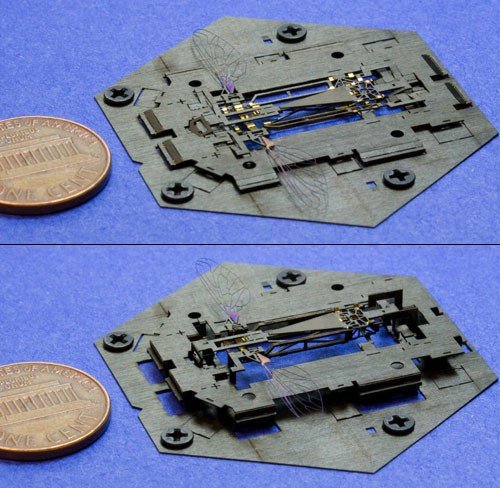
The whole pop-up phenomenon just got a bit more literal, with the debut of tiny robots inspired by pop-up books.

[Image: The pop-up robot sheet, developed at Harvard].

Equal parts origami and electrical engineering, each robot “has 137 folding joints,” PopSci explains. “The assembly scaffold, which has folds of its own, performs 22 origami-style folds, resulting in a fully formed robot you can pop out and turn on.”

Science Daily points out that this “will soon allow clones of robotic insects to be mass-produced by the sheet.”

[Image: A close-up of the pop-up sheet, courtesy of Harvard].

The system, developed at Harvard, “works by combining all the robots’ component layers, [and] sandwiching each piece of metal or carbon fiber into a single sheet. First each layer is laser-etched into the proper design, and the sheets are laminated together. The end result is a hexagonal sheet with a small assembly scaffold, with the whole thing the size of a U.S. quarter.”

On a wildly different scale, and relevant only for reasons of formal resemblance, I’m reminded of Bernard Khoury’s B 018 project in Beirut, a nightclub that “comes to life in the late hours of the night when its articulated roof structure constructed in heavy metal retracts hydraulically. The opening of the roof exposes the club to the world above and reveals the cityscape as an urban backdrop to the patrons below.” Prior to that moment of retraction, Khoury’s “building” is more like a highly compressed 2D surface.

[Images: B 018 by Bernard Khoury].

The point of this comparison being to wonder aloud what sorts of pop-up architecture might be possible using the sandwiched components technique described above. What might “soon allow clones of robotic buildings to be mass-produced by the sheet,” if we could export and scale this up to the world of spatial design? 2D surfaces that pop-up—or pull down—into functional buildings.

[Image: A 2005 installation by Do-Ho Suh; photograph by Marcus Trimble].

Buildings that pop up out of city sidewalks; robots that pop up out of those buildings’ floors; smaller buildings that pop up out of those pop-up robots; tiny, insect-sized robots that pop up out of them.

Electric Landscapes

[Image: An otherwise unrelated photo of marsh grass, courtesy of the USDA].

Gardens might soon be power plants, scaled up to whole landscapes generating domestic electricity. “With a tangle of bright red cables spilling out from among the plants’ roots, this grass is wired to the hilt and produces electricity day and night,” New Scientist reports. After all, there is “potential in harvesting electrons released among plant roots” in damp, conductive soil, and this “could eventually generate a significant portion of our domestic electricity needs, making juice that will be even greener than power from solar panels or wind turbines.”

Researchers in the Netherlands have narrowed in not on trees or other charismatic megaflora—not future forests sparkling with electrical storms between branches—but on any plant “with shallow roots that thrives in damp or waterlogged soil where oxygen is scarce.” More specifically, this means marsh grasses and reeds (though we read that “the technology should have particular appeal in Asia, where it could be used to turn millions of hectares of rice paddies into power stations”).

The techniques under study in Holland currently involve a specially designed electrode that can harvest excess electricity from otherwise organic plantlife. But, as various species (sugar beet, rice, marsh grass) are trialled, and as chemically different soil matrices are reviewed, it’s not hard to imagine a forthcoming scenario for landscape design in which genetically-modified plants grown in carefully mixed artificial soils, fertilized with conductive nutrients and finely wired with grids of geotextile mats, become the gardens of the late 21st century. Warm electric landscapes power houses through the darkness of peak oil, as increasingly efficient landscape formats get tested day after day by amateur planters, who rearrange their backyard plots based not on aesthetics but on the potential for electrical interchange.

(Earlier on BLDGBLOG: Shining Path).