Cliff House

I randomly came across this image, below, of Adolph Sutro‘s now-lost Cliff House, perched on the rocks outside San Francisco. It stood for eleven years, from 1896-1907, before being destroyed by fire.

[Image: The Sutro Cliff House, San Francisco].

This gallery of images is extraordinary; the house is so badly situated on its site that it appears simply to be hovering over the rocks on an artificial ground plane. It’s like a continental afterthought, the dream of western architecture pushed beyond its ability to retain anchorage. But it’s a cinematic sight, to say the least.

For more about Adolph Sutro, meanwhile, don’t miss the wave motors of California.

One Million Years of Isolation: An Interview with Abraham Van Luik

[Image: Yucca Mountain, Nevada; courtesy of the U.S. Department of Energy].

Abraham Van Luik is a geoscientist with the U.S. Department of Energy; he is currently based at the nuclear waste-entombment site proposed for Yucca Mountain, Nevada. Yucca Mountain, a massive landform created by an extinct supervolcano inside what is now Nellis Air Force Base’s Nevada Test and Training Range, 90 miles northwest of Las Vegas, is the controversial site chosen by Congress for the storage of nuclear waste. Its political fate remains uncertain. Although the Obama Administration has stated that Yucca Mountain is “no longer… an option for storing nuclear waste,” Congress has since voted to continue funding the project—albeit only with enough funds to allow the licensing process to continue.
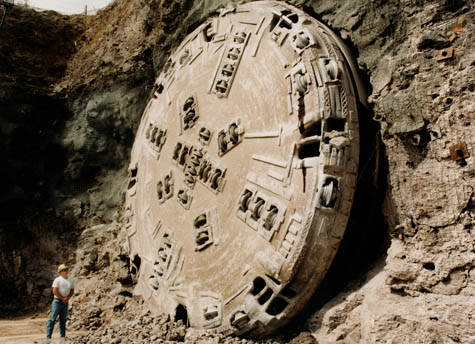
[Image: Resembling some new breed of Stargate emerging from the Earth, the tunnel-boring machine at Yucca Mountain reaches daylight; view larger! Courtesy of the Department of Energy].

As part of our ongoing series of quarantine-themed interviews, Nicola Twilley of Edible Geography and I spoke to Van Luik about the technical nature of nuclear waste storage and what it means, on the level of geological engineering, to quarantine a hazardous material for more than one million years.

• • •

BLDGBLOG: How did you start designing a project like Yucca Mountain, when you’re dealing with such enormous timescales and geological complexity?

Abraham Van Luik: You start with a question: how do you perceive the need to isolate a material from the environment?

I think most people would begin to answer that by looking at the nature of the material. Wherever that material is currently, we make sure that there is either a thick wall or a deep layer of water to protect the people working around it. That’s what’s being done at a reactor: when spent fuel comes out of a reactor, it’s taken out remotely with no one present, and put into a water basin that’s deep enough that there is no radioactive shine from the spent fuel escaping out of that water. If the pool is getting full, after five years or so of cooling, then the utility company will take the material out of the pool—remotely manipulated from behind leaded-glass windows—and put it into dry storage. Dry storage uses very thick steel and concrete. And there it will sit until someone disposes of it, or until it’s reprocessed.

Now, in most countries, what they have done next is asked: What geology would be very good for isolating this material from the environment? And what geologies are available in our country? The Swedes have gone to their granites, because their whole country is basically underlain by granites. The French looked at granites, salts, and clay, and decided to go with clay. The Belgians and Dutch are looking at clay and salts; and the Germans are looking at salts right now, but also at granites and clay. The Swiss are looking at clay, mostly, although they did look at crystalline rock—meaning rock with large crystals, like granite, gabbros, and that kind of thing. But they decided that, in their particular instance—since the Alps are still growing and slopes are not all that stable over hundreds of thousands of years—to look instead at their deep basins of clays close to the Rhine River as a repository location. We’re all looking to isolate this material for about a million years.

In the U.S. we did a sweep of the country, looked at all the available geologies, and we decided that we had many possible sites. We investigated some, which basically involved looking at what we knew from geological surveys of the states, and then we made a recommendation to go look at three of the possibilities in greater detail. There was then a decision process: it went from nine sites, to five, to three.

At that point, Congress stepped in. They started looking at the huge bills associated with site-specific studies—excavation is not cheap—and they said: let’s just do one site and see if it’s suitable. If it is not, then we’ll go back and see what else we can do.

So that’s how Yucca Mountain, basically, was selected. It was a cost-saving measure over the other two that were in the running for a repository. Those were a bedded salt site in Texas and a basalt site—a deep volcanic rock site—in Washington State.

But all three were looked at, and all three were judged to be equally safe for the first 10,000 years—which, at that time, was the regulation. Since the selection of Yucca Mountain, the regulation has been bumped up to a million years, which is pretty much where the rest of the world is looking: a million years of isolation.
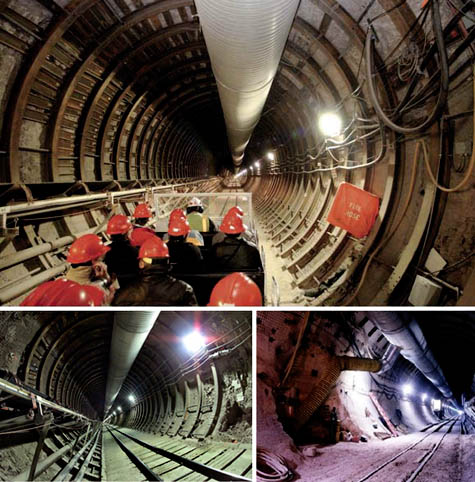
[Images: Views inside the tunnels of Yucca Mountain; top photo by Rick Gunn for the Associated Press].

Now, the reason that you want to isolate this material for a million years is that the spent fuel—meaning fuel that no longer supports the chain reaction that keeps reactors making electricity—contains actinides. These are metal elements, from 90 to 103 on the Periodic Table, most of which are heavier than uranium (which is 92). Actinides are generally very slow to radioactively decay into smaller atoms—which then decay more rapidly—and some of the actinides actually do remain hazardous for a million years and beyond. The trick is to isolate them for that length of time.

At Yucca Mountain we took the attitude that, since we basically have a dry mountain in a dry area with very little rainfall, we would use a material that can stand up to oxygen being present. The material we selected was a metal alloy called Alloy 22. Our design involves basically wrapping the stainless steel packages, in which we would receive the spent fuel, in Alloy 22 and sticking them inside this mountain with a layer of air over the top. What we know is that when water moves through rock or fractured materials, it tends to stay in the rock rather than fall—unless that rock is saturated. Yucca Mountain is unsaturated, so water ought not be a major issue for us at Yucca Mountain—yet it is.

We have to worry about future climates, because, right now in Nevada, we are in a nine year drought—and, basically since the last Ice Age, we have been in a 10,000-year drought. 80% of the time, if we look a million years into the past, we have, on average, twice the precipitation we have now. Most of the past is—and the future will be—wetter and cooler. Which is nice for Nevada! [laughs]

In any case, we tried to take advantage of the natural setting, as well as take advantage of a metal that stands up very well to oxidizing conditions. That is how, in our safety analyses, we showed that we are basically safe for well beyond a million years—if we do exactly what we said we would do in that analysis.
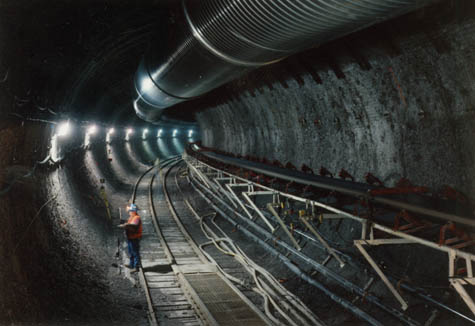
[Image: An engineer stands inside one of the tunnels in Yucca Mountain; courtesy of the Department of Energy].

Other countries have decided not to go in a similar direction to us. The only other country that’s contemplating a similar repository to ours is Mexico. All the other countries in the world are looking at constructing something that is very deep—and under the water table. If you go under the water table deep enough, there is no oxygen in the water, and if there is no oxygen than the solubility of a sizable number of the radionuclides is a non-problem. Many are just not soluble unless there is oxygen in the water.

Going that deep then allows those countries to use a different set of materials, ones that last a long time when there is no oxygen present. For example, the Swedes are using granite—so are the Finns, by the way, and the Canadians, though the Canadians might decide to go for clays. With the granites, the older they are, the more fractured they are, and they can’t predict a million years into the future where the fracture zones are going to be. So they have chosen a copper container for their spent fuel; copper is thermodynamically stable in granite. In fact, copper deposits naturally occur in granite. They then wrap a very thick layer of bentonite clay around the container, which they put in dry. When that clay gets wet, as it will do eventually, it expands. When there is a fracture zone that is created by nature, the clay will basically decompress itself a little bit, fill the fracture zone, and you will still have a lot of protection from that clay layer. It’s a similar set up with salt or clay repositories, they eventually close up against the waste packages. Nothing moves through clay or salt very rapidly.

Those are basically the three rock types that the whole world is looking at in terms of repositories.

So you can rely more on the engineered system or more on the natural system. Either way, it’s the combination of the two systems that allows you to predict, with relative security, that you’re going to isolate a material for well over a million years. By that time, the natural decay of the material that you’ve hidden away has pretty much taken care of most of the risk. In fact, by about half a million years, most of the spent fuel is less radioactive than the ore from which it was created. That’s a wonderful argument—but the spent fuel still isn’t safe at that point. You still need to continue to isolate it, just as you don’t want to live on top of uranium ore, either. It’s a dangerous material.

In a nutshell, that’s our philosophy of containment.
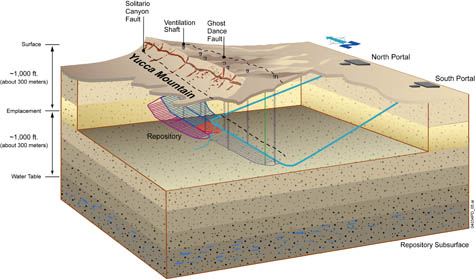
[Image: Yucca Mountain diagrammed; courtesy of the Department of Energy].

BLDGBLOG: I’m interested in how you go about testing these sorts of designs. Do you actually build scale models, like the U.S. Army Corps of Engineers’ hydrological models, or do you rely on lab tests and computer simulations, given the timescale and complexity?

Van Luik: What we do is safety assessments that project safety out to a million years. What I used to say to my troops, when I was a manager of this activity, was: “Safety assessment without any underlying science is like a confession in church without a sin: without the one, you have nothing to say in the other.”

To collect the science needed to make credible projections of system safety, we have dug several miles of tunnels under this mountain; we’ve done lots of testing of how water can move through this mountain, if there was more water; and we’ve done testing of coupons of the materials that we want to use. These tests were performed using solutions, temperature ranges, and oxygen concentrations that we think are representative over the whole range of what can be reasonably expected at Yucca Mountain. Those kinds of physical tests we have done.

We have also utilized information from people who have taken spent fuel apart in some of our national laboratories and subjected it to leaching tests to see how it dissolves, how fast it dissolves, and what dissolves out of it. We have done all of that kind of testing, and that’s what forms the basis for our computer modeling.

One thing we have not done, and can’t do, is a mock-up of Yucca Mountain. It just doesn’t work that way. It’s too complicated, too large, and too long a time-scale.
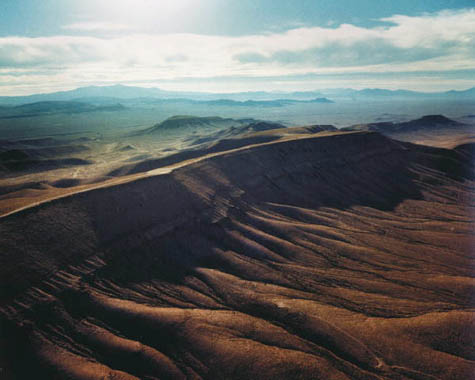
[Image: Yucca Mountain, courtesy of Wikipedia].

In compensation for that spatial- and time-scale difficulty, what we have done is looked for similar localities with uranium deposits in them, like Peña Blanca, Mexico, just north of Chihuahua City. There, we have rock very similar to Yucca Mountain’s rock, and we have probably a 30-million year old uranium deposit—quite a rich one—that was going to be mined until the price of uranium dropped considerably. We’ve studied that piece of real estate—it has roughly similar rock, sitting under similar conditions except for more summer rainfall—and we’ve looked at the movement of radioactivity from that ore body. From that we’ve gained confidence that our computer modeling can pretty much mimic what was seen at that uranium site.

We’ve looked for natural analogues of other possible conditions—for example, the climate at Yucca Mountain during an ice age. We’ve studied six or seven sites that mimic what we would see during a climate change here.

And, in terms of materials, there are some naturally occurring materials that have a passive coating on them. We’ve studied metals found in nature that are similar in the way they act to the metals that we are using for our waste packages.

So we have gone basically all through nature looking for analogous processes—but none are exact matches for Yucca Mountain. It’s going to need something more unique than that. I think the same is true for every other repository being contemplated.

We have worked in cooperation with fourteen other countries through the European Commission’s Research Directorate in Brussels, and the Nuclear Energy Agency in Paris, to compare notes on natural analogues and discuss what is useful and what is not for which concept. All these countries are doing the same kind of thing: looking at natural occurrences that are hundreds of thousands, if not hundreds of millions, of years old.

In some cases, the natural analogues we’ve studied are billions of years old. We’ve looked at the Oklo mining district in Gabon, Africa. We studied several occurrences in that mining district where, for the last few million years, ore bodies have been subjected to oxidizing conditions, because uplift of the land brought them above the water table. We’ve looked at these natural reactor zones, which were active two billion years ago when the earth was much more radioactive than it is now, to see what we could learn about the movement of radioactivity in an oxidizing zone. We can use that data for corroborating the modeling of Yucca Mountain.

On top of all that, we have the problem of unlikely volcanic events, as well as strong earth motions from equally unlikely seismic events, at Yucca Mountain. These are problems you won’t have at most of the other repository sites being considered in the world. To study that, we brought in expert groups with their own insights and models to evaluate what the chances are, from a risk perspective, of a volcanic event actually interrupting or disrupting the repository. They also looked at the possibility of a very large ground motion adding stress and causing eventual failure of one or more of the waste packages. Although volcanic events are highly unlikely—as are very large ground-motion events—they must be factored into our analyses, based on the likelihood of their occurring over a one-million year time span.

We have basically done all safety-evaluation analyses from the perspective of the things that could happen, given the nature of this geologic setting. Looking at analogues for processes in nature has given us confidence that what we expect to see at Yucca Mountain is what we have seen nature produce elsewhere. These are indirect lines of evidence that support us—but we have also made a lot of direct measurements and observations, as well as testing in laboratories of materials and processes, to make sure that we’re on the right track.

The National Academy of Sciences has reviewed our research and our situation, and they’ve agreed that we have predictability for about a million years. That judgment influenced the EPA, who then gave us a standard for a million years.
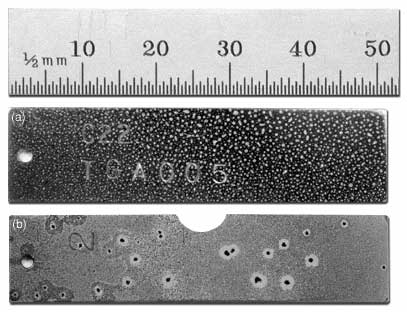
[Image: “Coupons” of metal tested for their long-term weathering and resilience; courtesy of the Department of Energy].

BLDGBLOG: Could you discuss the material selection process in more detail? I’d like to hear how you found Alloy 22, for example. Also, when my wife and I visited Yucca Mountain a few years ago, we were given a black glass bead at the information center—what role does that glass play in the containment design? Finally, are the materials you’ve chosen specifically engineered for the nuclear industry, or are these simply pre-existing materials that happen to have the requisite properties for nuclear containment?

Van Luik: No, the materials are not specifically engineered for the purpose of nuclear containment.

Let’s look at Alloy 22 first. We looked at the whole range of what is commercially available, in terms of pure metals and metal alloys. We also looked at things like ceramic coatings. There are some very, very hard ceramic coatings that, for example, are used on bearings for locomotives. There are also ceramics that the military uses on projectiles to penetrate buildings. There are some very good ceramic materials out there, but we had a problem with the predictability of very, very long-term behavior in ceramics. That’s why we decided to go with a metal; a metal will fail by several different corrosion mechanisms, but not by the breakage that is typical of ceramics.

One of the things that the metals industry has been doing—for the paper-pulp industry, for example, which creates the worst possible chemical environment you can imagine—is that they have been developing more and more corrosion-resistant materials. One of the top of the line of these corrosion-resistant materials was Alloy 22. We tested it alongside about six other candidates in experiments where we dripped water on them, we soaked them in water, and we had them half in and out of water, with varying solutions that we tailored for what we would expect in the mountain over time. The one that stood out—the most reliable in all of these tests—was Alloy 22.

The black glass that you saw is not something that the waste is wrapped in. This material will be made at Hanford and maybe at Idaho, too—and at Savannah River they are making that black material right now. It’s an imitation volcanic glass—a borosilicate glass—in which radioactive materials are dispersed. Material would be released from that if the waste package breaks, and if the material is touched by water or even water vapor. It would then start to alter, and as it alters it would start to release the radioactivity inside. So what you and your wife were looking at was basically a glass waste-form. We don’t make it here—that’s how radioactive waste will be delivered to us from the Defense Department and Department of Energy. We will receive it in huge containers, not as beads.

We also have little pellets of imitation spent fuel, similar to pencil lead in color, to show visitors what the fuel rods look like inside of a reactor. The fuel rods are ceramic, coated on the outside with an alloy.
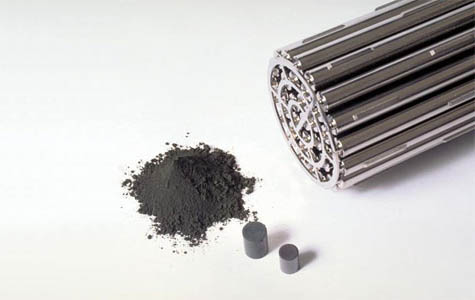
[Image: Nuclear fuel rods].

Edible Geography: Could you walk us through the planned process of loading the waste into the mountain, all the way up to the day you close the outer door?

Van Luik: Sure. The process, depending on whether Yucca Mountain ever goes through, politically speaking, will be as follows.

From the cooling pools or dry storage at the reactor, we’ve asked the nuclear utility companies to put their spent fuel—or waste—into containers that we have designed and that we will supply to them. The waste will be remotely taken out of whatever container it is in now, put into our containers, which are certified for shipping as well as disposal, and then we would slide those containers onto trains. We want to use mostly trains—we try to avoid truck use.

Rail shipping containers currently in use are massive—some approaching two-hundred tons fully loaded. The trains would bring the containers to us and then we would up-end them remotely and take the material out in a large open bay—all done remotely, again. If it comes in the shipping cask that we have provided, we will be able to put it directly into the Alloy 22 and stainless steel waste package and weld it shut. Then, with a transporter vehicle that’s also remotely operated, we would take it underground and place it end-on-end, lying down in our repository drifts. That’s what we call the tunnels; tunnels without an opening are called drifts. We would basically fill the drifts until we get to the entrance, put a door on, and then move on to the next one. That’s the basic scheme of how this would be done. Everything is shielded, of course, so that people are not exposed to radiation; workers are protected, as well as the public.

[Image: The “drifts” inside Yucca Mountain; view larger. Courtesy of the Department of Energy].

Edible Geography: How many containers could you fit inside a single drift, and how many drifts do you actually have in the mountain?

Van Luik: The drifts are each about 600 to 800 meters long. They vary a little bit, depending on where they are in the mountain. We will have 91 emplacement drifts—with an average of about 120 waste packages, set end-to-end, in each drift—to take care of the 70,000 metric tons that we are authorized to have. If we receive authorization to have more than 70,000 metric tonnes, then we’re prepared to go up to 125,000 metric tonnes of heavy metal. That metric tonnage figure doesn’t represent the total weight that goes into the mountain, by the way—it means that the containers have the equivalent of that many tonnes of uranium in them. In other words, 70,000 metric tons is about 11,000 containers that weigh about ten metric tons each, so it’s a huge amount of weight. Each container contributes a significant amount of weight in itself: the steel and the Alloy 22 are very heavy.

In terms of what the repository would look like, if built, it would be a series of open tunnels, one after the other, with a bridging tunnel that allows the freight to be brought in on rail. Everything is done remotely. The 40km of tunnels would all be filled up at some point, and then we would seal up the larger openings to the exterior, but leave everything else inside the mountain unsealed.

This is very different, by the way, from every other repository in the world, which would tightly compact material around the waste packages. We want to leave air around the waste packages, because of our situation. We have unsaturated water flow, rather than saturated flow, and as I’ve mentioned, water does not like to fall into air out of rock—it would rather stay in the rock, unless it’s saturated and under some degree of pressure (such as from the weight of water above it). So if we put something like bentonite clay around our packages, that would actually wick the water from the rock toward the waste packages—which is a silly thing to do if you’re trying to take advantage of an unsaturated condition.
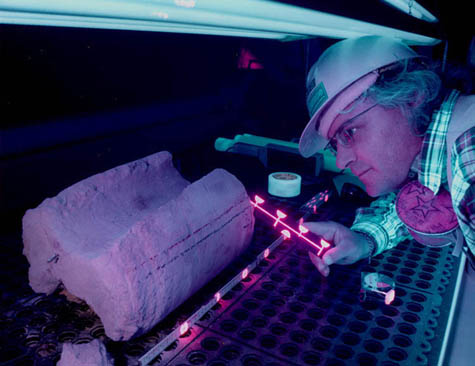
[Image: An engineer uses ultraviolet light to analyze water-movement through rocks; courtesy of the Department of Energy].

Edible Geography: What process have you designed for sealing the exterior door? Does that also require a uniquely secure set of material and formal choices?

Van Luik: Sealing the repository wouldn’t happen for at least 100 years, so what we have done at this point is basically left that decision for the future. We have done a preliminary design, which uses a heavy concrete mixture—as well as rock rubble for a certain portion—to seal the exits from the main tunnel that goes around and feeds all the smaller tunnels.

The idea is that these openings have nothing to do with how the mountain itself functions, because the mountain is a vertical-flow system. Coming in from the sides, as we are, has nothing to do with how the water behaves in the repository, or with the containment system we’ve designed. So we just want to block the side exits and make it very difficult for someone to reenter the mountain—to the point where they would basically be much better off reentering it by drilling a whole new entryway beside one of the old ones that’s filled in.

Then there are going to be about seven vertical shafts for ventilation that will be sealed at the time of final closure. Those will be filled to mimic the hydrological properties of the rock around them; we don’t want them to become preferred pathways of water, because those will point directly into the repository.

So there are two different closure schemes for the two different types of openings: three large entryways that will be completely sealed off to prevent reentry, and seven ventilation shafts that will be filled with materials that have been engineered to mimic the hydrological properties of the rock around it.
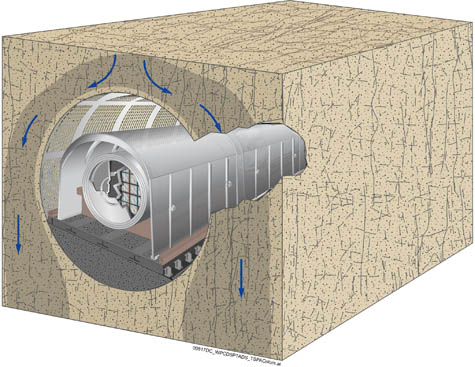
[Image: A diagram of hypothetical water-movement around the waste packages at Yucca Mountain; courtesy of the Department of Energy].

Edible Geography: And the ventilation shafts are required because the material is so hot?

Van Luik: Yes. Once we put the waste in, we want to blow air over it by drawing in air from the bottom and blowing it out the top to take heat away until we shut off the vents for final closure. The idea is to take enough heat out of the system so that, when we close it, it doesn’t exceed our tolerances for temperature.

Edible Geography: Is there any chance that having such a large amount of heavy material at Yucca Mountain could actually pose a seismic risk for the region?

Van Luik: When we selected this particular location, we looked very carefully at faults. But you’re right: if you get beyond a certain amount of weight, as under a growing mountain range, you do start shifting things in the ground. If you build something right on a fault line you can probably change the frequency of vibration at that location, and maybe aggravate the earthquake that’s eventually going to happen.

However, even if we fill this repository to 125,000 metric tons, that is only something like .01% of the weight of the mountain itself. Plus, we are surrounded by two major faults, on both sides of the mountain, and even though there’s movement occasionally on those faults, the block in the middle—where Yucca Mountain sits—is like a boat, riding very steadily. It’s been like that for the past twelve million years, so we don’t see that it’s going to change in the future.

That said, we are in an area that’s moving all the time. The entire area now is moving slowly to the northwest, and the basin and range here is still growing—the distance between Salt Lake and Sacramento is already twice what it was twelve million years ago, and they will continue to be pulled apart. We’re well aware of the consequences of basin and range growth, and the possibility that the faults Yucca Mountain is sitting next to could be active again in the future. We factored that in. In fact, it’s those earthquakes that might actually lead to failures in the system that would allow something to come out before a million years—otherwise nothing would come out until beyond a million years.

But you can’t put enough weight in that mountain to change the tectonic regime in the area.
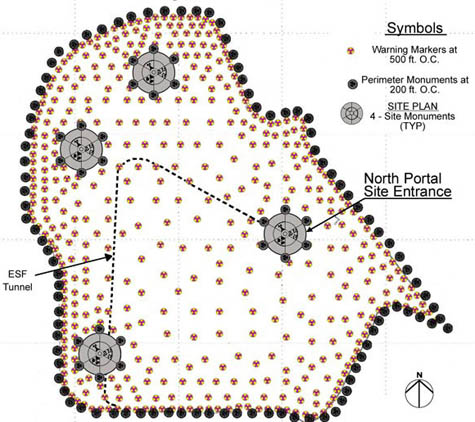
[Image: Future warning signs scattered across the Yucca Mountain site, part of “the monumental task of warning future generations“; courtesy of the Department of Energy].

BLDGBLOG: Of course, once you have sealed the site, you face the challenge of keeping it away from future human contact. How does one mark this location as a place precisely not to come to, for very distant future generations?

Van Luik: We have looked very closely at what WIPP is doing—the Waste Isolation Pilot Plant in New Mexico. They did a study with futurists and other people—sociologists and language specialists. They decided to come up with markers in seven languages, basically like a Rosetta Stone, with the idea that there will always be someone in the world who studies ancient languages, even 10,000 years from now, someone who will be able to resurrect what the meanings of these stelae are. They will basically say, “This is not a place of honor, don’t dig here, this is not good material,” etc.

What we have done is adapt that scheme to Yucca Mountain—but we have a different configuration. WIPP is on a flat surface, and their repository is very deep underground; we’re basically inside a mountain with no resources that anybody would want to go after. We will build large marker monuments, and also engrave these same types of warnings onto smaller pieces of rock and metal, and spread them around the area. When people pick them up, they will think, “Oh—let’s not go underground here.”

Now if people see these things and decide to go underground anyway, that becomes advertent, not inadvertent, intrusion—and we can’t protect against that, because there’s no way to control the future. All we’re worried about is warning people so that, if they do take some action that’s not in their best interest, they do so in the full knowledge of what they’re getting into. The markers that we’re trying to make will be massive, and they will be made of materials that will last a long time—but they’re just at the preliminary stage right now.

What I have been lobbying for with the international agencies, like the International Atomic Energy Agency and the Nuclear Energy Agency is that before anybody builds a repository, let’s have world agreement on the basics of a marker system for everybody. Whoever runs the future, tens of thousands of years from now, shouldn’t have to dig up one repository and see a completely different marker system somewhere else and then dig that up, too. They should be able to learn from one not to go to the others.

Of course, there’s also a little bit of fun involved here: what is the dominant species going to be in 10,000 years? And can you really mark something for a million years?

What we have looked at, basically, is marking things for at least 10,000 years—and hopefully it will last even longer. And if this information is important to whatever societies are around at that time, if they have any intelligence at all, they will renew these monuments.
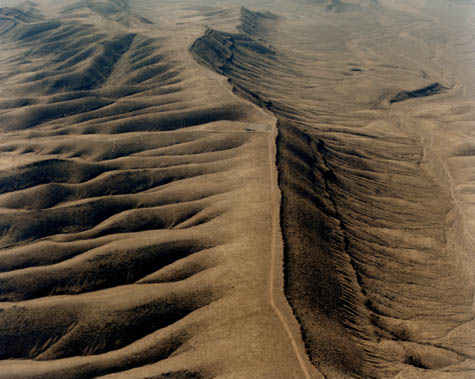
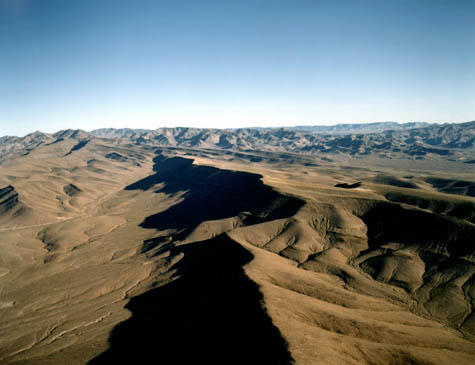
[Image: Aerial view of Yucca Mountain; courtesy of the Department of Energy].

BLDGBLOG: What kinds of projects might you work on after Yucca Mountain? In other words, could you apply your skills and a similar design process to different containment projects, such as carbon sequestration?

Van Luik: I think so—if we ever get serious about carbon sequestration. I don’t know if you know this, but we laid off a lot of people here because there were budget cuts, and many of those people, because of the experience they had with modeling underground processes, are now working on carbon sequestration schemes for the energy sector and the Department of Energy.

No matter what happens to Yucca Mountain—whether it goes through or not—dealing with spent fuel and other nuclear waste will still be a problem, and that’s the charter that was given to our office. What I’m hoping is that, as soon as Yucca Mountain gets completely killed or gets the go-ahead, I can go back to what I loved doing in the past, which was to look at selecting sites for future repositories.

One repository won’t be enough for all time; it will be enough for maybe a hundred years, at the very most. You have to plan ahead. As long as you create the nuclear waste, you need to have a place to put it. Even if you reprocess it—even if you build fast reactors and basically burn the actinides into fission products so that they only have to be isolated for 500 years rather than a million—you still have to have a place to put that material. Even if we can build repositories less and less frequently, we will still be creating waste that needs to be isolated from the environment.

BLDGBLOG: You mentioned that your favorite pastime was looking for repository sites. If you had the pick of the earth, is there a location that you genuinely think is perfect for these types of repositories, and where might that location be?

Van Luik: My ideal repository location has changed over time. When I worked on crystalline rock, like granites, I thought crystalline rock was the cat’s meow. When I worked for a short time in salt, I thought salt was the perfect medium. Now that I have worked with the European countries and Japan for the past twenty-five years, learning of their studies of various repository locations, I’m beginning to think that claystone is probably the ideal medium.

In the U.S., I would go either to North or South Dakota and look for the Pierre Shale, where it grades into clay: there, you get the best of both worlds. I have been quoted by MSNBC, much to the chagrin of my bosses, saying that, if I were to get the pick of where we go next, that’s where I would go. They really didn’t like that—I was supposed to praise the Yucca Mountain site. But let’s get real: Yucca Mountain was chosen by Congress. We have shown that it’s safe, if we do what we say in terms of the engineered system. But it was not chosen to be the most optimal of all optimal sites, the site-comparison approach was taken off the table by Congress. As long as a chosen site and its system are safe, however, that is good enough.

Our predicted performance for Yucca Mountain, lined up to what the French are projecting for their repository in clay, and next to what the Swedes are projecting for their repository in granite, shows about the same outcome, over a million years, in terms of potential doses to a hypothetical individual. We’re safe as anybody can be—which is what our charter requires. We told Congress in 2002 that, yes, it can it be done safely here—but it’s going to cost you, and that cost is in Alloy 22 and stainless steel. Congress said OK and it became public law.
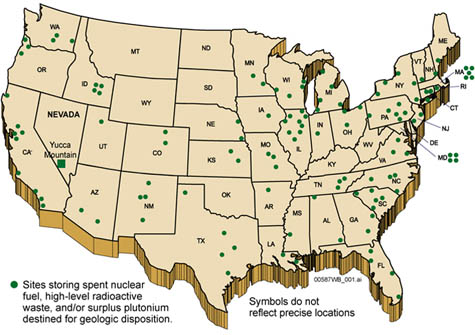
[Image: Map of repository sites across the United States; courtesy of the Department of Energy].

Edible Geography: Are any countries actually using their repositories yet?

Van Luik: They’re getting very close to licensing in Finland and Sweden. Those are going to be the first two. We have a firm site selection in France, which means that they’ll be going into licensing soon. Licensing takes several years in every country. In fact, we’re in licensing now, except we had a change of administration and they’ve decided that they really don’t want to do Yucca Mountain anymore. They want to do something else. They have every right to make those kind of policy decisions—so here we are.

No one is actually loading high-level waste or spent nuclear fuel into a repository yet. We have our own repository working with transuranic waste from the Defense program, in New Mexico, and both the Swedes and the Finns have medium-level waste sites, which are basically geological disposal sites, that have been active for over a decade.

The Swedes and Finns have a lot of experience building repositories underground, and their situation is interesting. The Swedes are building a repository under the Baltic Sea, but in granites that they can get to from dry land. When there is a future climate change, however, there’s going to be a period when the repository area will be farmable; it will be former ocean-bottom that is now on the surface. Their scenario is that, at the end of the next ice age, you might actually get a farmer who drills a water-well right above the repository.

The Finns actually have a very pragmatic attitude to this. They have regulations that basically cover the entire future span, out to a very long time period—but they also say that, once the ice has built up again and covered Finland, it won’t be Finland. No one will live there. But it doesn’t matter whether anyone lives there or not: you still have to provide a system that’s safe for whoever’s going to be there when the ice retreats.

We—as in the whole world—need to take these future scenarios quite seriously. And these are very interesting things to think about—things that, in normal industrial practice, you never even consider.

The repository program in England, meanwhile, went belly-up—because of regulatory issues, mostly—but it’s coming back, and it’s probably going to come back to exactly the same place as it was before. That’s a sedimentary-metamorphosed hard-rock rock site at Sellafield, right by the production facility. No transportation will be involved, to speak of. That’s not a bad idea, but they had to prove that the rock was good. The planning authority rejected their proposal the first time, so they dissolved the whole waste management company and now the government is going to take over the project; it’s not going to be private anymore. In the end, the government takes over this kind of stuff in most places because the long-term implications go way beyond the lifetime of one corporation.

If there’s any country that’s setting a good example for waste disposal, it’s Germany. They’re the only country I know of who have the same kind of regulations for hazardous waste and chemical waste as they do for nuclear waste. There are two or three working geological repositories for chemical waste in Germany, and they have been working for a very long time. They’re the only ones in the world. The chemical industry in the U.S. has basically said, no, no, don’t go there! [laughs]
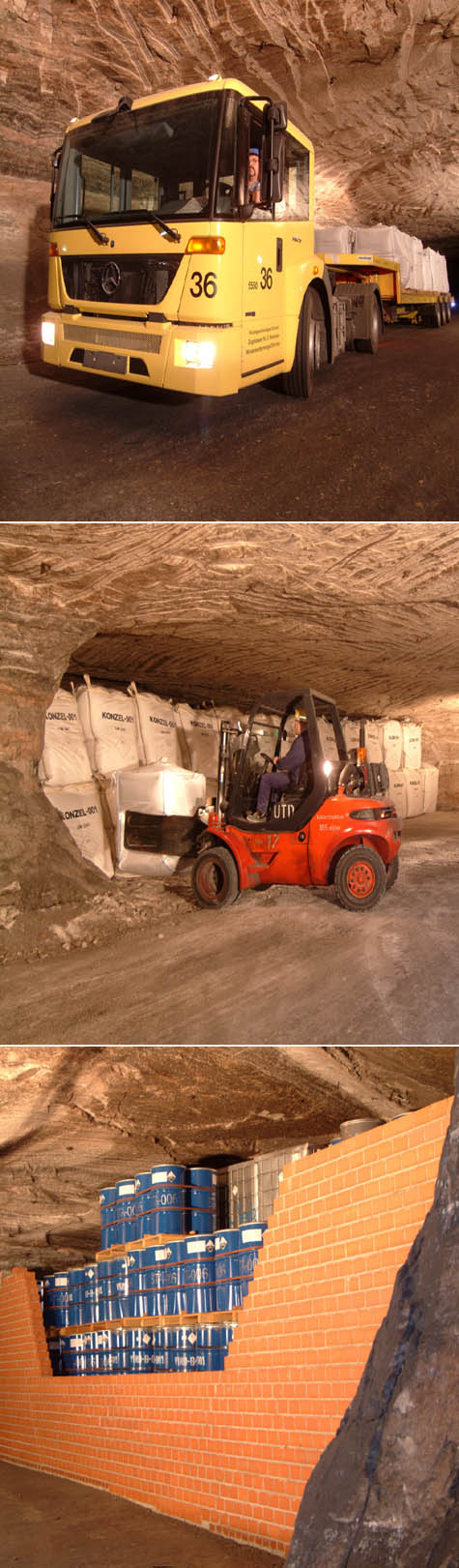
[Images: Like a scene from Poe’s “Cask of Amontillado“—as rewritten by the international chemical industry—hazardous materials undergo geological entombment].

But I think Germany is right: if one thing needs to be isolated because it’s dangerous, then the other thing—that never decays and is also dangerous—needs to be treated in the same way. The EPA does have a standard for deep-well injection of hazardous waste—they have a 10,000-year requirement for no return to the surface. That was comparable to what we had here, until the standard for Yucca Mountain got bumped up to a million years by Congress. But with some chemicals, regulations only require a few hundred years of isolation—that’s all. Those things don’t decay, so that doesn’t make sense to me.

Anyway, I applaud Germany for their gumption—and they’re very dependent on their chemical industry for income. It’s not like they’re trying to torpedo their industry. They’re just saying: you have to do this right.

• • •

This autumn in New York City, Edible Geography and BLDGBLOG have teamed up to lead an 8-week design studio focusing on the spatial implications of quarantine; you can read more about it here. For our studio participants, we have been assembling a coursepack full of original content and interviews—but we decided that we should make this material available to everyone so that even those people who are not in New York City, and not enrolled in the quarantine studio, can follow along, offer commentary, and even be inspired to pursue projects of their own.

For other interviews in our quarantine series, check out Isolation or Quarantine: An Interview with Dr. Georges Benjamin, Extraordinary Engineering Controls: An Interview with Jonathan Richmond, On the Other Side of Arrival: An Interview with David Barnes, The Last Town on Earth: An Interview with Thomas Mullen, and Biology at the Border: An Interview with Alison Bashford.

More interviews are forthcoming.

Ghostly

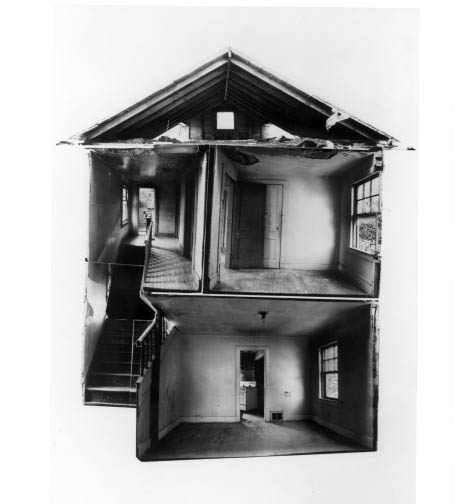
I spent Halloween afternoon over in New York’s West Village, being given a tour of a gut-renovated townhouse by one of the home’s owners. While a description of the actual house will appear next spring in an article I’m writing for another publication, what struck me most was the opening half of the home tour. The homeowner and I stood there alone in the downstairs kitchen, as I listened to her describe what used to be there: the walls that got taken down, the halls that no longer exist, the lost backyard and the missing stairs. We were surrounded by a halo of absent spaces, rooms that had been cut out around the edges and removed.

[Image: A photo-collage from Splitting by Gordon Matta-Clark].

And it seemed that you could put together a long and fascinating series of home renovation interviews, with people describing, from memory, the missing architecture around them: where rooms used to be, perhaps entire buildings. It’d be as much an architectural podcast as an experiment in narrative neurology: how former buildings are remembered and described.

I have no idea how long this sort of thing could sustain anyone’s attention, to be honest; but what might be called oral histories of missing space could extend from demolished buildings to whole war-destroyed towns, from renovated suburban homes to newly partitioned spaces in a nearby office high-rise. The point would be to tour buildings based only on what those buildings used to be.

In a sense, it’s the appeal of ruins.

Perhaps you go on a camping trip to a distant country, where you hike deep into the desert, heading for a series of abandoned villages beyond the mountains northwest of the airport. They are Roman sites, some say, but others suggest a 2500-year old fringe culture outside imperial reach. Either way, as the group of you sits down to cook dinner around a fire—flames lighting up a circle of illegible building forms eroding back into sand—your guide starts to tell a story. The only thing he’s describing, however, is an imaginary building that looms around you, he says, on all sides, with rooms, spiral stairways and halls, and the occasional door resting alone somewhere in the darkness, that no one has yet to open. Temples form in the outline of his story: things that used to be but are no longer. The description goes on for hours. You realize, when the moon disappears behind the mountains and your campfire has burned out, that you’ve been taken several hundred rooms deep into some massive, impromptu architectural edifice produced on the spot by the guide.

Perhaps it could become an alternative oral tradition: buildings handed down, generation after generation, to form a kind of speculative-architectural harddrive inside of which a culture stores its myths. Great events remembered by the rooms they supposedly occurred within.

In any case, it also seems like an interesting opportunity for an iPhone app… Instead of a Phantom City of the unbuilt avant-garde, it’s a removed city of the various rooms that used to be there. You could walk into any building in the city and get descriptions and floorplans of the spaces that no longer exist. Renovation detector. Your phone starts to beep as you walk through missing walls.

New Local Worlds in Section

[Image: “Moravian Mount” from New Local Zlín by Margaret Bursa].

In a recent post I included an image from Margaret Bursa’s project New Local NY, which she produced while a student at the Bartlett School of Architecture. Bursa’s tutors for that project were Mark Smout and Laura Allen, of Smout Allen; and I should right away that I’m consistently amazed at the quality of work coming out of Smout Allen’s studios.

I thought, then, that I should take the occasion to share more images from Bursa’s projects. You can check out her website here.

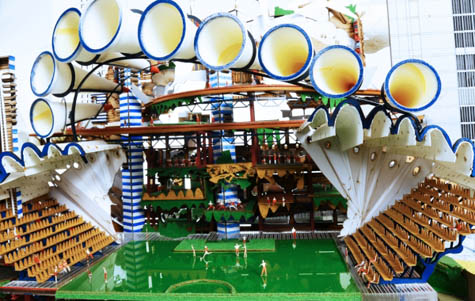
[Images: From New Local NY by Margaret Bursa].

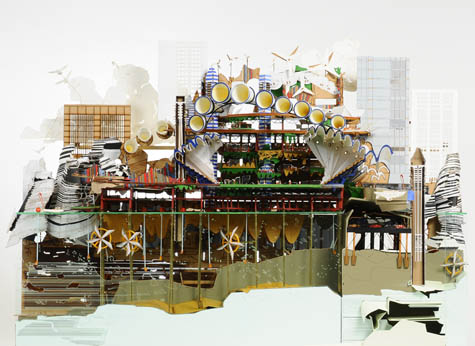
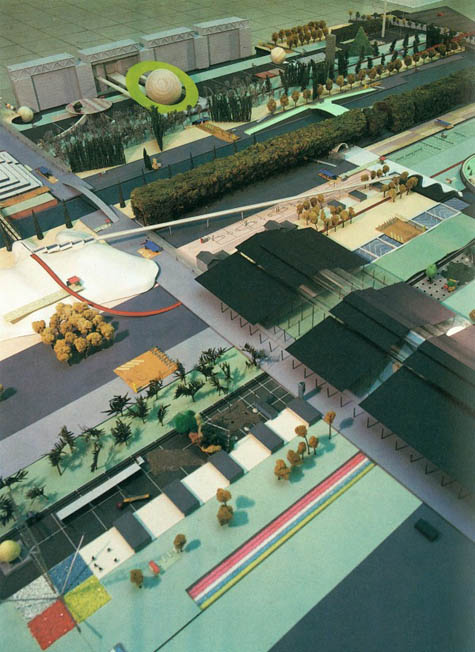
New Local NY features “a ‘landscape of movement’,” Bursa writes. It “takes the form of a condensed urban playground on the west side of Manhattan, overhanging onto the River Hudson,” and it was at least partially inspired “by the ongoing relocation of immigrants and cultures to America, in particular Sokol, a Czech mass-exercise movement, promoting togetherness, flocking, fresh air and cultural pride.”

The result is an intensely colorful, wind-powered megastructure, sitting comfortably astride the worlds of home craft and experimental architecture.

[Image: From New Local NY by Margaret Bursa].

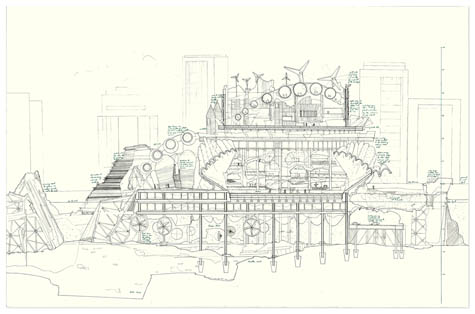
Here are some amazing sectional sketches:

[Images: From New Local NY by Margaret Bursa; larger version one and two].

Then there is New Local Zlín, an earlier companion piece to New Local NY.

Zlín, Bursa explains, is the fading capital of the Bata shoe-making empire:

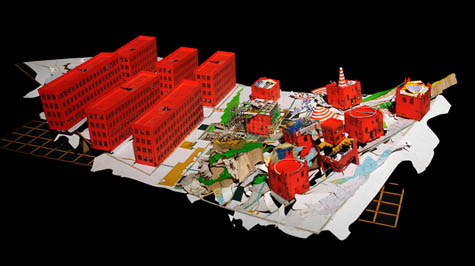
The Czech town of Zlín is the site of a social, industrial and architectural experiment begun by Tomas Bata in 1894. However, his shoe-making factories that were once the town’s driving force no longer operate and so the social and commercial structure of the town and its suburbs are in decline. Responding to the New Local Manifesto, a layer of facilities is laid over and interwoven into the residential neighborhoods where seven housing typologies are afforded dual functions of work and domestic life such the House of Drink, where both production and consumption are combined.

The images, again, are drenched in color and extraordinarily detailed.

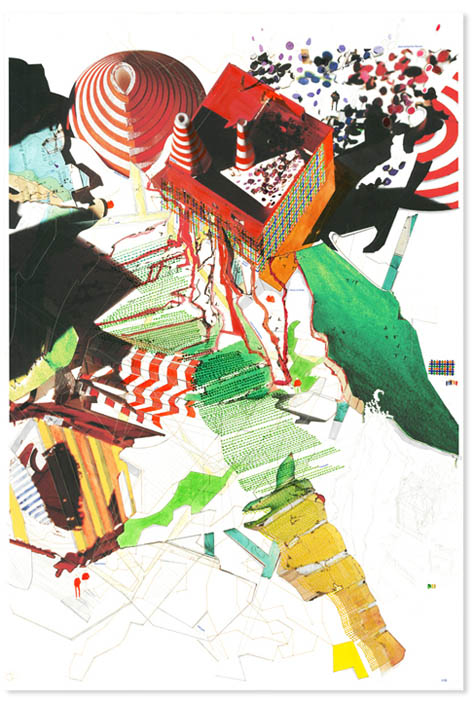
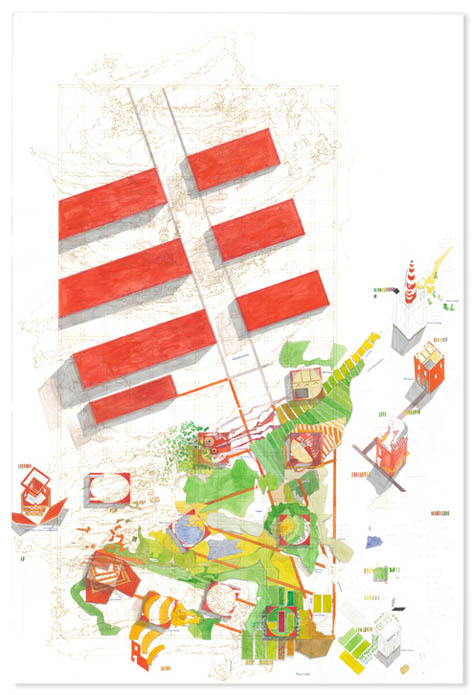
[Images: “House of Drink,” “Greenhouse,” and town plan from New Local Zlín by Margaret Bursa].

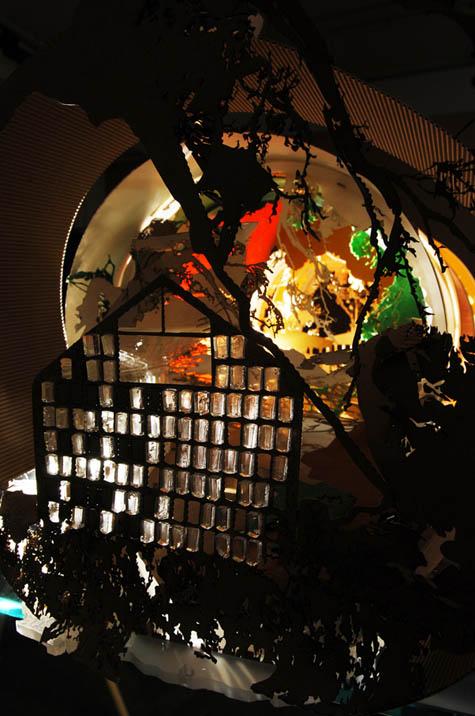
The next project is a kind of tube-diorama: you look into the miniature landscape and see autumn trees, a ruined Greek temple, and a many-windowed architectural section standing in silhouette.

The project seems to come with the implication that, when you look inside a telescope, perhaps it’s possible that you might simply be seeing a world inside the telescope—that is, an optical device that, instead of revealing new worlds from afar, actually contains local worlds within it.

[Image: From Layered Landscapes by Margaret Bursa].

Called Layered Landscapes, the project is a “compositional map,” Bursa writes, and it comes complete with hardcover book and poster.

[Images: From Layered Landscapes by Margaret Bursa].

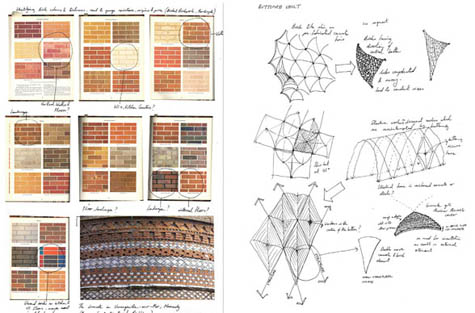
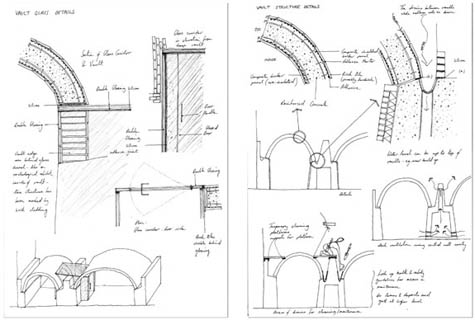
Finally, I have a weird affinity for sketches of archways, and so I’d be remiss if I didn’t include this short series of brick studies—called, unsurprisingly, Brickscape.

[Images: From Brickscape by Margaret Bursa].

In any case, there’s some great work in there. Check out Bursa’s site for a bit more.

Mine / Stack / Vertigo

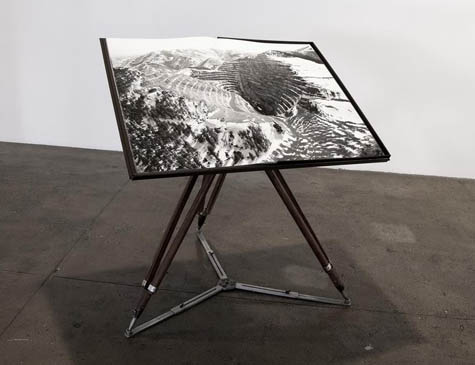
[Image: Michael Light, Bingham Pit photograph mounted and on display].
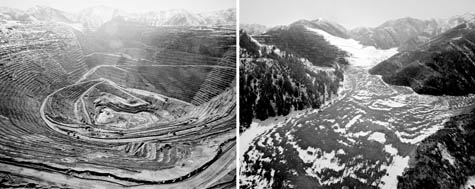
A beautiful new book of photographs by Guggenheim Fellow Michael Light has been released. Called Michael Light: Bingham Mine/Garfield Stack, and released by Radius Books, it includes an essay by “experimental geographer” Trevor Paglen.

[Image: Two photos from Michael Light: Bingham Mine/Garfield Stack].

Light, well known for, among other things, his aerial photographs of the American west, “pursuing themes of mapping, vertigo, human impact on the land, and various aspects of geologic time and the sublime,” as Radius Books describes it, has put together a collection of 22 images from his surveys of the Bingham Pit and the Garfield smelter stack.

The sheer scale of each site—one a void excavated into the surface of the earth, the other one of the tallest structures in the United States—is mind-blowing:

Located at 8,000 feet in the Oquirrh Mountains—20 miles southwest of Salt Lake City—the Bingham Canyon copper mine is the largest man-made excavation on the planet. Its hole reaches more than half a mile deep and its rim is nearly three miles in width. It has produced more copper than any mine in history.

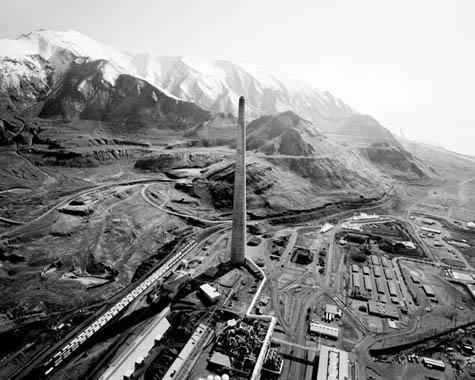
[Image: Michael Light, “Garfield Stack, Oquirrh Mountains and Ancient Beach of Great Salt Lake” (2006)].
Meanwhile:

The mine’s Garfield smelter stack, situated at the edge of the Great Salt Lake about 10 miles away, is the tallest free-standing structure west of the Mississippi River, and is only 35 feet shorter than the Empire State Building.

In a nearly 9-page interview with Afterimage, Light comments:

I work with big subjects and grand issues, and I am fascinated about that point where humans begin to become inconsequential and realize their smallness in relation to the vastness that is out there. In my archival work I also enjoy inserting a certain kind of revisionist politics into big iconic subjects that are owned by the world, where I can tell a story through my particular prism, in a way that hopefully offers a fresh perspective.

This is part of his ongoing interest in taking apart “the fundamental building blocks of landscape perception and representation.”

The book is available through Radius.

Who would want to be an architect?

Who would want to be an architect?” the Times asks. In answering that question, the article focuses more or less entirely on London’s Bartlett School of Architecture—whose students have been producing some amazing work lately, work that I have often posted about here on BLDGBLOG. Here, here, here, and here, for instance.

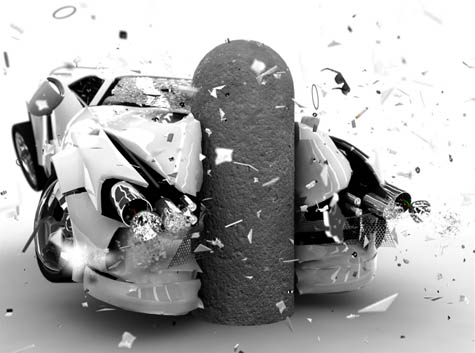
But, the article claims, “Leave the future to Bartlett students and we’ll all be living in car-crash spaces that occasionally come into focus as giant mechanised spindly crustacea.”

[Image: “Oops” by C. Loopus].

Reading such things easily prompts the familiar zing of schadenfreude—but it also seems totally inaccurate. If only it were as cut-and-dried as mistaking student work for what someone will produce professionally later; if only it were as easy as extrapolating from someone’s earliest university sketchbooks to see how they’ll someday end up.

I’m reminded here of Lebbeus Woods’s recent short essay on the work of Rem Koolhaas: there was “another Rem,” Lebbeus writes. Looking back at one of Rem’s early projects—an unsuccessful bid for the Parc de la Villette in Paris—Lebbeus suggests:

This project reminds us that there was once a Rem Koolhaas quite different from the corporate starchitect we see today. His work in the 70s and early 80s was radical and innovative, but did not get built. Often he didn’t seem to care—it was the ideas that mattered.

Over on his own blog, Quang Truong puts it more simply: “Young Koolhaas was just so punk.”

(Of course, parenthetically, Truong’s formulation opens up a whole series of possible readings through which we could interpret Rem’s ongoing career moves; we could say, for instance, that Rem is still “punk,” to use that term deliberately, but his decisions to work for clients like the Chinese government are just him giving the finger to you. That is, if punk is a universal form of energetic rebellion, then don’t assume that every punk will remain forever on your side).

[Image: From Rem Koolhaas’s unbuilt proposal for the Parc de la Villette in Paris, via Lebbeus Woods].

In any case, my point in citing Lebbeus’s essay in this context is to agree with the Times that student work can often stand on the absolute fringes of incomprehensibility, charged with the energy of poetry, myth, or confrontational politics, even verging on functional uselessness—but it’s also an ongoing joke at nearly every architecture crit I’ve been to over the past few years that, upon surviving their final day of project criticism, those students “can now get back to designing minimalist boxes.” In other words, there simply is not the assumption in these studios that now you are prepared only for the construction of rhizomes and biomorphopedic multi-agent typology swarms. There is obviously a problem if that is all you have been taught to do; but it’s not one or the other. Being taught how to make short films about architecture—more on this, below—doesn’t mean you can’t simultaneously be taught how to renovate a kitchen or how to market yourself to new clients.

The fact of the matter, anyway, is that very few clients today will actually pay to construct “car-crash spaces that occasionally come into focus as giant mechanised spindly crustacea.” If architecture school is the only time and place in which you can have the freedom to explore that sort of thing, then I don’t see any reason why you should be told not to do so. Again, if that’s all your architecture school offers you, leaving you alone to sort out the business of client management as you go, then of course your educational track needs reconsidering.

However, much of the Times‘s criticism seems predicated on the assumption that, if architecture is a vocational trade, similar to plumbing, then it cannot simultaneously be an expressive art, akin to film, painting, or literature. But, of course, it is both. In fact, the controversy more or less instantly disappears: architecture is the imaginative production of future worlds even as it is the act of building houses for the urban poor or the obtaining of technical skills necessary for rationally subdividing office floorplates.

[Image: From a project by Margaret Bursa for the Bartlett’s Unit 11, taught by Smout Allen].

Having said all this, the Times article ends up being a formulaic list of reasons why such-and-such an industry is doomed to fail—too many people want to pursue it, we read, not enough people want to fund it, and hardly anyone understands anymore what made it so popular in the first place. But replace the word “architecture” with “writing,” and “Bartlett School of Architecture” with “Iowa Writers Workshop”—or use “music” and “Mills College”—and you’d get a nearly identical article.

There are some very real questions to ask about the nature of architectural education today—and, when it comes to things like how architects write, I am probably in agreement with the author of the Times article (and with many of the students quoted in the piece)—but holding up the overall profitability of the industry, and the likely financial success of its individual practitioners, as the only criteria by which we should judge an architecture school seems absurd to me.

I’ll end this simply by citing some provocative statements made in the article’s comments thread—provocative not because I agree with them but because they’re well-positioned to spark debate. I’ll quote these here, unedited, and let people discuss this for themselves.

—The Bartlett “seem to want to be an architecture school and a school of alternate visual media culture at the same time. More often than not these agendas work against each other… They should make a choice and be clear about it. Are you training students to be architects or something else that has to do with architecture? What should a student expect to learn when they finish school? What are you being prepared for. If bartlett graduates go on to become film-makers, and video game designers, and such, maybe its a good idea to say it is not an architecture school and say it is a school of visual media. Then you will attract students with that goal in mind.”

—From the same commenter: “Consider, if a school opens up and starts teaching alternative medicine (acupuncture, aromatherapy, Atkins diet, chiropractic medicine, herbalism, breathing meditation, yoga,etc), gives its graduates medical degrees and sent them off to hospitals and emergency rooms to perform surgery, a lot of people would have a problem with that. This is, in effect, what the architectural profession is doing when it allows schools like the Bartlett to give architecture degrees.”

—”architectural education is still a leftover of that idea of the businessman/artiste producing unusual shapes for art critics”

—”The profession does not work. It’s economically non viable. Our work is pure iteration. Far too time consuming, and as a result, it’s impossible to charge anyone for the work we have actually done.”

And on we go…

(Spotted via @brandavenue and @ArchitectureMNP).

Isolation or Quarantine: An Interview with Dr. Georges Benjamin

[Image: An emergency hospital ward in Kansas during the 1918 flu].

Dr. Georges Benjamin is executive director of the American Public Health Association (APHA) and former Secretary of Maryland’s Department of Health and Mental Hygiene; there his responsibilities included updating the state’s quarantine laws in response to the threat of bio-terrorism. Dr. Benjamin is publisher of both the American Journal of Public Health and The Nation’s Health.

He is also co-editor, with Laura B. Sivitz and Kathleen Stratton, of the 2005 report Quarantine Stations at Ports of Entry: Protecting the Public’s Health. That report consists of more than 300 pages of policy guidelines for how the United States can operate, maintain, and even expand its network of national quarantine stations. The very idea of a national quarantine policy, let alone phrases like the international “Quarantine System,” can inspire, at the extreme, all manner of conspiracy-laden theories—including the specter of fully militarized, FEMA-administered concentration camps on U.S. soil. In reality, however, “today’s quarantine stations are not stations per se, but rather small groups of individuals located at major U.S. airports. Their core mission remains similar to that of old: mitigate the risks to residents of the United States posed by infectious diseases of public health significance originating abroad.”

A jurisdictional map of CDC quarantine stations is available online, complete with informational PDFs ready for download.

[Image: Map of the CDC’s U.S. quarantine stations].

As part of our ongoing series of quarantine-themed interviews, Nicola Twilley of Edible Geography and I spoke to Dr. Benjamin about the APHA’s policy recommendations for pandemic flu quarantine, about the role of eminent domain in the medically-motivated seizure of private property, and about the architectural challenge of designing dual-use facilities for public emergencies.

• • •

Edible Geography: I was interested to read the American Public Health Association’s flu policy recommendations from 2007—in particular, to see the APHA’s emphasis on mental health support for people held in quarantine. What led to that being included in your official guidelines?

Dr. Georges Benjamin: If people are going to be confined for some time within a facility, then you want to make sure that you’re identifying those people who are already being treated for mental health issues. You want to make sure they’re getting their therapy and their medications, and you want to deal with any issue that might occur when someone has to stay alone under that level of stress.

Remember that someone who is quarantined is different from someone who is isolated. Quarantined people aren’t sick; they’re people who may get sick. They’re people who have been exposed to a disease but who are not physically ill. In many cases of voluntary quarantine, people are being asked to stay at home by themselves, or to stay self-isolated, and we need to make sure that someone is paying attention to them. We want to identify people who are not able to handle being by themselves or being in a relatively confined space—even if it’s inside their own home.

We were also concerned about making sure people have the basic needs of life: food, water, access to medical care, and access to social services. You want to make sure that you’ve addressed whatever those needs might be. All of these things were part of our package for people who might be quarantined.

BLDGBLOG: Who were the specific constituencies that called for those guidelines, and did anyone try to push you in another direction?

Dr. Benjamin: These guidelines come from our members. A lot of these discussions started way back when we were talking about smallpox, rather than pandemic influenza. We were thinking seriously about the idea of having people stay at home and be isolated, if they’re ill, or quarantined should there be a terrorist attack.

No one actually has access to smallpox now, but we were going out and vaccinating people against a potential terrorist threat, anyway. So we started having these discussions around the idea of whether or not you really needed to reinstitute large-scale—primarily voluntary—quarantine. In addition, we were talking about the risk of a pandemic.

Then, as you know, Hurricane Katrina hit New Orleans. You had people there who, by virtue of the fact that they ended up in the Superdome, did not have all of the things they needed. Certainly a lot of that stuff had been planned for, but it hadn’t been done as robustly as it needed to have been—and, obviously, they had more people in there than they could take care of.

Our thinking, based on that experience in New Orleans, was: in an emergency situation, how do you make sure that people have what they need? And, quite frequently, the mental health needs of people are something that matters in every kind of large-scale public health emergency—whether that’s a tornado, a hurricane, the flu, or an event where large numbers of people have died. It’s one of those things that people don’t really think about ahead of time, unless you remind them to think about it.

Our recommendations don’t just apply, by the way, to the people who are confined; there are huge stresses on the people who are managing those events. The EMTs, the paramedics, and the public health personnel who are all actually managing things can be really challenged—and you have to pay attention to them, too.

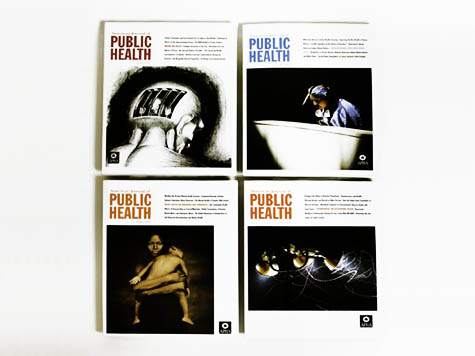
[Image: Sample covers of the American Journal of Public Health; design by Kropf Design].

BLDGBLOG: The APHA has also written about who exactly should have the authority to make decisions about who goes into quarantine and why. Can you talk us through your policy on that issue?

Dr. Benjamin: First of all, we try to guide by the least restrictive policy possible—and, to the extent that someone can be voluntarily in quarantine, that’s our first principle. Voluntary quarantine and the least restrictive quarantine possible is what we think is the most important way to start.

Simply giving people the facts about a disease process and keeping them well-educated and well-informed long before you’re going to need to take any action is the best policy. We, as an association, along with our colleagues in the federal agencies, have been trying to talk to the public about what the risks are for various diseases. How do you catch a disease—and how do you not catch it? How you protect yourself? How do you protect your loved ones? Usually, armed with this information, most people will follow the basic recommendations.

However, to the extent that you have to have compulsory quarantine—because you have someone who is continuing to put people at risk—then that is imposed, in the United States, by public health authorities. They have powers, mostly at the state and local level: those powers give them the authority to incentivize people not to put others—or themselves—at risk. In some cases, they can do that by having the police authorities act; in other cases, they have to go to court first. It depends on the individual jurisdiction.

In most cases, federal authorities’ powers end at the borders of the nation and then at the borders of each state. They can deal with issues across state lines, in some cases, and, of course, at our national borders and at ports of entry; but most of these quarantine authorities rest at the state and local health officer level.

BLDGBLOG: Has any of that legislation been revised in light of SARS, H1N1, or even the anthrax attacks?

Dr. Benjamin: There has been a national effort to modernize our public health laws. A lot of them were written years and years ago.

For instance, I was a state health official in Maryland from 1995 to 1999, and I was the secretary of health in Maryland from 1999 to 2002. During that time we began a process, which we finished when I was secretary, to update and modernize our laws. We had started talking about it before 9/11, but after 9/11 and the anthrax attacks , we realized that biological terrorism was a significant risk, and we really worked to strengthen the public health laws.

To give you an example of the kinds of changes and updates we made: we worked to put in some additional patient protections. The law at that time gave the health secretary enormous police powers to hold and to quarantine individuals—but there were no rights or rules for those individuals, or regulations about what they needed to receive while they were in confinement. The assumption was, of course, that they would get reasonable support and care—but we felt it was very important to guarantee that.

So we worked with several members of our advocacy community to strengthen the authority that the health officer had, and to make the authorities that I had at the time, as secretary of health, much clearer. But, on the same token, we were writing in protections. We guaranteed people due process. We guaranteed that, if we had to forcibly confine someone, then they would get medical care, social services, and social supports that they actually need. We put that in writing.

Other states around the nation have begun doing the same thing. There have been some public health law centers set up through various foundations, and they have also been working very hard to strengthen the various laws. There was a model public health law—I think it was produced with a grant from the Centers for Disease Control and several of the public health groups working with them. That law was then shared with all of the states and their elected officials, and it was used as a template through which states could look at their own laws and see how they matched up to the model.

Some states simply took the model and implemented it, exactly as it was written; some took pieces of it out; others took it and said, no, compared to the law we currently have, ours is better and we like ours. Either way, it served as a useful catalyst for people to begin looking at their own public health laws—not only in terms of the authorities that the public health officer had around isolation and quarantine, but also about reportable diseases, which diseases ought to be reported, and how, and who should do the reporting. There were also things that we added around patient protections, citizen protections, and due process. And there were sections that meant to clarify existing law, based on case law in the state, or nationally.

That work has been going on since late 2001, and it continues to this day in a variety of formats.

[Images: Hong Kong’s entire Metro Park Hotel was put under quarantine for seven days after an H1N1-positive Mexican tourist stayed there in May 2009; “psychologists were on standby,” we read. All photos courtesy of the China Post].

BLDGBLOG: In terms of these public health laws, where can quarantine occur? It was interesting during the SARS outbreak in Toronto, for instance, to see that hotel rooms were simply repurposed as temporary quarantine facilities.

Dr. Benjamin: Quarantine can occur anywhere—that’s the short answer.

Remember that quarantine is basically telling someone who has been exposed to a disease, even if they haven’t come down with that disease, to stay away from others, and to stay somewhere that we can observe them and see if they get sick. Functionally, that can occur anywhere—as long as you have the support that you need, and as long as you’re not kept somewhere where other people will be at risk. For someone who’s quarantined, a hospital is probably not a good place for them, because there are sick people in that hospital and, in any case, the hospital will usually need those beds.

Let’s say I travel to England for a business meeting, and there’s a big infectious disease outbreak. They’re not quite sure what it is, but I could theoretically have been exposed. They don’t want me to travel back home because they don’t want me on an airplane; I could expose people on that airplane. So they ask me to stay in my hotel room, and to get room service. That’s probably a perfectly reasonable request—as long as you know that, in everybody who’s had this disease, it shows up within 48-72 hours. It might be very inconvenient, but, in the interest of public health, somebody could ask me to do that. Now, there are issues around the air circulation in the hotel, and whether or not that’s appropriate—but let’s just assume that it is. From the APHA perspective, that request would be fine, particularly if you have somebody who can call and check on you a couple times a day and make sure that you’re not getting sick in the hotel room.

Now let’s say this happens at a wedding party taking place at a small hotel. For all practical purposes, if everybody at that hotel had been at the wedding, it would be reasonable to ask everybody to stay at that hotel—and, actually, they wouldn’t even have to stay in their rooms. They could be out and amongst each other, as long as they were fully informed about the symptoms that you get when you start to come down with whatever this disease process is. If those symptoms start to show, those people would then self-isolate, call public health authorities, and tell them, “I’m in my room, and I’ve got a cough and a fever, and I didn’t have that yesterday.”

If it turns out that this disease process is something mild, and we know you can take care of it there in the hotel room, then we’d probably just say, OK, isolate yourself in the hotel room. Before, you were able to get up and walk around the hotel—no big deal—but now you have to stay in your room. We’ll have the concierge send up your meals, and we’ll give you some Tylenol for your temperature. If it was something like H1N1—or some other viral illness that we knew is susceptible to antiviral agents—then we may very well give you antiviral agents, too. Of course, we’d also have the hotel doctor come up and see you. However, we would still ask you to stay in your room. That’s a voluntary isolation, now, within a quarantine facility, because you’ve been separated from everybody else.

The people who run the hotel, on the other hand, could say that they really don’t want this sick person staying in the hotel, for whatever reason. We’d then actually ask you to come out of the hotel; we’d come pick you up; and we’d take you to someplace else where people are being held and provided with medical care. At that point, you’re in isolation. It could be a hospital; it could be another facility. It could be a hotel; it could be a home. It could be anyplace where they’ve designated that as an isolation point. Again, in most cases it would be voluntary.

So it depends—these examples show that quarantine could take place anywhere, in a variety of forms.

[Images: (left) Reporter Will Weissert, quarantined in China, receives his lunch sealed in a plastic bag; (right) Weissert’s wife receives a medical check-up in the hotel room].

BLDGBLOG: Things like eminent domain and the government seizure of private property—these legal issues surely play a role in quarantine guidelines?

Dr. Benjamin: You’re right—and we’ve had long discussions about those issues.

For example, let’s say we have to isolate people due to a very severe disease process. In most cases, when people are sick enough, they need to, and are willing to, go to a hospital—but one of the challenges we’ve found is that hospitals don’t want to be known as the “X-disease hospital”: the SARS hospital, the swine flu hospital, the smallpox hospital. There’s some history there—in the United States, it began with places that became known as tuberculosis sanatoriums. If the public begins to shun a place because they’re afraid of catching a disease that has somehow been associated with that hospital, then it takes that hospital out of business—even if you only have one or two cases.

We saw this during the anthrax attacks at hospitals where somebody had been exposed, in whatever way, to anthrax. Even though we know anthrax is not a contagious disease, we had patients who were very concerned—at OBGYN services, in particular. Pregnant women just wouldn’t go to that hospital. As it turns out, we only had a very few cases of anthrax, but the press got onto this, and they publicized the fact that a person with anthrax had been at this particular hospital. Then that hospital had patients who were concerned about going there. So, of course, what we had to do was get on TV ourselves and say: “No, no, you don’t need to worry about that. It’s not contagious. That’s not how you get anthrax. You can still go there; you can still deliver your baby there.” But reassuring the public is sometimes very difficult. In many cases, it’s more about fear than anything else.

The other piece of this is that, if you have a disease outbreak that is so widespread that you have lots of sick people, then it’s unlikely that you’ll have only one hospital impacted. One of the fallacies of people worrying about their hospital being the SARS hospital, or their hospital being the smallpox hospital, or the flu hospital, is that, in most cases, those diseases are so infectious that lots of cases are already in the hospital environment. They’re in the ER, in the outpatient clinics, etc. One hospital might have an intensive care unit, and the very sick patients may end up in that unit—but the other hospitals in the area will end up taking care of the outpatients. The likelihood of only one hospital being the hospital with a particular disease process, and being stigmatized because of that, is very low.

There are exceptions, of course: let’s say you’ve got a research hospital and it has a novel therapy, and the only way to get that novel therapy is by going there—well, that hospital is going to end up with a disproportionate number of those patients. That’s one of the communication issues that hospital is going to have to manage with the public.

Now, to your question, many of the public health laws do have statutes that allow for the taking of stuff. In Maryland, for example, the state can confiscate your facility—and it’s not just your facility: it could be your pharmaceuticals; it could be your box of syringes. If the state declares an emergency, and it has the authority of the law and it goes through the proper procedures, then, yes, it can confiscate things.

But what we did in Maryland was we clarified a few things: firstly, that you would be compensated. We thought that was very important to put in. We also wanted to make sure that it requires extraordinary efforts to make it happen. In Maryland, for instance, a disaster has to be declared by the governor, and there’s a legal process that one has to go through in order to confiscate someone’s stuff.

A lot of the plans in the U.S. for where we’ll put sick people raise some interesting issues. For example, some of these plans say that if we need to expand bed-space beyond the hospitals, then we need to use schools, gymnasiums—anyplace where you have a wide-open ward. Of course, there’s a big debate going on about whether those are the best places for these folks—and the reason for that debate is that they’re not built as health facilities. You couldn’t put your sickest people there. You might be able to quarantine people there—people who are well enough to get up and wash their hands and go to the bathroom, etc.—and you might be able to put people there who are moderately ill, but you couldn’t put very sick people there. It’s simply not set up as an intensive care unit.

The other thing to remember is that, even though you’ve got a disease outbreak going through your community, you still have the other, baseline disease processes. There are still heart attacks and strokes and people with seizures and kids with fever unrelated to the flu or unrelated to the infectious disease going on. You still need beds for people at ICUs for heart attacks, and you still have to treat cancer. The management challenge is to make sure that local providers don’t set up a process, of either isolation or quarantine, that deprives them of the resources they need to maintain their ongoing health system.

Edible Geography: Where are the gaps, as you see it, in public preparations for quarantine?

Dr. Benjamin: There are a couple of things I can think of right away. There’s the public education aspect that we and our colleagues are continuing to work on—there’s always more that could be done there.

The other thing is that we need buildings and facilities that have multiple uses. When you build hospital emergency rooms, for example—and it’s been fascinating watching this shift occur—we’ve gone from a situation where people had individual rooms in the ER to open-bed concepts. But what you need is flexibility. You need facilities flexible enough to accommodate multiple purposes.

You remember I talked about a gym being utilized as a potential quarantine spot? Well, some of the issues that get in the way of that are that there are not enough electrical outlets. You can’t bring up walls to partition the place in a way that easily allows you to isolate one group and quarantine another. There also isn’t the plumbing, and there probably aren’t enough bathrooms. You’ve put a lot of people together who may have a disease—and now you have a problem, because not everybody can wash their hands. We’re all using hand sanitizers today, and they’re wonderful, and they work; but, frankly, good old soap and hot water is the best thing to use.

Then again, most elementary schools were designed for little people, and now you’re about to put a bunch of adults in there; they might not have as many soap dispensers as you need, or the bathrooms are too large, or the toilets are too low, or there aren’t enough sinks. Or, again, maybe the sinks aren’t in the right place: they’re not by the bedside where infection-control needs to occur.

Building an environment that thinks about these other potential uses is extremely important, for places like hotels or gyms or the other big spaces that might be used to hold a bunch of people. And, by the way, quarantine is only one need for those things: as part of our overall public health preparedness, we have to look at putting people up because of a hurricane, or floods, or a tornado, or a big infectious outbreak.

The single-center principle means that a place needs to be flexible enough for large numbers of people, and in which you can have adequate infection-control, adequate toilet facilities, and adequate food facilities so that everyone can eat.

If we build places that do those kinds of things, then they’ll meet all the needs for isolation, all the needs for quarantine, and all the needs for housing people in an emergency.

[Images: Shuhei Endo’s “tennis dome/emergency center” (left), photographed by Kenichi Amano, next to the New Orleans Superdome, post-Katrina].
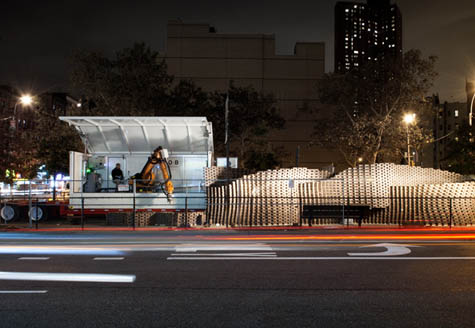
BLDGBLOG: That actually reminds me of some stadiums in Japan that were built both as sports stadiums and as earthquake-disaster centers. There’s food and water stockpiled in the basement, the entryways are sized for emergency vehicles, and so on. How would you recommend this sort of architectural adaptation, on a policy level?

Dr. Benjamin: We wouldn’t have much trouble convincing the presidents of universities today, who are already challenged with a disease process big enough to affect the whole student body. In the United States right now, with H1N1, the number of sick kids is big enough that they’re having to manage those kids on campus. For a disease process in which people are going to be sick for five or seven days, it’s unrealistic to send them home once they’ve shown up on campus. Colleges are having to deal with accommodating them right now. You can bet that, at least on college campuses in the United States, they would be very sensitive to this idea of dual-use facilities, because there’s an operational need for it.

The second thing is, if I was trying to do this, I would be working directly with architects and engineers, convincing them of the need to do it and then letting them sell it. They can say how best to do this, in a way that does not obstruct the primary purpose of the facility. We don’t want to interrupt anyone’s football games, but at the moment, everyone says, yes, we can put people here but it’s only going to happen once or twice in my lifetime, when the truth is that, if you design it that way, then you could use it much more frequently for that purpose. You could get dual-use out of it. Getting the people who design these places to tell us how to do it, in an appropriate and cost-efficient manner, and then having them make the case to the owners and users, so that they know that this is value added to their facility: that’s how I would get this message across.

Then I would talk to elected city and state officials about ways they could leverage tax-payer dollars to get these dual-use facilities built. Let’s say I’m in city government and I have someone coming up to me wanting the city to put up tax-payer dollars to support the building of a football stadium or a basketball stadium or a new school. If I get this additional bonus—this dual-use that helps my emergency-preparedness—I’m more likely to want to use taxpayer dollars to support it. Increasingly, as you know, private sector guys are coming to the government and asking for fiscal support to build these facilities. If tax-payers are going to be paying for things, then the city or the community needs to get something out of it.

I can tell you that a lot of work had to be done to fix and clean the New Orleans Superdome—but if you had built it so that it could be much more functional in an emergency situation then you would have had less damage. And from an image perspective, a dual-use sports facility now has much more of a public value.

That’s my personal view, not the Association’s view; but I think it’s an effective argument.

• • •

This autumn in New York City, Edible Geography and BLDGBLOG have teamed up to lead an 8-week design studio focusing on the spatial implications of quarantine; you can read more about it here. For our studio participants, we have been assembling a coursepack full of original content and interviews—but we decided that we should make this material available to everyone so that even those people who are not in New York City, and not enrolled in the quarantine studio, can follow along, offer commentary, and even be inspired to pursue projects of their own.

For other interviews in our quarantine series, check out Extraordinary Engineering Controls: An Interview with Jonathan Richmond, On the Other Side of Arrival: An Interview with David Barnes, The Last Town on Earth: An Interview with Thomas Mullen, and Biology at the Border: An Interview with Alison Bashford.

More interviews are forthcoming.

Robotism, or: The Golden Arm of Architecture

For the past four weeks, an orange robotic arm has been constructing a brick wall in south Manhattan.

[Image: Pike Loop by Gramazio & Kohler].

Neither a new Berlin Wall nor part of a delayed realization of Superstudio’s Continuous Monument, the machine was, in fact, built and programmed by Swiss architects Gramazio & Kohler. It is now the focus of an exhibition, called Pike Loop, at Storefront for Art and Architecture.

Tonight—Tuesday, October 27—at 7pm, Storefront will be hosting a public event in celebration of the project, down at the wall itself, free and open to the public. Here’s how to get there from Storefront. Be sure to stop by.

100

Even knowing how much it annoys certain people whenever I mention The BLDGBLOG Book on this website, I’m ridiculously excited—and admittedly quite stunned—to see that the book is #92 on Amazon.com’s list of the 100 Best Books of 2009.

[Image: Six of Amazon.com’s 100 Best Books of 2009].

To be on a list that includes J.G. Ballard, Thomas Pynchon, Nicholson Baker, A.S. Byatt, William T. Vollmann, and many more is just totally astonishing to me. But it’s a fantastic testament to the strength of the architects, photographers, writers, illustrators, historians, artists, cartographers, musicians, geologists, and more whose work appears in the book, as well as to the book’s designers, MacFadden & Thorpe. So thanks, Amazon!

In fact, there have been many fantastic books published this year, all worth checking out if you get a chance, including China Miéville’s The City & The City, David Gissen’s Subnature: Architecture’s Other Environments, Owen Hatherley’s Militant Modernism, Leslie Chang’s Factory Girls, James Lawrence Powell’s Dead Pool: Lake Powell, Global Warming, and the Future of Water in the West, Tom Zoellner’s Uranium, Stephen Asma’s On Monsters, the paperback reissue of Infrastructural City, Greg Grandin’s Fordlandia: The Rise and Fall of Henry Ford’s Forgotten Jungle City, and a million more.

(Thanks to Lauren Gilbert for pointing out the list!)

The Sphere and the Labyrinth

[Image: The cooling towers of the Ferrybridge power station; photo by Eric de Mare].

The above photo has really stuck with me since seeing it last week over at Millennium People—not only its juxtaposition of architectural types (the narrative ornamentalism of a small English church almost literally overshadowed by the minimalist hyper-functionalism of the cooling towers) but the photo’s implied collision of material activities (prayer, say, vs. the illuminative processing of rare fuels).

I might even suggest that it presents us with some strange, nuclear-Anglican revision of what Manfredo Tafuri would call the sphere and the labyrinth—that is, the altarpiece meets the reactor core—but the station is actually coal-powered, not nuclear at all. The image is nonetheless quite stimulating.

Imagine disused cooling towers repurposed as a church—or a library—or Chartres Cathedral put to work as a nuclear power station, its filigrees of saints and masonry trembling as atoms split and machines spin wildly in the basement.