Find a lake, float out to the center, build a house

[Image: Fishermen on Lake Tanganyika, via Wikipedia].

“The matted growths of aquatic plants fringing its shores are cut off in sections, and towed to the centre of the lake. Logs, brushwood, and earth are laid on the floating platform, until it acquires a consistency capable of supporting a native hut and a plot of bananas and other fruit trees, with a small flock of goats and poultry. The island is anchored by a stake driven into the bed of the lake; and if the fishing become scarce, or should other occasion occur for shifting his domicile, the proprietor simply draws the peg, and shifts his floating little mansion, farm, and stock, whither he chooses.”

—John Geddie, The Lake Regions of Central Africa: A Record of Modern Discovery (Edinburgh, 1883), as quoted by Giles Foden in Mimi and Toutou’s Big Adventure: The Bizarre Battle of Lake Tanganyika

(Thanks, Valerie!)

Post-residential Venice

While packing up the apartment for our move to San Francisco, I keep coming across articles I’ve clipped from newspapers and magazines, even whole chapters of books, that I obviously once meant to write about for BLDGBLOG…

[Image: J.M.W. Turner, The Dogana and Madonna della Salute, Venice, 1843; for more, see Tate Britain].

One such article, published nearly a year ago today, proclaims that Venice, Italy, may soon become “a tourist ghost town.”

Venice is on course to become a city virtually without residents within the next 30 years, turning it into a sort of Disneyland – teeming with holidaymakers but devoid of inhabitants… The city may then become a museum, to which, as La Repubblica remarked, it would be “normal to charge entry”.

Other cities for whom this fate could be very, very interesting, if culturally ill-advised? Detroit and the New York borough of Manhattan.
In any case, as the BBC describes this phenomenon:

At night Venice sometimes resembles an empty museum, a ghost town.
After [11pm], when the day trippers have all left and the restaurants and bars are closed, the waterways and calles – narrow streets that intersect the islands upon which Venice is built – are almost deserted.
Tomorrow another 60,000 people will arrive – and depart.

This vision – of Venice, populated only by the odd night security guard and a few absent-minded curators – surely sets up a far more interesting future storyline than Night in the Museum ever hoped to be.

(Earlier on BLDGBLOG: Venice Resonator).

Conspiracies of Demolition

In what seems like a deliberate attempt at conspiratorial double-entendre, the New York Times reports this morning that an “Obscure Company Is Behind 9/11 Demolition Work.”

[Image: The South Tower of the World Trade Center on 9/11; photographer unknown].

This obscure company, we read, is the John Galt Corporation, and they were “hired last year for the dangerous and complex job of demolishing the former Deutsche Bank building at 130 Liberty Street, where two firefighters died last Saturday.”
Wait a minute – what was all that about “9/11 Demolition Work”? Isn’t there an implication in that phrase that 9/11 was –
Well, no.
130 Liberty Street, you see, was heavily damaged by the collapse of the World Trade Center towers on September 11; it’s being dismantled because of this.
That apparently makes it “9/11 Demolition Work” – besides, the cryptic headline sells more papers.

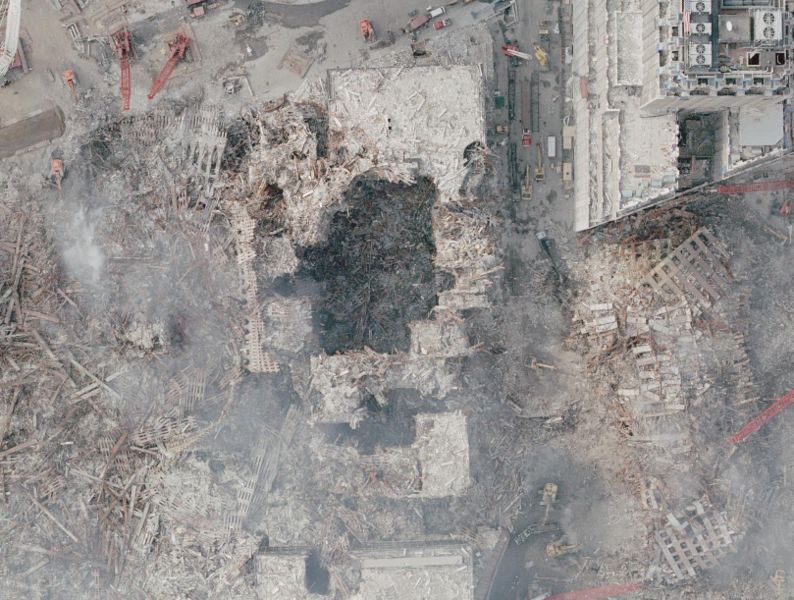
[Image: An aerial view of Ground Zero, taken on September 23, 2001, by NOAA’s Cessna Citation Jet. Via Wikipedia].

What’s interesting, nonetheless, is that the John Galt Corporation “has apparently never done any work like [this],” the New York Times reports.
“Indeed, Galt does not seem to have done much of anything since it was incorporated in 1983.”

Public and private records give no indication of how many employees it has, what its volume of business is or who its clients are. There are almost no accounts of any projects it has undertaken on any scale, apart from 130 Liberty Street. Court records are largely silent. Some leading construction executives in the city say they have never even heard of it.

The CIA masquerading as a demolition services firm in New York City!
Well, the article doesn’t say that – but it does parse through some of the complicated financial superstructures within which the John Galt Corporation operates (including distant ties to the Gambino crime family).
The John Galt Corporation is thus a kind of administrative straw man, a legal way “to insulate the assets of a parent company from the enormous potential liabilities of demolition work.”
Indeed, demolition is a legally complex undertaking; one need only read the last few chapters of Jeff Byles’s Rubble to understand the subtle vicissitudes of the growing industry.
In any case, the Times article goes on to say that New York state and its corporate partners experienced a lot of “difficulty” in “attracting any contractors interested in, or capable of, performing the novel and high-profile job” of demolishing 130 Liberty Street.

It is not hard to understand why most contractors – particularly during a building boom, when they can pick and choose work – would balk at doing a job involving hazardous materials under microscopic regulatory scrutiny for a governmental client whipsawed by demands that demolition go faster (so that ground zero redevelopment could proceed) and slower (to ensure that contaminants were not released into the neighborhood).

But I want to go back to the original motivation for this post: the world of legally shady demolition firms operating in the maze of high-rises and vacant lots, warehouses and Jersey docklands, of New York City. After all, there are so many potential novel plots in this set-up, I can hardly believe it.
There’s the Nicolas Cage/National Treasure 3 version: the John Galt Corporation is actually a front for some rogue group of foreign archaeologists – because there is something inside the building… and they need to recover it.
There’s the Loose Change version: 130 Liberty Street contains far too much chemical evidence that thermite really was used on 9/11 – and so the John Galt Corporation was brought in by Langley to clean up the job…
There’s the Ghostbusters/Grant Morrison version: the building is not a building at all… it is a valve, built directly above the Pillar of Manhattan, and it is only there as a way to vent subterranean steam. The John Galt Corporation is really a team of Columbia-trained paranormal investigators…
Anyway, obscure NYC demolition firms seem like a remarkably underused resource for contemporary novels and films; in fact, it’ll be interesting to see if demolition firms, post-9/11, take on a kind of conspiratorial aura, with unclear connections to investors in suburban DC… somehow showing up before major terrorists attack… starring Denzel Washington…
Read more about John Galt at The New York Times.

(Interesting note: John Galt is the name of a character in Ayn Rand’s Atlas Shrugged).

The Fold

[Image: An example of origami tesselation, turning surface to structure, called “Count?” by Christine Edison – whose other work is simply unbelievable: check out “Triad back backlit,” for instance, or this set of her “favorite tesselations.” While you’re there, don’t miss “New Years Eve Tess” or “Blue Snowflake Tess.” Christine also has a blog where you can click around on other spectacular examples of folds and pleats to your heart’s content. Spotted via Eric Gjerde, who recently published a short booklet explaining how you, too, can produce similar foldings of local paper-space… Architects would do well to study origami’s spatial densification].

(Earlier on BLDGBLOG: Paper Topographies: 1, with some stunning work by Eric Gjerde himself).

Airborne Geology

One of several interesting things I’ve found in Alan Weisman’s new book The World Without Us is his rhetorical approach to the industrial burning of fossil fuel.

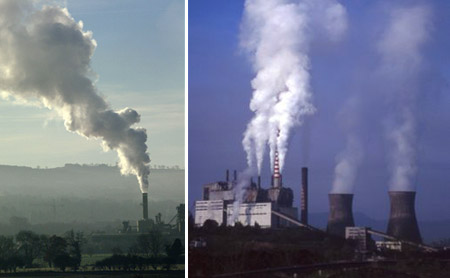
He refers to burning oil and coal as a way of “tapping the Carboniferous Formation and spewing it up into the sky” – that is, it’s “carbon we have mined from the Earth and loaded into the air.”
Or: geology gone airborne.

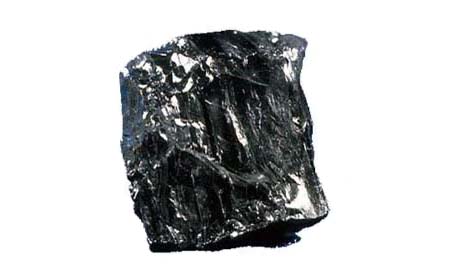
[Image: A glimpse of the Carboniferous Formation, or coal awaiting its own secular ascension; via].

Because of this unintentionally aero-geological project, Weisman writes, “[a]mong the human-crafted artifacts that will last the longest after we’re gone is our redesigned atmosphere.” After all, that atmosphere now has a very large chunk of the Earth’s surface floating around inside it, storing sunlight and heat.

[Image: Coal – before being “loaded into the air” through burning].

The word Carboniferous, meanwhile, refers to huge, continent-spanning deposits of coal that first began forming roughly 300 million years ago, in the appropriately named Carboniferous Period. Coal is formed from the compression, burial, and slow cooking of biological matter: old tropical forests and other organisms thus transform into an energy-intense geological formation.
In addition to the burning of oil – itself an ancient, carbon-based biological deposit – it is the combustion of all this coal that has fueled our ongoing industrial revolution.
In the process, Weisman implies, humans have achieved something extraordinary: the installation of a geological formation in the sky.

Looked at this way, it should come as no surprise that the Earth’s climate is now changing.
Its air is full of geology.

(Also in reference to The World Without Us – a very uneven but still fascinating book – see BLDGBLOG’s earlier post about the accidental discovery of underground cities in Cappadocia).

Derinkuyu, or: the allure of the underground city

My friend Robert and I finished reading Alan Weisman’s The World Without Us almost simultaneously – and we both noted one specific passage.
Before we get to that, however, the premise of Weisman’s book – though it does, more often than not, drift away from this otherwise fascinating central narrative – is: what would happen to the Earth if humans disappeared overnight? What would humans leave behind, and how long would those remnants last?
These questions lead Weisman at one point to discuss the underground cities of Cappadocia, Turkey, which, he says, will outlast nearly everything else humans have constructed here on Earth.
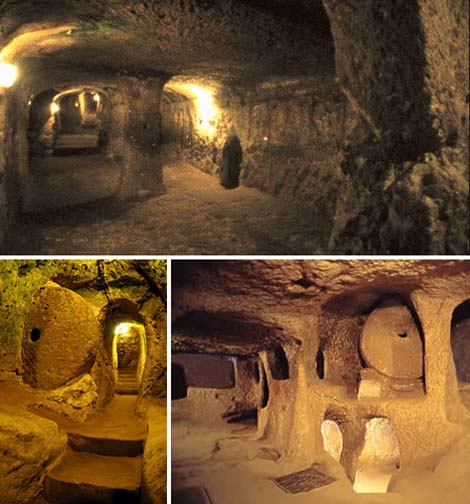
[Images: Derinkuyu, the great underground city of Cappadocia; images culled from a Google Images search and from Wikipedia].

Manhattan will be gone, Los Angeles gone, Cape Canaveral flooded and covered with seaweed, London dissolving into post-Britannic muck, the Great Wall of China merely an undetectable line of minerals blowing across an abandoned landscape – but there, beneath the porous surface of Turkey, carved directly into tuff, there will still be underground cities.
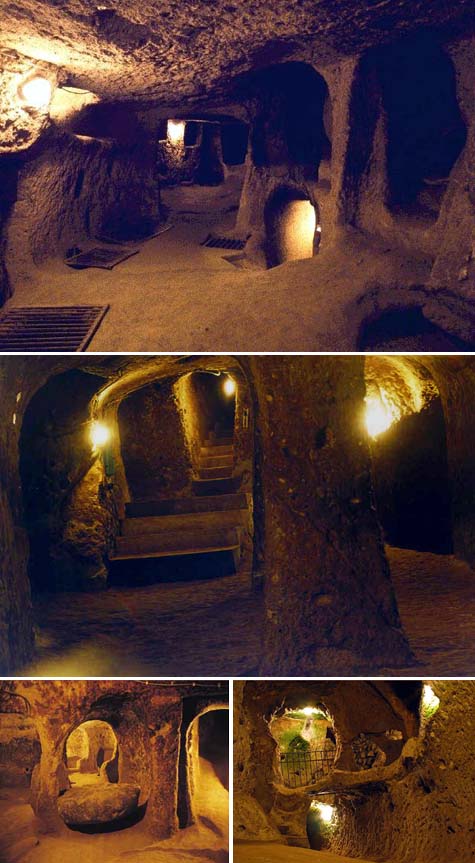
[Images: Derinkuyu, the great underground city of Cappadocia; images culled from a Google Images search and from Wikipedia].

Of course, I’m not entirely convinced by Weisman’s argument here – not that I have expertise in the field – but Turkey is a very seismically active country, for instance, and… it just doesn’t seem likely that these cities will be the last human traces to remain. But that’s something for another conversation.
In any case, Weisman writes:

No one knows how many underground cities lie beneath Cappadocia. Eight have been discovered, and many smaller villages, but there are doubtless more. The biggest, Derinkuyu, wasn’t discovered until 1965, when a resident cleaning the back wall of his cave house broke through a wall and discovered behind it a room that he’d never seen, which led to still another, and another. Eventually, spelunking archeologists found a maze of connecting chambers that descended at least 18 stories and 280 feet beneath the surface, ample enough to hold 30,000 people – and much remains to be excavated. One tunnel, wide enough for three people walking abreast, connects to another underground town six miles away. Other passages suggest that at one time all of Cappadocia, above and below the ground, was linked by a hidden network. Many still use the tunnels of this ancient subway as cellar storerooms.

I was excited to learn, meanwhile, that another – quite possibly larger – underground Cappadocian city, called Gaziemir, was only opened to tourists this summer (someone send me, please!), having been discovered in January 2007 (a discovery which doesn’t seem to have made the news outside Turkey).
So the next time the ground you’re walking on sounds hollow – perhaps it is… Whole new cities beneath our feet!
I was also excited to read, meanwhile, that these subsurface urban structures are acoustically sophisticated. In other words, Weisman writes, using “vertical communication shafts, it was possible to speak to another person on any level” down below. It’s a kind of geological party line, or terrestrial resonating gourd.
There were even ancient microbreweries down there, “equipped with tuff fermentation vats and basalt grinding wheels.”

[Images: Derinkuyu and a view of Cappadocia; images culled from a Google Images search and from Wikipedia].

Meanwhile, Robert, my co-reader of Weisman’s book, pointed out that the discovery of Derinkuyu, by a man who simply “broke through a wall and discovered behind it a room that he’d never seen, which led to still another, and another,” is surely the ultimate undiscovered room fantasy – and I have to agree.
However, it also reminded me of a scene from Foucault’s Pendulum – which is overwhelmingly my favorite novel (something I say with somewhat embarrassed hesitation because no one I have ever recommended it to – literally no one – not a single person! – has enjoyed, or even finished reading, it) – where we read about a French town called Provins.
In the novel, a deluded ex-colonel from the Italian military explains to two academic publishers that “something” has been in Provins “since prehistoric times: tunnels. A network of tunnels – real catacombs – extends beneath the hill.”
The man continues:

Some tunnels lead from building to building. You can enter a granary or a warehouse and come out in a church. Some tunnels are constructed with columns and vaulted ceilings. Even today, every house in the upper city still has a cellar with ogival vaults – there must be more than a hundred of them. And every cellar has an entrance to a tunnel.

The editors to whom this story has been told call the colonel out on this, pressing for more details, looking for evidence of what he claims. But the colonel parries – and then forges on. After all, he’s an ex-Fascist.
He’ll say what he likes.
As the colonel goes on, his story gets stranger: in 1894, he says, two Chevaliers went to visit an old granary in Provins, where they asked to be taken down into the tunnels.

Accompanied by the caretaker, they went down into one of the subterranean rooms, on the second level belowground. When the caretaker, trying to show that there were other levels even farther down, stamped on the earth, they heard echoes and reverberations. [The Chevaliers] promptly fetched lanterns and ropes and went into the unknown tunnels like boys down a mine, pulling themselves forward on their elbows, crawling through mysterious passages. [They soon] came to a great hall with a fine fireplace and a dry well in the center. They tied a stone to a rope, lowered it, and found that the well was eleven meters deep. They went back a week later with stronger ropes, and two companions lowered [one of the Chevaliers] into the well, where he discovered a big room with stone walls, ten meters square and five meters high. The others then followed him down.

So a few quick points:
1) Today’s city planners need to read more things like this! How exciting would it be if you could visit your grandparents in some small town somewhere, only to find that a door in the basement, which you thought led to a closet… actually opens up onto an underground Home Depot? Or a chapel. Or their neighbor’s house.
2) Do humans no longer build interesting subterranean structures like this – with the exception of militaries, where, to paraphrase Jonathan Glancey, we still see the architectural imagination at full flight – and I’m referring here to things like Yucca Mountain, something that would surely be too ambitious for almost any architectural design studio today – because they lack the imagination, or because of insurance liability? Is it possible that architectural critics today are lambasting the wrong people? It’s not that Daniel Libeskind or Peter Eisenman or Frank Gehry are boring, it’s simply that they’ve been hemmed in by unimaginative insurance regulations… Is insurance to blame for the state of contemporary architecture?
And if you called up State Farm to insure an underground city… what would happen?
Or if you tried to get UPS to deliver a package there?
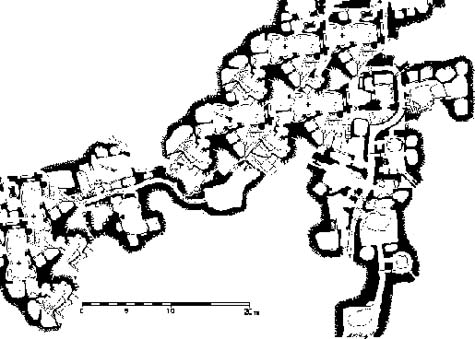
[Image: A map, altered by BLDGBLOG, of an underground Cappadocian metropolis].

In any case, underground cities are far too broad and popular an idea to cover in one post – there’s even a Stephen King story about a maze of tunnels discovered beneath some kind of garment factory in Maine, where cleaners find a new, monstrous species of rat – and I’ve written about these subterranean worlds before. For instance, in Tokyo Secret City and in London Topological.
While I’m on the subject, then, London seems actually to be constructed more on re-buttressed volumes of air than it is on solid ground.
As Antony Clayton writes in his Subterranean City: Beneath the Streets of London:

The heart of modern London contains a vast clandestine underworld of tunnels, telephone exchanges, nuclear bunkers and control centres… [s]ome of which are well documented, but the existence of others can be surmised only from careful scrutiny of government reports and accounts and occassional accidental disclosures reported in the news media.

Meanwhile, I can’t stop thinking about the fact that some of the underground cities in Cappadocia have not been fully explored. I also can’t help but wonder if more than two thousand years’ worth of earthquakes might not have collapsed some passages, or even shifted whole subcity systems, so that they are no longer accessible – and, thus, no longer known.
Could some building engineer one day shovel through the Earth’s surface and find a brand new underground city – or might not some archaeologist, scanning the hills with ground-penetrating radar, stumble upon an anomalous void, linked to other voids, and the voids lead to more voids, and he’s discovered yet another long-lost city?
It’s also worth pointing out, quickly, that there is a Jean Reno film, called Empire of the Wolves, that is at least partially set inside a subsurface Cappadocian complex. What’s interesting about this otherwise uninteresting film is that it uses the carved heads and statuary of Cappadocia not at all unlike the way Alfred Hitchcock used Mount Rushmore in his film North by Northwest: the final action scenes of both films take place literally on the face of the Earth.
In any case, I should be returning to the topic of underground cities quite soon.

Books cited:
• Alan Weisman, The World Without Us
• Umberto Eco, Foucault’s Pendulum
• Anthony Clayton, Subterranean City: Beneath the Streets of London

(With huge thanks to Robert Krulwich for kicking off this post!)

Architectural Sustainability

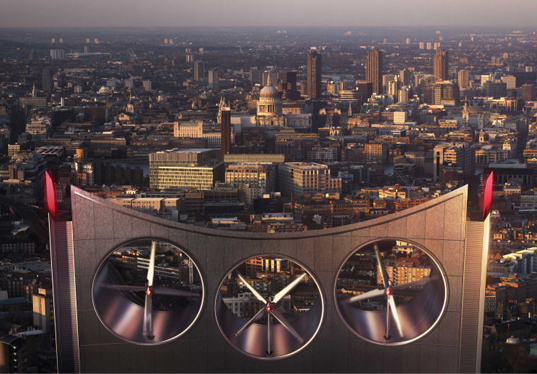
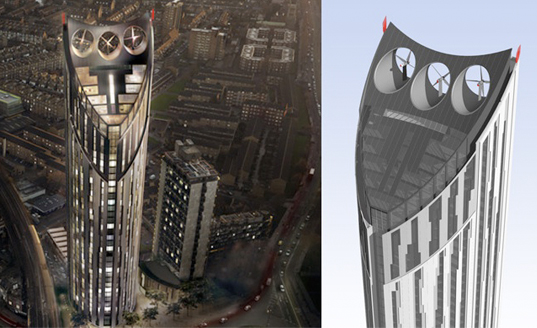
[Image: The Castle House tower by Hamiltons architects; via Inhabitat].

Unless a “green” building actively remediates its local environment – for instance, scrubbing toxins from the air or absorbing carbon dioxide – that building is not “good” for the environment. It’s simply not as bad as it could have been.
Buildings aren’t (yet) like huge Brita filters that you can install in a city somewhere and thus deliver pure water, cleaner air, better topsoil, or increased biodiversity to the local population.
I hope buildings will do all of that someday – and some architects are already proposing such structures – but, for the most part, today’s “green” buildings are simply not as bad as they could have been.
A high-rise that off-sets some of its power use through the installation of rooftop wind turbines is great: it looks cool, magazine readers go crazy for it, and the building’s future tenants save loads of money on electricity bills. But once you factor in these savings, something like the new Castle House eco-skyscraper still ends up being a net drain on the system.
It’s not good for the environment; it’s just not as bad as it could have been.

[Image: The Castle House tower by Hamiltons architects; via Inhabitat].

My larger point, however, is that you can write about a tower that uses less structural steel, and that tower might be better for the environment than, say, a steel-intensive luxury high-rise with three rooftop wind turbines, but your article probably won’t get 890 Diggs – and so you write about flashy gizmos with huge downsteam maintenance bills, instead.
To use an inappropriately over-simplified example, imagine two identical 60-story high-rises. The architect of Tower A convenes his engineering team one day and they proceed to rearrange some of the building’s internal structural steel; they’re thus able to cut out some cantilevers, for instance, and to eliminate excess building material, more generally. This reduces the structure’s embodied construction energy, by which I mean transport costs, steel manufacture, etc. A few days later, maybe the architect of Tower A even cuts out 10% of the track-lighting, or he makes the office lobbies a tiny bit smaller and, thus, easier to climate-control.
The architect of Tower B makes no such changes – but he does add a wind turbine to the roof.
Architect A has arguably had a much greater impact on his building’s environmental bottom line – but we don’t hear about Architect A.
We hear about Architect B, because wind turbines look great, they are easy to explain, and they don’t require much journalistic research.
Architect B – who has mastered the art of ornamentalizing sustainability – comes off as a hero; Architect A, despite his accomplishments, is overlooked.
Again, my point is simply that relatively unspectacular design decisions can be made in the process of constructing a building that will help lessen that building’s environmental impact – but often these decisions aren’t flashy. They don’t photograph well, and they don’t require cool new pieces of Digg-friendly technology.
And so your building, however not bad it is for the environment, doesn’t receive any free publicity on green building blogs. I’m not pointing fingers, either: this diagnosis is at least as true for BLDGBLOG.
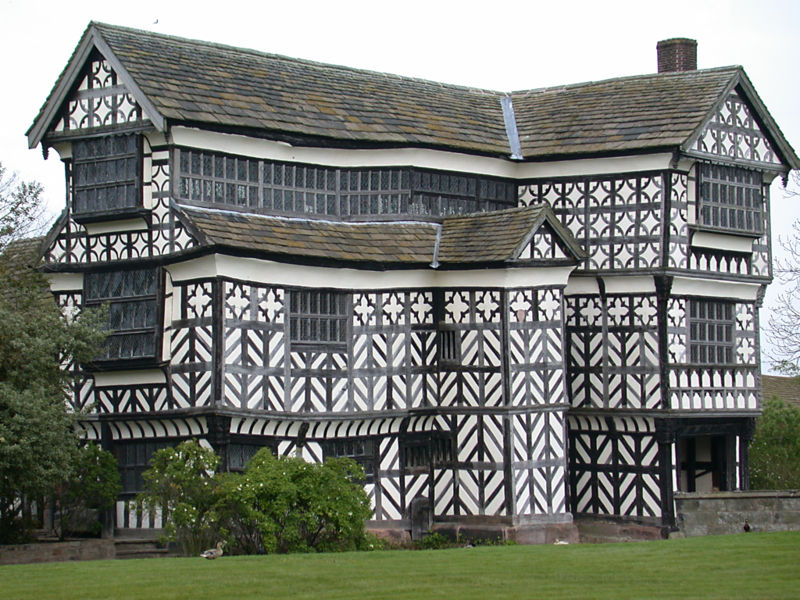
A relatively lame example here is Tudor residential architecture: as I mentioned back in November, Tudor-style houses are remarkably energy efficient. “Wind turbines, solar panels and other hi-tech green devices might get the media attention,” I quote in that earlier post, “but the smartest way to save energy may be to live in a Tudor house and insulate the attic and repair the windows.”

[Image: Little Moreton Hall, “an early model of energy efficiency,” according to the Guardian Weekly].

In any case, I just think it’s worth pointing out that you can compare a new building to the environmental impact of no building at all – in which case you have quite a high bar to clear before your new building is truly “green” – or you can compare that new building to how bad it might otherwise have been.
If you’re only doing the latter, then almost literally any minor design decision – including ornamental wind turbines or a few arbitrary solar panels – will make that building “green.” In the process, “green building” slowly loses any rigor or integrity it might previously have had.
Wind turbines, solar panels, rainwater catchment systems, etc., are totally awesome – I unironically endorse their architectural use – but they don’t make a building good for the environment. Or at least they don’t yet.
They just make that building less bad for the environment than it would have been without them.
Which is still great – but we shouldn’t mistake restraint for generosity.
In other words, we shouldn’t pretend that a steel-intensive high-rise with a few wind turbines on top is somehow good for us; it’s just not as bad as it could have been.
I would hope that at least long-term readers know that this blog is “pro-sustainability” – I’ll even sheepishly point out my own interview with Ed Mazria – but I think it’s extremely important to realize that you may be building less bad high-rises, but you are still building high-rises. I remain radically unconvinced that a “green” skyscraper is better than no skyscraper at all – and yet green skyscraper enthusiasts are out high-fiving each other as if their own positive energy is enough to counteract carbon emissions from the global steel industry.
This is actually one of the reasons why I like Ed Mazria and his Architecture 2030 organization so much.
In a recent press release, Architecture 2030 pointed out that “the CO2 emissions from only one medium-sized (500 MW) coal-fired power plant” are enough to negate the effects of planting 300,000 trees in only ten days, among other amazing statistics – including the fact that the entire Architecture 2030 effort, as applied to building renovations, would be negated by the “CO2 emissions from just one 750 MW coal-fired power plant each year” from now till 2030.
If we want to be “green,” Mazria’s press release implies, then a far more effective route toward that goal is to change the coal industry – not to become a luxury high-rise developer in Miami’s South Beach (or, worse, in Dubai).

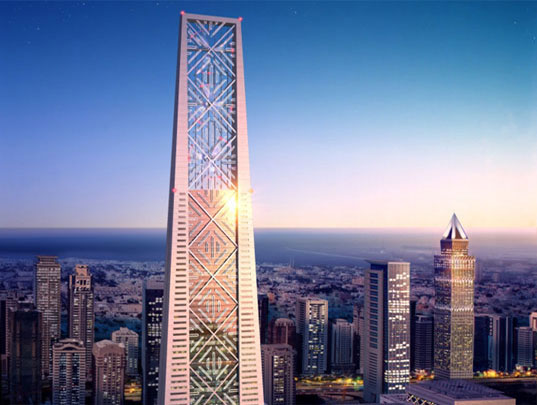
[Image: The Lighthouse, in Dubai; via Treehugger].

Being not as bad as you could have been is not a viable future goal for sustainable architecture.
Build something that genuinely improves the environment – build something that has a measurably negative carbon footprint, for instance, from the manufacture of its steel to the billing of its electricity – and then I’ll be as excited as you are about how “green” the project really is.
Until then, people who are only guilty of screwing the environment over partially win huge accolades: thank you, we say, for only mugging two people last night – I thought you were going to mug three
Which is positive reinforcement, sure – but it’s not necessarily good for the state of architectural sustainability.

(I apprehensively want to make clear that this post may have been motivated by a post at Inhabitat, but it is in no way meant as an attack on that site; I’ve linked to, hosted an event with, and even written several posts for Inhabitat. I also want to make clear that I am 100% behind so-called green building practices; I just don’t think a “green” building should be mistaken for an environmental improvement; otherwise it’s like mistaking fat-free pound cake for health food: deluded by the packaging, you eat tons of the stuff and you end up like Dom DeLuise).

Musique concrète

[Images: Rosslyn Chapel, container of symphonies].

I meant to post this ages ago – at the beginning of the summer – but it slipped right by… So this isn’t exactly news, but I still love it: Scotland’s Rosslyn Chapel, world famous for its appearance in Dan Brown’s The Da Vinci Code, has apparently been hiding a fascinating secret, after all.
It turns out that “[a] father and son who became fascinated by symbols carved into the chapel’s arches say they have deciphered a musical score encrypted in them.”

[Image: The intricate ceilingry of Rosslyn Chapel, photographed by Benjamin Lee; via Sacred Destinations].

From the website of Thomas J. Mitchell, who “decrypted” the music: “Rosslyn Chapel holds a musical mystery in its architecture and design. At one end of the chapel, on the ceiling are 4 cross-sections of arches containing elaborate symbolic designs on each array of cubes (in actual fact they are rectangles mostly). The ‘cubes’ are attached to the arches in a musically sequential way.”
In the over-ambitious application of a cryogenics metaphor, Mitchell says that the music has now “thawed out” to be understood – and heard – by people today. Being a composer, he also seems to have released the music on CD.

[Image: The Rosslyn Chapel doorway, photographed by seth + lara m.; via Sacred Destinations].

Whether or not there really is music encoded in the arches of Rosslyn, the implications of this are exciting.
Will someone detect, for instance, a thousand years from now, a symphony encoded in the runways at Heathrow? Or will the New York City subway system be reunderstood as a series of sub-terrestrial folk songs, themed around a chorus of transportation?
Or perhaps the International Space Station will be revealed after all as an étude of pressurized air tanks, awaiting its musical decryption; it is three-dimensional music, hovering in space.

(Thanks, Christopher! And happy birthday!)

Oceanic

[Image: A spectator gazes out at the wave that will destroy him; via LiveScience].

This picture has been haunting me ever since I first saw it back in June: it depicts what appears to be a man, standing on the coast of Hawaii in 1946, watching a tsunami rush to shore, bringing a wall of debris down upon him – a literal and terrifying experience of the oceanic.
Caused by a massive earthquake – or catastrophic landslide – off the coast of the Aleutian Islands, the tsunami made it all the way to Hawaii and beyond. I say earthquake or landslide because there is still some controversy over what exactly caused the wave in the first place.
The Pacific Tsunami Museum, meanwhile, with an oddly titled series called the “Tsunami Survivor Video of the Month,” has more general information about tidal waves in the Pacific.

Waterville

[Image: Center for Biodiversity by Tecla, part of the Waterpower project; via Domus].

There was an interesting, though brief, article posted on Domus last month about Italy’s Valle dei Mulini, which Domus describes as “a fascinating microcosm of industrial history, dotted by abandoned paper mills.”
In order “to prevent this heritage from disappearing,” a local planning and design group, calling itself Waterpower, “asked a series of Italian and foreign designers to make projects for the renewal of the deserted water and paper mills. There was one condition: that they take the ‘power of water’ as the poetic metaphor and technological guideline of their projects, turning the valley into an eco-sustainable environment.”

[Image: A parking garage and “river remodelling” structure by Labics, part of the Waterpower project; via Domus].

The resulting proposals look at programmatically different reuses of the old mills, including purposes as diverse as a youth hostel (complete with water from the Canneto River flowing through part of the building), a Center for Biodiversity –

[Image: The Center for Biodiversity by Tecla, via the Waterpower project].

– newly cultivated “lemon terraces,” a spa, a kind of outdoor historical walkway, a “Waterfall Home” deeply fixed into the bedrock, complete with some kind of Slow Food studio/kitchen –

[Images: The Waterfall Home by Nemesi, via the Waterpower project].

– and a hydraulics museum.

[Image: A “Hydraulics Museum & Panoramic Bar” by Sudarch, part of the Waterpower project; via Domus].

The Waterpower website has a lot more information about the various projects, including a short history of the Valle dei Mulini itself.

[Images: A topographical view of the Valle dei Mulini, via the Waterpower project].

We read, for instance, that the project “aims to recover a landscape and a system of pre-industrial water mills (mulini) currently in danger of collapse beyond repair.”

As described with a wealth of illustrations in Diderot and D’Alembert’s Encyclopedie, from the early 13th century the paper mills, iron mills, and later hydro-electric power stations exploited water power through ingenious systems of channels, tanks, level drops, funnels and water wheels to produce energy to make things. The mills were carefully distanced one from the next to exploit the height differential and hence the water power. From the port of Amalfi the network of mills rises 3km inland and 350m in height.

It’s the river valley as landscape-machine.
In any case, I think it’s a cool project. Read more at the official website.

Golf Stars

I went out to meet the folks behind Planetizen last night at a rooftop party near Wilshire and Western, in L.A.’s Koreatown, to celebrate the recent publication of their new book, Contemporary Debates in Urban Planning. The book has contributions from the usual suspects in today’s city planning debates, such as Joel Kotkin and Andrés Duany, and it includes a variety of short essays by other writers, critics, and practitioners, from Alex Garvin and Robert Olshansky to James Howard Kunstler, Harriet Tregoning, and Constance Beaumont.

What made the night particularly memorable, however, was that I had to park several blocks away – and so, to get back to my car in the darkness, the sun having set on Los Angeles, I found myself walking past the Aroma, a multi-level indoor golf driving range, well-lit and thriving there on a Tuesday at 9pm.
I looked up at the glowing structures of netting that surround the place, a soft-focus rectangle of light, nearly the size of a city block, only to see little white flashes like meteors – falling stars – streaking across the sky in front of me. Everything else was silent.
Then another flash – and another – as the nets at the end of the driving range rippled with the impacts.
Then more flashes.
And that artificial astronomy of tiny white spheres crossing space went on and on as I walked away.