Study in Mass

[Image: Boutique Monaco by Mass Studies; view larger].

I’ve mentioned architect Minsuk Cho, of Mass Studies, on BLDGBLOG before: he designed the so-called “ring dome” for the Storefront for Art and Architecture’s Z-A event last month in New York City, and he collaborated with Jeffrey Inaba’s SCI-FI studio to propose an “urban district above the water” in Seoul.
I’d say that Mass Studies is hard to beat for sheer spatial interest and originality; witness their Torque House, Pixel House, or Cheongam Media Headquarters, for instance – let alone the famously freaky Seoul Commune 2026.

[Images: Three rendered views of the building’s lobby and ground level exterior].

Or take a look at the Boutique Monaco, pictured here.
The Monaco is “a high-density, massive building for residential/office/commercial/cultural activities to be located in the heart of the Seoul metropolitan life, the area around Gangnam station.”

[Images: Day and night renders of the project’s exterior, complete with punctuated vertical bays of greenery and residential terracing; view both the top and bottom images larger].

As Mass Studies explains:

Unlike the existing high-rises where one is segregated from the outside world as soon as he [or she] leaves the ground floor, Boutique Monaco will be a building where at each level will be a vertical open space accessible from different spots in the floor. The exterior, designed in an orthogonal pattern in the interest of efficiency in space allocation, is intended to strike a balanced harmony with the surrounding box-type high-rises.

Further: “In the plan for Boutique Monaco, around 172 units are created in 49 different types and sizes and interconnected as if in an enormous puzzle. At the same time, different types of internal/external, private/public areas are to be installed.”
You can see some of the building’s floorplans here.

[Image: A kind of rooftop park and bioscape, complete with what appears to be a helipad].

The project can be seen in renderings, drawings, and diagrams on the Mass Studies website – but also now in photographs.
The building is under construction even as this post is being written, and it should be open for inhabitation by late summer 2008.

[Image: The Boutique Monaco under construction; view larger].

Meanwhile, I don’t mean to uncritically promote the actions of a property developer in Seoul; nor do I wish to suggest that because this building has a few trees growing out of it that it’s “green.”
But I do have to say that I like 1) the project’s use of materials (the wood cladding inside the vegetated nooks is especially brilliant), 2) the punctuated bays themselves, which break up the facade in a really great way and add a spatially and experientially inspired dimension to the project, and 3) the diagonal bracing, however ornamental and non-structural it may be, of the podium. We may be seeing more and more of these sorts of structural weavings – but that’s because they’re cool.

[Image: Bracing at the base of the Boutique Monaco; view larger].

For other projects by Mass Studies, check out their archives.

Mobile Minimalism

Flavio Galvagni of Lab Zero has a few projects that I think deserve mention here.

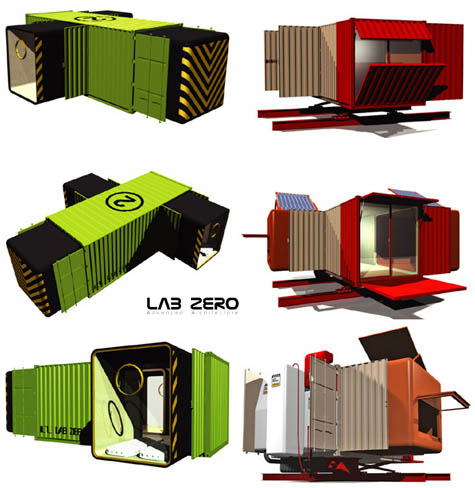
[Image: The solar-powered Minimum Mobile Module by Lab Zero].

Let me say right away, though, that I know a lot of people are tired of shipping container architecture – in fact, I think most people are tired of shipping container architecture – yet I have a fairly limitless patience for this sort of thing. Actually, I love shipping container architecture.
But the same questions inevitably arise whenever things like this re-appear in the blogosphere: Are shipping containers comfortable? Is reusing them as a form of readymade architecture even structurally realistic? Would anyone really want to raise a family inside one of these things? And does the appeal of such designs actually cross cultures and income levels and ethnicities and, more important, climates? Sure, these might work in Santa Monica – but would they work in Minneapolis-St. Paul?
To which I would have to say that the answer is: no, they probably aren’t that comfortable when it comes to raising two and a half kids – and they probably don’t equally appeal to, say, bedouins, Russian oil tycoons, Detroit’s inner city poor, suburban parents, or even BLDGBLOG readers.
But I don’t think those are the right questions to ask.
I don’t think the point of cargo container architecture is for us to pretend that it’s a universally appropriate design solution for every situation that could possibly exist in the world today – because it isn’t. Then again, nothing is universally appropriate in architecture.
What I think is, actually, the point of reusing shipping containers as architecture is: 1) when you can, you should reuse existing materials for somewhat obvious environmental reasons, and 2) the spatial, logical, and combinatorial systems that cargo containers imply are simply awesome. The possibilities excite me. Container-made buildings are fun to look at, they’re fun to render, and they’re fun to imagine forming new architectural reefs and Tetris cities, interlocking in a sci-fi future coming soon to a landscape near you.
Whole new outer districts of London made from shipping container towers!

[Image: The Minimum Mobile Module by Lab Zero; view larger].

So arguments about the architectural reuse of shipping containers shouldn’t be based on the claim that it’s all or nothing; it’s not either we replace all existing architecture in the world with cargo containers and then force everyone to live in them or we never construct a single cargo container building anywhere ever again, even for something as simple as a meditation retreat in your own backyard.
Maybe only one cargo container building will ever be built again – or maybe none will – but that doesn’t mean we can’t still screw around for hours on end with them on our home computers, virtually assembling weird new unfolding structures or houses with legs or helicopter-borne instant cities simply because it’s fun and a way to kill time.
In other words, even if these plans serve as nothing but design exercises – studies in volume, combination, and color – then that’s fine with me. We can be done with the ongoing arguments and just enjoy looking at cool imagery.
But I digress.
Lab Zero has put together a number of cool projects, including the solar-powered Minimum Mobile Module, pictured above, and the Carapace House, below.

[Image: The Carapace House by Lab Zero; view larger].

The Carapace House – a larger diagram of which can be seen here – is intended for use in “challenging natural environments.”
Similar to Lab Zero’s own Drop Off Unit, the Carapace House is temporary, mobile, and easy to “drop off” in a variety of locations.

[Image: The Drop Off Unit by Lab Zero; view larger or in more detail].

All of which brings us to the Jellyfish House – not that Jellyfish House – a kind of floating tower perfect for those of us interested in “spatial delocation.”
You can drift around the world’s oceans in it, reading William Gibson.

[Image: The Jellyfish House by Lab Zero; view bigger].

The Lab Zero website is still apparently under construction, meanwhile, but keep your eye out for more of their work in the future. They were featured in Actar’s recent book Self-Sufficient Housing, for instance, and will no doubt be popping up elsewhere soon.
And for more cargo containers on BLDGBLOG see Container Home Kit or even Project Blackbox.

Golf amongst the glaciers

In an old book by John McPhee, called In Suspect Terrain, we meet a geologist named Anita Harris who takes McPhee on a tour of post-glacial North American landscapes.
The two of them drive through and discuss “a confused and thus beautiful topography of forested ridges and natural lakes, stone fences, bunkers and bogs, cobbles and boulders under maples and oaks,” and they follow the moraines, that line of retreat at which the glaciers stopped, hiking over “hills of rock debris” that were dragged into place – by ice – ten thousand years ago.

At one point Harris comments that glaciers and golf go together like wind and surfing:

“This would be a good place for a golf course,” Anita remarked, and scarcely had she uttered the words than – after driving two thousand yards on down the road with a dogleg to the left – we were running parallel to the fairways of a clonic Gleneagles, a duplicated Dumfries, a faxed Blairgowrie, four thousand miles from Dumfriesshire and Perthshire, but with natural bunkers and traps of glacial sand, with hummocky roughs and undulating fairways, with kettle depressions, kettle lakes, and other chaotic hazards. “If you want a golf course, go to a glacier” is the message according to Anita Harris. “Golf was invented on the moraines, the eskers, the pitted outwash plains – the glacial topography – of Scotland,” she explained. “All over the world, when people make golf courses they are copying glacial landscapes. They are trying to make countryside that looks like this. I’ve seen bulldozers copying Scottish moraines in places like Louisiana.”

And, sure enough, as only one example, if you read about the golf course in Kohler, Wisconsin, you learn the following:

The River Course at Blackwolf Run is a commanding layout that offers a dynamic golf challenge with sweeping panoramic views of the Sheboygan River valley. A glacier served as early landscape architect for this site, sculpting river valleys with deep ravines, meadow plains, gentle rolling hills and abundant lakes. Ten thousand years later, Pete Dye took this same piece of land, added his signature style and designed one of the best golf courses in America.

All of which indirectly reminds me of one of my favorite posts on Pruned, in which we read about a golf course in Ohio that’s been constructed atop a series of old Native American moon-viewing mounds.
That landscape itself, in other words, is not only artificial – it is, in fact, a 2000-year old earthwork temporarily lost to view under thickets and autumn leaves (until the golf course came through, clearing the scene) – but the whole thing is also astronomically aligned with the cycles of the moon.
Now that this strange overlay has been discovered, we read, “there is an eagerness among many people to see moonrises from the mounds the way the Indians did, a desire that has caused a conflict with the golf club.”
Imagine a golf course deliberately aligned with the universe! You study astronomy with a putter in your hand, hiking amidst coincidence like some strange god on a midwestern hillside.
But the fact that a climatic occurrence ten thousand years ago – the most recent Ice Age – actually formatted the landscape in such a way as to help make golf possible just floors me. That the design of golf courses is thus a continuation of the Ice Age – by means other than geology – is just icing on the cake.
And that this specific type of landscape – the golf course – is then exported, repeated, and cloned, via bulldozer, in decidedly non-glacial landscapes all over the world, from the urban cores of Chinese cities to American military bases in Afghanistan, only adds to the fascination.

[Image: Found, via a Google Images search, here; some of the comments there beggar belief].

We are the glaciers now™.

(More: Pruned‘s Of tumuli, moonrises, and a nice Par 3 and John McPhee’s In Suspect Terrain).

Foundation

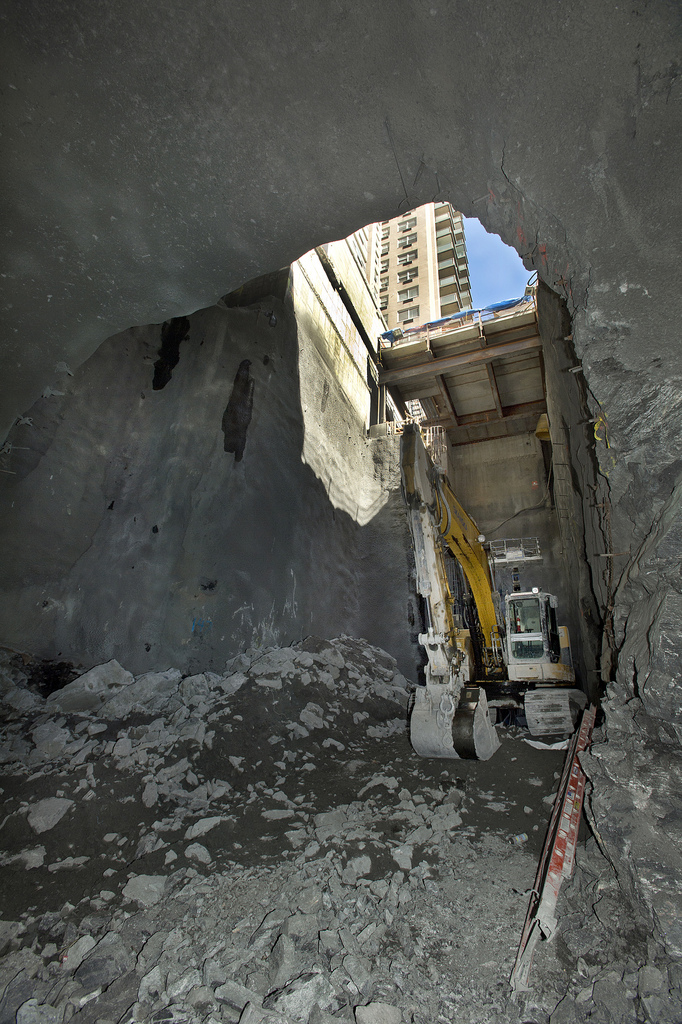
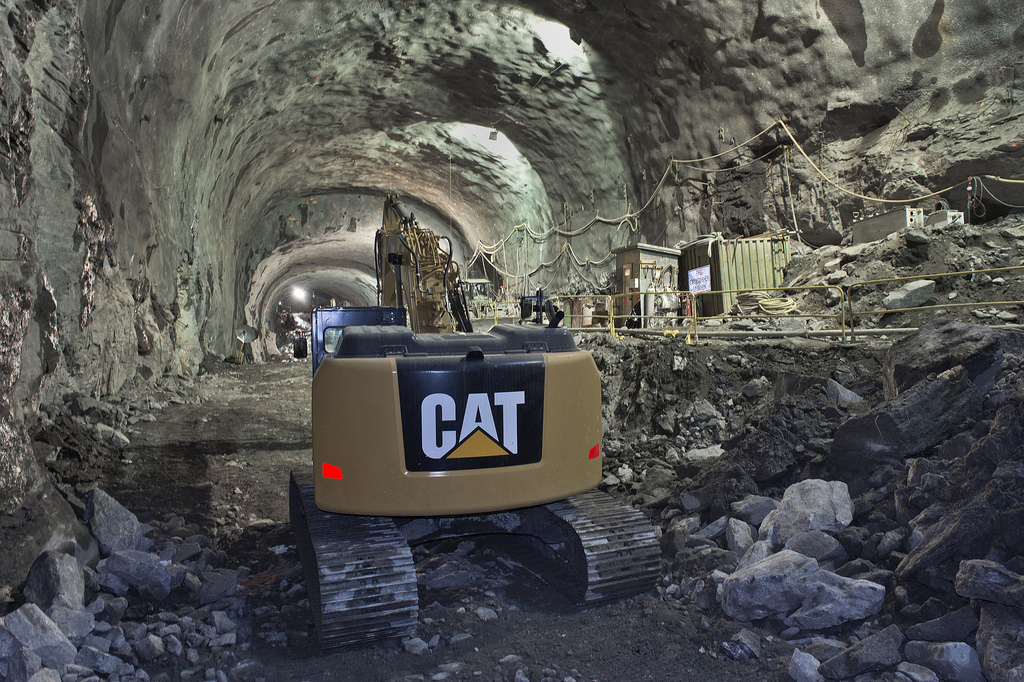
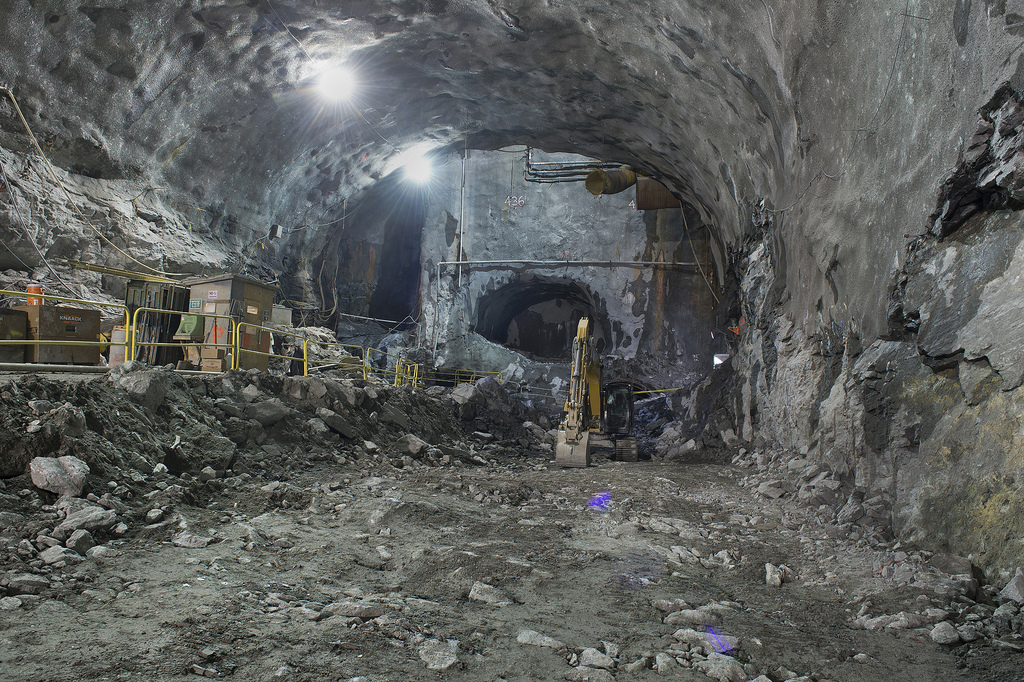
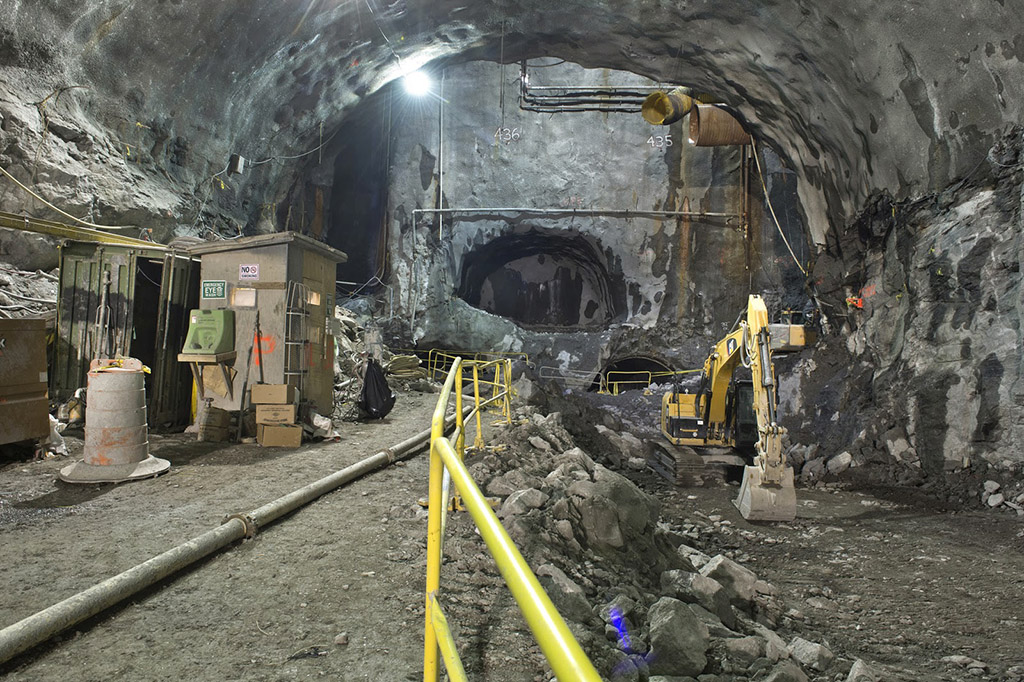
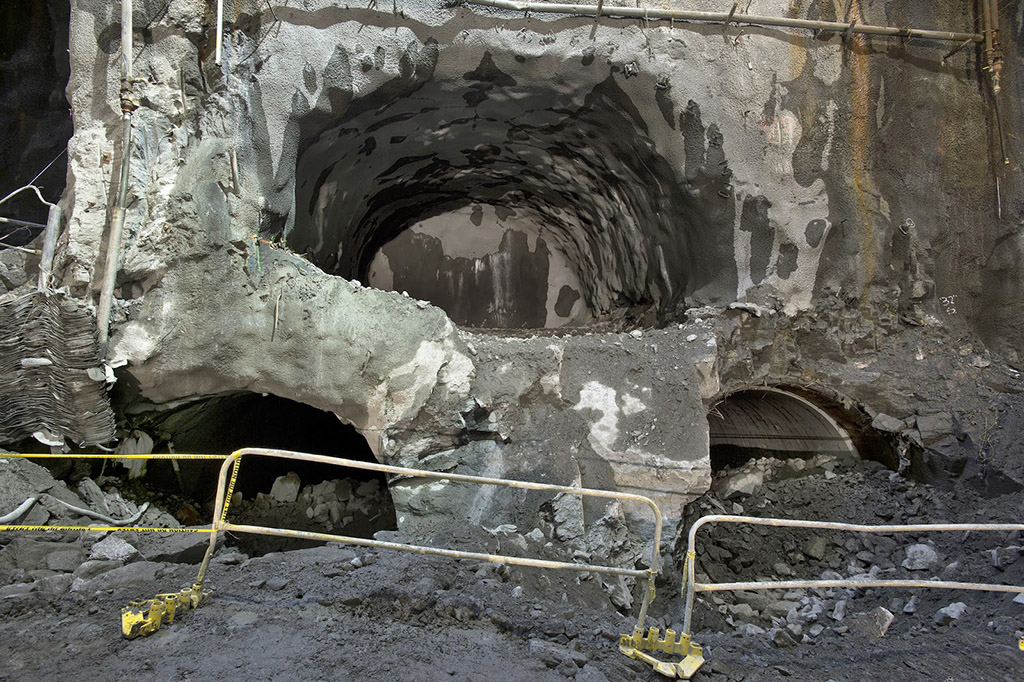
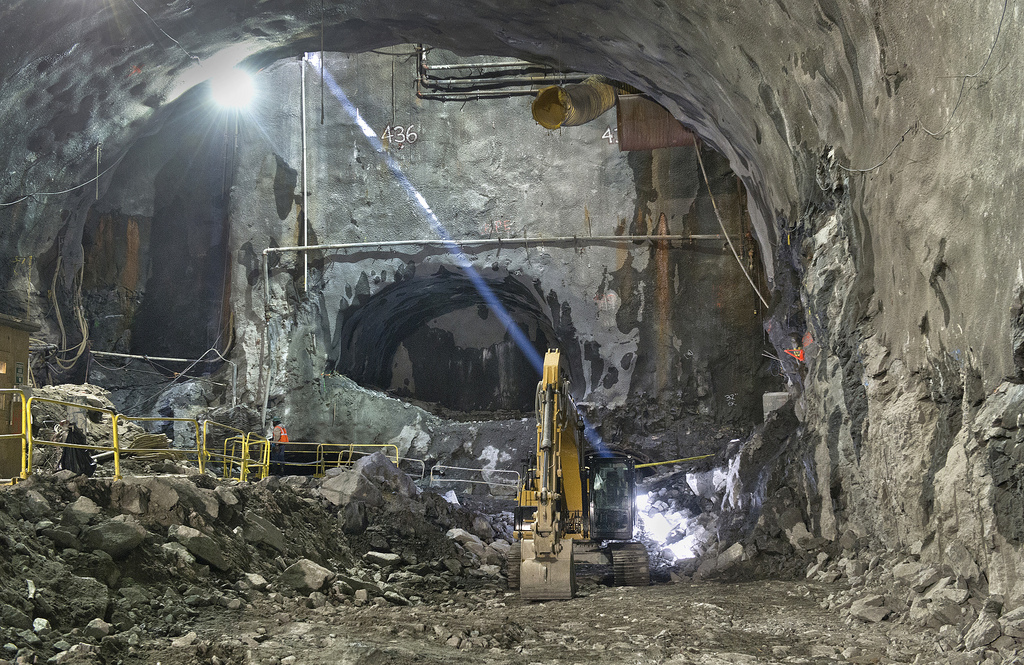
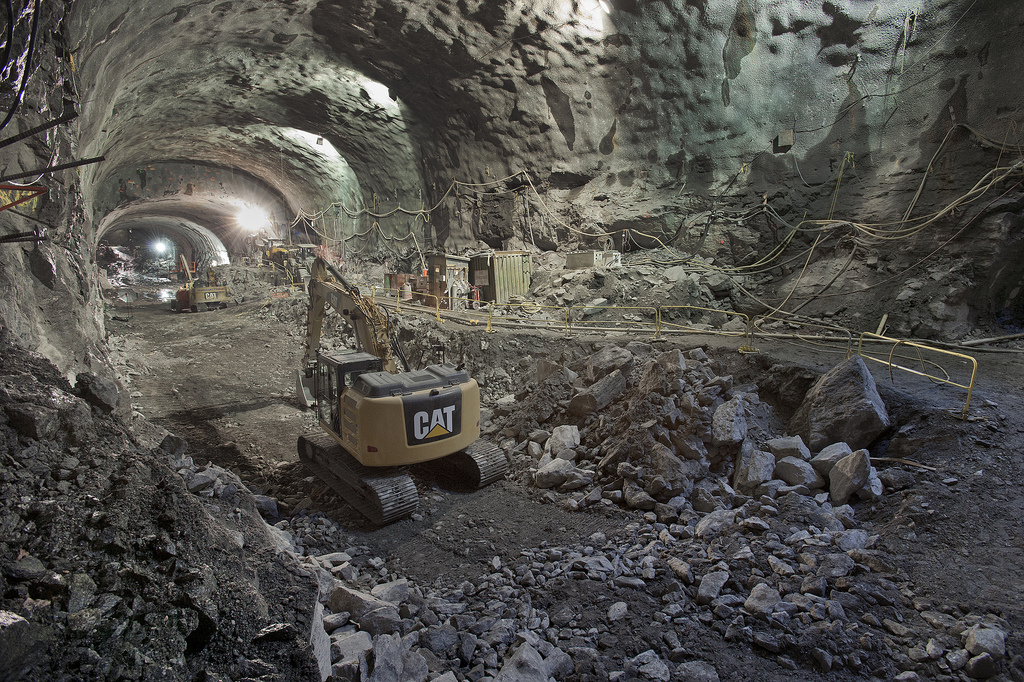
New York’s Metropolitan Transportation Authority has released some new shots by photographer Patrick Cashin of the so-called “86th Street cavern,” through which the future 2nd Avenue subway will someday travel.

[Image: Inside the “86th Street cavern”; photo by Patrick Cashin. View larger!]

The artificial caves are roughly 100 feet below street level. Quoting from a now-subscriber only article originally published back in 2009 in the trade journal New Civil Engineer, Wikipedia offers a glimpse of the difficulties: “Of the below-ground obstacles, Arup director of construction David Caiden says: ‘It’s a spaghetti of tunnels, utilities, pipes and cables—I’ve never seen anything like it.’ Additionally, the project must go over, or under, subway lines, Amtrak railway lines, and the Queens-Midtown Tunnel linking Manhattan and Queens.” It’s woven through the city like a carpet.

[Image: Photo by Patrick Cashin].

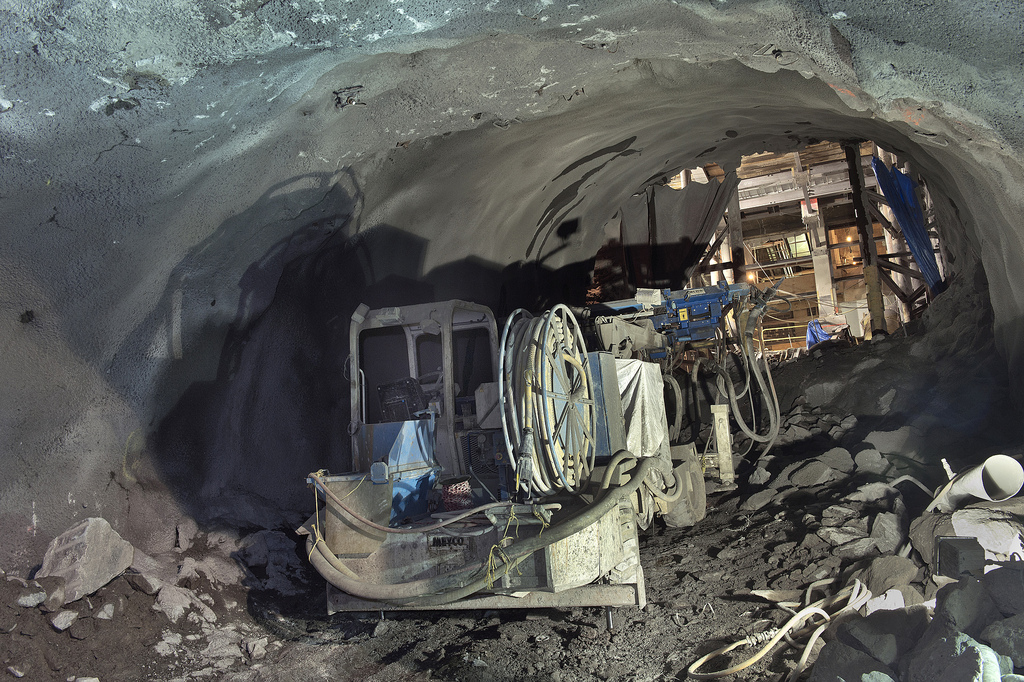
It’s extraordinary, though, to see how easy it is to forget that, when walking up and down stairs inside subway stations, you’re actually walking around inside a series of relatively dark and irregular caverns—

[Image: Photo by Patrick Cashin].

—their walls and ceilings seemingly held in place only by an acupuncture of rock bolts, a monochrome world of uneven geologies smoothed over by shotcrete and disguised by tile.

[Images: Photos by Patrick Cashin].

I bookmarked an old article that seems relevant here, especially in light of the next image, that the tunnels had been “blessed”—made holy—by a Catholic priest back in August 2012. In a short article written with suitably—if obvious—Dantean undertones, we read that “the priest, Rev. Kazimierz Kowalski of the Roman Catholic Church of Our Lady of Good Counsel on East 90th Street in Manhattan, stepped over rocks into a small clearing away from the shaft to be clear of falling objects. And there he began to pray, blessing the underground cavity where the Second Avenue subway tunnel is taking shape.”

[Image: Photo by Patrick Cashin].

Fascinatingly, he then made architectural reference to the urban work of laying down this subterranean layer of the city: “Reading from a letter of Paul to the Corinthians, he added, ‘For no one can lay a foundation other than the one that is there, namely our Lord’,” something I quote not out of theological advocacy but for the interest of a possible religious connection between mining out “a spaghetti of tunnels, utilities, pipes and cables” beneath New York City and the establishment of a metaphoric “foundation” upon which a future city might sit. Tunneling, we might say in this specific and limited context, is God’s work, the subway system secretly a consecrated labyrinth of artificial caves, its stations like chapels drilled into solid bedrock.

[Image: Photo by Patrick Cashin].

The priest then “sprinkled holy water on the ground and invited the sandhogs to sing sometime for his parishioners.”

[Image: Photo by Patrick Cashin].

In any case, I feel compelled briefly to revisit something in Jonathan Lethem’s recent novel Chronic City, in which we read about a tunneling machine that has gone “a little out of control” deep beneath the streets of New York, resurfacing at night like some terrestrial Leviathan to wreak havoc amongst the boroughs. From the book:

“I guess the thing got lonely—”
“That’s why it destroys bodegas?” asked Perkus.
“At night sometimes it comes up from underneath and sort of, you know, ravages around.”
“You can’t stop it?” I asked.
“Sure, we could stop it, Chase, it we wanted to. But this city’s been waiting for a Second Avenue subway line for a long time, I’m sure you know. The thing’s mostly doing a good job with the tunnel, so they’ve been stalling, and I guess trying to negotiate to keep it underground. The degree of damage is really exaggerated.”

Eventually the machine—known as the “tiger”—is spotted rooting around the city, sliding out of the subterranean worlds it helped create, weaving above and below, an autonomous underground object on the loose.

(For a tiny bit more context on the Lethem novel, see this earlier post on BLDGBLOG, from which the final line of the current post is borrowed).

Earthquake Towers, Trapdoors, and other such delights

Just a reminder that I’ll be speaking in Los Angeles tonight at the Southern California Institute of Architecture, in case you’re around. The event is free, it starts at 7pm, it’s open to the public, and it’s located here, with plenty of parking.
It will be the single most exciting thing that’s ever happened, anywhere.

Climate Change Escapism

The Guardian recently introduced us to a series of images, produced by artists Pedro Armestre and Mario Gómez, for a new project by Greenpeace.
The images show us what Spain will look like in the future, in a world transformed by climate change.

[Image: By Pedro Armestre and Mario Gómez].

The basic idea here is that these visions of flooded resort hotels, parched farmlands, and abandoned villages, half-buried in sand, will inspire us to take action against climate change. Seeing these pictures, such logic goes, will traumatize people into changing how they live, vote, consume, and think. You can visually shock them into action, in other words: one or two glimpses of pictures like these and you’ll never think the same way about climate change again.
But I’m not at all convinced that that’s what these images really do.

[Image: By Pedro Armestre and Mario Gómez].

In fact, these and other visions of altered planetary conditions might inadvertantly be stimulating people’s interest in experiencing the earth’s unearthly future. Why travel to alien landscapes when you can simply hang around, driving your Hummer…?
A few years go by and the planet is suddenly different.
So if the speculative landscapes pictured here are both imminent and immanent – if they are both inevitable and hidden inside the landscapes we see today, simply waiting for their opportunity to materialize (through drought, flood, fire, etc. etc.) – then there also seems to be a growing curiosity about what the world of tomorrow will really look like.
But mere seeing, I would guess, is not enough: I would assume, in fact, as more images of our climate-changed future are produced, that more and more people will simply gear themselves up to experience that future firsthand. If this is what’s coming, then let’s buy more bottled water.
Climate change is the adventure tour of a lifetime – and all it requires is that you wait. Then all the flooded hotels of Spain and south Florida will be yours for the taking.
Given images like these, the future looks exciting again.

[Images: By Pedro Armestre and Mario Gómez].

Of course, such thinking is absurd; thinking that flooded cities and continent-spanning droughts and forest fires will simply be a convenient way to escape your mortgage payments is ridiculous. Viewing famine, mass extinction, and global human displacement into diarrhea-wracked refugee camps as some sort of Outward Bound holiday – on the scale of a planet – overlooks some rather obvious downsides to the potentially catastrophic impact of uncontrolled climate alteration.
Whether you’re talking about infant mortality, skin cancer, mass violence and rape, waterborne diseases, vermin, blindness, drowning, and so on, climate change entails radically negative effects that aren’t being factored into these escapist thought processes.
But none of those things are depicted in these images.
These images, and images like them, don’t show us identifiable human suffering.

[Image: A full-page ad in The New York Times by Architecture 2030].

So what do these images show us?
What we see is a world transformed, made unearthly, like something from a J.G. Ballard novel. Where there once was a pristine beach, the sea has returned, giving us modern ruins: sandbars in the lobbies of hotels, tide pools accumulating on the boardwalks of towns you didn’t like in the first place. What appear to be coral reefs are the underwater remains of marinas. What look like atolls are lost subdivisions, or banks at the bottom of the sea.
Maintaining the J.G. Ballard reference, this description is from his book The Drowned World:

Giant groves of gymnosperms stretched in dense clumps along the rooftops of the submerged buildings, smothering the white rectangular outlines… Narrow creeks, the canopies overhead turning them into green-lit tunnels, wound away from the larger lagoons, eventually joining the six hundred-yard-wide channels which broadened outwards toward the former suburbs of the city. Everywhere the silt encroached, shoring itself in huge banks against a railway viaduct or crescent of offices, oozing through a submerged arcade… Many of the smaller lakes were now filled in by the silt, yellow discs of fungus-covered sludge from which a profuse tangle of competing plant forms emerged, walled gardens in an insane Eden.

Lush, science fictional, Romantic: apparently this is the future of climate change.
My point in saying all this is simply that these images don’t shock; they’re more like posters for tomorrow’s specialty tourism firms.
After all, there is no one way to interpret these images; there is no singular narrative by which to understand them, or comprehend them.
Just look at photographs of New Orleans after Hurricane Katrina: that drowned city, for the political Left, became a symbol of all that is wrong with American Conservativism – that people like Dick Cheney would launch debt-fueled oil wars in the deserts of foreign countries while remaining blind to problems of national infrastructure back home – yet, for the political Right, New Orleans was a sign of what happens when you’re forced to rescue, over and over again, a whole social class that refuses, or is systematically unable, to look after itself.
In other words, go show someone a photograph of New Orleans underwater – then tell me what they say that photograph “means” to them.
Then show them these images.
Then tell me what these images mean.

[Images: By Pedro Armestre and Mario Gómez].

What are we supposed to take away from these scenes, then?
Does the religious Right look at these images and see what the political Left sees – or even what the financial Right sees, that opportunity-seeking managerial class of entrepreneurs and venture capitalists? What about New Age utopians? What about BLDGBLOG readers?
What about Muslim fundamentalists? Do visions of a submerged Manhattan make Hamas want to burn less oil?
Because there is not one singular explanation for these images; there is not one scientific narrative or political diagnosis that everyone will agree on.
Some people, as I’ve said, may even be excited: South Beach is under five feet of water…? Get your camera…
In any case, interpreting these Greenpeace images gets even more interesting when you reverse the original sequence in which some of them first appeared.

[Images: By Pedro Armestre and Mario Gómez].

Let’s say, then, that here, in the image featured above, we are looking at central California before corporate water lobbyists have pushed huge irrigation bills through Congress. We see unaffected Nature, with a capital N, with all its colors and rough edges: the water has yet to arrive, flowing in from distant pumps and reservoirs, and so Nature is still in balance with itself. It may be dry, in other words, but it is still vaguely Edenic.
Now, however, in the image below, let’s say that this is what money, influence, and tightly controlled aqueducts will bring.
What should be desert, in other words – raw, beautiful desert – has become an apricot farm: gridded, geometric, and designed to turn a profit.

[Images: By Pedro Armestre and Mario Gómez].

Again, my point is simply that these images lend themselves to a huge variety of interpretations – and so looking at them, in any order, can result in someone being offended, whether that someone is an environmentalist, a preacher, or a libertarian taxpayer.
And yet my intention is not to question – or, worse, trivialize – the effects of climate change, or to imply that the real danger of climate change is that someone will be “offended” by it; my intention is simply to question the visual rhetoric through which climate change is now being addressed.
How do we visually represent climate change in a way that will make more people take it seriously?
Because cinematic, quasi-Spielbergian images of drowned cities simply don’t accomplish that.
Only half-jokingly, I might even suggest that the real way to scare people about climate change – assuming that fear is the correct tactic to use here – is not through referring to landscape at all, but through threats involving 1) sex and 2) children.
All that pollution… so much carbon in the atmosphere… dirty water, social unrest, lack of food…
Well, your prostate will swell with metal and your kids will all drown.
In any case, aerial views of an underwater Manhattan, or Romantic landscape photographs of the Spanish countryside, simply do not inspire people to turn the lights down or drive their Escalades less frequently.
If you want to use fear – and that’s a huge if – then choose something scary.
As it is, we’re being told that we should worry about climate change… because it resembles one of the most exciting tropical adventures ever to befall the human race.
Who’s going to get upset about that?

(Remarkably similar thoughts can be found in BLDGBLOG’s earlier post: Liberation Hydrology: Miami, 2107 A.D.).

Bannerman’s Island

[Image: Bannerman’s Island, copyright Shaun O’Boyle].

I have a thing for abandoned islands, so I was excited to see Shaun O’Boyle‘s photo series of Bannerman’s Island, an old, half-flooded and fire-damaged derelict mansion built on a small island in the Hudson River.

[Images: Bannerman’s Island, copyright Shaun O’Boyle].

As American Heritage describes it, “this island fortress was once the private arsenal of the world’s largest arms dealer.” And that was Frank “Francis” Bannerman.
Bannerman, we learn, “bought up ninety per cent of all captured guns, ammunition, and other equipment auctioned off after the Spanish-American War. He also bought weapons directly from the Spanish government before it evacuated Cuba. These purchases vastly exceeded the firm’s capacity at its store in Manhattan and filled three huge Brooklyn warehouses with munitions, including thirty million cartridges.” Accordinglty, “Bannerman now needed an arsenal.”
Or, more accurately speaking: he needed a private island.

[Image: Bannerman’s Island, copyright Shaun O’Boyle].

Bannerman soon purchased “six and a half acres of scrub-covered rock called Polopel’s Island, about fifty-five miles north of New York City.” But even that wasn’t enough. He then “bought seven acres more of underwater land in front of the island from the state of New York. He ringed the submerged area with sunken canalboats, barges, and railroad floats to form a breakwater” – a kind of artificial reef.
“The island was under continuous construction for eighteen years.”

[Image: Bannerman’s Island, copyright Shaun O’Boyle].

Quoting at length:

The castle was Bannerman’s vision and his execution. It was creviced and encrusted with battlements, towers, turrets, crenellations, parapets, embrasures, casements, and corbelling. Huge iron baskets suspended from the castle corners held gas-fed lamps that burned in the night like ancient torches. By day Bannerman’s castle gave the river a fairyland aspect. By night it threw a brooding silhouette against the Hudson skyline.

[Image: Bannerman’s Island, copyright Shaun O’Boyle].

More:

Visitors approached the place along a breakwater bristling with cannon and then passed through an opening flanked by two watchtowers. After tying up their boat at a large unloading dock they crossed a moat spanned by a drawbridge and passed under a portcullis crowned by the Bannerman coat of arms carved in stone.

Bannerman died a week after the end of World War I – and the island had sunk into a state of “monumental decay” by the 1960s.
It was then gutted by arsonists.
And then photographer Shaun O’Boyle came into the picture.

[Image: Bannerman’s Island, copyright Shaun O’Boyle].

“I found the island,” Shaun explained to me over email, “while commuting to NYC via the Amtrak train along the east bank of the Hudson River, which passes by the island and is plainly visible. It is located north of Cold Spring, NY, and can be seen when crossing the Beacon Bridge.”
“New York state owns the island now,” O’Boyle added, “and there are renovations going on, but I’m not sure what their plans are for public access. You can take tours of the island, via kayak, or motor boat.”

[Image: Bannerman’s Island, copyright Shaun O’Boyle].

O’Boyle goes on to describe how he “explored the island using a kayak with friends,” and that he’s “made 3 visits, 2 in the past 2 years. The last visit we climbed the mountain adjacent to the river,” he adds, “and that is where the aerial views are from.”
When I asked him about what appear to be flooded foundation walls, ringing the island like a tropical atoll, Shaun said: “What look like sunken foundations in the Hudson are actually part of the breakwater constructed to form a harbor for unloading the ships of supplies.”
And when I asked him about the actual construction of the building – how the ruined walls handle themselves today, maintaining their shape and structure – O’Boyle wrote that “the construction quality was lacking, and I heard that Bannerman used old musket barrels to reinforce some of the concrete walls.”
Architecture as a kind of thinly described weapon: like almost all archaeology, scrape deep enough and you’ll uncover the residues of warfare.

[Images: Bannerman’s Island, copyright Shaun O’Boyle].

O’Boyle:

The island is a beautiful place. I have been there in the mid-summer only, and thick vegetation covers everything, making it a challenge to move around anywhere but the paths. It certainly is a different kind of ruin for me to photograph: most of my photography work is of large scale industrial ruins, like Bethlehem Steel, and some of the industries that feed the steel mills – like coal and mining. Although my latest work is a bit different, I have been photographing the coal mining region of Pennsylvania – the towns, buildings and landscapes. It’s a fascinating area. But Bannerman’s is a more romantic ruin, set among the beautiful hills of the Hudson river.

It’s also the perfect setting for a future Patrick McGrath novel.
And the island – or at least Bannerman’s arsenal – has had its effects elsewhere. As O’Boyle explained, Bannerman “published a catalogue of all his products – Bannermans Catalogue – and, in fact, I currently have a 1925 edition on order from a used book store. Word has it that many of the canons you find in front of American Legions and town halls around the country are from Bannermans.”

[Images: Bannerman’s Island, copyright Shaun O’Boyle].

Don’t miss the rest of O’Boyle’s website, Modern Ruins, including his exquisite visual tour of Philadelphia’s Eastern State Penitentiary – where my wife once worked as a tour guide – as well as this freaky crypt.
Of course, you can also support the artist by purchasing a print.
Finally, you can read more about Bannerman’s Island here and here – and, while you’re at it, why not read a bit about Boldt Castle, another ruined, island-bound mansion, this one standing amidst vegetation further north in the Thousand Islands. I used to visit that place as a kid; we’d go up to see my grandpa, a boatbuilder, who lived on one of the nearby islands, and then we’d toot on over to Boldt Castle.

Inside the Vault

The post-apocalyptic seed vault – or “international doomsday vault” – now under construction on the Arctic island of Spitsbergen can be counted upon perhaps not to save global agriculture but to pop up now and again on the internet for years to come; it’s been on BLDGBLOG twice already – and I have a feeling we’re only going to hear more about this thing.
And for good reason: it’s fascinating.
But now we actually have a photograph of the vault’s interior.

[Image: Mari Tefre for Getty Images, via the Guardian].
So what’s the vault? As the Guardian says:

Engineers last week finished work on one of the world’s most ambitious conservation projects: a doomsday vault carved into a frozen mountainside in the archipelago of Svalbard, a few hundred miles from the North Pole.
Over the next few weeks, the huge cavern – backed by the Norwegian government and the Gates Foundation – will be filled with more than a million types of seed and will be officially opened in February next year.
“This will be the last refuge for the world’s crops,” said Cary Fowler, of the Rome-based Global Crop Diversity Trust, which is building the vault. “There are seed banks in various countries round the globe, but several have been destroyed or badly damaged in recent years. We need a place that is politically and environmentally safe if we are going to feed the planet as it gets hotter.”

And the inside of the vault may look cold now, but “engineers are scheduled over the next few weeks to use refrigerating equipment to cool the vault to around minus 18 degrees. Then it will be ready for its seeds, say scientists.”
Perhaps those engineers can combine all this with the ice wall and build a whole new architecture of frozen vaults in the earth’s surface, domed labyrinths beneath the snow.
In 225 years a group of climate change survivors, sunburnt and half-mad with starvation, will flee the intolerably tropical temperatures that now extend as far north as Oslo and literally stumble upon the place, slipping into a crevasse and knocking up against the rusting door of a long-forgotten vault.
It takes only a few hours to hack open the door – and then they’ll cautiously walk inside…

BLDGBLOG @ SCI-Arc

I’ll be down in Los Angeles next week to give a lecture at SCI-Arc on the night of Thursday, November 15. The talk is sponsored by Ed Keller’s new MediaSCAPES program, with the support of onMatter, and it should be a lot of fun.

MediaSCAPES, for those curious, describes itself as follows:
Founded and directed by Ed Keller, MediaSCAPES… blends an intensive design studio culture with theory, research and practice. A cutting edge faculty team – with critics, lecturers, workshop leaders and guests drawn from academia and professional practice worldwide – provides students with training and a vital global network in both academic and professional contexts.

It does this in a “‘thinktank R&D’ environment,” concentrating on “technology, software, media, film and game spaces, to produce new content and ideas.” The program thus prepares students for “positions in design, research and theory work across the fields of architecture, new media, landscape design, and digital cinema.”
I’ll be giving a talk called Future Conjecture Speculation and, as far as I’m aware, it’s free and open to the public; it starts at 7pm on November 15; it’s located here; and, against all better judgement, I’ll try to mention the secret burial place of Christ at least once… and I’ll almost certainly discuss the militarization of geology, some urban knot theory, a few solidified carbon dioxide cities, and an inflatable architectural cosmos or two. Maybe even the museum of assassination.
And if you’re interested in applying for admission to the MediaSCAPES program, click here

.
More info about the talk should be coming up soon! I’m excited.