Precambrian Motorways

[Image: The geological time scale, in spiral form; via the USGS].

Upon seeing the above diagram, it occurred to me that you could – or should – redesign the 10 Mile Spiral so that it communicates geological information.
In other words, you could literally be driving up a diagram of the Earth’s deep history.
Vacationing families tootle their way around the spiral, eating ice cream cones – twisting in loops, upward through space – reading signs posted on either side about Precambrian tectonics

[Image: The 10 Mile Spiral, by Terraswarm].

At the very least, it would make the US highway system a bit more educationally worthwhile…
Every off-ramp of I-95, for instance, would tell you a quick story: the discovery of edicarans, as you pull off to get gas; the rotational history of the North Pacific Gyre, explained to you at a Georgia rest-stop; outside New York City you read in awe, slowing down at a toll-booth, about the ancient reversal of the Amazon River
Signs like these proliferate, inspiring a whole new generation to take endless car trips: driving up and down the east coast of the United States, reading about geology.
Soon, though, all those curious kids and their millions of cars emit so much carbon dioxide the Atlantic weather system shifts, plunging them all into an ice age… a planetary event that will someday be described on a sign and posted next to a highway in Kentucky.

(Geo-spiral found via Leah Beeferman).

Other Landscapes

[Image: Michael Benson, from Beyond, via the New York Times].

The New York Times reports on Beyond, “a one-year exhibition of more than 30 large-format photographs of Earth’s planetary neighbors,” opening soon at the American Museum of Natural History in New York. (For what it’s worth, the AMNH is easily one of my favorite museums in the world; I couldn’t count all the times I’ve been there.)

In any case, the New York Times explains that Michael Benson, “a writer, photographer and filmmaker, created the stunning series of pictures from the enormous archives of images taken over the years by robotic explorers of the solar system.”

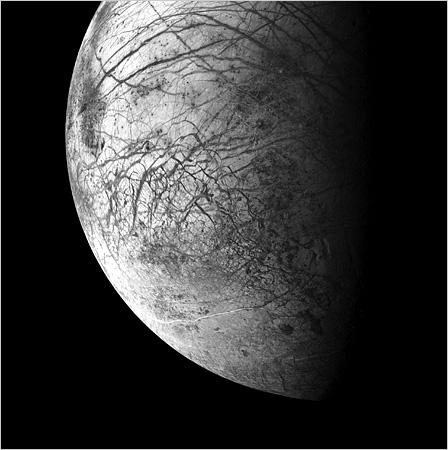
Beginning in 1995 Mr. Benson spent years sifting through hundreds of thousands of photographs, looking for those that offered an aesthetic punch. He then painstakingly combined images, using digital tools like Photoshop, to eliminate dropouts and blurs from individual photos beamed back across millions of miles of space. A lovely picture of Europa, a moon of Jupiter, gliding in front of the swirling atmosphere of that planet, for example, is a blend of some 70 frames sent back by Voyager.

Benson’s got an entire book of these photographs, called Beyond: Visions of the Interplanetary Probes, complete with essays by Arthur C. Clarke and Lawrence Weschler. The book is very positively reviewed, being referred to as “breathtaking,” “resplendent,” “miraculous,” “sublimely exhilarating,” and “supremely reproduced.” Best of all, from my end, I’ll be in NY next month, so I’ll get to see the show…

Stylin’

I was perhaps a little over-excited to see that Time Magazine included BLDGBLOG in its “Style & Design 100” list for 2007…

Other blogs on the list include Greenopia, Apartment Therapy, MoCo Loco, and designboom.
I have to admit, though, to a certain amount of stunned optimism when a blog about Copernicus, Don DeLillo, science fiction and architecture, Mars, and… whatever this post was about makes it into Time Magazine.
Does that mean, in other words, that there’s some huge and untapped audience in the United States for articles about urban exploration, inflatable architecture, and W.G. Sebald? Are people in this country really looking for more information about micronations, offshore oil platforms, mud mosques, Greek myths, and futuristic outbreaks of statue disease? Does the U.S. secretly demand more Alpine thrillers…?
It makes me really happy, actually, to think that people out there want to read about this stuff – this machine, for instance. Or this lost city. Amidst more news of Don Imus there’s… the London Tornadium. And J.G. Ballard.
Anyway, congrats to everyone on the list. Congrats to everyone, in fact – I’m in a good mood.
Congratulations!

The disorienting mass of fog-bound outcroppings

[Image: Orogenesis: Man Ray/Duchamp, 2006, by Joan Fontcuberta. Courtesy of Zabriskie Gallery, via the ICP].

“Rather than venturing out into nature,” the International Center of Photography explains, Spanish photographer Joan Fontcuberta “creates plausible, even spectacular landscapes using Terragen, a computer program originally created for military and scientific uses that turns maps into images of three-dimensional terrain.”
Fontcuberta’s work was featured in the ICP’s show Ecotopia, alongside work by David Maisel and Simon Norfolk.
The above image features “a disorienting mass of fog-bound outcroppings,” generated from a photograph of Marcel Duchamp’s Large Glass, taken by Man Ray.
If the inputs can be that random, however, I have only to point out that the imaginative – and technical – possibilites are literally endless. Whole world-surfaces could be generated from tourist snapshots; photos of Manhattan turned into the undersea canyons of a distant sea; Fontcuberta’s work itself used to produce even more landscapes, three or four times removed from their source material.
Even more intriguingly, though, if you could reverse-engineer Fontcuberta’s photographs to find the original image by Man Ray mathematically encoded somewhere deep inside all that repetitive geometry of detail, what would happen if you applied the same analysis to, say, your family photo album…? Only to discover, lurking there, within those dusty prints, something monstrous and ill-formed, some original hidden mystery from which you and your loved ones derived.
Leading me to speculate, on a fairly unrelated note, that the great conspiracy plot of the future – filmmakers take note! – will involve some guy in an apartment building spending all this time reverse-engineering political photographs and news reels – presidents and heads of state and ambassadors and kings – only to realize, as the camera pulls away revealing his shaking hands, that deep beneath all those images is a…

(Thanks, Steve!)

Autumn leaves to black flowers

[Image: “The greenery on other planets may not be green,” New Scientist reports. Indeed, alien vegetation may be orange and yellow – “so the foliage would wear bright autumn colours all year round” – or even black: flowers the color of charcoal blooming over electrically charged soil. But why not transparent vegetation…? Vast equatorial jungles full of transparent plantlife, rooted on blocks of quartz, glowing from within as twin suns set behind wooded plateaus in the distance. (Above illustration by Doug Cummings @ Caltech)].

Quick list 8

It’s been a really busy few weeks, so I’ve missed a lot of interesting stories that would’ve been perfect for the blog; but it’s better late than never, right? So I thought I’d do another Quick List…

[Image: Architectural Design by Rolf Mohr; Modeling and Rendering by Machine Films. Via New York magazine].

First, Lisa Chamberlain, of Polis, had an immensely popular article in New York magazine two weeks ago exploring the idea “that ‘vertical farm’ skyscrapers” designed by a man named Dickson Despommier “could help fight global warming.”

Imagine a cluster of 30-story towers on Governors Island or in Hudson Yards producing fruit, vegetables, and grains while also generating clean energy and purifying wastewater. Roughly 150 such buildings, Despommier estimates, could feed the entire city of New York for a year. Using current green building systems, a vertical farm could be self-sustaining and even produce a net output of clean water and energy.

Despommier’s towers could also free up cropland so that literally hundreds of thousands of acres of corn, wheat, potatoes, cotton, oranges, lemons, artichokes, strawberries, spinach, parsley, sage, rosemary, thyme, etc., could return to – or be turned for the first time into – forest. This, in turn, might help reverse global warming (though it also might not).
At the very least, it’d be cool.

[Image: Architectural design by Rolf Mohr; modeling and rendering by Machine Films; interiors by James Nelms Digital Artist @ Storyboards Online. Via New York magazine].

Chamberlain cites an example of how this could work: “Depending on the crops being grown,” she writes, “a single vertical farm could allow thousands of farmland acres to be permanently reforested.” For instance, she continues, “after a strawberry farm in Florida was wiped out by Hurricane Andrew, the owners built a hydroponic farm. By growing strawberries indoors and stacking layers on top of each other, they now produce on one acre of land what used to require 30 acres.”
This 30:1 densification rate could radically transform the American landscape.
The actual details of a “vertical farm” are fascinating, meanwhile, and for that reason alone I would recommend reading the whole article; I particularly like the “Evapotranspiration Recovery System,” which will be “nestled inside the ceiling of each floor”; there, it will “collect moisture, which can be bottled and sold.”
In any case, Pruned actually covered this story, albeit in far less detail, two years ago, before anyone – including Boing Boing – took off with it. More on topic, though, if you like the idea of skyscrapers being turned into vertical croplands, then don’t miss Future Feeder‘s look at so-called urban underground farming, also from 2005.
Lisa’s piece wasn’t the only look at farming in recent weeks, however; The New York Times reported that, due to a rising industrial demand for ethanol – a biofuel product derived from corn – American farmers this year will be planting “a staggering 90.5 million acres [of corn], the most since World War II and 15 percent more than last season.”
The fact that the American landscape thus gives physical form to distant legislative decisions meant to regulate the ethanol content of gasoline absolutely fascinates me. For every freeway and gas station, there is a cornfield somewhere – but, for very obvious reasons, the reverse is also true.
But perhaps we should combine Lisa Chamberlain’s article with the rise of biofuels… and free up all these excess cornfields for something a bit more biologically adventurous. Like entire forests full of living knots and ladders.

[Image: The water behind stored Hoover Dam is down more than eighty feet; photo by Jim Wilson for The New York Times].

Speaking of landscapes, then, The New York Times also reported on a growing, nearly decade-long drought in the American southwest. “Everywhere in the West, along the Colorado and other rivers,” we read, “as officials search for water to fill current and future needs, tempers are flaring among competing water users, old rivalries are hardening and some states are waging legal fights.”
With a wonderfully Ballardian twist, we learn that the drought’s effects “can be seen at Lake Mead in Nevada, where a drop in the water level left docks hanging from newly formed cliffs, and a marina surrounded by dry land.”

[Image: One of several “docks left hanging from newly formed cliffs” on the edge of a receding Lake Mead; photo by Jim Wilson, for The New York Times].

Even more interesting:

Preparing for worst-case outcomes, the seven states that draw water from the Colorado River – Colorado, Wyoming, Utah and New Mexico in the upper basin and California, Arizona and Nevada in the lower basin – and the United States Bureau of Reclamation, which manages the river, are considering plans that lay out what to do if the river cannot meet the demand for water, a prospect that some experts predict will occur in about five years.

Five years! Is part of their plan to drain the Great Lakes?
We then read that Las Vegas actually wants to build a pipeline drawing water all the way from northern Nevada – so that water currently used by ranchers can, instead, spray out of faux-Italian fountains at the sagging chests of morbidly obese vacationing children who are too big to fit in the hotel kiddy pool.

[Image: Workers remove turf from a Nevada golf course, revealing the desert sand beneath; photo by Jim Wilson for The New York Times].

To their credit, “[r]anchers and farmers in northern Nevada and Utah are opposed to the pipeline plan”; they have, in fact, “vowed to fight it in court, saying it smacks of the famous water grab by Los Angeles nearly a century ago that caused severe environmental damage in the Owens Valley in California.” This “famous water grab,” of course, was dramatized by Roman Polanski’s film Chinatown – and the water grab’s long-term effects have been beautifully documented, in a series of aerial landscape photographs, by David Maisel, who I had the pleasure of interviewing last Spring in a Feature on Archinect.
David Maisel refers to sites like Owens Lake as “dismantled landscapes, abandoned, collapsing on themselves.”

[Image: The scarred bed of a drained Owens Lake, as photographed by David Maisel; the water of Owens Lake was stolen by the city of Los Angeles nearly one hundred years ago].

Maintaining our temporary focus here on landscape and pollution, the BBC reported last week about the “toxic truth” of a “secretive Siberian city.”
Reporters from that news organization apparently “entered a remote region of Russia normally closed to foreigners that produces almost half the world’s supply of palladium – a precious metal vital for making catalytic converters.” Like an image from William Blake – if he’d perhaps been raised in a different era, watching too many films by Andrei Tarkovsky – we read that, deep in the smelting plants, “[v]ast furnaces roast the ore extracted from the mines, eventually disgorging streams of red-hot liquid metal into containers that dwarf the workers standing nearby.”
Huge and poisonous clouds then belch upward from smokestacks, like an artificial weather system hanging above the city.
Greenpeace warns that all this pollution “has created a 30km (19 mile) ‘dead zone’ around the city and quotes scientists as saying the acid rain has spread across an area equivalent in size to Germany.”

[Images: From the BBC].

From there, the BBC leads us into a landscape of industrial destruction; this treeless waste, in what should really be a forest, “stretches across an area so great it has been described as perhaps the largest man-made desert in the world.”
You can find this “desert” on the Kola peninsula, also in Russia.

[Image: A landscape of death in the Kola peninsula; photo via the BBC].

This is turning out to be a rather depressing post at this rate, but I was also interested to read that urban air pollution is considered, according to a recent study conducted in England, “more than dangerous than Chernobyl“:

The study suggests high levels of urban air pollution cut short life expectancy more than the radiation exposure of emergency workers who were sent into the 19-mile exclusion zone around the site straight after the accident.

But cities aren’t all bad…
Even in the filth and ruin and degradation; the anonymity, violence, and emotional free-fall; amidst so much friendlessness and abandonment, we can still find our own strange epiphanies.
In a great interview with writer Luc Sante, for instance, we’re greeted with this wonderful excerpt from his work:

In the 1970s New York City was not a part of the United States at all. It was an offshore interzone with no shopping malls, few major chains, no golf courses, no subdivisions. We thought of the place as a free city, where exiles and lamsters and refugees found shelter. Downtown we were proud of this, naturally.

The use of the word “interzone,” however, immediately conjures up the literary ghost of William Burroughs, who used the term to indicate a city “where the unknown past and the emergent future meet in a vibrating soundless hum.” More, the Interzone is a “Composite City where all human potentials are spread out in a vast silent market”; its architecture consists of “perilous partitions built on multi-levelled platforms, and hammocks swinging over the void.”
In any case, Sante continues: New York “was a wild, one-in-a-million conjunction of circumstances, a sort of black pearl of world history, when New York City was at one and the same time both the apex of Western culture and the armpit of the Western world.”
This isn’t entirely relevant, meanwhile, but I’m going to quote it anyway; here is a long excerpt from that interview, describing the “founding myth” of the U.S.A.:

Well, think about it: the founding myth of this country involves pushing farther and farther out into terra incognita, cutting ties to family and background, maybe adopting a new name and a completely concocted new identity, and somehow making lots of money, the existence of which in sufficient quantity is enough to stifle any questions about its provenance. The land that formerly belonged to the Sioux, the copper that formerly belonged to the Navaho, the skins that formerly belonged to the beavers, the stake that formerly belonged to the miner who caught diphtheria – they’re yours now, pal. Call yourself “Colonel” and declare that your fortune was left to you by Dutch burghers from the seventeenth century. Now you’re a solid citizen, the embodiment of hard work and rugged individualism. You’re no criminal. The criminal is the guy who comes up short, who gets caught, who fails to adopt a respectable cover. But after a while the solid citizen gets to missing those wild years, even as he is ensconced in his forty-room Carrera-marble Beaux-Arts palace on upper Fifth Avenue. He thinks wistfully of how he used to hop freights, sleep in culverts, drink white lightning in hobo jungles, take a sash-weight to his competitors, go through the pockets of the recently dead. He envies those who live that life now denied him forevermore. It seems to him that he’s a prisoner of his own success and that those yeggs out there are truly free.

Meanwhile, all this talk of “perilous partitions” and “multi-levelled platforms… swinging over the void” reminds me of another story I neglected to link last week: the now well-known tale of a Russian gangster who built himself a castle made of planks.

[Image: The gangster’s castle; photo by Dmitry Beliakov, via the Telegraph].

“Dominating the skyline of Arkhangelsk, a city in Russia’s far north-west,” the castle “is believed to be the world’s tallest wooden house, soaring 13 floors to reach 144ft – about half the size of the tower of Big Ben.”
This “remarkable architectural feat,” the Telegraph says, “defies easy description.”

A whimsical jumble of planking, from a distance it bears a resemblance to a Japanese pagoda, but draw closer and it seems more like a mix between a Brobdignagian tree house and the lair of a wicked fairytale character.

The castle’s designer and builder – the “gangster” himself – now spends his time giving “death-defying tours that involve criss-crossing rotting planking and climbing icy ladders.”

[Image: The gangster’s castle; photo by Dmitry Beliakov, via the Telegraph].

All of which pales slightly when faced with the quote-unquote “looming sink-hole crisis.”
It seems we should all be very afraid: “Last year was the worst ever in the U.S. for sinkholes. Almost every state in the country experienced record problems.”
In what is surely one of the most ridiculous examples of scare journalism I’ve ever seen, we read the following:

In San Diego, the mayor held a news conference near a yawning abyss. A 64-year-old Brooklyn woman fell into a 5-foot-deep sinkhole in front of her house.
In Los Angeles, a broken water main created a sinkhole 30 feet deep and shut down half of Pacific Coast Highway near Malibu. At the same time, a broken sewer pipe shut down the adjacent beach.
In Northern California, an 8-foot-deep sinkhole stunned the occupants of a nearby office building. In Grand Rapids, Mich., residents had to boil water after a sinkhole cut off their water service.
And this year is shaping up to be even worse.

The article goes on to urge almost literally everyone to fix their old pipes – because a broken pipe means leaking water, and that means underground erosion… which just might produce another sinkhole.
What makes the article even more absurd – just totally and stunningly, even amazingly, absurd – is that its author is the “president and chief executive of a large sewer, water and oil pipe repair company.”
I think I’ll leave it at that; these Quick Lists are getting longer and longer. Apologies, meanwhile, for not covering any of these stories when they first hit the web – but I’m hoping to get back on a regular posting schedule soon… Busy times!

(With thanks to Jill, doilum, Carl Douglas, Jon Haeber, Lisa Chamberlain, and others for the tips. Earlier on BLDGBLOG: Quick list 7, Quick list 6, etc.)

The Event

Well, I’m back in LA and so I wanted to give a quick and public thanks to everyone who came out on Saturday afternoon for the event in San Francisco; to the speakers themselves: John Bela & Matthew Passmore, Erik Davis, Lisa Iwamoto & Craig Scott, and Walter Murch; and to everyone else involved with the proceedings, including Alan Rapp & Chronicle Books, Fred Dolen & the CCA, and our two indefatigable technical assistants.
We videotaped everything, as well, so once I figure out whether we’ll be putting those tapes online or simply transcribing them, I’ll let you know.
But it was a great event, I thought. There were some moments in which the screen turned magenta and we went rather beyond the scheduled time slot, but it was a nice mesh of topics, approaches, ideas, and imagery, and some really cool conversations ensued at the end.
So thanks again – and, if you did come out, I hope you had a good time! If you didn’t have a good time, of course, please feel free to tell me why…

Of jellyfish, loops, site constraints, and canopies

[Image: Jellyfish House by IwamotoScott].

One of the speakers at the big event this Saturday will be Lisa Iwamoto, of IwamotoScott Architecture and Assistant Professor of Architecture at UC-Berkeley.
Lisa and her firm’s co-principal, Craig Scott, seem to be everywhere lately. IwamotoScott was a finalist, for instance, in the 2006 Next Generation contest sponsored by Metropolis; they both taught at the Urban Islands design studio in Sydney, Australia, last summer; they were finalists for this year’s PS1 courtyard competition in New York; they just spoke as part of the Architectural League’s Emerging Voices series; their work is featured in “Innovation by Design,” on display now at SF MOMA; they’re featured in “Open House: Architecture and Technologies for Intelligent Living” in Pasadena; and Lisa was even on the judging panel for last year’s Bottom Line Design Awards.
For all of that, however, I’ve hardly even cracked the long list of credits that IwamotoScott has amassed; for more comprehensive coverage, visit their site and click on Profile.

[Image: Jellyfish House by IwamotoScott].

Lisa will be presenting two projects on Saturday; those projects are the Jellyfish House and the PS1 competition entry, and they’re both worth hearing about.
I don’t want to pre-empt her talk by giving away too much information, however – so I’ll just show you a few images, quote a few soundbites, and urge you to stop by the event if you’re anywhere near San Francisco.
So the Jellyfish House, we read, “is modeled on the idea that, like the sea creature, it coexists with its environment.”

[Image: Jellyfish House by IwamotoScott].

As such, the house is designed “as a mutable layered skin, or ‘deep surface’, that mediates internal and external environments.”
That “external environment” is rather interesting, in this case, because the proposed site is actually an artificial island, in the middle of San Francisco Bay. The island once served as a military base, which means that there is a legacy of “toxic soil” to clean-up – but the project, being impressively imagined on a variety of levels, has detoxification schemes built directly into it.

[Image: Jellyfish House by IwamotoScott].

The house, then, is part of a much larger landscape proposal involving wetlands, soil remediation, and a complex “water filtration system” that operates within the very walls of the house. There are “phase change materials,” and even a “water jacket” featuring “quilted baffles.”
In any case, the house is really cool and well thought-out, and I’m excited to hear more about it.

[Images: Jellyfish House by IwamotoScott].

Then there’s IwamotoScott’s PS1 competition entry.
The PS1 competition is an annual event in which entrants are asked to design a temporary installation for the PS1 courtyard; that space will then serve both as a venue for events and as a place for the public to congregate.

[Images: PS1 courtyard competition entry by IwamotoScott].

Unfortunately, I don’t have very much information about this project – all the more reason for me to attend my own event and find out – but I can perhaps justifiably speculate that it uses a webbed canopy stretched across the courtyard to define and frame individual spaces…

[Image: PS1 courtyard competition entry by IwamotoScott].

There are several other projects on IwamotoScott’s website worth checking out. There’s the Loop House, for instance, the Split House, the FiberOpticRoom, and the 2:1 House, for starters.
That latter project is particularly interesting, as its proposed site comes with some fiendishly unique ground conditions – what the architects call “an extreme set of site constraints.”
These “site constraints” include the following:

A steep 2 to 1 upslope and extremely long, narrow access; a limited zoning envelope due to the irregular shape of the property; a stand of protected Coast Live Oak trees that cannot be removed; reuse of an existing foundation on the upper part of the site; and a panoramic view from the top of the site encompassing San Francisco Bay, the Golden Gate and Mount Tamalpais.

The resulting “house” is more like an inhabitable land-bridge spanning downward along the hillside, several feet off the ground, turning at just the right moment to avoid the oak trees (thus forming a “trapezoidal void that accommodates the protected trees”).
The house/bridge/structure also appears to consist, internally, of multiple stairways, turning each room into something more like a terrace. This is referred to as the project’s “internal terrain.”
Meanwhile, IwamotoScott also has a housing project called FaceSide, several different images of which I’ve here assembled into one.

[Image: FaceSide houses by IwamotoScott].

And then there’s the Moire Tower. I’ve cropped an image, below, so as to zero-in on the latticed and woven structure of the tower itself.

[Image: The Moire Tower by IwamotoScott].

Finally, for this post at least, there is the LiveWorkShop House, a “case study house” proposed for Cleveland, Ohio.
Among other things, the house uses “a hybrid structure – combining steel with off-the-shelf, lightweight, prefabricated structure and enclosure systems.” This allows for “a flexible menu of finish materials” by which future residents can customize their individual homes. “The proposed final design,” in other words, is not final at all; it is “but one demonstration of a number of possible permutations.”
Of course, as with almost all good prefab, it feels – and looks – a bit like a game of Tetris.

[Image: The LiveWorkShop House by IwamotoScott].

So come out on Saturday to hear Lisa discuss both the Jellyfish House and the PS1 competition design – though feel free to ask her questions about the other projects, too. In the meantime, be sure to check out IwamotoScott’s website.

(A few more images are available in my IwamotoScott Flickr set).

Monocular Landscapes, Unmanned Drones, and the Orbital Future of Australian Archaeology

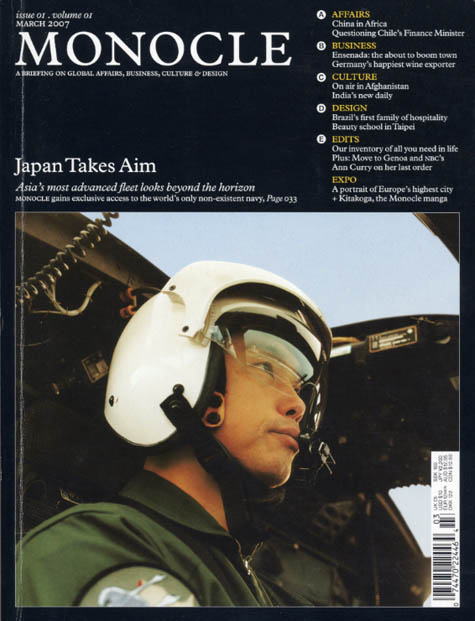
The new magazine Monocle has been getting loads of press lately, from both lovers and haters; and while I can’t necessarily say that I’m one or the other, I will admit to erring on the side of enthusiasm.
There’s some great stuff in there.

I’ve only got the first issue, however, so I’m not exactly an informed reader; and I won’t be performing a rigorous review of the magazine here – discussing its design, intentions, etc. etc. etc. I simply want to point out a few cool articles that have an architectural or landscape bent.
Which is quite a large part of the magazine, as it happens.
First, for instance, we take a brief trip to Paris, where we step down onto the Champs-Elysées and learn that a Citroën “flagship showroom” will soon open up, putting shiny cars with waxed bonnets on display in the window. Then there’s a glossy photo-essay on Le Chaux-de-Fonds, Switzerland, “the city were timing is everything” (they manufacture watches). And there’s a quick visit to the nearby town of Sedrun, Switzerland, where the Gotthard Base Tunnel “is being dug more than 600m below the [earth’s surface], through nearly 58km of Massif stone.” A subterranean train station, located at the midpoint of the tunnel, will be “linked to the surface by the world’s tallest lift.” Long-term readers may note that this same tunnel was mentioned on BLDGBLOG back in December.

[Image: Gotthard Base Tunnel, via Wikipedia].

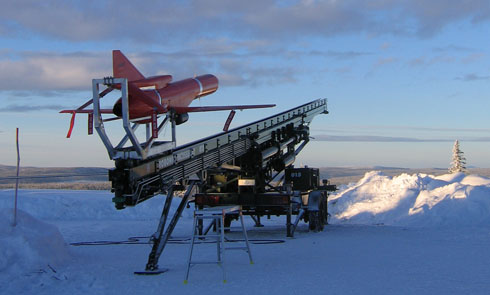
Awesomely, Monocle then turns its cyclopean gaze onto the empty skies above Kemijärvi, Finland, north of the Arctic Circle, where “a test centre for unmanned aerial vehicles (UAVs)” has opened. The test center is run by a firm called Robonic; Robonic “has taken advantage of the vast, virtually unused airspace – a rarity in Europe – above Finnish Lapland to create the only private test centre in the world devoted solely to UAVs.” This would also seem to be the perfect setting for a new novel by J.G. Ballard. Or an Alfred Hitchcock film: unmanned drones fly state secrets across the Arctic Circle…
Meanwhile, could you use these launchers, I wonder, to hurl small buildings into the sky? And if you could, would you do it?
Frustratingly, the article doesn’t ask these questions.

[Image: The launcher for a UAV; courtesy of Robonic].

Moving on, we read, Budapest wants to clean up its river; as it is, the Danube is now “a muddy grey-brown, thanks in part to the sewage gushing out underneath Elizabeth Bridge” – which is a structure, not a woman.
Apparently a “warehouse district” will soon be built, modeled after the Docklands in London.
There’s also a great article on China’s bankrolling of infrastructural construction projects throughout Africa:

China’s influence in Africa is growing at an unprecedented rate. Across the continent the Chinese are building stadiums, parliaments, roads, offering their expertise as well as they wallet. But China is not just giving to Africa, it is taking too. By the end of next year China will have become the world’s largest importer of oil, and most of it will come from Africa. China is also in desperate need of minerals such as copper, aluminium and iron ore – and African nations are willing to provide them.

This topic was also previously explored on BLDGBLOG.
I’m going on a bit here, I have to say, but there’s even a feature-length exposé on Bartenbach LichtLabor (BLL) and their “daylight-redirection” scheme in Rattenberg, Austria – a project Pruned told us about so long ago.
Monocle explains how BLL plans “to create an elaborate system of heliostats and fixed mirrors that could bounce sunlight from a nearby mountaintop on to a hill opposite and into the main street’s gift shops and cafés.” Without these mirrors – and their “secondary mirrors,” in turn – the town would spend “almost four months of the year in the shadow of Rat mountain.” In the shadow of Rat mountain!
The English name alone would cause depression.

[Image: The lighting technologies of Bartenbach LichtLabor].

To test these devices, BLL has constructed an “artificial sky… packed with fluorescent lamps, translucent lamps and LEDs.” It’s referred to as “the ultimate toy for a lighting geek.”
Anyway, I could go on and on – it’s an impressive magazine.
However, I do have to mention, finally, the one article I was actually intending to write about here before I started drinking coffee: on page 70, there’s a short, one-column piece about Alice Gorman.
Gorman is an Australian archaeologist whose university homepage states her interests as “material culture relating to space exploration, including terrestrial launch sites like Woomera (South Australia), Kourou (French Guiana) and Hammaguir (Algeria).” She also studies “orbital debris” and “planetary landing sites.”
Gorman’s got a blog called Space Age Archaeology; she’s got a research abstract online discussing “the archaeological record of human endeavours beyond the atmosphere” (!); and she’s got a downloadable PDF about all of the above. Vaguely similar topics, meanwhile, pop up in an old – and somewhat confusingly typeset – BLDGBLOG post called “White men shining lights into the sky“…
Monocle further tells us that Gorman has been “calling on the United Nations this month to create a protected ‘heritage list'” for orbital objects, “including the Vanguard 1 satellite, launched in 1958 and now the oldest man-made object in orbit.”
Gorman: “Maybe the only evidence that a country has a right to be in geostationary orbit will be [the presence of] an old satellite.” As space fills up with more and more junk – not to mention working satellites – she says: “It’s not impossible that being able to claim access to an orbit could be a bit like Aboriginal people in Australia being able to say, ‘This is where my ancestors camped.'”

[Image: The International Space Station].

A few things: 1) Last week I interviewed science fiction novelist Kim Stanley Robinson for BLDGBLOG and I asked him about this very topic – directly referencing Monocle: will we yet see an archaeology of space, complete with in-orbit excavation sites, etc. etc. etc.? I hope to have that interview up and public within the month.
2) The very idea of an orbiting, geostationary archaeological site strikes me as so amazing, and so fun to think about, that I almost can’t believe it. What will happen, say, in 400 years, or 900 years, or 1500 years, when the International Space Station has become like Petra or Skara Brae or even Macchu Picchu – the lost and dusty relic of a dead civilization – visited by space tourists with a thing for archaeology, snapping photos of themselves beside old push-button consoles as the sun rises through command windows in the background…? Masked grad students earn summer credits in Forensic Anthropology, roping off portions of the Station, mapping ancient social dynamics as dictated by architectural space…
Ruins in orbit around the earth!
Anyway, I found the first issue of Monocle to be really exciting and well-done, and I’m looking forward to issues two, three, four, etc.
Although… note to Monocle: it is actually cheaper to buy the magazine issue by issue here in the States; subscribing is nearly 30% more expensive.

The Museum of Nature

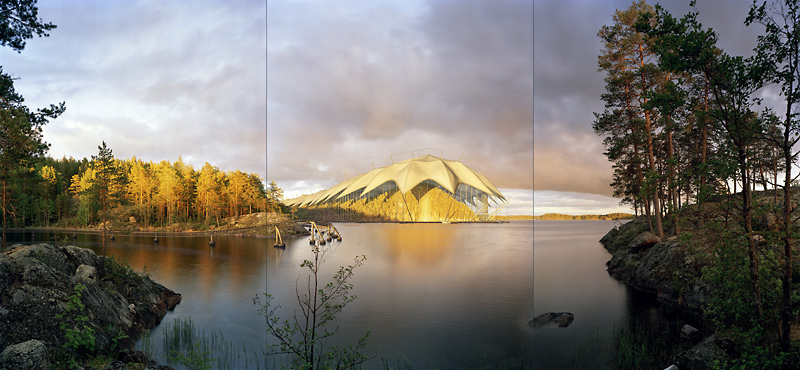
[Image: Museum 2 by Ilkka Halso, featuring a protected mountain. If you look close enough, you’ll also see the roller-coaster, pictured below, as it wraps around the bay…].

A few years ago, I picked up an old copy of Framework: The Finnish Art Review because it looked really good and had some cool images in it – and, even now, I think it’s an interesting magazine. I don’t regret the purchase.

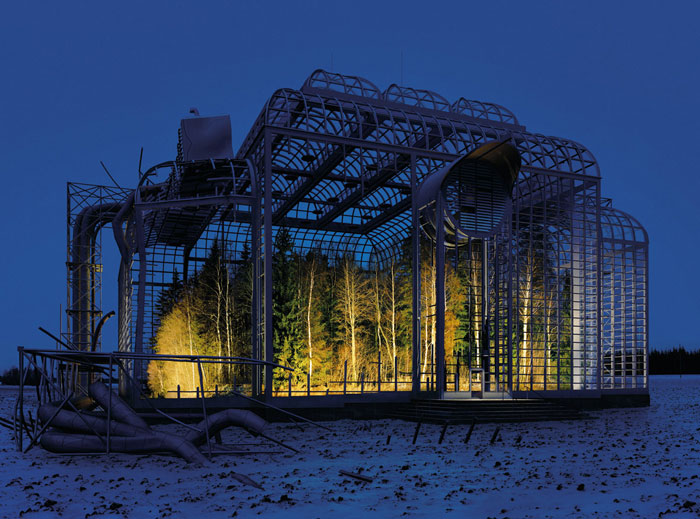
[Image: Museum 1 by Ilkka Halso].

So I was flipping through it again the other night, looking for something, when I re-discovered a bunch of photographs by Ilkka Halso.

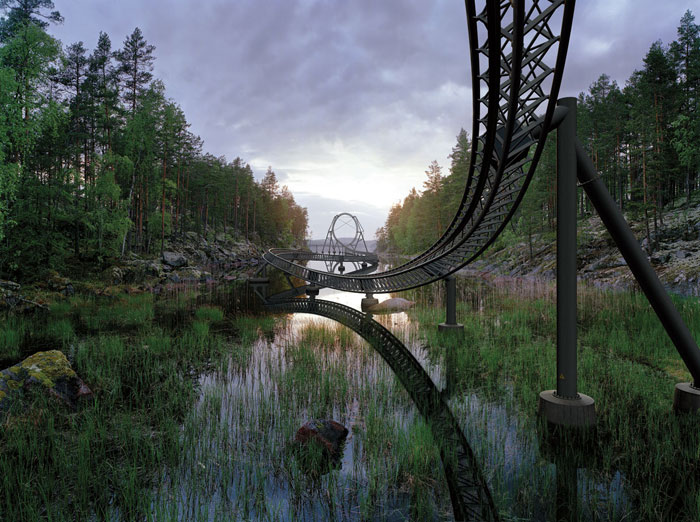
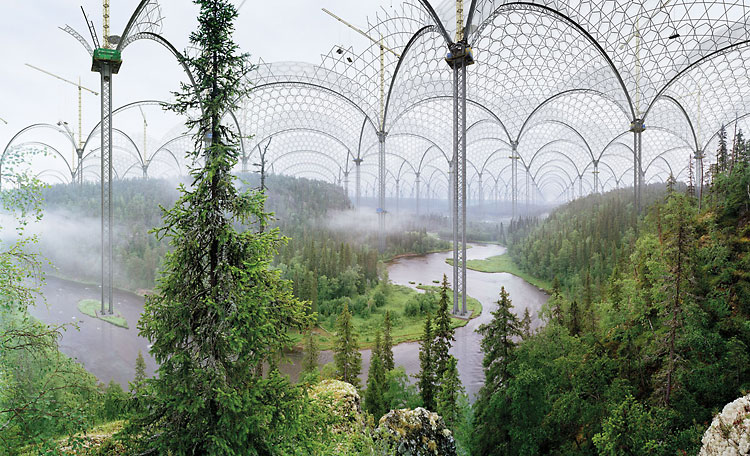
The images are part of an amazing series called the “Museum of Nature,” and I’m frankly still in awe of the project.

[Image: Roller-coaster by Ilkka Halso].

The basic premise of Halso’s digitally manipulated work is that “nature” has been transformed into a museum display – yet the public’s interaction with this new, endangered artifact is limited to spectacular roller coaster rides, perfectly reflected in the still waters they pass over. Alternatively, you can visit this steamy, delirious, quasi-Parisian gallery of iron and glass roofs built arching into disappearance over pine forests.

[Image: Kitka-river by Ilkka Halso].

These are “shelters,” the artist writes, “massive buildings where big ecosystems could be stored.”

The more I think about this project, the more interesting it gets; someone should write a novel set in this place – a kind of eco-catastrophic sequel to Westworld, perhaps – or, at the very least, someone should put Halso’s images on display in the United States. They’d also make a gorgeous spread in Wired.

In any case, be sure to spend time clicking around through Halso’s site. It’s worth it. And check out another of Halso’s projects, featured on Pruned back in 2005.