12 Houses: The Wonderfully Puzzling and Colorful Use of Spatial Volume

After participating in a roundtable discussion with architect Lorcan O’Herlihy yesterday at Dwell on Design, I decided to look into his work a bit more – and it’s been a great way to spend time. Lorcan has both a great sense of modernist architectural volume and a brilliant eye for color; the lime green he used on a multi-unit residence in West Hollywood, for instance, is extraordinary. I’ll see if I can dig up some photos of the finished building.
The following images, meanwhile, are just a random look at three or four of O’Herlihy’s most interesting projects. To start with, here is a recent building in Los Angeles, called Gardner 1050.

[Images: Gardner 1050, by Lorcan O’Herlihy].

I’m a particular fan of the outdoor footbridges, as they criss-cross a shared entry courtyard in the all-pervading sunlight of LA.
O’Herlihy, you see, has a small thing for residential bridges: these next images feature the Fineman residence – a house with its own “enclosed glass-walled bridge.”

[Images: The Fineman house, by Lorcan O’Herlihy].

This next image gives us a bird’s-eye rendering of O’Herlihy’s proposal for a new dormitory and “Educational Facility” at CalArts – more information about which is available on O’Herlihy’s website.

[Image: Proposal for CalArts, by Lorcan O’Herlihy].

In a nutshell, though, the circulation-friendly building complex uses a “shifted” east-west axis “to take full advantage of the complete spectrum of the optimal solar angle.” This not only “supports the passive ventilation system,” it means that “the need to artificially and mechanically condition an internal corridor year round can be eliminated resulting in a significant reduction in the net energy demand over the life of the building.”
Below, then, you see the architectural logic behind O’Herlihy’s Norton Avenue Lofts, going from a bare-bones diagram of abstract spatial volumes –

[Image: The Norton Avenue Lofts, by Lorcan O’Herlihy].

– to the final renderings of the project’s exterior.

[Images: The Norton Avenue Lofts, by Lorcan O’Herlihy].

In any case, I know I’m not exactly going into much detail with these projects – in fact, I’m just sort of whipping out a bunch of cool, unrelated images without offering any real or substantive analysis – but I still want to point out one more: O’Herlihy’s 12 Houses, an almost Bach-like study in formal variation.

[Image: 12 Houses by architect Lorcan O’Herlihy].

The original idea behind 12 Houses, we read, was “to create individualized identities and experiences for each house using shared elements of design and construction.”
As a result, O’Herlihy generated “four prototypes”:

Starting from a simple main floor plan consisting of two adjoined rectangular bars, a second floor is created by pulling up or pushing down one bar – either in complement or contrast to the topography of each site. From these two formal gestures, four variations emerge: up, down, long, short. Further variation is produced by siting (for privacy and views), adjustment of each prototype in response to stringent building envelope limits, and a carefully-developed palette of exterior/interior materials.

I absolutely love the puzzle piece-like results.

[Image: 12 Houses by architect Lorcan O’Herlihy].

But let me pre-empt some criticism right away: yes, this is simply another kind of suburban sprawl, destined to grace tasteless cul-de-sacs, surrounded by well-watered lawns and reachable only by private automobile – yet the houses are also beautifully devised and formally stimulating.
I also have an active soft spot for systems like this, and so I’m easily seduced by basic variations upon simple architectural plans – the same animating principal behind Palladianism, for instance. The mathematics of the ideal villa, indeed.

[Image: 12 Houses by architect Lorcan O’Herlihy].

O’Herlihy’s 12 Houses are apparently slated for construction, too: they should be ready for inhabitation by Spring 2008.
For more projects by Lorcan O’Herlihy, book a visit to his firm’s website.

Sci-Fi Regionalism

Yesterday was another good day at Dwell on Design, with a handful of talks in the morning followed by more general mingling in the exhibition space all afternoon.

North Carolina-based architect Frank Harmon – behind the exquisite Prairie Ridge Eco Station, pictured below, designer of Duke University’s Smart House, and architect of many, many other great projects – gave the final speech of the conference, presenting his firm’s work in the context of “new regionalism.”

[Images: The Prairie Ridge Eco Station, an open air classroom designed by Frank Harmon].

Frank talked about the use of local materials; how to survive humidity, thunderstorms, summer dry spells, and the harsh winter cold without using electricity, putting architecture itself to use as a local climate modification system; and, finally, the blending of traditional design styles with what could be called global architectural modernism. He showed us a church, a pottery museum, the aforementioned Prairie Ridge Eco Station, an ironworkers’ studio, and a few other of his firm’s own projects.
One of the most interesting sequences of images he showed was a quick sketch describing the sinusoidal shape of local wind patterns over the North Carolina landscape – which he then clicked away from to reveal the wing-like angled slope of a roof he’d designed to fit into the local windscape almost perfectly.
It’s hard to exaggerate how exciting I find that sort of thing.
In any case, Frank Harmon’s work is well worth checking out in more detail – and a great Q&A with him is coming up in a future issue of Dwell (where, in full disclosure, I now work) – so here’s his website.
But I wanted to follow up here with a few other quick thoughts – because I was on a panel with Frank after his talk, alongside Gwynne Pugh, Lorcan O’Herlihy, and Reed Kroloff, and in the spotlit glare of being on stage I might have been a tad less articulate than I’d hoped to be.
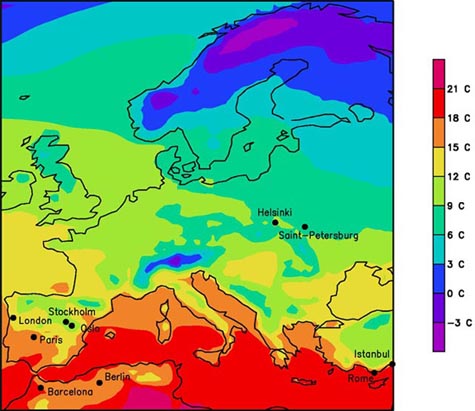
Briefly, then, I mentioned a climate map, published earlier this summer, in which Europe has been re-mapped according to what its regional climates will be like in the year 2071 A.D.

The map is initially quite confusing, but it shows that London will have the climate of Lisbon, Portugal; Berlin will have the climate of northern Algeria (!); and Oslo will feel like Barcelona (and so on).
So the question I wanted to propose to the other speakers was: how can architects account for these sorts of wild fluctuations in both weather and climate through architectural design? How can a building be prepared – structurally, materially – for future climate change?
Or, more relevant to Frank Harmon’s presentation, especially in the context of “new regionalism”: what if you build a house that’s perfect for North Carolina as North Carolina now exists – but what happens to that house in, say, twenty years’ time, when North Carolina is more like Houston, Texas, or even like Key West?
In which case, what about the new, modern, glass-walled housing stock of Berlin when it finds itself baking in Algiers-like desert temperatures? (How I would love to see sand dunes rolling through the streets of Berlin!)
This, if anything, is the real new regionalism: a regionalism that includes future transitions so out of the ordinary that they verge on science fiction.
It’s sci-fi regionalism – architectural design in an era of global climate change.

Fire Department Psychiatry

One of the presenters this morning at Dwell on Design – I believe it was Gwendolyn Wright – mentioned a fire department that had once employed a psychiatrist to help solve mysterious house fires.

They had noticed, apparently, that some recent fires involving stately old Victorians occurred immediately after those houses’ residents had got divorced.

And it wasn’t just insurance fraud.

What really happened, the psychiatrist proposed, was that the houses themselves had been blamed, or scapegoated, for the interpersonal strife that once occurred within them – and those houses had thus been destroyed.
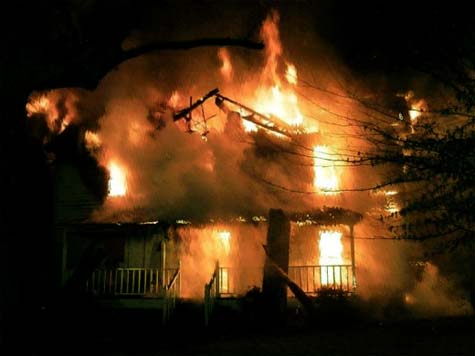
It was anti-maritally inspired arson – another front in the war against architecture – with the house as the enemy to be destroyed.
At least that’s what I think the speaker said.

(Note: I’m sure there were many other factors involved in those fires – and this is, by no means, some over-arching explanation for all domestic fires in the United States – but it did make a fascinating anecdote: desperate people depressed, even enraged, by architecture, setting fire to the very thing they think has limited them).

Well-behaved Homes

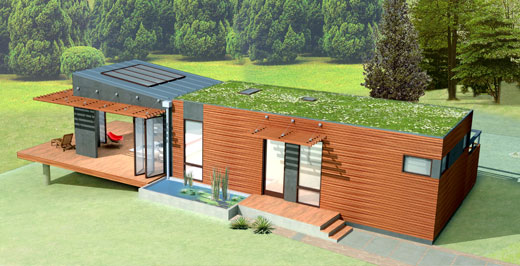
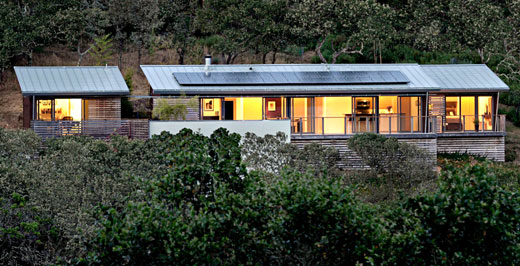
[Image: The Glidehouse by Michelle Kaufmann].

Architects Michael McDonough and Michelle Kaufmann are now on stage here at Dwell on Design.
Their topic is “Well-behaved Homes.”
Michael, in full performance mode, explains that building houses using conductive materials (metal, for instance, which is also used to make pots and pans) instead of using insulating materials (he specifically refers to aerated autoclave concrete, used in the majority of European houses) is inherently problematic from the standpoint of energy efficiency and climate control.
He talks about the importance of mechanical engineers in coming to understand the movement of air through enclosed architectural structures.
McDonough’s firm is now developing what he calls the eHouse, a kind of domestic research station in New York state through which they can test out the use of more energy-efficient – and climate-appropriate – building materials.

[Images: Michelle Kaufmann’s mkLotus house].

Michelle Kaufmann, meanwhile, still speaking as I type this, is introducing everyone to green roofs, rainwater catchment, passive/active solar energy systems, and the relatively streamlined construction process involved in assembling one of her projects. She even, briefly, touched on issues of affordability (or the lack thereof).
She just finished up, in fact.
Anyway, I can’t help but wonder, referring to the title of this panel, what a non-well-behaved home might be.
In fact, one of the respondents literally just mentioned this, in a passing reference to the possibility of “outlaw homes,” which she describes as homes whose owners tear up the front yard to plant vegetable gardens.
But is that not just another way of being well-behaved? Eating right, being a good neighbor?
What if you installed a shake table in your front yard?
Is there a modernism for bad neighbors?

(Note: I’ll be live-blogging the Dwell on Design conference this weekend; expect more posts soon – and bad editing or typos might have to stay up for now. Please excuse any such editorial lapses…)

The Tomb of Agamemnon

Easily some of the best books of architectural history to be published in the last few years can be found in a series called the Wonders of the World, edited by Mary Beard.
Because I’ll be posting part one of a two-part interview with Beard tomorrow morning, I thought I’d introduce BLDGBLOG readers to the Wonders of the World series and kick off my own (short) series of book reviews about each of the published titles.
As it is, I’ve read every book in the series – and I’m impatiently waiting for more.
In a nutshell, the Wonders of the World describes itself as “a small series of books that will focus on some of the world’s most famous sites or monuments.”

Their names will be familiar to almost everyone: they have achieved iconic stature and are loaded with a fair amount of mythological baggage. These monuments have been the subject of many books over the centuries, but our aim, through the skill and stature of the writers, is to get something much more enlightening, stimulating, or even controversial, than straightforward histories or guides.

So it may not be the place to go if you want to read about Archigram’s Walking City; but if you want a quick shot of archaeology and architectural history, and if you’re a fan of, say, the Parthenon, or the Alhambra, or the Colosseum, or even London’s St. Pancras Station – or the Rosetta Stone – then it’s an absolutely fantastic series to pick up.

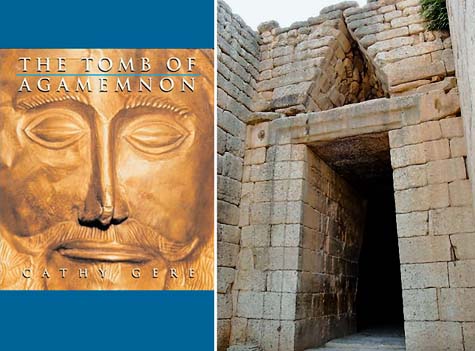
In preparation for tomorrow’s interview, then, I’ll start with a quick look at the book that first hooked me: The Tomb of Agamemnon by Cathy Gere, one of the most exciting things I’ve read in years.
Ostensibly an armchair introduction to the Tomb of Agamemnon – a Mycenean shaft grave discovered in 1876 by the flamboyant amateur German archaeologist Heinrich Schliemann – the book is really a study in European culture and the political stakes inherent in archaeological interpretation and discovery.
Schliemann, who presented himself through “a syrupy blend of Homer and Hollywood,” and who developed quite a knack for media hype, transformed his somewhat accidental discovery into a de facto origin point for modern European self-identity.
The tomb was not just a hole in the ground, in other words, but a place through which Europe could explain itself, achieving narrative control over the archaeological past and rooting itself in a much more glorious version of what then passed for its history. Starting with the Greeks, she writes, “historians and dramatists reinvented the Trojan War and Agamemnon’s horrible destiny time and time again, in an increasingly desperate effort to understand and control their own violent history.”
On another level, Schliemann’s discovery only intensified the already politicized stakes of Mediterranean archaeology; his deliberately spectacular excavations were part of a much larger media project, Gere writes, that “represented a symbolic reclamation of the monument from the Ottoman [Empire],” then the dominant power in the region.
For every site uncovered, that is, with the imaginative help of story-telling archaeologists and the enthusiastic newspaper editors who cheered them, Europe came into its own.
It could project its own wished-for history onto the dusty screen of archaeology.

The book is compulsively readable, and it’s also short: I started reading it one afternoon and had finished it by that evening.

Though it’s a history of the grave and of the grave’s discovery, it’s also an eye-popping look at the interpretive difficulties associated with how we dig up the past.
At several points, Gere ridicules what she calls the “genre of mytho-anthropology” – her term for how the past can be mis-used in the service of heroically re-narrating, and thus justifying, the present order.

As the great tide of Christian faith receded, a wave of archaeologically inspired origin myths swept in to replace it, every nation and group racing to rewrite the Book of Genesis in the image of its own interests.

Newly excavated and insufficiently understood “icons of antiquity” were thus “made to bear all the fears and desires of modernity.”
This particular form of mytho-anthropology, Gere suggests, exhibited its most extreme tendencies in the historical era beginning with, say, the birth of Lord Byron and ending with the death of Adolf Hitler, and it is Gere’s description of this politically volatile time period that makes her book so extraordinary.
She explores how a lost golden age of Homeric warriors – sailing the high seas, declaring war, hoarding treasure – became a referential presupposition for nearly all arguments of European nationalism – particularly, we read, in the case of Friedrich Nietzsche and the German military commanders who later read him.
In the early years of the 20th century, Gere explains:

Europe filled up with neurasthenic young scholars, innocent of the horrors of combat, marshalling archaeological evidence in the support of their dreams of blood and empire. War was repeatedly proclaimed as physically and morally desirable, an antidote for decadence and a prescription for spiritual renewal.

These were the “classically educated young men who went to meet the horrors of war at Gallipoli.”
Things only got worse when the Nazis came to power.

By the time of Hitler’s ascendancy, a Teutonic Mycenae had been completely assimilated into the crackpot mixture of archaeology, mythography and so-called ‘racial science’ that provided German fascism with its own tailor-made prehistory.

Nazi field commanders marshalled their own archaeological evidence for Aryan superiority, sending morally deluded and historically misinformed storm troopers marching south toward Athens.

[Image: The “mask of Agamemnon”].

In any case, I could go on and on about the book. Instead, I’ll just say that it offers an intellectually refreshing and beautifully explained – if also sinister – angle from which to view the ideological construction of modern Europe, and the whole thing is told from the otherwise often dry perspective of archaeology.
In fact, it’s difficult to over-emphasize how exciting I found the book to be. I’m not entirely sure I’m kidding when I say that, had I read Gere’s book as a teenager, I might have become an archaeologist. Or at least a classicist.

And it will probably horrify Gere to hear me say this – because this implies that I completely misread the whole book – but The Tomb of Agamemnon falls somewhere between Indiana Jones and the most high stakes university lecture course you’ve ever taken – and it made me an absolute addict for the Wonders of the World.
More reviews coming soon! For now, stay tuned for tomorrow’s interview with Mary Beard.

Highly recommended: The Tomb of Agamemnon by Cathy Gere

Buy a Silk Mill

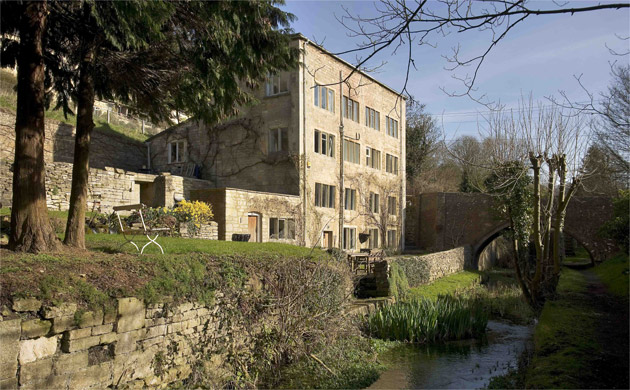
[Image: This Gloucestershire silk mill is for sale; photo courtesy of Jackson-Stops & Staff].
An 18th-century silk mill, located in Chalford, Gloucestershire, is on the market for a mere £650,000. The house presents its future owner with an “artful marriage of old and new,” we read, complete with “huge stone fireplaces, beams and a bread oven alongside a designer kitchen and a dashing mezzanine-level music room. It’s not short of space either, with three reception rooms, a study, utility room and four bedrooms.”
I’d buy it for the small stream and bridge outside… Live there for a few summers and write books.

(Earlier: Buy a Fort, Buy a Church, or even buy an island).

Hot-Mapping the UK, or: Spy Planes Over Haringey

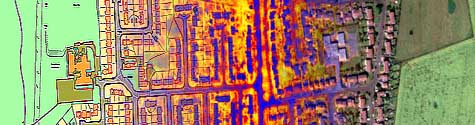
Earlier this year it was reported that the London borough of Haringey had used a spy plane to record residents’ energy use patterns:

Thermal images of homes have been taken by a light aircraft fitted with military spy technology to record the heat escaping from people’s houses.
Maps identifying individual homes have now been placed on the internet to encourage occupiers to reduce their wastage and carbon emissions by fitting insulation and turning the thermostat down.

More specifically:

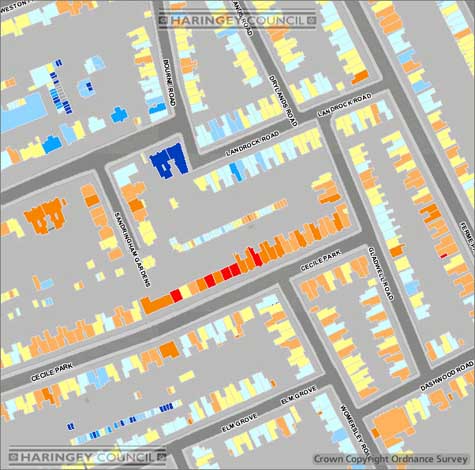
An aircraft, fitted with a military-style thermal imager, flew over the borough 17 times to take pictures of almost every house in the area.
Footage of heat loss was converted into stills, then laid over a map of the area, before each house was given colour-coded ratings.
Homes that were losing the most heat were represented as bright red on the map. The least wasteful households were shown in deep blue. Shades of paler blues and reds were used to show grades of heat loss.

The Haringey heat map is now available online.

The practice itself is referred to as “hot-mapping,” and the company behind the Haringey project also has “complete aerial heat-loss data sets of most of London and all of Norwich. Other locations may follow, and specific areas can always be commissioned.”
What’s interesting, though, is that the use of a “spy plane” – really, just an airplane – makes the whole thing sound like some sort of Gestapo-esque invasion of privacy; one wonders if the Haringey heat-map would have generated quite as much negative commentary if it had used, say, random satellite maps or even a house-by-house home inspection team.
Though, having said that, I’m reminded of a story I heard on NPR a few months ago, about chimney sweeps in Germany and how they’re still considered somewhat suspicious due to their historical use, by the Stasi, as domestic spies during the good old days of the DDR.
All of which is just a long way of saying: is it possible to monitor and regulate something like domestic home energy-use without tripping off people’s sense of being targeted by The Man – some terrifying and abstract Big Government that sends agents to your home and fills the sky with spy planes? Does the very mention of the phrase “spy plane” lead to resentment and paranoia?

(Story spotted at collision detection).

BLDGBLOG Interviews…

For a variety of reasons I thought I’d post a quick round-up of the interviews I’ve done for BLDGBLOG – and announce, in the process, that more interviews are forthcoming, and I’m excited.

[Image: Rome’s Colosseum].

In less than a week, for instance, I’ll be posting a long, two-part interview with Cambridge University classicist and general editor of the Wonders of the World series, Mary Beard. In that interview, she discusses everything from Mussolini and the politics of urban archaeology to Cape Canaveral, the Taj Mahal, and the recent film 300. That’ll be up by Monday morning. That interview is now up: Part One and Part Two.
Soon thereafter I hope to publish interviews with sci-fi novelist Kim Stanley Robinson – about climate change, sustainability, and the literature of the future – as well as with DJ /rupture (who spoke at Postopolis!) about sound, migration, cities, and the acoustic ins and outs of sonic borderlands.

[Image: A “short drop” in Toronto’s Viceroy Drain; photo by Michael Cook].

In any case, perhaps you’re new to the site and don’t even know that I’ve been interviewing anyone, or maybe you just never read the interviews in the first place because they’re too long – or perhaps you did read the interviews and you’ve just been dying for me to refer to them again…
So here’s a quick list of links to old interviews:

Drains of Canada: An Interview with Michael Cook Last week, BLDGBLOG posted an interview with urban explorer Michael Cook. Cook has extensively documented and photographed the concrete knots and tubes of Canada’s municipal drains and hydroelectric stations. He discusses organized hydrology and the environmental impact of urban infrastructure, as well as the myths, waterproof boots, and respiratory infections that accompany his explorations.

The possibility of secret passageways: An Interview with Patrick McGrath. Novelist Patrick McGrath talks to BLDGBLOG about the landscapes, buildings, weather, madness, and mold associated with Gothic fiction, from Mary Shelley’s polar void to the swamps of Honduras. McGrath mentions dinosaur skeletons, psychiatric institutions, the desert, David Lynch, and his own forthcoming novel, Trauma.

• BLDGBLOG has also interviewed the editorial team behind Volume magazine, including Jeffrey Inaba and Ole Bouman, head of the Netherlands Architecture Institute:

Of Cars, Dogs, Golf, and Bad Feng Shui: An Interview with Jeffrey Inaba
Agitation, Power, Space: An Interview with Ole Bouman

The Heliocentric Pantheon: An Interview with Walter Murch. Academy Award-winning film editor and sound designer Walter Murch talks to BLDGBLOG about Nicolaus Copernicus and the heliocentric structure of Rome’s Pantheon. I ask him about sound and the city, urban surveillance, and the architecture of solar alignment.

Architecture and Climate Change: An Interview with Ed Mazria. Architect Ed Mazria explains the basics of his Architecture 2030 organization, elucidating the connections between architecture, the construction industry, and global climate change.

War/Photography: An Interview with Simon Norfolk. In one of my favorite interviews yet, British war photographer Simon Norfolk explains what exactly makes him a photographer of war, capturing battlefields in their extended sense: the supercomputers that model nuclear warheads and the remote imperial radar installations sweeping empty space for signs of enemy aircraft.

The Lonely Planet Guide to Micronations: An Interview with Simon Sellars. Simon Sellars, author and overseer of the excellent site Ballardian, talks to BLDGBLOG about the recent travel guide he co-edited for Lonely Planet: a field guide to micronations.

Science Fiction and the City: An Interview with Jeff VanderMeer. Dark fantasist Jeff VanderMeer discusses the imaginative architectures of science fiction, via coral reefs, the pedestrianized city cores of Europe, a childhood spent on tropical islands, the vaults of York Minster, and a cathedral made from medical devices.

The Visionary State: An Interview with Erik Davis. Author Erik Davis tells BLDGBLOG about his recent book, The Visionary State, a long look at the spiritual geography of California, from Philip K. Dick’s final apartment to the intersections of greater Los Angeles.

Interview with Mike Davis: Part 1 and Part 2. In BLDGBLOG’s first interview, sociologist Mike Davis talks about all kinds of things: urban warfare, the Pentagon, the films of Ridley Scott, the RAND Corporation, global poverty, avian flu, and his widely discussed book Planet of Slums.

So there you go.
Watch out for the Mary Beard interview next week – and many more to come.

Sovereignties of air: the new strategic landscape

The Guardian writes today of a “new strategic landscape” taking shape as long-range Russian bomber patrols cross over into “remote areas” of ungoverned ocean air, brushing up against the aerial terrain of 21st-century British sovereignty – England scrambles its jets, phone calls are made, the crisis is defused – and as newly affiliated militaries co-simulate and train, linking distant nations in strategy.

[Image: A Russian TU-95; the TU-95s were originally “designed as bombers but are now frequently used for maritime reconnaissance.” They have recently been intercepted in the north Atlantic].
“A burst of war games and military manoeuvres around the world hints at a new strategic landscape,” we read.
NATO is training in Sevastopol, for instance, a former Soviet sea port; Japan, Singapore, Australia, and the United States are hosting “war exercises” with India in the Bay of Bengal; China has constructed “an intelligence listening post on the Cocos Islands” in that same Bay of Bengal (a future flash point?), even while helping Pakistan and Bangladesh “build deep-water ports”; and, of course, “Russia and China held their largest ever war games in the Urals last month,” during which uniformed men and armed helicopters terrorized fake villages and filled empty architecture with smoke.
Stripped of ornament and devoid of decoration, such training sites are the military’s version of a Modernist utopia: eminently functional, purpose-built, a testing ground for new forms of management and planning, they are temporary cities built for and by war – destroyed just as quickly by the forces that assembled them.
Meanwhile, repurposed jets fly above summer coastlines, radioing back and forth with coordinates and suspicious greetings.

A big cop in a small town: architecture of the model village

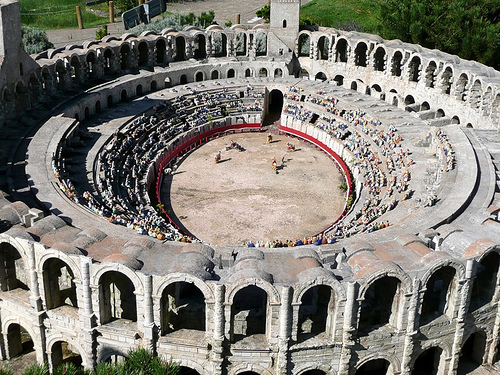
[Image: A model of the Arles Ampitheatre; photo by http2007].

I stumbled across a whole Flickr pool full of photographs of model villages the other week – and some of the pictures are just fantastic.

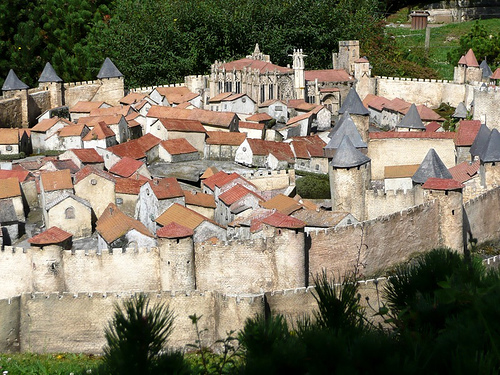
[Image: A model of the Fortified cité of Carcassonne; photo by http2007].

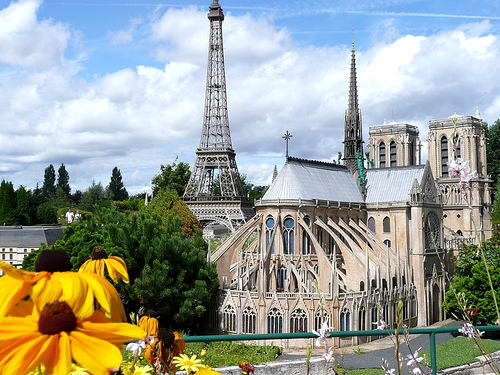
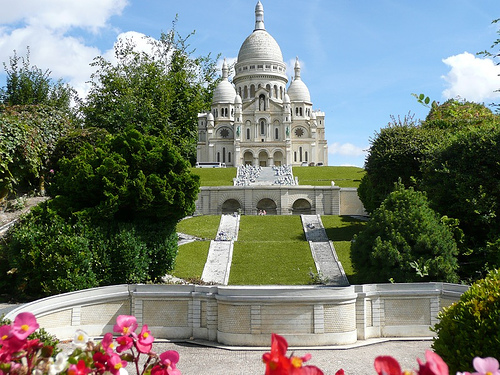
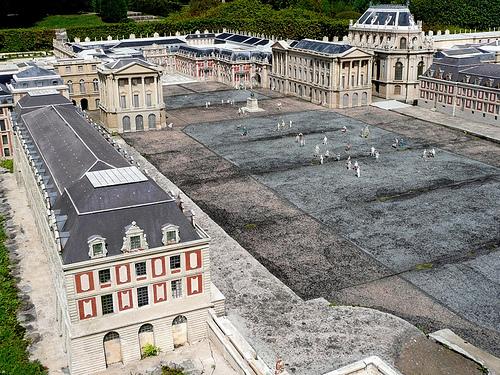
A Flickr user called http2007, in particular, has some great contributions – and he also maintains a great sub-set, called France Miniature Park, that’s well worth checking out; all images in this post come from that collection.

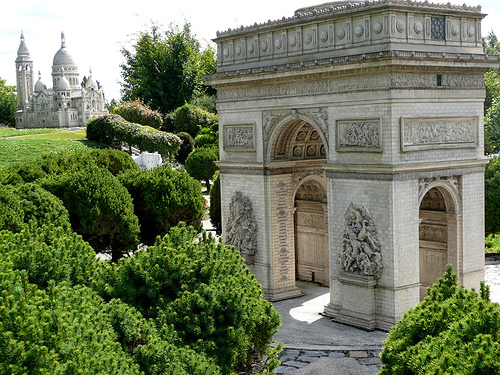
[Images: Models of Notre-Dame de Paris, Montmartre, the Château de Versailles, and the Arc de Triomphe. All photos by a Flickr user named http2007].

Many, many, many more photos available at the model villages Flickr pool.