Deep-water city-states

[Image: Illustration by Holl Liou, courtesy of Wired].

Wired reports on “a small team of Silicon Valley millionaires” who hope to develop “a new option for global citizenship: A permanent, quasi-sovereign nation floating in international waters.”
They call this practice seasteading.

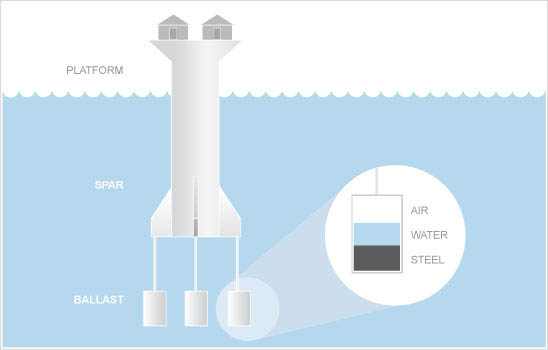
The seasteaders want to build their first prototype for a few million dollars, by scaling down and modifying an existing off-shore oil rig design known as a “spar platform.” In essence, the seastead would consist of a reinforced concrete tube with external ballasts at the bottom that could be filled with air or water to raise or lower the living platform on top. The spar design helps offshore platforms better withstand the onslaught of powerful ocean waves by minimizing the amount of structure that is exposed to their energy.

Build enough of these spar platforms and you’ve got yourself a “deep-water city-state.”
The group’s 300-page book on the managerial practicalities of running “modular seastead groups” references everything from Sealand, the offshore micronation, to the Texas Tower, to houseboats, to the dangers of tropical storms.
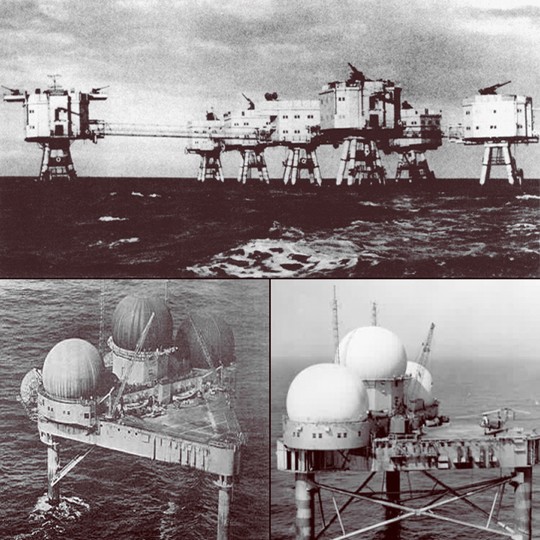
[Images: The Maunsell Towers (top), unmentioned by the libertarian seasteaders, and the Texas Tower (bottom)].

They touch on the political and economic circumstances involved in steading the high seas, including SOLAS, the International Convention for the Safety of Life at Sea, and UNLOS, the United Nations Law of the Sea. They mention the process of buying a Flag of Convenience, in which hopeful microsovereigns can “shop around for a country that has the least objectionable laws and rates, and count on the seller’s apathy to minimize restrictions. A seastead is potentially high-profile, and if it proves a serious embarrassment to a registrar it may lose its flag.”
The seastead’s power storage needs are then discussed in terms of electrochemical batteries, gravity batteries, and supercapacitors, and the production of this power will, the authors presume, come from wind and solar systems, and even one or two fuel-powered generators. Of course, there’s also the power of the sea to consider – and the authors’ “favorite” method for harvesting “wave power” is something called Isaac’s Wave Pump.

[Image: Tapping into oceanic motion with BioPower Systems].

In any case, one can fantasize forever about endless small changes in the construction of a functioning seastead. (Note to Chronicle Books: publish an architectural guide to seasteading; it’ll be a huge hit on Father’s Day).
What interests me here, aside from the architectural challenge of erecting a durable, ocean-going metropolis, is the fact that this act of construction – this act of building something – has constitutional implications. That is, architecture here proactively expands the political bounds of recognized sovereignty; architecture becomes declarative.
The stakes for design have gone up, in other words. It’s not just a question of producing better loft apartments, for which you can charge an extra $300,000, or of perfecting the art of luxury kitchen space; it’s a question of designing architecture for extreme conditions and, should your architecture survive, thus opening up room for a new form of what might be called post-terrestrial sovereignty, i.e. governance freed from landed terrain.
Which is not to be confused with advocacy of the project; I just like discussing its political side-effects: architecture becomes wed with, indeed inseparable from, a political project. It is construction in the service of constitutionality (and vice versa).
Wed with oceanic mobility, the architecture of seasteading doesn’t just aesthetically augment a natural landscape; it actually encases, or gives physical shape to, a political community. It is architecture as political space in the most literal sense.

The Digital Replacement of the Natives

[Images: Garmin GPS devices].

“For their recent trip to Namibia,” a short blurb in Wired magazine explains, “Greg and Anja Manuel packed light: PowerBars, clothes, and a Garmin GPS loaded with Traveler’s Africa version 8.02, a user-generated map brimming with 50,000 points of interest. That last item meant they didn’t have to hire an experienced guide.”
Fair enough. The map looks beautiful, the idea is cool, and, within two or three trips, the GPS device does indeed save money; however, I can’t help but wonder what this might foretell for local economies, all over the world, based on guided tourism. For instance, a small group of American tourists comes through your village, eating PowerBars and looking at handheld GPS devices. They don’t go to any restaurants; they don’t ask any questions of anyone; perhaps they don’t even rent a hotel room.
For all economic purposes, it’s as if they were never there. They were more like surreal poltergeists wearing Vasque boots, reading Jonathan Safran Foer on a Kindle.
What better way to avoid meeting Namibians! Just use their electrical grid to recharge your gadgets, pay no taxes, and leave.

[Images: Three examples of maps displayed on Garmin GPS devices].

I’m left imagining the inverse of this situation, of course, in which a small group of Namibians shows up in London. They ask no questions, eat at no restaurants, and avoid all hotels – before going off to wander round the countryside, sleeping in tents. It would all seem rather mysterious.
In any case, do handheld technologies mean that we’ll soon be digitally replacing the native populations of the Third World, never needing them again for guidance, travel advice, or even insights into medicinal plantlife? You fly down to the Amazon to try ayahuasca, but you don’t hire any local shamans or native botanists because you’ve got everything you need to know already saved on a 300GB iPod – as if that might be the atomized fate of the West in general: desperately seeking visions, alone in the wild, surrounded by portable gadgetry.
“Your tradition is right here,” the tourist says, holding his Garmin GPS loaded with Traveler’s Africa version 8.02 over the heads of impoverished villagers. “I don’t need you anymore.”
Next year, someone gives you a small handheld device with an interestingly honest tagline.
Go Everywhere, it says. Meet No One.

Mountain Monuments

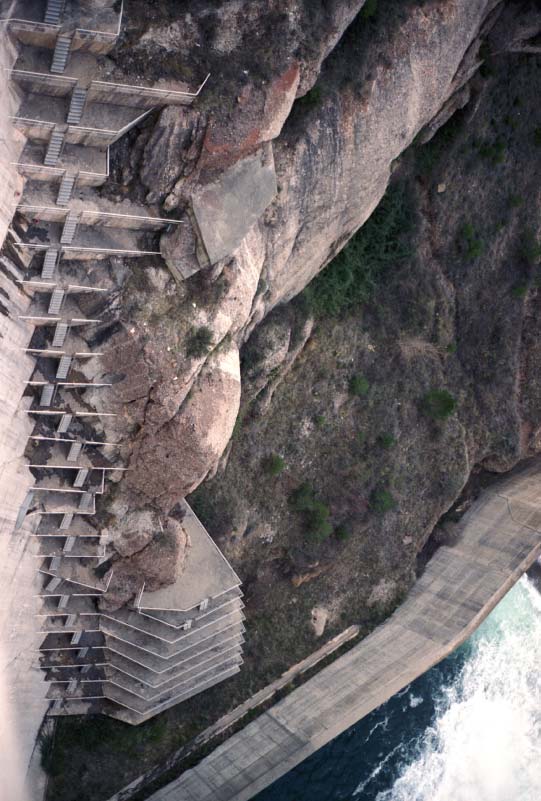
[Image: From the series the water, the dams, the landscape by photographer Eduoard Decam].

Eduoard Decam is a Barcelona-based French architect whose photographic project the water, the dams, the landscape won an EDF Foundation award back in 2006. The images in the series document massive hydrological installations in the Pyrenees Mountains of northeastern Spain, turning dams and spillways into abstract monuments, like some new piece of mountain infrastructure designed by Superstudio.
As Decam himself explained to A10 magazine: “I do not see the dam as a technical element in the mountain, but as part of the mountain, as a landscape.”
Personally, I’m just blown away by the terraced stairways we see in the image, above; it’s like some ultramodern update to the monastic retreats of Meteora, or perhaps even a new stage in Guild Wars.

(Spotted in A10, issue #19).

Botanical Otology

Alex Metcalf’s Tree Listening Installation is a small electronic listening device built for eavesdropping on the inner acoustics of trees.

[Image: “Peach Tree in Flower in Orchard” by J.E. Fee].

How does it work? The device is placed on the trunk of a given tree and then connected to as many as ten sets of headphones, which hang down from the tree’s canopy. Botany becomes your iPod.
“This allows the public to listen ‘live’ to the sound of water being pulled up from the roots to the leaves through the xylem tube,” Metcalf writes.
As he explained in an interview with the Guardian last week: “The technology for this is usually invasive. You bore into the tree and take away a section, then seal in a listening device. The thing about my device is that you don’t have to cause any damage, and you can listen to any tree, anywhere, any time – plus you can do it long term. Cutting a hole in a tree means you are wounding and infecting it, which will affect the recording.”
The “device” in question is a small and somewhat unassuming metal cone that looks more like an 18th-century otological device. You hold it up against the side of the tree – like an FBI roving wiretap on the natural world – and listen in…
But could you broadcast this? A pirate radio station pops up one evening after dinner time in the distant suburbs of west London – and it turns out that an eccentric old couple living on a large plot of land near Windsor Great Park have begun broadcasting their trees. It’s soon an international sensation, and a great hit with cover bands; you go down to the Cafe du Nord one night to hear live music, but the band, visibly drunk, gets lost in a three-hour rendition, using only acoustic guitars, of the sound of young sessile oak trees.
Oddly, you’re the only one there who enjoys it – legs crossed, beer in hand, listening intently.

Deep in the basement of an ancient tenement on Second Avenue in the heart of midtown New York City, I was fishing

Last summer, on the extremely short-lived blog Urbablurb – which only managed five posts before dying, yet still remains interesting today – we read about the little-known phenomenon of people fishing in the basements of Manhattan.

[Image: A map of the lost rivers of Manhattan, via Urbablurb].

Urbablurb quotes from The New York Times:

We had a lantern to pierce the cellar darkness and fifteen feet below I clearly saw the stream bubbling and pushing about, five feet wide and upon its either side, dark green mossed rocks. This lively riverlet was revealed to us exactly as it must have appeared to a Manhattan Indian many years ago.
With plum-bob and line, I cast in and found the stream to be over six feet deep. The spray splashed upwards from time to time and standing on the basement floor, I felt its tingling coolness.
One day I was curious enough to try my hand at fishing. I had an old-fashioned dropline and baited a hook with a piece of sperm-candle. I jiggled the hook for about five minutes and then felt a teasing nibble. Deep in the basement of an ancient tenement on Second Avenue in the heart of midtown New York City, I was fishing.

The lost rivers of Manhattan are real; hundreds of streams and whole wetlands were paved over and filled so that the roots of buildings could safely grow. But whether or not you could ever fish in them – and this whole thing sounds like Dr. Seuss to me – is the subject of a post on the also now defunct blog, Empire Zone. There, a commenter informs us that fishing for eyeless carp in the underground cisterns of Istanbul is something of a national past-time.

Alas, we also learn that, as to the question of “whether any carp could be found swimming under Manhattan today,” the answer, sadly, is no.

But how much would I love to find myself in New York City for a weekend, perhaps sent there by work to cover a story – when the phone rings in my hotel room. It’s 11pm. I’m tired, but I answer. An old man is on the other end, and he clears his throat and he says: “I think this is something you’d like to see.” I doubt, I delay, I debate with myself – but I soon take a cab, and, as the clock strikes 12am, I’m led down into the basement of a red brick tenement building on E. 13th Street.

I step into a large room, that smells vaguely of water – and six men are sitting around an opening in the floor, holding fishing poles in the darkness.

(Also on Urbablurb: Who is Jack Gasnick?).

Vertical House

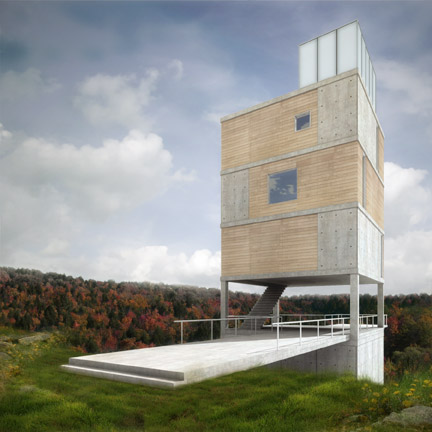
[Image: Vertical House by axis mundi architects].

Here are two views of a proposed mountain house for a site in Smugglers Notch, Vermont, by New York architects axis mundi.
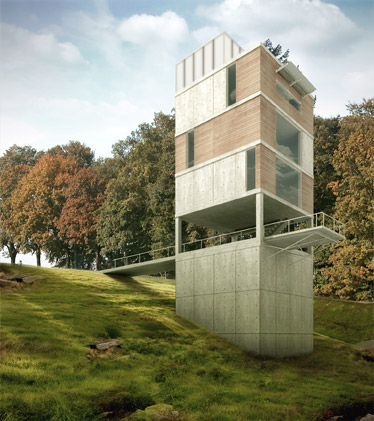
“Entry is via a long and dramatic bridge to a viewing platform from which one ascends a staircase into the house,” the architects’ website explains. Kitchen, dining room, living room, and master bedroom are encountered in sequence as one moves upward through the structure.

[Image: Vertical House by axis mundi architects].

You eventually arrive at an “open air garden… situated on the roof.”

The intention is that over time the house will become considerably lush as vines grow down from the roof, in effect making the house into a modern ruin.

The wood cladding you see is teak on a concrete and steel frame.
Give that thing wider corner posts, run the utilities and services down through through them, and you’re good to go. Install a portaledge or two, and the house gets even better.
Then, three hundred years from now, refugees from a half-flooded Manhattan – that city all but destroyed by an unspecified disaster – make their way north to find the house still standing and covered in a thick labyrinth of vines, home to migrating tropical birds. They clear themselves a place to sleep amidst the dust and vines, and stay for nearly two weeks – before heading further inland, toward the ruins of Montreal, still fleeing whatever unknown fate awaits those stuck in that city down south.
Another hundred years and the building collapses, forming a debris field of wood, metal, and concrete across the hillside, washing down to nothing over decades of rain.

The Architecture of Ascent

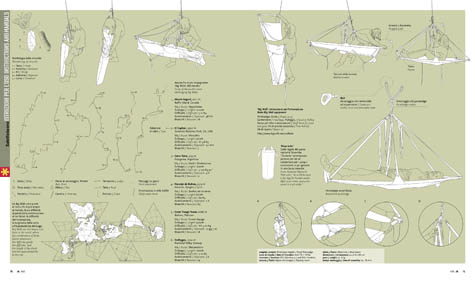
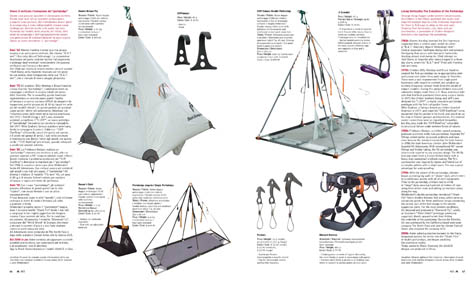
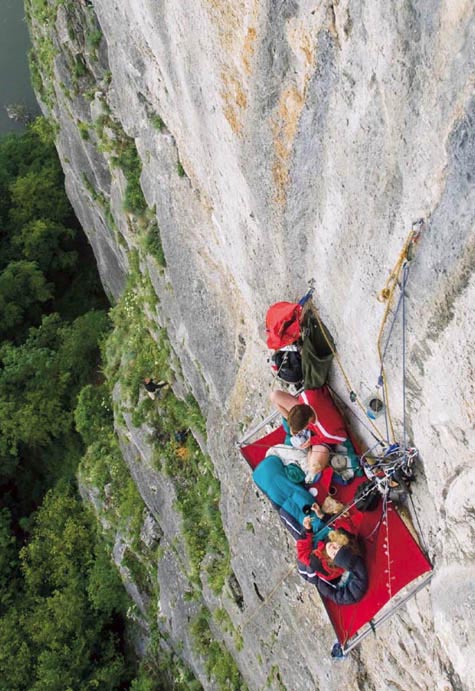
In what would merely have been an article about camping equipment in almost any other situation, revamped Italian architecture magazine Abitare recently took a fascinating look at portable mountain climbing shelters.

[Image: From an article by Jonathan Olivares, in Abitare; view much larger!].

Viewed architecturally, these examples of high-tech camping gear – capable of housing small groups of people on the vertical sides of cliffs, as if bolted into the sky – begin to look like something dreamed up by Archigram: nomadic, modular, and easy to assemble even in wildly non-urban circumstances. This is tactical gear for the spatial expansion of private leisure.
There are about a million implications here – including, at the very least, the question of whether or not architects should be involved in designing tents for North Face or for REI. If Zaha Hadid can design desk lamps and Frank Gehry, jewelry – and Michael Graves, teapots – then why can’t, say, Jean Nouvel design a new series of outdoor recreational equipment, including tents, portaledges, platforms, and hammocks?
In fact, Jonathan Olivares, the author of the piece, describes the invention of the portaledge as follows: “Drawing from hammocks, cots, tents and sail construction, a generation of climber-designers invented a new typology: the portaledge.” As such, the portaledge already has a fascinating design genealogy – one that includes the B.A.T. tent, the LURP, so-called “Cliff Dwellings” equipment, and tube-framed, waterproof tepees – but get some architects involved with this and see what happens.
Unless, of course, this is yet another case where architects have fallen behind the other design fields, too obsessed with accurately quoting Gilles Deleuze to notice that the world has been revolutionized. All sorts of amazing new tools, techniques, materials, shapes, and spaces were being framed and even mass-manufactured out there, for decades, but architects were all cooped up, underlining things for each other in the library.

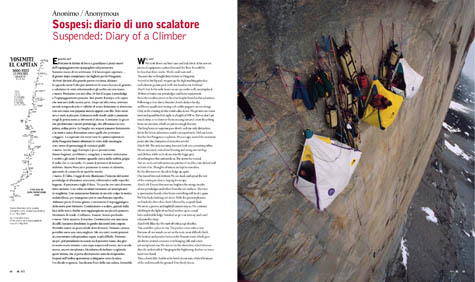
[Image: Another spread from Abitare, an article by Jonathan Olivares; view larger!].

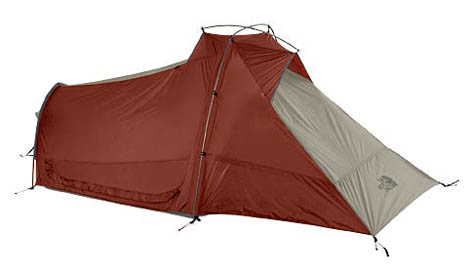
In any case, I suppose one could say that this tent, below, the Dyad 22 by North Face, looks vaguely like some sort of microlight architectural folly designed by Neil Denari for the beaches of Southern California –

[Image: The Dyad 22 by North Face].

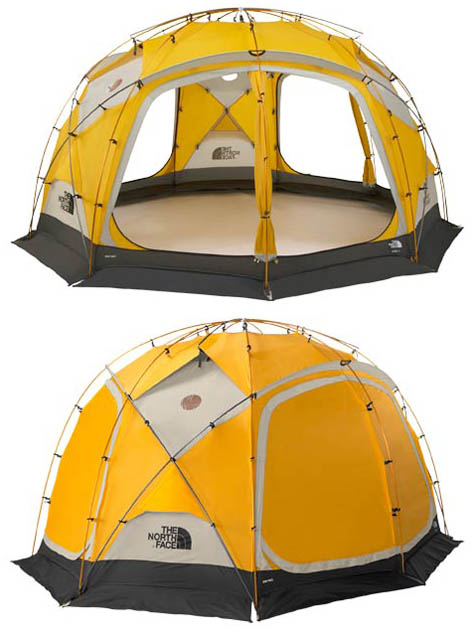
– and these tents, the Domes 5 and 8, also by North Face, look like, say, Buckminster Fuller in collaboration with Shigeru Ban. Or: if Buckminster Fuller and Shigeru Ban came together to franchise the design of London’s Serpentine Pavilion one summer, perhaps this is what they would make.
Leading to the question: are tents an example of franchise architecture?

[Image: The Dome 5 and Dome 8 by North Face].

So why aren’t architects involved, as far as I’m aware, in the portable, modular architecture market known as high-end camping gear?
You ascend to the top of Mt. Everest… sleeping in a tent by Greg Lynn. Your sleeping bag is by OMA. Your best friend is comfortably slumbering beside you in a tent designed by LOT-EK.

[Images: Two spreads from Abitare; view larger: top and bottom].

But Abitare‘s article also implies something like the opposite of what I’ve written above: in other words, if high-tech camping gear used for vertical mountain ascents is actually a form of architectural technology, and thus worthy of being covered and critiqued by architecture magazines, then architects themselves should find more uses for such gear in their designs.
Rather than design camping gear, then, they should design with camping gear, filling private homes and office high-rises with unexpected tent-like rooms and rapidly deployed nylon conference facilities. You carry your boardroom around in your briefcase, installing it up on the roof when summer allows.
Or, perhaps, you construct a 21-story bare steel frame somewhere on an empty lot in New York City. It has no walls or floors; it is just a vast and abstract grid of I-beams, welded throughout with anchorage points. Using portaledges and tents, the inhabitants of this empty frame, like people from a fever dream by Yona Friedman or Constant, come in and colonize the structure, installing themselves at odd angles with carabiners and clips, bungee cords and tactical ropes, paying rent only on the spatial volume that the resulting structures occupy. $10 per cubic foot.
The grid – the structure – is taken care of. Architecture becomes nothing but the process of designing better tents. Flexible interiors. Sewn space.
So is high-tech 21st century camping gear exactly what the 1960s architectural avant-garde had been looking for? The portaledge as vertical utopia.

[Image: Spatial City by Yona Friedman: “The framework was to be erected first, and the residences conceived and built by the inhabitants inserted into the voids of the structure.” Courtesy of the Museum of Modern Art].
To a certain extent, though, this reminds me of my experience just last week as a judge for the Design Village 2008: Mission to Mars competition, photographs of which can be found here. With some obvious exceptions, that contest gave us the tent as avant-garde – and even extra-planetary – architecture. In one case, it was the tent as full-fledged micronation, flirting with new definitions of political sovereignty.
Perhaps 2009 will be the year tent design explodes across architecture schools, worldwide.
Given zero insurance liability, then, could you arrange for a new, annual architecture competition, sponsored by REI, the point of which is to ascend Yosemite‘s Half Dome or El Capitan using only home-made, microlight portaledge technology? If you fall, you lose. You have to make it to the top within seven days – and you have to stay there for another three.
Then you have to make it back down.

[Image: From Abitare; view larger].

All these instant cities of tents and portaledges, moving up and down mountainsides around the world, like Walking Cities, the urban condition gone nomadic – the new, vertical suburb, till now so architecturally underexplored.

(Original articles curated by Anniina Koivu. With huge thanks to Fabrizio Gallanti from Abitare for emailing me the page spreads!)

Space as a Symphony of Turning Off Sounds

In David Toop’s classic book Ocean of Sound – something I cite repeatedly here on BLDGBLOG – we read about a musical performance that, by accident of circumstance, became a process of turning off all sources of noise within a building.

[Image: Felix Hess assembles similar sound machines, next to a photo of an unrelated concert hall].

For an installation of fifty specially made “sound creatures” – little interactive robots “inspired by the communication eco-system of frog choruses,” Toop writes – experimental musician Felix Hess insisted that there be no “extraneous sounds” in the concert hall. Hess’s miniature sound performance required absolute silence, or else the machines would not function.
Toop then quotes a lengthy description of the creatures’ set-up:

We had imagined that the foyer, on an afternoon when nothing was being held there, was extremely tranquil, but not even one of them began to call out in response to any of the others. So first we turned off the air conditioner in the room, and then we turned off the one on the second floor. Then we turned off the refrigerator and the electric cooking equipment in the adjoining cafe, the power of the multi-vision in the foyer, and the power of the vending machine in a space about ten metres away. One by one we took away these continual noises, which together created a kind of drone there… Hess was very interested in this and said things like, “From now on maybe I should do a performance of turning off sounds.”

It’s amazing to think, of course, that anything could pick up, and even respond to, sounds that subtle; but it’s also quite incredible to imagine one’s own acoustic awareness of architecture as a process of subtraction.
You could even turn it into a game:

1) You are sitting on a stage, wearing a blind-fold.
2) Every electrical device in the building around you is on.
3) Suddenly, you detect a slight difference, a vague change in sonic pressure somewhere, as if an extremely distant mosquito has been swatted – a spot of silence, as it were, has appeared in the room.
4) “Toaster, fourth floor!” you call out – and you’re right. Someone turned off the toaster.
5) You win a trip to France.

In any case, it’s easy to imagine Hess and his assistants finding this process much more difficult than they’d imagined. At one point in the afternoon, then, with only hours to go before the doors open, they have to step across the street and turn off the appliances in a nearby high-rise – and then next door, to a block of flats, and then down the road to the neighborhood hospital. Still nothing.
Gradually they go on to turn off the entire world, street by street, city by city, in an ever-expanding ring of total silence.
The world becomes a sonic sculpture from which sources of background sound are constantly removed.
Finally, twenty-five years from now, as the very last radio is unplugged in a distant house in Tanzania, the “sound creatures” sitting with Felix Hess on stage begin singing.

Hotels in the Afterlife

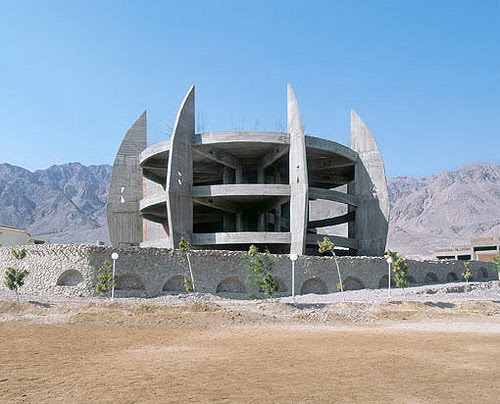
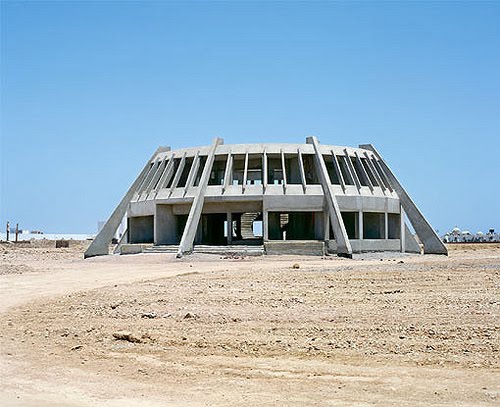
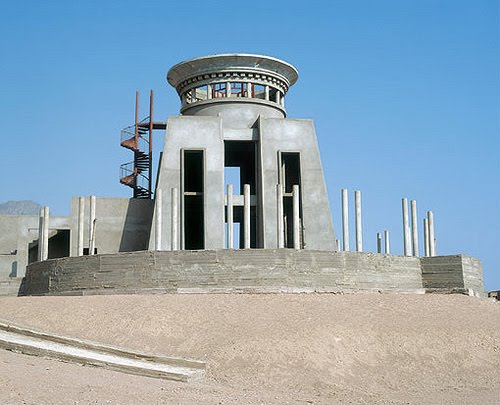
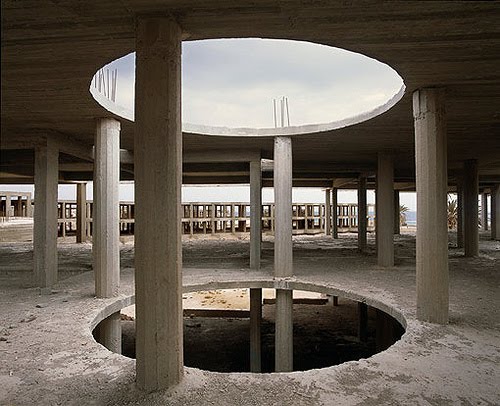
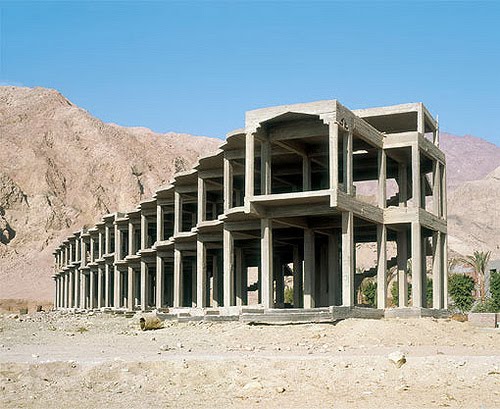
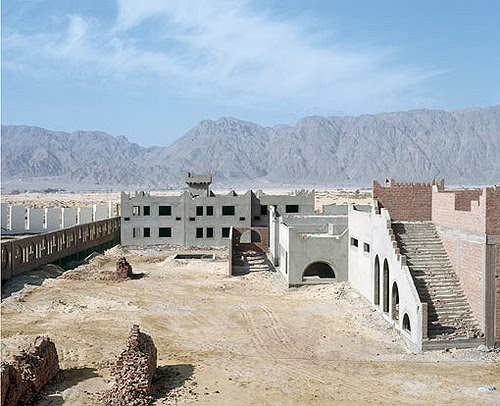
[Image: From Sinai Hotels, by Sabine Haubitz and Stefanie Zoche of Haubitz+Zoche].

Vienna’s Architekturzentrum will be hosting a new photography show, opening this Wednesday, April 24, called Sinai Hotels.
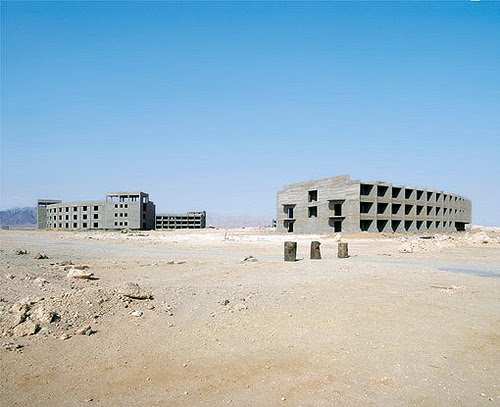
With images by Sabine Haubitz and Stefanie Zoche of Haubitz+Zoche, the show looks at “the concrete skeletons of five-star hotel complexes” abandoned on Egypt’s Sinai Peninsula.
They are resorts that never quite happened, then, with names like Sultan’s Palace and the Magic Life Imperial. This makes them “monuments to failed investment.”

[Images: From Sinai Hotels, by Sabine Haubitz and Stefanie Zoche of Haubitz+Zoche].

The hotels now look more like “architectonic sculptures” in the desert, the photographers claim, or derelict abstractions, as if some aging and half-crazed billionaire had constructed an eccentric sculpture park for himself amongst the dunes.

[Images: From Sinai Hotels, by Sabine Haubitz and Stefanie Zoche of Haubitz+Zoche].

The billionaire goes for long walks at night alone amongst the ruins, sweeping dust from recent sandstorms off windowsills and open doorways.
At night, when the stars come out, different constellations are framed by unglazed windows, as if justifying these concrete forms from above with the poetic force of celestial geometry.

[Image: From Sinai Hotels, by Sabine Haubitz and Stefanie Zoche of Haubitz+Zoche].

Or, for that matter, five years from now these deserted monuments simply disappear – but because they’ve been put to use, finally, enwrapped with drywall and plaster, fitted out with drapes and marble floors, and you can sleep inside them for $300 a night, never even dreaming that these hotels were once ruins, temporarily abandoned to the sand and only recently reclaimed.
The empty swimming pool is now full – and you dive into it, unaware that you’re more like a ghost than a tourist, haunting the afterlife of these sites in bleaching sunlight.

Control Shift

I’ve been going through old magazines to find articles that I hope to read, re-read, or even incorporate into the final edits of the BLDGBLOG Book – and so tonight I came across the January 2007 issue of Metropolis.
There, we read about the ten greatest engineering feats of architectural history – including this short blurb about Hagia Sophia, in Istanbul:

The building was constructed of masonry, which shifted constantly during construction and thereafter. Today we use “switch-on gravity analysis,” where we imagine a structure built on the Moon and then digitally move it over to the Earth in a fraction of a second, and suddenly it’s loaded. But a structure like this changed its characteristics during construction, almost minute by minute. I can’t image [sic] how people could have had the courage to construct it.

It’s fascinating to think that the very thing under construction is in the process of altering itself. The structure has taken on agency, in other words: moving, shifting, becoming something other than what you intended it to be. That which you add to, shifts; that which supports you, changes.
At the end, then, perhaps we’ll all look down at our own foundations, at the walls and arches below us, as if to reassure ourselves, to remember who we were, how we got here, and who we once thought we could be – but our foundations will be defaced or gone.
The past has “changed its characteristics during construction, almost minute by minute” – and so we’re stranded, over a void, our feet firmly planted on nothing.
The only answer, then, will be to keep building up, to go out, to resist the nostalgic pull of foundations, seeking overwhelming extremes of both altitude and complication.
Perhaps we’ll then forget, in a state of self-induced vertigo, that we once needed a past at all – and that the building in which we now stand had a plan, a plan the building itself had always been exceeding.