Architecture on the Cusp

The Third & The Seventh, a short film by Alex Roman uploaded to Vimeo just last month and already viewed more than half a million times, is an entirely computer-generated, exquisitely rendered, photorealistic tour of architectural space.


While Frank Gehry’s Disney Concert Hall unfortunately makes an appearance, the remainder of the film tours some pavilions, museums, wind farms, and other urban icons, from both inside and out, that you will no doubt recognize.

There’s no plot as such, but the imagery is of such ridiculously high quality—although I could skip the soundtrack—that this seems much more visually promising to me then, say, the much hyped, half-a-billion dollar technologies used in Avatar; I would rather watch the opening two or three minutes of Roman’s film stretched out to feature length and threaded through with some narrative cues than revisit James Cameron’s badly rendered blue giants.
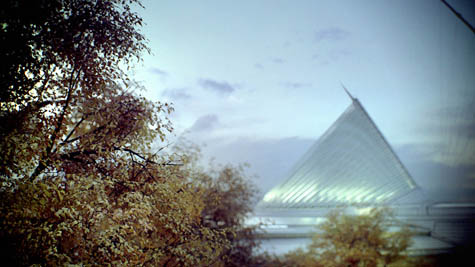
[Images: A Calatravian still from Alex Roman’s The Third and the Seventh].

This also seems to be yet more evidence that architecture students are literally just on the cusp of expertise in several different industries, and that even the briefest of collaborations with interested writers could push many student projects instantly over into fully realized narrative films. While I’m aware that many architecture students couldn’t care less about this—they didn’t, after all, apply to film school—I think it is nonetheless a strategically interesting option to consider when it comes to developing, presenting, and recontextualizing spatial ideas: a slight tweak here and there, a presentation of the most bare-bones scenario imaginable, and you’ve gone from student thesis project to La Jetée after one late night and some 5 Hour Energy drinks…
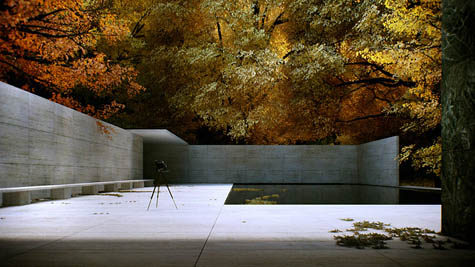
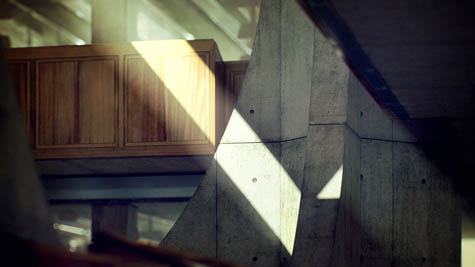
[Images: Stills from Alex Roman’s The Third and the Seventh].

In any case, Roman’s website includes galleries of some gorgeous film stills, including these details, these lighting effects, a few examples of “man-made vs. nature,” and multiple glimpses of classic furniture.
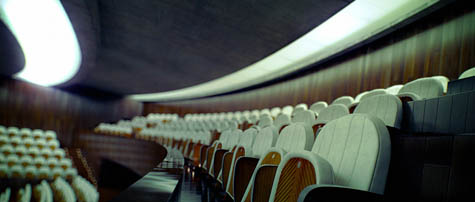
[Image: From Alex Roman’s The Third and the Seventh].

However, Vimeo seems to be loading quite slowly at the moment, so I’ve included a few stills here.
[Image: Alex Roman, The Third and the Seventh].

Here’s hoping Roman gets the attention he deserves for this, and that we someday see his work popping up in more venues. The film was created using 3ds Max, V-Ray, After Effects and Premiere.

(Thanks to Jim Rossignol and Ilari Lehtinen for the tip!)

Quick Links 1

[Image: Lebbeus Woods, from On the Malecón].

As a few people have noticed, the Quick Links section here on BLDGBLOG disappeared a few days ago; there are a variety of reasons for this, including an overall streamlining of the site design (moving to two columns from three, for instance). More importantly, over the past few years those Quick Links never actually showed up as part of BLDGBLOG’s RSS feed, meaning that people who don’t stop by the site itself, but prefer instead to read it through things like Google Reader, never even saw those links. This further meant that, during busy periods when whole days slip by between posts, BLDGBLOG would appear totally silent to those readers—when, in fact, new links were still appearing here at a reliable pace.

In any case, to make a long story short, I will now be publishing frequent Quick Links posts—the first of which appears here. This will make those links easier to find and archive; these posts will now show up in my RSS feed; and this allows readers to comment on the articles I’ve linked to (something that the previous Quick Links system never allowed).

If you have any suggestions for improvement, please let me know; I hope the much cleaner site design seems appealing, and that these Quick Links will continue to point you in stimulating directions… And happy new year! I hope this is a good one for you.

• • •

—Olivia Judson looks at “memories in nature,” where immune systems and plant forms display mnemonic traces. The biochemical archive.

—Perhaps a machine-assisted, agricultural equivalent of this: keeping rare strains of livestock, including “huge dreadlocked Cotswold sheep,” alive using the subzero techniques of cryopreservation. Distant shades of Pleistocene Park, perhaps.

—Speaking of the Pleistocene, consider joining the Friends of the Pleistocene, “dedicated to exploring the conjuncture between landscape and contemporary human activity at sites shaped by the geologic epoch of the Pleistocene (2.588 million to 10000 years BP, Before Present).”

—Perhaps we met yet artificially preserve the world’s glaciers by wrapping them in huge blankets.

—”Have researchers found dark matter at the bottom of a mine in Minnesota?”

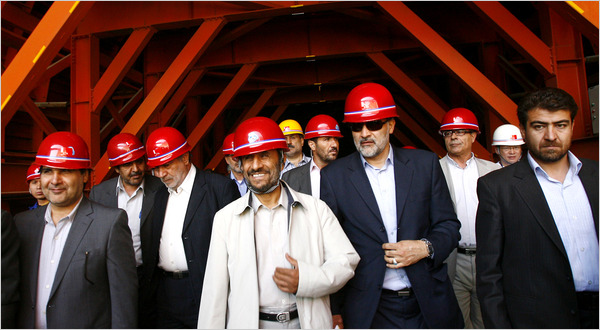
[Image: Ahmadinejad emerges from a highway tunnel; photo by Henghameh Fahimi for the Agence France-Presse, via the New York Times].
—Like a minor character from Reza Negarestani’s extraordinary book Cyclonopedia, Iran’s president, Mahmoud Ahmadinejad—busy burying his nation’s nuclear program inside a “maze of tunnels”—is actually the founder of the Iranian Tunneling Association. Quoting at length:

Heavily mountainous Iran has a long history of tunneling toward civilian as well as military ends, and Mahmoud Ahmadinejad has played a recurring role—first as a transportation engineer and founder of the Iranian Tunneling Association and now as the nation’s president.
There are hundreds, perhaps thousands, of big tunnels in Iran, according to American government and private experts, and the lines separating their uses can be fuzzy. Companies owned by the Islamic Revolutionary Guards Corps of Iran, for example, build civilian as well as military tunnels.
No one in the West knows how much, or exactly what part, of Iran’s nuclear program lies hidden. Still, evidence of the downward atomic push is clear to the inquisitive.
Google Earth, for instance, shows that the original hub of the nuclear complex at Isfahan consists of scores of easily observed—and easy to attack—buildings. But government analysts say that in recent years Iran has honeycombed the nearby mountains with tunnels. Satellite photos show six entrances.

It might be time to revisit geology in the age of the war on terror.

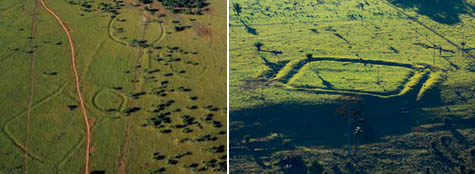
[Images: A civilization beneath the trees; images via New Scientist].
National Geographic visits the “geometric earthworks” previously hidden by tree cover in the Amazon but recently discovered via satellite photography. “Hundreds of circles, squares, and other geometric shapes once hidden by forest hint at a previously unknown ancient society that flourished in the Amazon,” we read.

—Lebbeus Woods kicks off the new year with a look at Cuba’s “malecón,” the coastal road skirting Havana’s massive sea wall (see the image that starts this post).

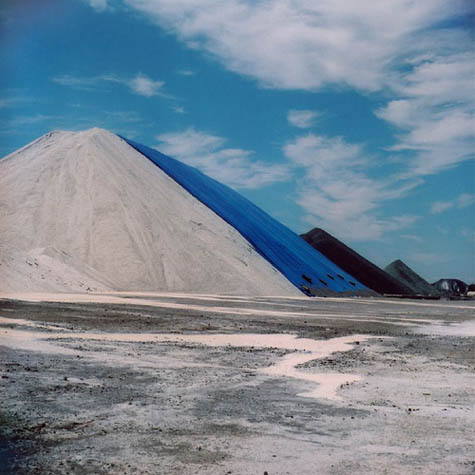
[Image: Piles of road salt outside Toronto. Photo by Flickr-user katalogue; via InfraNet Lab].

InfraNet Lab looked into the dispersed geological presence of road salt, used to melt ice and snow, last winter—building into a three-part series about “sea dust.” Part 1. Part 2. Part 3.

—Finally, for now, L.A. Times architecture critic Christopher Hawthorne takes a long look at the building formerly known as the Burj Dubai and its growing role in cultural predictions of apocalypse.

(Some links via @masoncwhite, @eatingbark, and the consistently wonderful Archaeology News).

Golden Scans

[Image: The Pelican Nebula, photographed by Charles Shahar at the Palomar Observatory].
A new book of photographs curated, cropped, and digitally reprocessed by Michael Benson (previously mentioned on BLDGBLOG here) has been reviewed by the New York Times as something you could flip through “for hours and never be bored by the shapes, colors and textures into which cosmic creation can arrange itself.” The book shows us “stars packed like golden sand, gas combed in delicate blue threads, piled into burgundy thunderheads and carved into sinuous rilles and ribbons, and galaxies clotted with star clusters dancing like spiders on the ceiling.”

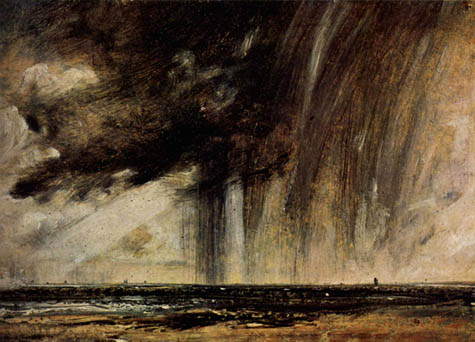
The above image of the Pelican Nebula, photographed by Charles Shahar at Caltech’s Palomar Observatory, brings to mind the later sky studies and weather paintings of John Constable, in particular Constable’s Seascape Study with Rain Cloud (1827). As if there are nebulas here on earth with us, moving through the sky (and through art history).

Stars, here, would be chemical weather that emits light.

[Image: John Constable, Seascape Study with Rain Cloud (1827); originally spotted at Pruned].

But such landscape comparisons only go so far; here are a few more photographs from the book, which you can buy at Amazon.

[Images: (top) The bewilderingly beautiful Cat’s Paw Nebula, photographed by T.A. Rector at the University of Alaska, Anchorage; (middle) The Witch Head Nebula, photographed by Davide De Martin at the Palomar Observatory; (bottom) The Rosette Nebula, photographed by J.C. Cuillandre (Canada France Hawaii Telescope) and Giovanni Anselmi (Coelum Astronomia)].

That final image shows us “3000 cubic light years of gas… heated to a temperature of over 10 million degrees Fahrenheit.” To my discredit, I have never thought of volumes of space in terms of “cubic light years” before—it’s an extraordinary unit of measurement. Perhaps someday it could even be applied to data: teraflops be damned, our future harddrives will be filled with cubic light years of information.

Who rules the night

[Image: “Top 9 Ninja Characteristics of Awesome Architecture Blogs” by Linda Bennett].

Sydney-based blogger, architecture student, comic book illustrator, and muscle car enthusiast Linda Bennett has produced a beautifully tongue-in-cheek guide to the “Top 9 Ninja Characteristics of Awesome Architecture Blogs.”

Summoning up her own ninja army from blogs like Super Colossal, City of Sound, ArchDaily, ArchitectureMNP, and Inhabitat, Bennett’s graphic skills—and sense of humor—are on colorful display. The weapons given to designboom would inspire terror in any foe.

Bennett has also been running an occasional series of interviews on her site; check out her conversations with Bjarke Ingels, Gerard Reinmuth, and Andrew Maynard—and here’s hoping she sits down someday to record one with fellow Sydneysider, and “Super Strength” blogging ninja, Marcus Trimble.

And, for that matter, here’s hoping Bennett keeps producing more comic strips!

The Blobwall and the Bomb

[Image: Operation Sailor Hat, before detonation, via Wikipedia].

It’s a house, it’s a ziggurat, it’s… 500 tons of TNT stacked in a dome on the Hawaiian island of Kaho’olawe. A later test-detonation of these architecturally arranged fissile materials left a huge, still-extent crater that “currently contains unique sub-species of shrimp” that have “evolved to survive the hypersaline conditions” in the artificially excavated hole.

Bringing to mind Greg Lynn’s Blobwall—amorphous and multicolored plastic “bricks” whose puzzle-like stacking produced (unfortunately quite garish) enclosures—or even Gramazio & Kohler’s robot-built wall in New York City, Pike Loop, the dome implies a kind of militarized vernacular through which new, functional architectures can be constructed.

20th-century prefab modularity by way of well-placed bricks of TNT.

[Image: Greg Lynn’s Blobwall, on display at SCI-Arc].

But perhaps someday we’ll see autonomous instruments of robotic war crawling behind enemy lines, building fantastically elaborate, Dr. Seussian architectures on the shores of foreign continents. Artificially intelligent 3D printers, producing bomb-domes—explosive ziggurats—vast and terrible buildings awaiting their detonative spark from the sky.

Art Trap

[Image: From Art Trap by Minsuk Cho].

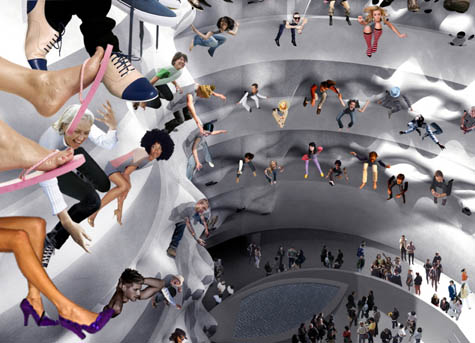
In an amazing response to the Guggenheim Museum’s Contemplating the Void call-for-ideas (mentioned in the previous post), architect Minsuk Cho has proposed Art Trap.

Explaining their approach, the architects write that “the Guggenheim has become, in a sense, a victim of its own success due to an over-saturation of human movement in a singular space. Our proposal aims to accomplish the seemingly incompatible: to restore a museum environment conducive to experiencing art and to maximize and heighten other experiences brought about by the iconic status of the museum itself.”

The specific strategy here is “to trap, i.e., to force a pause. This programmatic component was not considered by Wright, who envisioned a space defined by tireless motion.”

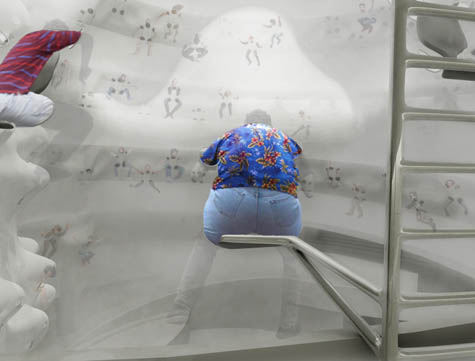
[Images: From Art Trap by Minsuk Cho].

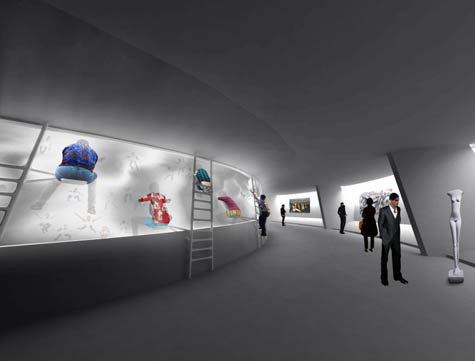
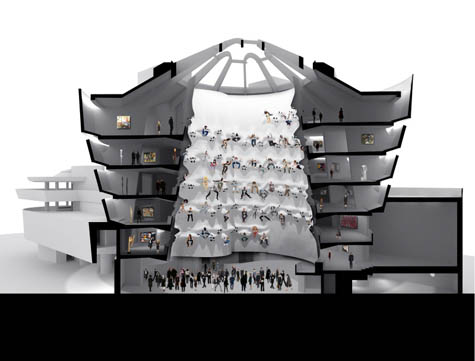
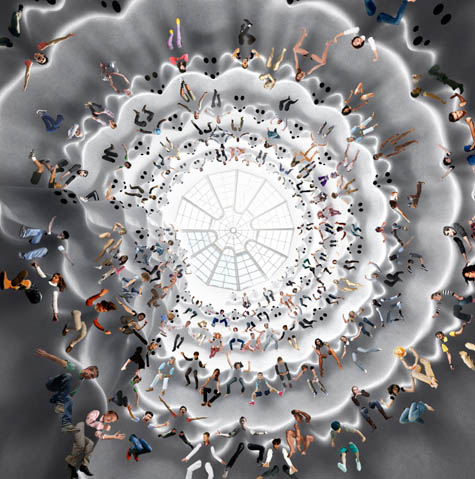
The resulting project is a gigantic membrane stretched throughout the interior, supplying “180 saddle-like seats along the entire ramp for pausing and viewing the rotunda.”

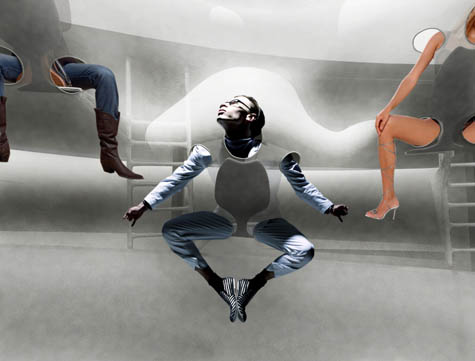
These seats protrude into the void with access ladders arranged in between the floor and the ceiling over the guardrails. Each of the 90 access ladders holds two cantilevering seats, which are angled gradually as they ascend to allow a view of the central area at ground level that functions almost like a stage—as though the rotunda were a new hybrid of opera house and arena. The 180 protrusions over the void are draped with a single, soft and translucent membrane that functions as a safety net.

There is no mention of a user weight-limit.

[Image: From Art Trap by Minsuk Cho].

The architects continue, writing that “the pop-out pods, each approximately 60 cm deep, contain seats,” and “each pod has five openings for the head and limbs, which make the membrane”—and I love this metaphor—”much like a garment that can be worn collectively by 180 people.”

Imagining a piece of clothing so huge you mistake for a building is an awesome change in both scale and context; you would go inside by putting the building on, slipping in one arm at a time.

Of course, this also raises the possibility of tailoring clothing specifically to function only within certain very specific architectural structures: nylon tights that only make sense to wear when seated in one of Cho’s “pop-out pods,” or sweaters that allow you to experience the spatial extravagance of luxury elevators at a new W Hotel in London. You and some friends zip yourselves up into the wall, forming a new private room that would otherwise not be there.

[Images: From Art Trap by Minsuk Cho].

But Cho saves the best analogy for last: once the overflowing crowds of art-drunk tourists come to fill the “pop-out pods,” it “as if they were performing as a part of a living Baroque ceiling sculpture.”

[Image: From Art Trap by Minsuk Cho].

I had the pleasure of seeing Cho present this project in person at a lecture he gave back in October at Columbia University; this was the project with which he kicked-off the evening, and it set a fantastically giddy tone for the rest of Mass Studies’ work.

You can see this and other projects at the forthcoming Contemplating the Void exhibition at the Guggenheim Museum, opening February 12, 2010.

Spiral Icon

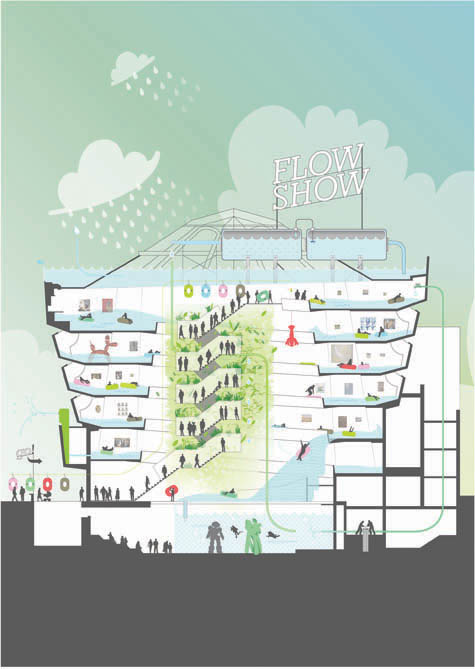
[Image: Flow Show by WORKac (2009)].

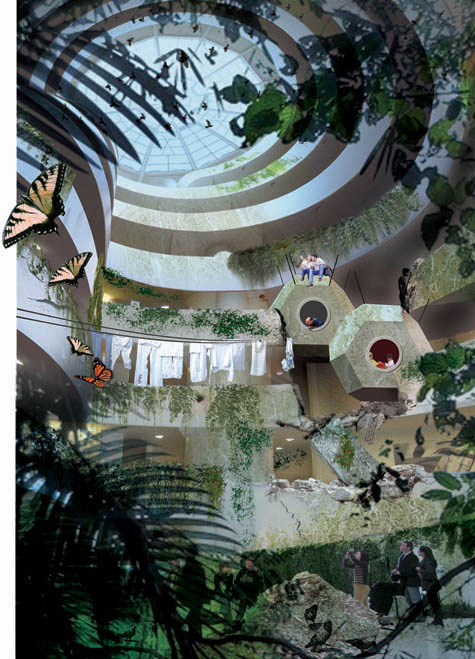
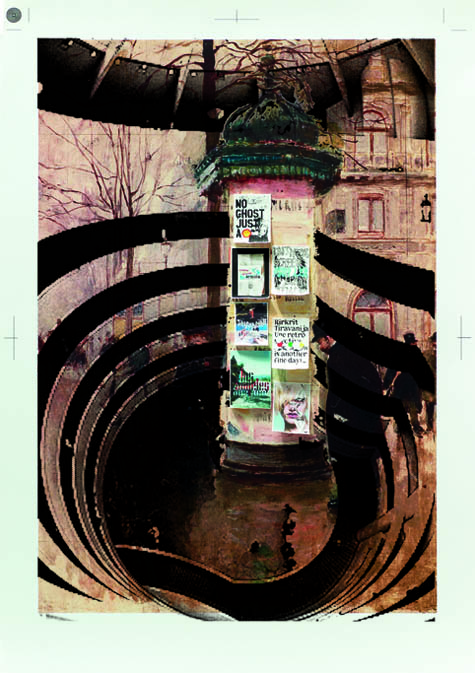
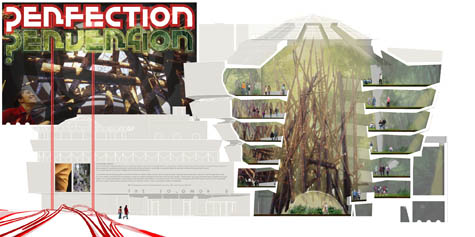
For a forthcoming exhibition called Contemplating the Void, New York’s Guggenheim Museum “invited more than two hundred artists, architects, and designers to imagine their dream interventions in the space.”

In this exhibition of ideal projects, certain themes emerge, including the return to nature in its primordial state, the desire to climb the building, the interplay of light and space, the interest in diaphanous effects as a counterpoint to the concrete structure, and the impact of sound on the environment.

Many of the images provide great eye-candy, as you’ll see, and I’ve included the best of those here (with my personal favorite coming up in the next post).

[Image: Untitled by N55 (2009)].

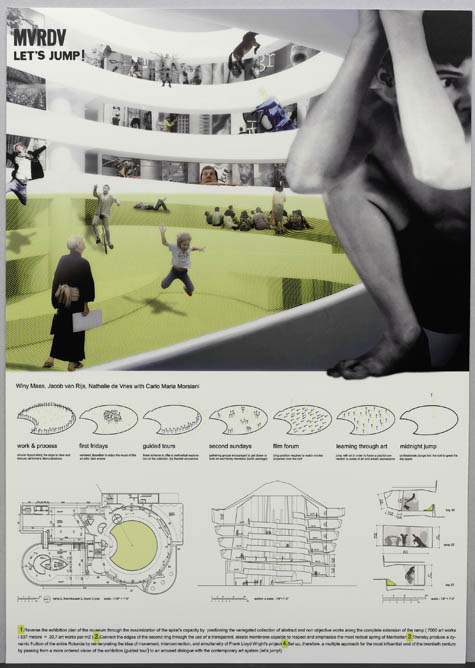
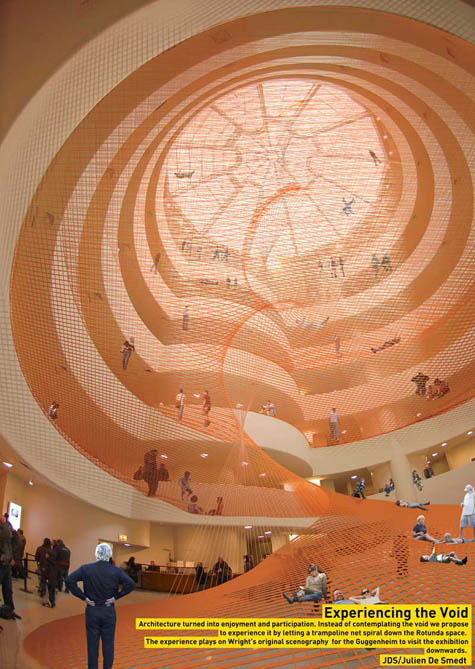
The interior is taken over by coastal rain forests; there are mystical arabesques of colored music wrapping upward in spatially impossible curls through the museum’s disappeared roof; there are trampolines and climbing nets strung from wall to wall above the lobby.

The Museum of Simulated Suicides, you could call it, where go to experience what it might be like to throw themselves into the void. You get a certificate of survival at the end.

[Images: (top) Let’s Jump! by MVRDV (2009) and (bottom) Experiencing the Void by Julien De Smedt Architects (2009), the latter project also depicted in Agenda, pubished earlier this month].

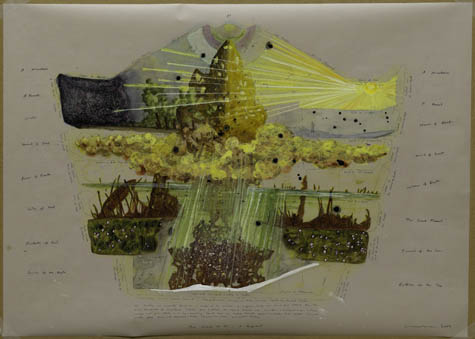
There are photo-collages and sectional diagrams of internally returning ecosystems.

[Images: (top) Morris in Guggenheim by M/M (2009), (center) Perfection_Perversion by West 8 (2009), and (bottom) The House of GI–A Proposal by Matthew Ritchie (2009)].
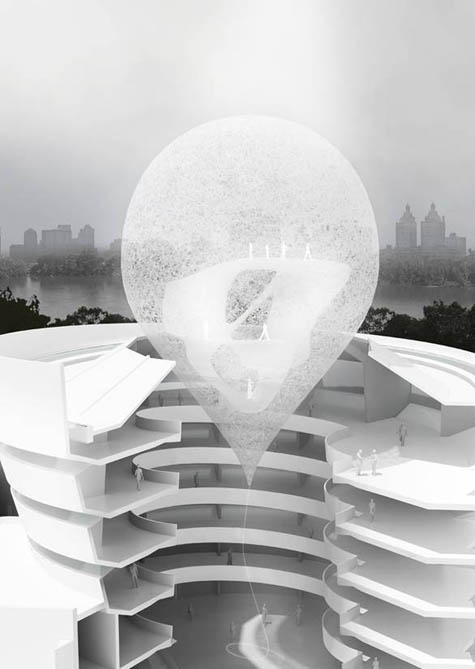
There are vast white balloons with visible structures trapped inside them rising out into New York’s winter skies—

[Image: State Fair Guggenheim by MAD Architects (2009)].

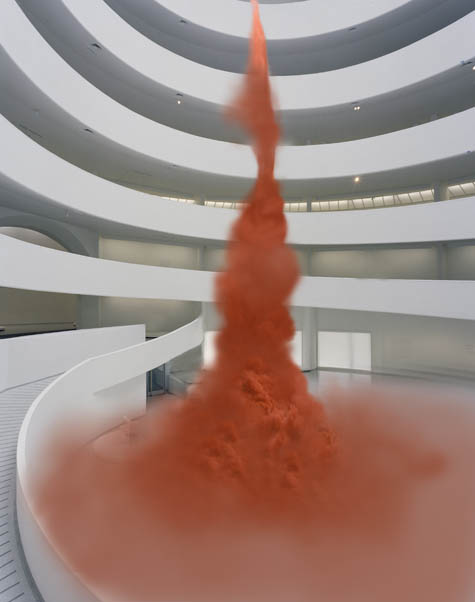
—as well as storms of red dust falling downward in a kind of gravitational pollution of the lobby.

[Image: Untitled by Anish Kapoor (2009)].

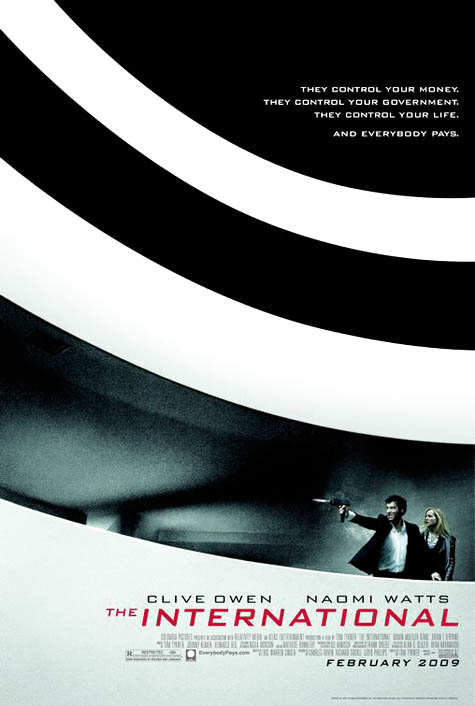
Perhaps predictably, though, I might say an even better intervention into the Guggenheim’s space is not a series of objects or architectural alterations at all, but an event—by which I’m specifically referring to one of 2009’s most talked-about spatial moments, at least in architectural circles, when we see that very same museum annihilated in a hail of bullets in the film The International.

[Image: A poster for The International featuring the Guggenheim Museum (2009)].

For all these calls for ideas and architectural design competitions, what if Hollywood set designers and location scouts are doing a more provocative job in non-preciously reimagining the inherited icons of the global built environment than 21st century architects?

These and many other images will be on display when the exhibition, Contemplating the Void, opens February 12, 2010.

Manhattan Paleolimnology

Temporary lakes have sprung up all over Manhattan again this week, sometimes more than twenty feet wide and a foot deep, spanning curbs and pooling in gutters, the aquatic remains of last week’s rain and snowmelt.

[Image: Photo by Flickr-user ShellyS].

This surprise limnology—often demanding new, indirect lines of approach from one side of the street to the next—reminded me of David Gissen’s recent, recommended book Subnature, which includes an entire chapter on urban puddles.

“Although we often think of puddles as inconsequential,” Gissen writes, “they appear in architectural history in prominent ways—in drawings of ruins, photographs of decaying buildings, and experimental designs that attempt to use water in provocative ways.” Now, however, “these stagnant pools of water, once signifying society’s vulnerabilities, appear to have disappeared in much contemporary work”; indeed, he adds, contemporary architects have seemingly always “viewed stagnant water with suspicion.” There is good medical reason for this suspicion, of course; indeed, the Centers for Disease Control advised last year that “neglected swimming pools“—i.e. stagnant bodies of water—are fast becoming vectors for mosquito-borne disease.

The CDC specifically cites “the adjustable rate mortgage and associated housing crises” as unexpected disease incubators: “Associated with home abandonment was the expanding number of neglected swimming pools, jacuzzis (hot tubs), and ornamental ponds. As chemicals deteriorated, invasive algal blooms created green swimming pools that were exploited rapidly by urban mosquitoes, thereby establishing a myriad of larval habitats within suburban neighborhoods,” they wrote.

In any case, Gissen describes “visions of the undrainable city” as a kind of sickly counterpart to the modern, infrastructurally managed, rational metropolis, pointing out that “the waters inundating the modern city rained from above and surged from below.” These overload our modern streets and sewers, bringing even 21st-century cities closer to the flooded Roman basements of Piranesi than to the hygienic visions of Le Corbusier, Gissen suggests. I’m reminded here of a disconcerting remark made by Alan Weisman in The World Without Us that the subways of New York City would be irreparably flooded within only 36 hours if the city’s underground pumps ceased to function.

While reading Gissen’s chapter on puddles, however, one of the first things that came to mind is that someone should produce a puddle map of New York—an urban atlas of temporary flooding. Set your parameters—puddles one foot deep by thirty-feet wide, say, or, more accurately, a volumetric guideline (at least one hundred square-feet of water or no less than 120 gallons)—and bring these fleeting aqueous forms into the geographic consciousness of the city.

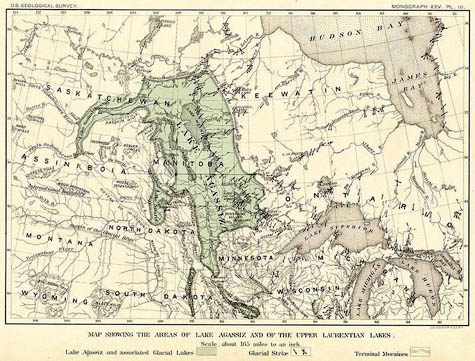
[Image: A map of glacial Lake Agassiz].

From one rainy season to the next, an accelerated paleolimnology of New York thus comes into being; the Lake Lahontans and Lake Agassizs of the five boroughs are given their cartographic due. Here a tiny lake once stood, historical plaques could read, bringing to mind a liquid version of Taylor Square, the famed “smallest park” in Cambridge, Massachusetts.

What monstrous puddles have existed in your neighborhood, and how have the urban circumstances of their existence changed over time? Did curb-cuts or new drains eliminate these hydro-geographies—or even make them worse? And whose lives have been affected by these unmapped bodies of water, whether through hydroplaning, sidewalk splashes, or even an expensive pair of ruined shoes?

Whole personal histories of human contact with puddles, and the effects such exposure might have, could be produced or recorded. This is extraordinary: we live beside temporary lakes and inland seas in cities all over the planet, yet these landmarks never make it onto our maps.

Rousseau and Echolocation

[Image: Perspective by Jan Vredeman de Vries; no explicit relation to this post].

Writing about the human experience of night before electricity, A. Roger Ekirch points out that almost all internal architectural environments took on a murky, otherworldy lack of detail after the sun had gone down. It was not uncommon to find oneself in a room that was both spatially unfamiliar and even possibly dangerous; to avoid damage to physical property as well as personal injury to oneself, several easy techniques of architectural self-location would be required.

Citing Jean-Jacques Rousseau’s book Émile, Ekirch suggests that echolocation was one of the best methods: a portable, sonic tool for finding your way through unfamiliar towns or buildings. And it could all be as simple as clapping. From Émile: “You will perceive by the resonance of the place whether the area is large or small, whether you are in the middle or in a corner.” You could then move about that space with a knowledge, however vague, of your surroundings, avoiding the painful edge where space gives way to object. And if you get lost, you can simply clap again.

Ekirch goes on to say, however, that “a number of ingenious techniques” were developed in a pre-electrified world for finding one’s way through darkness (even across natural landscapes by night). These techniques were “no doubt passed from one generation to another,” he adds, implying that there might yet be assembled a catalog of vernacular techniques for navigating darkness. It would be a fascinating thing to read.

Some of these techniques, beyond Rousseau and his clapping hands, were material; they included small signs and markers such as “a handmade notch in the wood railing leading to the second floor,” allowing you to calculate how many steps lay ahead, as well as backing all furniture up against the walls at night to open clear paths of movement through the household.

Entire, community-wide children’s games were also devised so that everyone growing up in a village could become intimately familiar with the local landscape.

Games like “Round and Round the Village,” popular in much of England, familiarized children at an early age to their physical surroundings, as did fishing, collecting herbs, and running errands. Schooled by adults in night’s perils, children learned to negotiate the landscapes “as a rabbit knows his burrow”—careful after dark to skirt ponds, wells, and other hazardous terrain. In towns and cities, shop signs, doorways, and back alleys afforded fixed landmarks for neighborhood youths.

Incredibly, Ekirch points out, “Only during the winter, in the event of a heavy snowfall, could surroundings lose their familiarity, despite the advantage to travels of a lighter, more visible landscape.” The mnemonic presence of well-known community landmarks has been replaced by what mammoth calls a “whitesward.”

But this idea, so incredibly basic, that children’s games could actually function as pedagogic tools—immersive geographic lessons—so that kids might learn how to prepare for the coming night, is an amazing one, and I have to wonder what games today might serve a similar function. Earthquake-preparedness drills?

In any case, we return to Rousseau. We see him advancing, now, heading forward into unknown architecture, dark space enveloping him on all sides, the walls fading into obscurity, black, leg-breaking stairwells threatening in the distance, unsure of where he stands, entirely alone in this shadow… until we hear a series of claps. And then another. Then one more.

And the philosopher, echoing himself, finding comfort and location based on objects he can’t see, soon works his way out of the labyrinth.

Music for Landscapes

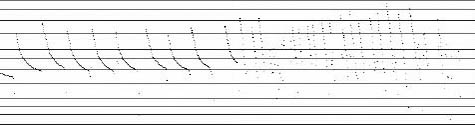
[Images: Two diagrams stitched together showing acoustics of bat echolocation at Carlsbad Caverns].
For those of you with audio-spatial interests, Word of Mouth on New Hampshire Public Radio ran a twenty-minute conversation between myself and Jace Clayton yesterday called “Music for Landscapes.”

We talk about urban acoustics, the sounds of flooded cities, DJing in ruined border towns on the divided island of Cyprus, some thoughts on echolocation by way of Jean-Jacques Rousseau, and more. Enjoy!

Geospatial Holograms

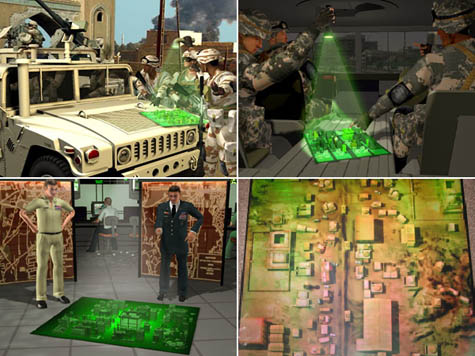
A firm called Zebra Imaging tells us about “geospatial holograms“—including the awesome handheld flashlight-sized projector seen below.

[Images: All images courtesy of Zebra Imaging].

Heavily pitching this as a military technology, citing its usefulness in “battle-space visualization” and “line-of-site analysis for sniper activity,” Zebra seems to under-appreciate the intense levels of interest this thing might generate in the civilian sphere. Hook one of these up to a projector phone and shine 3D holograms of urban space all around you. 3D narrative films of the future!

Geospatial holograms used in commercial and government applications typically enhance conventional 2D maps, aerial photos, and 3D physical scale models. Complex environments can be well understood using geospatial holograms much faster than with conventional 2D media.

But imagine the gaming possibilities with this thing, let alone the architectural applications: you step up to the front of the class and shine a hologram of your final thesis project onto the blank tabletop before you… Architectural lightsabers.

I don’t at all doubt the usefulness of portable holograms when it comes to invading enemy cities, but I have to wonder what a few games design students in New York or San Francisco could do with this.

Replace all the streetlights on 5th Avenue next year with Zebra Imaging technology and, instead of Christmas decorations, baroque mansions shine in holographic 3D… a new one every half-block for more than a mile, outlined against winter snow.

Or fly black airships over Rome and shine holograms of missing buildings down onto the city below you, ancient walls reappearing in a Batman-like flicker of urban unreality, people looking out their windows, stunned, at this laser archaeology from the sky.

(Link originally spotted via @geoparadigm).