Brutalism at Giza and the Iron Room Beneath the Pyramids

[Image: A pyramid at Giza, the earth archaeo-surgically opened at its base; courtesy of the Brooklyn Museum; for what it’s worth, this photo just knocks me out].

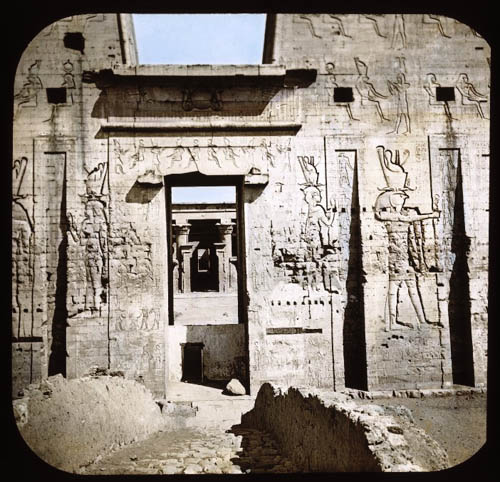
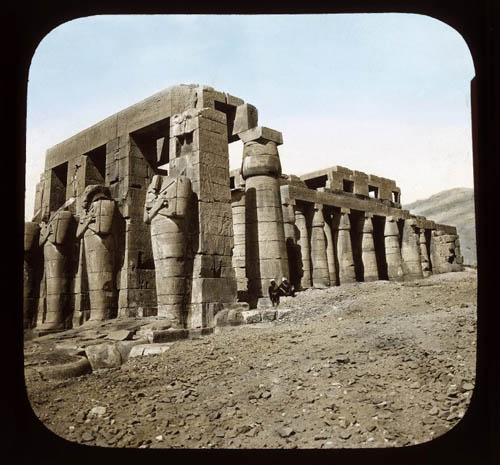
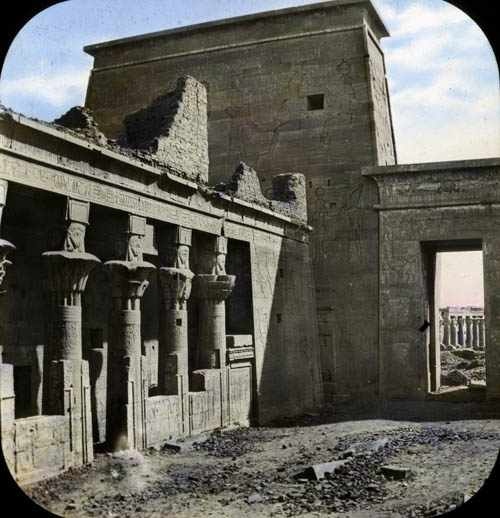
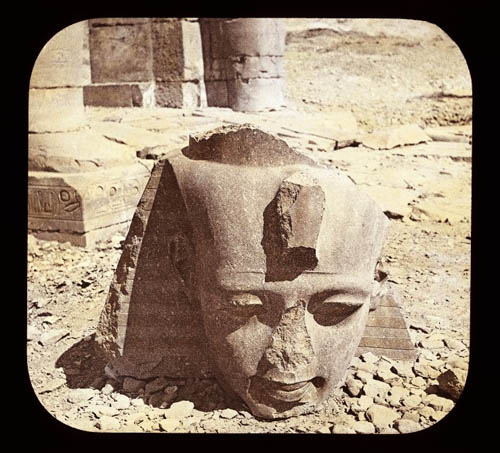
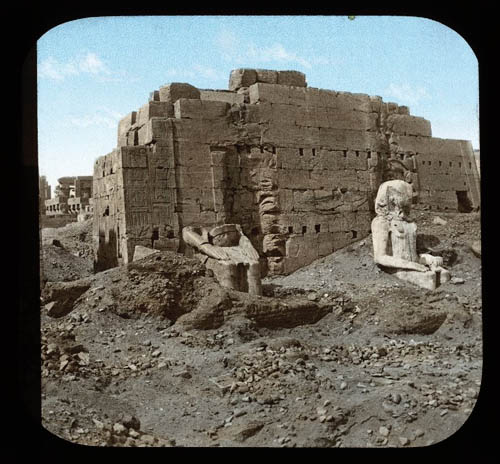
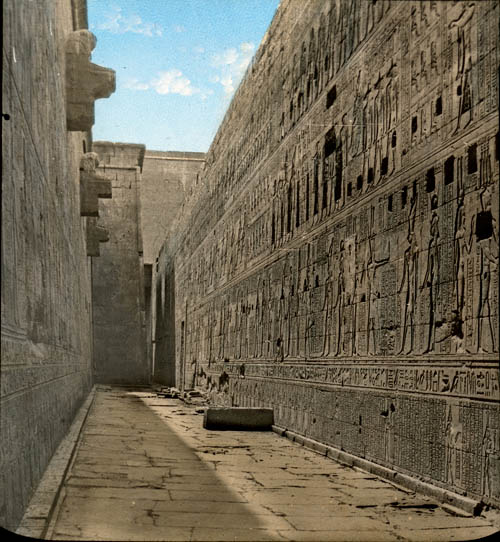
The Brooklyn Museum has an amazing collection of old lantern slides from Egypt, documenting that country’s archaeological history and monumental remains.

The shots above and immediately below, in which we see the pyramids at Giza, exude a stage-set quality: the diffuse and hand-colored light, the foreshortened perspective, and the cut-away glimpse into a world of subterranean vaults lending an air of surreality to the whole collection.

[Image: Giza, courtesy of the Brooklyn Museum; for what it’s worth, this photo just knocks me out].

Overall, the architecture captured in these images is a mixture of deeply shaded, geometric minimalism—

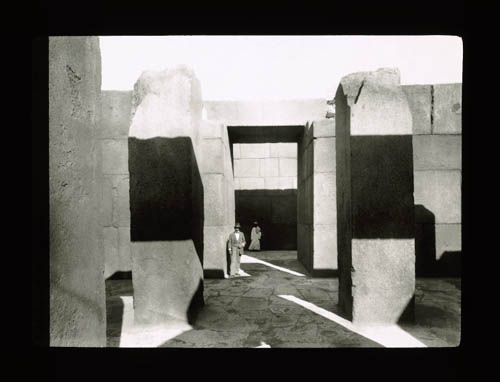
Egypt, GizehEgypt, Gizeh[Images: Brutalism at Giza, circa 2,500 B.C.; courtesy of the Brooklyn Museum].

—wed with moments of ornamental grandeur, as hieroglyphic bas-reliefs, revealed by passing angles of sunlight, offer whole worlds of spatial detail. Stone inscriptions become less like something you might read, in other words, and more of a spatial experience in their own right.
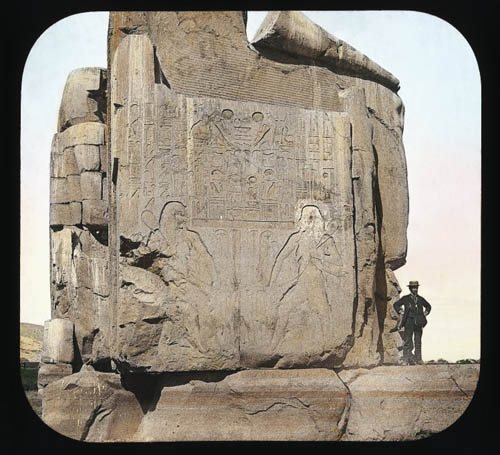
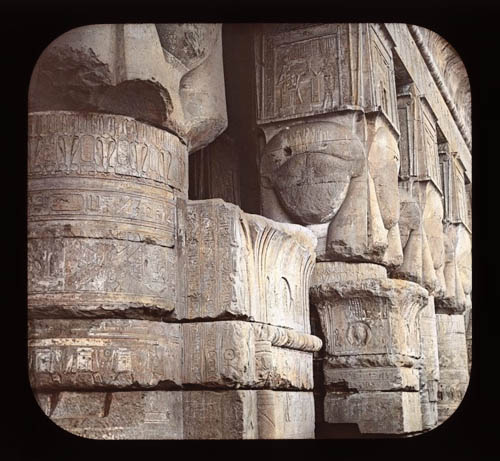
Egypt, ThebesEgypt, DenderahEgypt, EdfuEgypt, ThebesEgypt, PhilaeEgypt, ThebesEgypt, KarnakEgypt, Edfu[Image: Ruins in light, courtesy of the Brooklyn Museum].

I’m reminded here of one of my favorite stories of all time, which is that of physicist Luis Alvarez. In the September/October 2008 issue of Archaeology magazine, author Samir Patel explained how Alvarez used a device called a muon detector “to scan the inside of an ancient structure,” which, in this case, was Khafre’s pyramid at Giza.

“Working with Egyptian scientists in the late 1960s,” Patel explains, Alvarez “gained access to the Belzoni chamber, a humid vault deep under the pyramid.” There, “Alvarez’s team set up a muon detector called a spark chamber, which included 30 tons of iron sheeting, in the underground room.” This image—of foreign physicists building iron rooms beneath the pyramids in a search for secret chambers based on cosmic particles raining down from above—is one of the coolest things I have ever read in my life.

[Image: An illustrated depiction of the physicists’ sub-pyramidal adventures; view larger].

As it happens, Alvarez’s work was not without local controversy:

Suspicion of the research team ran high—here was a group of Americans with high-tech electronics beneath one of Egypt’s most cherished monuments. “We had flashing lights behind panels—it looked like a sci-fi thing from Star Trek,” says Lauren Yazolino, the engineer who designed the detector’s electronics.

Alvarez’s humid iron room beneath the pyramid—like a collaborative project by Lebbeus Woods and Mike Mignola—took one full year to perform its work. At that point, when the team finally took a long look through its gathered data, Yazolino “spotted an anomaly, a region of the pyramid that stopped fewer muons than expected, suggesting a void.”

There were still undiscovered rooms inside the structure.
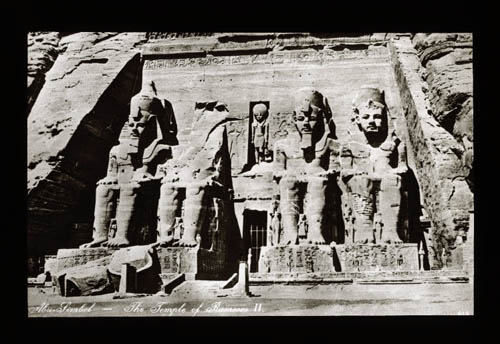
Egypt, AbuSimbel[Image: Tombs at Abu Simbel, Egypt, courtesy of the Brooklyn Museum].

In any case, you can find these and many more on the Brooklyn Museum’s website; just go to the Lantern Slide Collection (including this write-up of the Lantern Slide Collection’s history) or to this Flickr set. The specific images seen here come from subsidiary collections: Giza, Thebes, Karnak, Philae, Abu Simbel, Edfu, Denderah, and so on.

This final image, below, featuring a doorway embedded in the hills—perhaps leading down into iron rooms, and further into spark chambers, and beyond even those into unmapped humid vaults—is particularly fantastic.
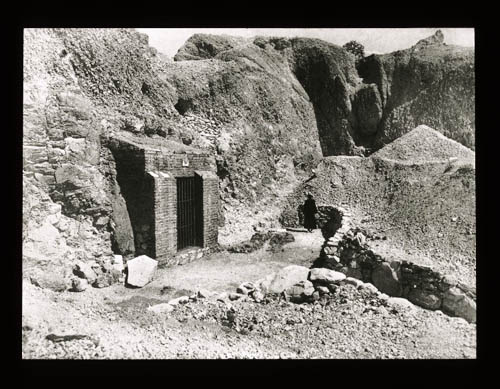
Egypt, Middle Kingdom[Image: The hollow hills of Egypt’s Middle Kingdom, courtesy of the Brooklyn Museum].

(Via @stevesilberman).

It’s the Trees

[Image: Tree pollen map, brought to you by the Weather Channel].
One of the most memorable posts on Pruned, I think, was written way back in September 2005, when Alex took a look at what he called “litter-free landscapes and the politics of pollen.” He quoted horticulturalist Thomas Leo Ogren at length:

In our urban landscapes we now have the most manipulated kind of city forest ever seen. In the past twenty years landscapers have grown inordinately fond of using male trees. In dioecious species (separate-sexed) there are separate male trees and separate female ones. Female trees and shrubs do not produce any pollen, ever, but they do produce messy seeds, fruits, old flowers, and seedpods. Landscapers and city arborists consider this female byproduct to be “litter”, and they don’t like to see it lying on our sidewalks.

In other words, urban landscapers over-utilize pollen-intensive plantlife—which, in turn, wildly amplifies seasonal allergies. What if you didn’t need more boxes of Claritin, then—you need a more informed city parks department?

I was thus thrilled when Alex pointed out that Ogren had written an op-ed piece for the New York Times, revisiting these very ideas. “As certain trees burst into bloom in spring,” Ogren writes, “their pollen wafts through the air in a wanton attempt to reach receptive blossoms.”

Millions of people with allergies pay the price, in sneezing, wheezing, coughing, drowsiness and itchy, watery eyes. They needn’t suffer so much. Cities could reduce the misery by planting street trees that produce very little pollen or none at all.

Approaching public health from the perspective of landscape design—streetscape botany—together with the unexpected history of our growth in urban allergies, is absolutely fascinating. “Street trees weren’t always as allergenic as they are today,” for instance, Ogren writes.

Back in the 1950s, the most popular species planted in the United States was the native American elm, which sheds little pollen. Millions of these tall, stately trees lined the streets of towns and cities from coast to coast. Sadly, in the 1960s and ’70s, Dutch elm disease killed most of the elms, and many of them were replaced with species that are highly allergenic.

Whether you suffer from allergies or not, the op-ed is worth reading in its entirety.

(Via Pruned).

Sydney Beaches, Future Towers, and How to Park Cars on the Moon

Linda Bennett of Archi-Ninja has posted an interview with Sydneysider architect and fellow blogger Marcus Trimble.

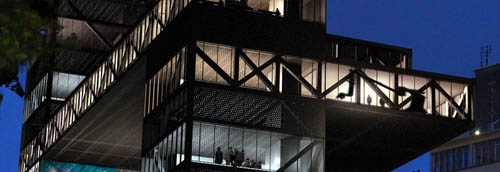
[Image: Proposal for a new UTS Tower by Super Colossal].

By way of some historical context, Marcus was writing one of the few architecture blogs out there, during an earlier phase in the field (say, 2004-2005), when Archinect, City of Sound, Archidose, Strange Harvest, we make money not art, Life Without Buildings, things magazine, and not a lot of others (though some deserving sites have been left out of that truncated and subjective list) were the only blogs offering consistent architectural coverage. Inhabitat didn’t exist till mid-2005; same with Pruned; Subtopia had yet to be launched; and the bigger sites today, like Dezeen, which sidestep architectural journalism altogether to focus simply on image reproduction and/or social networking, were still years away.

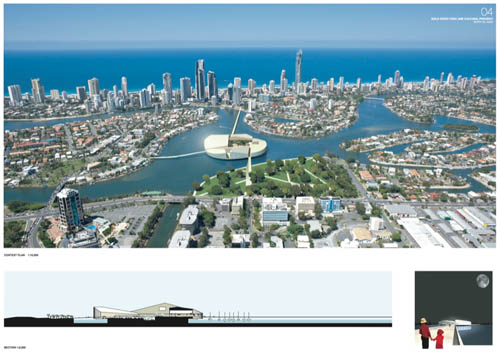
But there was Marcus, writing his first blog gravestmor—which lasted from May 18th, 2004, to July 12, 2007—a site that morphed into a blog for his own architectural practice, Super Colossal. That firm has since gone on to win first place in the Gold Coast Performing Arts Centre design competition (proposing a sort of inhabitable bridge -slash- artificial harbor island), as well as the high-profile Australian Peacekeeping Memorial (and their overlooked design for a new UTS Tower, which can be seen in the image above). Of course, those are in addition to several finished projects, including a private house, apartment, bathroom renovation, and the internet-famous cardboard cubby house.

[Image: Super Colossal’s competition-winning design for Gold Coast Performing Arts Centre].
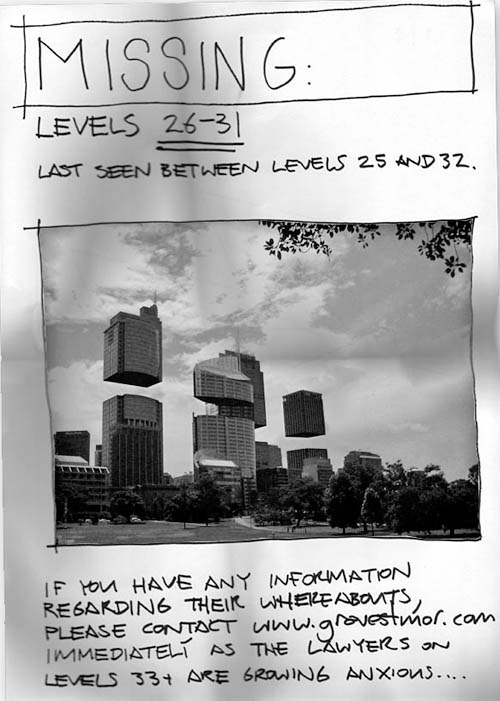
But it’s Marcus’s roving and very widespread field of interests that made gravestmor so appealing, and that Super Colossal extends today—whether it’s his ongoing explorations of comic book architecture, steampunk spaces, the racial politics of Sydney beaches, how to park cars on the moon, urban space as depicted in the work of J.G. Ballard, his suggestion that China might really be a USB external harddrive for the French, and much more. This was actually the first post I ever remember seeing over there—and I was pretty much hooked from then on.

[Image: “Lost and Found” by Marcus Trimble].

In any case, the interview over at Archi-Ninja is a bit on the short side, and I would love to hear more from Marcus about his active organizational role down there in Sydney, promoting that city’s architects and their work both to one another and to the rest of the world. But it’s still worth a read, covering space elevators, the films of Stanley Kubrick and Michael Mann, the future of the architect, running in the city, and more.

Chocolate City

[Image: Via Edible Geography].

In a long new post, Edible Geography takes a look at the planned cities of chocolate barons, suburban sites where the capitalist ideal of a company town overlapped with philanthropic inclinations toward utopia. Quoting at length:

The towns that chocolate built are a curious blend of idealistic vision and pragmatic company town—the convergence of paternalistic benevolence and capitalist expedience. The Cadbury and Rowntree brothers were devout Quakers, whose humanitarian beliefs undoubtedly impelled them to improve the living conditions of their workers. Hershey’s benevolence seems not to have been motivated by religious belief, despite the fact that he was raised by a strict Mennonite mother. However, he was undoubtedly a grand philanthropist, anonymously giving away his entire personal fortune (an estimated value of $60 million in 1918) at the age of sixty-one to endow a school for poor and orphan boys.

Nonetheless, as Tim Richardson is quick to point out [in his recent book Sweets], “philanthropy was always accompanied by efficiency in these developments.” Hershey chose his rural location, for example, less from a desire to ensure his factory workers had access to healthy, rural air, than for strategic gain—deep in dairy-farming land to ensure a cheap supply of milk, but close enough to major cities (Philadelphia and New York) to allow cost-efficient distribution.

The design, planning, economic administration, and cultural history of these chocolate cities would be a fascinating subject for a longer book (or Ph.D.).

Until then, see a related—and similarly titled—story over at Lapham’s Quarterly, then check out the Edible Geography post in full.

Speculative subways for landscapes with no need for them

I’m a big fan of these speculative subway maps in which underground transportation systems have been projected for landscapes in which their actual construction would be absurd.

[Image: A speculative future subway map by Transit Authority Figures].

Indeed, in many cases, constructing a subway in these sites—Acadia National Park, for instance, seen above, or Martha’s Vineyard—would not only be technically ridiculous, or simply surreal, it would be a disaster.

[Images: Maps by Transit Authority Figures].

Designed by Transit Authority Figures, there are currently nine posters to view (and purchase).

[Image: By Transit Authority Figures].

Hopefully more maps are forthcoming—and it would be great to see more sites outside of New England. A subway for Rocky Mountain National Park, say, or the Galapagos. How about the Greek island of Patmos, where St. John so famously experienced his revelation? Or mechanized travel beneath the Antarctic base at McMurdo. Marrakech. The Florida Keys.

Keep your eye on the Transit Authority Figures’ poster page to see what might come next.

(Via @stevesilberman).

Ice Cream Climatology

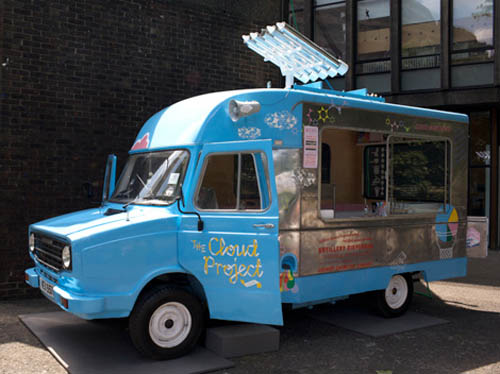
[Image: The Cloud Project van by Zoe Papadopoulou and Cathrine Kramer].

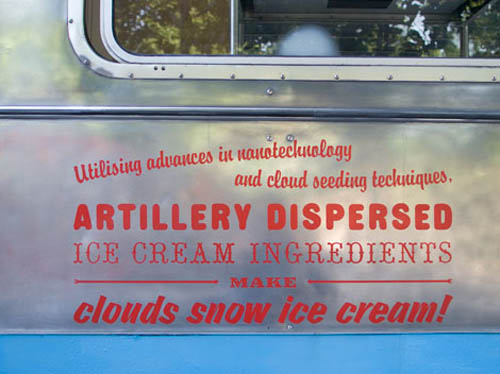
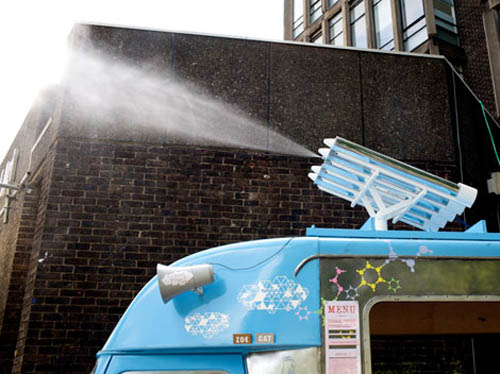
Like a whimsical hybrid of molecular gastronomy and Glacier/Island/Storm, the Cloud Project by Zoe Papadopoulou and Cathrine Kramer, design-interaction students at London’s Royal College of Art, would use “artillery dispersed ice cream ingredients,” fired from roof-mounted cannons, “to make clouds snow ice cream.”

[Images: From the Cloud Project by Zoe Papadopoulou and Cathrine Kramer].

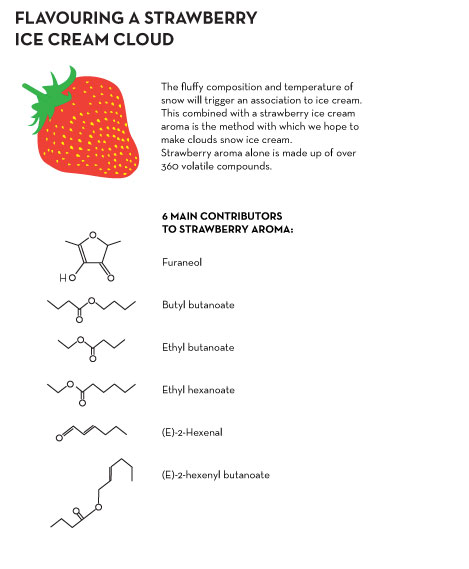
The van’s projectile clouds of aerosolized nanotechnology would kick-start snowflake formation high above—seemingly inspired by the cloud-producing exhalations of open-ocean algae—but they would also then scent the resulting snowfall with the aroma of fresh strawberries.

The result? Ice cream, delivered soft, cold, and delicious, falling straight from the afternoon sky. Perhaps we’ll soon all need ice cream gloves.

[Image: A how-to guide for precipitating strawberry ice cream by Zoe Papadopoulou and Cathrine Kramer].
Oddly, BLDGBLOG proposed a variant on this—scented snow—a few years back, so it should come as no surprise that I think it’s at least worth a shot. After all, what could possibly go wrong?

But it’s worth asking what other foodstuffs might also be made to precipitate directly from the summer sky—when agriculture gives up the ghost, say, or once our planetary soils have been entirely depleted, could we someday farm the sky? Aerocultural precipitation: nutrition fresh and direct from the planet’s atmosphere.

And what a strange planet it would be if this somehow sparked runaway ice cream climate change: unstoppable drifts of Chunky Monkey filling the streets of Montreal, vast glaciers of the stuff carving valleys through Antarctic plains.

(Thanks to Liam Young for the tip! Speaking of food, meanwhile, don’t miss the previous post about this coming weekend’s quarantine banquet).

Digital Analog

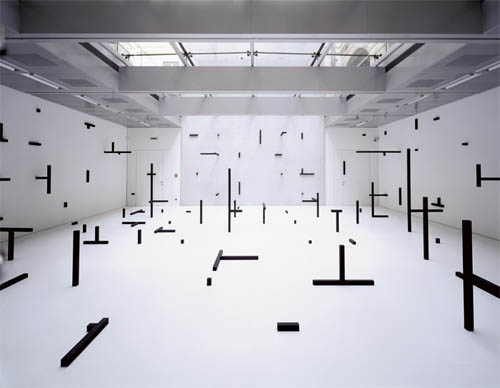
[Image: O.T. (2006) by Esther Stocker, photographed by Rainer Iglar].

Here are two projects by artist Esther Stocker. They both use the black, abstract outlines of fragmented spaces to suggest much larger architectural shapes. There is the implication in each that, if only you could stand in the right place, at the right angle, all of these detached typographies of edges and corners might merge, Felice Varini-like, overlapping backward through the stages of a slow explosion, to form a building.

[Image: Abstract thought is a warm puppy (2008) by Esther Stocker; photo by Sacha Georg].

But each of these also has the optical side-effect of generating what looks like an immersive matrix of information hovering somewhere in the room in front of you, the stark contrast between black and white, and the geometric clarity of the pieces, taking on a disconcertingly digital air.

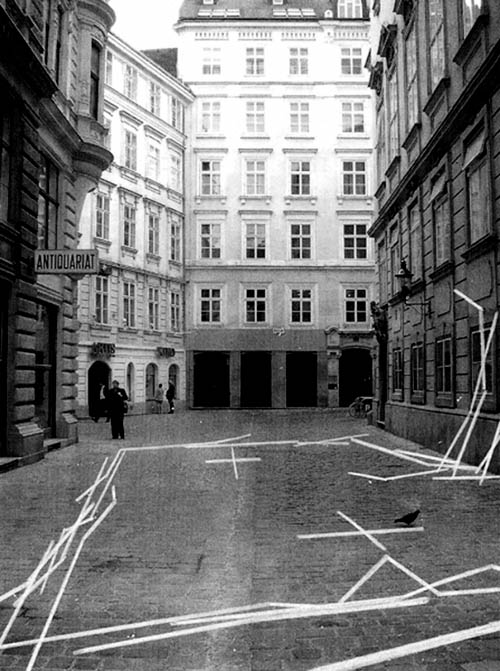
Tangentially, I’m reminded of the System Wien/”Architecture of Energy” project by Lebbeus Woods and Christoph Kumpusch, which translates a series of seemingly directionless sketches of white lines in black space—

[Image: From System Wien/”Architecture of Energy” by Lebbeus Woods and Christoph Kumpusch].

—into reflective implications of perimeters, the outermost envelopes of buildings that don’t exist, when “drawn” onto city streets with metal pipes.

[Images: System Wien by Lebbeus Woods and Christoph Kumpusch installed on the streets of its urban namesake].

This up-scaled materialization of the 2D sketch—from flat line on paper to angular filling of space, built with what Woods calls “vector rods”—for me also has the optical effect of gesturing toward something that doesn’t really seem to be there. In other words, these pipes, so reflective as to appear white, seem more like retinal tears (or even scratches in the negative), not objects that you can actually see or touch somewhere out there in the city. They are pieces of an invisible building—like fingernail clippings of space.

(Esther Stocker spotted via but does it float).

Trophy Hunter

[Image: From Trophy Hunter by Bryan Christiansen, on display at the Nevada Museum of Art till May 9].

While out in Reno last month, in addition to our virtual spatial adventure relayed in the previous post, we stopped in for a few great shows at the Nevada Museum of Art.

The photos here are from Bryan Christiansen’s Trophy Hunter, which is up through May 9, in case you can stop by. The basic idea here is great: Christiansen treats “discarded household furniture that he finds in neglected urban areas” as rare animals found on a hunt.

[Image: From Trophy Hunter by Bryan Christiansen at the Nevada Museum of Art].

He skins them, mounts their resulting pelts on the wall, and then digs through the cracks, stuffing, folds, and hollows to store whatever lost objects remain.

[Image: Trophy Hunter by Bryan Christiansen at the Nevada Museum of Art].

These gutted insides thus “stand in for the trophies, antler mounts, and pelts so often prized by hunters,” the museum explains, Remote controls, stained upholstery, scattered coins, buttons, and much more are all displayed like preserved organs and prized cuts of meat, the trappings of a wild hunt as played out in the world of home furnishings.

[Images: From Trophy Hunter by Bryan Christiansen at the Nevada Museum of Art].

The furniture that is thus skinned and gutted is then reassembled into totemic animal forms, like some strange new shamanism of couches. These creatures now stand alert throughout the gallery space, their bodies ingenious reconfigurations of wooden legs, springs, and seat frames.

[Images: Trophy Hunter by Bryan Christiansen, on display at the Nevada Museum of Art].

There is something genuinely amazing, for me, in this almost animistic approach to the world of sofas, kitchen chairs, and love-seats; there is also an eye-opening candor in Christiansen’s recognition that many of these furnishings were wearing animal skin in the first place: leather couches and den chairs and more all already surfaced in the flesh of living creatures. The hunt analogy is both artistically inspired and materially appropriate. Even the case of an artificial covering—such as polyester or vinyl—being hung up like the skin of a prized animal takes on a post-natural ring that leaves me stunned.

It’s like a scene from John Carpenter’s 1984 film Starman, where Jeff Bridges brings back to life a deer that was recently shot and killed by hunters: only, in this case, artist Bryan Christiansen walks into a room and the furniture around him comes creaking back to life, broken apart and shelved in pieces, but welcomed back to the realm of animal nature.

Optical Spelunking

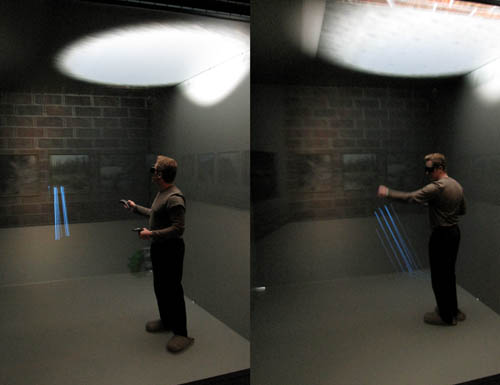
[Image: The CAVE at the Desert Research Institute in Reno, now called the CAVCaM].

I mentioned a week or two ago that I had been out to Reno, Nevada, visiting, among other things, the Desert Research Institute, where Nicola Twilley of Edible Geography, Mark Smout of Smout Allen, and I began a roadtrip down to Los Angeles, through San Francisco—less a city than a peninsular amphitheater of conflicting microclimates—by way of the Virtual Reality CAVE that you see pictured here.

[Image: Daniel Coming, Principle Investigator of the CAVCaM, manipulates geometries that don’t exist, and we photograph him as he does so].

The facility is no longer called the CAVE, I should add; it’s now the CAVCaM, or Center for Advanced Visualization, Computation and Modeling. CAVCaM “strives to maintain a state-of-the-art visualization system, improve data collections, simulations, and analyses of scientific information from the environment.”

Advancements will create new capabilities for multidisciplinary research, produce top tier visualization environments for use by the broader scientific community, and offer opportunities to improve management decisions including prediction, planning, mitigation, and public education throughout Nevada and the world.

It also blows the minds of landscape theorists and practitioners in the process.

[Image: Touring virtual light].

In most of the photos here you see Matthew Coolidge from the Center for Land Use Interpretation, Bill Gilbert from the Land Arts of the American West program, and activist landscape historian and theorist Lucy Lippard all trying their hands at setting virtual forest fires, chasing digital terrains off cliffs, and navigating a world of overlapping proximities that sewed together around us like high-end neurological garmentry—a perfectly tailored world of pharaonic nonexistence, standing in tombs of imagery and light—to become almost seamlessly 3D. Glimpsing, in advance, possible afterlives of the optic nerve.

[Image: Cthulhoid satellites appear in space before you, rotating three-dimensionally in silence].

Of course, these photos also show the inteprid Dr. Daniel Coming, “Principle Investigator” of the CAVCaM—a fantastic job title, implying that this strange machinic environment that the DRI has built isn’t so much put to use, in a dry, straight-forward, functional way, but investigated, researched, explored. Daniel showed us all how to use the hand controls, putting on a display of virtual light and shadows. Objects that were never built, reflecting light that isn’t real.

We were all there on an invitation from the staff of the Nevada Museum of Art—who don’t appear in these photographs, but were absolutely key in making this tour happen.

[Images: Photos by BLDGBLOG and Nicola Twilley].

For whatever reason, meanwhile, that last photograph, above, featuring Matthew Coolidge, Bill Gilbert, and Lucy Lippard seemingly entranced—as we all were—by this new altarpiece of virtual surfaces, reminds me of the final lines from R.S. Thomas’s old poem “Once”:

Confederates of the natural day,
We went forth to meet the Machine.

Or perhaps it was the Machine that has come to meet us.

[Image: The CAVCaM reboots after a universe of simulation].

New World Order

[Image: Work by Shannon Rankin, taken from the artist’s Flickr page].

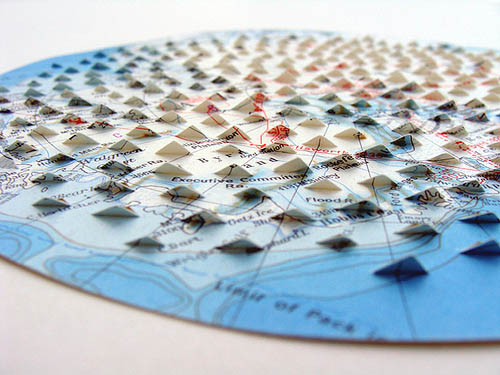
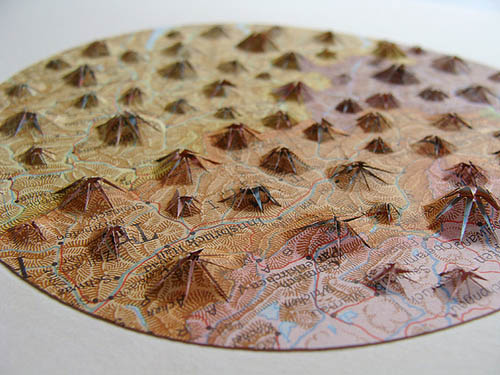
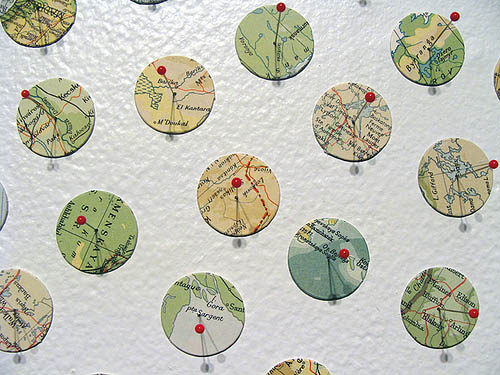
Artist Shannon Rankin does amazing things with maps. Treating them as mere pieces of decorated paper to be manipulated—clipping out spirals, folding crevassed roses of ridges and faultlines, pinning up confetti-like clouds of circles and zigzags—she creates “new geographies, suggesting the potential for a broader landscape.”

[Image: Work by Shannon Rankin, taken from the artist’s Flickr page].

The maps thus become more like the terrains they originally referred to: textured, complex, and subject to eruption. Unexpected forms emerge from below—like geology, overlapping, igneous, and dynamic.

[Images: Shannon Rankin, taken from the artist’s Flickr page].

Outlines of new island continents appear in the process, polar regions and archipelagoes that out-Dymaxion Buckminster Fuller in their collaged vortices and coasts.

[Image: By Shannon Rankin, taken from the artist’s Flickr page].

All of the works you see here come from Rankin’s Flickr page—specifically, the Uncharted, Bayside, ETA6, Maps, and Aggregate sets, where there are many other images to see.

[Images: All works by Shannon Rankin, taken from the artist’s Flickr page].

But seeing these makes me want to feed full-color sheets of obscure maps through laser-cutting machines, slicing elaborate and random geometries to reveal the longest possible distance between two adjacent things, or to discover previously unknown proximities, the whole Earth cut-up and unspooled like a lemon rind.

[Image: By Shannon Rankin, taken from the artist’s Flickr page].

There are a variety of distinct styles at work, as you can see, from tiling and tesselation to straight-ahead origami.

[Images: All works by Shannon Rankin, taken from the artist’s Flickr page].

Another approach is to reduce every map to capillaries—pure roads. The geography is simply how you get somewhere.

[Image: Work by Shannon Rankin, taken from the artist’s Flickr page].

And lest all of these look diminutive, or simply too tiny to see, the scale of execution is often surprising.

[Images: By Shannon Rankin, taken from the artist’s Flickr page].

If you want to see some of these in person, meanwhile, work from Rankin’s Convergence set are on display now through April 17 at the Craftland Gallery up in Providence, RI.

Consider supporting her work, as well, by purchasing a piece or two; you can contact the artist via her webpage.

(Originally spotted via Data is Nature).

Events in the Landscape and their Acoustic Shadows

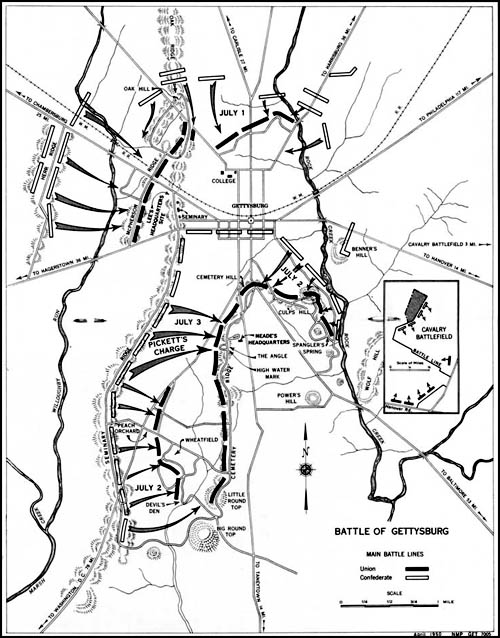
While writing the previous post, about sound and warfare in Iraq, I came across a brief description of something called an acoustic shadow and its occurrence during the American Civil War.

[Image: Map via University of Maine Civil War Webquest].

An “acoustic shadow” is when the sounds of an event—here, a battle—cannot be heard by people nearby—say, in the neighboring valley or a parallel city street—but those same sounds can plainly be heard over much larger distances. This effect is caused by “a unique combination of factors such as wind, weather, temperature, land topography, forest or other vegetation, and elevation,” we read. For example, “battle sounds from Gettysburg fought on July 1, 2, and 3, 1863 could be heard over one hundred miles away in Pittsburgh, but were not heard only ten miles from the battlefield.”

Without my own access to contemporary accounts of these battles and their acoustic shadows—sonic phantom limbs haunting distant landscapes—I simply have to trust the accounts that I’m quoting from here; nonetheless, these stories are fascinating. “More than 91,000 men were engaged in battle at Gaines’s Mill, Virginia on June 27, 1862,” for instance. “Confederate commanders and troops were less than two miles from the battlefield and could plainly see the smoke and flashes from the guns and artillery, but not a sound could be heard of the battle for two hours. Strangely, the battle sounds from the Battle of Gaines’s Mill were easily heard in Staunton, Virginia over one hundred miles away.”

The unexpected atmospheric reflection of sound, and sound’s complicated relationship with certain topographies, levels of humidity, climatic systems, and more presents an amazing—if impossibly complex—dimension to the future of urban design and landscape architecture. Could 5th Avenue be retrofitted to cultivate acoustic shadows—or might a neighborhood in eastern Brooklyn someday find itself overhearing distant traffic events and individual human conversations that have been carried on the winds from Midtown, acoustic effects soon traced back to the mirage-like venting of a new steam plant on the East River?

This also makes me wonder if instances of ghostlike visitation in ancient times—a king crazed by invisible whispers in his fortified tower bedroom, a city cursed by nocturnal voices, a village terrified by bodyless beasts unseen by any hunter—might actually have been examples of acoustic shadows. How could acoustic shadows be archaeologically and historically investigated without exactly reproducing the landscape topography and climatic conditions of the time?

(Vaguely related: a very old post about sound mirrors).