Mineral Hurricane

I recently had the pleasure of attending a press preview of the new documentary Architecton, directed by Victor Kossakovsky and released last week by A24.

Surreally, the screening I attended was held inside a Cedars-Sinai medical-imaging center in west Los Angeles. Seeing this particular film, with its intensely granular focus on the geological underpinnings of the built environment, amidst diagnostic tools designed for peering inside the human body seemed strangely appropriate.

I imagine that, if you were simply to wander into a room where Architecton was playing, it would very likely appear to be a film about geology: about rocks and mountains, quarries and mines, and the raw streams of matter that create and emerge from them.

There is an extraordinary early sequence, for example, from which the stills in this post were taken, where Kossakovsky captures a landslide. We watch as increasingly large rocks, from sand to gravel to room-sized blocks to immense boulders, all flow downhill in slow motion, crashing into one another, exploding, ricocheting, and splitting apart.

It looks for all the world like an oceanic phenomenon—a series of waves, not a solid planet at all, as if the Earth has begun to boil and heave with liquefaction.

The sequence then fades into what I believe is an aerial drone shot of the same landslide, but the visuals here become almost astronomical in their power and beauty, as if Architecton had somehow captured a proto-planetary storm of partially aerosolized rock. It looks like you’ve woken up inside the asteroid belt—or perhaps what J.M.W. Turner would have depicted if he had traveled in space. Not landscapes but nebulae.

There is something so elemental, even infernal, in this sequence, verging on the cosmic: glimpsing how the Earth itself was assembled through a billion-year maelstrom of mineral hurricanes, spherical landslides, and weather systems made entirely of geology.

Later, the camera lingers over detonations in the walls of strip mines. We watch rocks being bounced and agitated on conveyor belts, wet with leachate and acid. At one point, the camera stares into a minimalist doorway, cut like an Etruscan tomb, through which rocks tumble to be processed as abyssal red embers glow.

It’s just a mine, of course, but Kassakovksy has made it look like an alchemical complex, a brutalist oven in which all things planetary can be melted and enhanced, sluiced off and purified, distilled into a purely economic form. It is brute oceanic metallurgy.

It’s these early sequences that I could have watched literally for hours. It was also these scenes that felt so perfect for the unlikely setting in which the film was being screened that day, knowing that, as we all sat there, people in the rooms around me were getting CT scans, MRIs, and X-rays.

But the movie takes a more architectural turn here, increasingly focused on buildings and cities, on archaeological sites and ruins. We see residential towers in Ukraine, for example, ripped open by Russian missiles and drone-bombs, and then earthquake-damaged apartments undergoing demolition and clearance, followed by landfill-dumping operations so large they look like attempts at terraforming.

These are intercut with the film’s only speaking sections, where we watch architect Michele De Lucchi supervise the construction of a small rock circle in his garden. A light snow falls and hazy mountains are visible in the background. The scenes are meditative and calming.

At one point, De Lucchi’s circle is visually rhymed with an all-too-brief aerial glimpse of what I believe is the Richat Structure in Mauritania, continuing the film’s play on form and organization, as if rocks have within them a natural capacity to resemble storms and hurricanes—as if everything we believe to be is solid is, in fact, made of vortices and waves.

And this is all perfectly enjoyable; I was mesmerized.

But the film ends on a strange note. Despite appearing—to me—to be a documentary about the Earth, geology, and elemental form—about the human relationship with matter and our attempts to control it—Architecton concludes with a somewhat head-spinning turn in which the director himself appears on screen and asks De Lucchi, in person, why humans now construct such ugly buildings.

The question felt totally out of the blue to me and, frankly, irrelevant to the rest of the documentary. Either I had mis-understood everything I’d seen leading up to that point or perhaps Kassakovksy had felt pressured to deliver some sort of easy takeaway, an interpretation or rhetorical question that critics could discuss after viewing.

Speaking only for myself, what I wanted to discuss as I walked out of the cinema was not whether we should build fewer glass towers in Milan, but whether or not we understand what the Earth really is; whether landslide dynamics repeat, in miniature, the formational mechanics of rocky planets in the early solar system; or whether our cultural—and, yes, architectural—encounters with rock, especially in the form of mines and quarries, might force us to reevaluate how we define humanism in the first place. Some people think literature makes us human, but what if it’s actually metallurgy?

In the end, it was as if someone had created a 100-minute-long Rorschach test, composed of extraordinarily beautiful imagery of landslides and rocks, only to spring out from behind a screen and tell us that, this whole time, he had been thinking about classical architecture.

Nevertheless, the film is worth checking out—and I’d recommend doing so in a theater while you can, for the sheer scale of what Kassakovksy depicts.

(Thank you to A24 for providing the stills that appear in this post.)
Urban Optometry

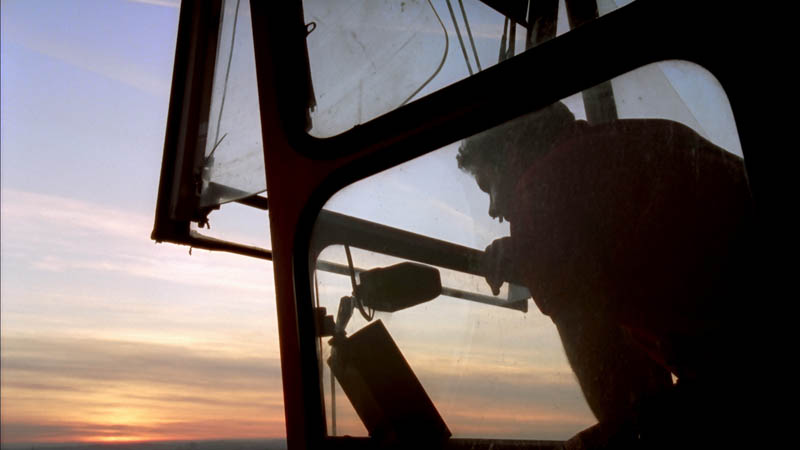
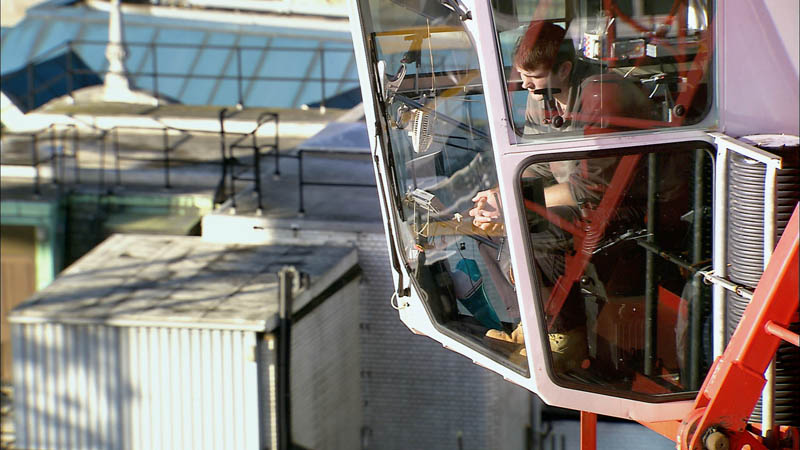
[Image: From The Solitary Life of Cranes by Eva Weber].

The Solitary Life of Cranes is a short film by Eva Weber about the work performed by construction crane operators in London. I’ve mentioned it many times in various talks I’ve given over the past year, but I realized last night that I never actually posted about it—so I thought I’d correct that. It’s a great film, and it’s worth seeking out. At only 27 minutes in length, as well, it’s also quick to watch.

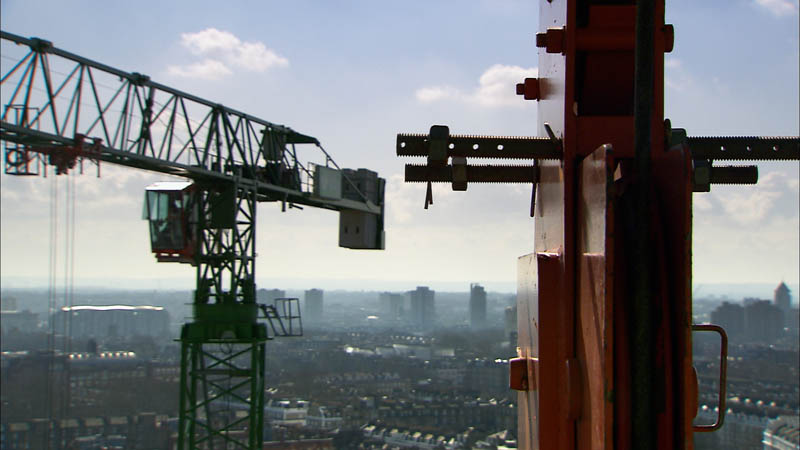
[Image: From The Solitary Life of Cranes by Eva Weber].

As the film describes itself:

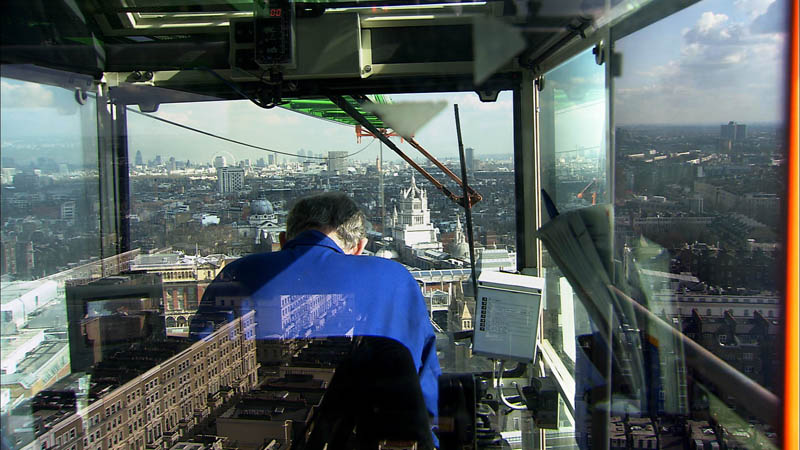
Part city symphony, part visual poem, The Solitary Life of Cranes explores the invisible life of a city, its patterns and hidden secrets, seen through the eyes of crane drivers working high above its streets. (…) From their elevated positions, crane drivers are the unsung chroniclers of our ever-changing metropolis: the bulk of their time is spent waiting, looking, observing the wind, the weather, and the people down below. From their airy towers, they do not only have the best overview of the construction site and some of the most impressive panoramic views of the city but also an unparalleled insight into any of the buildings surrounding them.

Looked at one way, Weber has made an oral history of crane operators: documenting where they work, what they think about, what they see, and—perhaps most interestingly—how they view the city.

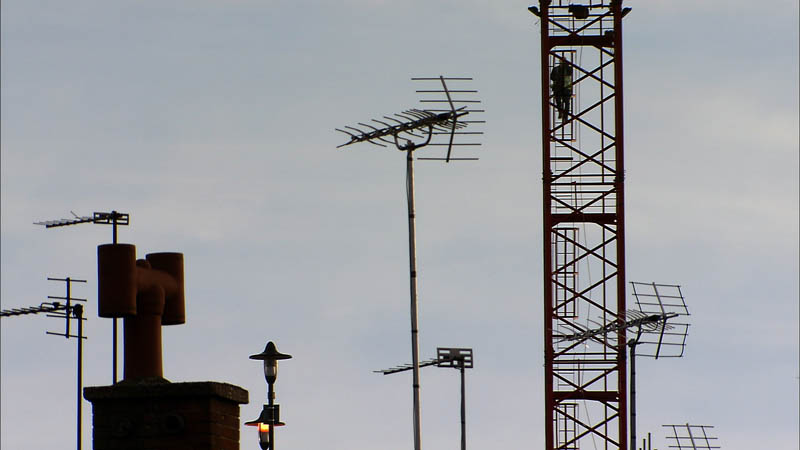
[Image: From The Solitary Life of Cranes by Eva Weber].

These operators, I would suggest, have a view of the metropolis that architects and planners have little or no access to, an optical insight into city life that often gives their job an almost mystic feel. “Many people don’t know that there’s somebody up there, don’t even think that there’s somebody up there,” one of the operators suggests. “They’re quite surprised when you tell them, ‘yeah there’s a guy up there, you know and this guy is me’.”

There are moments of both inadvertent and advertent voyeurism in the process. “You see really private moments of people’s lives… because people can’t see you or aren’t aware of you.” Indeed, “There’s a couple of people in—how can I put this now without sounding like a voyeur? There are flats right opposite me with the same people in, every day, if you know what I mean, and they’re there, you cannot not look.”

“If you did meet the same person on the street,” one of them says, “then you’d think twice… you wouldn’t introduce yourself, but you stop and think and turn your head when they walk by, you know, as if to say, look I’m part of your life but you don’t know it.”

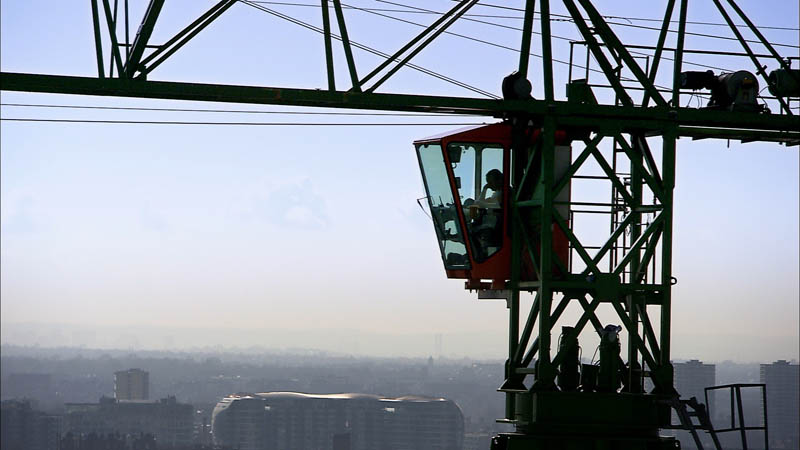
[Image: From The Solitary Life of Cranes by Eva Weber, like a shot from Michael Wolf’s book The Transparent City].

One of them even compares the experience to living and working inside a cloud: “Coming down… it’s like coming out of a cloud. You sort of come down it, and it just disappears and then you’re back on normal ground again. You think, ‘Jesus, what a different way of life down here than what it is up there’.”

This terrestrial dislocation is not necessarily a good thing: “We’re getting operators that we all call ‘cab happy’, and they just want to stay on the cab all the time. You know, it’s hard to get them out… I think all crane operators, to a certain degree, I think they’re ‘cab happy’—when you’re on the floor you always miss being in the crane.”

[Image: From The Solitary Life of Cranes by Eva Weber].

One of my favorite moments in the film is when we hear an operator talk about storms. “You can see a storm develop,” he says, looking out over the city, “sort of 10-15 miles away, you can see the cloud shapes, you know, you can watch the rain come in,” and we see moving fronts of English weather cross over the city, “and the rain physically comes in as a wall. You can see that curtain,” he says, “moving across the town, moving across the city.”

[Image: From The Solitary Life of Cranes by Eva Weber].

When I talked about this film at an event in New York City last winter, architect Ed Keller, the event’s host, compared these crane operators to Daedalus figures, looking down into the labyrinth that they themselves have built—only here the labyrinth is London, and the there is not one Daedalus but thousands, and they are awake all the time in overlapping shifts, keeping eyes on the city from above, in perpetuity.

[Image: From The Solitary Life of Cranes by Eva Weber; the building in the lower left of this image is actually the London office of Foster and Partners].

“The sky is full of stories,” as author Sukhdev Sandhu wrote in an essay for the book A Manual For the 21st Century Art Institution. Looking at the social, economic, and even narrative implicatons of architectural verticality in East London, Sandhu specifically cites Weber’s film:

These men, perched in their metal boxes, invisible to ground-bound Londoners, speak with precision and poetry about the beauty they are afforded by their enhanced perspectives—about the pale delicacy with which the sun rises above the city, the lush greenery of far-off hills, the way streets curve and snake into the distance. They are blessed with the opposite of tunnel vision, able to spot oncoming storms at a distance of fifteen miles, and witnesses to the teeming life that takes place above pavement level: roof-garden parties, office workers taking fag breaks, pigeon fanciers chatting to their birds. London, one of them observes, consists of a series of layers.

Sandhu calls for a need “to gaze out across the callous metropolis—and conjure forth connections,” taking advantage of these unprecedented viewpoints, perspectives on the city that were literally impossible before these buildings and cranes came along, to help fashion a new understanding of how the metropolis works, how people live within it, and where it might yet go. As if the building boom brought with it a new optics of the city—a new picturesque—an angled optometry of everyday space.

[Image: From The Solitary Life of Cranes by Eva Weber].

Briefly, I’m reminded of the story of Babu Sassi, a crane operator atop the Burj Dubai/Burj Khalifa who, the legend goes, didn’t come down to earth for a full year, as it would have taken too long to make the trip. You can read more about Babu at that earlier post, but the overall question would be the same: how does your understanding of the social world change after spending time inside these massive, temporary constructs without names or fixed addresses, as if only unofficially present in the built landscape that surrounds them? They are towers that disappear, never to be seen again in the same location, and you are perched there, like some rogue landscape theorist, at fantastic height above the very thing you both assemble and secretly study.

[Image: From The Solitary Life of Cranes by Eva Weber].

More information about the film can be found at its—unfortunately Flash-based—website, and the film itself is worth seeking out.