The Mushroom Tunnel of Mittagong

[Image: Shiitake logs on racks in the Mittagong mushroom tunnel. All photos by the author].

Note: This is a guest post by Nicola Twilley.

As Geoff mentioned here on BLDGBLOG a few weeks ago, we spent our last full day in Australia touring the Li-Sun Exotic Mushroom Farm with its founder and owner, Dr. Noel Arrold. Three weeks earlier, at a Sydney farmers’ market, we had been buying handfuls of his delicious Shimeji and Chestnut mushrooms to make a risotto, when the vendor told us that they’d all been grown in a disused railway tunnel southwest of the city, in Mittagong.

[Image: The mushroom tunnel, on the left, was originally built in 1886 to house a single-track railway line. By 1919, it had to be replaced with the still-functioning double-track tunnel to its right, built to cope with the rise in traffic on the route following the founding of Canberra, Australia’s purpose-built capital city. The tunnel is still state property: the mushroom farm exists on a five-year lease].

The idea of re-purposing abandoned civic infrastructure as a site for myco-agriculture was intriguing, to say the least, so we were thrilled when Dr. Arrold kindly agreed to take the time to give us a tour (Li-Sun is not usually open to the public).

Dr. Arrold has been growing mushrooms in the Mittagong tunnel for more than twenty years, starting with ordinary soil-based white button mushrooms and Cremini, before switching to focus on higher maintenance (and more profitable) exotics such as Shimeji, Wood-ear, Shiitake, and Oyster mushrooms.

[Images: (top) Dr. Arrold with a bag of mushroom spawn. He keeps his mushroom cultures in test-tubes filled with boiled potato and agar, and initially incubates the spawn on rye or wheat grains in clear plastic bags sealed with sponge anti-mould filters before transferring it to jars, black bin bags, or plastic-wrapped logs; (middle) Shimeji and (bottom) pink oyster mushrooms cropping on racks inside the tunnel. Dr. Arrold came up with the simple but clever idea of growing mushrooms in black bin bags with holes cut in them. Previously, mushrooms were typically grown inside clear plastic bags. The equal exposure to light meant that the mushrooms fruited all over, which made it harder to harvest without missing some].

A microbiologist by training, Dr. Arrold originally imported his exotic mushroom cultures into Australia from their traditional homes in China, Japan, and Korea. Like a latter-day Tradescant, he regularly travels abroad to keep up with mushroom growing techniques, share his own innovations (such as the black plastic grow-bags shown above), and collect new strains.

He showed us a recent acquisition, which he hunted down after coming across it in his dinner in a café in Fuzhou, and which he is currently trialling as a potential candidate for cultivation in the tunnel. Even though all his mushroom strains were originally imported from overseas (disappointingly, given its ecological uniqueness, Australia has no exciting mushroom types of its own), Dr. Arrold has refined each variety over generations to suit the conditions in this particular tunnel.

Since there is currently only one other disused railway tunnel used for mushroom growing in the whole of Australia, his mushrooms have evolved to fit an extremely specialised environmental niche: they are species designed for architecture.

[Images: (top) Logs on racks (Taiwanese style) and mounted on the wall (Chinese style) in the tunnel; (bottom) Wood-ear mushrooms grow through diagonal slashes in plastic bags filled with chopped wheat straw].

The tunnel for which these mushrooms have been so carefully developed is 650 metres long and about 30 metres deep. Buried under solid rock and deprived of the New South Wales sunshine, the temperature holds at a steady 15º Celsius. The fluorescent lights flick on at 5:30 a.m. every day, switching off again exactly 12 hours later. The humidity level fluctuates seasonally, and would reach an unacceptable aridity in the winter if Dr. Arrold didn’t wet the floors and run a fogger during the coldest months.

In all other respects, the tunnel is an unnaturally accurate concrete and brick approximation of the prevailing conditions in the mushroom-friendly deep valleys and foggy forests of Fujian province. This inadvertent industrial replicant ecosystem made me think of Swiss architecture firm Fabric‘s 2008 proposal for a “Tower of Atmospheric Relations” (pdf).

[Image: Renderings of Fabric’s “Tower of Atmospheric Relations,” showing the stacked volumes of air and the resulting climate simulations].

Fabric’s ingenious project is designed to generate a varying set of artificial climates (such as the muggy heat of the Indian monsoon, or the crisp air of a New England autumn day) entirely through the movements of the air that is trapped inside the tower’s architecture (i.e. by means of convection, condensation, thermal inertia, and so on).

If you could perhaps combine this kind of atmosphere-modifying architecture with today’s omnipresent vertical farm proposals, northern city dwellers could simultaneously avoid food miles and continue to enjoy bananas.

[Images: (top) Li-Sun employees unwrap mushroom logs before putting them on racks in the tunnel. The logs are made by mixing steamed bran or wheat, sawdust from thirty-year-old eucalyptus, and lime in a concrete mixer, packing it into plastic cylinders, and inoculating them with spawn. (middle) Fruiting Shiitake logs on racks in the tunnel. Once their mushrooms are harvested, the logs make great firewood. (bottom) The Shiitake log shock tank – Dr. Arrold explained that the logs crop after one week in the tunnel, and then sit dormant for three weeks, until they are “woken up” with a quick soak in a tub of water, after which they are productive for three or four more weeks. “Shiitake,” said Dr. Arrold, in a resigned tone, “are the most trouble – and the biggest market.”]

Outside of the tunnel, Dr. Arrold also grows Enoki, King Brown, and Chestnut mushrooms. These varieties prefer different temperatures (6º, 17º, and 18º Celsius respectively), so they are housed in climate-controlled Portakabins.

[Images: (top) The paper cone around the top of the enoki jar helps the mushrooms grow tall and thin. (second) Chestnut mushrooms grow in jars for seven weeks: four to fruit, and three more to sprout to harvest size above the jar’s rim. (third) Thousands of mushroom jars are stacked from floor to ceiling. Dr. Arrold starting growing these mushroom varieties in jars two years ago, and hasn’t had a holiday since. (fourth) Empty mushroom jars are sterilised in the autoclave between crops, so that disease doesn’t build up. (bottom) The clean jars are filled with sterilised substrate using a Japanese-designed machine, before being inoculated with spawn].

The fact that the King Brown and Chestnut mushrooms only thrive at a higher temperature than the railway tunnel provides makes their cultivation much more expensive. Their ecosystem has to be replicated mechanically, rather than occuring spontaneously within disused infrastructure.

I couldn’t help but wonder whether there might be another tunnel, cave, or even abandoned bunker in New South Wales that currently maintains a steady 17º Celsius and is just waiting to be colonised by King Brown mushrooms growing, like ghostly thumbs, out of thousands of glass jars.

[Image: Temperature map of the London Underground system (via the BBC, where a larger version is also available), compiled by Transport for London’s “Cool the Tube” team].

In the UK, for instance, Transport for London has kindly provided this fascinating map of summertime temperatures on various tube lines. Most are far too hot for mushroom growing (not to mention commuter comfort). Nonetheless, perhaps the estimated £1.56 billion cost of installing air-conditioning on the surface lines could be partially recouped by putting some of the system’s many abandoned service tunnels and shafts to use cultivating exotic fungi. These mushroom farms would be buried deep under the surface of the city, colonizing abandoned infrastructural hollows and attracting foodies and tourists alike.

[Image: A very amateur bit of Photoshop work: Li-Sun Mushrooms as packaged for Australian supermarket chain Woolworths, re-imagined as Bakerloo Line Oyster Mushrooms].

Service shafts along the hot Central line might be perfect for growing Chestnut Mushrooms, while the marginally cooler Bakerloo line has several abandoned tunnels that could replicate the subtropical forest habitat of the Oyster Mushroom. And – unlike Dr. Arrold’s Li-Sun mushrooms, which make no mention of their railway tunnel origins on the packaging – I would hope that Transport for London would cater to the locavore trend by labeling its varietals by their line of origin.

[Images: Shiitake logs on racks in the Mittagong mushroom tunnel].

Speculation aside, our visit to the Mittagong Mushroom Tunnel was fascinating, and Dr. Arrold’s patience in answering our endless questions was much appreciated. If you’re in Australia, it’s well worth seeking out Li-Sun mushrooms: you can find them at several Sydney markets, as well as branches of Woolworths.

[Image: Nicola Twilley is the author of Edible Geography, where this post has been simultaneously published].

London Yields, Harvested

Note: This is a guest post by Nicola Twilley.

As Geoff mentioned last month, London’s Building Center hosted a daylong seminar at the end of May called London Yields: Getting Urban Agriculture off the Ground.
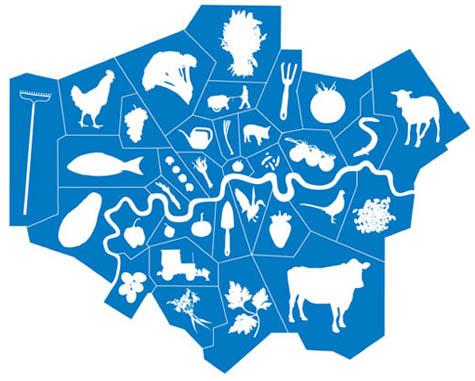
[Image: From London Yields: Urban Agriculture].

The speakers covered a lot of terrain—so, instead of a full recap of the event, the following list simply explores some of the broader ideas, responses, and questions about urban agriculture that stood out from the day’s presentations.

1. Becoming public policy
The event was introduced and moderated by David Barrie, a sustainable development consultant, who framed the day as a collective opportunity to brainstorm ways in which urban agriculture could be moved from mere “sustainable accessory” to become a standard practice of both everyday life and city design. Interestingly, Mark Brearley, Head of Design at Design for London (DfL) and the day’s first speaker, provided confirmation of Barrie’s diagnosis, confessing that food production was a recent add-on to many of their open space projects. Why? “Because people were asking us about it,” he said.

Brearley’s presentation was an overview of DfL’s hundreds of urban regeneration and infrastructure improvement projects; these are, in themselves, interesting but, in aggregate, somewhat exhausting. However, as an office of the London Development Agency, working on behalf of the Mayor of London, Brearley was able to provide a fascinating insight into some of the current institutional priorities that need to be satisfied before urban agriculture can become a standard part of London public policy. For example, DfL’s main interest in food production today is in terms of its “public engagement potential” and their primary stumbling block is how to measure the scaleability of local initiatives. Any London-based urban agriculture projects hoping for a mayoral blessing, take note!

2. Food is a design tool
The second speaker was Carolyn Steel, author of the excellent book Hungry City: How Food Shapes Our Lives. Hungry City traces how food has shaped both the city and its productive hinterland throughout history, from the Sumerian city of Ur to today’s London via the markets and gates of ancient Rome. Steel provides a wide-ranging historical look of food production, importation, regulation, and culture, before putting forward her own intriguing and potentially revolutionary proposition: what would happen if we consciously used food as a design tool to create a “sitopic” city? Steel’s coinage here, sitopia—from “sitos” (food) and “topos” (place)—is derived from her realization that “food shares with utopia the quality of being cross-disciplinary… capable of transforming not just landscapes, but political structures, public spaces, social relationships, [and] cities.” And because “food is necessary,” a sitopian city (unlike its utopian cousin) would remain tied to reality and of universal relevance.

The quotations above come from Steel’s book, however, rather than her lecture; twenty-five minutes was enough time to provide fascinating examples of food’s role in shaping cities and urban life, but, sadly, not enough to explain (let alone explore) further thoughts about food’s use as an urban planning tool. More to come soon, I hope, on this topic…

[Image: Ebenezer Howard’s original scheme for the Garden Cities of To-morrow shows a landscape reimagined in terms of food production and supply. As Carolyn Steel explains in her own book Hungry City, Howard’s plans relied on land reform that was never carried out, and the garden cities of today (Letchworth, Welwyn, etc.) are, as a result, little more than green dormitory suburbs].

3. Partnerships as infrastructure
Anna Terzi, who runs London Food Link’s small grants scheme for Sustain, was the day’s third speaker; she described one of their current projects, demonstrating how key insights from both Mark Brearley’s and Carolyn Steel’s talks might look in action.

Sustain (a nonprofit alliance for better food and farming) is currently poised to create borough-wide institutional change by partnering with Camden Council and Camden Primary Care Trust (part of the National Health Service). This alliance—with its intriguing implication that the National Health Service might be the one institution with the most to gain by promoting urban agriculture—speaks to the impact of creating new interest groups for locally grown food. By partnering with institutions responsible for dealing with established urban challenges—issues such as public health, economic growth, community engagement, waste, and environmental sustainability—groups like Sustain have the potential to take urban agriculture from decorative hobby to investment-worthy infrastructure.

The Camden partnership’s report (still in draft stage) aims to outline a relatively coherent and holistic food program for the borough—a plan that promises to use food to reshape at least this part of the city, in terms of promoting social enterprise, meeting infrastructure needs, and reducing health inequalities.

[Image: A lemon grown in Dulwich; photograph by Jonathan Gales (2008), ©Bohn & Viljoen Architects].

4. Mapping and visualization tools
The last two presentations of the day agreed that successfully producing food in the city requires a detailed resource inventory combined with effective promotion efforts. Mikey Tomkins, a PhD candidate at the University of Brighton, described systematically mapping the rooftops, grass patches, vertical faces, and vacant lots of Elephant & Castle—whereupon he discovered that 30% of the area’s food needs could be met through the cultivation of found space alone.

Architects Katrin Bohn and Andre Viljoen, creators of the uninspiringly named CPUL (Continuous Productive Urban Landscapes), emphasized the need to think about spare inventory in terms of population and three dimensionality (their Urban Agriculture Curtain filled a display window one floor above us). Their research techniques included the accumulation of census data and questionnaires combined with GPS mapping and site visits in order to analyze a landscape’s food production capacity.

Both Tomkins and Bohn & Viljoen also showed several projects intended to help people read the city in terms of food, using tools as diverse as “edible maps” of London and visual analyses of urban agriculture in Havana, to installations and public events, such as the Continuous Picnic. This was a day-long event, part of the 2008 London Festival of Architecture, that included an “Inverted Market” (bring your own locally grown fruit and vegetables to be admired, judged, and then prepared), as well lessons in “Community Composting”; a giant public picnic then spread throughout Russell Square and Montague Place, with connecting corridors between.

Meanwhile, for his Edible Maps series, an example of which appears below, Tomkins targets a new type of urban resident: the “food-flâneur,” who, map in hand, “could start to picture… the grassed areas around housing, the corners of parks, or the many flat rooftops of this quarter of Croydon spring into life with psychogeographic food.”

Another example of urban agriculture as an opportunity for community activation was Croydon Roof Divercity, Tomkins’s collaboration with AOC (previously discussed, along with other AOC projects, on BLDGBLOG here).

[Image: From Mikey Tomkins’s series of Edible Maps, this guide represents the area around Surrey Street car park, site of Croydon Roof Divercity, in terms of inventory and potential yield].

5. Easy, cheap, and somewhat under control
Both Anna Terzi and Bohn & Viljoen recognized the difficulty of maintaining urban agriculture projects, once the initial novelty has worn off. Bohn & Viljoen are currently working on a twelve-step program to prevent relapse, while Sustain are offering ongoing practical and financial support to new food growing spaces in London through their Capital Growth initiative.

Throughout the morning, David Barrie repeatedly registered his concern that urban agriculture needed to be economically viable, not just an upscale $64 Tomato lifestyle choice. Several of the presenters added a layer of nuance to Barrie’s formulation, noting that cheap food has simply had its costs externalized and hidden (Carolyn Steel) and that organizations like the New Economics Foundation are developing the much-needed tools to measure urban-agriculture-created value, such as increased community engagement and environmental sustainability, which is currently perceived as intangible and qualitative (Katrin Bohn). Mikey Tomkins argued against an economics-based one-size-fits-all approach to urban agriculture, explaining that the scale of a food growing project determines its possible benefits. Thus differentiated, food gardening generates educational and quality of life outcomes and should be measured accordingly, while market gardening creates recycling benefits, and urban agriculture can be evaluated in terms of yield.

Finally, the elephant in the room was the degree of coordination and regulation needed to transform London into a food-producing landscape. In an environment where, as Carolyn Steel said, the supermarkets where Londoners buy more than 80% of their groceries refused to participate in consultations with the Mayor’s London Food Strategy, it seems unlikely that sustainable food production and distribution will become the norm without legislative intervention.

In her book, Steel quotes Cassiodorus, a Roman statesman who wrote: “You who control the transportation of food supplies are in charge, so to speak, of the city’s lifeline, of its very throat.” At the moment, Steel tells us, roughly 30 agrifood conglomerates—unelected, and with no responsibility other than to their shareholders—have almost unfettered control over London’s food supply. Until that changes, urban agriculture can’t help but remain “at the artwork stage”—an inspiring, attractive, and completely optional extra.

[Other guest posts by Nicola Twilley include Watershed Down, The Water Menu, Atmospheric Intoxication, Park Stories, and Zones of Exclusion].
Farmadelphia

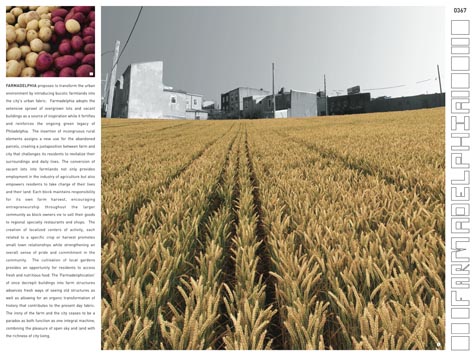
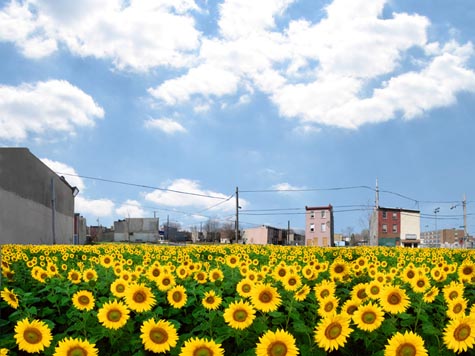
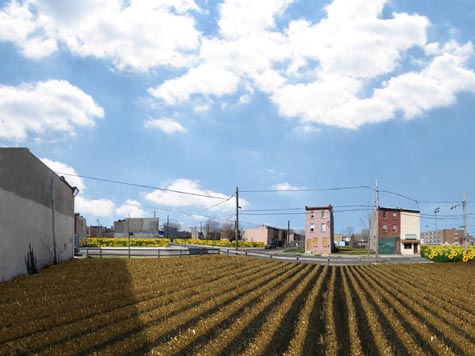
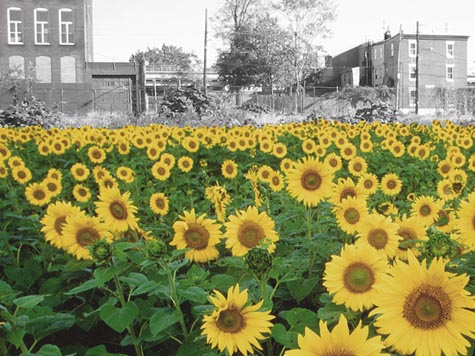
[Image: Front Studio. “Sunflowers aid in the bio-cleansing of land in preparation for crop farming”].

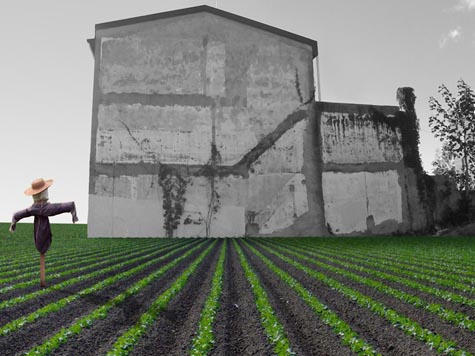
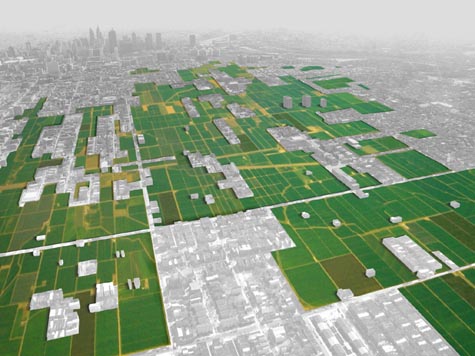
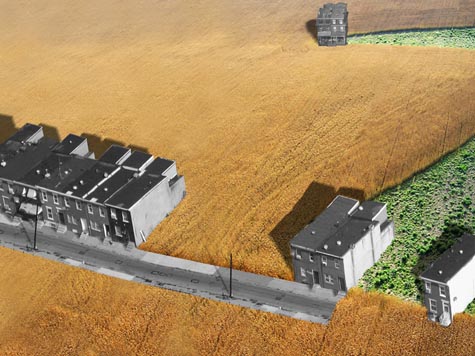
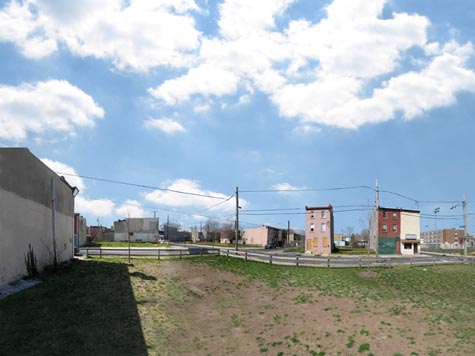
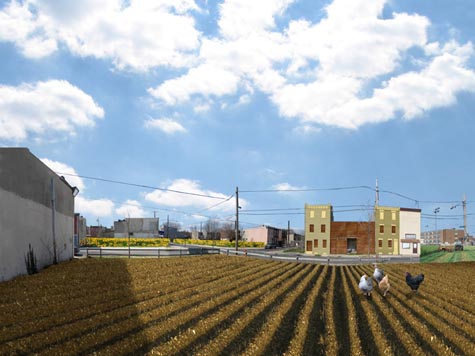
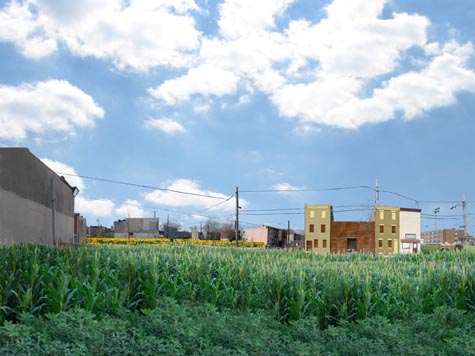
Last month, Front Studio architects gave a talk at the University of Pennsylvania Department of City & Regional Planning. There they outlined “Farmadelphia,” their now widely known proposal for the transformation of Philadelphia, in which that city’s vacant and abandoned lots are turned into a thriving agricultural zone – complete with crops grown for local consumption and soil remediation, and with an eye toward future tourism, including surreal petting zoos, hay rides, and even corn mazes.

[Image: Front Studio].

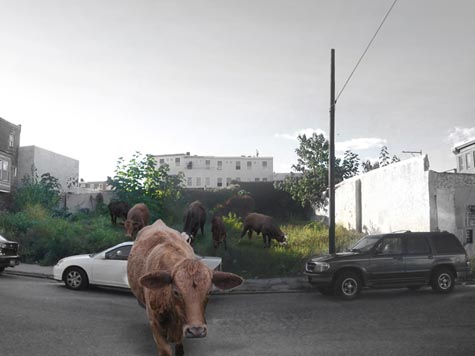
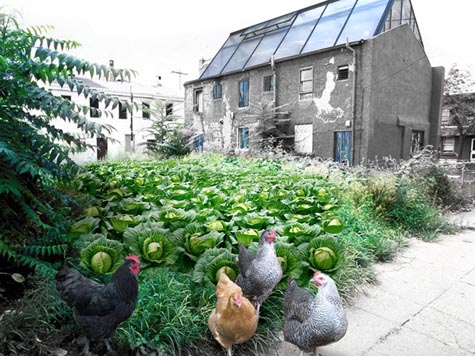
Philadelphia would become “an ‘edible landscape’,” we read, “with vast crop fields, and free roaming farm animals.”

[Images: Front Studio. “Free roaming city cows graze on locally owned pasture” (top); chickens hang out amidst lettuce (bottom)].

The project would also address – or is intended to address – “the rehabilitation of the existing city fabric by proposing ideas for vacant buildings that would allow the present-day character to remain while creating new uses.”

[Images: Front Studio].

From the project description:

For example, an abandoned building could have its walls and ground lined with a non-permeable membrane to prevent soil contamination for new plantings. Then layers of a weed barrier, soil bed, loam and mulch are added on top. The nurseries would provide: year-round job opportunities, high profit yields from selling flowers and the adaptive reuse of abandoned buildings.

Whole sections of the city would thus be deliberately cultivated. Or, from a slightly different perspective, it’s the controlled re-wilding of the city.

[Image: Front Studio. Philadelphia’s “urban voids interwoven with agricultural patchwork”].

This urban re-wilding would also include “the rehabilitation of abandoned buildings into stables to house animals.”

[Images: Front Studio].

“Looking into Philadelphia’s past,” Front Studio writes, one finds “a green legacy dating back to William Penn’s pastoral vision of a ‘green countrie towne’.”
But what about Philadelphia’s green future – not its past or some distant legacy it’s passively inherited?
How might Philadelphia actively re-green itself for the future?
Some appropriate crops for the proposed agricultural stabilization of the city might include the following, the architects suggest:

—start with low maintenance, easy to grow, and profiting crops; consider perennial crops such as asparagus, shallots, garlic and herb varieties
—other crops include shade tolerant, easy to grow kale, sweet potatoes, lettuce
—other crops that do well in Philadelphia climate: collard greens, broccoli, mustard greens, corn, raspberry bushes

Those plants, in particular, would form a biosystem that could help push the city onto a seven year agricultural plan – after which this newly implanted ecosystem would level off, forming something like a cultivated permaculture.

[Images: Front Studio‘s seven year plan for agricultural stabilization].

More about the project can be found on Front Studio’s own website (under “Work” and then “Competition”).

(See also Roof-farming southeast London, earlier on BLDGBLOG, as well as Going Agro.)

Roof-farming southeast London


Swiss Cheese City, by London-based architecture firm Agents of Change (AOC), proposes that “vacancy in cities” is really “a starting point for a new urban form.” Accordingly, the project hopes to “generate new possibilities from holes in the built fabric,” such as “Special Cultivation Zones (SCZs).”
Special Cultivation Zones are an urban land-bank, defined by “temporary boundaries within which land can’t be bought or sold, and emerging skills, social networks and locally-grown produce are cultivated in the ‘vacant’ city fabric.”
(For more on urban farming, see Pruned or Inhabitat).
Then there’s AOC’s Croydon Roof Divercity project –


– which radically rethinks the landscape of Croydon’s roofs (and sounds really, really fun): “Taking the flat roofs of Croydon as our testbed,” they write, “we propose a new roofscape for the city – beaches, ice rinks, golf courses, allotments, skateboard parks and pasture refresh Croydon’s tired concrete.” How about a shooting range? (For more on green roofs, see Inhabitat).
After all, AOC asks, how could London be adapted “to an agricultural logic – the logic of rotation, seasons, ground and growth?”
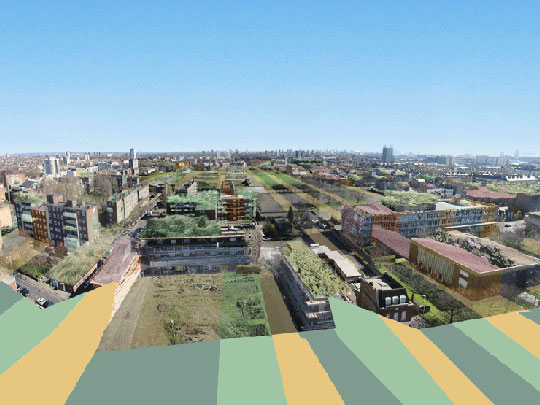
Thus, with a vision straight out of sci-fi, they describe Hackney New Garden City, complete with an “Agricultural Action Zone (AAZ).” This would include “a self-sufficient ecology of grass roads, localised rainwater collection, organic solar films and biological compost systems… liberating the ground’s agricultural potential.”


[Images: Hackney New Garden City, before and after].

For another place you could put those ideas to work, see Philadelphia’s Urban Voids; then check out these photos of “arbortecture” – or, plants growing out of buildings. (Via Pruned).