A Design History of Military Airspace

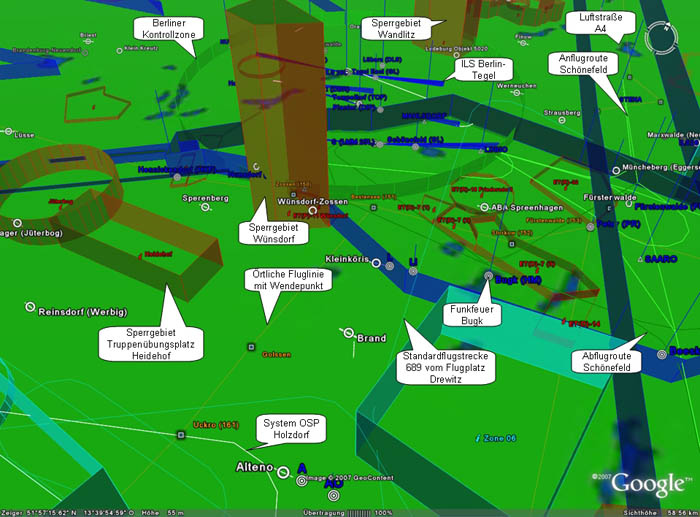
This is pretty great: a volumetric rendering of military airspace in East Germany during the 1980s, as imaged in Google Earth. “The air space over the GDR was a complex three-dimensional thing,” we read.

[Image: DDR-Luftraum].

While the very idea of mapping military airspace is fascinating, the historical nature of the above image strikes me as its most provocative aspect. After all, what maps or archives now exist depicting lost military airspace volumes as defined by closed bases, renovated airfields, or no-longer-existing countries?

For that matter, what about the civilian airspace volumes of urban buildings that have since been torn down? How does real estate law account for property transactions based on air volumes for buildings that no longer exist?

How and where—and by what representational means—can these spaces be archived? Could there be an experiential museum of lost airspace volumes, and what atmospheric form might it take?

(Thanks to Nick Sowers for kicking off the idea for this post).

The Meadowlands

I’ve just finished reading The Meadowlands: Wilderness Adventures on the Edge of a City by Robert Sullivan, a book perfectly discussed in the visual context of Meadowlands, a collection of photographs by Joshua Lutz (for which Sullivan actually wrote an introduction).
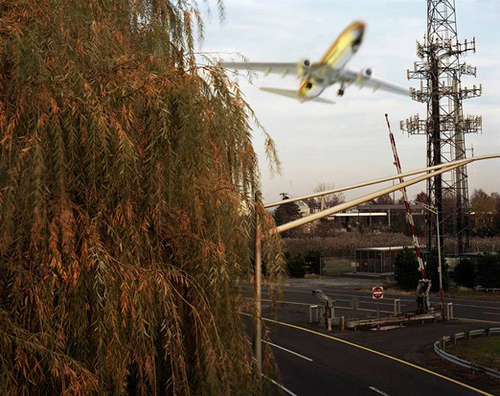
[Image: From Meadowlands by Joshua Lutz].

“Just five miles west of New York City,” the back cover of Sullivan’s book reads, are the Meadowlands: “this vilified, half-developed, half-untamed, much dumped-on, and sometimes odiferous tract of swampland is home to rare birds and missing bodies, tranquil marshes and a major sports arena, burning garbage dumps and corporate headquarters, the remains of the original Penn Station, and maybe, just maybe, of the late Jimmy Hoffa.” It is “mysterious ground that is not yet guidebooked,” Sullivan writes inside, “where European landscape painters once set up their easels to paint the quiet tidal estuaries and old cedar swamps,” but where, now, “there are real hills in the Meadowlands and there are garbage hills. The real hills are outnumbered by the garbage hills.”

Lutz’s book describes the region as a “32-square-mile stretch of sweeping wilderness that evokes morbid fantasies of Mafia hits and buried remains.” As Lutz explained in a 2008 interview with Photoshelter, “When I first saw the Meadowlands I was completely blown away at this vast open space with the Manhattan skyline in the distance. It was this space that existed between spaces, somewhere between urban and suburban all the while made up of swamps, towns and intersecting highways. None of it made any sense to me, still doesn’t.”

All told, the area has become, Sullivan writes, “through negligence, through exploitation, and through its own chaotic persistence, explorable again.”
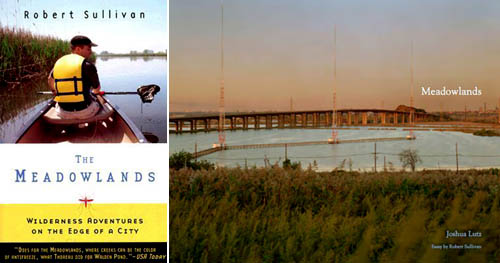
[Images: The Meadowlands: Wilderness Adventures on the Edge of a City by Robert Sullivan and Meadowlands by Joshua Lutz].

To write his book, Sullivan went on a series of explorations through the Meadowlands, including by canoe and in the company of a former police detective.

While there are definitely some moments of rhetorical over-kill, the book is so filled with interesting details that it proved very hard to stop reading; in between learning about the “discharged liquefied animal remains” that were dumped into the region’s streams and rivers, or the “major pet company and Meadowlands development firm” that “drove so many steel girders into the ground that people joked Secaucus would become a new magnetic pole,” or even the old—and, unfortunately, forgotten—mine shafts that began swallowing a development called the Schuyler Condominiums, Sullivan’s book, like any good and truly local history, builds to a level of narrative portraiture that is as braided and fractally involuted as the wetlands it documents.
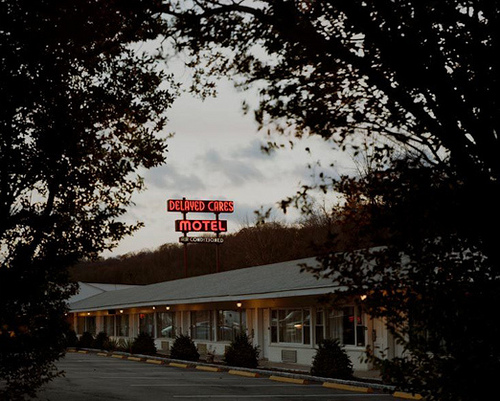
[Image: From Meadowlands by Joshua Lutz].

For instance, Sullivan discovers a flooded radio transmission room, “its giant antenna felled in the water like a child’s broken toy,” as well as “little islands, composed wholly of reeds,” one of which, in the middle of soggy nowhere and accessible only by boat, was “surrounded by bright yellow police emergency tape: CAUTION, the tape said.”

Relating the litany of pollutions that exist in the swamps, he guides the reader’s eye toward ponds of cyanide, truckloads of “unregulated medical waste,” and soil so thoroughly contaminated with mercury that, “as recently as 1980, it was possible to dig a hole in the ground and watch it fill with balls of shiny silvery stuff.”

This might even have affected the New York Giants football team after they moved into Meadowlands Stadium: “In the mid-1980s, playing football in the Meadowlands meant possibly risking your life, because shortly after the stadium opened players for the Giants began developing cancer… ‘Players complained of occasionally foul-smelling water, and the high incidence of leukemia in adjacent Rutherford…'” No official medical link was either admitted or found. Indeed, certain streams are really a kind of “garbage juice”—an “espresso of refuse,” as Sullivan nauseatingly describes it.

In many places, the so-called ground is, in fact, trash—so much so that “underground fires are still common today… you can see little black holes where the hills have recently burped hot gases or fire… huge underground plumes of carbon dioxide and of warm moist methane, giant stillborn tropical winds that seep through the ground to feed the Meadowlands’ fires, or creep up into the atmosphere,” forming a particularly Dantean local climatology of reeking crosswinds. One of these fires “burned for fifteen years.”
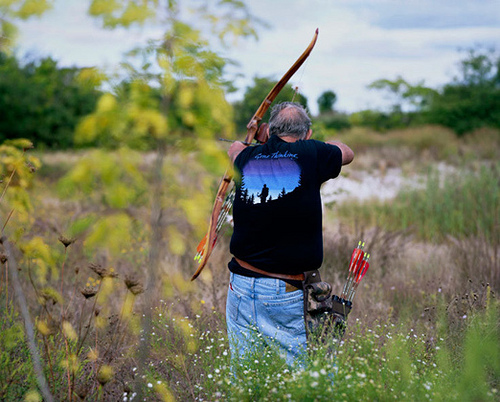
[Image: Bow-hunting amidst the reeds, from Meadowlands by Joshua Lutz].

The Meadowlands are, after all, a massive dump, more landfill than landscape. The effect, though, is a kind of new picturesque, an engineered sublime of artificial hills, deltaic chemical accumulants, cheap hotels overlooking it all on the periphery, and even entire lost buildings buried beneath three centuries of dumping. “If you put a shovel anywhere into the ground and dig just about anywhere in the Meadowlands,” Sullivan writes, “it won’t be long until you hit rubble from a building that was once somewhere else.”

In Kearny, one old dump contains pieces of what was once Europe. In 1941, under the auspices of the Lend-Lease Act, shipments of defense equipment went from the United States to Great Britain by boat. On their return trip, the boats used rubble from London bombings as ballast. William Keegan, a Kearny dump owner, contracted to accept the ballast. As a result, some of the hills of the Kearny Meadows are London Hills.

This is actually also true for New York’s FDR Drive, which is partially constructed on British war ruins used as fill.
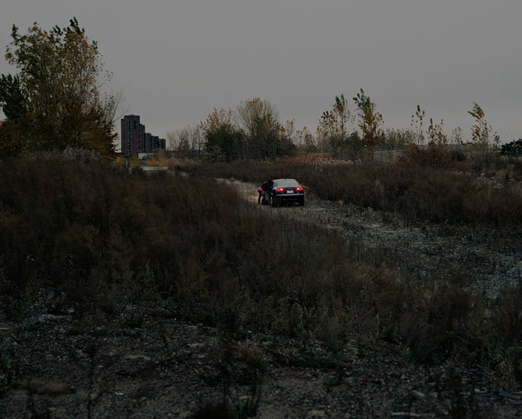
[Image: An awesomely sinister photo from Meadowlands by Joshua Lutz].

There is an amazing chapter about mosquito control in the region, something I want to return to in a future post someday; another about treasure hunters on a quest for Revolutionary War-era gold and silver; and another about the construction of the hulking and monumental Pulaski Skyway. Before that oddly tunnel-like, 3.5-mile, elevated roadway was built, “ferries and sailboats took passengers from New York to Newark via Jersey City,” but, like something out of a Terry Gilliam film, “it was not unusual for papers to report that a ship making the trip had been blown out to sea and never been seen again.”

I could go on and on. There is even an entire subplot in which Sullivan hunts down the buried remains of New York’s Penn Station.

I want to end, though, with something said by the retired police detective who takes Sullivan under his wing on a series of driving tours toward the end of the book. When Sullivan asks the former investigator if he misses his job, the response is intelligent, thoughtful, and extraordinary. I’ll quote it in full:

“I miss it to this day, to this minute,” he said. “And do you know why? Because it takes you a long time to accumulate the knowledge.”
He pointed out the car. “Like for instance,” he continued, “look over there at that building, that warehouse. See how one door is open and one door looks like it’s closed up. Now, what I’ll do is store that. Keep it in my head. And see that sign over there in front of that building? You remember that. You remember that because you may need it someday. It may be useful. You accumulate the knowledge. Do you see what I mean? And then all of a sudden you’re supposed to just stop.”
He shook his head and started the car moving again, driving slowly up out of the swamp, up the hill. “The thing is, you just can’t,” he said.

This hermeneutic attention to everyday details—through which open warehouse doors or unusually parked cars all become raw data accumulated over decades for use in some later, possibly never-to-occur narrative dissection—is exactly the task not only of the detective but of the writer, and of anyone who would attempt to study an existing landscape in order to uncover its most unexpected and far-reaching implications.

In any case, together with Lutz’s photos of the region and its very particular anthropology—which Lutz discusses in an interview with Conscientious, remarking that the Meadowlands are “an astonishing mixture of towns, swamps, trains, motels and an amazing array of bisecting highways all trying to keep you out”—both books have been invigorating encounters over the past week or two, and each is worth checking out if you get the chance.

Family Mines and the Basement Zoning Codes of Minnesota

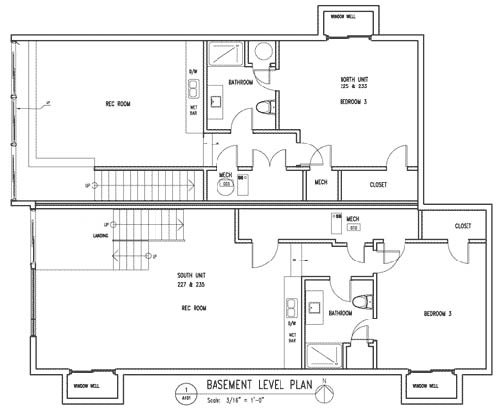
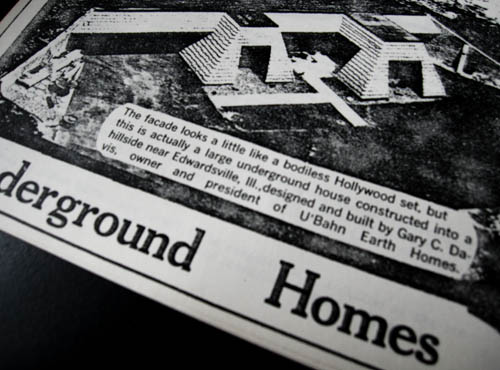
One of many fascinating details to be found in the Underground Space Center Library archives at the Canadian Centre for Architecture is something from a paper, written by a University of Minnesota law student, called “Zoning Ordinances as Obstacles to Earth Sheltered Housing: A Minnesota Perspective.”

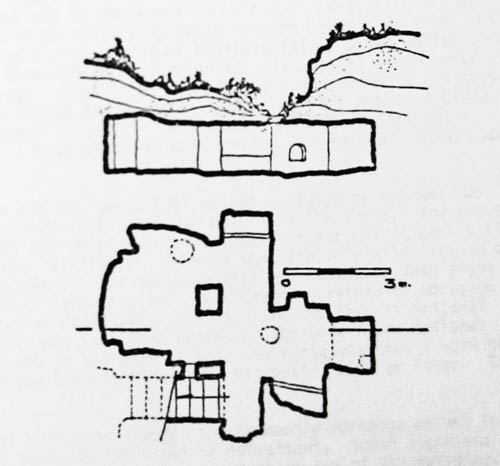
[Image: Random basement floorplan].

There, amongst other key legal points, the student weighs in on what he calls the “definitional problems” that arise when traditional zoning law is applied to underground space—indeed, “whether zoning regulations apply at all to underground structures.”

Though the paper clearly focuses on the state of Minnesota, it goes as far afield as Texas; in the case of Hancox v. Peek, for instance, “a Texas Court of Appeals held that a fallout shelter which was wholly underground, except for a concrete slab which extended a mere two or three inches above the ground, was not a building—merely an appurtenance, and therefore not within the contemplation of a zoning ordinance requiring a minimum distance between buildings and adjacent property.” One can easily imagine byzantine courtroom arguments and legal appeals of the future, citing legal precedents from wartime bunker construction, domestic fallout shelters in Texas, and perhaps even subsurface mine-safety regulations in some strange Kafkaesque scenario involving, say, the late Mole Man of Hackney and his contested underground estate.

But, as it happens, my reference to mining safety is deliberate.

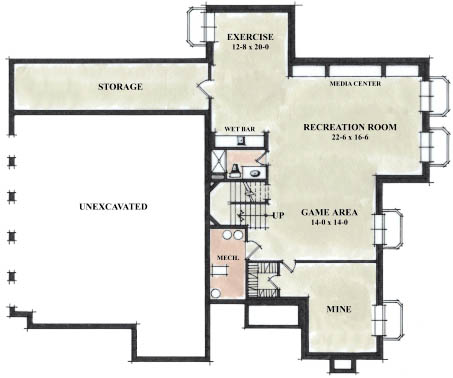
[Image: Random basement floorplan].

At the time of the paper’s writing—the late 1970s—underground facilities, from parking garages to hospitals and private homes, were considered so novel from the perspective of traditional Minnesota zoning law that there was no accepted legal means for how to define or describe them. These are the “definitional problems” mentioned above. “Examples,” we read, “are the broad definitions of basement and cellar… defining excavations of greater than 400 cubic yards as ‘mining’—thus requiring a special permit, and defining ‘detached dwelling’ as one ‘entirely surrounded by open space’.”

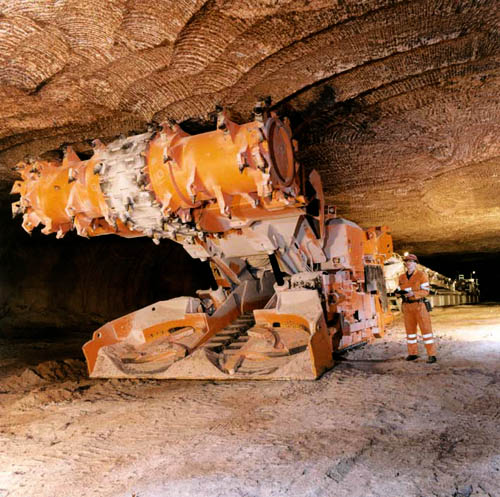
That’s worth repeating: excavations of greater than 400 cubic yards were legally zoned as mines—whether it was a parking garage or your newly renovated basement rec room.

In other words, if you lived in Minnesota in the 1960s and 70s, and you had a particularly enormous basement, inside of which you and your siblings might have watched television, you could, legally speaking, have been playing inside a mine. Whether or not this gave you permission to harvest minerals is unclear.

[Image: A continuous mining machine at work; image courtesy of Salt Union Ltd].

No lawsuit, to my knowledge, has ever been retroactively filed against Minnesotan parents, accusing them of mine-safety violations—but there is always a first time.

Nor has the reverse of this scenario—in which a Minnesotan industrial minerals magnate from St. Cloud successfully rezones his mine or quarry as a domestic basement—been, to my knowledge, attempted.

#CCA

Subterranean Builders’ Guide

In the underground-themed issue of Rassegna, mentioned earlier, author Nicola Sinopoli offers a brief subterranean builders’ guide to bringing architecture underground. “There are now no technological limitations that could stop us from colonizing the underground,” he declares, providing a short catalog of useful construction materials in the process.

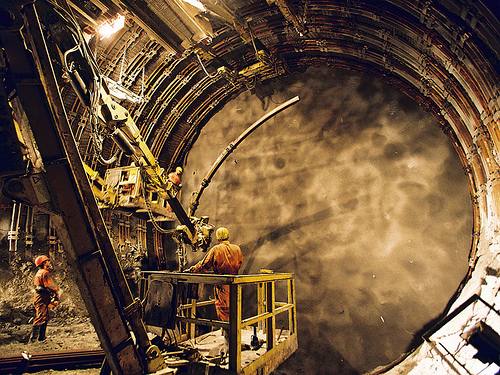
[Image: The Gotthard Base Tunnel in Sedrun, Switzerland; photo by Brian Fulcher, Walnut, CA, courtesy of Engineering News-Record‘s 2006 “Year in Construction” recap].
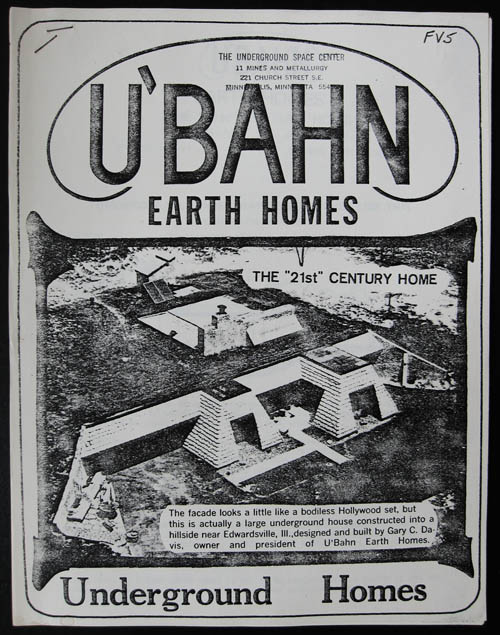
Sinopoli’s purpose is to point out “some of the new materials that chemistry and physics have offered this new world of construction.” And this goes beyond mere drilling equipment—which Sinopoli does not, in fact, cover—to encompass things like high-density buckled polyethylene membranes that are “impervious to organic bacteria and mildews that may be in the ground,” and that serve “as an effective barrier against radon, a radioactive gas sometimes found in the earth.”

We see flexible geocomposite mats, fiber-optic lighting technologies, a wide variety of grass turf for roofs, and self-ventilating, anti-humidity wall panels, all of which allow “colonizing the underground,” as Sinopoli puts it.

Cases, membranes and buckled plates protect the building from the infiltration of water and roots; woven and non-woven geotextiles, geocomposites, geomats and synthetic monofilaments stabilize and drain the land; and ultra high yield reflective films convey natural light inside the new underground spaces

He specifically focuses on issues of water and humidity, citing “an exciting array of innovative products in the field of green roofs and facades, where we now have an endless selection of materials for waterproofing and draining, water storage systems, draining sublayers, watering systems, hydrosowing systems and a panoply of plants modified in their deepest nature to adopt to any climate imaginable. The plants are often the fruit of an ingenious union of botany, genetics and new materials research. As if that weren’t enough, we have found that natural earth is an excellent insulator from heat and cold.”

The idea that “colonizing the underground” will be made possible at least partially through the use of genetically modified plants is pretty fascinating. This extends engineered biologies—future crops and oxygen gardens, perhaps even crypto-forestry—into the earth’s subsurface. Speleonauts living inside an architecture of growth chambers three miles underground, shining UV lights at specialty plantlife bred specifically to produce a breathable atmosphere, researching new anthropological directions in the deep.

It’s not much of an exaggeration here to say that gardening will be as important to the future of underground living as tunneling equipment.

[Images: Photos by BLDGBLOG of documents in the Underground Space Center Library archive at the Canadian Centre for Architecture].
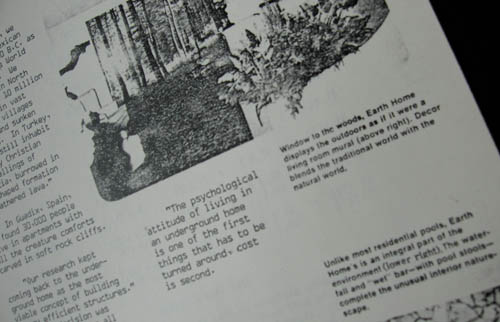
Sinopoli suggests that building underground is, for all intents and purposes, a solved problem: “If anything,” he quips, “we should explore what effects living and working in underground or almost underground spaces might have on behavior and quality of life. Sociologists will give their answers to this.” This is what I have earlier called psychology at depth, or the unanticipated psychiatric implications of living underground.

[Image: Photo by BLDGBLOG of documents in the Underground Space Center Library archive at the Canadian Centre for Architecture].
I should note, however, that Sinopoli’s article is less about moving into scifi mega-cities inside the earth than it is about making things like underground shopping malls and even suburban basements more safe for everyday use. Nonetheless, over-ambitiously applying these same techniques in the outright construction of artificial caverns on a continental scale is, for me, simply too interesting to pass up.

Indeed, I’m reminded of Jeff Long’s scifi-horror novel The Descent, in which armed military units lead an invasion of the underworld, heading downward into the earth, Jules Verne-like, but with machine guns, hydroponic agriculture, UV klieg lights, and truckloads of instant concrete. They “approached the subplanet the way America approached manned landings on the moon forty years ago,” Long writes, “as a mission requiring life support systems, modes of transportation and access, and logistics.” The Army Corps of Engineers gets involved, “tasked to reinforce tunnels, devise new transport systems, drill shafts, build elevators, bore channels, and erect whole camps underground. They even paved parking lots—three thousand feet beneath the surface. Roadways were constructed through the mouths of caves.” It takes days at a time to get anywhere in Long’s underworld; there are outbreaks of “tropical cave disease,” we read, and claustrophobia.

[Image: Photo by BLDGBLOG of documents in the Underground Space Center Library archive at the Canadian Centre for Architecture].
In any case, at this point, Sinopoli suggests, questions of architectural style can re-enter the picture. Indeed, “there are questions about the consequences of underground building on architecture and its language. That’s a discussion still waiting to be had.”

We can assemble a subterranean builders’ guide, in other words, and solve the problem of constructibility; but when it comes to architectural form, if we hope someday to move beyond mere underground shopping malls—for instance, Montreal’s overwhelmingly anti-climactic “underground city“—then there is still an awful lot of work to do.

#CCA

Crypto-Forestry and the Return of the Repressed

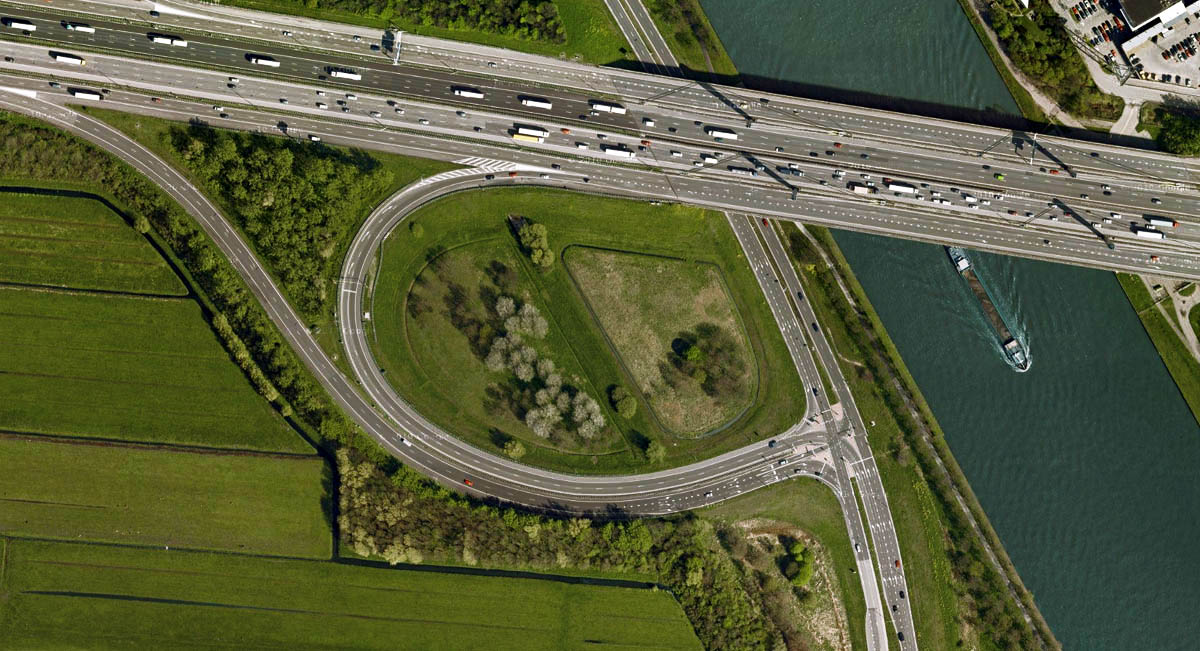
[Image: My own “crypto-forest of Utrecht,” via Google Maps].
While we’re on the subject of PrimatePoetics!, I’m intrigued by their “CryptoForests of Utrechtseries, which kicked off back in October 2009. It’s an ongoing exploration of botanical landscapes in and around Utrecht, Netherlands, that have sprung back from aggressive anthropological intervention. Weed patches in which the earliest emergent traces of a thicket can be found; clusters of trees growing semi-feral on the edges of railroad yards; forgotten courtyards sprouting with random saplings unplanted by any hand: these are all crypto-forests.

Each example of this type of landscape, PrimatePoetics! explains, is “almost entirely hidden from view and very few people know about it.” Each is “a forest grown in the shadow of neglect, private ownership and municipal refusal.” Each is a landscape that has been “left to fallow” but then spurts back in spikes of weedy regrowth, becoming “unnoteworthy from all angles, but pretty large when you are inside it.”

All of them together would make an amazing travel guide or landscape pamphlet—a short tour through minor quasi-forests around the city of Utrecht (or elsewhere). I’m tempted to launch a global “crypto-forestry” group on Flickr for documenting exactly this sort of thing—in fact, I’ve gone ahead and done so. Feel free to contribute, if you’re in the mood, burgeoning scholars of urban weeds. Photographic documents of minor landscapes on the rebound; urban forests in their earliest, stunted stage; insurgent fringes of suburbia coming back to vitality; derelict groves extending underground roots. The return of the botanical repressed.

The “star thing that holds the summer”

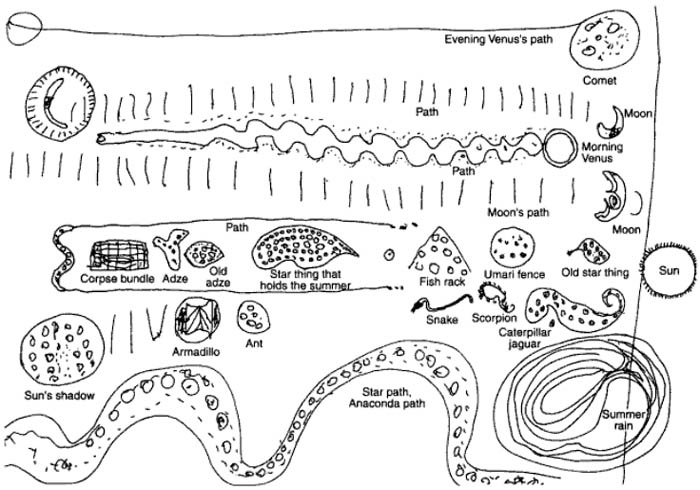
Just in time for the summer solstice, I thought I’d post this hand-drawn, shamanic map of the “Barasana cosmos.”

[Image: The Barasana Cosmos, via PrimatePoetics!].

“Constellations are here mapped as identities from Barasana mythology,” we read. “The Pleiades, or Star Woman, is shown here as the ‘star thing that holds the summer.'” As a brief aside, the Pleiades are known in Japan as Subaru—which explains that carmaker’s astrally inflected logo. So, if you’re driving a Subaru, there’s a kind of ethno-astronomical star chart emblazoned on the front grill of your car.

In any case, the image seen above comes from a recent series of short posts, looking at hand-drawn cartographies from peripheral cultures around the world, posted on the excellent blog PrimatePoetics! (whose exhilarating manifesto reminds us that “we still have at least 30,000 years to go before our existence in history will be of equal duration to our existence in prehistory,” and whose blog thus hopes to document “the transmutation of the ape into a conversationalist”).

That blog’s ongoing interest in ethnocartography extends from this “Yage Map” and a handful of “Amazonian Maps” (including the Barasana map, above) to the “Ojibwa Migration Map,” the “Arawete Village Map,” the “Aboriginal Water Map,” the “First Contact Eskimo Driftwood Map,” a “Valcamonica Topographic Rock Carving,” and many, many more examples that should not be missed.

A Flower Factory for the Caves Beneath Naples

[Image: The subterranean Flower Factory of Naples by Marco Zanuso; photograph by BLDGBLOG of an image from Rassegna].
I thought I’d kick off a series of posts looking at my time spent so far going through the “Underground Space Center Library” archives at the Canadian Centre for Architecture with a look at a summer 2007 issue of Rassegna magazine, its topic nothing other than underground architecture or architetture sotteranee. While the issue is not actually part of the “Underground Space Center Library” archives, it makes a convenient starting part for a few new posts.

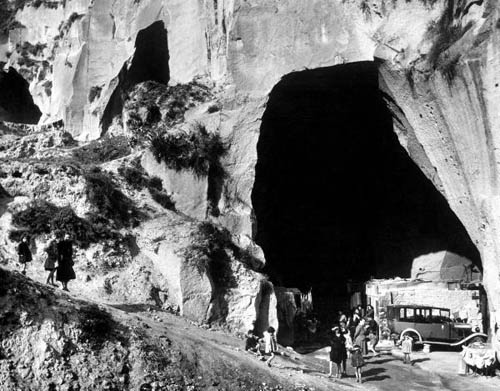
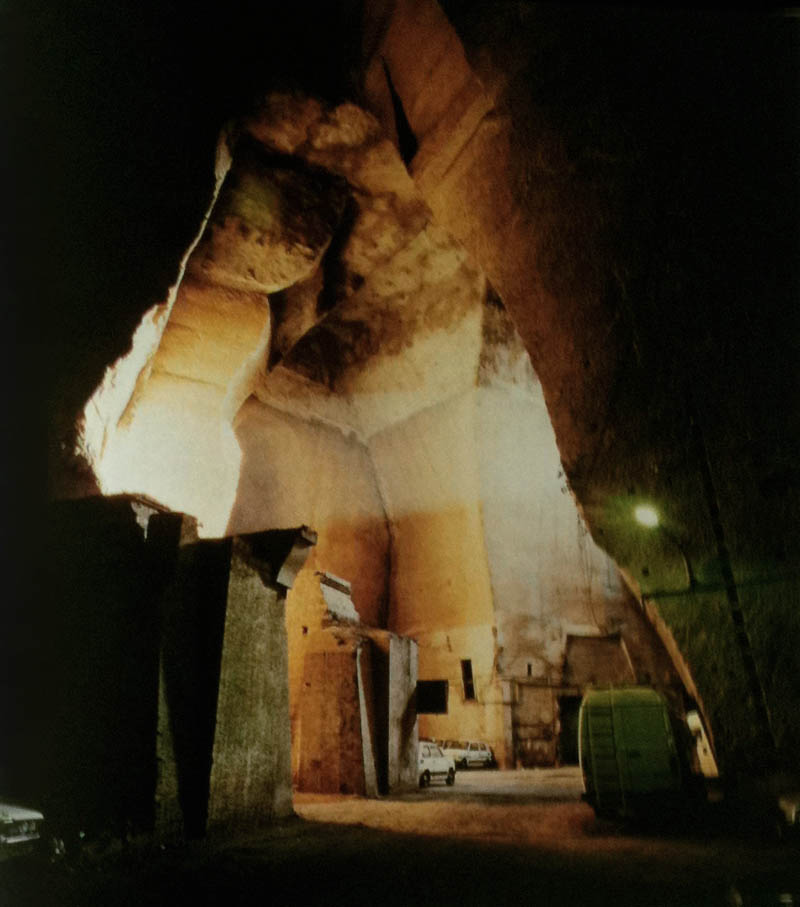
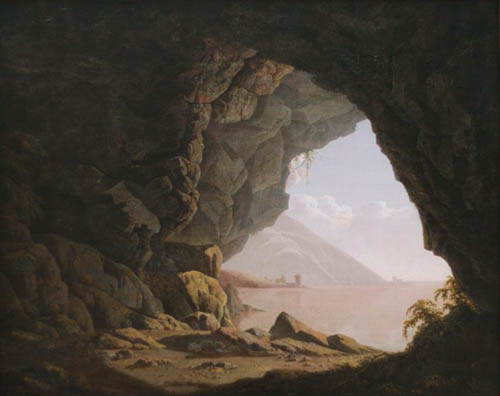
The city of Naples, as many readers will know, is built atop a series of caverns. These continue throughout the coastal region, extending down the coast for quite some time to form grottoes, harbors, and coves; they have been depicted throughout art history and used for everything from smuggling illicit goods (see Roberto Saviano’s Gomorrah, for instance) to sheltering the populace from bombing raids during World War II.

[Images: Joseph Wright of Derby, Cavern, near Naples (1774) and A Grotto in the Gulf of Salerno, Sunset (1780-81)].

As the BBC reported a few years back, these caves “have been dug out over thousands of years and used for everything from aqueducts to air raid shelters.” Though “more than 900 have been discovered so far,” they add, “that is believed to be only a third of what actually lies below.” Approximately 2,700 caves, then: there is a whole other world beneath greater Naples.

Photographer Margaret Bourke-White was sent by LIFE magazine to document the wartime reuse of the city’s most prominent geological features; from children playing on gravel hillsides to teetering stacks of agricultural machinery waiting quietly in the darkness for the day they could be reactivated, every conceivable activity of everyday life was hosted underground.

[Images: All photos by Margaret Bourke-White, courtesy of LIFE magazine].

But what sorts of sustained, economically pragmatic uses for these spaces might we develop today?

In 1988, an exhibition called SottonapoliBeneath Naples—explored possible architectural transformations of the caves.

Amongst those projects was a proposal for an automated “Flower Factory” by Marco Zanuso.

[Image: Underneath Naples; photograph by BLDGBLOG of an image from Rassegna].

As Francesco Trabucco, one of Zanuso’s collaborators on the project, wrote in Rassegna‘s underground issue, the project was for—and the parenthetical comments here are Trabucco’s own—”a large phytotron (a neologism referring to an accelerator of natural growth).” He continues:

The operating principle of the phytotron involves creating and monitoring the optimum microenvironment for plant growth: temperature, air humidity, lighting, photoperiodism and nutrition. At the same time, all negative factors tied to the natural environment are eliminated, i.e. climatic variation, the unpredictability of precipitation, variability in the length of the solar day, and—naturally—air and water pollution, and infestation by plants and animals. In the conditions created inside a phytotron, a plant grows at a pace that can be accelerated, with the complete absence of pollutants that are now widely present in plants grown ‘naturally,’ such as weed killers, insecticides, pesticides, acid rain, smog deposits and chemical fertilizers.

It’s basically an underground greenhouse, of course, but a fully automated one forming its own subterranean microclimate. Think of it as a buried version of VW’s legendary CarTowers in Wolfsburg, Germany, crossed with the indoor skyscraper farms so popular on architecture blogs back in 2007. The botanical results are not tomatoes, corn, wheat, or cucumbers, however, but prize flowers.

It’s a kind of pharaonic Keukenhof, or a cultivated series of entombed precision-microclimates powered by a surrogate sun.

[Image: The subterranean Flower Factory of Naples by Marco Zanuso; photograph by BLDGBLOG of an image from Rassegna].

Indeed, “A circular system of solar mirrors is designed to be installed on the ground level,” Trabucco explains, “thereby concentrating enormous amounts of thermal energy to a steam ball set on an upper level. The latter produces superheated steam to power the electric turbines.”

Nearby that is “a sterile laboratory, set up at the system entrance, in which plant cloning and micropropagation are conducted.” Successful shoots are then “placed in growth chambers until they are large enough to transplant to trays, which have holes that are sized and spaced according to the morphology of the individual plants.”

These aeroponic trays of engineered flowers are then placed, via automated relay, into a series of “maturation tunnels”—in many ways quite similar to the mushroom tunnel of Mittagong—”that are 1.8 meters wide and about 100 meters long. Tunnel height varies to cater to plant morphology; the number of overlaid tunnels or growth levels depends on the height of the gallery.”

From there, these flowers grown in such unique architectural circumstances would be harvested, pruned, crated, and shipped all over the world—and probably no one would know their actual origin.

[Image: The Flower Factory by Marco Zanuso; photograph by BLDGBLOG of an image from Rassegna].
In any case, the possible underground future of botanical cultivation, using specialty equipment and architectural design to transform caves into ornamental flower farms or large-scale plantations, is something I’ll mention again while exploring the archives of the “Underground Space Center Library” at the CCA.

(For more CCA-related posts, click here).

Sewer-Diving Mexico City

Edible Geography has posted a must-read interview with Julio Cou Cámara, one of Mexico City’s famed sewer divers.

[Image: Diver Carlos Barrios is lowered into the sewers of Mexico City; Julio Cou Cámara can be seen on the right. Photo by Mary Jordan, courtesy of the Washington Post].

“Good afternoon,” the transcript of Cámara’s recent live presentation begins, “my name is Julio and I’m a diver in the sewage here in Mexico City. What I do is a bit weird. Most people, when I tell them that I’m a diver, they think, ‘Oh wow, that’s beautiful—the ocean and the beach.’ But no, we are divers of the sewage.”

I’m part of a team, and we work for the government in DF, in the Sistema de Aguas. We’re a water emergency team, so we participate in everything that has to do with flooding and repairing drainage systems. Under the city, under the streets where you walk, that’s where we dive.

The whole interview is well worth reading in full: Julio the Sewer Diver.

(Edible Geography‘s transcript of food historian Rachel Laudan is also fantastic).

Fracturing and a complete bleed-out are already underway

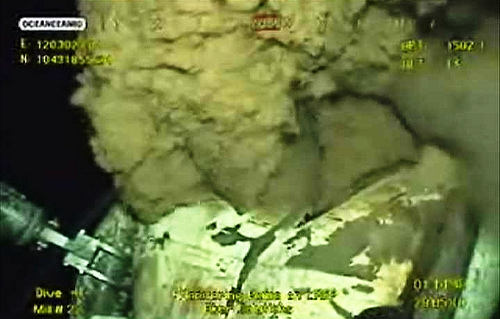
I think easily the most sobering thing I’ve read in a long time is that the BP Gulf oil spill might now be unstoppable.

It’s never the best editorial practice in a situation like this to laminate comments on top of comments on top of comments, but the internet is a-riot tonight with a chain of frankly terrifying speculation that boils down to one anonymous note posted on The Oil Drum earlier this week (which you can read in full through that link). In a nutshell, “the well bore structure is compromised ‘down hole’,” we read, leading to “one inescapable conclusion. The well pipes below the sea floor are broken and leaking.” This means that no surface capping will ever, at this point, work; the well is leaking in too many places, and the seabed itself is now beginning to show signs of collapse.

Indeed, the comment immediately following suggests that “a massive collapse of the Gulf floor itself is in the making,” and that “fracturing and a complete bleed-out are already underway”—meaning that no fewer than 2 billion barrels of oil could leak into the Gulf before the reservoir has fully depleted itself. That’s two billion.

Again: this is all rumors, anonymous comments, and geological speculation, but it’s also the most chilling scenario I’ve read yet for what is already an ecological disaster. The consequences of an unstoppable, multi-billion-barrel oil spill in the Gulf are truly unimaginable.

Read the Oil Drum comment and feel free to join one of the numerous threads discussing it.

(Spotted via @stevesilberman).

The “City-in-a-Box” and just-in-time private urbanism

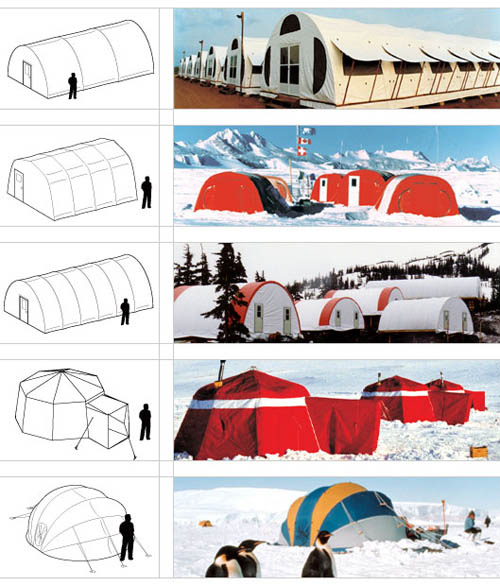
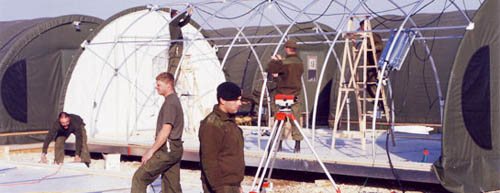
While writing a brief post for the CCA today about 19th-century “portable buildings” and their unexpected role in facilitating the European colonial project, I stumbled on the “portable camps” of Canadian shelter firm Weatherhaven.

[Images: Multiple projects by Weatherhaven].

Weatherhaven was founded, historian Robert Kronenburg explains in his book Portable Architecture, “in 1981 by the merging of two separate businesses, an expedition organizing team and a Vancouver-based construction company.”

The founders recognized the need for a dedicated approach to the provision of temporary shelter in remote places and developed a strategy to provide a complete service including design, manufacture, packaging, transportation, and erection of buildings, all of which would be created specifically to respond to the logistical problems of remote deployment in harsh environments.

For Weatherhaven, this includes the production of whole “Geological Survey Camps” and “mining villages,” among many other examples, almost all of which are capable of being rapidly deployed and air-delivered by crate.

It is Flatpak City: pop open the box and go.

[Image: Service-installation by Weatherhaven].

“The first stage of the operation,” Kronenburg writes, referring to a specific example of their cities-on-demand, “was to establish a Weatherhaven crew shelter so that a construction team could prepare a temporary landing site for heavier aircraft.” From that initial seed, a whole civilization-by-airfield could be grown—an instant city from the sky. “A single crate was flown in by light aircraft and the building was assembled and in use within four hours.”

The team then prepared the camp layout, and as the rest of the building components and other equipment were flown in, assembled the entire facility… The completed facility included sleeping and leisure accommodation, a 24 hour kitchen, showers, and toilets, a hospital, offices, and an engineering base, and was built in 20 working days.

The buildings themselves are neither architecturally nor materially interesting, Kronenburg adds, but they “are remarkable for their organizational and logistical approach.”

It is just-in-time urbanism: parachuting in whole cities and logistical systems till a new, geographically remote metropolis is up and running in less than three weeks.

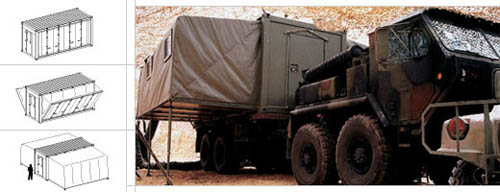
[Image: A military village by Weatherhaven].

These temporary mining villages and other extraction towns—somewhere above the Arctic Circle or deep in the desert, “often so remote as to be invisible to most of the world”—unfold in an industrial nanosecond. They stick around for mere years and then disappear, leaving no real archaeological traces, producing no tourist postcards, finding no place on any map, perhaps never even achieving the status of a formal name, yet nonetheless managing to house thousands of workers at a time.

What role should such compounds play in the writing of urban and architectural history?

[Image: A military village by Weatherhaven].

At the very least, these “longer-stay remote shelters,” as Kronenburg calls them, are surely as vital to the global economy—with deep connections to the extraction industries, from diamond mines to tar sands—as the banking district of a recognized urban conglomerate. How ironic it would be to discover someday that an instant village for 2,000 residents, air-delivered by Weatherhaven into the emotionally bleak but mineralogically rich Australian Outback, has a larger economic footprint than the entire business district of a city like Sydney.

In many ways, I’m reminded of an article published last week in which we read that “Cisco Systems is helping build a prototype in South Korea for what one developer describes as an instant ‘city in a box’.”

Delegations of Chinese government officials looking to purchase their own cities of the future are descending on New Songdo City, a soon-to-be-completed metropolis about the size of downtown Boston that serves as a showroom model for what is expected to be the first of many assembly-line cities.

The idea that a government—or private corporation—can simply “purchase their own cities of the future” is a fascinating and oddly troubling one. “Five hundred cities are needed in China; 300 are needed in India,” an excited developer explains—so why not simply “purchase” them from the cheapest or most reliable supplier?

Cities will be things you have delivered to you, like pizza, and they and their residents will be treated just as disposably.

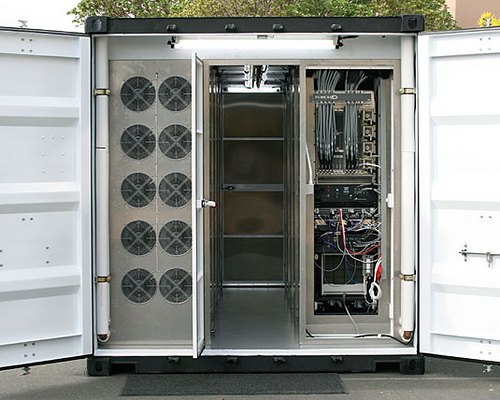
[Image: The “modular datacenter” of Sun’s Project Blackbox, a stackable, shipping container-based, portable supercomputing and data storage unit].
Offloading a few of Sun’s Project Blackbox units, seen above, in order to construct a privately chartered city-in-a-box, based around a remote airfield somewhere in the Canadian Arctic, is something as likely to be seen in a Roger Moore-era James Bond film as it is in the corporate spreadsheets of a firm like Rio Tinto; but I’m left dwelling on the question of where these sorts of settlements belong in architectural history.

Purpose-built instant cities “purchased” wholesale from private suppliers, and erected in as little as one month’s time, are only going to increase in quantity, population, diversity of purpose, and global economic importance in the decades to come; their impact on political science and concepts of sovereign territory and constitutional law is something we can barely even begin to anticipate. But if architects have more to learn from the international warehousing strategies of Bechtel than they do from the Farnsworth House or the software packages of Patrik Schumacher, then what role might firms like Weatherhaven prove to have played in transforming how we understand the built environment?

Put another way, should the COO of Weatherhaven be invited to contribute to Icon‘s next “Manifesto” issue? If so, what might architects and urban planners learn?

(Thanks to my dad for the Cisco “city-in-a-box” link!)

The Underground Light Mine of Batavia

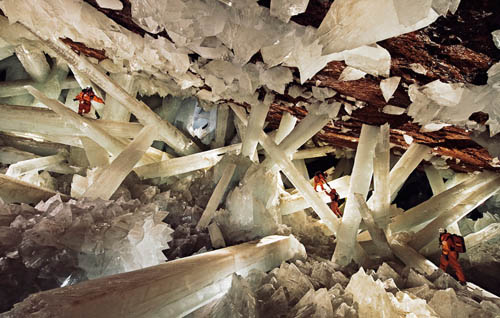
[Image: Mexico’s “Cavern of Crystal Giants” photographed by Carsten Peters, courtesy of National Geographic].

I’ve got another post up over at the CCA, looking at Paul Scheerbart’s recently republished 1912 short story “The Light Club of Batavia,” in which an abandoned mine is transformed into a glass-filled environment for the hosting of underground “light parties.” Check it out if you get a chance: Hurray for crystal!