Liquid films and water-signs: landscape in an age of information design


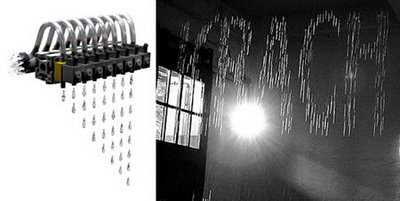
[Image: Julius Popp’s Bitfall].

Bitfall, pictured above, is a kind of liquid computer monitor. As Ruairi Glynn, of Interactive Architecture dot Org, describes it, Bitfall uses carefully-timed drops of falling water “to project images taken from the internet. A computer observes various news websites and chooses thereafter the images to be displayed. 128 nozzles are controlled by synchronised magnetic valves, and the water drops falling to the ground shape the images. The visual information is only tangible for a second before the drops merge to become water again.”
The sheet of falling water, then, becomes a screen – a liquid cinema – a monitor on which to surf the web.

All of which would be amazing enough were it not for some unbelievable landscape design possibilities.
You’re in Rome, and you decide to visit the Trevi Fountain – but you’re confused. Is that an image you see in the cascading water…? You look closer and realize a television show is being played using the water itself. The whole city, in fact, is full of fountains, and they’re all playing films, news shows, stationary images of art. It begins raining later that evening, and you swear you see films in the falling water…
Then fountains are installed in red light districts around the world, showing porn…
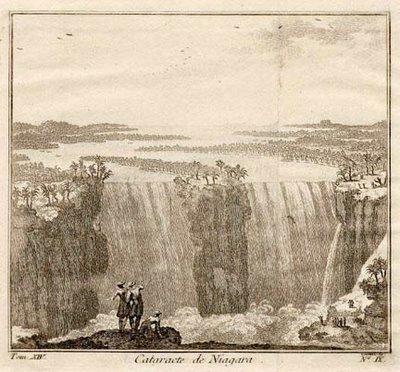
The next summer huge gates are attached to the top of Niagara Falls, and every August a film fest begins: you sit down on the Canadian side of the border and watch Hitchcock, Truffaut, Roberto Succo, an almost-subliminal cinema roaring downward into mist with the water.

A computer-controlled showerhead is installed in your home bathroom, and you watch the news, or put on a film and… do whatever while you watch it. Headlines falling on your shoulders from above.
Hotel lobbies with fake waterfalls are transformed into newsrooms, with financial information trickling down the corporate surface of the falls. From different angles you receive different information; from further away you see different films.
The New York Stock Exchange replaces its news tickers with fountains: the Dow, the FTSE, the price of mined tungsten. Mineral futures. All cascading inside smooth surfaces of water.


[Image: Asymptote‘s re-design of the NYSE].

Soon trees can be genetically altered to form images in their bark: tree-screens. You accidentally stumble into a test-forest, after a car accident in rural Bavaria, and all the trees around you seem covered in pictures, and certain angles make them all add up into a 3D film…
Filmstills from award-winning directors of the past are put into genetically modified flowers; you look closely and it’s Hollywood Ninja, frame by frame, growing in your bestfriend’s garden. When breezes come, short scenes go animated, looped. Hypnotic. The film garden.
Then flowers replace DVDs, and we go from libraries to planting special trees.
Landscapes everywhere bear encoded information.

A huge dome is built over New York City. As rain falls the water is filtered, bit by bit through the dome to form texts: images, signs and financial information.
You pay the city and your logo is displayed, coming down in curtains on the city, liquid. The weather-advertising complex.
The rain industry.
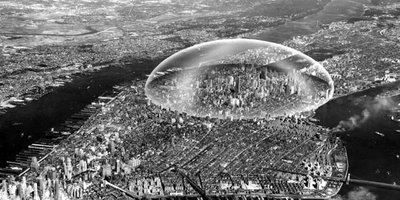

[Image: Buckminster Fuller, glass dome for Manhattan].

Endless information, printed three-dimensionally in space.

(Via Interactive Architecture dot Org, via Information Aesthetics).
The Remote Viewer


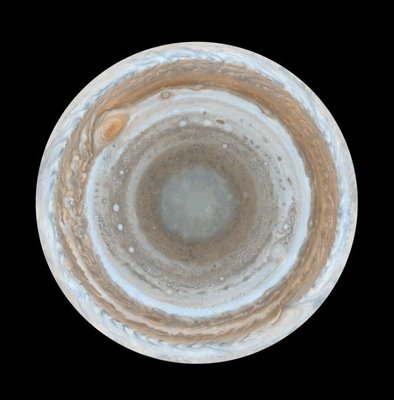
[Images: All but perfect for album art, these are new photos of Jupiter’s South and North poles, respectively; see also this ridiculously beautiful landscape scroll of Jupiter unrolled into a ribbon. Meanwhile, one wonders if you could actually be alone there, flying through hydrogen storms, breathing helium, reading Ovid, self-exiled… In any case, does Jupiter sound like this?].

Trafalgar Flu


[Image: Daniel Defoe’s Journal of the Plague Year, another cover of which pleads: Lord, have mercy on London…].

Is Trafalgar Square doomed to become an avian flu hotspot? New Scientist implies as much in a short piece published last week: “Pigeons could carry H5N1 bird flu into city centres,” we read, “increasing the chances of humans being exposed to the virus.”
But does this tiny factoid mean anything at all – let alone that public squares all over the world will soon act as disease vectors for bird flu’s apparently impending sweep through the human genome?
If it does mean something, and if pigeons are a major risk for spreading influenza, will we first hear reports of human-human infection coming from hospitals in central London? Again, if so, will the pigeons of Trafalgar Square be to blame? And do infected pigeons mean that Venice’s Piazza San Marco is also a European vector for the disease?
Or am I just giving away the plot for BLDGBLOG’s first feature film…?

Super Reef: In Stereo!


[Image: California Academy of Sciences].

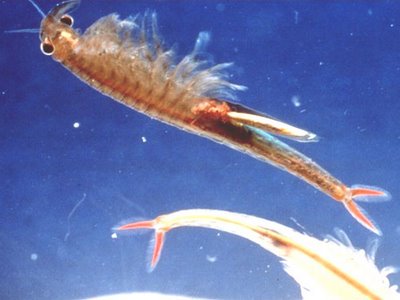
While BLDGBLOG just explored the possibility that reefs might actually be huge musical instruments, it turns out that a group of Scotsmen have been testing that exact hypothesis: “Stephen Simpson at the University of Edinburgh, UK, and his colleagues set up 24 artificial reefs, each with a speaker system, near Australia’s Great Barrier Reef. On six consecutive nights they played recordings of natural reefs at half the sites. A reef that was noisy one night was silent the next and vice versa. Reefs with the audio cue attracted four times as many cardinal fish and nearly twice as many damselfish.”
This “audio cue” is elsewhere described as the “‘frying bacon’ sound of snapping shrimps,” and it “can be picked up from 20 kilometres away.”
All of which is another way of saying that reefs already are musical instruments: vast landscape saxophones being played by shrimp underwater…


Having said that, what if you switched Simpson’s recordings and played, say, the sound of Madison Avenue along one of the reefs – what new ecosystems might result? Conversely, what if you played the sounds of a reef through speakers down Madison Avenue?
And could you imitate the sounds of a reef at a Hong Kong karaoke bar? Rather: what would happen in you did?
What is the future of abstract karaoke?
If you totally scramble the soundtracks of the world – what happens?

The Hollow Earth


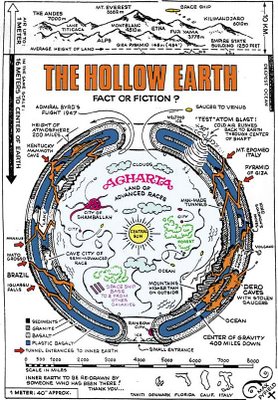
[Image: 2012; see also their bit on Hollow Earth Cities].

“I declare that the earth is hollow,” U.S. Army Captain John Cleves Symmes Jr. wrote in the early 1800s, “and habitable within; containing a number of solid concentric spheres, one within the other, and that it is open at the poles twelve or sixteen degrees. I pledge my life in support of this truth, and am ready to explore the hollow, if the world will support and aid me in the undertaking.”
Somewhere along the line, Himalayan space ships, Nazi explorers, remnant Stone Age tribes, undersea caves, north-flowing Siberian rivers, and Edmund Halley all get involved… setting up BLDGBLOG’s upcoming pitch for Indiana Jones 5

Mantleslides

“Deep beneath our feet, rock is constantly on the move.”


According to New Scientist, massive avalanches of molten rock inside the earth’s mantle may affect the speed of the earth’s rotation – briefly accelerating the planet. “Like an ice skater pulling in their arms,” these internal landslides shift mass towards the earth’s core, making the earth spin faster.
Over the long term, the earth is actually slowing down – yet weird anomalies in the planet’s geological record suggest that short bursts of acceleration come, as if from nowhere, and last roughly ten million years before fading. “For the trilobites,” for instance, “530 million years ago, one year contained about 420 days and each day lasted about 21 hours. Now we get a mere 365 days every year and our days last for 24 hours.” Interestingly, “as time goes by, days and nights will continue to stretch” – meaning that every single day, albeit probably by only a few nanoseconds, is literally longer than the day before.
(PS: don’t forget to set your clock forward tomorrow night).
So, when a runaway chunk of the earth’s mantle starts to slide, it “carries on going, sliding through the lower mantle like a stone dropped into a pond,” meaning that “a massive blob of rock the size of the Moon has shifted towards the centre of the Earth.”


What I’d like to know is: could you deliberately bomb the internal fissures of the earth – using a new hydrogen bomb, nicknamed The Jules Verne – starting huge mantleslides that accelerate the planet’s rotation so fantastically… that the skyscrapers of New York go flying into space?

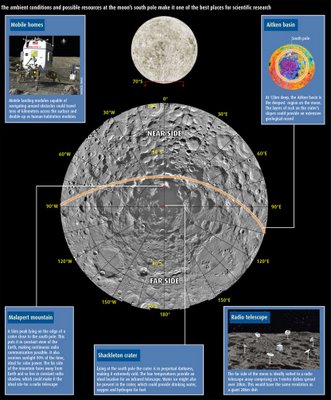
Lunar urbanism 6

“The moon,” New Scientist claims, “is about to follow the fate of Antarctica, which remained virtually untouched for nearly half a century after the first intrepid explorers penetrated its vast expanse. What followed was a mushrooming cluster of year-round laboratories, observatories and research facilities used by tens of thousands of scientists in summer and a thousand more who brave the long, dark winter.”


[Image: Where to site a lunar laboratory; New Scientist].

Deep within such a permanent lunar base, scientists will find an “interference-free environment,” which is “the perfect place to search for signs of extraterrestrial intelligence.” Though one is forced to wonder: if the scientists aren’t on Earth anymore… won’t they themselves constitute a source of extraterrestrial intelligence?
In any case, in “certain places near the poles” these scientists will find “perpetual sunlight, handy for continuous solar power; and in the shadows of crater rims, perpetual darkness, ideal for astronomy… Plus, there is a rock-steady surface on which to build structures, and the materials with which to build them.” Except – that’s not entirely true: in fact, the very real risk of “deep moonquakes,” NASA warns, is so great that the astronauts “may need quake-proof housing.”
Finally, somebody go get Barry White ’cause “there are sites available where the nights are long and uninterrupted” – and that’s all I gotta say about that.

[See also: Lunar urbanism 5, Lunar urbanism 4 – et cetera].

Super Reef

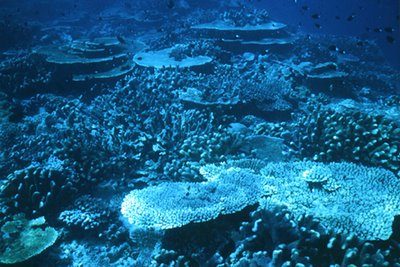
[Image: Australia’s Great Barrier Reef].

A “vanished giant has reappeared in the rocks of Europe,” New Scientist writes. It extends “from southern Spain to eastern Romania, making it one of the largest living structures ever to have existed on Earth.”

This “bioengineering marvel” is actually a fossil reef, and it has resurfaced in “a vast area of central and southern Spain, southwest Germany, central Poland, southeastern France, Switzerland and as far as eastern Romania, near the Black Sea. Despite the scale of this buried structure, until recently researchers knew surprisingly little about it. Individual workers had seen only glimpses of reef structures that formed parts of the whole complex. They viewed each area separately rather than putting them together to make one huge structure.”

[Image: The reefs of Raiatea and Tahaa in the South Pacific; NASA/LiveScience].

In fact, Marine Matters, an online journal based in the Queen Charlotte Islands, thinks the reef was even larger: “Remnants of the reef can be found from Russia all the way to Spain and Portugal. Portions have even been found in Newfoundland. They were part of a giant reef system, 7,000km long and up to 60 meters thick which was the largest living structure ever created.”

[Image: The Pearl and Hermes Atoll, NW Hawaii, via NOAA Ocean Explorer].

The reef’s history, according to New Scientist:

About 200 million years ago the sea level rose throughout the world. A huge ocean known as the Tethys Seaway expanded to reach almost around the globe at the Equator. Its warm, shallow waters enhanced the deposition of widespread lime muds and sands which made a stable foundation for the sponges and other inhabitants of the reef. The sponge reef began to grow in the Late Jurassic period, between 170 and 150 million years ago, and its several phases were dominated by siliceous sponges.

Rigid with glass “created by using silica dissolved in the water,” this proto-reef “continued to expand across the seafloor for between 5 and 10 million years until it occupied most of the wide sea shelf that extended over central Europe.”

Thus, today, in the foundations of European geography, you see the remains of a huge, living creature that, according to H.P. Lovecraft, is not yet dead.

Wait, what—

“We do not know,” New Scientist says, “whether the demise of this fossil sponge reef was caused by an environmental change to shallower waters, or from the competition for growing space with corals. What we do know is that such a structure never appeared again in the history of the Earth.” (You can read more here).

For a variety of reasons, meanwhile, this story reminds me of a concert by Japanese sound artist Akio Suzuki that I attended in London back in 2002 at the School of Oriental and African Studies. That night, Suzuki played a variety of instruments, including the amazing “Analapos,” which he’d constructed himself, and a number of small stone flutes, or iwabue.

The amazing thing about those flutes was that they were literally just rocks, hollowed out by natural erosion; Suzuki had simply picked them up from the Japanese beach years before. If I remember right, one of them was even from Denmark. He chose the stones based on their natural acoustic properties: he could attain the right resonance, hit the right notes, and so, we might say, their musical playability was really a by-product of geology and landscape design. An accident of erosion—as if rocks everywhere might be hiding musical instruments. Or musical instruments, disguised as rocks.

[Image: Saxophone valve diagram by Thomas Ohme].

But I mention these two things together because the idea that there might be a similar stone flute—albeit one the size and shape of a vast fossilized reef, stretching from Portugal to southern Russia—is an incredible thing to contemplate. In other words, locked into the rocks of Europe is the largest musical instrument ever made: awaiting a million more years of wind and rain, or even war, to carve that reef into a flute, a flute the size of a continent, a buried saxophone made of fossilized glass, pocketed with caves and indentations, reflecting the black light of uncountable eclipses until the earth gives out.

Weird European land animals, evolving fifty eons from now, will notice it first: a strange whistling on the edges of the wind whenever storms blow up from Africa. Mediterranean rains wash more dust and soil to the sea, exposing more reef, and the sounds get louder. The reef looms larger. Its structure like vertebrae, or hollow backbones, frames valleys, rims horizons, carries any and all sounds above silence through the reef’s reverberating latticework of small wormholes and caves. Musically equivalent to a hundred thousand flutes per square-mile, embedded into bedrock.

[Image: Sheridan Flute Company].

Soon the reef generates its own weather, forming storms where there had only been breezes before; it echoes with the sound of itself from one end to the next. It wakes up animals, howling.

For the last two or three breeding groups of humans still around, there’s an odd familiarity to some of the reef-flute’s sounds, as if every two years a certain storm comes through, playing the reef to the tune of… something they can’t quite remember.

[Image: Sheridan Flute Company].

It’s rumored amidst these dying, malnourished tribes that if you whisper a secret into the reef it will echo there forever; that a man can be hundreds of miles away when the secret comes through, passing ridge to ridge on Saharan gales.

And then there’s just the reef, half-buried by desert, whispering to itself on windless days—till it erodes into a fine black dust, lost beneath dunes, and its million years of musicalized weather go silent forever.

Algorithmic urbanist

These were all drawn by a computer, using code by Jared Tarbell.


The above image – called Substrate – is only one stage in a long algorithmic process. The various versions morph through different, oddly city-like fractal patterns, forming boulevards, squares, medinas – and reminding me of central Fes.
A few intermediary steps:


And some square ones:


All of which leaves me to wonder if the Artificially Intelligent city of the future will constantly reprogram itself, forming new wards and clusters where there had only been streets before – only to back-track, erupting fungus-like in bursts of self-assembled geometry. Weird overlaps and elisions. Symmetrical superslums.
Alternatively, you could create a videogame that reprograms itself as it’s played – forming new and unique levels, none of which ever repeats itself – and the maps you try to make… look like these.
Meanwhile, Tarbell’s algorithms also produce more organic forms:


[Note: It’s worth clicking on the sand dollars and scrolling down].

So if algorithms ever broke into a genetic lab – what might crawl out the next day?
Finally, there’s this beautifully tangled, gravitationally avant-garde quasi-planet, like someting out of a sci-fi novelist’s wet dream. An anti-earth re-seamed together forming monstrous rings and topographies:


And there’s more on Tarbell’s website.

(Via Drawn – with huge thanks to Brent Kissel!).