An orbiting array of reflective balloons

[Image: “An orbiting array of reflective balloons focuses sunlight onto the surface of Mars, providing extra heat and solar power for human colonists.” Via New Scientist. The plan being illustrated here would specifically use “300 reflective balloons, each 150 metres across, arranged side-by-side to create a 1.5-kilometre-wide mirror in orbit.” This would thus create “Earth-like conditions” on Mars – and perhaps inspire some strange future version of the Narcissus myth, in which a whole civilization turns its eyes to the nighttime skies… only to be confronted with an unmoving reflection of itself. What new astronomies are we doomed to construct? Of more earthly concerns, could we build small clouds of mirrored balloons, and – when our teenage neighbors aren’t shooting them down – amplify urban solar power intake during the off-season? Manhattan, masted to a thousand clouds of silver balloons, all shining].

(Thanks, Bryan! Related: Pruned’s Let there be light!)

Utopian Typography

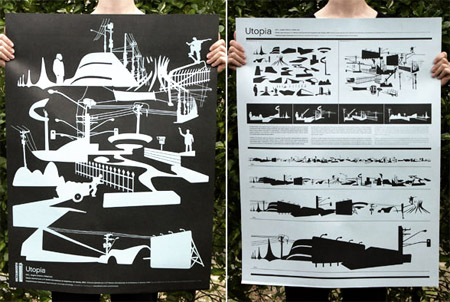
Utopia, pictured above, is a “digital typeface that portrays the mixture between the modernist architecture of Oscar Niemeyer and informal occupation of the urban space that shapes major Brazilian cities.” In other words, all the letters look like buildings designed by Oscar Niemeyer, jumbled up in Brazilian proximities.

[Images: BLDGBLOG written in Utopia; the whole font, posterized].

Utopia was designed by Angela Detanico and Rafael Lain; because their site uses Flash, however, you can’t directly link to the font. But it’s there.
So if somebody stumbles on a city full of Oscar Niemeyer buildings… will they suspect hidden messages in every glance?

Beijing Underground

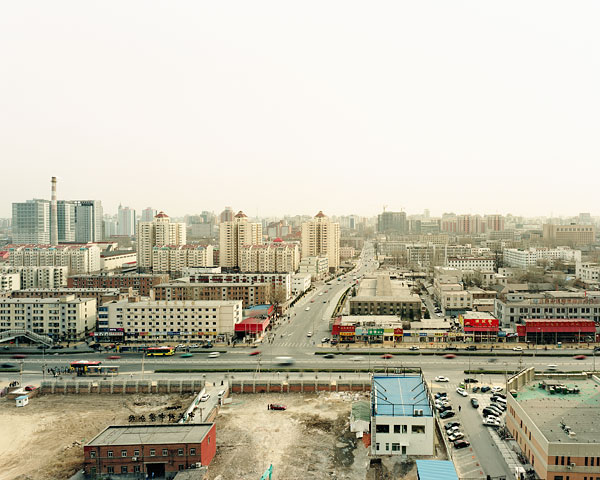
[Image: Chengfu Lu, Haidian District, Beijing (2004) by Sze Tsung Leong].

Apparently Beijing hopes “to ease congestion and other urban growing pains plaguing the city” by going underground.
“City planners have identified 17 key areas of the city for subterranean development, and envision an eventual ‘underground town‘ spanning 90 million square meters by 2020.”
This new subterranean Beijing “would quadruple the amount of underground space now being utilized in the city, which is currently at about 30 million square meters… Underground floor space [has] expanded by three million square meters in Beijing annually, [accounting] for 10 percent of the city’s total floor space completed each year” – much of which has been “devoted to parking and other traffic use.”

(Thanks, Alex P.!)

Earth’s Surface

[Images: Sze Tsung Leong, Seine I (2006), Baogang, Inner Mongolia (2003), and Jersey City (2002) from his Horizons Series, exhibited at the Yossi Milo Gallery earlier this year; discovered via Artkrush. The gallery’s accompanying press release gives some background on Sze Tsung Leong’s photos, but it concentrates entirely on his work from China. For more images, see The Built Environment].

The business card and the garden smuggler

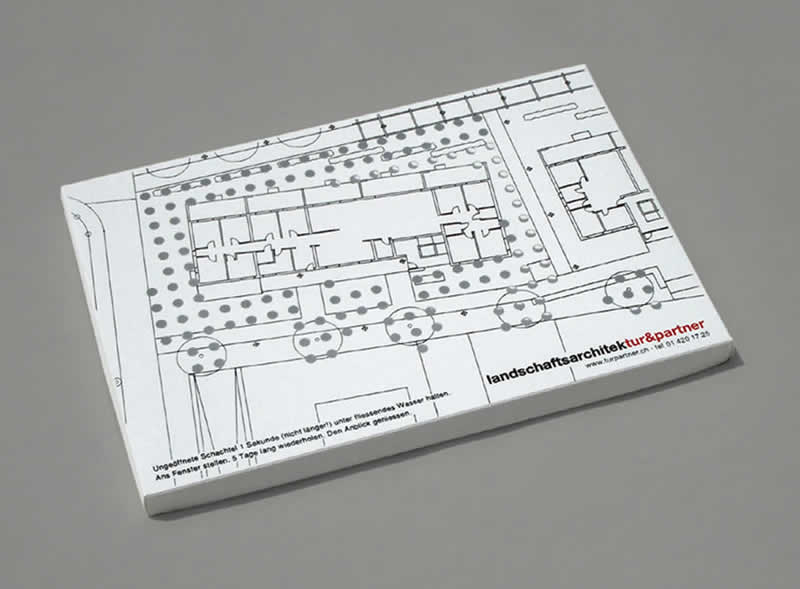
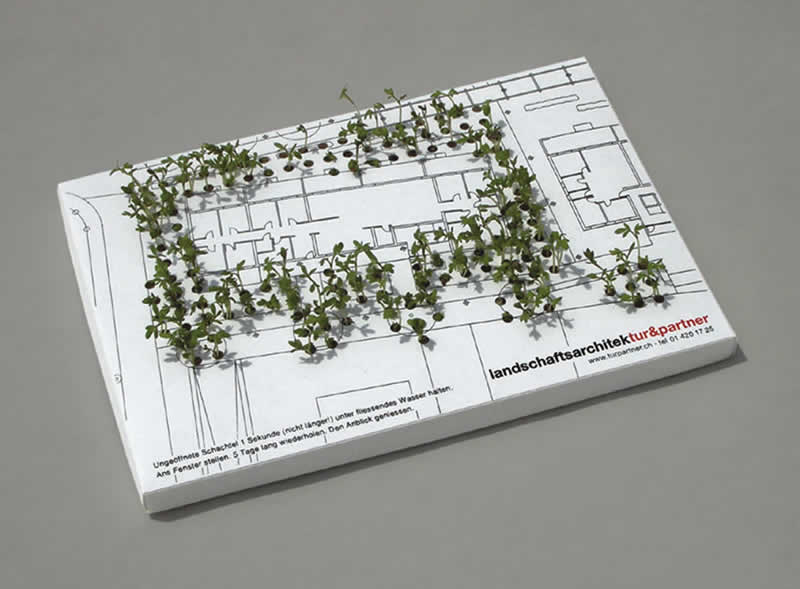
The Dirt introduces us to this business card slash micro-terrain by Tur & Partner, landscape architects. It’s a portable garden: impregnated with seeds, in the photosynthetic presence of sunlight and water, the paper eventually sprouts.
Which reminds me of a birthday card my brother once bought: if you buried the card and watered it, small seeds incorporated into the cardstock’s fibers would germinate. Which, in turn, makes me wonder if you could use this exact same method to smuggle rare plants out of totalitarian regimes intent on crushing botany within their borders… whether or not such regimes actually exist.
Or future trans-botanical geneticists, fleeing persecution, will hide their greatest seeds inside the pages of fake landscape guides, woven into the actual paper; they then bury their libraries in the soil of distant hillsides, and cloned roses and hybrid flowers soon grow.

(Card also featured at anArchitecture, among other places).

Earth Instrument

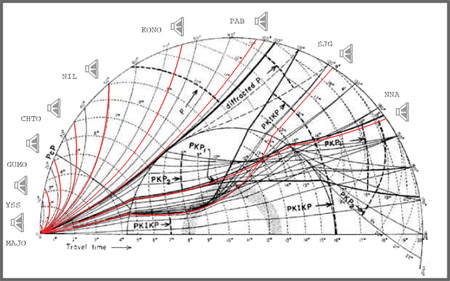
Artist Florian Dombois‘s Auditory Seismology project plays you the sound of earthquakes.
Using time-compression to accelerate the vibrational waves of global seismic activity, Dombois makes landscape events audible to human ears. Specifically, he writes, “if one compresses the time axis of a seismogram by about 2000 times and plays it on a speaker (so called ‘audification‘), the seismometric record becomes hearable and can be studied by the ear and [by] acoustic criteria.”
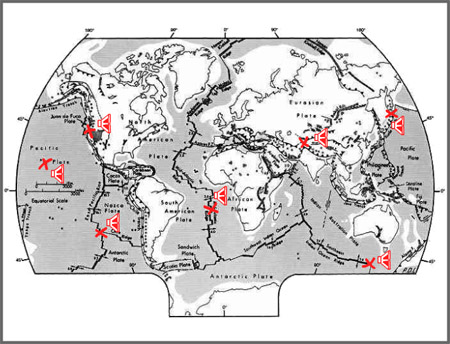
In this map of global tectonics, for instance, you can listen to the weird, rubbery snapping of plate boundaries.
Dombois: “The sound of earthquakes at spreading zones differs much from earthquakes at subduction zones. Whereas earthquakes produced by plates that are drifting against each other appear as sharp and hard beats, an earthquake from a parting mid ocean ridge sounds more like a plop.”
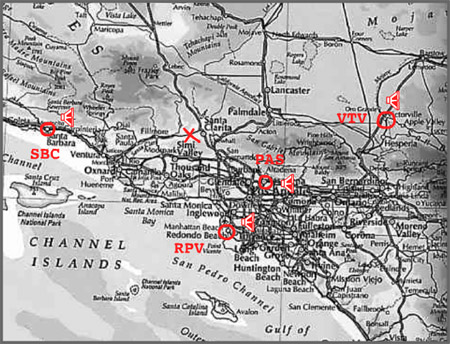
Meanwhile, Dombois also introduces us to the sonic seismicity of southern California, where the aftershocks of 1994’s Northridge quake sound like loose bits of metal banging against the side of a speeding bus. Then we go to Japan, whose plentiful subterranean dislocations come out like snaps of a drum. Finally, of course, we confront distance (the graph, featuring Earth’s surface, mantle, and core, that appears at the top of this post). Clicking on the seismic stations listed round that graph, you get short ambient works that weave together to form endless varieties of terrestrial drones.
Click on more than one at the same time, and you can waste whole minutes of your life tuning faultlines and making dissonant chords of plates; the earth becomes your instrument.
Dombois’s exhibition of Auditory Seismology closes November 18th, at the galerie rachel haferkamp in Cologne.

(Thanks, Alex! Earlier: Fault Whispers, Dolby Earth, resonator.bldg, Sound dunes, and, to some extent, Podcasting the sun).

Payphone Warriors

Going on right now in a New York City near you is Payphone Warriors: “You and your teammates must dash across the blocks around Washington Square Park in a bid [to] control as many payphones as possible. You simply make a call from a payphone to the game system and enter your team number to capture a phone. For each minute your team controls that phone the team scores one point. Grab more phones for more points.”

And if someone complains that they actually need to use that phone… you know what to do.

(Brought to you by Abe Burmeister of Abstract Dynamics).

A lesson in abysses

[Image: The surface of the earth peeled away to reveal rock and fissures – a perfect excuse for one of my favorite quotations: “Look down well!” Jules Verne once wrote. “You must take a lesson in abysses.” Image produced by R.C. McDowell, G.J. Grabowski, and S.L. Moore for the U.S. Geological Survey; this is Kentucky. An alternative map, by A.C. Noger, is no less topo-optically extraordinary].

(Earlier: BLDGBLOG’s Topographic Map Circus – although most of the links in that post are now broken).

Tativille

[Image: Tativille; a scene from Playtime. As Jacques Tati later explained, “there were no stars in the film, or rather, the set was the star, at least at the beginning of the film. So I opted for the buildings, facades that were modern but of high quality because it’s not my business to criticise modern architecture” – it was only his job to film it].

The idea that an abandoned film set could be archaeologically mistaken for a real city, ten, twenty, even a thousand years in the future, has popped up on BLDGLBOG before.
However, it turns out that there’s an equally interesting story to be found in Tativille, the instant city and film set built for Jacques Tati‘s now legendary Playtime. “Tativille came into existence,” we read in this PDF, “on the ‘Ile de France’ on a huge stretch of waste ground [in Paris]”:

Conceived by Jacques Tati and designed by Eugene Roman, it was strictly a cinema town, born of the needs of the film: big blocks of dwellings, buildings of steel and glass, offices, tarmacked roads, carpark, airport and escalators. About 100 workers laboured ceaselessly for 5 months to construct this revolutionary studio with transparent partitions, which extended over 15,000 square metres. Each building was centrally heated by oil. Two electricity generators guaranteed the maintenance of artificial light on a permanent basis.

During pre-production, “Tati visited many factories and airports throughout Europe before his cinematographer Jean Badal came to the conclusion that he needed to build his own skyscraper. Which is exactly what he did.”
In fact, he built Tativille: an entire city inhabited by no one but actors – who left after each day of filming.
One estimate puts the total mass of built space and material at “11,700 square feet of glass, 38,700 square feet of plastic, 31,500 square feet of timber, and 486,000 square feet of concrete. Tativille had its own power plant and approach road, and building number one had its own working escalator.”
Those hoping to visit the set’s cinematically Romantic remains are out of luck: “I would like to have seen it retained – for the sake of young filmmakers,” Tati claimed, “but it was razed to the ground. Not a brick remains.”

[Image: Tativille; from Playtime].

Notes for future screenwriters (who credit BLDGBLOG): in the summer of 2009 a delightful Ph.D. candidate from Columbia University, studying architectural history and writing her thesis on the lost sets of mid-20th century French cinema, will fly to Paris for three months. There, she rents a flat near the Seine, sketches buildings in blue ink on cafe napkins, reads Manfredo Tafuri, then sets up her most important interviews – but all is not well. She has strange dreams at night; she thinks she’s being followed; she has a mysterious run-in at the Musée D’Orsay; and she begins to suspect, upon deeper research, that Tativille wasn’t destroyed after all… Till, one day, in a beautifully shot scene at the French National Library – all weird angles and reflective glass walls – our heroine discovers that a small note has been slipped into her jacket pocket.
The note is actually a map, however, with directions addressed solely to her.
For, outside the city, in an arson-plagued banlieue, an old cluster of import warehouses silently waits.
She takes the train – and a small pocket-knife.
Then, standing alone inside one of those warehouses, torch in hand, she finds –

(Thanks, Nicky, for the tip! Of earlier interest: City of the Pharaoh).