Table of Contents

[Image: From Table of Contents by LOOMstudio; photo by Don Vu].

LOOMstudio—whose work has been on BLDGBLOG before (and I’m also a fan of their Sheep Barn project)—produced what they called the Table of Contents for a group show at Minneapolis’s Form+Content Gallery last summer.

The Table of Contents is a machine to decipher the housing crisis; a hybrid of game board, dining table, and scale model. It records evocative and uncanny housing “values” within a neighborhood in North Minneapolis through interactive discovery and play.

That description isn’t the most helpful text in the world, but you can see from the images re-posted here that the result is landscape, machine, stage-set, and exploded box by Joseph Cornell all in one.

[Image: From Table of Contents by LOOMstudio; photo by Don Vu].

Grass lawns with sawed-off tree trunks sit beside card games that have yet to begin, while copper pipes hold inexplicable rubber gloves full of marbles and a tea kettle (or is it a bedpan?) hangs nearby. Newspaper clippings like stars drift overhead in slowly moving constellations. Tiny ecosystems grow inside overturned Mason jars and the door of a safe sits sprung wide open, as if robbed.

[Images: From Table of Contents by LOOMstudio; top two photos by Don Vu].

The project is not available on the architects’ own website, but you can check out the Flickr set here.

The Extra Room

The Extra Room is a project by Bernhard Hopfengärtner and TheGreenEyl; it went on display last year as part of the What If… show at the Science Gallery in Dublin.

[Image: From The Extra Room by Bernhard Hopfengärtner and TheGreenEyl].

The Extra Room proposed a secret space “built into the basement of a multi storey building where it is shared by the house’s inhabitants,” and inside of which those inhabitants could spend time alone and practice “protective self discipline.”

“Utilising effects of sensory deprivation and methods used by the military to break someone down,” the artists explain, “the room enables subjects to adjust their thinking and beliefs.” It is a sensory-deprivation chamber by another name, in other words, a “reversed disciplinary architecture” in which you can lose yourself in the facets of a silent, white geometry and temporarily go a bit nuts. Think of it as a room for Socratic self-interrogation in an era of waterboarding and Guantanamo Bay.

While the actual image, seen above, is by no means the most interesting illustration that could have been produced for this project, the basic idea behind it—that architects, sociologists, and even behavioral psychologists could someday team up to explore a new architecture with deliberately cultivated neurological side-effects—suggests a moral risk to the design of private space that deserves further exploration. In fact, the idea that we could build a kind of psychological sacrifice zone in the basement of a residential high-rise is a narratively compelling one. Perhaps an entire district of the city could be architecturally adapted for the needs of self-experimentation, testing your own limits in the face of strange ornament and topologically inconsistent space. You receive a prescription for a five-hour visit to the Extra Borough, and you walk in, alone, faced with odd, windowless buildings and empty squares on either side. It is an urban arena for a new breed of psychological X-Games.

L.A. on the Nile

[Image: From the Los Angeles Times photographic archive at UCLA Library; copyright Regents of the University of California, UCLA Library].

The above image, originally published by the L.A. Times in 1965 and now in a collection at UCLA, shows “electric streetcars that once carried passengers on Los Angeles streets” being loaded by crane onto “the Liberian ship Santa Helena at Long Beach Harbor.” The boat soon thereafter set sail for Cairo, Egypt, as the streetcars had been purchased by that city’s own Transportation Co. “The streetcars will be used,” the caption adds, “in Alexandria, Egypt.” So, like something out of a story by Ignacio Padilla, if you want to experience a lost chapter in Los Angeles public transportation history, perhaps you need to book a flight to Cairo and head north toward the Mediterranean Sea.

Vivarium

[Image: Inside Vivarium].

Juan Azulay‘s Vivarium project opens to the public tonight, Friday, March 26, over at SCI-Arc. Vivarium “explores the relationship between technology, media, and environmental preservation/dereliction,” we read, “[…] by placing itself in the midst of processes of intense transformation within the ecosystem it has isolated.”

[Images: Cladding for Vivarium].

The bulk of the exhibition space will feature a “sunken pyramid” that houses the “vivarium”; the vivarium itself will contain “three types of organisms. Living microorganisms will transform the vivarium’s air-moisture into salt. Robotic-engineered organisms made for the installation will in turn generate heat. Virtual (digital) organisms will mimic the behavior of both the living and robotic microorganisms.”

These living/semi-living/replicant/undead/digital organisms will thus transform “a freshwater ecosystem into a brackish one… creating a new hybrid ecology that will grow and self-stabilize throughout the exhibition period of three months.”

[Images: Assembly diagrams for Vivarium].

I’m reminded of an Ecosphere I had in my work desk a year or two back, a glass sphere inside of which two little shrimp—barely perceptible to the naked eye—swam around living plantlife while I edited articles nearby, only Vivarium blows that up to the scale of installation architecture while simultaneously scattering an oddly post-mortem (or is it pre-?) collection of quasi-organisms into the mix. An aquarium left alone in a VR cave until it thinks it’s dreaming.

Azulay will be discussing the project in a public event at SCI-Arc on April 9, so be sure to check that out if you have any questions.

Klip House

[Image: The Klip House system by Interloop architects].

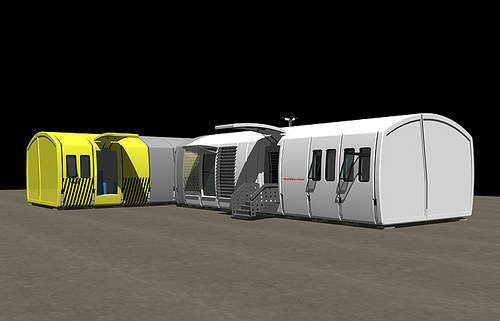
The Klip House by Texan architects Interloop is a project dating back to 1997-2001. The architects describe it as “a delivery system that provides the physical and operational infrastructure for trade corporations to participate in the production, delivery, and servicing of housing.”

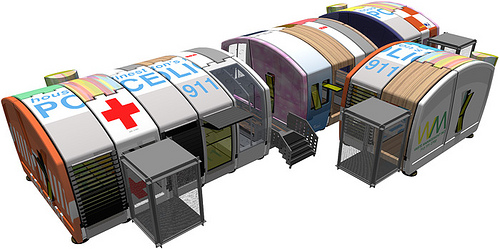
Not limited only to housing, however, the Klip system was seen as being just as easy to use for hospitals, police stations, and more—even, why not, a pink auto-detailing shop.

[Image: A pink auto-detailing shop in the Klip system by Interloop].

At the time, Interloop had become “frustrated,” they explain, by “Federal and State initiatives that provide financial assistance to qualified families and individuals by awarding housing ‘vouchers’ to serve as the down payment on a house. In its current format, the voucher system distributes a mass of capital such that one voucher equals one house.” However:

We were, and are, frustrated with a design system that is constricted by insurance companies, loan officers, municipalities, and contractors, etc. and decided to look at the overall economic impact that these vouchers might have if they were bundled, rather than distributed. Instead of designing a single house that has very little impact to the housing industry, we worked with the idea of consolidating the vouchers to pay for a housing platform, or infrastructure. We needed to work outside of the home mortgage process in order to gain some ground.

In other words, producing new housing also means producing new (non-predatory) ways to finance those housing options—architects have to rethink systems of payment as much as they have to rethink the design parameters of prefab componentry.
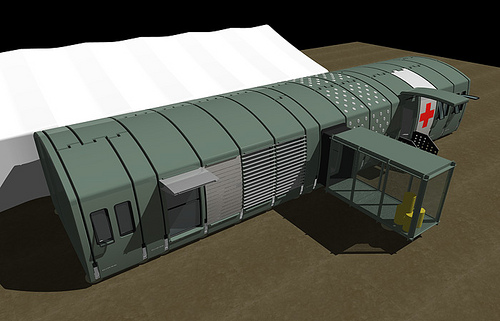
[Images: The Klip system by Interloop].

Klip House, seen here, “is essentially engaging financing systems that exist in automotive and product industries”—a statement which comes with a slight twinge of nostalgia for those heady, Greg Lynn-inspired days of the late 1990s when automobile assembly was the reigning model for cutting-edge architectural thesis projects. If your BMW could be assembled offsite and to your every specification, down to heated seats, aerodynamic rear spoilers, and the perfect JBL sound system, why couldn’t the architecture you live in follow suit?

Seamless, robotic, and delivered perfectly on schedule, the modular assembly of housing—borrowing assembly line techniques taken from Ford, Saturn, or Lexus—was to lead the way to our architectural future.

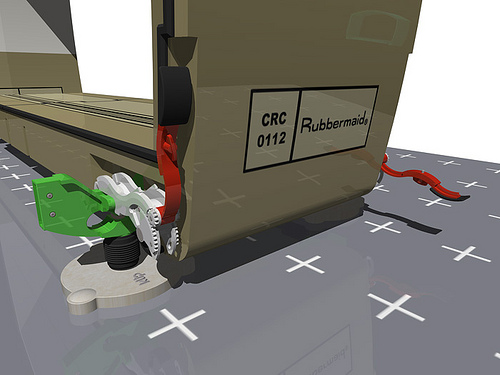
In any case, the Klip house itself was at least partially inspired by the boot clips of skis and snowboards. That is, its foundation would operate through a terrestrial “binder,” or “adjustable footing system,” onto which new rooms or components could be clipped (thus the house’s name).

The binders thus allow for “an open array of housing components [to] be added, released, interchanged, upgraded and rearranged” at will. “The architectural contribution,” Interloop points out, “is simply to introduce a single enabling technology, i.e. the binder, to generate or illicit response.”
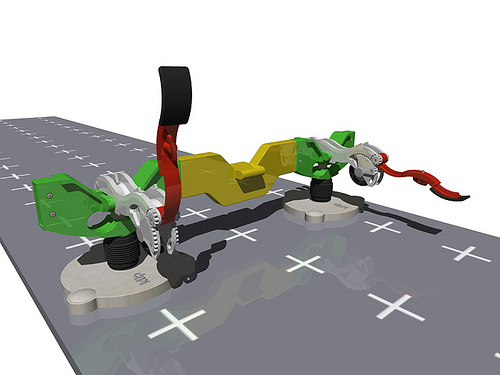
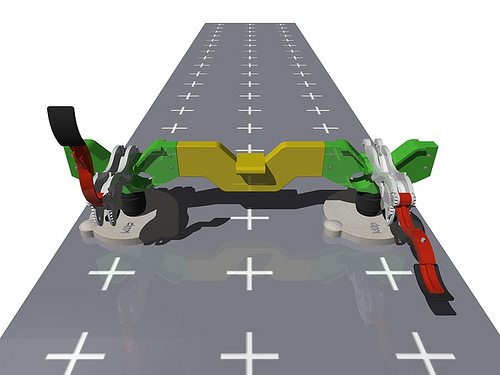
[Images: Inspired by the boot clips of snowboards: the Klip‘s binder system by Interloop architects].

Further, the Klip’s “components are available in three and six foot widths, each made with a variety of options and upgrades,” and they can be either purchased or leased. This adds a Smart Car/iPod-like personalization to the housing design and procurement process.

Your house, hospital, police station, nightclub, field kitchen, mobile writing lab, counterfeit university space, or auto-body shop can thus be expanded (or shrunken)—let alone recolored, retextured, and resurfaced—based on immediate personal and economic needs.

[Image: The Klip House by Interloop architects].

Read more at the architects’ website.

Shanghai Seedling

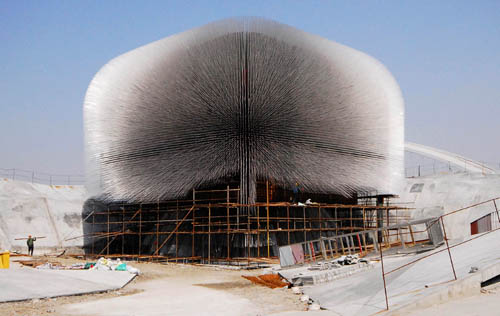
[Image: Thomas Heatherwick’s “Seed Cathedral” at the 2010 Shanghai World Expo; photo by Reuters/China Daily, via The Big Picture].

I have to admit that, however over-exposed this building might be, it is one of the coolest architectural constructions I’ve seen in a long time—and while I say that in the most superficial way imaginable, i.e. I just think it looks really, really cool, this structure, the so-called “Seed Cathedral” by Thomas Heatherwick, under construction in Shanghai for this summer’s 2010 World Expo, has an amazing ulterior motive: at the end of every one of the 60,000 transparent acrylic rods that you see fuzzing outward into the sunlight are the seeds of plants.

[Image: The seeds revealed; photo by Aly Song for Reuters, via The Big Picture].
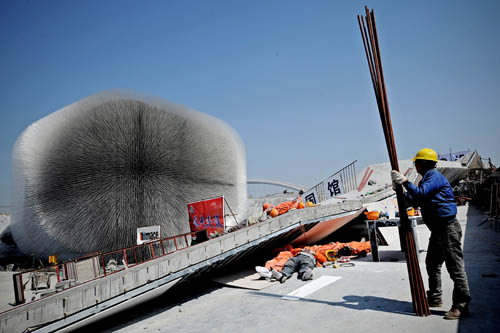
The result looks very much like an expansion of Heatherwick’s earlier work Sitooterie II, but the final design also incorporates seeds from the Kew Millennium Seed Bank project.

From the New York Times last autumn: “Heatherwick and his team worked with Kew’s Millennium Seed Bank partnership to showcase Britain’s commitment to conservation. They encased thousands of seeds in the ends of the transparent rods, creating a larger-than-life catalog of the plant species that contribute to national and global conservation programs, in a veritable cathedral of seeds.”

[Images: Thomas Heatherwick’s “Seed Cathedral” prepares to open in Shanghai; photos by Philippe Lopez/AFP/Getty Images; STR/AFP/Getty Images; and AP; all via The Big Picture].

Seed vaults have long been of interest here, of course, but this non-doomsday-inspired celebration of terrestrial botany is, for me, surprisingly much more thrilling than some top secret polar room predicated on an end-of-the-world agricultural scenario. Perhaps every town should have its own seed cathedral, blur-buildings of acrylic rods to showcase their local flora.

Access Restricted

[Image: Inside the Association of the Bar of the City of New York, courtesy of the Lower Manhattan Cultural Council’s Access Restricted program].

If you’re in New York, three more tours in the Lower Manhattan Cultural Council’s Access Restricted series await you. The general idea behind Access Restricted is amazing; it is “a free nomadic lecture series that opens rarely visited and often prohibited spaces in Manhattan to the general public. Once inside these unique interiors, the audience is treated to a site-specific lecture and discussion addressing a range of topics revolving around issues of architectural history and preservation, social justice, and urban development.”

The mind boggles at the range of spaces that could be visited for such a thing, from historical urban waterworks to the city’s food infrastructure, from top secret bank vaults to famous murder sites and the apartments of long-dead poets; this year, the LMCC is focusing on the heady couplet of “Law & Representation”:

Even though Manhattan possesses one of the richest legal infrastructures in the country, the general public hardly ever interacts with these buildings and their use except for a few, very specified situations. In order to showcase this legal fabric, Access Restricted: Law & Representation hosts a series of talks by practicing lawyers and scholars in the palaces and parlors where law is practiced or discussed.

Check out the LMCC’s site, linked above, for the complete schedule, and definitely consider supporting such a unique program.

Migratory Anagram

[Image: From “HLYWD” by Jeffrey Inaba and Darien Williams].

As part of the forthcoming UNPLANNED exhibition here in Los Angeles, opening March 25, Jeffrey Inaba and Darien Williams have produced “HLYWD,” a series of images in which the individual letters of the Hollywood sign break off, rearrange themselves, and appear here and there around the city.

It is, the creators write, a “proposal for the migratory distribution of the Hollywood sign across Los Angeles”—like mobile anagrams in a game of trans-neighborhood Scrabble.

[Images: From “HLYWD” by Jeffrey Inaba and Darien Williams].

After all, “why limit [the Hollywood sign] to a fixed location?”

Proposal: Let it roam? The sign’s simple structure and generic materiality lend it well to temporary erection on any number of sites throughout the city. Neighborhoods ‘borrow’ the sign or any subgroup of its letters for a determined period of time. Migration affords the sign a temporal dimension, which ensures its continued vitality as an unplanned landmark.

With one letter lent out at a time, it’d bear an urban-scale resemblance to Shelley Jackson’s Skin project, blown up and imposed on the roofs and hilltops of the city.

[Image: From “HLYWD” by Jeffrey Inaba and Darien Williams].

Or, like a new form of megastructural language poetry—perhaps an unexpected hybrid of Aram Saroyan and Ed Ruscha—the resulting project is a random species of unplanned words on the loose.

California City Expedition Update!

For those of you who have signed up for the BLDGBLOG/Atlas Obscuraexpedition to the geoglyphs of nowhere” trip tomorrow afternoon, March 20, part of the first annual international Obscura Day, I wanted to touch base briefly about what will actually occur out there.

First of all, I’m excited—I think this will be a lot of fun, and I look forward to meeting lots of you and exploring the abandoned geometry of a city that was never fully built in the first place (and about which you can read a bit more here). Even CNN is excited, writing that nearly “200 people have committed to a trip to California City, California, a planned city in the middle of the Mojave Desert that was never finished. It is now home to about 15,000 people, many of whom live within a surrounding network of crumbling roads, the vestiges of the abandoned city plan.”

Second, it looks like at least 182 people have signed up for this, which I assume translates into roughly 75 cars making the journey—that’s a substantial caravan. That being the case, our initial meet-up in the parking lot of the California City Rite Aid—as the current plan now stands—will actually be quite hard, if not impossible, to manage.

So I think we need to activate Plan B: we will still arrive via that Rite Aid (9482 California City Boulevard) at 1pm tomorrow, and you should still use it as a place to get something to drink or whatever else you might need (and there’s a fast food place next door if you need a bathroom break), but if you do not actually speak to me, or to anyone else, for that matter—perhaps because you are a misanthrope attracted to abandoned cities in the desert—don’t worry: just head out of the city, going northeast along Randsburg Mojave Road, onto 20 Mule Team Parkway. Here’s a link to the most basic map of that road.

At that point, to be honest, you can just do whatever you’re going out there to do: make films, take photographs, record sounds, write blog posts, Tweet things, interview people, do cartwheels, read Ballard and meet your future best friends. Fly remote-control airplanes with small nose-mounted cameras over the failed glyphs of a forgotten real estate dream. Build kites. Assemble simulated Iron Age tumuli in the dirt and gravel and dedicate them all to Anselm Kiefer. Establish a makeshift geothermal drilling operation and cause an earthquake. Call your mother.

This is not a guided tour, and we are not experts. This is a kind of documentarian flash mob, and together we’ll produce the largest archive of contemporary California City photographs that exists anywhere in the world. We can start by filling out this Flickr group—but, again, feel absolutely free to do your own thing and save your own photographs wherever you choose to do so.

Finally, a brief bit of legalese—sorry, but I need to cover this stuff, too:

I understand and acknowledge that my attendance at and participation in Obscura Day is voluntary. I assume full responsibility for any injuries or damages resulting from my attendance at and participation in any related events or activities, including responsibility for using reasonable judgment in all phases of participation and travel to and from any event location. By attending an Obscura Day event, I, the attendee, in full recognition and appreciation of the dangers, hazards and risks inherent in such activities, do hereby waive, release, indemnify, hold harmless and forever discharge JPSF LLC., its officers, agents and employees, from and against any and all claims, demands, liabilities, causes of action, losses, costs and expenses of any nature (including, without limitation, attorneys’ fees) resulting from damages to personal property, personal injury or death, arising out of or relating in any way to my attendance and participation in these activities. 
I acknowledge that I have read and understand this entire Waiver of Liability and Release, and I agree to be legally bound by it. I further acknowledge that I am over the age of 18 (at or above the age of majority in the jurisdiction in which I reside, if different from 18). If not, I understand that my attendance and participation in any event is expressly conditioned on the acknowledgment of this Waiver of Liability and Release by my parent or legal guardian.

So bring sunscreen, fill up your gas tank, wear comfortable shoes, don’t forget some water, and I will see you out there in the middle of nowhere.

Two L.A. Evenings

This is just a quick reminder to anyone in Los Angeles that Architizer‘s official L.A. launch party is tonight down at the A+D Museum‘s new location on Wilshire Boulevard. Stop by Architizer for more details—but it should be a beautiful evening to be out and about, and things kick off at 6:30pm.

This is a further reminder, as well, that Peter Cook of Archigram and Crab Studio will be throwing open the doors for a new exhibition over at SCI-Arc tomorrow night: London Eight features work by professors and their “proteges” from the Bartlett School of Architecture in London. Tomorrow night—Friday, March 19—also includes a group discussion, moderated by Peter Cook, with Yousef Al-Mehdari, Pascal Bronner, Johan Hybschmann, CJ Lim, marcosandmarjan, and Mark Smout and Laura Allen of Smout Allen. That’s at 6pm. Hope to see you at both events!

Urban Research

[Image: San Francisco, as seen from the cockpit of a 747; photo by Olivier Roux].

The last few days have been pretty awesome. We’ve been road-tripping up from Los Angeles to Reno for a dinner with author William Fox, Matthew Coolidge of the Center for Land Use Interpretation, landscape activist Lucy Lippard, Land Arts of the American West co-founder Bill Gilbert, cultural programmer Dorothy Dunn, Steve Wells of the Desert Research Institute (DRI), Libby Robin from the National Museum of Australia, and the staff of the Nevada Museum of Art‘s Center for Art + Environment; we spent the day yesterday on a tour of the DRI’s ice core research facilities, its micro-atmospheric testing rooms (like characters in a Borges story, they once used their equipment to test the metal content in the ink letters of a Gutenberg Bible in order to identify those letters’ near-millennium-old liquid chemistry), and the DRI’s full-scale virtual reality room.

I have some hilarious and amazing photos of Matthew Coolidge wearing black VR goggles, holding remote controls in each hand, while Bill Gilbert and Lucy Lippard look on, equally engoggled and optically stunned, flying helter-skelter over virtual terrains to chase simulated forest fires up canyon walls, the replicant ground dropping out from beneath them as we ran straight off a cliff, and I hope to post those here soon.

We had amazing conversations, as well: we’re all gearing up for a big conference next year in Reno, hosted by the Center for Art + Environment at the end of September 2011. That will definitely be something to keep your eye on if you’re at all interested in landscapes, the hydrosciences, water rights, mythology and the American West, archaeoastronomy, the contested history (and future) of weather modification, offworld exploration, the anthropology of mining, nature writing in its broadest possible sense, and much more. We’re putting together something really fantastic, to be honest, and you have 18 months to make plans to be there.

Even better, Nicola Twilley from Edible Geography and Mark Smout of Smout Allen were also on hand, winning stuffed animals together in the Circus Circus casino (Mark quipped that the casinos were simply “giant, ugly buildings with jewelry stuck on them, like earrings”), and so the three of us are now down in San Francisco, where we’ll be picking up Sarah Rich tomorrow to drive down to LA—and I can hardly imagine a better group of people to hit the Californian road with. The roads outside Reno were eight-foot canyons of plowed snow till we hit the Bay Bridge and drove past Alcatraz blinking in the darkness.

[Image: Photo by George Steinmetz/CORBIS for National Geographic; via @stevesilberman].

In any case, if you’re near San Francisco tonight, Tuesday, March 16, I’ll be giving a talk at the San Francisco Planning and Urban Research Association (SPUR) starting at 6pm. It costs $5, unfortunately, but it should be fun, and I’m looking forward to seeing a lot of old friends and colleagues again; as all of those friends and colleagues know, I wasn’t a huge fan of San Francisco when I lived here, but it’s good to be back in this rolling city of fog lines, abandoned bunkers that look like hills, tectonic trembling, lost ships, ghost streets, buried dunes, vinicultural microclimates, chemical weapons, a suicide bridge, and its artificially shrunken bay. I’ll be talking about quarantine, The BLDGBLOG Book (which I’m thrilled to say has just gone into a second printing), the “Glacier/Island/Storm” studio and its accompanying blog-week experiment, blackouts, and more.