Buy A Complex Of Submarine Pits

[Image: Courtesy of Sotheby’s].

Back to opportunities in real estate: if you were tempted by the Minneapolis skyway but you’re saving your money for something a bit warmer throughout the year, consider snapping up the “Submarine Pits on Boca Chica Key.”

[Image: Courtesy of Sotheby’s].

As Sotheby’s describes the carved landscape of submarine docking pens, the pits can be found amidst “approximately 122 acres of vacant land just north of Key West.”

Here’s the site on Google Maps.

[Images: Courtesy of Sotheby’s].

They’re basically just deep slots blasted through the coral and limestone, barely visible beneath the water line in the form of somewhat ominous black strips where the ground drops away.

[Images: Courtesy of Sotheby’s].

The site is zoned as a “Commercial Fishing Special District,” perhaps implying some future reuse of the submarine pens as exotic fish farms.

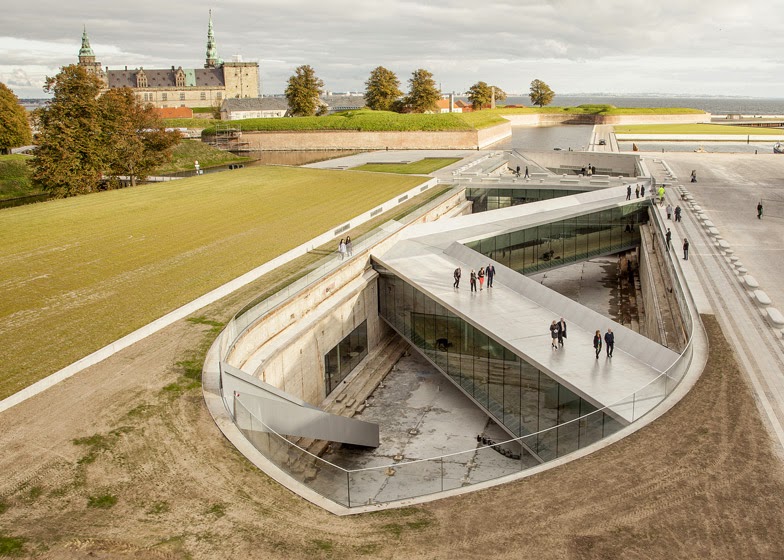
But imagine all the weird opportunities here for submerged foundations, underwater hotel rooms, or other half-aquatic facilities—even something like the Danish National Maritime Museum by BIG—looped in and around these linear, Nazca-like features.

[Image: The Danish National Maritime Museum by BIG; photo by Luca Santiago Mora via Dezeen].

From Sotheby’s:

This parcel was used by the Navy Air Station to house its submarine war ships during the Cuban Missile Crisis and has a very colorful and distinct history. Perfect for marine use and development in a great location. Property includes seven finger cut coral canals that are 90 feet wide and over 25 feet deep, plus a deep water basin with dredged entry channel that provides passage to Boca Chica Channel (Oceanside) and Key West Harbor (Bayside).

The asking price?

[Images: Courtesy of Sotheby’s].

A mere $21.2 million—but then these drowned geoglyphs in the semitropical sun can be all yours.

(Spotted via Curbed Miami. Previously on BLDGBLOG: Buy a Skyway, Buy a Fort, Buy a Lighthouse, Buy an Underground Kingdom, Buy a Prison, Buy a Tube Station, Buy an Archipelago, Buy a Map, Buy a Torpedo-Testing Facility, Buy a Silk Mill, Buy a Fort, Buy a Church).

Gyroscopolis

[Image: From “Destination Docklands” by Emma Colthurst; via Lobby].

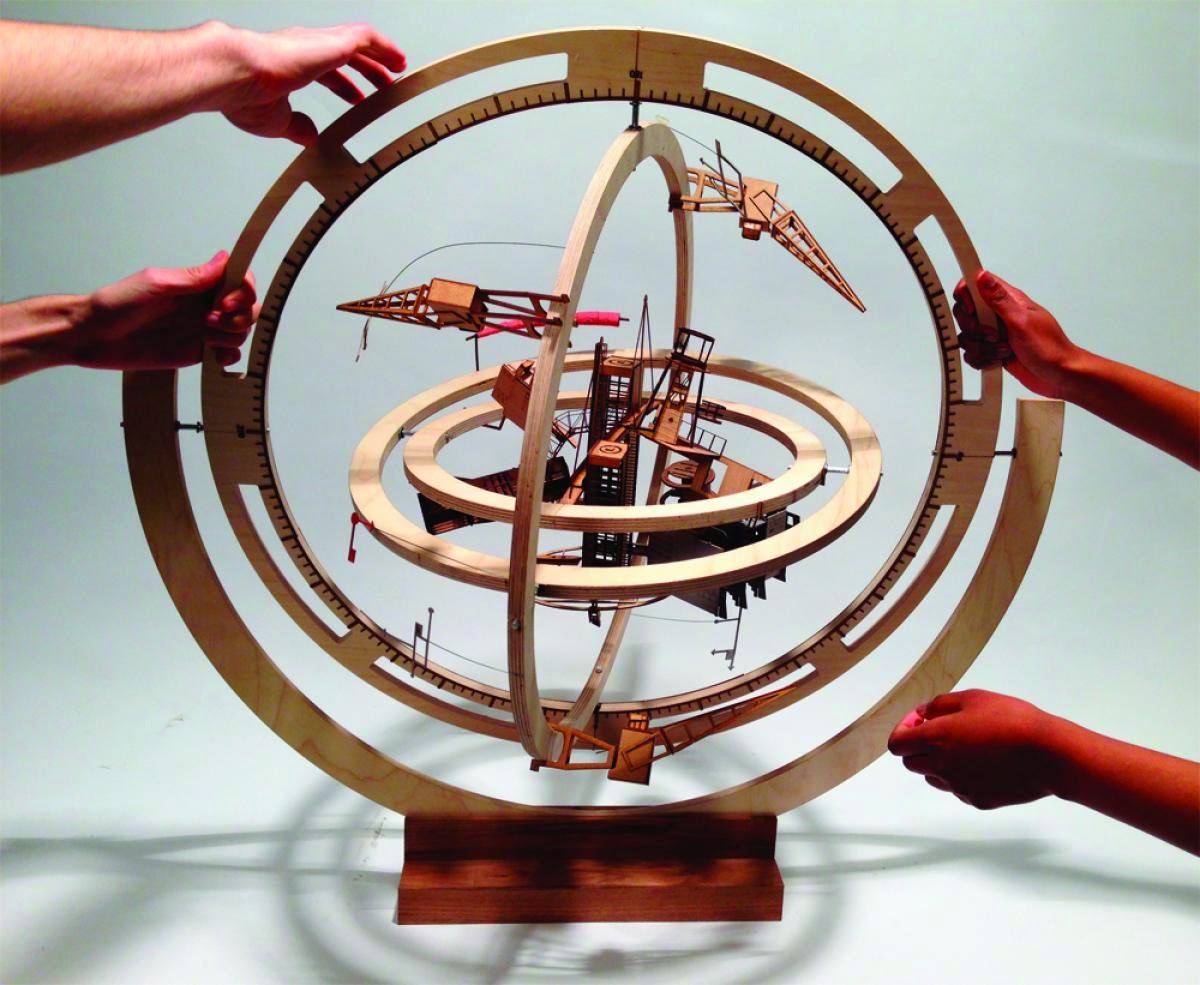
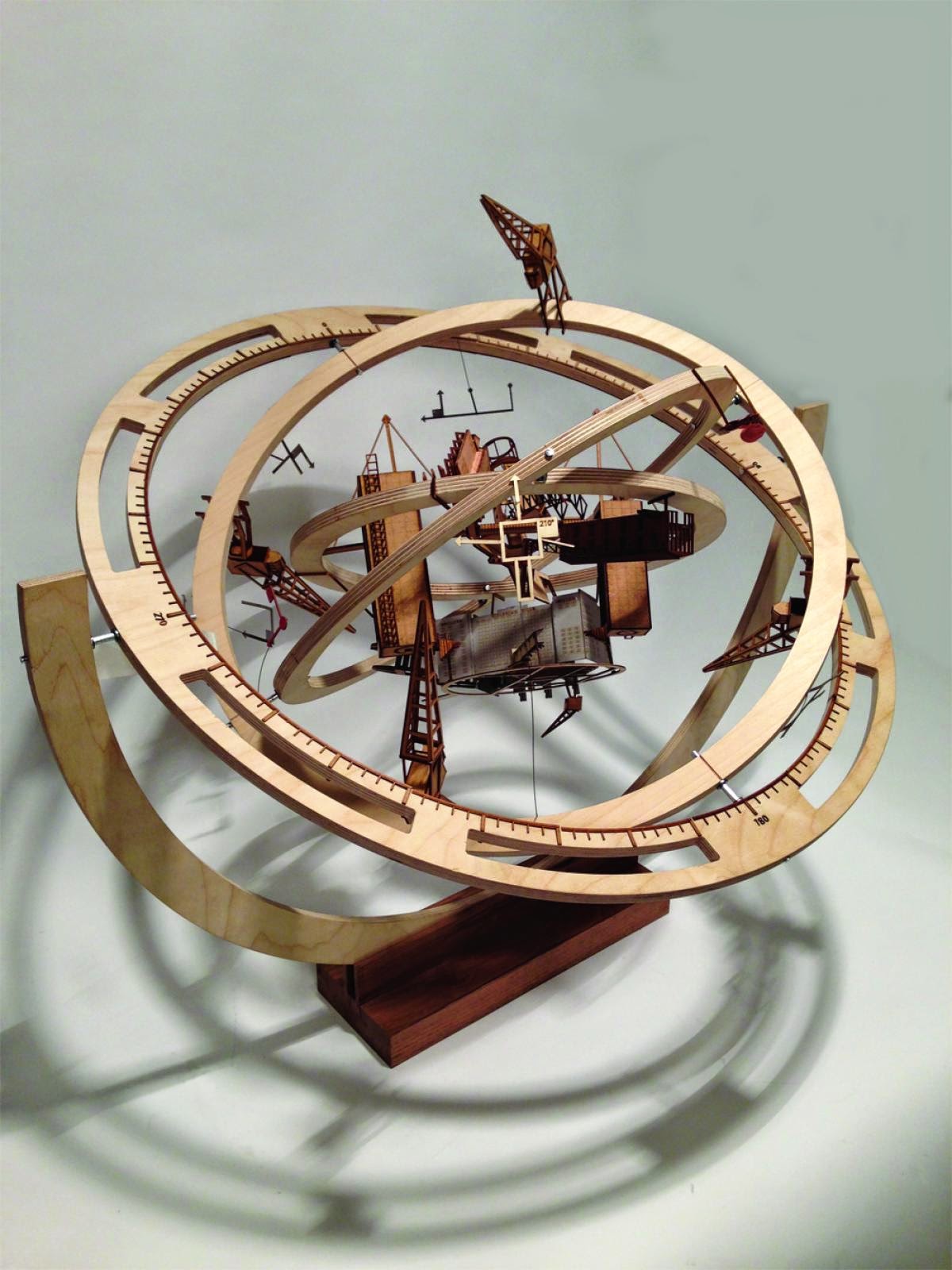
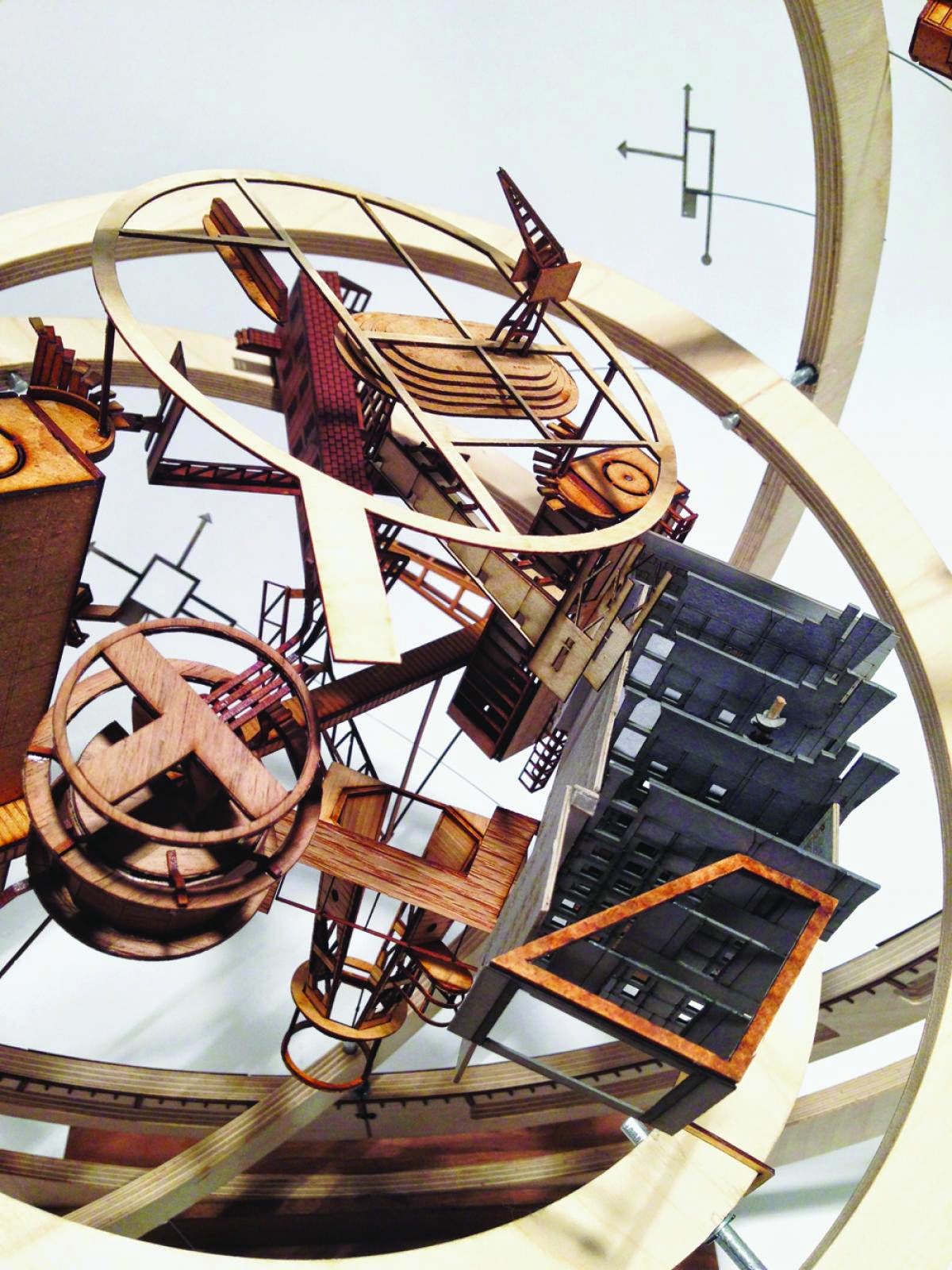
This is such a clever architectural model: a project by Emma Colthurst from the Bartlett School of Architecture in London is presented as a narrative gyroscope, an urban universe of wheels within wheels, of shifting ground planes and emerging landscapes amidst a carousel of new horizons.

[Image: From “Destination Docklands” by Emma Colthurst].

Called “Destination Docklands,” it is intended as a kind of horological device, telling the story of the site through time.

This includes the “submerged industrial landscape” that re-arises with a turning of the gears to the towering cranes of as-yet unrealized construction projects set to transform the Docklands for generations.

[Image: From “Destination Docklands” by Emma Colthurst].

As Colthurst herself explains over at Lobby:

“Destination Docklands” seeks to reconnect the remnant memory of the submerged industrial landscape. A Gimbal—a mechanism, typically consisting of rings pivoted at right angles, for keeping an instrument such as a compass or chronometer horizontal in a moving vessel or aircraft—holds the Dock’s spatiality in fragmented balance. Previously a device used for ship navigation, the Gimbal realigns glimpses of the area’s connected history, and its axes pivot perpendicularly, bringing their own relationship and meaning to the Dock. The Gimbal becomes a capsule for the connected “players” of this industrial world.

“As the rings turn,” she adds, “the spatial relationships between the industrial worlds are juxtaposed against each other. As these tangible connections teeter on the edge of the Dock’s hemisphere, their world is refocused in moments of realisation, before falling away.”

[Image: From “Destination Docklands” by Emma Colthurst].

The result is a gyroscopic scenography of different contexts rolling into view, momentarily aligning, and then sinking once again into the urban murk of potential rearrangements yet to come.

Read more about the project over at the recently launched Lobby.

Models & Prototypes

[Image: “Dome-shaped Architectural Staircase Model,” courtesy of the Cooper Hewitt].

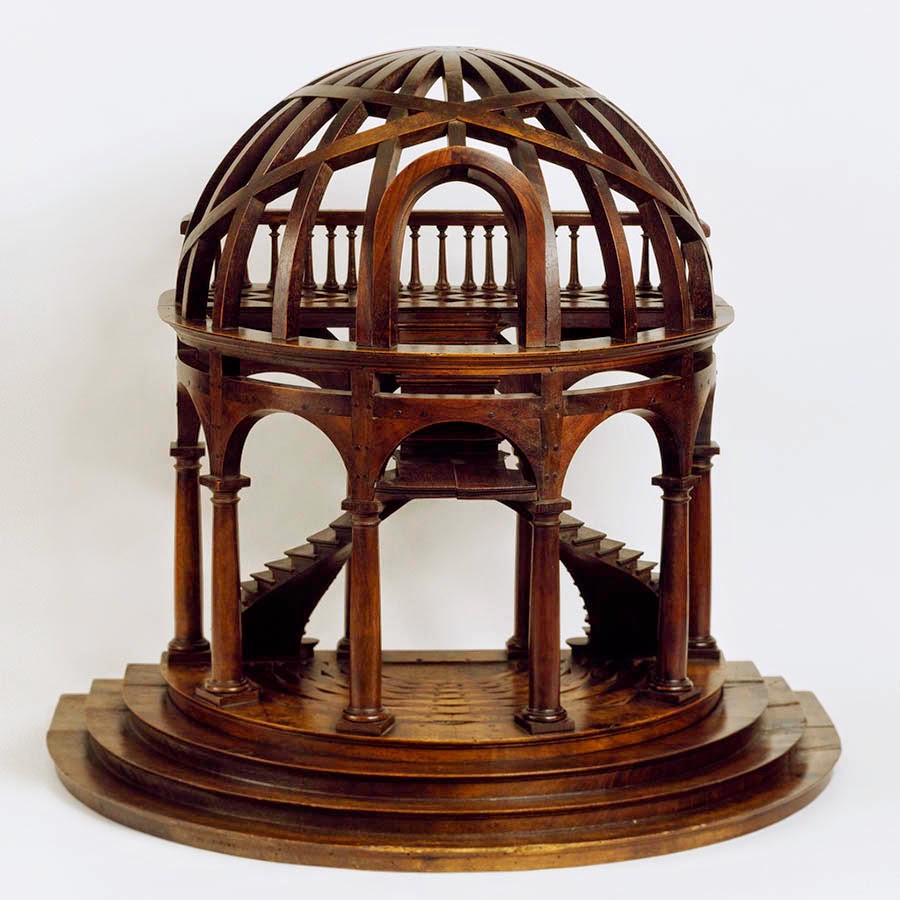
If you liked those two staircase posts from earlier today, a reader has pointed out that the Cooper Hewitt has a whole slew of “Models & Prototypes” on display that seem worth checking out.

More specifically, it’s “a gallery devoted to exhibiting three-dimensional representations of ideas that demonstrate the design process; test concepts and resolve problems; enhance presentations; and display complex technical skills.”

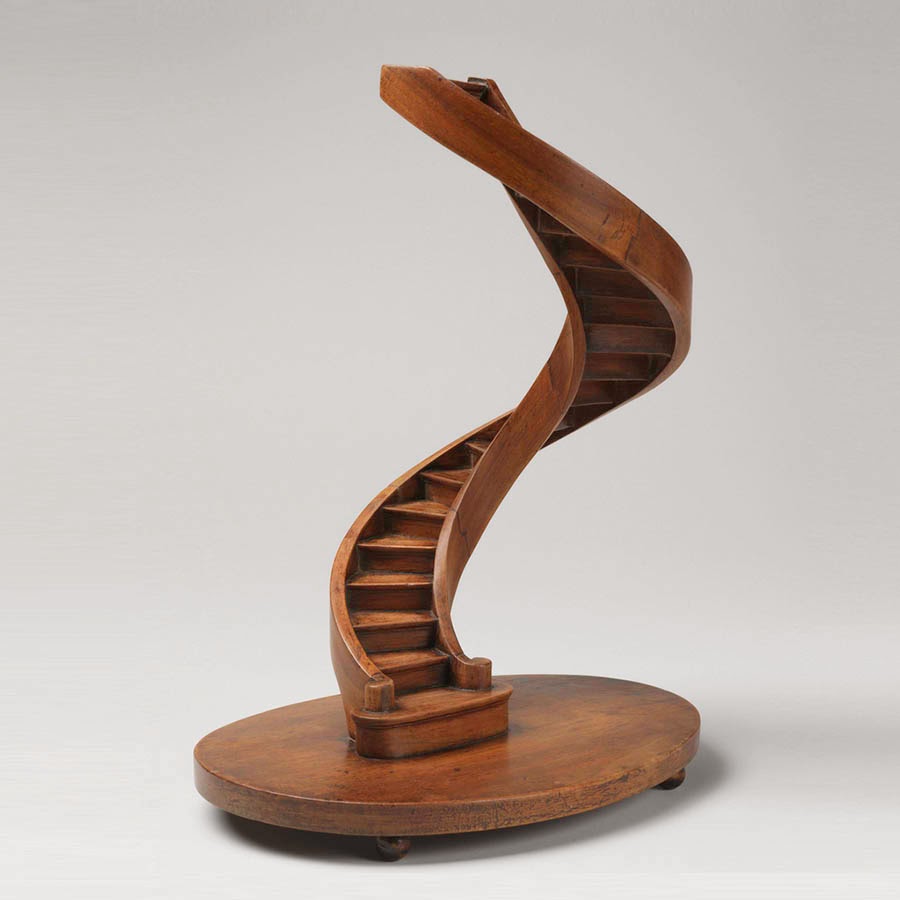
Take a look at the “Dome-shaped Architectural Staircase Model” from the mid-19th-century, for example, seen above, or this gorgeous “staircase model from France“.

[Image: A “staircase model from France,” courtesy of the Cooper Hewitt].

Freestanding and divorced from their ultimate architectural context, they become more like vertebrae or genetic helices spiraling in midair.

[Image: “Staircase Model, France,” courtesy of the Cooper Hewitt].

See more over at the Cooper Hewitt.

(Thanks to John O’Shea for the tip!)

The Subterranean Celebrity Libido Labyrinth of Greater Hollywood

[Image: A blueprint of tunnels rumored to connect the Playboy Mansion with nearby celebrity homes, via Playboy].

This is hilarious and amazing: there may (or may not) have been secret underground tunnels connecting the Playboy Mansion to the homes of nearby celebrities, including Kirk Douglas and Jack Nicholson. It’s like the becoming-priapic of the Mole Man of Hackney.

According to some blueprints literally unearthed from the Playboy Mansion basement after overhearing a rumor about some “tunnels,” it seems that, at the very least, underground routes were designed all the way to the point of construction diagrams, to connect the homes from below.

Those construction documents imply, according to the post over at Playboy, that “tunnels were built to the homes of ‘Mr. J. Nicholson,’ ‘Mr. W. Beatty,’ ‘Mr. K. Douglas’ and ‘Mr. J. Caan.’ We’ll go ahead and assume they’re talking about Jack Nicholson, Warren Beatty, Kirk Douglas and James Caan—all of whom lived near the Playboy Mansion during the late 1970s and early 1980s. There are no dates on the architectural schematics, but the dates on the Polaroids were from 1977.”

The Polaroids referred to show excavations and construction material, and can be seen at the original article.

Of course, no one seems to know if the tunnels were, in fact, ever constructed—or even if the Playboy story itself isn’t just a rumor-stirring bit of architectural fiction—but a staff member apparently “heard they were closed up sometime in 1989.”

The idea that the libidos of Hollywood stars are all secretly linked by a maze of underground tunnels is awesomely perfect: equal parts psychoanalytic metaphor and potential plot for a new David Lynch film. Has-been celebrities clad head to toe in fur wander through a maze of multicolored halls beneath Los Angeles, experiencing bizarre moments of time travel that serve no narrative function other than to let them spy on earlier versions of themselves, making love in a wood-paneled mansion where wall-sized fireplaces roar with logs that never burn. Everyone is played by Bill Pullman.

(Thanks to Josh Glenn for the tip!)

Grimm City

[Image: Grimm City University from Grimm City by Flea Folly Architects].

Later this summer, London’s Flea Folly Architects—Pascal Bronner & Thomas Hillier—will be running a workshop in what they broadly call “narrative architecture” at the Tate Modern.

“What would a town inhabited by Salvador Dali, Pablo Picasso, Alexander Calder and Man Ray look like?” they ask. “Taking inspiration from works in the Tate collection, in particular the speculative etchings by architects Alexander Brodsky and Ilya Utkin and paintings by the Surrealists, our objective is to design and build a fictional miniature village made entirely from paper.”

Their own project, Grimm City, is perhaps an example of what might result.

[Image: The Barometer from Grimm City by Flea Folly Architects].

As architect CJ Lim describes it in his introduction to the project in a gorgeously produced, limited print-run hardcover catalog, as “Grimm City is a future state derived from architectural extrapolations of the fairytales by the Brothers Grimm.”

That is, it is an elaborate narrative disguised as a city—a story given urban form.
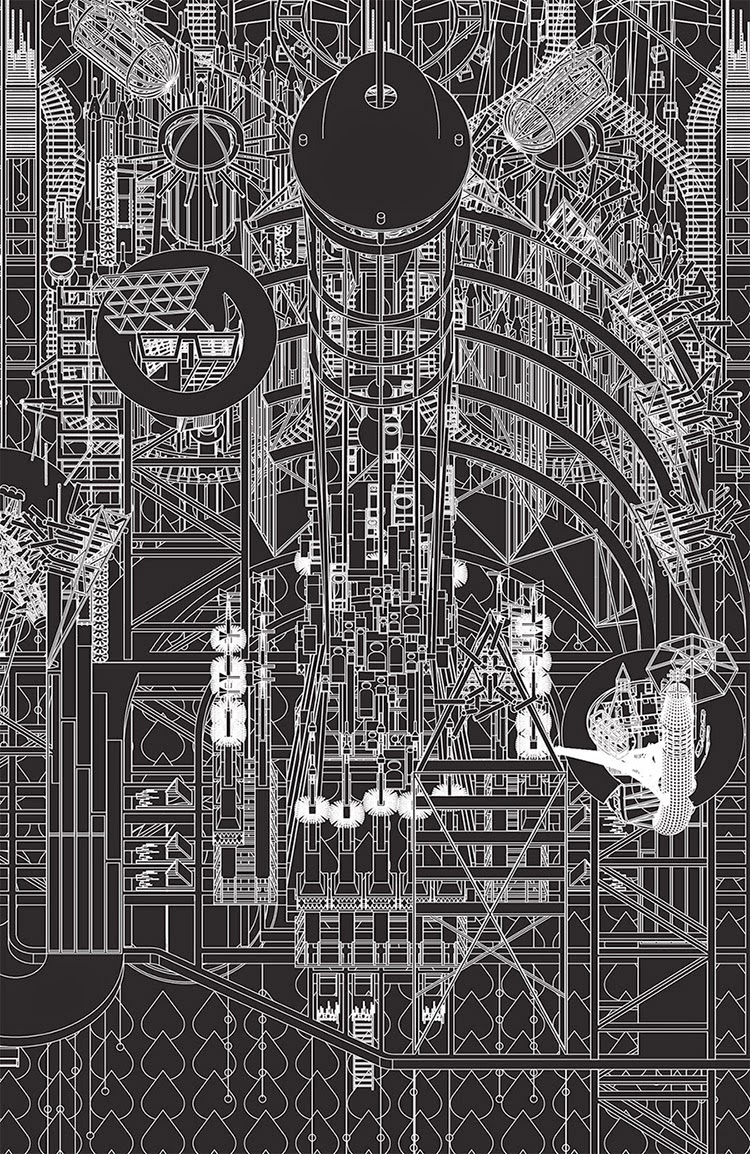
[Image: The Bremen Town-Musicians from Grimm City by Flea Folly Architects].

Bronner and Hillier explain that the “blueprint” for their city was “conceived in ink exactly 200 years ago,” and “was shaped by 86 magnificent tales collected by two of the most distinguished storytellers of their time.”

They are referring, of course, to the Brothers Grimm.
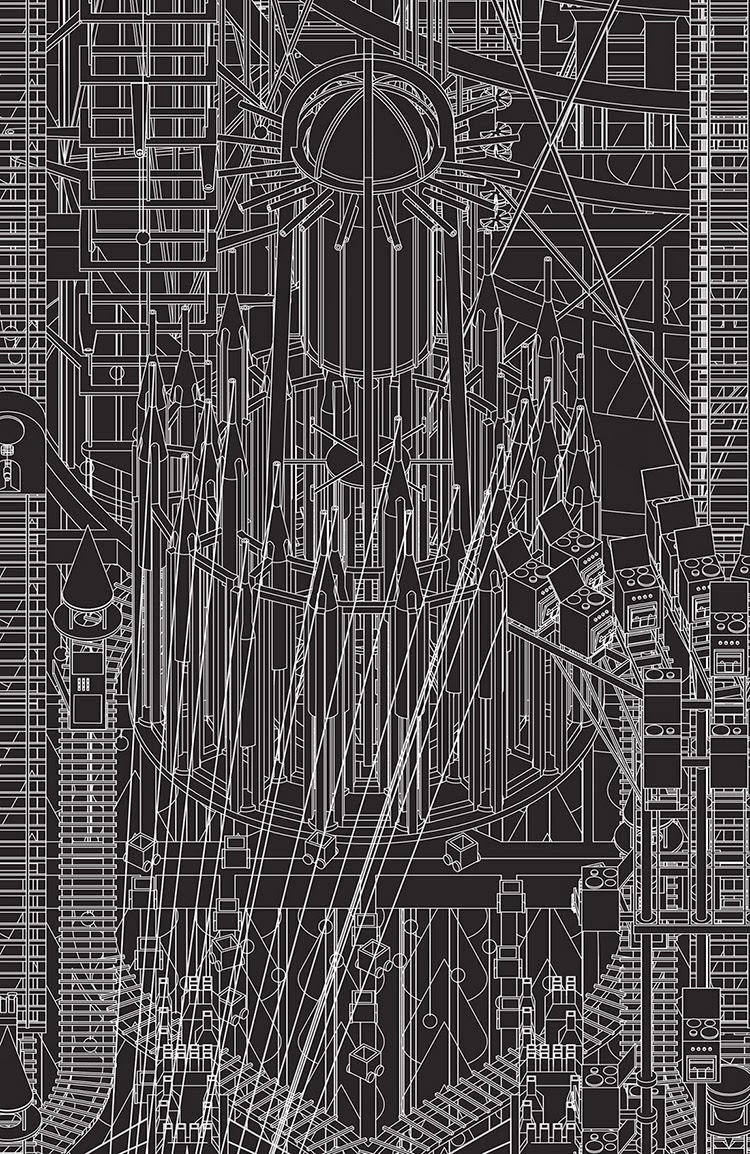
[Images: Two views of the Church and the neighboring Destruction Structure from Grimm City by Flea Folly Architects].

Briefly, in what now feels like another lifetime, when I was backpacking through Germany after graduating from college, I made a beeline to the small city of Marburg after reading that it was a university town overlooked by an 11th-century fort—and that it was also once home to the Brothers Grimm.

I showed up by train and spent a few days there, mostly reading Grimm stories, feeding ducks, and walking around the roads that spiraled up to the castle; and I later learned, with equal interest, that one of the weird coincidences of history would make Marburg the same city where a strain of hemorrhagic fever would be isolated.

The disease, which is now rather straight-forwardly called Marburg, seems a fittingly strange continuation of the stories of the Brothers Grimm, in terms of the dark and often fatal transformations humans can undergo.

In any case, Grimm City is an architectural translation of their various stories, plots, allegories, and characters, and it took on a life of its own. “With enormous spinning wheels, tower-like limbs and turrets for claws, it began to resemble a machine that had been unjustly woken from its deep slumber,” they write.
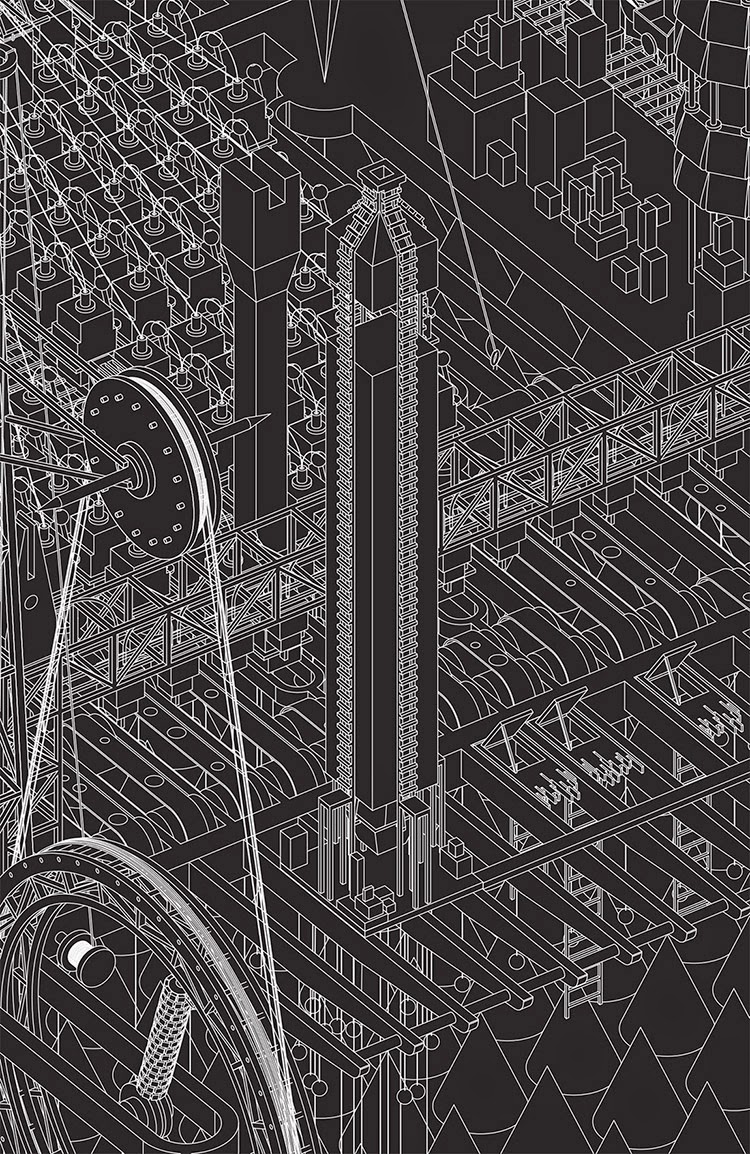
[Image: The Timber Factory from Grimm City by Flea Folly Architects].

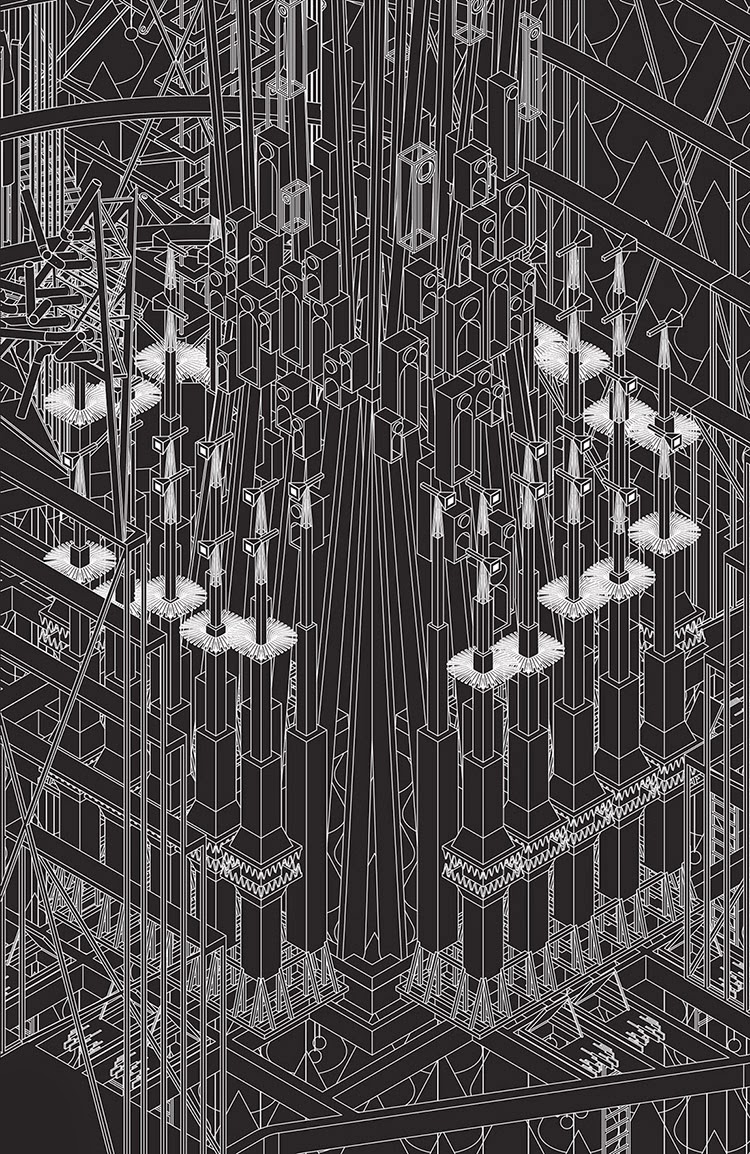
At times visually reminiscent of Aldo Rossi or even John Hejduk, the black diagrams are unexpectedly carnivalesque, monochromatic yet fizzing with lively detail.

There are structures such as The Ink Factory, a Silver Forest (made entirely of money-producing slot machines, eg. a forest where silver grows), an economic Barometer spinning over the city, and a school of thieves and burglary.
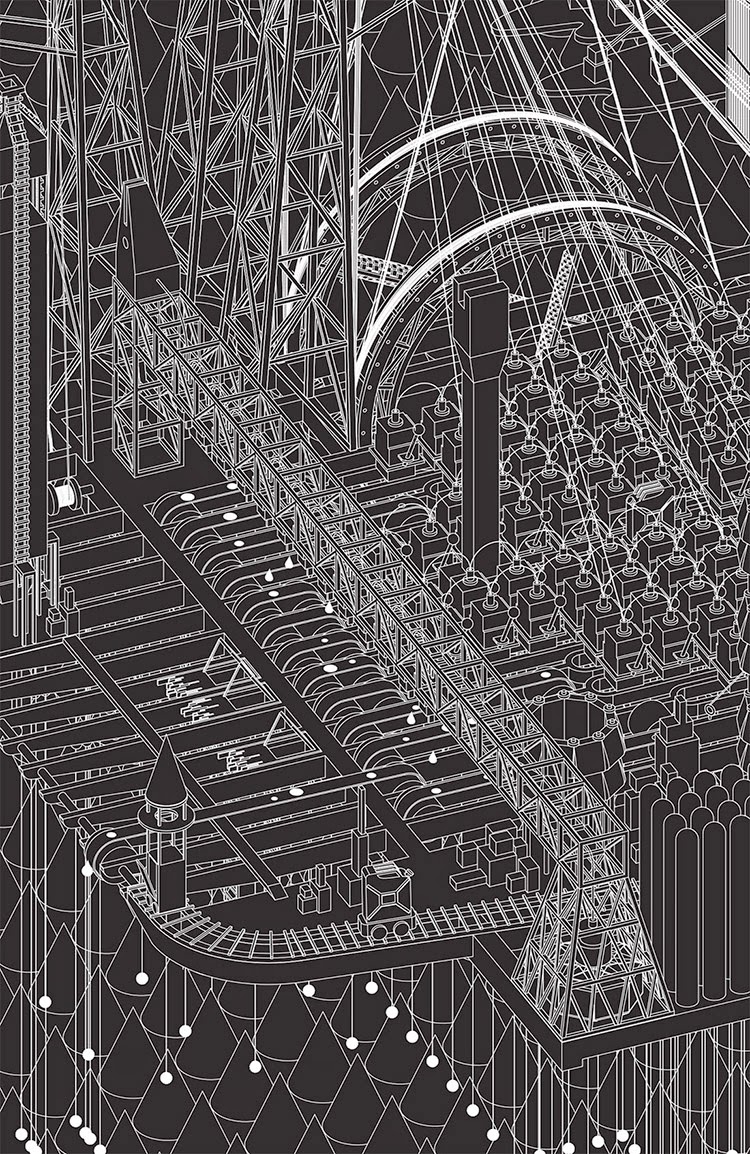
[Image: The Ink Factory from Grimm City by Flea Folly Architects].

There are also banks, churches, and a “windowless monolith” filled with forensic evidence of the city’s crimes.

Then, tacked way at the top of massive stairways so inclined they look like ladders, there are Confession Booths where the city’s sins are meant to be narrated and explained.

[Image: The Confession Booths from Grimm City by Flea Folly Architects].

Your exposure and isolation in ascending to the Booths is part of the process: a confessional infrastructure that compels one toward self-incrimination.

Elsewhere, there’s The Morning Star, a kind of heliogenic megabulb that hangs over the city, casting shadows and making time, burning at the center of an urban calendar that guides the lives of those living in the streets below.
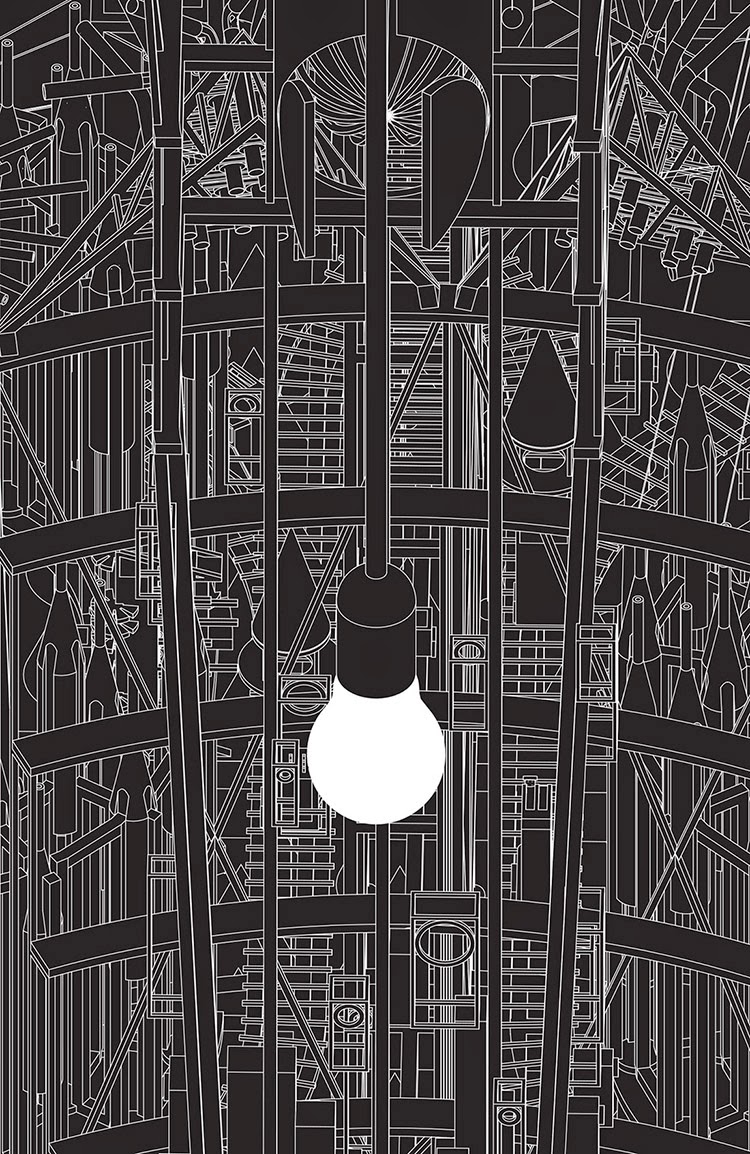
[Image: The Morning Star from Grimm City by Flea Folly Architects].

And, finally, there is a huge plateau known as The Golden Compound where a vast sprawl—of what appear to be batteries—promises a “commune for the living-dead,” a dormitory those who “cheat death and remain everlasting” in this fairy tale metropolis.

“No one really knows if those inside” of these endless, battery-like structures, “are dead or alive,” we read, “and no one dares to find out.” They could be described as electrical mausoleums where sleeping beauties lie, equally alive and dead.

[Image: The Parliament from Grimm City by Flea Folly Architects].

There are many, many further images, of course, as well as an intricate physical model that accompanied them; the whole thing was displayed at the London Design Museum back in October-November 2013 and, with any luck, the images and model both will someday show up in a gallery near you.


In a Pinch

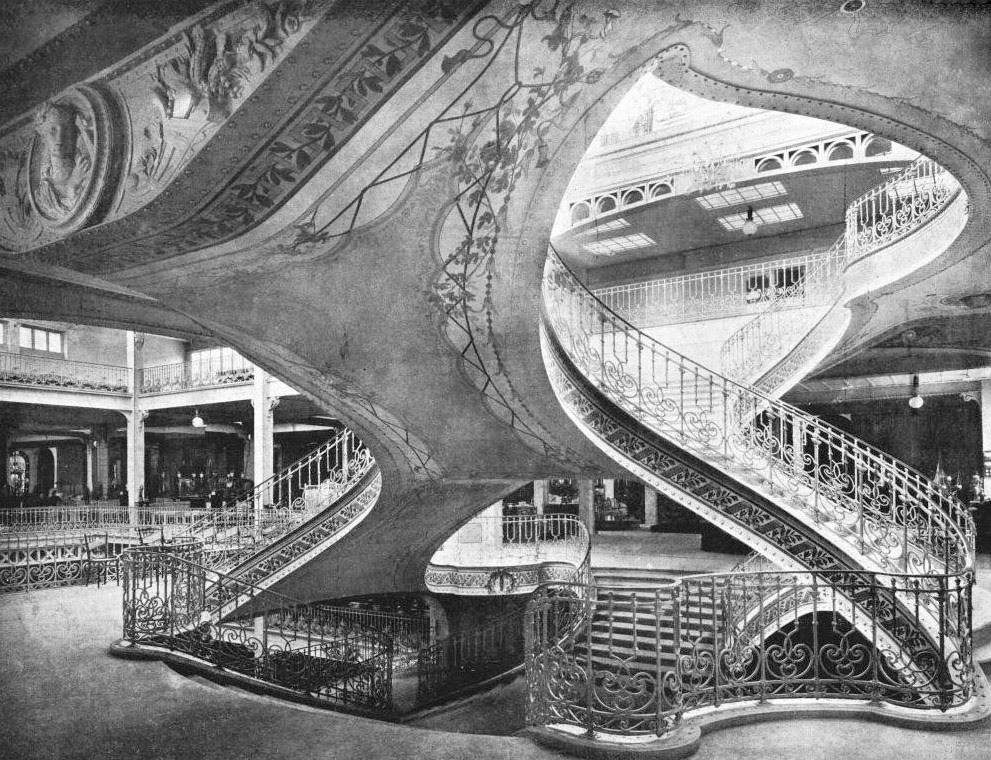
[Image: A staircase in the Grands Magasins Dufayel; view larger].

The second staircase I wanted to post today—here’s the first—is from the Grands Magasins Dufayel, a vast, 19th-century department store in Paris. View it larger.

Aside from the obvious grandeur of the structure, what makes this spatially noteworthy is the fact that one floor is pinched together with the next, and that the self-supporting “pinch” that results then becomes formalized as a stairway, a hyperbolic object in space that allows passage from one level to the next.

It’s as if a loop has been pulled or extracted from each level and then woven together—in effect, using a self-intersecting geometric pattern as the basis of a floorplan.

In any case, what I like in both examples (this one and the previous staircase), is that you have two floors or levels, obviously, but then there is the emptiness that separates them, a gap buzzing with unrealized forms of connection, and that you can fill that gap with pinches, spirals, knots, and loops, and that the magic of a well-designed staircase is precisely in giving material form to the invisible math that hovers in the space between floors.

(Originally spotted via ARCHI/MAPS).

Solved by Knots

[Image: Stairs inside the New York Life Insurance building, Minneapolis, by Babb, Cook and Willard; view larger].

There are two stairways I wanted to post, as they each solve the problem of getting from one floor to another in a particularly interesting way. The first example, seen above, is from the New York Life Insurance building in Minneapolis, Minnesota, designed by Babb, Cook and Willard.

View it larger.

What I love about this is incredibly simple, and it’s nothing more than the fact that a constrained approach from one floor to the next—with the far wall serving almost more like a cliff face—gave the architects no real room to operate. So they put in two, mirror-image spiral stairways, which kept the center of the room clear while dramatically increasing its available circulation space.

Today, of course, we’d probably just stick an elevator there and be done with it—but the compression of space made possible by spiral staircases is amazing. They are elegant prosthetics, connecting two levels like a casual afterthought with their efficient knots and coils.

Here’s the second staircase.

(Spotted via the always interesting ARCHI/MAPS).

Squeeze Play


An Australian company called Ingström designs and manufactures “escape chutes” for use both inside and outside of buildings.

These are fabric chutes—like large sleeves or pant legs—that allow relatively quick evacuation from an architectural structure, where the word “evacuation” takes on a somewhat comical double meaning, as the examples seen in the YouTube video, above, genuinely look like an alien bowel has taken up residence inside an office building somewhere in India, with people squeezing themselves down through its sphinctrous maw to a soundtrack of tablas.

Like the “SkySaver” system we looked at last summer, Ingström chutes offer a kind of secondary or alternative method of circulation through and around architectural space. What’s interesting about the “Multi-Entry” chute in particular, however, is that it seems to go so far as to suggest an entire secondary interior for the building, one that cuts through existing rooms like a web to form a bulbous topology that would be just as useful as some strange new form of children’s playground as an actual, life-saving system for emergency egress.

(See also Rain Noe’s take on escape chutes over at Core77. Originally spotted via @machimachinc).