Screens, Buses, Kegs, and Cranes

[Image: “Crane Rooms and Keg Apartments” by Aristide Antonas].

Architect Aristide Antonas will be speaking tonight, Tuesday, June 8, at the BauhausUniversität in Weimar, Germany. Antonas’s Flickr set has long been a favorite of mine, as it thoroughly documents his work, which radically reuses existing structures and pieces of mobile industrial equipment, such as cranes, trucks, and buses. In fact, you might recognize his “Crane Rooms” project from ArchDaily.

His “Bus Hotel,” for instance, is a double-decker bus transformed into a mobile, 7-bed hotel.

[Images: “Bus Hotel” by Aristide Antonas].

The “Keg Apartment,” designed in collaboration with Katerina Koutsogianni, continues what Antonas calls his “stable vehicle” series. There, “existing transportation wagons of different types… form rooms that can still move or can function again as movable. They can be used as holiday rooms or as small office places.”

[Images: “Keg Apartment” by Aristide Antonas and Katerina Koutsogianni].

His “Crane Rooms,” mentioned earlier, deserve a look here—

[Images: “Crane Rooms” by Aristide Antonas and Katerina Koutsogianni].

—about which Antonas writes:

Simple concrete foundations and elementary water pools are proposed to be installed in non hospitable beaches or arid hills nearby the sea. The room units form independent cells, they can be covered by tissues during the day; they provide a quality connection to the Internet. The private or public character of each room is regulated by the chosen high of every unit. The high control system is located inside every room. Platforms go up and down following the will of every provisional inhabitant. A bigger screen, related to the bed, serves as a home cinema structure; a small office, a wardrobe and a shower are placed in the same moving platform. A common underground kitchen serves the needs of all the complex; a reverse osmosis desalination plant provides drinkable water to the invisible kitchen and to the units (the water pipes follow the length of the crane).

He also proposes the construction of a “Crane Room Hotel” in which a network of individual units “moving up and down provide summer shelters with changing views.”

[Images: “Screen Wall House” by Aristide Antonas, including a map of possible sites and locations].

I’m more or less just randomly sampling his Flickr page, but “Screen Wall House” also deserves a quick look. Here, from what I can gather, a roofless island camping structure has the ability to expand indefinitely with the addition of further walls. “The walls that form this house are made out of screens,” Antonas writes. “These thin walls arrive by boat and are maintained by the desert place company, which is something similar to a camping set with particular rules. The screens can be added to existing concrete bases. A power engine provides the electricity that is needed for each unit.” The architecture, then, is dependent on the concrete floor plan laid out in advance by the “desert place company”—but one can easily imagine an alternative wall-structure that brings its modular floor plates along with it, thus allowing these flexi-mazes of temporary screens to encompass unprecedented interior spaces without a need for prior planning.

In any case, Antonas will be presenting his work at the Bauhaus-Universität in only a matter of hours; say hello to him if you happen to be there tonight.

Species of Spaces

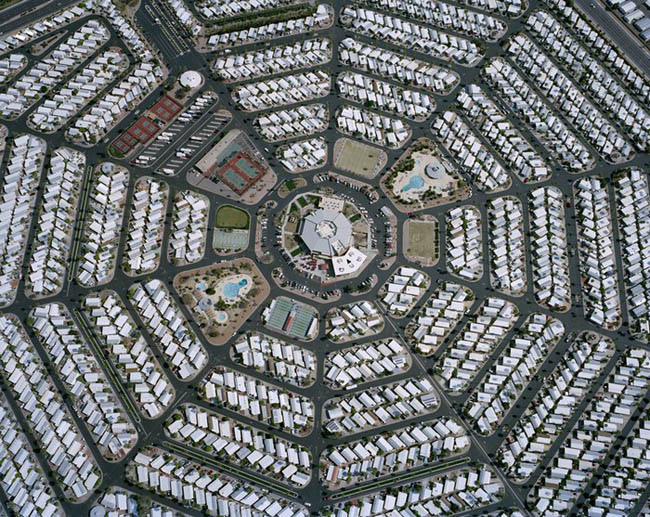
Christoph Gielen‘s aerial studies of suburban land-use patterns can be seen in the new issue of Culturehall, curated by David Andrew Frey around the theme “Future History.”

[Image: “Skye Isle II, Florida” (2009) by Christoph Gielen].

Glyphic, abstract, and typological, Gielen’s chosen land forms span the multidirectional universe of ribbons in the highway structures of Southern California to kaleidoscopic rosaries of Arizona houses.

In his own words, Gielen “specializes in conducting photographic aerial studies of infrastructure in its relation to land use, exploring the intersection of art and environmental politics.”

[Image: “Untitled Arizona III” (2010) by Christoph Gielen].

The results are often stunning, as monumental earth-shields of anthropological sprawl reveal their spatial logic from above. Seemingly drab and ecologically disastrous—even intellectually stultifying—suburbs become complex geographic experiments that perhaps didn’t quite go as planned.

Some of the photos—such as “Sterling Ridge VII, Florida” (2009), below—look genuinely alien, more like conceptual studies for exoplanetary settlements as imagined in the 1950s by NASA.

[Image: “Sterling Ridge VII, Florida” (2009) by Christoph Gielen].

How strange, though, and deeply ironic would it be for a photographic project ostensibly intended to show us how off-kilter our built environment has become—Gielen writes that “he hopes to trigger a reevaluation of our built environment, to ask: What kind of development can be considered sustainable?”—to reveal that the suburbs are, in a sense, intensely original settlement patterns tiled over the landscape in ways our species could never have anticipated? We are living amidst geometry, post-terrestrial screens between ourselves and the planet we walk upon.

Stonehenge at Night, 1944

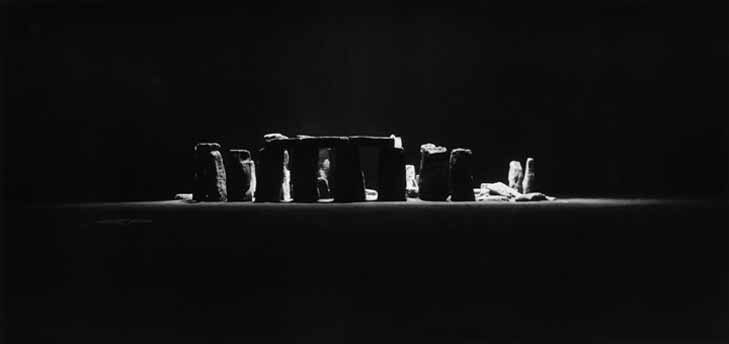
[Image: “Stonehenge at Night” (1944) by Harold Edgerton].

In 1944, Harold Edgerton, one of the forefathers of stroboscopic photography, produced an extraordinary image of Stonehenge. According to the authors of Stopping Time, that image was commissioned specifically as part of a larger military/optical experiment:

Illuminated by a 50,000 watt-second flash in the bay of a night-flying airplane 1500 feet above the ancient monoliths, Edgerton’s pictures of Stonehenge served as a demonstration to the Allied commanders of the potential for nighttime reconaissance photography. Edgerton was on the ground with a folding pocket camera braced on a fence post as the plane flew overhead. Simultaneously, the monument was recorded in perfect detail by a camera in the plane. The target was chosen because it was remote enough to allow the equipment to be tested without arousing unwanted interest.

Edgerton’s photograph was pointed out to me recently by architect Nat Chard after he read an earlier post here about the illuminative possibilities of aerial weaponry—or military chiaroscuro.

But the idea of a stroboscopic light-bay opening up in the base of an aircraft and illuminating scenes of human prehistory from above is breathtaking—as if dropping illuminative ordnance into a world of darkness, far below. Indeed, as a photographic technique, pinpoint-flashes of high-powered aerial lighting would also be something well worth exploring in other archaeo-architectural contexts, from Angkor Wat to the Spiro Mounds. Light-bomb archaeology.

(Thanks, Nat!)

Quick Links 12

[Image: “A 1566 rendering of ‘terrible and curious’ quake damage” in Istanbul; courtesy of the New York Times/Collection Kozak].

Five quick links for a Thursday morning:

1) “AT&T is launching a free wi-fi network for its customers in New York City’s Times Square,” Business Insider explained last week. “This will take a load off AT&T’s battered 3G network, by pushing peoples’ email, web, and app traffic onto wi-fi and off of 3G. And it should speed up downloads for AT&T customers in the area.” I’m reminded of Charles Komanoff’s proposed transportation policy changes for New York City, in which bus rides would always be offered free of charge, “because the time saved when passengers aren’t fumbling for change more than makes up for the lost fare revenue.” In other words, both cases suggest that offering certain urban services for free, at moments of high-intensity usage, often makes much better financial sense than charging for everything, all the time.

2) “In these hard economic times, when much of the country could use a walk in the woods or a night in the mountains or a wade in the river or a picnic by the lake, states across the country seem to be creating obstacles to the great outdoors… Campgrounds are closing, fees are increasing, employees have been laid off.”

3) In a look at impending, and possibly extreme, seismic activity in the Pacific Northwest, Nature writes that “public officials should maybe look at the new numbers and think about this earthquake as a real possibility in the next 50 years.” Watch this video to see what a strong quake hitting Seattle can really look like. This brings to mind the overdue earthquake long expected for Istanbul, “where tens of thousands of buildings throughout the city, erected in a haphazard, uninspected rush as the population soared past 10 million from the 1 million it was just 50 years ago, are what some seismologists call ‘rubble in waiting.'” After all, “expected earthquakes in this region represent an extreme danger for the Turkish megacity.”

4) Genetically Modified Fruit Flies Can Smell Light: “Blue light smells like delicious bananas.”

5) “Exploiting a political crisis, Malagasy timber barons are robbing this island nation of its sylvan heritage, illegally cutting down scarce species of rosewood trees in poorly protected national parks and exporting most of the valuable logs to China,” the New York Times reports. Worse, following a March 2009 coup and the island’s now “weakened and tottering government that is unable—and perhaps unwilling—to stop the trafficking,” the illegal timber trade “has increased at least 25-fold.”

Extra Credit:
a) Register for this competition to design a Lunar Capital City
b) For Robots, By Robots: Japan Plans a Moon Base by 2020

(Quick Links 1, 2, 3, 4, 5, 6, 7, 8, 9, 10, 11, and 12).

Military Chiaroscuro

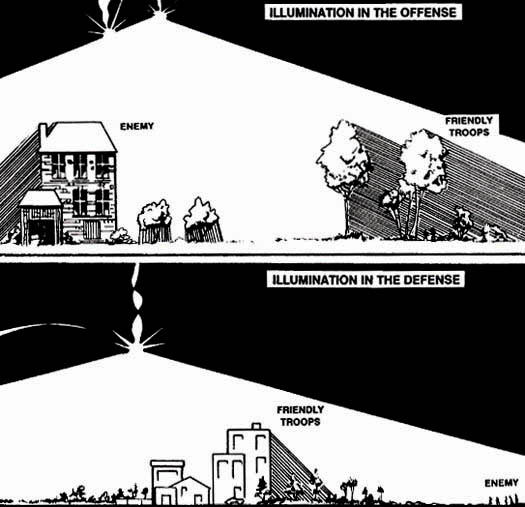
The diagram below explains two simple lighting strategies for use during “military operations on urban terrain,” or MOUT, taken from the U.S. Army’s Infantryman’s Guide to Combat in Built-Up Areas. While there is nothing particularly surprising about an army using light to its advantage, a number of interesting things arise when considering weapons from the perspective of their optical effects.

[Image: “Trip flares, flares, illumination from mortars and artillery, and spotlights (visible light or infrared) can be used to blind [the] enemy… or to artificially illuminate the battlefield,” from An Infantryman’s Guide to Combat in Built-Up Areas].

In another army field manual, for instance, called Tactical Employment of Mortars, the practice of running “illumination missions” using “luminous markers” and “specified amounts of illumination ammunition” is explained, such that mortars become less kinetic weapons used in the destruction of buildings than surprise lighting effects—decentralized chandeliers, so to speak, hurled down from above at high speed.

Indeed, “medium and heavy mortars can provide excellent illumination over wide areas,” whereas with lighter rounds “the illumination lasts for about 25 seconds, and it provides moderate light over a square kilometer. The gunner must adjust the elevation to achieve height-of-burst changes for this round. The best results are achieved with practice.”

One of many reasons I mention this here is because I wonder how these techniques could be de-weaponized and used for the purpose of civilian illumination. You visit a small town somewhere in Scandinavia where night’s fall is disturbingly total, with no street lights of any kind turning on after the sun has long since set; yet people are still out there milling about, even sitting on public benches with books in hand, as if preparing to read in utter darkness. But then a lightburst flashes in the sky above, burning for half a minute or more; and then another; and another, at odd angles, turning the streets and squares below into stroboscopes of moving geometry; and this continues for hours—strange nets of light popping in the air above you—as the city goes about its unexpected nightlife, illuminated by repurposed mortars fired by a light brigade camped out on the urban fringe.

Finally, any discussion of how urban lighting effects can be militarized reminds me of a stunning scene from Anthony Beevor’s retelling of the fall of Berlin during World War II. There, we read of a Russian general who ordered such extraordinary use of spotlights during the Battle of the Seelow Heights that his own soldiers became totally disoriented when the shelling began: massive clouds of smoke and dust rose up into the beams, forming an impenetrable glowing mist that quickly enveloped them, robbing the battlefield of detail. Light came from every direction and no direction at all, in a complete loss of the shadow-casting effects needed to hide their own troops’ movement—a failure, we might say, of military chiaroscuro, or the controlled use of shadows during invasion as seen in the diagram, above.

The Duplicative Forest

Atlas Obscura points our attention to a site in Oregon known as the “duplicative forest.”

[Image: The Duplicative Forest—17,000 acres of identical trees—awaits; photo courtesy of Atlas Obscura].

The poplar trees growing at this 17,000-acre farm are “all the same height and thickness,” we read, “and evenly spaced in all directions. The effect is compounded when blasting by at 75 mph. If you look for too long the strobe effect may induce seizures.”

While this latter comment is clearly a joke, it would actually be quite interesting to see if optical regulations are ever needed for the spacing of roadside objects. If, for instance, the Duplicative Forest really did induce seizures in motorists—but only those driving more than 90 mph, say—thus exhibiting neurological effects, what sorts of spatial rules might need to be implemented? Every sixth tree could be planted off-grid, for instance, in a slight stagger away from the otherwise mesmerizing patterns, or the speed limit could be rigorously enforced using bumps—in which case you would know that, just over the horizon of your car’s speedometer, a strange world of neurobiological self-interference looms, as the world around you threatens cognitive failure in those passing through it at a high enough speed or intensity.

Want to find out for yourself? Consider doing a drive-by.

On an only vaguely related note, meanwhile, fans of Fredric Jameson might recall his spatial analysis of Alfred Hitchcock’s absolutely excellent film North by Northwest—specifically Hitchcock’s use of rhythmically placed, identical trees.

Catch-and-Release Archaeology

[Image: Archaeologists work at Gobero, “the largest graveyard discovered to date in the Sahara.” Photo by Mike Hettwer, courtesy of National Geographic, otherwise unrelated to this post].

Archaeologist Sara Gonzalez, we read, courtesy of an older post on Middle Savagery, “practices what she calls ‘catch and release’ archaeology.” This means Gonzalez “plots all of the artifacts as they are excavated and then reburies the artifacts after analysis.”

While you can apparently read more about her method in this paper, I’m intrigued by the more general idea of systematically reburying things for their later, contrived rediscovery. This sort of behavior seems all but guaranteed to upset the existing stratigraphy of a site—and thus, in fact, be archaeologically usless—but it also sets up an interesting relationship with subterranean artifacts. That is, objects inside the earth enter into a kind of regulated hide-and-seek with surface dwellers.

Anthropologically speaking, I would love to learn more about cultures that have practiced this strangely squirrel-like behavior: burying perhaps quite large-scale things, in a loop bordering on repetition-compulsion, so that someone can unearth them later, thus deliberately leaving traces that future humans might not even know to look for.

Bloggers in the Archive

I’m thrilled to say that I will be blogging all summer from the late-lit northern evenings of Montreal, where I will be hosted for two months by the Canadian Centre for Architecture as part of their 2010 Visiting Scholars program.

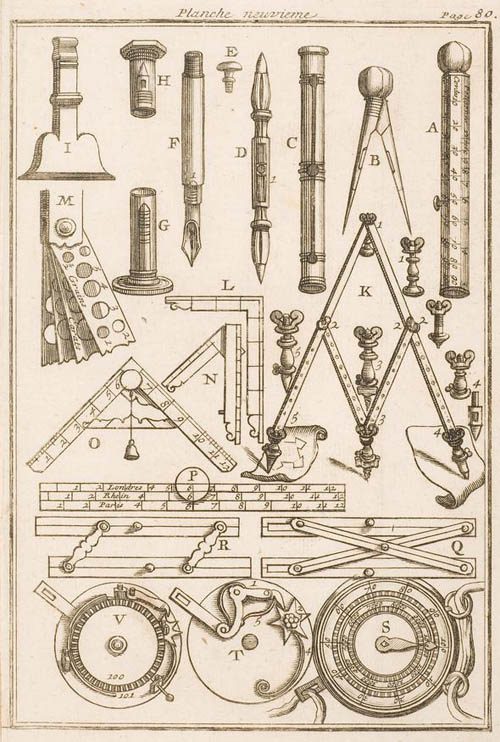
[Image: From the drawing instruments collection of the CCA, courtesy of the Canadian Centre for Architecture].

For the most part, I will be writing about many of the items in the CCA’s collection—films, models, photographs, manuscripts, architectural tools, and more—and, for good or for bad, publishing the results on the CCA’s own website.

There is a truly mind-boggling amount of material to explore up there, from the archives of Gordon Matta-Clark and Cedric Price to a collection of antique drawing instruments and souvenir models, John Hejduk’s Bovisa sketches, photographic plates from English India, Canadian fire insurance maps, speculative proposals for river lighthouses, massive archives of stage set designs and dramatic scenography, and a beautiful manuscript copy of the Plan of St. Petersburg, among far, far more than I could possibly mention in one post. Konstantin Melnikov. Aldo Rossi. Three airports by Lloyd Wright. Travel sketches by Louis Kahn.

[Image: “Unknown photographer. Konstantin Melnikov (1890-1974) and his wife stand before their house” (1927); courtesy of the Canadian Centre for Architecture].

The overall idea is something that I’ve been calling “Bloggers in the Archive,” a program I’m starting with myself as a guinea pig, and that I would love to bring to other institutions elsewhere in the future.

In other words, there are architectural and design archives all over the world, full of astonishing things, but these same collections are often unexplored in their entirety, even by members of the institutions that have collected them. Even more commonly, many of these global collections are open only to scholars who stop by once every five or six years—if that often—to write niche monographs or academic publications about specific aspects of an archive’s contents.

But what if you could install an architecture blogger—or a film blogger, a food blogger, an archaeology blogger, a fiction blogger—in an overlooked archive somewhere, anywhere in the world, and thus help to reveal those items to the general public?

[Image: From Scenes of the World to Come: European Architecture and the American Challenge, 1893-1960 at the CCA; courtesy of the Canadian Centre for Architecture].

Why not put Archidose up at the National Building Museum, for instance, or Frank Jacobs in the UN’s Dag Hammarskjold Library, Colleen Morgan at the National Archaeological Museum in Athens, or even give Clastic Detritus a guest residency at the central archives of the USGS? Maud Newton, temporary blogger-in-residence at the British Library.

Call all of it part of “Bloggers in the Archive,” and suddenly collections all over the world are being appreciated and seen by more than the five professors who have been deemed qualified enough to explore a specific phase in architecture, design, or landscape history. Put Tim Maly up at the Reuleaux Collection of Mechanisms and Machines for two weeks, or Bruce Sterling at the National Science Foundation.

After all, are academic essays the only textual form appropriate for archival exploration, or does the relatively ad hoc, point-and-shoot blog post, motivated less by scholarly expertise than by curiosity and personal enthusiasm, also have something valuable to offer? Somewhere between front-line archival reportage, historical research, and what we might call popular outreach.

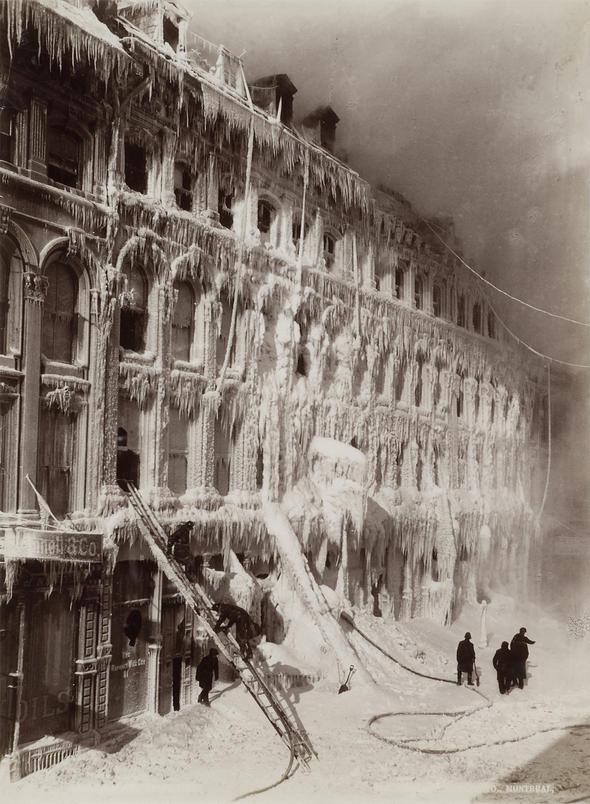
[Image: “William Notman & Son, Building encased in ice after a fire, 65-83 Little St. James Street, Montreal” (1888); courtesy of the Canadian Centre for Architecture].

In any case, in addition to surrounding myself with the CCA’s seemingly endless collections—international expositions and fairs! winter festivals! fortified cities in colonial North America! Roman archaeology!—I also hope to find time to explore the landscapes around Québec (including the megascale hydroelectric stations peppered throughout the province’s subarctic forests, such as MANIC-5—leading me to wonder if Hydro-Québec has ever been the subject of a minor architectural retrospective, and, if not, if Pruned could perhaps be hired to curate one…).

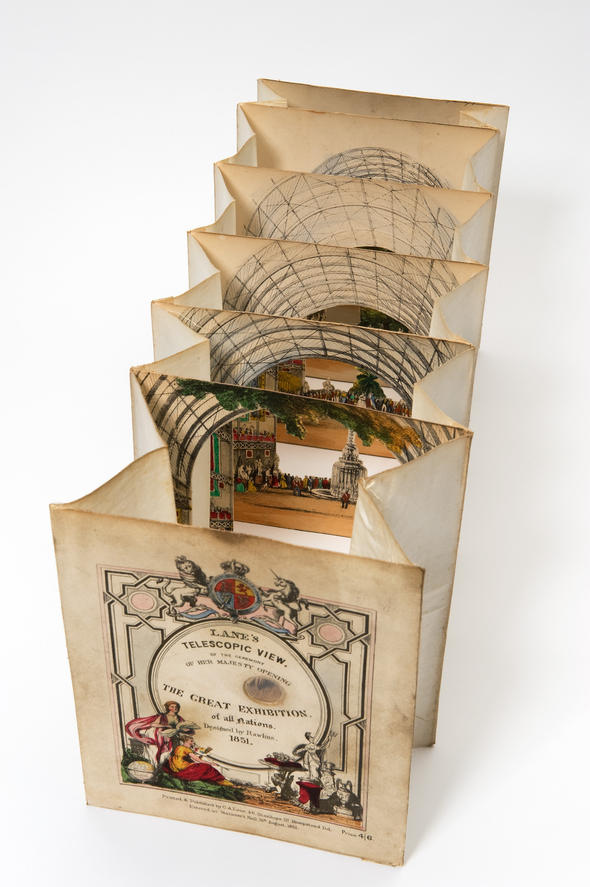
[Image: A “telescopic” book from the Great Exhibition in London (1851); courtesy of the Canadian Centre for Architecture].

So stay tuned for regular posts beginning late next week from Montreal—and also watch for updates on the CCA’s website (I’ll have specific info on exactly where my posts for the CCA will appear soon). And, of course, huge thanks to the CCA for making this summer possible!

Quick Links 11

[Image: A fun-ride isolated amidst its paved surroundings, by Christoph Morlinghaus].

Some quick links for a Wednesday afternoon:

1) Photographer Christoph Morlinghaus’s work is fantastic. His well-patterned explorations of the parking lot sublime are well worth checking out, as are his remote desert landscapes, snow-accentuated mountain peaks, and vast greenhouses. However, his explicitly architectural photography is how I first discovered—and became a fan of—his work, including these amazing shots of Saarinen’s TWA terminal; but it’s these unforgettable glimpses of church interiors that really stun me, perhaps even visually demonstrating that contemporary Christianity and science fiction come together in the Venn Diagram of architectural speculation. 2001 meets the Ascension. (Originally spotted via the excellent blog but does it float).

[Image: Photo by Christoph Morlinghaus; contact the artist].

2) I’ve already linked to the extraordinary story of “Richard Préfontaine and his wife, Lynne Charbonneau, [who] were watching a playoff hockey game with their two daughters on Monday night when the ground beneath their house gave way suddenly and without warning.” But were “very recent tarmac repairs extending right across the road” nearby, including “other hairline cracks” visible for weeks in the paving, signs of this impending collapse? “It may well be that [the] slide was creeping prior to final collapse,” we read—and this “creeping” of the earth was visible in the form of patchwork road repairs taking shape outside. Amazingly, the New York Times adds, “the family’s shocking demise was a stark reminder of a hidden menace under many parts of Quebec, one that dates back 10,000 years to an ancient inland sea.” (Thanks to Brian Romans for the road-repairs link!)

[Image: Photo by Christoph Morlinghaus].

3) Using an eye-popping series of satellite images, geologist Michael Welland explains that “barrier islands are amongst the most dynamic and ephemeral natural landforms on the planet“—and thus a major reason why Louisiana’s plan for the “dredging and construction of eighty miles of six-foot sand berms along the coast on either side of the Mississippi Delta as protection against the oil spill” unleashed last month by BP is all but functionally impossible.

[Image: Photo by Christoph Morlinghaus].

4) Speaking of oil spills, I’ve been enjoying the Twitter feed @BPGlobalPR.

5) systemic explores the imaginative allure of remote Pacific islands and the astronomical possibility of “habitable worlds.”

[Image: Photo by Christoph Morlinghaus].

6) Recent architecture grad Nick Sowers—congrats, Nick!—has posted several fantastic back-to-back posts: one, on the “American Military Pastoral“—or the overseas U.S. military base as preserved landscape—another a long, swirling, metafictional look at what Nick calls “Military Speleology,” the “jet noise barrier” of passing American warplanes on Guam, and “the production of new faults” in the island’s bedrock when these thunderous sonic booms help to destabilize the earth’s interior. Creating caves through sound. There’s also an archaeological report exploring future speculative excavations, and a forensic inquiry: “How is ruination measured and tracked?”

[Image: Photo by Christoph Morlinghaus].

7) Middle Savagery asks “if any architecture has been inspired by archaeology”—specifically, “how would you construct a building explicitly to excavate it?”

[Image: Photo by Christoph Morlinghaus].

8) Participants in the speculatis workshop will use “advanced modeling techniques and fabrication technologies” to explore “lighting systems and their possible interaction with user movement.” That is, you’ll be designing an interactive chandelier. Apply by 15 June for this weeklong workshop in Oporto, Portugal, held 10-17 July 2010. And then send in images of whatever you produce there!

9) The 3rd Coast Atlas “is a platform for research and design initiatives that explore the urbanization, landscape, infrastructure and ecology of the Great Lakes Basin and Great Lakes Megaregion.” Submissions are due 31 August 2010.

[Image: Photo by Christoph Morlinghaus].

10) Friends of the Pleistocene are embarking on a tour along the ancient shores of Lake Bonneville, the partially vanished megalake that once spanned the entire Great Basin (and whose hydrological remnants include Utah’s massive Salt Lake). They’ll be “using photography, drawing, super 8 film, and GPS mapping/logging” to record their trip.

We’ll also look for traces of lines carved by Lake Bonneville’s fluctuations in size and depth—significant enough changes to warrant their own names: Lakes Gilbert, Provo and Stansbury. Many of the lines, sometimes called benches, strand lines, and even “bath tub rings,” are clearly visible from main roads and Interstates. We’ll also go off-road in search of more remote shorelines and playas left behind by the lake.

Their “Geologic Time Viewer” is also worth a long look (see also mammoth).

Extra Credit: Lasers Could Create Clouds, and Perhaps Rain, on Demand.

[Post updated 28 May 2010 with more links to Nick Sowers’s work, on a tip from mammoth].

The Fires

I want to remind anyone near New York tonight that author Joe Flood will be presenting his book The Fires: How a Computer Formula, Big Ideas, and the Best of Intentions Burned Down New York City—and Determined the Future of Cities.

[Image: Photo by Lisa Kahane, courtesy of the New York Times].

As I mentioned here the other week, The Fires covers a huge range of topics, from NYC neighborhoods where a full 90% of the buildings burned down to a short history of the RAND Corporation, from the analytic shortcomings of statistical urban planning to the larger-than-life people who implemented these increasingly catastrophic financial decisions that inadvertently set the city ablaze.

The book also has some memorable details about the fire department’s interaction with the built environment, including highly codified response protocols for different architectural forms, fire chiefs “studying structural defects in new skyscraper designs” and “pressure differentials in the city’s water mains,” even while driving around the city with “blueprints of local buildings in their cars,” and survival tips for firefighters lost in the smoke of a burning building.

We learn, for instance, that fire crews developed a whole repertoire of unconventional forensic techniques for reorienting themselves in a burning building. Flood quotes a fireman: “Maybe you’d have to tear up the linoleum on the floor to find the old wood beneath it and see which way the seams ran to find the door out. All those little tricks to stay alive, it was really something else, excitement-wise.”

These adrenalin-fueled nights of often multi-block blazes are very poignantly juxtaposed with tales of wrecked families, whole neighborhoods erased from the map, and a borough—the South Bronx—deliberately abandoned once the damage got bad enough by city planners pursuing a policy of “planned shrinkage.”

[Image: Photo by Mel Rosenthal, courtesy of the Duke University Libraries].

Flood will launch his book tonight, following an introduction by Steven Johnson, author of The Ghost Map, Everything Bad is Good for You, and many more; I will also be there, interviewing Flood about The Fires and then fielding audience questions with Johnson’s moderation.

The whole thing will be followed by drinks, a DJ, and a book-signing.

Things kick off at 7pm over at powerHouse Books in Brooklyn; here is a map. Hope to see you there!

Berthier’s Door

[Image: From Les spécialistes by Julien Berthier and Simon Boudvin].

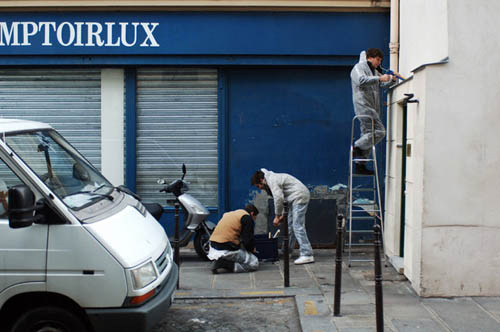
Back in 2006, early on a Saturday morning, artists Julien Berthier and Simon Boudvin installed a new door in the city of Paris—but it was a fake door, leading nowhere, on an otherwise empty wall in the 3rd arrondissement.

[Image: From Les spécialistes by Julien Berthier and Simon Boudvin].

The project was called Les spécialistes. “The façade, using the local architectural codes, occupies 10 cm of public space,” Berthier explains, “and was mounted and glued on in thirty minutes.”

[Images: From Les spécialistes].

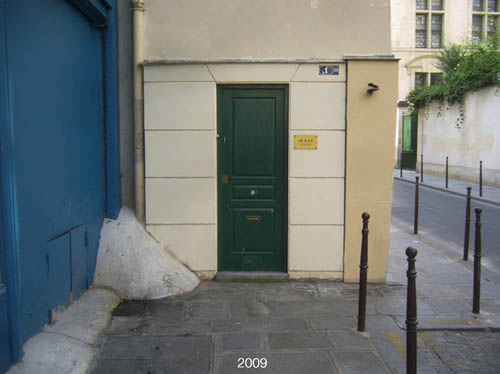
Unbelievably, Berthier adds, “Almost 4 years later, the address still exists. Regularly graffitied it is even cleaned by the city service.”

[Image: Les spécialistes seen in 2009; its co-creator, Julien Berthier, has a flair for secret doors].

In a way, I’m reminded of an article published last month in New York magazine called “There’s a Brownstone in Brooklyn With a Secret Passage to the Subway.” There, the magazine wrote that “among the lovely three-story brownstones in Brooklyn is one extra-special home, one that really isn’t a home at all. It’s merely a façade that serves to disguise a passage into the dark subway tunnel” below. An emergency evacuation-and-access system for the subway, the doorway and its Potemkin house remain unmarked and undisclosed; it is the NYPD as Julien Berthier. (Which, in turn, reminds me of the Rentable Basement Maze).

But, of course, these sorts of “fake” spaces are not uncommon at all. There are also “dummy houses” in London—specifically at 23-24 Leinster Gardens—that were constructed from the very beginning as nothing but façades. They don’t even have interiors; they are simply vents for the Underground, disguised as faux-Georgian flats. Check out some cool photos of them over at Urban 75.

This further brings to mind, however, a scene from Umberto Eco’s underappreciated novel Foucault’s Pendulum, where the narrator, being regaled with tales of subterranean Paris, is told that, “People walk by and they don’t know the truth… That the house is a fake. It’s a façade, an enclosure with no room, no interior. It is really a chimney, a ventilation flue that serves to release the vapors of the regional Métro. And once you know this you feel you are standing at the mouth of the underworld…”

Fake buildings and fake doors with secret interiors—or interiors that don’t even exist. Purloined interiority.

Might I suggest, then, in light of these examples, that if someone, someday, were to approach Berthier’s Door—after all, it deserves a name, capitalized and cartographically handed down friend-to-friend in a countergeography of the city—and finds themselves able to open it, to step through into a labyrinth of staircases and rooms stacked one on top the other leading down dozens of meters, and they are then able to explain later, after emerging somewhere perhaps near Dijon, what marvels of literally suburban cross-connection exist back there in a knitted fabric of minor spaces no one else has ever seen, that art, architecture, and mythology will finally have experienced their rightful co-identification.

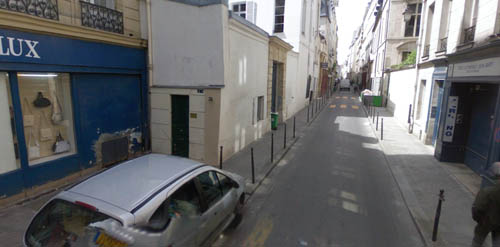
[Image: Berthier’s Door—near 1 Rue Chapon—visible on Google Street View].

Or, perhaps, if someone installs a door of their own—atop a hill in the 19th arrondissement, or down on a side-street near the Musée des arts et métiers, site of the now-irreparably damaged Foucault’s Pendulum, or over in Moscow somewhere with its rumored secret subway—a maze of connective spaces will open up between them—indeed, wherever you install a door, in any city, if you simply wait long enough, the invisible network of tunnels burrowing away in the background of urban awareness will eventually come to find it.