[Images: The forests of northern Michigan, via Google Maps].
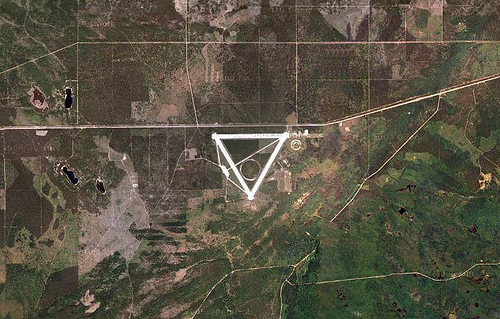
In the woods of northern Michigan, near Hiawatha National Forest, is a massive triangle, unnamed and unlabeled on Google Maps.
[Images: Geometry amidst the forest, via Google Maps].
But, despite its anonymity (it even disappears from view altogether when you switch from “Satellite” to “Map“), this is not some underground HQ for a secretive cult of aerially-minded geoglyph-builders, and it’s not more scientological circles—it’s a former military base and landing-strip complex called Raco Army Airfield.
As it is, the site’s monumental geometry, with its northernmost airstrip aligned almost perfectly east-to-west, makes a massive and slightly puzzling triangle in the middle of heavy forest.
Raco AAF is a facility that has seen a variety of different uses, according to the website Abandoned & Little-Known Airfields: “The site of the pre-WW2 civilian Raco Landing Field was evidently reused by the military at some point after 1940 for the construction of a much more elaborate military airfield, intended to provide protection to the Sault Sainte Marie locks.” However, “As no threats materialized to the locks, the airfield was apparently little-used, or possibly never used at all.” Anti-aircraft guns were nonetheless installed on concrete pads in the surrounding forest; these pads remain in the woods today, overgrown with moss and tree roots, offering an unexpected and highly artificial surrogate bedrock for the ecosystem around them.
The facility was later armed with nuclear missiles:
Part of the airfield property was later reused by the Air Force to build a launch site for the huge BOMARC ramjet surface-to-air missiles. The BOMARC was a long-range surface to air missile, intended to shoot down Soviet bombers with a nuclear warhead. This facility was known as the Kincheloe AFB BOMARC site, and it was manned by the 37th Air Defense Missile Squadron starting in 1960. The BOMARC site was a rectangular installation, just southeast of the runways. It operated the 2nd-generation IM-99B version of the BOMARC missile. The site consisted of a grid of 28 individual missile launcher buildings on the south end, along with larger missile assembly buildings on the north end.
The whole thing was shut down in 1972.
Abandoned & Little-Known Airfields goes on to quote a man named David McLaren: “I visited Raco AAF back in 1974 after spotting it from a B-52 at 20,000 feet. At that time the seedlings had just been planted. The only remaining Air Force structure was a mess hall, which still had the stainless steel coolers & tables. The missile buildings were intact, and although the launching equipment had been removed, the buildings still had their heaters installed.”
Some time later, after the field was closed, a “circular automobile testing track” was added to the center of the site, and this was later replaced by a “serpentine vehicle testing track,” which you can see in the lower right—the southeast corner—of the above images.
And so the site remains today, oddly: it is intensively reused every winter by a small army of vehicle-testing engineers, who have transformed the facility into the Smithers Winter Test Center. This former military airport, visible as a near-perfectly white triangle hidden amidst the sub-arctic trees, is “ideal for testing and conducting performance evaluations of vehicles, tires and components under the special challenges of extreme cold and hazardous road conditions.”
An 18th-century ship has been discovered deep in briny muck “flecked with oyster shells” at the bottom of a World Trade Center construction site. As the New York Times reports, archaeologists called in to investigate the find soon realized that “a wood-hulled vessel had been discovered about 20 to 30 feet below street level on the World Trade Center site, the first such large-scale archaeological find along the Manhattan waterfront since 1982, when an 18th-century cargo ship came to light at 175 Water Street.”
The article adds that “a 1797 map shows that the excavation site is close to where Lindsey’s Wharf and Lake’s Wharf once projected into the Hudson.”
Recalling the buried ships of San Francisco that we explored several years ago, New York City stands astride landlocked boats, its foundations piled down through wrecks of hulls, grids of masts waiting to be uncovered, perhaps the whole island of Manhattan threatening to unmoor itself one day and set sail into the Atlantic. The prow of Battery Park, ramming through grey waves.
Like some magnificent fulfillment of Lebbeus Woods’s “Slow Manifesto,” all of the island metropolis-at-sea would embody “an architecture that rises from and sinks back into fluidity,” rocking through rogue waves “into the turbulence of a continually changing matrix of conditions, into an eternal, ceaseless flux… drawing its sinews from webbings of shifting forces”, like these buried ships far below, as buildings break down into maritime vessels according to other, more mobile tectonics, the city “struggling to crystallize and become eternal, even as it is broken and scattered” across the oceans of the world.
The New York Times adds that these blackened timbers now emerging were clearly “more than just remnants of the wooden cribbing used in the late 18th and early 19th centuries to extend the shoreline of Manhattan Island ever farther into the Hudson River”—a fantastic image of potential structural confusion between the already highly artificial terrain of southern Manhattan (its “land” actually a thick gauze lodged inside “wooden cribbing” and held in place by seawalls and heavy office blocks above) and these strange foreign bodies of wooden ships, their diagonal counter-grids and unexpected stratigraphies piercing the underground matrix like slow bullets. That is, until a newfound archaeological buoyancy brings them up from the briny deep, like rare submarines surfacing through mud and darkness.
Buried ships—flaws in the wooden crystal of the city—interrupting New York’s grounded logic from below.
[Image: Partial site plan for the Stratford Kiosks design competition].
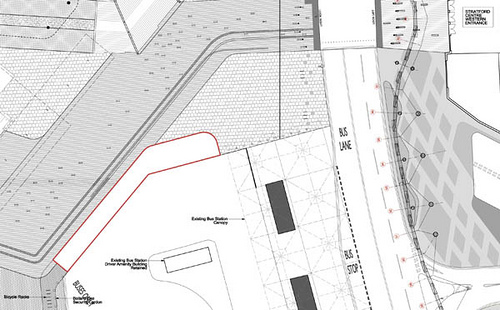
An interesting design competition has been announced to produce a suite of minor buildings at the 2012 London Olympics:
The Architecture Foundation is pleased to announce the launch of an open international competition to design a permanent yet flexible, free standing group of kiosks in Meridian Square, Stratford, London, for use before, during and after the London 2012 Olympic and Paralympic Games. Situated at the front of Stratford Regional Station and hosting a variety of uses, the kiosks will serve as key venues for information, orientation and services within the rapidly changing town centre.
Here are all the basic site documents you need; you have to register, however, and the deadline for project submissions is 3 September 2010. Good luck!
[Image: From The Thing, directed by John Carpenter].
As glaciers and mountain snow packs recede, their disappearance sometimes reveals archaeological evidence of earlier human settlements, with tools and other implements dropping out of the melting ice. As LiveScience reported back in April, “patches of ice that have been in place for thousands of years in the mountains of the Canadian High Arctic” are disappearing, revealing “a treasure trove of ancient hunting tools” in their wake.
The forensic investigation of these unexpected windows into human history has been dubbed “ice patch archaeology.”
One of the field’s originary archaeologists drew an analogy last week for how these artifacts probably got there:
Maybe you missed a shot and your weapon disappeared into the snowbank. It’s like finding your keys when you drop them in snow. You’re not going to find them until spring. Well, the spring hasn’t come until these things started melting for the first time, in some instances, in many, many thousands of years.
The idea that historical surprises are in store for us, waiting to be revealed—as if by glacial metabolism—in an era of global climate change is a compelling one (and seemingly an inexhaustible plot device for burgeoning writers). In fact, the image that opens this post was taken from John Carpenter’s 1982 film The Thing, in which a spaceship—along with its infectious, shapeshifting passenger—is discovered buried in Antarctic ice that’s at least 100,000 years old. It’s a kind of moving archaeological site, carved from ancient ice and drifting along with the pulse of the glacier.
[Image: Antarctica’s Blood Falls“, via Atlas Obscura].
But we needn’t turn to scifi to find extraordinary examples of “ice patch archaeology.”
Earlier this year, for instance, Atlas Obscura noted a site in Antarctica called “Blood Falls.” It is a “five-story, blood-red waterfall [that] pours very slowly out of the Taylor Glacier in Antarctica’s McMurdo Dry Valleys.”
Roughly two million years ago, the Taylor Glacier sealed beneath it a small body of water which contained an ancient community of microbes. Trapped below a thick layer of ice, they have remained there ever since, isolated inside a natural time capsule. Evolving independently of the rest of the living world, these microbes exist in a world with no light or free oxygen and little heat, and are essentially the definition of “primordial ooze.” The trapped lake has very high salinity and is rich in iron, which gives the waterfall its red color. A fissure in the glacier allows the subglacial lake to flow out, forming the falls without contaminating the ecosystem within.
The scientific value of these previously inaccessible reservoirs of planetary history should only become more obvious in the years to come.
Climate change, together with melting glaciers, becomes an inadvertent archaeology of the human—and profoundly inhuman—past.
But, of course, we’ve seen other stories like this, in which caches of human history unexpectedly reappear as the climate heats up. Last year, for instance, we looked at melting glaciers as chemical archives: “As the world’s glaciers melt, they’ve begun to release an archive of banned industrial substances back into the environment, chemicals that have been locked, frozen, inside the glacial ice for up to thirty years.”
Thirty years is nothing compared to the hundreds—often thousands—of years involved in ice patch archaeology, but the untimely release of dangerous chemicals we once thought long-forgotten is chilling proof that very few things are ever gone for good.
[Image: Offshore Oil Strike by BP; photo by BLDGBLOG].
One of the most extraordinary—and timely—subcollections in the archives of the Canadian Centre for Architecture can be found resting on a few metal shelves in the basement, where you will discover stacks of old, oil exploration-themed board games.
Cartel: The International Oil Game. La Conquête du Pétrole. King Oil: Combine Luck and Strategy to Control the Oil Fields. Oil: The Slickest Game in Town. Total Depth: An Oil Man’s Game.
There’s even the confident one-word title of Gusher, with no description or subtitle needed—or, if none of those strikes your fancy, you can always play a few rounds of Gas Crisis. Its goals include an exhortation to “Master the Minicar” and “Shun the Sheikhs,” showing that smaller cars (and better gas mileage) have been seen as tools of foreign policy since at least the 1970s, when many of these games were first released.
But the one game that seems particularly delirious, a kind of sad joke now, or unfortunate coincidence, is Offshore Oil Strike, “Designed and Manufactured by Printbox (Scotland) Limited in collaboration with The British Petroleum Company Limited.” Offshore Oil Strike, brought to you by BP.
[Images: Offshore Oil Strike by BP; photos by BLDGBLOG].
With this “exciting board game for all the family,” released in 1970, BP delivered all “the thrills of drilling, the hazards and rewards as you bring in your own…”
Bring in your own “Offshore Petro-Dollars,” that is.
[Image: Offshore Oil Strike by BP; photo by BLDGBLOG].
The game’s internal monetary supply comes in denominations of $200,000, $500,000, $1,000,000, $2,000,000, $10,000,000, and $20,000,000—which is good because you need to earn a lot of it: “The 1st player to make $120,000,000 cash is regarded as the winner.”
After all, it’s “a race to find and develop the riches ‘neath the seabed,” where no deepwater is beyond the horizon of possible drilling.
[Images: Offshore Oil Strike by BP; photos by BLDGBLOG].
Accumulating this fortune, however, is not without its difficulties. Each player has “Hazard” cards to deal with; here are some of the risks BP thought to include:
—”Accident. Rig shuts down while replacement of key personnel takes place. Miss one turn.” —”Fire breaks out. Pay $2,500,000 for repairs.” —”Hit High-Pressure Gas—Rig Damaged. Specialists called in.” —”Blow-Out! Rig Damaged. Repairs cost $2,000,000″ —”Drill pipe breaks. Pay $500,000 for replacement.” —”Strike High Pressure Gas. Platform Destroyed.” —”Blow-Out! Rig Damaged. Oil Slick Clean-Up costs. Pay $1,000,000.”
Players are assigned one of four competing oil company identities, each of which is associated with a specific urban headquarters: Chevron/Rotterdam, Mobil/Dieppe, Amoco/Bergen, and BP/Hull.
[Images: Offshore Oil Strike by BP; photos by BLDGBLOG].
As the CCA wrote in their excellent book and exhibition catalog, Sorry, Out of Gas, “Historians and researchers often see games as a source of information about the customs and concerns of a given era. The way games work, their meanings and goals, are linked to the social context in which they are invented and popularized.”
[Images: Offshore Oil Strike by BP; photos by BLDGBLOG].
I’ve included several photos of BP’s game here so that you can see the space of play for yourself. But perhaps it’s time now for BP to release a new edition: Beyond Petroleum: Nightmare Well!, with whole new strategies for hazards and risks, with “Junk Shot” cards and “Top Kill” moves to deploy when needed. Perhaps they could even throw in a few special supplements for good measure: Perpetual Blow-Out! or It’ll Take a Clean-Up of $6 Billion to Bring the Gulf Back!
[Images: Offshore Oil Strike by BP; photos by BLDGBLOG].
Anderson Cooper and Joe Barton could play a few rounds on national TV.
Just a quick note that I will be speaking in Montreal Wednesday evening, at the Canadian Centre for Architecture, as part of an informal series of summer research presentations hosted in the historic Shaughnessy House.
[Image: One of the CCA‘s “cold vaults”; photo by BLDGBLOG].
The talk is free and open to the public, so if you are around please feel free to stop in (if you are not, it will be live-streamed). From the event description:
Blogger Geoff Manaugh discusses the strategic opportunities and limitations of blogging as a form of architectural research. Manaugh has been testing out a program called “Bloggers in the Archive,” meant to see if the point-and-shoot pace of a blog and the inertia of an archive can work together to generate public interest in artifacts that are usually stored in vaults. In his seminar, he also discusses blogging in general, based on his experience of writing BLDGBLOG.
The talk is called “On Method,” as the bulk of this informal presentation—and, I hope, the ensuing discussion—will be about the pros and cons of using a blog as a publicly accessible research notebook for the ongoing exploration of certain themes, whether they are architectural, literary, scientific, cinematic, sonic, or otherwise. I believe there will also be a reception of some kind immediately afterward, and things kick off at 6pm. Hope to see some of you there!
[Image: From Take a Closer Listen, designed and edited by Rutger Zuydervelt].
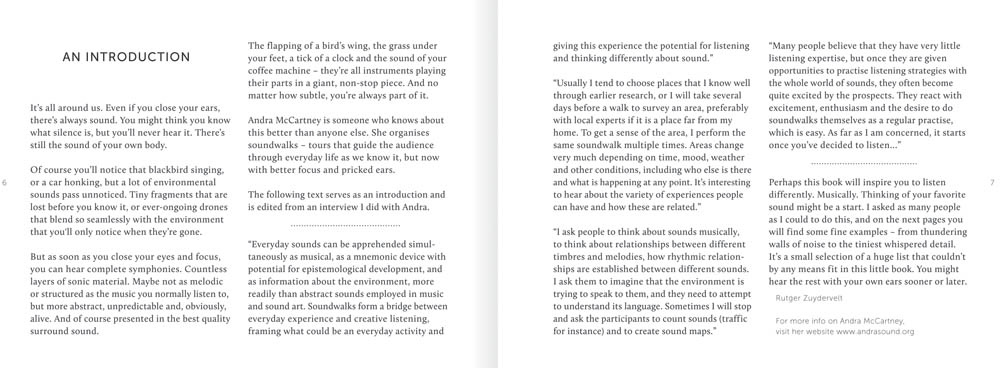
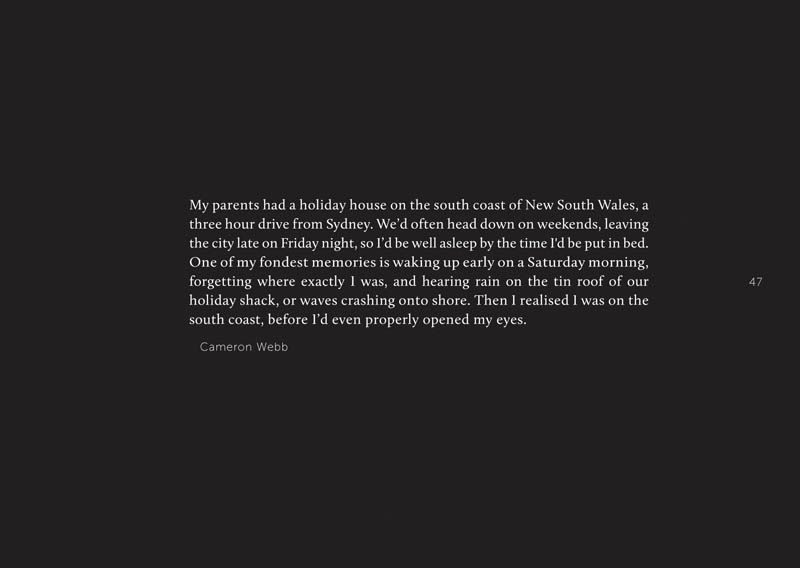
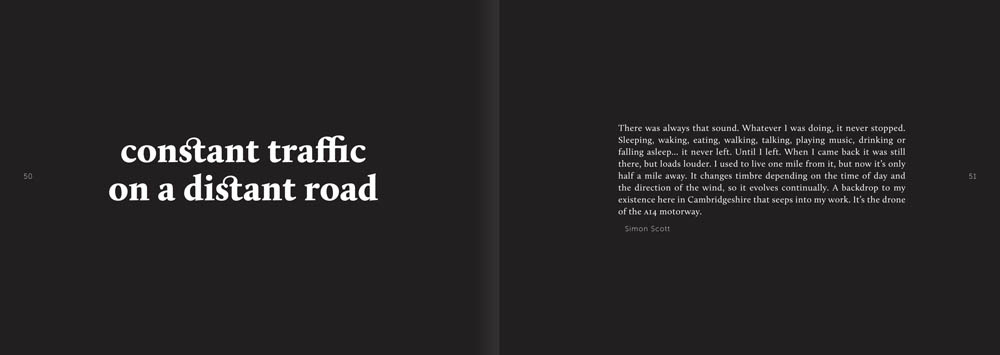
Take a Closer Listen is a project by the talented Dutch graphic designer Rutger Zuydervelt in which a variety of people have been asked to describe their favorite sound. The results—which range from quick, five-word responses to entire short narratives about found sounds—were collected into an eponymous booklet, Take a Closer Listen, this past winter.
[Image: From Take a Closer Listen, designed and edited by Rutger Zuydervelt].
Flipping through the pamphlet is like reading a silent soundtrack to a landscape you will never see in full.
[Images: From Take a Closer Listen, designed and edited by Rutger Zuydervelt].
Zuydervelt’s original inspiration for the project is worth quoting in full:
It was a beautiful, sunny day in July, and I was lying in a park in Geneva. My iPod was out of batteries, but I still had my headphones on. I closed my eyes and listened to the sounds surrounding me. Having these earphones in somehow gave me the idea that I was more actively listening than I normally would. As if these environmental sounds were playing on my iPod. A world was slowly unfolding to me. I could hear people talking, cycling, walking and roller-skating. A dog barking. A truck passing. Behind me, there was the rhythmic sputter of a sprinkler installation, and kids laughing and fooling around. I could hear a wine bottle being uncorked 3 and a box of crackers being opened. But most enjoyable were the sparrows, flying around nervously, trying to get hold of breadcrumbs. They were flying from tree to tree, from my left ear to my right. A chirp here and there. Sometimes they would burst out in an excited chirping laughter, as if they were watching a ballgame and someone scored. It felt like listening to a great radio play. I just had to do something with this. A project on environmental sound. Maybe a book?
Here, below, are some sample spreads from the book, as well as one or two examples I particularly enjoyed reading.
[Images: From Take a Closer Listen, designed and edited by Rutger Zuydervelt].
Many of the stories are worth reading in full, if for no other reason than to watch how acoustic information is made narratively accessible through verbal description. Here is Romke Kleefstra, for instance, on “the flapping of birds’ wings”:
In winter, over 30,000 geese spend the night at a roost near one of the Frisian lakes, not far from my house. At sunrise I often go there to watch them. Especially their spectacular departure. To fly to a nearby place to spend the day feeding on meadows, the geese will lift off together, in one big movement. Imagine a group of over a thousand percussionists, positioned in a diamond shape, all having a floor tom and two brushes. A split second after the rightmost percussionist starts a five second ruffle, the percussionists left of him do the same, and so forth. Further to the middle of the group, the sound grows louder, fading again when the middle is passed, leaving the leftmost percussionist to make the final beat on his kit. A group of alto sax players is mimicking this movement by simultaneously blowing short puffs. It’s truly incredible.
Or here is Chris Herbert on “echoes in a tube station,” the London Underground turned into a vast musical instrument made of compressed human voices:
A few years ago, I wandered into a tube station on the deeply buried Central Line in London. Along the platform and out of my line of sight, three or four girls were singing close RnB harmonies. By the time this arrived at my ear, it had been bounced along several hundred metres of tunnel, an unfathomable series of natural comb filters that rendered it an unintelligible but gorgeous wooze, speckled with the faint percussive clank and rumble of a fully operational mass transit system. Although I sometimes record environmental sounds, you can never really be prepared for those one-off events that take you by surprise. In a way, I’m glad all I was able to do was stand and listen when I chanced upon the most beautiful improvised arrangement. I think every piece of music I have ever made has tried but fallen short of recalling this moment.
The assumed ephemeral nature of these found sounds becomes readily apparent after reading Zuydervelt’s edited collection; but is the intangible, nostalgic, beyond-grasp nature of sound inherent to the sonic experience, or simply an artifact of the rhetorical tone most often used in today’s writing about the acoustic environment?
In other words, are sounds really the disappearing remnants of a world that we are always trying—and failing—to reassemble? Is there really always a connection between sound and memory or sound and nostalgia—not sound and physical experience, say, or even sound as a subset of astronomy?
[Images: From Take a Closer Listen, designed and edited by Rutger Zuydervelt].
For instance, as a rhetorical counterexample—one that does not rely on memory at all in order to communicate the acoustic and experiential value of a given sound—here is Nate Wooley on “the drone of an electrical generator”:
There’s a giant generator that heats and cools the large library building for the main campus of New York University. The sound of its drone is very deep, rich and colorful. The overtones seem to dance above a base set of fundamentals the same way as in an Eliane Radigue or Phill Niblock piece. It changes slowly and organically, almost imperceptibly, from one place to the other. No one just walking by would ever even notice its almost human quality, but if you stand and listen for five minutes, the building seems to breathe and sing.
And I was particularly struck by this one—here is Felicity Ford on “the clunk of a cooling paint can”:
I love the sound of paint tins in an outside building responding to shifts in temperature. When they get warm, the air inside the tins expands, and then when they cool down again, the air contracts, pulling the metal lids down with a subtle, percussive clunk. I love how it sounds a little bit like a steel drum—sort of musical and metallic. And I love how the sound always comes as a surprise.
The crisp, animate nature of both of those—the electrical generator and the paint cans alike—is astonishing.
[Image: From Take a Closer Listen, designed and edited by Rutger Zuydervelt].
Of course, certain sounds do seem maddeningly unrepeatable and lost to time—for instance, the utter weirdness of things like the Bloop, Julia, and the eery Slowdown, even, for that matter, #pdxboom—but I have to wonder if the gossamer-like ghostly nature of sound, its always-slipping-away-into-nothing-ness, is not simply the result of writers emotionally acting out their own inability to conjure a sound in its precise and every detail. The language used becomes a performance of personal yearning, not a description of the sound at all.
But descriptions are descriptions, not technical reproductions of noise itself. I’m reminded of those ads from seven or eight years ago—perhaps produced by Meineke?—in which customers were shown unsuccessfully acting out the strange noises their car engines had begun to make, implying that fixing an automobile is at least as much about re-tuning industrial machinery to fit within an appropriate acoustic range as it is about remedying potentially fatal mechanical flaws. It also makes me wonder if a car has ever been recalled because it sounded bad. (See also my recent Q&A with sonic historian Sabine von Fischer for the Canadian Centre for Architecture about some of these ideas: Noise versus noise).
In any case, Take a Closer Listen is a fascinating project, and I would love to see it opened up to the entire commenting public, perhaps as a dedicated website, a global archive of acoustic descriptions from anyone who wants to log-in.
I’m enamored with this cutaway diagram, by Christopher Klein of National Geographic, depicting Egypt’s so-called “tunnel to nowhere.”
[Image: A cutaway of Seti’s tomb by Christopher Klein, courtesy of National Geographic].
In fact, it is a “mysterious tunnel that links the ancient tomb of Pharaoh Seti I to … nothing.”
After three years of hauling out rubble and artifacts via a railway-car system, the excavators have hit a wall, the team announced last week. It seems the ancient workers who created the steep tunnel under Egypt’s Valley of the Kings near Luxor abruptly stopped after cutting 572 feet (174 meters) into rock.
Christopher Klein’s image shows the complex in its full volumetric glory, a void hewn into the depths of the cliff face, “painstakingly chipped into high limestone cliffs above the Valley of the Kings.” Exploring its interior was a kind of reverse mining operation: these “recent excavations had to take new precautions, most notably bracing the tunnel roof with metal supports to prevent collapse, as in mines.”
That the sprawling tunnelwork would eventually lead—it seems—to nowhere was not a credible option at the start of these recent explorations: “The ancient Egyptians never built something without a plan,” we read back in 2008, “without an aim or a target to do this, so I think this tunnel will lead to something important.”
On the other hand, it’s an interesting additional detail that this particular pharaoh was called Seti.
Returning to Klein’s image, it would be amazing to see his take on, say, the entire New York subway system, its tunnels drilled through bedrock, or a cutaway diagram drawn by Klein, explaining the underground nuclear waste storage facilities at Yucca Mountain (or, for that matter, at Onkalo). Or, why not, a weird hybrid of all three: a pharaonic tomb crossed with a densely packed urban subway system that eventually leads, after thousands of loops and coils, to some throbbing subterranean underworld stacked with Dantean spirals of nuclear waste.
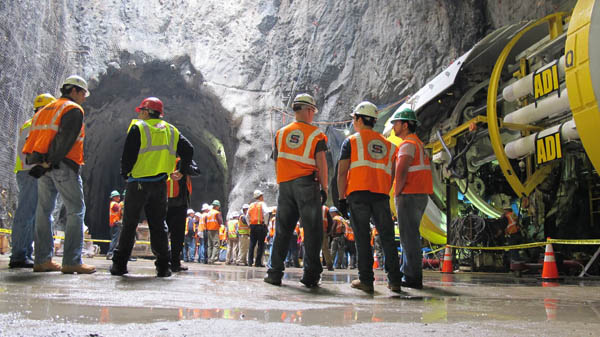
1) Have you been reading The Launch Box? “The purpose of this blog is to document activities in and around the 2nd Avenue Subway Tunnel Boring Machine Launch Box construction site between 91st and 95th streets in Manhattan.”
[Image: “This odd looking structure is part of the steel form that is being used to cast a concrete lining for the 72nd Street work shaft. This shaft, and the other one that’s just like it [at 69th Street], will be used during the construction of the 72nd Street station”; photo by The Launch Box].
As such, it features a pretty fascinating weekly catalog of the shifting surface structures found on-site—from plywood shacks to piles of tarps—as well as the actual subterranean work sites, including temporary elevators, off-duty digging equipment, and even rat infestations (“a Maginot Line of rat traps has been deployed along the east fence line of the work site”), associated with this massive urban engineering project. Start here, perhaps—but also don’t miss what The Launch Box calls “the official New York City rat map.”
3) Check out this book about Improvised Architecture in Amsterdam Industrial Squats and Collectives. “This web-book presents a visual-conceptual-experiential documentation of four occupied industrial sites in central Amsterdam, researched and recorded between 1990 and 1997 and between 2006 and 2008.”
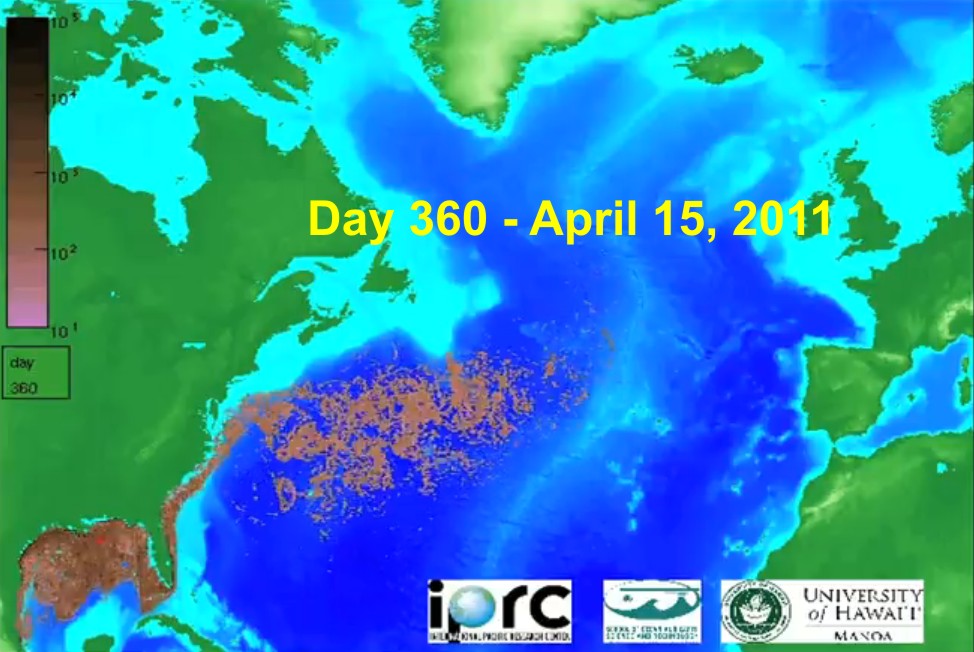
4) “There are more than 27,000 abandoned wells in the Gulf of Mexico, according to AP,” we read in the Guardian, “of which 600 belonged to BP.”
The oldest of the abandoned wells dates back to the late 1940s and the AP investigation highlights concerns about the way in which some of the wells have been plugged, especially the 3,500 neglected wells which are catalogued by the government as “temporarily abandoned.” The rules for shutting off temporarily closed wells is not as strict as for completely abandoned wells.
Further:
AP quoted state officials as estimating that tens of thousands are badly sealed, either because they pre-date strict regulation or because the operating companies violated rules. Texas alone has plugged more than 21,000 abandoned wells to control pollution, according to the state comptroller’s office. In state-controlled waters off the coast of California, many abandoned wells have had to be resealed. But in deeper federal waters, AP points out, there is very little investigation into the state of abandoned wells.
On a side note, this all reminds me of an architectural detail from H.P. Lovecraft’s scifi/horror story “The Shadow Out Of Time.” The story’s narrator discovers a massive abandoned city full of “never-opened trap-doors,” we read, “sealed down with metal bands and holding dim suggestions of some special peril.” He keeps returning to these doors, over and over again, as if obsessed by what they might be holding back—”those gigantic sealed trap-doors in the lowest level, around which such an aura of fear and forbiddenness clung,” “sealed trap-doors,” he says again, as if stuttering, constructed “for strategic use in fighting the elder things if ever they broke forth in unexpected places”—only here, in the Gulf of Mexico, it is a shapeless presence older than human history, an “elder thing” made of black liquid petroleum, leaking slowly into the subtropical waters of the planet. So will our “sealed trap-doors” hold over time? Generations from now, will ruptured fittings and broken “metal bands” release untold amounts of shapeless toxicity into the sea?
[Image: “A tapping machine used in tests to evaluate the ability of floor coverings to reduce the transmission of impact sound from one floor to another in multi-family dwellings,” courtesy of the National Research Council Canada].
Sabine von Fischer: The tapping machine, as it was first published in 1930 and as it was standardized in the 1960s, has five steel rods that hammer against the floor. The speed has changed a bit over time—and its speed is now standardized—but it just tramples on the floor. It’s a very basic machine.
The principle of the machine can be found in older apparatuses, such as those used in grinding food items, but this particular application was to simulate the sound of footsteps, furniture, and machines on the floors of multistorey buildings. In this form—with five hammers, which are electrically operated—it was first published in 1930, in the Journal of the Acoustical Society of America.
Everyone who has been working on building acoustics claims that, since 1923 or 1926, they’ve been doing similar tests on structure-borne sound, but almost all of those earlier tests were done with women in high-heeled shoes. High-heeled shoes make a very distinct sound… [T]he National Bureau of Standards, in the period between the wars, had ladies in high-heeled shoes walking around inside buildings.
8)GOOD reports on the UK’s Empty Shops Network: “For Dan Thompson, helping to get empty shops back into action has become a full-time job. The founder of the Empty Shops Network, Thompson says that the United Kingdom has seen a surge in pop-up shops, galleries, and community spaces that tap into a wider national mood: “There’s a DIY movement going on with more and more people setting up their own events… you get knitting groups setting up in pubs and cafes, [gardening] groups, people are really engaging with their local community. It’s a huge shift in the national culture.”
9) Doomsday economics. As the New York Times reports, “market forecaster and social theorist” Robert Prechter “is convinced that we have entered a market decline of staggering proportions—perhaps the biggest of the last 300 years.” Believing that a series of “repetitive patterns, or ‘fractals,’ in the stock market” will destabilize the global economic system, Prechter warns that “investors will be devastated in a crash much worse than the declines of 2008 and early 2009 or the worst years of the Great Depression or the Panic of 1873.”
The Dow, which now stands at 9,686.48, is likely to fall well below 1,000 over perhaps five or six years as a grand market cycle comes to an end, he said. That unraveling, combined with a depression and deflation, will make anyone holding cash “extremely grateful for their prudence.”
Indeed, Schechter compares the current state of the global stock market to the South Sea Bubble.
Extra Credit: “Disneyland, with its far-flung colonies in Florida, Japan and France as well as affiliated city-states such as EPCOT, is a key symbol of contemporary American culture… The Architecture of Reassurance: Designing the Disney Theme Parks follows the layout of the parks themselves—from berm to Main Street, and from hub to ‘lands’: Frontierland and Adventureland, playing on the relationship between humankind, myth, and nature; Fantasyland, with its imagery from the movies; and Tomorrowland, with its once optimistic visions of the future becoming sinister, playful and ironic.” Think of it as an architectural variation on Susan Willis’s Inside the Mouse: Work and Play at Disney World.
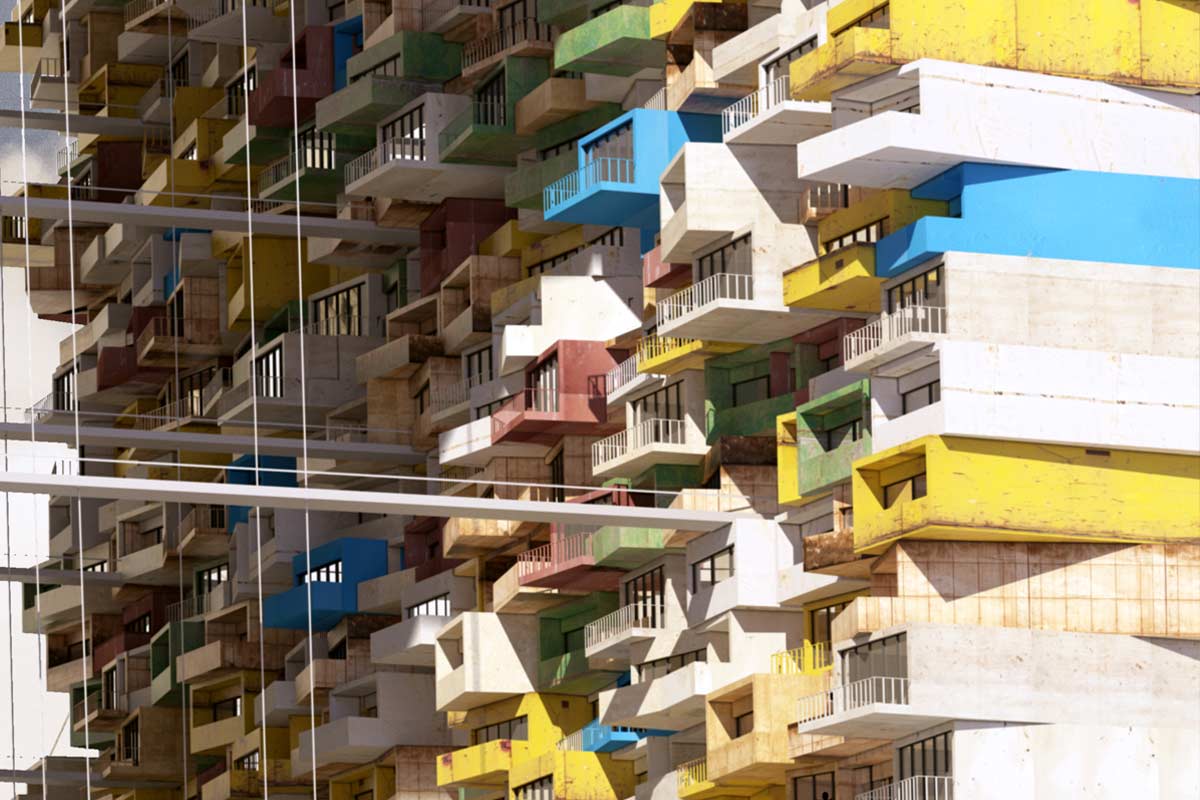
In the second of two projects by architect Stéphane Malka that I want to look at here, the Arche de la Défense in Paris has been transformed into a honeycomb of subsidiary spaces: encrusted with modules that have been attached to the inside of the existing building’s vast interior.
As writer and curator Maryse Quinton describes it, “this study imagines the hijacking of a building that is symbolic for its monumentality and its location: the Arche de la Défense.”
A pocket of active resistance installs itself within the building in the form of a modular complex offering an alternative and militant lifestyle. The project bears with it a permanent insurrection and unites all malcontents, whether refugees, stateless persons, dissidents, outcasts or utopians. Referring to the notion of concretion, its construction principle allows for expansion tailored to the effervescence of this spontaneous community. It bases itself on the existing fabric using walkways grafted on to the lifts and a system of scaffolding leaning against the rear facade. A guerrilla architecture project that aims to hijack the great arch of fraternity.
In a detail that seems slightly tongue-in-cheek to me, Malka estimates that each module would cost only 3,000 Euros—as if you, too, could simply purchase your own plot of permanent insurrection, without need for a long-term mortgage or loan. Which leads me to wonder if there might someday be an insurrection bubble, with derivatives traded exclusively by Goldman Sachs.
In any case, I really like this overhead view (below): the precarious spatial state of these revolutionary modules becomes readily apparent from above, as if this inspired reclaiming of urban space is really just one or two steps away from total collapse.
These units, of course, could also very easily be adapted to other buildings or sites, just as symbolic for their monumentality and location, as Quinton writes; in Malka’s hands, the images would be equally breathtaking.
From U.S. Federal Buildings to overseas military bases; from the Kremlin to the Great Wall of China; from Parliament Square to historic battlefields; even as a structural cousin to Raimund Abraham’s Church on the Berlin Wall—a project I hope to write about soon—where else could Malka’s modular counter-utopias be anchored and what political scenarios might result?
Malka writes that architecture now “means reclaiming territory in the marginalized areas of our cities, with projects that bear insurrection and civic mobilization,” thus “creating new potentials for collective use.”
This methodology seeks to promote public participation as an act of resistance against urban restrictions. It is a colonization of neglected public spaces by the participation of a non-specialized labor collective that elaborates on prefabricated and hijacked construction systems.
As this and Malka’s Galerie Bunker project indicate, parasite spaces—and the incredible idea of “hijacked construction systems”—are one surprisingly fast way to begin rebuilding the modern city.
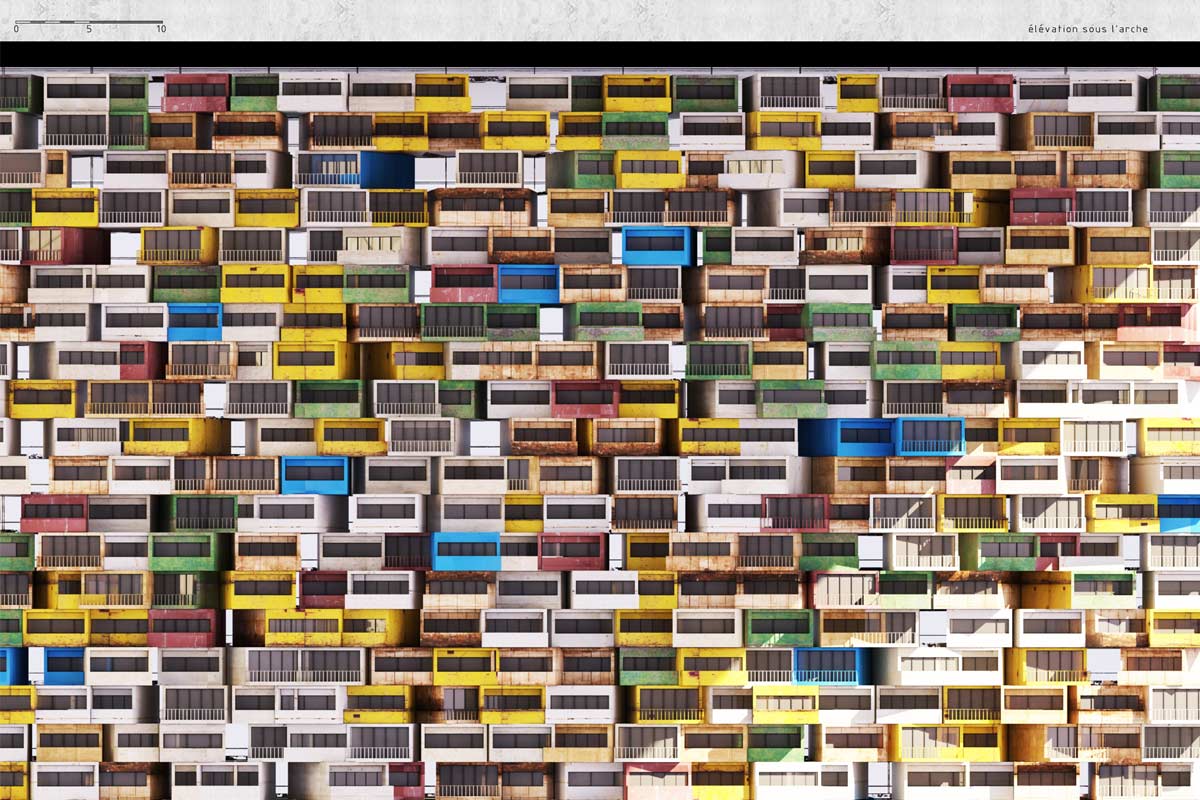
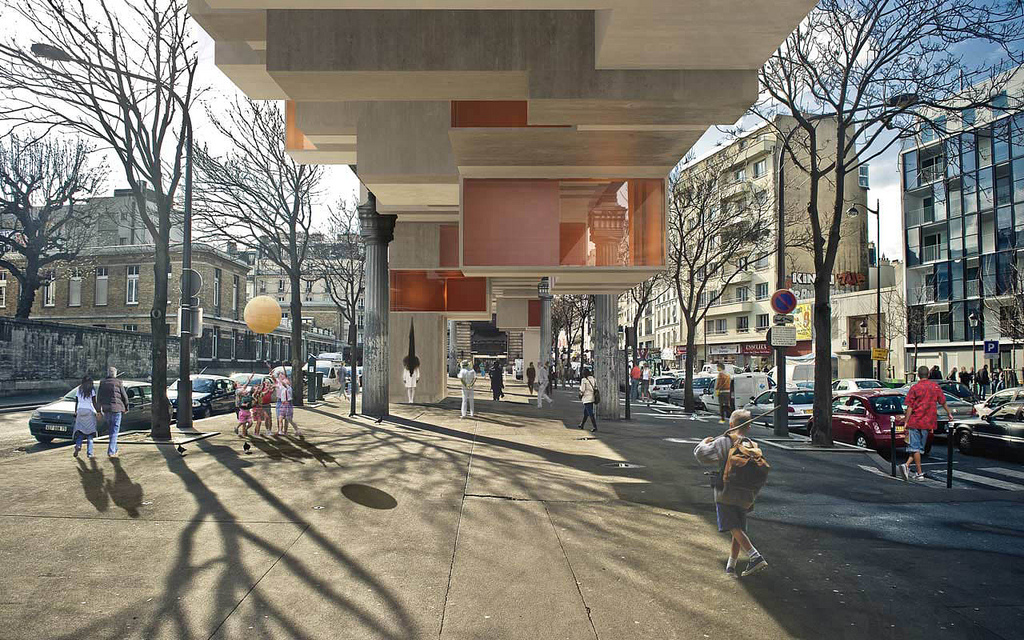
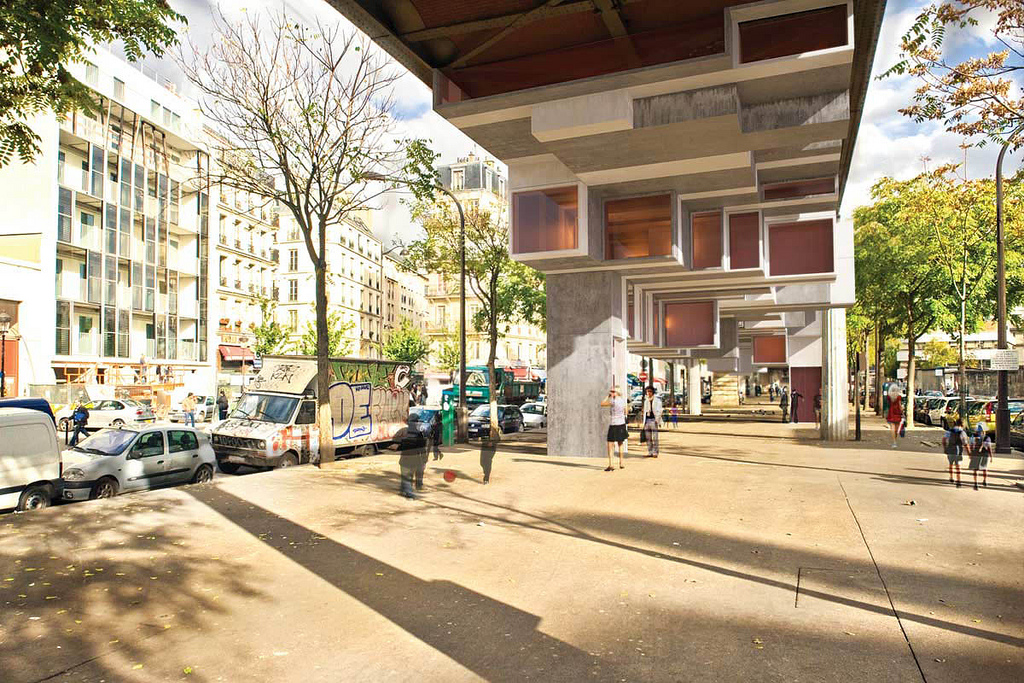
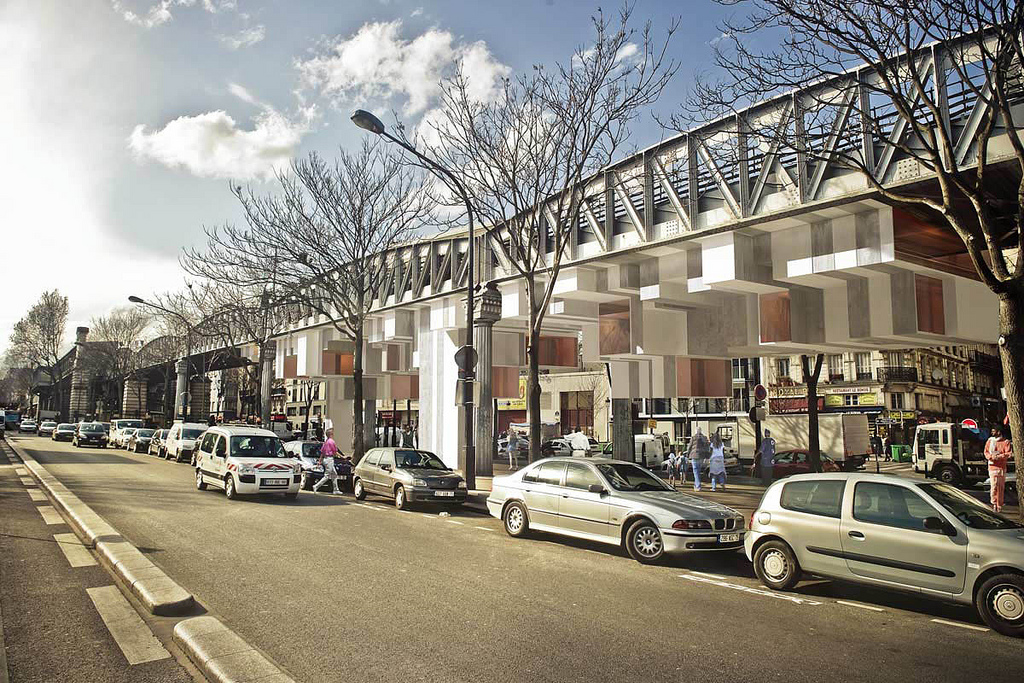
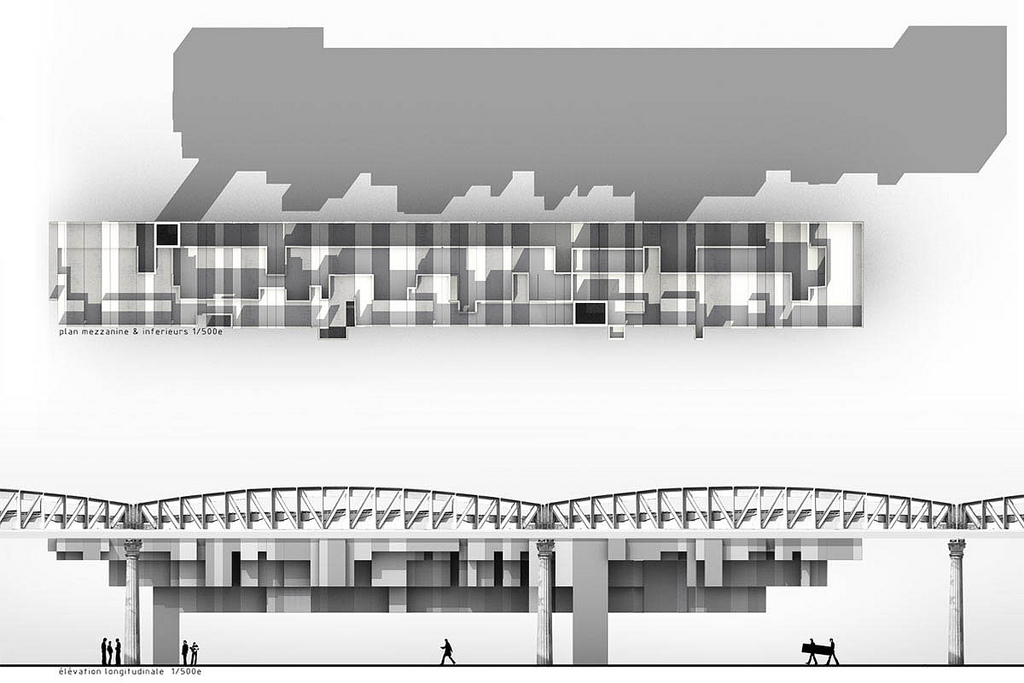
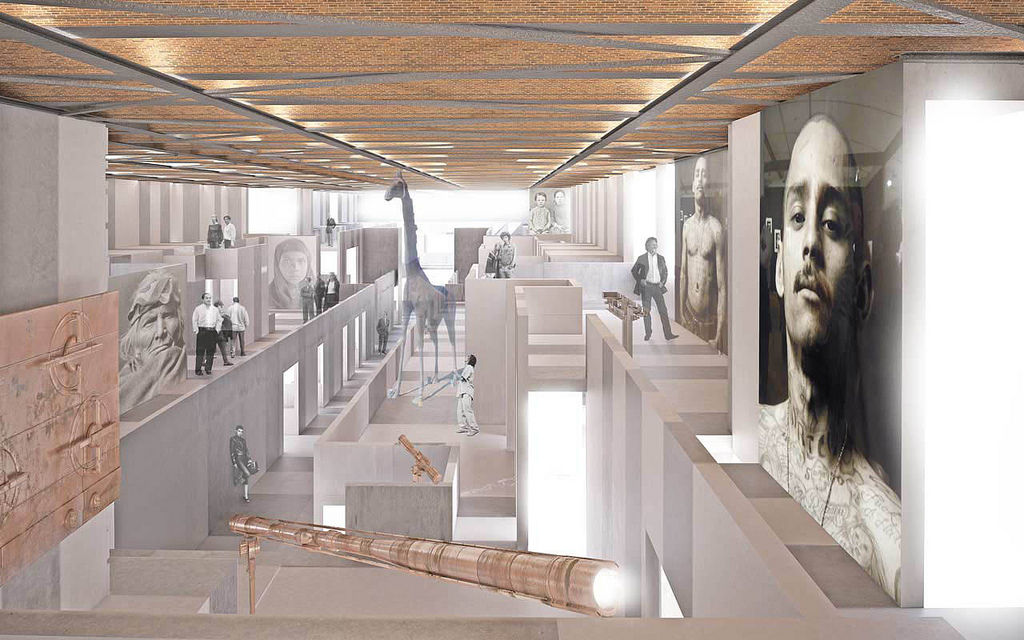
In the first of two proposals by Stéphane Malka that I want to post about here, we see what Malka calls “an alternative art gallery” installed like vertical parasites beneath the tracks of the Barbès–Rochechouart metro station in Paris.
An assemblage of powerfully simple rough precast concrete, the modules are attached to each other and secured to the beams of the viaduct. The alignment of different blocks creates spatial diversity while the unified whole protects the artwork and creates a strong interiority. Nevertheless, lateral openings introduce unexpected light from below as well as elevationally reframing views to the site.
He refers to the project as a “bunker,” or Galerie Bunker. “The gallery responds to the challenge of addressing neglected spaces,” he adds, “generating a singular place, a spontaneous cultural space divergent from the restrained exhibition spaces of Paris.”

 [Images: The forests of northern Michigan, via Google Maps].



 [Images: Geometry amidst the forest, via Google Maps].
 [Image: Raco Army Airfield, via Google Maps].
 [Image: A plan of the site, via Abandoned & Little-Known Airfields].
 [Images: The Smithers Winter Test Center].
 [Image: Photo by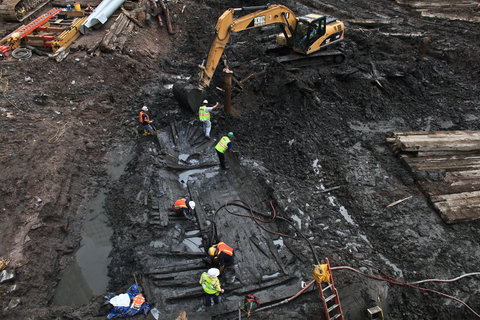
 [Image: Photo by
  [Image: Photo by
 [Image: Partial site plan for the
 [Image: From
  [Image: Antarctica’s
 [Image: Offshore Oil Strike by
 [Images: Offshore Oil Strike by
  [Image: Offshore Oil Strike by
 [Images: Offshore Oil Strike by

 [Images: Offshore Oil Strike by
 [Images: Offshore Oil Strike by


 [Images: Offshore Oil Strike by
 [Image: One of the
 [Image: From Take a Closer Listen, designed and edited by
  [Image: From Take a Closer Listen, designed and edited by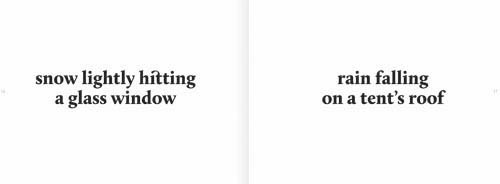
 [Images: From Take a Closer Listen, designed and edited by
 [Images: From Take a Closer Listen, designed and edited by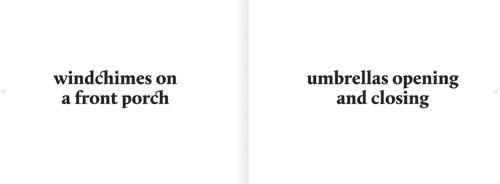
 [Images: From Take a Closer Listen, designed and edited by
  [Image: From Take a Closer Listen, designed and edited by
  [Image: A cutaway of Seti’s tomb by Christopher Klein, courtesy of
 [Image: “This odd looking structure is part of the steel form that is being used to cast a concrete lining for the 72nd Street work shaft. This shaft, and the other one that’s just like it [at 69th Street], will be used during the construction of the 72nd Street station”; photo by
  [Image: Photo by
  [Image: A projection for day 360 of the oil spill, courtesy of the
  [Image: “A tapping machine used in tests to evaluate the ability of floor coverings to reduce the transmission of impact sound from one floor to another in multi-family dwellings,” courtesy of the National Research Council Canada].
 [Image: From
  [Image: From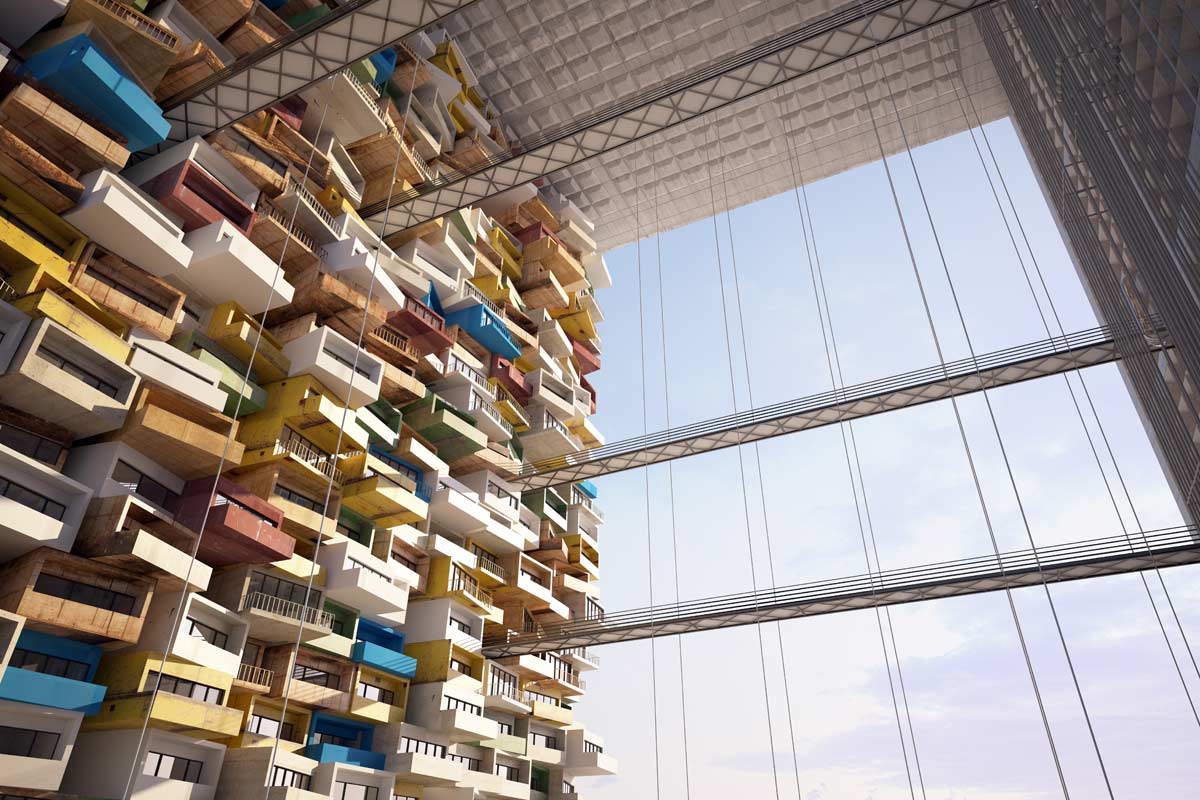
 [Images: From
  [Image: From
  [Image: From
 [Image: Proposal for a “
 [Images: Proposal for a “
 [Image: Proposal for a “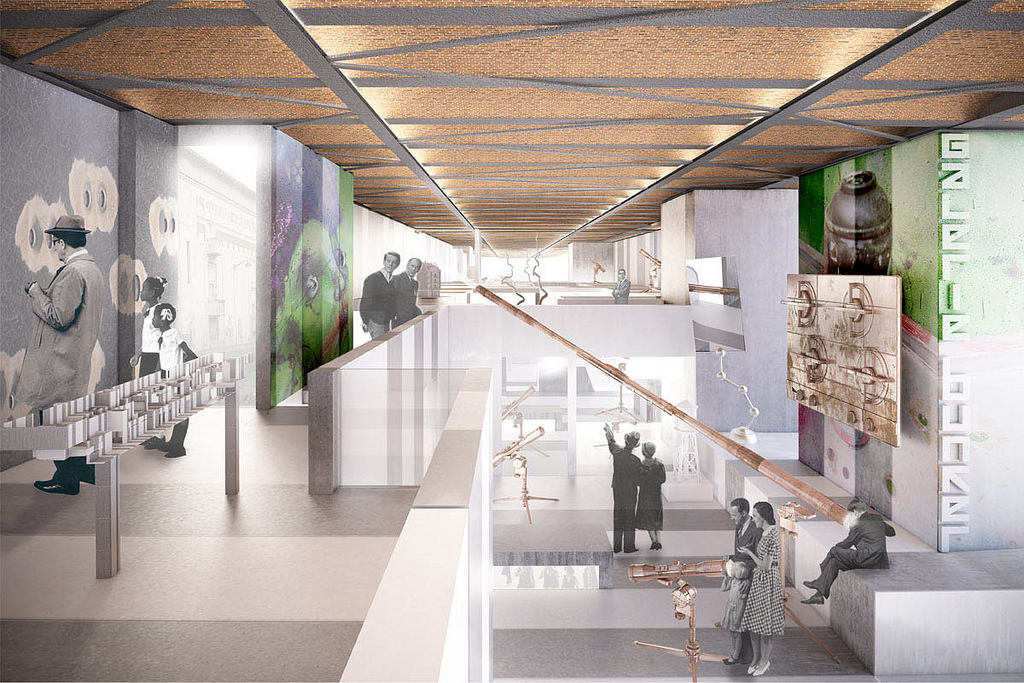
 [Images: Proposal for a “