States of Metamorphosis

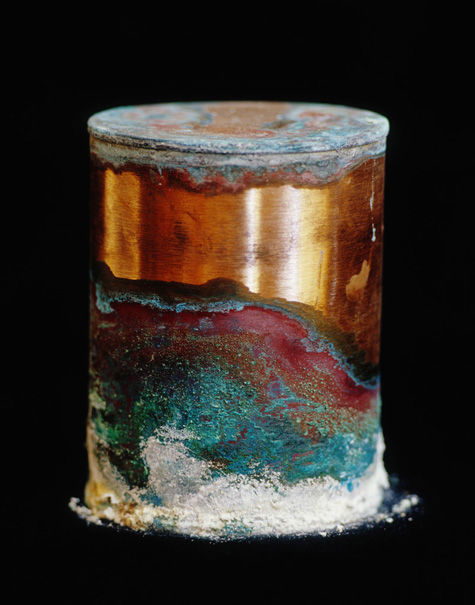
Photographer David Maisel will be celebrating the opening of his show “Library of Dust” tonight, Thursday, January 21, at New York’s Von Lintel Gallery.

[Image: From Library of Dust by David Maisel].

Chronicle Books put out an absolutely gorgeous book documenting Maisel’s work last year. From the project’s own description:

David Maisel’s Library of Dust features copper canisters in varying states of metamorphosis. The containers are photographed individually, black backdrop in place, each posed like a subject sitting for a portrait. Maisel’s treatment of these objects is apropos. The canisters, once stored in a dilapidated outbuilding of a state-run psychiatric hospital, hold the cremated remains of people—more specifically, the unclaimed ashes of the asylum’s patients. The Oregon State Hospital, inaugurated as the Oregon State Insane Asylum in 1883, interred the canisters in an underground vault in the mid-1970s. As the vault flooded repeatedly, the canisters—some containing remains more than a century old—underwent potent transformations. The chemical composition of each cremated body’s ashes has caused unique and colorful mineralogical blooms to form on its individual copper surface.

The gallery opens at 6pm—roughly one hour from now—and the show will stay up until February 27, 2010. Be sure to stop by if you are near; here is a map.

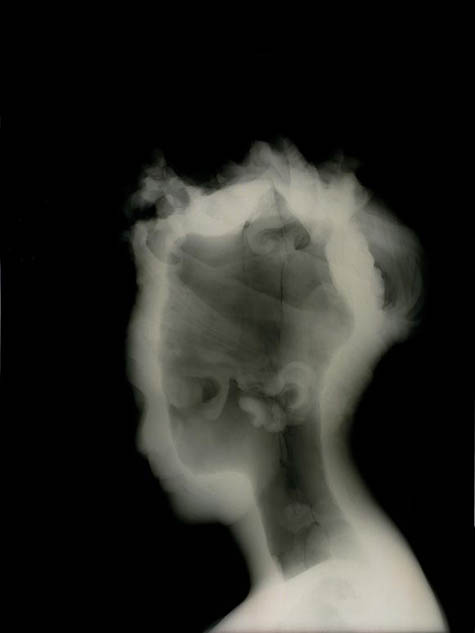
For those of you already familiar with this project, meanwhile, Maisel has been working on a new, long-term series called “History’s Shadow.” This consists entirely of “re-photographed x-rays of art objects from antiquity,” and the results offer eerily delicate views inside objects thousands of years old. An example appears below, but the whole series is well-worth checking out in full.

[Image: “GM12,” from History’s Shadow by David Maisel].

I would love to see an architectural version of this project, with Maisel somehow re-photographing large-scale x-rays of cathedrals and temple walls, peering inside columns, arches, and ruins, with buttresses doubled and tripled with the grain of their rock revealed, stuttering into the silent core of an object not ever meant to be seen this way.

(I was fortunate enough to have an essay included in Maisel’s Library of Dust; you can read that essay in its entirety on BLDGBLOG).

Glacier / Island / Storm

I thought it might be fun to post the course description and design brief for a course I’ll be teaching this semester at Columbia.

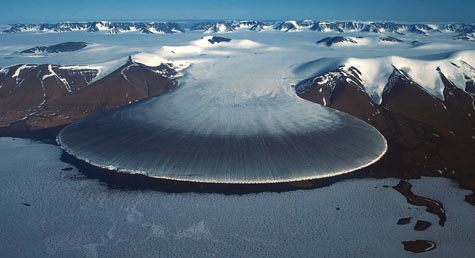
[Image: Photo via the Alfred Wegener Institute].

The idea behind the studio is to look at naturally occurring processes and forms—specifically, glaciers, islands, and storms—and to ask how these might be subject to architectural re-design.

We will begin our investigations by looking at three specific case-studies, including the practical techniques and concerns behind each. This research will then serve as the basis from which studio participants will create original glacier/island/storm design proposals.

GLACIER: For centuries, a vernacular tradition of constructing artificial glaciers in the Himalayas has been used to create reserves of ice from which freshwater can be reliably obtained during dry years. This is the glacier as non-electrical ice reserve, in other words; some of these structures have even received funding as international relief projects—for instance, by the Aga Khan Rural Support Program in Pakistan. Interestingly, the artificial glacier here becomes a philanthropic pursuit, falling somewhere between Architecture For Humanity and a sustainable water-bank.

Through an examination of glacier-building techniques, water requirements, and the thermal behavior of ice, we will both refine and re-imagine designs for self-sustaining artificial glaciers, for the ultimate purpose of storing fresh water.

But what specific tools and spatial techniques might this require? Further, what purposes beyond drought relief might an artificial glacier serve? There are myths, for instance, of Himalayan villagers building artificial glaciers to protect themselves against invasion, and perhaps we might even speculate that water shortages in Los Angeles could be relieved with a series of artificial glaciers maintained by the city’s Department of Water and Power at the headwaters of the Colorado River…

ISLAND: Building artificial islands using only sand and fill is relatively simple, but how might such structures be organically grown?

In the ocean south of Japan is a complex of reefs just slightly below the surface of the water; Japan claims that these reefs are, in fact, islands. This is no minor distinction: if the international community supports this claim, Japan would not only massively extend its Exclusive Economic Zone (EEZ), complete with seabed-mining and fishing rights, but it would also block China from accessing those same resources. This would, however, also limit the ability of Chinese warships to patrol the region—and so the U.S. has publicly backed Japan’s territorial claim (China does not).

Okinawan scientists have thus been developing genetically-modified species of coral with the express idea of using these species to “grow” the reefs into a small but internationally recognized archipelago: the Okinotori Islands. Think of it as bio-technology put to use in the context of international sovereignty and the U.N. Law of the Sea.

The stakes are high—but, our studio will ask, by way of studying multiple forms of reef-building as well as materials such as Biorock, where might other such island-growing operations be politically and environmentally useful? Further, how might the resulting landforms be most interestingly designed? Assisted by a class visit from marine biologist Thomas Goreau, one-time collaborator of architect Wolf Hilbertz, we will look at the construction techniques and materials necessary for building wholly new artificial landforms.

STORM: For hundreds of years, a lightning storm called the Relampago del Catatumbo has flashed in the sky above Venezuela’s coastal Lake Maracaibo. The perfect mix of riverine topography, lake-borne humidity, and rain forest air currents has produced what can be described, with only slight exaggeration, as a permanent storm.

This already fascinating anecdote takes on interesting spatial design implications when we read, for instance, that Shanghai city officials have expressed alarm at the inadvertent amplification of wind speeds through their city as more and more skyscrapers are erected there—demonstrating that architecture sometimes has violent climatological effects. Further, Beijing and Moscow both have recently declared urban weather control an explicit aim of their respective municipal governments—but who will be in charge of designing this new weather, and what role might architects and landscape architects play in its creation?

We will be putting these—and many other—examples of weather control together with urban, architectural, and landscape design studies in an attempt to produce atmospheric events. For instance, could we redesign Manhattan’s skyline to create a permanent storm over the city—or could we rid the five boroughs of storms altogether? And under what circumstances—drought-relief in the American southwest or Gulf Coast hurricane-deflection—might our efforts be most practically useful?

• • •

The studio will be divided into three groups—one designing “glaciers,” one designing “islands,” one designing “storms.” Each group will mix vernacular building technologies with what sounds like science fiction to explore the fine line between architectural design and the amplified cultivation of natural processes. Importantly, this will be done not simply for the sake of doing so (although there will be a bit of that…), but to address much larger questions of international sovereignty, regional drought, global climate change, and more.

They Will Build Clouds For Us

[Image: A C-141 Starlifter flying toward sunset; via Wikimedia].

A cloud of metal dust released by U.S. military airplanes in the skies 100 miles west of Los Angeles caused a temporary blackout in the city and “interfer[ed] with radar at airports in southern California” when the cloud began blowing back toward land.

What exactly was the purpose of this inadvertently weaponized offshore atmospheric event? “The Navy says it spread several thousand pounds of the particles of chaff in an operation 100 to 300 miles offshore designed to test its ability to jam radar,” the New York Times reported.

However, all of this actually occurred 25 years ago, in January 1985; I simply stumbled upon it while researching blackouts.

The idea, though, that there are airplanes flying somewhere out there west of Los Angeles creating strange weather for those of us on shore—clouds sculpted on the rising winds of the Southland, drifting unpredictably toward Santa Monica—seems both extraordinary and all too ready for capitalization. Sunsets on demand! Your least favorite celebrity gets married on a Malibu terrace and repurposed military aircraft paint the distant skies red, weaving fantastic ribbons of color in front of the falling sun.

It’s like something out of J.G. Ballard’s old short story “The Cloud Sculptors of Coral D,” in which famous portraits are carved into passing cloud forms by trained kite operators standing below on the shores of a tropical island. They have invented a stunning, lo-fi, vernacular 3D printing that can only be applied to the earth’s atmosphere.

“Lifted on the shoulders of the air above the crown of Coral D, we would carve seahorses and unicorns, the portraits of presidents and film stars, lizards and exotic birds,” Ballard wrote, describing this new mythology of atmospheric design and the “manicurists of the air” who so beautifully practiced it.

Or, for that matter, perhaps this strange meteorological event—the metal chaff of a new weather emperor, self-installed atop his flying throne, deploying cloud-weapons across the horizon—was an electromagnetically active twist on the anti-hero from Roberto Bolaño’s novel Distant Star. There, we meet a skywriting poet-pilot with a penchant for fascism who sells his political soul to the Nazis in order to write his Romantic words in huge drifting scripts above the mountains of South America.

He becomes “a Michelangelo of the sky,” as Ballard might have it.

Meanwhile, radar-jamming clouds of nanoparticles settle onto the plates of outdoor diners in Venice Beach, salting take-out pizzas and dusting the bodies of sunbathers, as screens inside the LAX control tower madly ping with invisible aircraft.

Super Powers Cultivate

Mitchell Joachim and Maria Aiolova of Terreform 1 have launched the From Mowing to Growing competition, aka the One Prize.

The competition hopes to inspire design research into “larger issues concerning the environment, global food production and the imperative to generate a sense of community in our urban and suburban neighborhoods.”

From Mowing to Growing is not meant to transform each lawn into a garden, but to open us up to the possibilities of self-sustenance, organic growth, and perpetual change. In particular, we seek specific technical, urbanistic, and architectural strategies not simply for the food production required to feed the cities and suburbs, but the possibilities of diet, agriculture, and retrofitted facilities that could achieve that level within the constraints of the local climate.

Citing the work of Fritz Haeg, the competition brief points out that “North Americans devote 40,000 square miles to lawns,” more than is used “for wheat, corn, or tobacco.” Further, U.S. residents “spend $750 million dollars a year on grass seed alone while only 2% of America’s food is locally grown.” So, the competition asks:

How can we break the American love affair with the suburban lawn?
Can green houses be incorporated in skyscrapers?
What are the urban design strategies for food production in cities?
Can food grow on rooftops, parking lots, building facades?
What is required to remove foreclosure signs on lawns and convert them to gardens?

Prizes go as high as $10,000, and judges include Cameron Sinclair and Kate Stohr of Architecture For Humanity, vertical agriculturalist (agriverticality?) Dickson Despommier, and many more. Register by March 31, with submissions due before April 30.

Quick Links 2

[Image: Proposal for a Museum of Polish History, Warsaw, by Paisajes Emergentes].

Nick Sowers | The End of the Grand Tour (see also)
Washington Post | Work begins on first planned Palestinian city
The New Republic | The Case Against Blowing Up Mountains
San Francisco Chronicle | Design Fantasies for Obsolete Bay Bridge Span (also earlier)
Treehugger | 3D Food Printer from Lab at MIT
Urban Omnibus | Clip-on Architecture: Reforesting Cities
InfraNet Lab | Islands of Waste pt. 1
Discovery News | “Oceans of liquid diamond, filled with solid diamond icebergs, could be floating on Neptune and Uranus”
The Journal of Tunnelling and Underground Space Technology

(Some links via @alexismadrigal, @leebillings, @lloydalter, and @eatingbark; don’t miss Quick Links 1).

River City

If you’re near New York City tomorrow night, Friday, January 15th, Exit Art is hosting an event in honor of the Waterpod project, exploring the twin ideas of interactive architecture and “reinventing social spaces.”

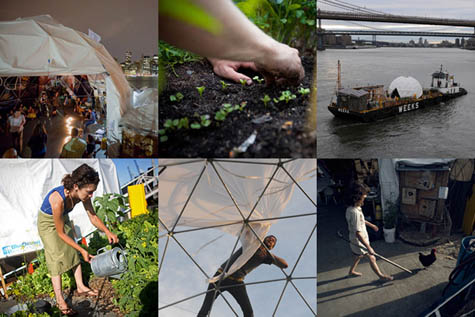
[Image: Glimpses of the Waterpod].

The Waterpod, if you are not familiar with it already, “was a floating, sculptural structure designed as a futuristic habitat and an experimental platform for assessing the design and efficacy of living systems fashioned to create an autonomous, fully functional marine shelter.” It traveled around the waterways of New York, bringing equal parts aquatic farm, mobile bio-utopia, and urban sci-fi to the hydroscape of the city.

As a self-sufficient, navigable living space, the Waterpod showcased the critical importance of water within the natural world. Collectively embracing the richly-patterned folkways of the five boroughs of metropolitan New York, the Waterpod reified positive interactions between communities: private and public; artistic and societal; scientific and agricultural; aquatic and terrestrial.

The New York Times described it as “an independent project [artist Mary] Mattingly dreamed up three years ago to explore the possibility of creating a self-sufficient community on the water—a kind of aquatic version of the Biosphere 2 complex built in the Arizona desert in the 1980s—that might offer an alternative to living on land in the future, if ‘our resources on land grow scarcer and sea levels rise,’ she said.”

Tomorrow night will feature three short presentations by Natalie Jeremijenko, “an artist whose background includes studies in biochemistry, physics, neuroscience and precision engineering”; architect Maria Aiolova, cofounder with Mitchell Joachim of Terreform 1; and myself, followed by a panel discussion and public Q&A. For my own part, I plan on discussing a number of hydrological topics, including the vernacular design of artificial glaciers and other kinds of “ice reserves” as a response to global water shortages, and, given time, to present a brief look at the history of weather control and urban storm cultivation.

Entrance is free, although there is a suggested donation of $5, and there is a cash bar to ease the mood of a Friday evening; things kick off at 7pm, and you will find us all gathered at 475 10th Avenue, near 37th Street. Here is a map and more info about the night in general.

Hope to see you there!

Flexible Filmography

I’m in the strange (and semi-sleepless) situation of having our apartment rented out for the day while a Ewan McGregor film is produced in our building. The industry of urban film location scouts seems particularly fascinating to me, I have to say; you put out some flyers in a certain neighborhood, say, asking for something really quite specific (in our case, south-facing windows on the fourth floor or higher) and I suppose you then just hope that someone in a specific building will respond or perhaps you just deal with what you get (and I wonder if there are films out there whose screenplays, or whole characters, were actually adapted based on location availability). But the idea that, out there somewhere, there is a little black book, or a huge three-ring binder, a whole mythic cabinet, full of hand-me-down insights about buildings and rooms and rooftops and halls and stairwells scattered throughout the city is amazing to me, a collection of first-hand urban research that architects would do very well to access and study. Advanced film location as an esoteric science of the city. Architects could rent these binders by the hour, interviewing film set installation professionals about the lived reality and emotional impact, the narrative demands and implications, of increasingly precise spatial parameters. Rooms with wall-to-wall carpet on the Upper West Side, with east-facing windows, are apparently perfect for divorcee clients… Meanwhile, location scouts drive lonely around the city, maps in hand, looking up through odd-angled windows at barely glimpsable pieces of punched tin ceilings, imagining the internal lives of yet-to-be-acted future characters. Taking notes. Filing photographs. Assembling a dossier on this unpredictable constellation of rooms, charting the human impact of the city to a degree that no other industry can ever quite have.

(Note: This is actually the first blog post I’ve written entirely on an iPhone, out for breakfast, typing very slowly with one finger… a method that seems to require more practice!)

Nakatomi Space

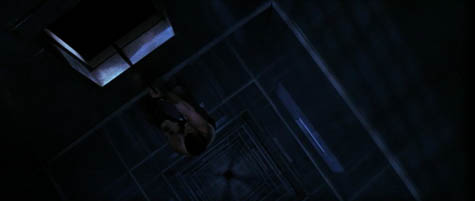
[Image: From Die Hard, directed by John McTiernan based on the novel Nothing Lasts Forever by Roderick Thorpe].

While watching Die Hard the other night—easily one of the best architectural films of the past 25 years—I kept thinking about an essay called “Lethal Theory” by Eyal Weizman—itself one of the best and most consequential architectural texts of the past decade (download the complete PDF).

In it, Weizman—an Israeli architect and prominent critic of that nation’s territorial policy—documents many of the emerging spatial techniques used by the Israeli Defense Forces in their high-tech, legally dubious 2002 invasion of Nablus. During that battle, Weizman writes, “soldiers moved within the city across hundred-meter-long ‘overground-tunnels’ carved through a dense and contiguous urban fabric.” Their movements were thus almost entirely camouflaged, with troop movements hidden from above by virtue of always remaining inside buildings. “Although several thousand soldiers and several hundred Palestinian guerrilla fighters were maneuvering simultaneously in the city,” Weizman adds, “they were so ‘saturated’ within its fabric that very few would have been visible from an aerial perspective at any given moment.”

Worthy of particular emphasis is Weizman’s reference to a technique called “walking through walls”:

Furthermore, soldiers used none of the streets, roads, alleys, or courtyards that constitute the syntax of the city, and none of the external doors, internal stairwells, and windows that constitute the order of buildings, but rather moved horizontally through party walls, and vertically through holes blasted in ceilings and floors.

Weizman goes on to interview a commander of the Israeli Paratrooper Brigade. The commander describes his forces as acting “like a worm that eats its way forward, emerging at points and then disappearing. We were thus moving from the interior of homes to their exterior in a surprising manner and in places we were not expected, arriving from behind and hitting the enemy that awaited us behind a corner.”

This is how the troops could “adjust the relevant urban space to our needs,” he explains, and not the other way around.

Indeed, the commander thus exhorted his troops as follows: “There is no other way of moving! If until now you were used to moving along roads and sidewalks, forget it! From now on we all walk through walls!”
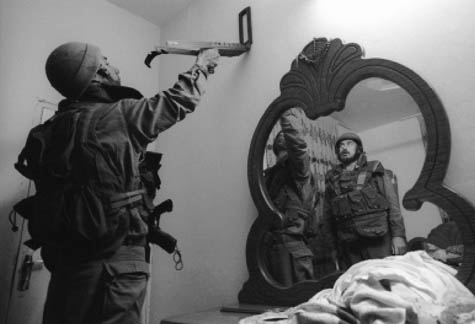
[Image: Israeli troops scan walls in a refugee camp; photo by Nir Kafri (2003), from Eyal Weizman’s essay “Lethal Theory”].

Weizman illustrates the other side of this terrifyingly dislocating experience by quoting an article originally published during the 2002 invasion. Here, a Palestinian woman, whose home was raided, recounts her witnessing of this technique:

Imagine it—you’re sitting in your living room, which you know so well; this is the room where the family watches television together after the evening meal. . . . And, suddenly, that wall disappears with a deafening roar, the room fills with dust and debris, and through the wall pours one soldier after the other, screaming orders. You have no idea if they’re after you, if they’ve come to take over your home, or if your house just lies on their route to somewhere else. The children are screaming, panicking. . . . Is it possible to even begin to imagine the horror experienced by a five-year-old child as four, six, eight, twelve soldiers, their faces painted black, submachine guns pointed everywhere, antennas protruding from their backpacks, making them look like giant alien bugs, blast their way through that wall?

In fact, I’m reminded of a scene toward the end of the recent WWII film Days of Glory in which we see a German soldier blasting his way horizontally through a house, wall by wall, using his bazooka as a blunt instrument of architectural reorganization—“adjusting the relevant space to his needs,” we might say—and chasing down the French troops without limiting himself to doors or stairways.

In any case, post-battle surveys later revealed that “more than half of the buildings in the old city center of Nablus had routes forced through them, resulting in anywhere from one to eight openings in their walls, floors, or ceilings, which created several haphazard crossroutes”—a heavily armed improvisational navigation of the city.

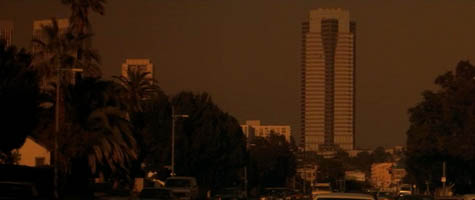
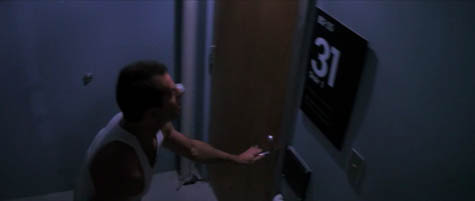
So why do I mention all this in the context of Die Hard? The majority of that film’s interest, I’d suggest, comes precisely through its depiction of architectural space: John McClane, a New York cop on his Christmas vacation, moves through a Los Angeles high-rise in basically every conceivable way but passing through its doors and hallways.
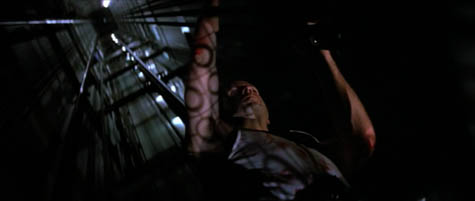
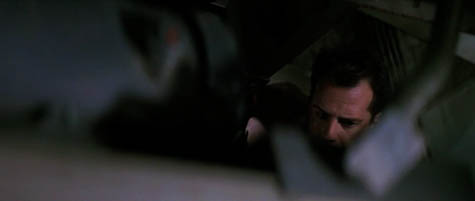
[Images: From Die Hard].

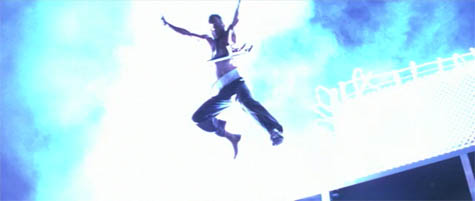
McClane explores the tower—called Nakatomi Plaza—via elevator shafts and air ducts, crashing through windows from the outside-in and shooting open the locks of rooftop doorways. If there is not a corridor, he makes one; if there is not an opening, there will be soon.
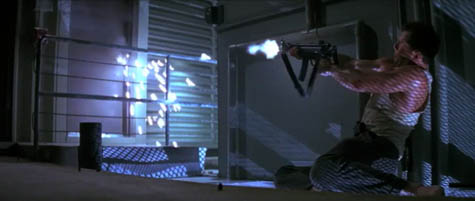
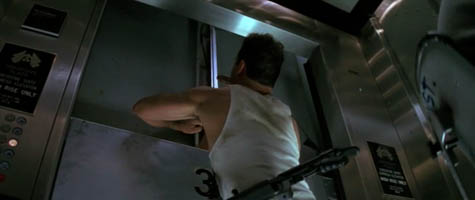
[Images: From Die Hard].

Over the course of the film, McClane blows up whole sections of the building; he stops elevators between floors; and he otherwise explores the internal spaces of Nakatomi Plaza in acts of virtuoso navigation that were neither imagined nor physically planned for by the architects.

His is an infrastructure of nearly uninhibited movement within the material structure of the building.

The film could perhaps have been subtitled “lessons in the inappropriate use of architecture,” were that not deliberately pretentious. But even the SWAT team members who unsuccessfully raid the structure come at it along indirect routes, marching through the landscaped rose garden on the building’s perimeter, and the terrorists who seize control of Nakatomi Plaza in the first place do so after arriving through the service entrance of an underground car park.
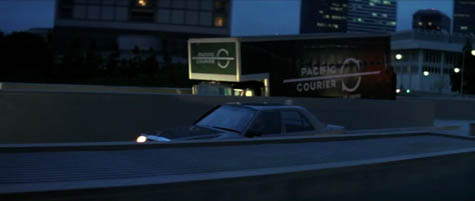
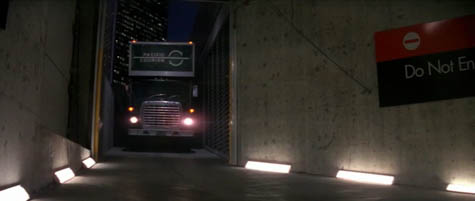
[Images: From Die Hard].

What I find so interesting about Die Hard—in addition to unironically enjoying the film—is that it cinematically depicts what it means to bend space to your own particular navigational needs. This mutational exploration of architecture even supplies the building’s narrative premise: the terrorists are there for no other reason than to drill through and rob the Nakatomi Corporation’s electromagnetically sealed vault.

Die Hard asks naive but powerful questions: If you have to get from A to B—that is, from the 31st floor to the lobby, or from the 26th floor to the roof—why not blast, carve, shoot, lockpick, and climb your way there, hitchhiking rides atop elevator cars and meandering through the labyrinthine, previously unexposed back-corridors of the built environment?

Why not personally infest the spaces around you?
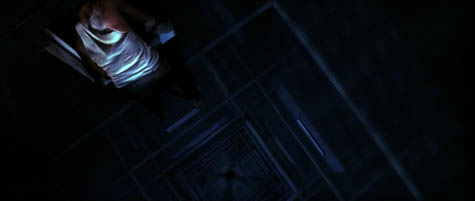
[Images: From Die Hard].

I might even suggest that what would have made Die Hard 2 an interesting sequel—sadly, the series is unremarkable for the fact that each film is substantially worse than the one before—would have been if Die Hard’s spatial premise had been repeated on a much larger urban scale.

For example, Weizman outlines what the Israeli Defense Forces call “hot pursuit”—that is, to “break into Palestinian controlled areas, enter neighborhoods and homes in search of suspects, and take suspects into custody for purposes of interrogation and detention.” This becomes a spatially extraordinary proposition when you consider that someone could be kidnapped from the 4th floor of a building by troops who have blasted through the walls and ceilings, coming down into that space from the 5th floor of a neighboring complex—and that the abductors might only have made it that far in the first place after moving through the walls of other structures nearby, blasting upward through underground infrastructure, leaping terrace-to-terrace between buildings, and more.

An alternative-history plot for a much better Die Hard 2 could thus perhaps include a scene in which the rescuing squad of John McClane-led police officers does not even know what building they are in, a suitably bewildering encapsulation of this method of moving undetected through the city.

“Walking through walls” thus becomes a kind of militarized parkour.
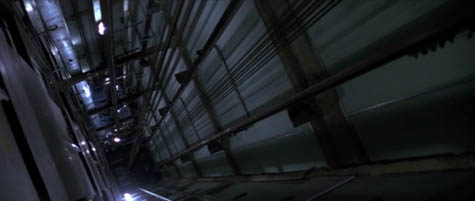
[Image: Inside Nakatomi space, from Die Hard].

Indeed, recent films like The Bourne Ultimatum, Casino Royale, District 13, and many others could be viewed precisely as the urban-scale realization of Die Hard’s architectural scenario. Even The Bank Job—indeed, any bank heist film at all involving tunnels—makes this Weizmanian approach to city space quite explicit.
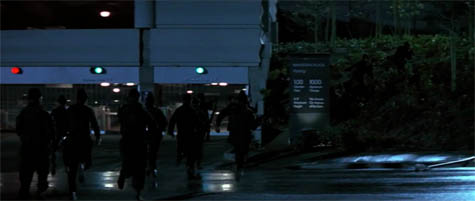
[Image: From Die Hard; it’s hard to see here, but an LAPD SWAT team is raiding the Nakatomi Building by way of lateral movements across the surrounding landscape].

Tangentially, I’m reminded of Matt Jones’s thought-provoking 2008 blog post about the urban differences between the Jason Bourne and James Bond film franchises. Jones writes that “there’s no travel in the new Bond”; there are simply “establishing shots of exotic destinations.” By the end of a Bond film, he adds, you simply “feel like you are in the international late-capitalist nonplace,” a geography with neither landmarks nor personal memory.

Compare the paradoxically unmoving, amnesiac geography of James Bond, then, to the compressed spaces of Paul Greengrass-directed Jason Bourne films. These films are “set in Schengen,” Jones writes, “a connected, border-less Mitteleurope that can be hacked and accessed and traversed—not without effort, but with determination, stolen vehicles and the right train timetables.” Indeed, Jones memorably suggests, “Bourne wraps cities, autobahns, ferries and train terminuses around him as the ultimate body-armor.”

Rather than Bond’s private infrastructure [of] expensive cars and toys, Bourne uses public infrastructure as a superpower. A battered watch and an accurate U-Bahn time-table are all he needs for a perfectly-timed, death-defying evasion of the authorities.

The space of the city is used in profoundly different ways by Bond and Bourne—but to this duality I would add John McClane of the original Die Hard.

If Jason Bourne’s actions make visible the infrastructure-rich, borderless world of the EU, then John McClane shows us a new type of architectural space altogether—one that we might call, channeling topology, Nakatomi space, wherein buildings reveal near-infinite interiors, capable of being traversed through all manner of non-architectural means. In all three cases—with Bond, Bourne, and McClane—it is Hollywood action films that reveal to us something very important about how cities can be known, used, and navigated: these films are filled with the improvisational crossroutes that constitute Eyal Weizman’s “Lethal Theory.”

As I wrote the other day, crime is a way to use the city.
[Image: From Die Hard].

On the other hand, as Weizman points out, this is not a new approach to built space at all:

In fact, although celebrated now as radically new, many of the procedures and processes described above have been part and parcel of urban operations throughout history. The defenders of the Paris Commune, much like those of the Kasbah of Algiers, Hue, Beirut, Jenin, and Nablus, navigated the city in small, loosely coordinated groups moving through openings and connections between homes, basements, and courtyards using alternative routes, secret passageways, and trapdoors.

This is all just part of “a ghostlike military fantasy world of boundless fluidity, in which the space of the city becomes as navigable as an ocean.”
[Image: From Die Hard].

Treated as an architectural premise, Die Hard becomes an exhilarating catalog of unorthodox movements through space. I would suggest again, then, that where the various Die Hard sequels went wrong was in abandoning this spatial investigation—one that could very easily have been scaled-up to encompass a city—and following, instead, the life of one character: John McClane. But, when taken out of Nakatomi Plaza—that is, out of the boundless, oceanic fluidity of Nakatomi space—McClane is reduced to an action film cliché whose failing charisma no amount of wise-cracking can salvage.

(I remembered while writing this post that I actually discussed Die Hard on National Public Radio last year; you can listen to that show here).
Exploring the Megastructure: Smugglers’ Caves and Shipwrecks

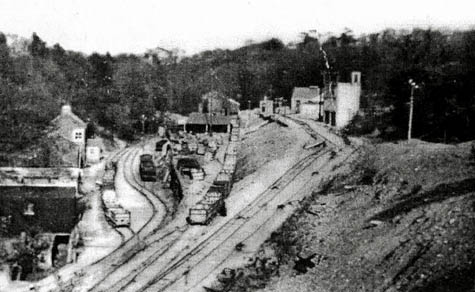
[Image: Archival view of the old mines at Grinkle, Yorkshire, UK].
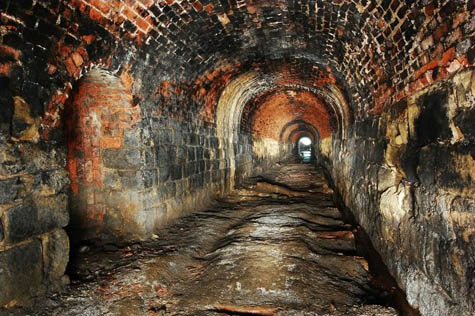
Worth checking out is a massive post detailing photographer Phill Davison‘s recent exploration of the half-collapsing tunnels and overgrown hillside entrances of an old Yorkshire iron mine.

Right when you think it’s over, they hike out through snow drifts and cross into another walled-up creek entrance—and the post just keeps on going.

[Images: Planetary vaultwork; photos by Phill Davison, from his monumental post exploring the Grinkle Ironstone Mine].
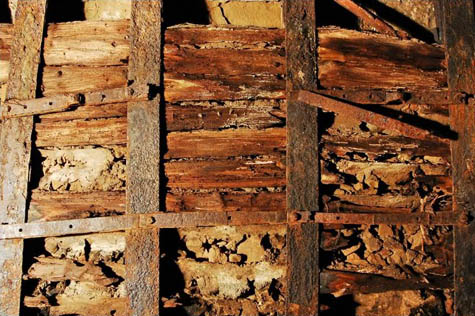
Davison remarks at one point that the structures he finds himself surrounded by down there remind him of smugglers’ caves and shipwrecks—and pictures like this one, below, detailing the awesomely compressed strata of wood boards and rock, and the rusting ironwork that holds it all back from collapse, make that comparison viscerally obvious.

[Image: The earth is like a sandwich; photo by Phill Davison, from his monumental post exploring Yorkshire’s Grinkle mine].
How amazing, though, to descend into the earth only to find it kitted-out like the hull of an oceangoing ship. Where the hills you’re walking on are actually engineered archways of an earlier civilization, with the occasional entryway peeking out from beneath the weeds. And so you descend into the vaults and debris-support cages of an artificial interior, hidden behind fences and beneath the winter snow.

Check out Davison’s post in its entirety—and then stop by the Flickr pool “Exploring the Megastructure,” where I originally saw these photos.

Architecture on the Cusp

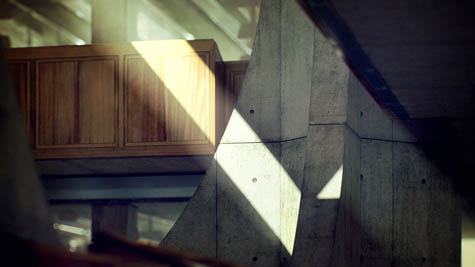
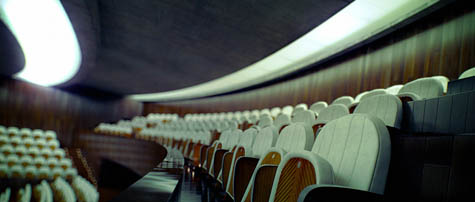
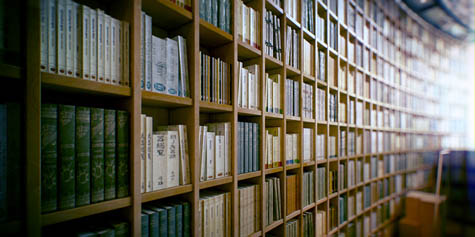
The Third & The Seventh, a short film by Alex Roman uploaded to Vimeo just last month and already viewed more than half a million times, is an entirely computer-generated, exquisitely rendered, photorealistic tour of architectural space.


While Frank Gehry’s Disney Concert Hall unfortunately makes an appearance, the remainder of the film tours some pavilions, museums, wind farms, and other urban icons, from both inside and out, that you will no doubt recognize.

There’s no plot as such, but the imagery is of such ridiculously high quality—although I could skip the soundtrack—that this seems much more visually promising to me then, say, the much hyped, half-a-billion dollar technologies used in Avatar; I would rather watch the opening two or three minutes of Roman’s film stretched out to feature length and threaded through with some narrative cues than revisit James Cameron’s badly rendered blue giants.

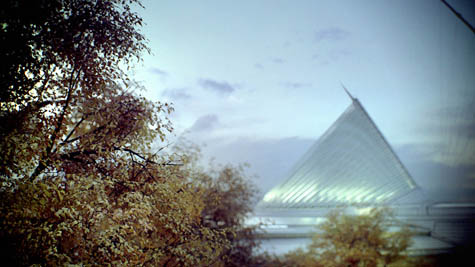
[Images: A Calatravian still from Alex Roman’s The Third and the Seventh].
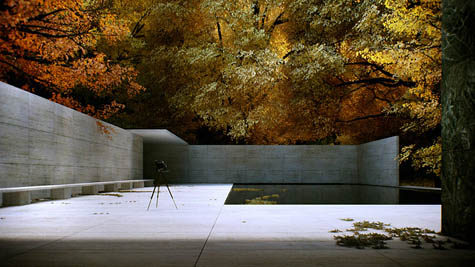
This also seems to be yet more evidence that architecture students are literally just on the cusp of expertise in several different industries, and that even the briefest of collaborations with interested writers could push many student projects instantly over into fully realized narrative films. While I’m aware that many architecture students couldn’t care less about this—they didn’t, after all, apply to film school—I think it is nonetheless a strategically interesting option to consider when it comes to developing, presenting, and recontextualizing spatial ideas: a slight tweak here and there, a presentation of the most bare-bones scenario imaginable, and you’ve gone from student thesis project to La Jetée after one late night and some 5 Hour Energy drinks…

[Images: Stills from Alex Roman’s The Third and the Seventh].

In any case, Roman’s website includes galleries of some gorgeous film stills, including these details, these lighting effects, a few examples of “man-made vs. nature,” and multiple glimpses of classic furniture.

[Image: From Alex Roman’s The Third and the Seventh].

However, Vimeo seems to be loading quite slowly at the moment, so I’ve included a few stills here.

[Image: Alex Roman, The Third and the Seventh].

Here’s hoping Roman gets the attention he deserves for this, and that we someday see his work popping up in more venues. The film was created using 3ds Max, V-Ray, After Effects and Premiere.

(Thanks to Jim Rossignol and Ilari Lehtinen for the tip!)

Quick Links 1

[Image: Lebbeus Woods, from On the Malecón].

As a few people have noticed, the Quick Links section here on BLDGBLOG disappeared a few days ago; there are a variety of reasons for this, including an overall streamlining of the site design (moving to two columns from three, for instance). More importantly, over the past few years those Quick Links never actually showed up as part of BLDGBLOG’s RSS feed, meaning that people who don’t stop by the site itself, but prefer instead to read it through things like Google Reader, never even saw those links. This further meant that, during busy periods when whole days slip by between posts, BLDGBLOG would appear totally silent to those readers—when, in fact, new links were still appearing here at a reliable pace.

In any case, to make a long story short, I will now be publishing frequent Quick Links posts—the first of which appears here. This will make those links easier to find and archive; these posts will now show up in my RSS feed; and this allows readers to comment on the articles I’ve linked to (something that the previous Quick Links system never allowed).

If you have any suggestions for improvement, please let me know; I hope the much cleaner site design seems appealing, and that these Quick Links will continue to point you in stimulating directions… And happy new year! I hope this is a good one for you.

• • •

—Olivia Judson looks at “memories in nature,” where immune systems and plant forms display mnemonic traces. The biochemical archive.

—Perhaps a machine-assisted, agricultural equivalent of this: keeping rare strains of livestock, including “huge dreadlocked Cotswold sheep,” alive using the subzero techniques of cryopreservation. Distant shades of Pleistocene Park, perhaps.

—Speaking of the Pleistocene, consider joining the Friends of the Pleistocene, “dedicated to exploring the conjuncture between landscape and contemporary human activity at sites shaped by the geologic epoch of the Pleistocene (2.588 million to 10000 years BP, Before Present).”

—Perhaps we met yet artificially preserve the world’s glaciers by wrapping them in huge blankets.

—”Have researchers found dark matter at the bottom of a mine in Minnesota?”

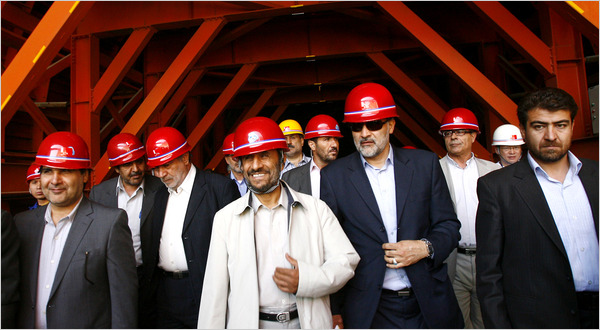
[Image: Ahmadinejad emerges from a highway tunnel; photo by Henghameh Fahimi for the Agence France-Presse, via the New York Times].
—Like a minor character from Reza Negarestani’s extraordinary book Cyclonopedia, Iran’s president, Mahmoud Ahmadinejad—busy burying his nation’s nuclear program inside a “maze of tunnels”—is actually the founder of the Iranian Tunneling Association. Quoting at length:

Heavily mountainous Iran has a long history of tunneling toward civilian as well as military ends, and Mahmoud Ahmadinejad has played a recurring role—first as a transportation engineer and founder of the Iranian Tunneling Association and now as the nation’s president.
There are hundreds, perhaps thousands, of big tunnels in Iran, according to American government and private experts, and the lines separating their uses can be fuzzy. Companies owned by the Islamic Revolutionary Guards Corps of Iran, for example, build civilian as well as military tunnels.
No one in the West knows how much, or exactly what part, of Iran’s nuclear program lies hidden. Still, evidence of the downward atomic push is clear to the inquisitive.
Google Earth, for instance, shows that the original hub of the nuclear complex at Isfahan consists of scores of easily observed—and easy to attack—buildings. But government analysts say that in recent years Iran has honeycombed the nearby mountains with tunnels. Satellite photos show six entrances.

It might be time to revisit geology in the age of the war on terror.

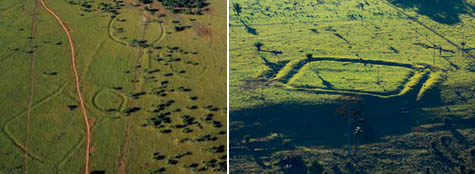
[Images: A civilization beneath the trees; images via New Scientist].
National Geographic visits the “geometric earthworks” previously hidden by tree cover in the Amazon but recently discovered via satellite photography. “Hundreds of circles, squares, and other geometric shapes once hidden by forest hint at a previously unknown ancient society that flourished in the Amazon,” we read.

—Lebbeus Woods kicks off the new year with a look at Cuba’s “malecón,” the coastal road skirting Havana’s massive sea wall (see the image that starts this post).

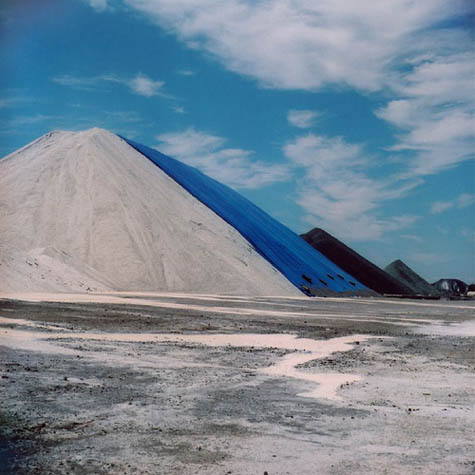
[Image: Piles of road salt outside Toronto. Photo by Flickr-user katalogue; via InfraNet Lab].

InfraNet Lab looked into the dispersed geological presence of road salt, used to melt ice and snow, last winter—building into a three-part series about “sea dust.” Part 1. Part 2. Part 3.

—Finally, for now, L.A. Times architecture critic Christopher Hawthorne takes a long look at the building formerly known as the Burj Dubai and its growing role in cultural predictions of apocalypse.

(Some links via @masoncwhite, @eatingbark, and the consistently wonderful Archaeology News).