Motorola has patented a Feng Shui detector: “The device houses a camera that checks the colour of the property, a microphone that listens for noise from nearby roads and factories and a compass to find north – a crucial factor for Feng Shui enthusiasts. It can also measure the strength of AM and FM radio signals from local radio transmitters and connect to the nearest mobile phone base station to check for indications of cellphone signal strength.”
Read the patent application here.
Perhaps coming soon: a field unit, designed for landscapes – gardens, campsites, caverns… Attachable to airplanes, so the flight can adapt in progress to the most psychologically calming path…
Or, Feng Shui for Machine Gun Nests.
Year: 2006
Landscape futures

What does the earth have in store for itself? The next million years, Discovery Channel News informs us, will be just like “the last million years. That means plenty of meteor impacts, supervolcanic eruptions, megaquakes and worse.”
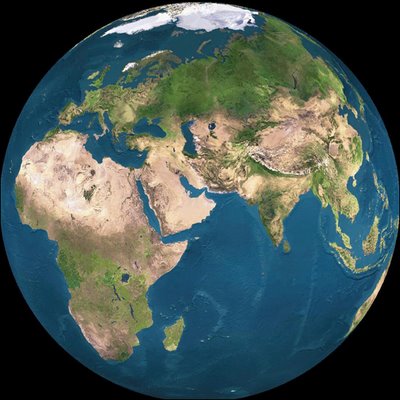
As Steven Dutch, a geologist at the University of Wisconsin, Green Bay, claims: “Events that are rare or unknown in recorded history become almost inevitable, even frequent, in the near geologic future.” This means that some unbelievably exciting things will happen on an Earth that I, certainly, will not be around to see – and that, perhaps, no human at all will witness.
These landscape futures include the relocation of Niagara Falls. The hard, dolomite cliffs over which the Falls currently plunge “are eroding at a rapid clip,” we read. “Once worn away, the softer rock upstream will erode even faster until it encounters another layer of hard rock at Tonawanda, NY, and creates another set of falls there in about 14,000 years.” Then, in California, “the temperamental San Andreas fault will set off about 7,000 earthquakes of magnitude eight in the next million years, offsetting the geography of San Francisco more than 15 miles. That will split the San Francisco Peninsula into a fork. Over the same million years the Hawaiian Islands will have moved about 60 miles northwest.” This will happen at the same time that Loihi, a currently active undersea volcano, will grow into “a new island rivaling today’s Mauna Loa.”
Elsewhere, “the Mississippi River outlet will shift in location many times, leaving today’s New Orleans far from the river, but still sinking.”
Potentially more interesting still, “even the stars will show obvious signs of change in as few as 10,000 years.” In other words, “our solar system will have moved 7.5 light years in its orbit around the center of the Milky Way, altering the shapes of familiar constellations.” This, of course, opens up the possibility of naming this future zodiac in advance – even devising moving constellations, animated images shifting as the planet moves, astral films starcasted across a million years.
But it is also worth remembering that London is sinking – indeed, the whole of southeast England is sinking – roughly 8″ every century. That may not sound like much, but there are 10,000 centuries in a million years; so, providing such a rate remains constant, London – amazingly, sadly, absurdly, excitingly – will be more than 6500-feet below ground, buried more than a mile in the muck and clay. The whole city will then fossilize.
Elsewhere, Taiwan will continue to move toward mainland China, setting off earthquakes – and complicating any long-term hopes of political independence; the Alps will continue to rise as the Mediterranean is squeezed shut by the northern approach of Africa; and, if recent information is to be believed, most of Italy could be adrift with Saharan dunes, the equatorial deserts of the world expanding both north and south.
Rome, abraded with overheated breezes, where statues of saints are reduced to sand.
Student projects 5: ship.bldg

A project I’ve been meaning to write about ever since it won first place at RIBA’s 2005 President’s Medals awards is Luke Pearson‘s maritime exploration of “the ship as a ‘dry-docked’ architecture.”


“The scheme is a retirement home for elderly fisherman that also houses a working men’s club for members of Newcastle’s fishing community,” Pearson writes. “As a reflection of the separation and torpor of this unique society, the scheme takes the notion of the ship in an architectural context, to create an ersatz environment which interacts with the city around it as if it were a dry docked vessel. The environmental technologies and the ways in which the notional ship has been translated into an architectural system are the focus of this study.”


In other words, you dock the ship for so long it becomes architecture, an extension of the earth’s surface into the sea.
Pearson’s ship/building – perhaps ship.bldg – would include a “heated superstructure” and a “microcosmic ocean upon deck” (both pictured above).
Then there is Pearson’s technique of “Alephographic drawing.” Pearson describes this part of the project as having been “inspired by Borges“; the image, below, “sees everything revealing the technologies and notorieties that exist within the Vessel.”

Now a similar such project needs to be worked out with a train, stopped for so long in the center of a city it becomes architectural, permanently anchored and settled there on tracks, perhaps with moving rooms, parts of a building detach then reattach to other buildings; then further projects with other forms of transport: helicopters, lorries, school buses, hovercraft… The future architecture of stalled vehicles.
Or, to quote Thomas Pynchon, who is here referring to a missile if I remember correctly: “The moving vehicle is frozen, in space, to become architecture, and timeless. It was never launched. It will never fall.”
(Luke Pearson’s project spotted long, long ago on Archinect; see also Student projects 4, 3, 2, and 1).
The uttermost reaches of solar influence
Whilst once again finding myself on the same intellectual wavelength as Pruned‘s Alex Trevi, who posted today about the shimmering and explosive self-resurfacing outer loops of the sun, I spent yesterday evening copying down solar-descriptive quotations from an old book by Guy Murchie, called The Music of the Spheres.
Now out of print, as well as scientifically outdated, I can still hardly believe how exciting the 2-volume book – about “the material universe, from atom to quasar, simply explained” – is to read, and how interestingly poetic Murchie’s take on the subject really is. His chapter 6, for instance, is an “Introduction to the Sun,” our local star in which “something much more profound and basic than fire is blazing.”
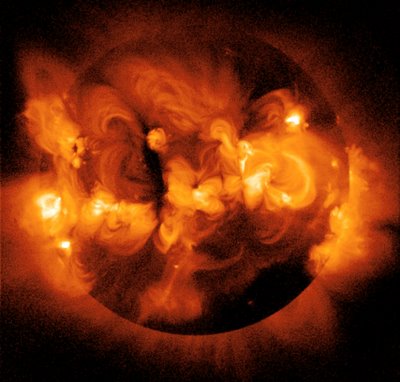
I get light-headed when I read that the surface of the sun “is really a thousand times more vacuous than a candle-flame on Earth, and even the concentrated moiling gases hidden a thousand miles below it are a hundred times thinner than earthly air.” Indeed, some stars, such as E Aurigae I – a star so huge that it could “contain most of our solar system, including the 5.5-billion-mile circumference of Saturn’s orbit” – “are sometimes described as ‘red-hot vacuums’ because their material, though hot, averages thousands of times thinner than earthly air and is normally invisible, so that you might fly through them for days in your insulated space ship without even realizing you were inside a star.”
Meanwhile, in the sun’s whirling interior, “the highly compressed gassy matter is ten times as dense as steel.” Then, of course, there are “magnetic hurricanes thousands of miles in diameter” – which would be a lot more exciting if those magnetic hurricanes were not “commonly known on Earth as sunspots.”
As the sun unceasingly explodes in arching structures of storm and prominence, “glowing veils of gaseous calcium” escape. In others words, the same mineral responsible for animal bones bursts outward from the sun in astrophysical shells that “look like gnarled trees with blazing rain pouring downward from their branches in beautiful magnetic curves that have been clocked at speeds up to 400 miles a second.”

The universe is loud with intercelestial thunder; there are “vast magnetic influences” at work across all scales of matter; “ionic ‘noise storms’ at radio frequencies” scream ceaselessly through antenna’d headsets of home astronomers; there is even a sunspot cycle that “corresponds to a ‘212-day cycle noted in some studies of human pulse rates’.” Incredibly, some “outlying clusters” of stars at the edge of the Milky Way “overlap each other so densely they are literally buried in light.”
In any case, I think every child in the world would become a scientist if they read Murchie’s 2-volume book – but it’s out of print. Alas. Perhaps, instead, we can all just watch this extraordinary short film, wherein sound art meets video art meets solar astronomy.
[Note: All emphases added. Elsewhere: Pruned‘s Sunscapes (where reader comments tipped us off to the film link, supplied above). Other elsewhere: The Surface of the Sun, a website claiming that the sun is, in fact, solid – furthermore, that it contains something called “solar moss.” Earlier on BLDGBLOG: Podcasting the sun].
Listening to a machine made entirely from windows
An old issue of The Wire introduces us to a synthesizer called the ANS, built in 1950s Moscow by Eugene Murzin and “constructed around a unique and incredibly intricate photoelectronic system.”
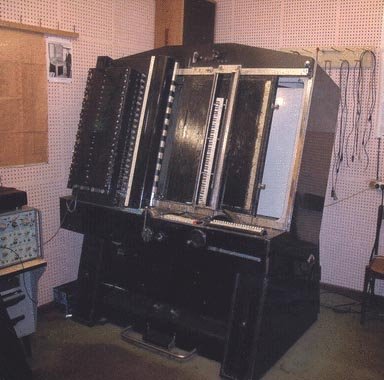 [Image: The ANS].
The ANS functioned through an “array of tiny chisels” that engraved “lines and points on rotating black enamelled glass discs.” These engravings would then “regulate the brightness of light rays” that passed “through the discs onto photoelements,” like the sun streaming through carefully shaded windows. The “level of intensity” of this light then produced specific sounds.
Elsewhere (scroll down in this link till you hit the COILANS review), we read about the ANS’s unique compositional process: “The composer inscribes his visual ‘score’ onto a glass plate covered with sticky black mastic, slides it through the machine, which reads the inscribed plate and converts the etchings into sound produced by a system of 800 oscillators.”
It’s a machine that reads windows.
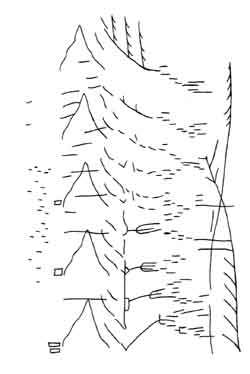 [Image: A representative musical score for the ANS – but what if you fed it architectural diagrams?].
The Wire then explains that, in 2002, British band Coil visited the synthesizer in Moscow and recorded nearly 4 hours of music using the machine. Listening to what they produced, we’re told, sounds “like travelling through the Oort Cloud or the Kuiper Belt – glitting slivers of distant white light and vast, nebulous spaces populated by inchoate radioactive matter.” As you’ll notice in these three, 3-minute samples, the effect is certainly weird – but also unbelievably mesmerizing: 1, 2, and 3 (all MP3s).
Light, chisels, glass plates, oscillators, enamelled surfaces, engravings on windows – with these elements it is not at all hard to imagine a kind of ANS architecture, rebuilt on the scale of a building. Windowed lobbies and escalators; sunlight; entire lift shafts full of glass discs, inscribed and black-enamelled, emitting music like light. Whole rooms of sound, angelic, the windows slightly trembling.
Moving panes of glass, washed clean at the end of the day, pass slowly behind curtains, casting acoustic shadows.
A symphony for glass escalators. Chamber music.
Entire cities, made from nothing but windows, tuning to one another like the sound of orchestral sunlight.
(Note: The ANS was apparently used to soundtrack Andrei Tarkovsky’s films Solaris and Stalker).
The surface of the earth, transformed into objects
“Is it painted?” Park asked. “Most people don’t think about pigments in paint. Most white-paint pigment now is titanium. Red is hematite. Black is often magnetite. There’s chrome yellow, molybdenum orange. Metallic paints are a little more permanent. The pigments come from rocks in the ground. Dave’s electrical system is copper, probably from Bingham Canyon. He couldn’t turn on a light or make ice without it.”
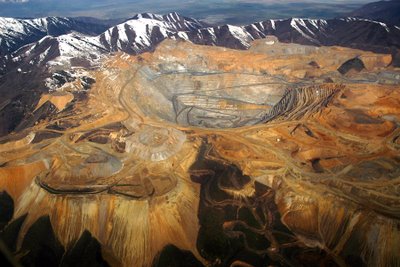 [Image: Bingham Canyon, Utah, photographed by the Center for Land Use Interpretation].
This text is all via John McPhee: “The nails that hold the place together come from the Mesabi Range. His downspouts are covered with zinc that was probably taken out of the ground in Canada. The tungsten in his light bulbs may have been mined in Bishop, California. The chrome on his refrigerator door probably came from Rhodesia or Turkey. His television set almost certainly contains cobalt from the Congo. He uses aluminum from Jamaica, maybe Surinam; silver from Mexico or Peru; tin – it’s still in tin cans – from Bolivia, Malaya, Nigeria. People seldom stop to think that all these things – planes in the air, cars on the road, Sierra Club cups – once, somewhere, were rock. Our whole economy – our way of doing things. Oh, gad! I haven’t even mentioned minerals like manganese and sulphur. You won’t make steel without them. You can’t make paper without sulphur…”
Rearranging planets into TVs. Producing objects from geology.
Portable entryways

German artist Martin Kippenberger once proposed a subway system for the entire world, connecting Los Angeles to Helsinki, Tokyo to Rome, Münster to Dawson City. Greek islands, Canadian towns, Swiss lakes, pharaonic tombs – there would be entrances everywhere.
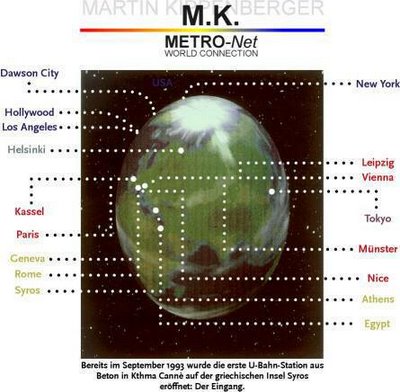
So Kippenberger actually began building these things – doors in the earth, leading nowhere – including this portable subway entrance.
But then he died.
The project ended.

Here are some construction specs and photo-speculative images to ponder.
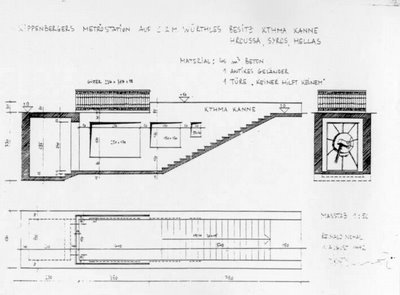

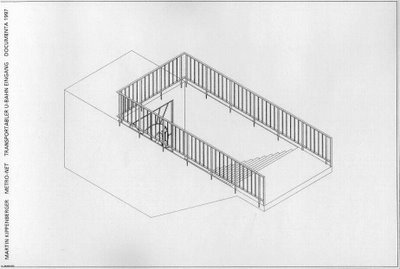
So who’s up for re-starting this thing? After all, an entrance was built on the roof of the World Trade Center – but, even though the towers have been destroyed, the entrance is still there, hovering invisibly above Manhattan. It leads to an unexplored subcavern deep inside Mammoth Cave – where you’ll find a door to the Vatican. Which leads to the International Space Station. Which leads to the aerotropolis. Which connects onward to Cape Farewell, via the Cabinet Magazine National Library. Rumor has it, an Australian bone surgeon once uncovered another entrance in a patient’s rib. Eve was an entrance.
Etc.

(Thanks to Brand Avenue for pointing out Kippenberger’s project to me – nearly seven months ago. And thanks to Andrew Blum for reminding me of The New Yorker cover, above, which I’ve been saving in a box of files since August 2002).
Manufacturing arches

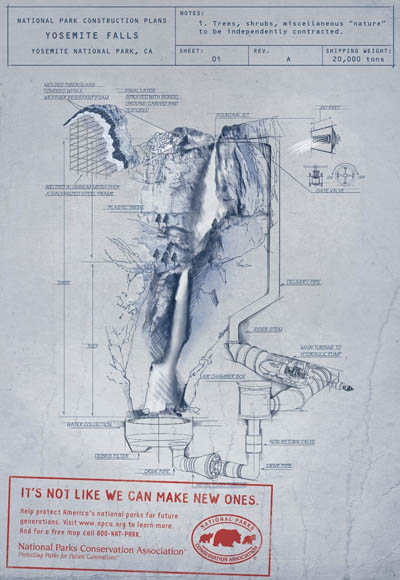
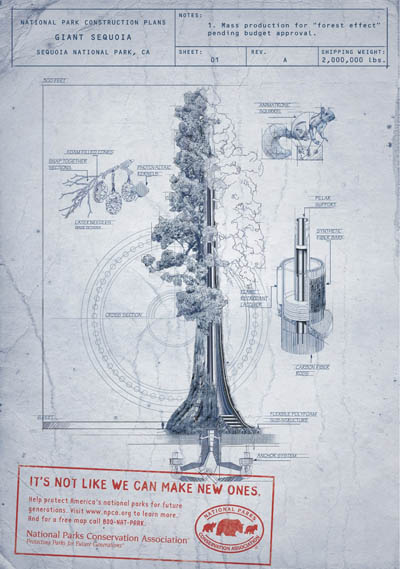
[Images: An ingenious ad campaign by Y&R for preserving America’s National Parks: landscapes blueprinted, seeds diagrammed, arches shock-absorbed. Here are Delicate Arch (PDF), Yosemite Falls (PDF), and Giant Sequoia (PDF)].
(Thanks to Eric Jamieson for the tip!)
resonator.bldg
There was a short article in the August 2004 issue of The Wire about sound artist Mark Bain. “Equipped with seismometers,” The Wire writes, Bain “can turn architectural structures into giant musical instruments and demolish buildings with sound alone.” His installations have included “sensing devices, oscillators and the occasional sculptural element” – such as the “six metre high inflatable speaker” featured below.

This is the Sonusphere, formerly installed in the Edith Russ Haus, Germany. The Sonusphere musicalizes the effects of plate tectonics: “Modified seismic sensors pick up the normally unheard movements of the earth and are channeled through the entire building until reaching a ‘crescendo’ in Bain’s sonusphere. Unique in its purpose and design, the sonusphere is essentially a wired, inflatable ball that fills the entire upper floor and takes signals generated from an acoustic network running through the entire architecture. It acts as a low frequency, 360 degree, acoustic radiator translating the sound to its curved walls as physically pulsating sound pressure.”
Bain’s work, The Wire explains, references “the ideas of maverick engineer Nikola Tesla.” Tesla’s prolific output and avant-garde electrical ideas inspired Bain to develop “a system for resonating buildings that allowed him to ‘play’ structures. ‘The multi-resonator system I designed could drive waveforms into buildings,’ Bain comments, ‘like giant additive synthesis where you get different beatings of frequencies and shifted harmonics. I was basically designing systems that turned a structure into a musical instrument.'”
Elsewhere, we’re told, “the portable earthquake machines [that Bain] showed in Holland in 2001 produced severe tremors that spread through the surrounding area. Then there was Het Paard, a large music venue in The Hague slated for demolition. The oscillators he attached to the building activated the entire structure, inflicting severe damage on parts of the walls and ceilings.”
Of course, Bain has been on BLDGBLOG before, where we discuss a musical composition of his made entirely from seismic data recorded during the collapse of the World Trade Center on 9/11 – the trembling of Manhattan turned into a roar of sound. (Listen to an excerpt here).
(Similar ideas are taken up in this post).
Rooms of algebraic theology
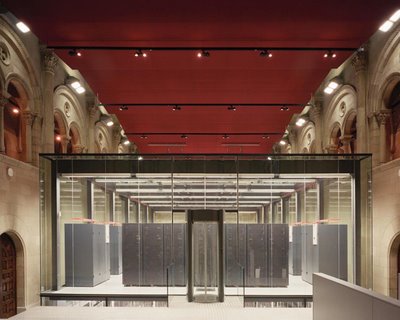 [Image: The supercomputer pictured above is the MareNostrum, “meaning ‘our sea,'” New Scientist writes; “it is housed in a 1920s chapel at the Technical University of Catalonia in Barcelona, Spain, and built from commercially available parts.” Photo by Simon Norfolk].
“The supercomputers I’m showing here are powerful almost beyond human understanding,” photographer Simon Norfolk explains, describing his extraordinary new images of supercomputers and their architectural settings. “They can map every molecule of the billions on a human DNA string; scrutinise at the atomic level the collision between two pieces of plutonium in an exploding bomb; or sketch the gravitational pull of every star in the galaxy upon every other star in the galaxy. These are not questions that humans could grapple with given plenty of time, a notebook and a sharp pencil.”
Norfolk has also photographed computers used for “mapping and predicting global virus outbreaks” and for “simulating automotive crash tests.”
 [Image: “Modeling physics inside an exploding nuclear warhead.” Simon Norfolk].
These computers, Norfolk continues, “are omniscient and omnipresent and these are not qualities in which we find a simulacrum of ourselves – these are qualities that describe the Divine. The problem is not that these computers might one day resemble humans; it is that they already resemble gods.”
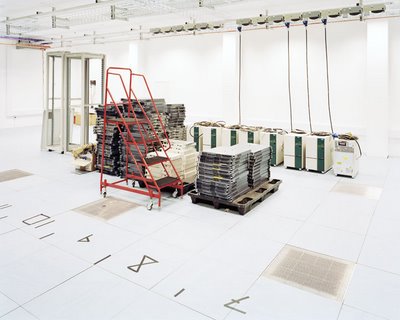
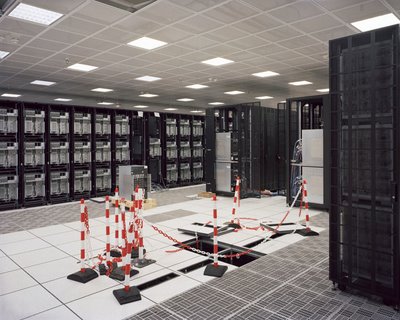
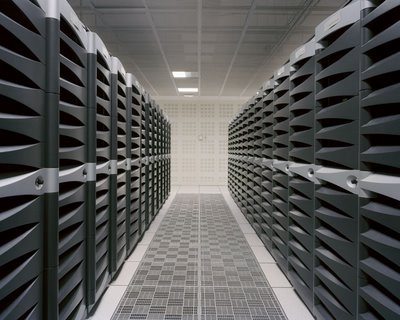 [Images: Simon Norfolk. The top image is titled “Mapping the human genome.” The others are the TERA-1 and the TERA-10].
In almost supernaturally sterile rooms, these angelic landscapes of silicon quietly hum their way through introspective worlds of calculation: derivatives, logorithms, advanced topologies. One could, in fact, imagine a whole new series of Duino Elegies, written by a posthumous Rainer Maria Rilke, in terrified praise of these cloistered machines – machines Rilke seems to describe preemptively in his “Seventh Elegy,” where the “annihilator” meets the “Angel.”
Rilke writes that “the external shrinks into less and less”:
Where once an enduring house was,
now a cerebral structure crosses our path, completely
belonging to the realm of concepts, as though it still stood in the brain.
Our age has built itself vast reservoirs of power,
formless as the straining energy that it wrests from the earth.
Temples are no longer known.
In this context, it seems almost like an act of religious sarcasm that the MareNostrum computer – pictured at the top of this post – has been housed in a chapel. (Of course, a consecrated supercomputer is certainly a stunning intellectual possibility – perhaps setting up the plot of Da Vinci Code 2, wherein future archaeologists discover that the Vatican is not a complex of buildings at all but a fully functioning Jesuit supercomputer).
In any case, because all harddrives are actually geological objects – careful rearrangements of minerals under the influence of artificial magnetic fields – these are mathematical terrains in the most exciting sense: the surface of the earth dreaming of stellar detonations.
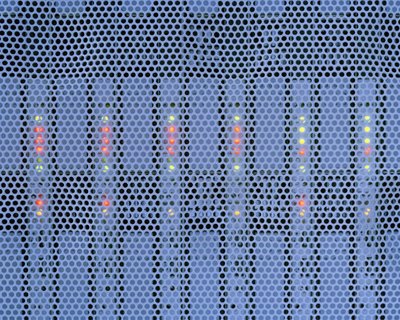
 [Images: Two close-ups of cerebral machines. Simon Norfolk].
Finally, Giordano Bruno, following Giulio Camillo, wrote extensively about the idea of a Memory Palace, or Memory Theater. As Victoria Nelson tells us, the basic idea was that an “esoterically trained memory was a godlike vessel for encapsulating the entire universe within a single human mind.” This was part of what Nelson calls a Neoplatonic “quasi-religion” that “venerated memory as an organ possessing magical and world-ordering powers.” Neoplatonists believed that “the whole cosmos could be ‘memorized’ in a much more overt imitatio dei and by this act magically incorporated into the human organism” – or, of course, into the air-cooled circuits of a supercomputer.
So if I were forced to take issue with the existence of these machines, it would not be because of their use in modeling new nuclear warheads – as Norfolk makes clear they do – but in something far more secondary, even faintly absurd: what I’d call the lack of a supercomputer poetics, or a more imaginative role for these machines to play in our literary and even religious lives. Oracular, Delphic, radically non-secular: they are either all or none of the above.
(With thanks to Simon Norfolk, who supplied all the images that appear in this post. And don’t miss BLDGBLOG’s later interview with Simon Norfolk, in which he discusses his war photography in much greater detail).
Urban Atmospheres
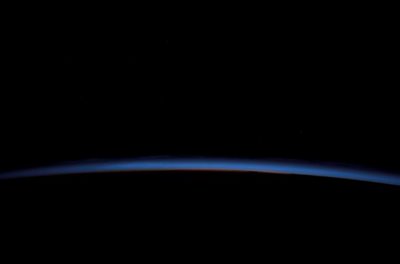
[Image: “Glowing, silvery blue clouds that have been spreading around the world and brightening mysteriously in recent years will soon be studied in unprecedented detail by a NASA spacecraft.” New Scientist].
Some unrelated items of atmospheric news…
First, the phenomenon of “noctilucent clouds” is under investigation. These are clouds “which glow at night, form in the upper atmosphere, at an altitude of about 80 kilometres, and their glow can be seen just after sunset or just before sunrise. ‘Even though the Sun’s gone down and you’re in darkness, the clouds are so high up, the Sun is still illuminating them.'”
However, could a city deliberately build upward curving traps of air, thermally concentrating moisture in huge, rising chimneys, giving its citizens a kind of Air TV – abstract films of silvery blue clouds coiling across the sky, mercurial and noctilucent? Gone would be Seasonal Affective Disorder; in its place you’d have this fairy tale gossamer light, glowing metallic on the edges of all things. Add to that the microscopic sounds of water crystallizing inside distant clouds – amplified throughout the canyons of the city – and you’d have a kind of climatopia.
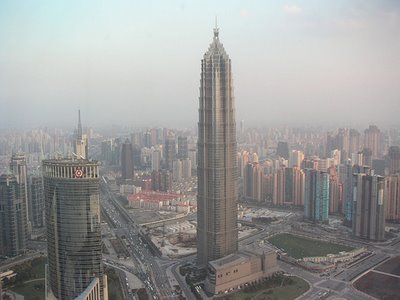
Meanwhile, “many of the skyscrapers in Shanghai could become quite dangerous” due to the high winds they’re now producing. This effect is seemingly parodied in Mission Impossible III when Tom Cruise parachutes out of a Shanghai skyscraper – only to find that his chute fails to open due to the torque of neon whirlwinds lashing him about between corporate bank towers. (Yes, I’ve seen Mission Impossible III).
In an inadvertant moment of architectural criticism, “the Shanghai municipal government identified skyscrapers as one of the biggest potential threats to the city.”
Ages ago, in a no doubt now embarrassing BLDGBLOG post, the idea of urban wind-guns was explored, wondering, simultaneously, what impact surburban tract housing might have on the storms that eventually blow through a city. Fences, back porches, forests cut down or left to grow: how do these affect the speed of regional wind systems?
[Image: By krisstr, from the Shanghai Flickr group].
Shanghai city authorities have more or less answered that question, suggesting that “more trees can be planted to block part of the winds,” and that “the walls of the buildings should be fortified while notice signs are put up to signal potentially dangerous areas.” Pockets of atmospheric turbulence within the city. (How do skyscrapers affect the flight-paths of airplanes?)
Finally, air wells, tropospheric rivers, and electromagnetic weather control all meet in this surprisingly long but very interesting article.
There, we discover that “huge filamentary structures” in the sky act as “preferable pathways of water vapor movement in the troposphere (the lower 10-20 km of the atmosphere) with flow rates of about 165 million kilograms of water per second. These ‘atmospheric rivers’ are bands from 200 to 480 miles wide and up to 4,800 miles long, between 1-2 kilometers above the earth. They transport about 70% of the fresh water from the equator to the midlatitudes, are of great importance in determining the location and amount of winter rainfall on coastlines.”
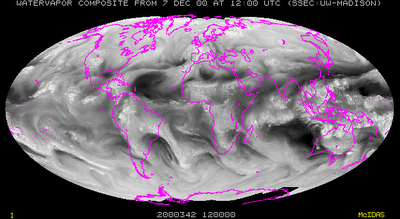
[Image: The aforementioned tropospheric rivers, a kind of fluted cobwebbing of intercontinental air pressure].
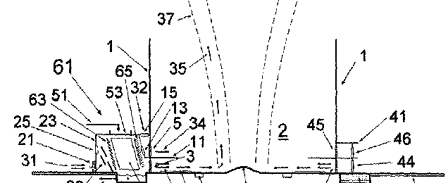
The following devices – towers, air wells, etc. – were all designed to help tap into these rivers, turning the sky itself into an aquatic reservoir.
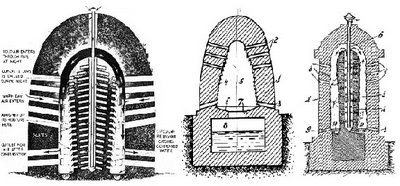
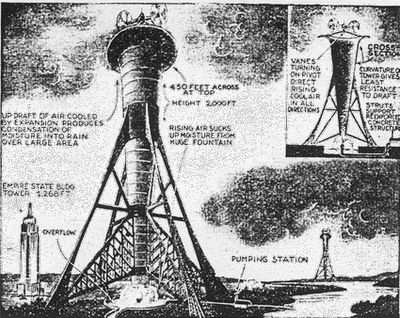
You basically build one of those things at a geo-atmospherically strategic location; you make youself a cup of tea; their height and geometry trigger downdrafts; then the internal chambers cause condensation of vapor from air. Thus, an air well. The end of drought through tropospheric riverways.
Here’s a diagram of one of the machines working:
The article, of course, also discusses electromagnetic weather control, such as the notorius HAARP Project, pictured here –
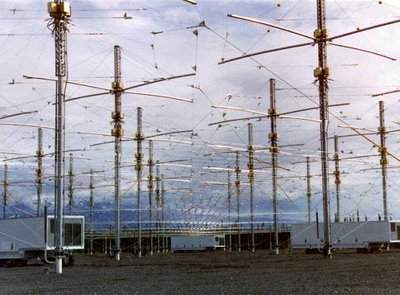
– but there’s a (very little) bit more on that in an earlier post.
(Thanks to Scott Webel for the air wells article; and to the incomparable things magazine for the link about Shanghai).